• Debugging adtech assumptions


    120px-Icon_Debug_256x256In this post I respond in detail to assertions made in a pair of pro-adtech pieces: Advertiser’s Mandate In The Age Of Ad Blocking: Blend In, by Pat LaPointe in MediaPost; and Welcome to hell: Apple vs Google vs Facebook and the slow death of the web, by Nilay Patel in The Verge.

    First, Pat LaPointe—

    Consumers are increasingly constructing their own digital “content cocoons.”

    “Cocoon” is a vivid metaphor, and makes sense from the adtech point of view. It also doesn’t position self-protecting people and their tech as enemies that need to be fought, which is good. But it’s not what people think they are doing when they control their lives, online or off. So let’s be clear here. People only want two things when they block ads and tracking:

    1. Freedom from annoyance, and
    2. Privacy.

    In the physical world they get those from the technologies we call clothing and shelter. There are no equivalents yet online. But ad and tracking blocking point in a civilized direction. More about this under the next item.

    From their Facebook network to apps for their favorite stores, consumers exert more control over the content and messages they are exposed to than any time in history.

    First, we aren’t just “consumers,” which Jerry Michalski calls “gullets with wallets and eyeballs.” Nearly everything that makes us human is not reducible to an appetite for “content.” And our gullets (which yes, we do have) are gagging on advertising we already hated and are being forced by adtech to hate even more.

    Second, people don’t exert control over content and messages with their “Facebook network” (whatever that is) or their “favorite stores” (which, even if they have them, are little more than one app among many on their phones). They exert control with technologies that are theirs, even if they only rent them — and that control is indeed increasing. Here’s how:

    In the physical world we exert control our ourselves and our interactions with others through many technologies for both selective disclosure (clothing, shelter) and engagement (wallets, purses, cars).

    In the online world the equivalent to these are browsers, email clients, computers, mobile devices and the apps that run on them. The fact that all those things are infected with spyware and controlled to a high degree by giant companies (notably Apple and Google) does not mean they are not under personal control. It means they are compromised. This is why people want to cure the infections in their mobile devices and increase their control.

    What we want most as free and independent human beings is agency: the ability to act with full effect. We know what this feels like in the physical world, and we are learning what this feels like in the virtual one, starting with ad and tracking blocking, which adds a higher degree of privacy to our browsers . (Apple is also on this case as well, by the way. Read more here.)

    Now consumers are curating their advertising experiences, as well with ad blocking.

    “Curating” is a strange word for what ad blocking does, which is actually prophylaxis.

    As a result, there is a battle between advertisers that try desperately to get their message in front of the right consumers, and the consumers who work hard to not be exposed to things they’re not interested in.

    That’s half-right. The battle is definitely going on, but what people are mostly not interested in — and hate at this point — are advertising and spying.

    Apple will offer an ad blocker in its newest OS.

    Actually, it’s called Content Blocking, and it’s only for supporting developments of apps that add selective forms of blocking to the Safari browser on iOS 9. Still, it’s one form of chemo for the cancer of adtech. (Bonus link on 18 September. Evidence of what I said here.)

    Ad blocking will hardly kill advertising; it’s what drives the Internet.

    Two errors here:

    First, ad blocking doesn’t kill advertising. It does for advertising what bug repellent does for bugs.

    Second, nothing “drives” the Net, which is an agreement among network operators about how data gets passed between end points. True, at this moment in time there are a lot of ad-supported sites on the Web, but those are neither the Net nor any more permanent than a mobile home park.

    Yet, it is a growing threat to the way marketers have traditionally approached marketing – to push mass messages out through standard channels and hope that the right audience is exposed to enough to drive revenue.

    Correct.

    The rise in ad blocking is a sign that advertisers need to re-engineer their dialogue with consumers to be a relevant part of consumers’ “content cocoons.”

    Almost none of the dialogue between companies and customers is conducted within advertising, which has been engineered from the start as a one-way thing. Even direct response marketing, the direct ancestor of adtech, was never about “dialogue.” That job belonged to other corporate functions, especially sales and service.

    Consumers Assume You Know What They Want.

    No they don’t. They assume you know shit, want to spy on them, and tospam them with ads that are unwanted 100% of the time, irrelevant 99.x% of the time, and creepy the .x% of the time they’re on target.

    Consumers have been leaving a trail of digital breadcrumbs online for years — from searches and shopping info to social media comments to survey responses.

    True. But that is not an invitation to spy on them, or to intrude into their lives with presumptuous and unwelcome messages.

    I also suspect that much of what adtech sees as a crumb trail is really what they harvest by surveillance tech.

    Many marketers have collected the information, but have done a less-than-stellar job of putting the picture together.

    “Collected” makes it sound like marketers just follow people around the digital world, collecting leftover debris (which they do), rather than spying on them constantly with tracking files, beacons and other invasive tech that no person asked for and few welcome.

    As for “less than stellar,” yeah.

    With the rise of content cocoons, it is vital that marketers work to assemble better pictures of their consumers…

    Do customers want marketers to have “better pictures” of them? Really? Most customers want the companies that serve them to have the information necessary for that service, but not much if anything more.

    (An aside: most marketers are not involved in adtech and have a respectful regard for people and what they want out of relationships with the companies that serve them. I’m debating here with the breed of marketers whose main interest is tracking people and personalizing advertising for them, whether they like it or not.)

    …or risk losing consumer contact completely.

    This is delusional marketing vanity.

    There are a zillion ways for a company to connect with customers, starting with sales and service people and systems. If marketing loses “contact” based on spying, it’s little if any loss (and mostly a relief) for the individuals being spied on, and possibly no loss at all for the company doing the marketing, given better ways to actually connect with customers.

    As consumers exert more control over their digital experiences, they actually expect relevance, particularly on mobile.

    No they don’t. At least not from advertising, which is irrelevant or off-base most of the time.

    We also got along fine without advertising on phones from 1876 to 2008, and as we get more control over our mobile devices, expect advertising to be the first thing we’ll wipe off them.

    This means doing more than simply retargeting shopping or search behaviors. As consumers continue to wield more control over their experiences, the imperative to meet their expectations rises considerably.

    It is insane (meaning disconnected from reality) to assume that more than a small minority of people will want ads of any kind of their phones, much less more relevant ones.

    Even Google Maps’ ads in the results of a search for “coffee shops” are rarely more helpful than the tiny red dots that mean “look at this one too.”

    Consumers expect that marketers are up to date. (e.g. don’t market that shirt to me, I just bought it!)

    No they don’t. They expect to see retargeted ads for what they just bought, up to months or years after they bought it. Unless they use an ad or tracking blocker.

    Consumers expect that marketers know why they are behaving in a certain way. (e.g. I bought a Honda because it is reliable, not because it’s cool.)

    No, they expect marketers to know nothing other than how to push crap at them constantly, based on scant, inaccurate, irrelevant and abundant data that’s harvested by unwelcome surveillance.

    Consumers expect that marketers know who they are intrinsically. (e.g. I am interested in innovative and unique electronics, not deals on last-years’ models.

    No, they expect marketers to want to know all kinds of crap about people, by every means possible, regardless of the manners (or even the legality) involved, and to assume what Nixon’s team of creeps (way back when) called “plausible deniability” when asked if they know a person’s actual identity.

    How can marketers meet these demands?

    Demands? Please.

    By understanding what drives a consumer to create their content cocoon…

    It’s simple. They want you to go away. Please. Go away.

    …and blending in.

    You mean camouflage? When hiding already isn’t working?

    First, marketers need to take a more deliberate targeted approach.

    Or maybe a less targeted one. See Separating Advertising’s Wheat and Chaff.

    Ad blocking happens both because of irrelevant generic messages but also because of creepy or badly targeted messages.

    No, it happens because millions of people don’t like being tracked and targeted — or any advertising at all.

    Marketers that go the extra mile will find a few distinct audiences more likely to find the message relevant, and may decide to leave one or more groups out rather than risk alienating them.

    Maybe. Good luck with that.

    For this shift to happen, the metrics of success have to change from generating “impressions” to building “engagement” in the form of access, sharing, or exploration.

    Actually, generated impressions have built brands from the beginning. Heard of Coke? McDonalds? Kodak? (Well, at least the branding worked.) The thing is, those impressions did not carry the burden of “engagement,” and that was their charm. They just impressed viewers, listeners and readers. Simple, and effective.

    You want engagement? Try doing brand ads that are so good they go viral and the market talks to itself about them without additional help from marketing dweebs. Example: Volkswagen of America’s TV ads with the old ladies.

    Marketers can look at how much consumers opt in, use apps, read email, shop, or how they search for key topics.

    This is the sound of marketing smoking its own exhaust.

    People don’t want to be looked at, unless they have a damn good reason to trust who or what is looking.

    Next, marketers need to match their tempo to a consumer’s activity levels.

    This tells me something is for sale. Being a curious type, I see Pat LaPointe is the Chief Growth Officer for Resonate, which “makes marketing more relevant by uncovering why people do what they do.” I’d rather stay covered, thank you. So would everybody else who would like to block whatever it is Resonate does to uncover them.

    Consumers don’t care if email, advertising or mobile coupons came from three different divisions of a company, they see it as one brand conversation.

    Wrong. If people have a real relationship with a company, they want it to be with sales or service. That’s it.

    For example, I have a great relationship with the service department of East Coast Volkswagen in Englewood Cliffs, New Jersey. I’m on a first-name basis with the guys there, who know their shit and have earned my trust and affection by treating us honestly and well. I’ve also seen and received the dealership’s marketing materials, and couldn’t care less about them. What matters is who I get on the phone when I need them, and how I’m treated. That’s it, for approximately everybody who owns a car.

    If companies took half of what they’re wasting on adtech and put it into service improvements, they would have better (and more real) conversations with customers, and earn genuine loyalty, rather than the coercive kind that comprises every “loyalty program.” (If you need a program to obtain loyalty, you’re not eligible for the real thing.)

    Finally, marketers must treat each message as if it’s part of a consumer’s own curated online persona.

    More smoked exhaust.

    Who wants any company’s message to be part of their “curated online persona,” whatever that is?”

    Marketers must improve their ability to interpret the breadcrumbs that consumers leave online to build the right picture of each consumer because the consequences of alienation are so much higher than before.

    What’s causing that alienation? Hmm?

    And how about giving us back the “crumbs” you’ve collected from us? Betcha we can do more with it than you can. (We did with computing, networking, and much else.)

    Every layer of the cocoon makes it harder and more expensive for marketers to break-thru to engage the consumer.

    It’s not a cocoon. It’s my house. Stay out of it.

    Now Nilay Patel

    So let’s talk about ad blocking.

    Yes, let’s.

    You might think the conversation about ad blocking is about the user experience of news, but what we’re really talking about is money and power in Silicon Valley. And titanic battles between large companies with lots of money and power tend to have a lot of collateral damage.

    Pure misdirection. He’s saying, “Don’t look at what people are doing to control their experience of the Web. Look over here at what the big bad companies are doing. That’s what ad blocking is all about.”

    And yeah, what big companies do is always interesting when one of them is starting a fight. (Which Apple in particular is doing.) But ad blocking is what a large and growing percentage of individual human beings are doing to repel intrusive files and a Niagara of ads. That’s a serious topic, and needs to be talked about. Which now we’re not.

    Unfortunately, the ads pay for all that content…

    A lot, but not all. There are plenty of publishers and broadcasters that get along fine without advertising. HBO, Netflix, Consumer Reports and this blog, for example.

    …an uneasy compromise between the real cost of media production and the prices consumers are willing to pay…

    Stop. The commercial Internet is just 20 years old (dating from the end of NSFNet, the last holdout against commercial traffic within the Internet). We’ve hardly begun to experiment with all the different ways things can be funded, and ways people can signal their willingness to pay. And as long as only the sell side can do the signaling, the best we’ll get from the buy side is crude means of saying “Nyah,” such as ad blocking.

    …that has existed since the first human scratched the first antelope on a wall somewhere.

    Hyperbole. Advertising by that name has only been around since the 19th Century. The term “brand” has only been around since the ’30s, when Madison Avenue first became advertising’s metonym. Direct response marketing, of which tracking-based adtech is a breed, is much younger, and descended from direct mail, first called “junk mail” in 1954.

    Alas, direct response marketing, which is entirely data driven and wants to get personal at nearly all times, has body-snatched Madison Avenue and the rest of advertising, so distinctions between the creepy kind based on tracking and the non-creepy kind (which just wants to be seen or heard) is all but lost. (I expand on the difference in Separating advertising’s wheat and chaff.) Thus adblocking kills both rather than just the most objectionable kind.

    Media has always compromised user experience for advertising…

    If we had to stick with “always,” we wouldn’t have the Net. Why do things only the old way?

    And speaking of the Net, here we have the first medium where individuals have serious power and control. And they are exerting it, finally, with ad and tracking blockers, which send a clear signal — one that media like The Verge should heed.

    … that’s why magazine stories are abruptly continued on page 96, and why 30-minute sitcoms are really just 22 minutes long.

    Those ads were (and still are) real ads, not adtech. Readers and viewers knew where they came from and what they were doing there. They also weren’t personal, or based on surveillance. On pubs such as The Verge, it’s not clear with any ad whether or not it’s based on tracking the reader. Or why, exactly, any ad is where it is, or what mechanisms placed it there. (In fact, it’s a good bet most ads on The Verge are based on surveillance, as we’ll see below.)

    It’s essential to remember the differences between advertising online and off. Ari Rosenberg does a good job of that in Why Does Randall Rothenberg Still Have a Job?. A sample:

    Ad blocking is not a universal media problem — it’s an online advertising problem. TV viewers give television ads a shot — just ask Geico, IBM and Direct TV. Moviegoers don’t sit outside a theater when ads are playing. Magazine readers don’t turn away from ads when they turn the page. Even radio ads get a listen. Ad blocking is an online advertising problem we created — and one we deserve.

    A successful publishing formula has a pecking order. Consumer needs are paramount to those of the advertiser. When this relationship is constructed that way, consumers accept advertising as part of this arranged marriage. Instead, the IAB has promoted and supported ad policies that put advertisers on a pedestal and the needs of consumers in the servants’ quarters. Blocking ads is the consumer’s way of asking for a divorce.

    Those are points @AdContrarian and @DMarti have been making for years. Good to see it coming from the inside of adtech. (I just wish Ari hadn’t wrapped his points inside a slam on IAB chief Randall Rothenberg. Randall has been in at least some degree of sympathy with what I’ve been saying here, for years, which is why he invited and paid me, twice, to give talks to IAB conferences. I didn’t pull any punches at either of them, but I also made no difference. Adtech is a mania, and you can’t talk a mania down. You just have to let it fail.)

    Media companies put advertising in the path of your attention, and those interruptions are a valuable product.

    To them. Not to us, except on rare occasions when we actually do click on them (which runs at fractions of 1% of the time).

    Your attention is a valuable product.

    Yes, to us. That’s why we care how we spend it. Clearly a lot of us would rather not spend it watching pages slowly load behind tracking files and ads based on that tracking.

    Speaking of which, check out Les Orchard‘s The Verge’s web sucks. He begins,

    So, I’ve been a big fan of The Verge, almost since day one. It’s a gorgeous site and the content is great.

    They’ve done some amazing things with longform articles like “What’s the deal with translating Seinfeld” and “Max Headroom: the definitive history of the 1980s digital icon“, and the daily news output is high quality.

    But, I have to say, reading Nilay Patel‘s “The Mobile Web Sucks” felt like getting pelted by rocks thrown from a bright, shiny glass house.

    And then he uses dev tools to look into what The Verge loads into your browser every time you visit. Simply put, it’s a mountain of spyware. More about that below.

    taking money and attention away from the web means that the pace of web innovation will slow to a crawl. Innovation tends to follow the money, after all!

    Not always. The Net, the Web, email, Linux, Wikipedia and countless open source code bases (on which we all depend) have come to the world from geeks working for needs other than money.

    The rest of Nilay’s piece does a good job of laying out the current and coming battles between Google, Apple, Facebook and others. But if he really wants to talk about ad blocking (as he says at the top of his piece), how about looking at reasons The Verge gives users for using them? For example, here is what Ghostery says loads along with Nilay’s story:
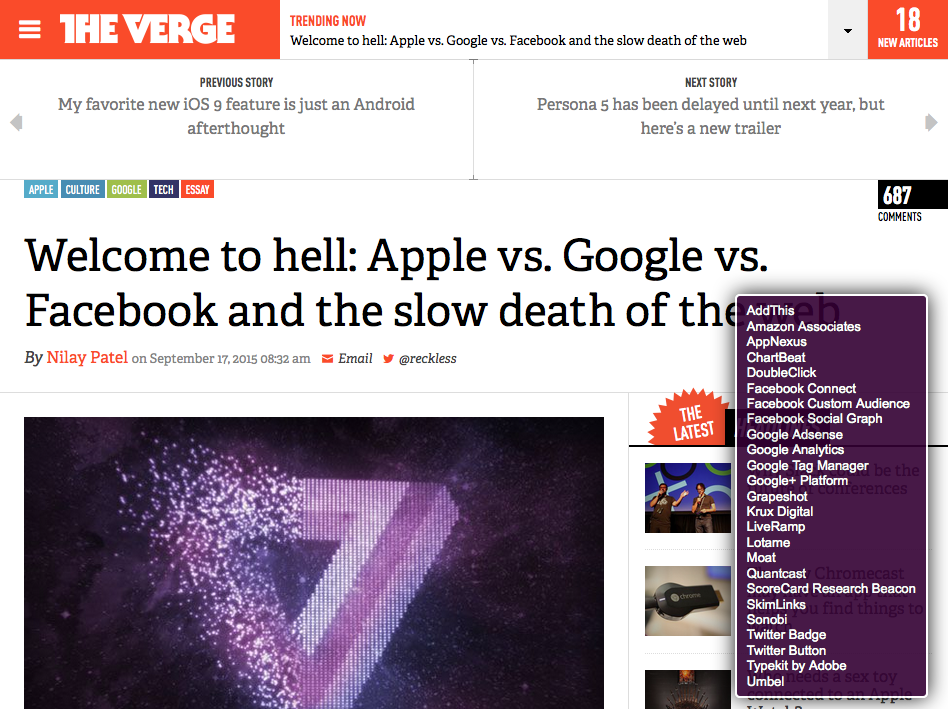
    Screen Shot 2015-09-18 at 5.26.41 PM

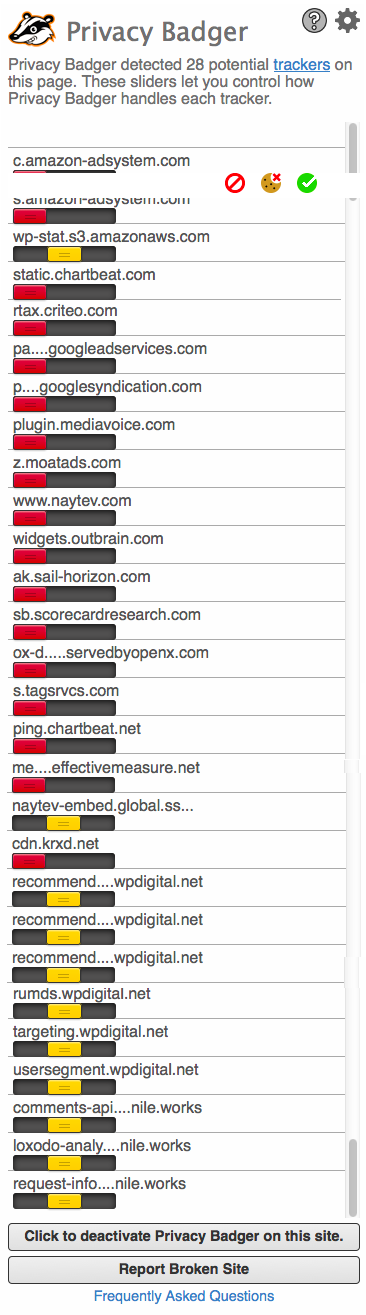
    Ghostery provides some means for throttling some of those trackers. So do other tools, such as the EFF‘s Privacy Badger. Here’s what happens to the same page on Firefox when I activate Privacy Badger:
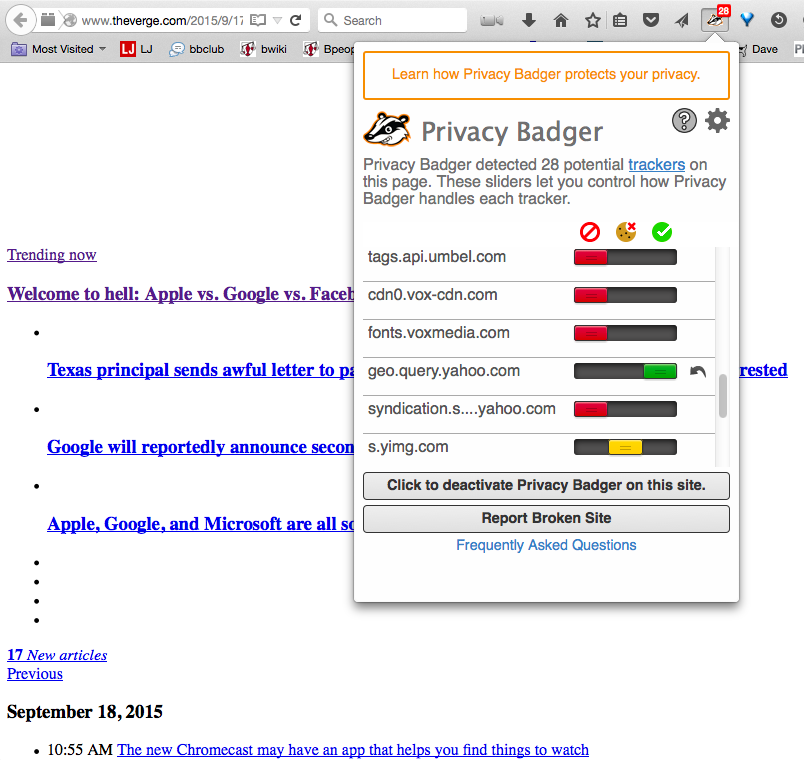
    Screen Shot 2015-09-18 at 5.15.26 PM

    While Privacy Badger provides ways for me to valve the trackers sent to my browser by The Verge, it would take way more time than I have to figure out what trackers do what, and then play with the sliders until The Verge and I come to some kind of compromise.

    Now here’s the main thing.

    When we go to a Web page, we expect to see that page. That’s what the http protocol is for: a way to ask for a page. What we get from commercial sites like The Verge, however, is a bunch of other crap we didn’t ask for. Some of it is welcome, some of it isn’t and it’s damn hard to tell the difference.

    The conversation we need to have is about what’s okay and what’s not okay. Ad and tracking blockers are giving us — the users (and in paying cases, the customers) — a crude and primitive way to say “Enough! That’s not okay!” And to start asserting some small degree of agency in a world where surveillance rules, and the individual has little control, other than to just walk away.

    In Be the friction – Our Response to the New Lords of the Ring, Shoshana Zuboff gives us —

    Zuboff’s three laws: First, that everything that can be automated will be automated. Second, that everything that can be informated will be informated. And most important to us now, the third law: In the absence of countervailing restrictions and sanctions, every digital application that can be used for surveillance and control will be used for surveillance and control, irrespective of its originating intention.

    Ad and tracking blocking are countervailing restrictions and sanctions — a friction supplied by the marketplace.

    Marketers and publishers can learn from what we’re saying with these tools. Or they can continue to misdirect our attention to what the Big Boys are doing while lecturing us about how we’re “killing the Web” or whatever.

    The problem isn’t ad blocking. It’s surveillance. That’s what the real fight is about.

    Meanwhile, it’s a shame to see the Chinese wall between editorial and advertising in publications turn into a trench. That’s what we see here.

    (Parts of this post appeared in my Liveblog, on Fri, Sep 11, 2015. For much more, see my whole Adblock War Series.)

  • How old aren’t you?

    Bing’s image search now has a #HowOldRobot that appears when you mouse over an image in the results. Click on it, and you get an age. Here’s one of Catherine Deneuve:

    Screen Shot 2015-09-14 at 1.11.15 PM

    Interesting that most of the guesses for her are on the low side. (One, for Catherine as a mature adult, guesses she’s 14.)

    Here’s one for Michelle, and one for Carl. (Chose those because they didn’t tend to bring up lots of shots of just one celeb.)

    Ones for me tend to guess high. Sucks, but what the hell. If you don’t mind being judged by a machine that’s wrong most of the time, and your image is splattered around online, give it a whack.

    And see if you don’t like Bing’s image search better than Google’s.

    The big advantage for me is that clicked images open in another tab automatically. But there’s stuff I like in Google’s image search too, such as the “View more” gallery.

    I use both, of course. Just wanted to point out this somewhat new Bing Thing.


  • Valley Fire losses

    Here is the current perimeter of the Valley Fire, according to the USGS’ GEOMAC viewer:

    ValleyFire 2015-09-13 at 3.10.24 PM_a

    As you see, no places are identified there. One in particular, however, is of extremely special interest to me: Harbin Hot Springs. That’s where I met my wife and made more friends than I can count. It is, or was,  one of the most lovely places on Earth, inhabited and lovingly maintained by wonderful people.

    I just matched up a section of the map above with Google Maps’ Earth view, and see that Harbin and its neighborhood are in the perimeter:

    Screen Shot 2015-09-13 at 3.12.19 PM

    After seeing this picture here, which looks northwest from downtown Middletown…

    COyGRRHVAAEwC4w… I suspected the worse.

    And now comes news that Harbin is “pretty much destroyed.” Damn.

    Other places in the perimeter — or so it appears to me (please don’t take this as gospel):

    • Outer edges of Middletown and Hidden Valley Lake communities
    • Parts of Whispering Pines, Cobb, Holbergs and Glenbrook
    • Areas adjacent to McCreary Lake and Detert Reservoir

    Watch here for official information about the fire.


  • Content as Icebergs

    ice-floes-off-greenland(Cross posted from this at Facebook)

    In Snow on the Water I wrote about the ‘low threshold of death” for what media folks call “content” — which always seemed to me like another word for packing material. But its common parlance now.

    For example, a couple days ago I heard a guy on WEEI, my fave sports station in Boston, yell “Coming up! Twenty-five straight minutes of content!”

    Still, it’s all gone like snow on the water, melting at the speed of short term memory decay. Unless it’s in a podcast. And then, even if it’s saved, it’ll still get flushed or 404’d in the fullness of time.

    So I think about content death a lot.

    Back around the turn of the millennium, John Perry Barlow said “I didn’t start hearing the word ‘content’ until the container business felt threatened.” Same here. But the container business now looks more like plumbing than freight forwarding. Everything flows. But to where?

    My Facebook timeline, standing in the vertical, looks like a core sample of glacier ice, drilled back to 1947, the year I showed up. Memory, while it lasts, is of old stuff which in the physical world would rot, dry, disintegrate, vanish or lithify from the bottom up.

    But here we are on the Web, which was designed as a way to share documents, not to save them. It presumed a directory structure, inherited from Unix (e.g. domain.something/folder/folder/file.html). Amazingly, it’s still there. Whatever longevity “content” enjoys on the Web is largely owed to that structure, I believe.

    But in practice most of what we pile onto the top of the Web is packed into silos such as Facebook. What happens to everything we put there if Facebook goes away? Bear in mind that Facebook isn’t even yet a decade old. It may be huge, but it’s no more permanent than a sand dune. Nothing on the Web is.

    Everything on the Web, silo’d or not, flows outward from its sources like icebergs from glaciers, melting at rates of their own.

    The one exception to that rule is the Internet Archive, which catches as much as it can of all that flow. Huge thanks to Brewster Kahle and friends for giving us that.

    Anyway, just wanted to share some thoughts on digital mortality this morning.

    As you were. Or weren’t. Or will be. Or not.

    Bonus link: Locking the Web open.

  • If marketing listened to markets, they’d hear what ad blocking is telling them

    What follows is my comment (the first one!) under Confusion Reigns as Apple Puts the Spotlight on Mobile Ad Blocking, in AdAge. I’ve added some links.


    Bury_your_head_in_the_sandMarketers should be looking at what the market wants, and why.


    The market is customers, and they are speaking to marketers today by making ad blockers the most popular browser extensions, and by telling survey after survey that they dislike having their privacy invaded by unwanted tracking (TRUSTe, Pew, Customer Commons) and that they are resigned to a status quo they don’t like (Wharton).

    In other words, the “key link between brands and customers” that customers sever with ad blocking isn’t a link at all. It’s a pain in the customer’s ass, or they wouldn’t be severing it.

    Apple knows ads and tracking are pains in the customers’ ass, because Apple is a B2C company that speaks every day to customers, on phones and on the floors of its stores. Apple sees there is a clear and obvious demand for Content Blocking, and want to be first to market with it. Serving that demand doesn’t hurt Apple outside of iAd, which accounts for a whopping 0.01% of Apple’s sales. (And what will Content Blocking add to Apple’s device sales? You can bet that Apple is running those numbers.)

    Meanwhile marketing doesn’t speak to customers, because marketing lives in a B2B echo chamber where the voice of the customer (hello!) is inaudible or ignored. [Later: Iain Henderson has some excellent push-back on this characterization, plus some helpful guidance, in his comment here.]

    Sure, marketers *think* they know what customers want, because they have Big Data and Big Analytics telling them, up to the second, what a customer might want to buy. Three problems with that: 1) there is no direct and conscious two-way interaction with customers; 2) most of the time customers aren’t buying a damn thing; and 3) guesswork based on all that data and analytics is wrong 99.x% of the time, thanks to #1 and #2.

    Denying and fighting what customers want is doing huge damage to marketing and advertising, and it will only get worse as long as it continues.

    Look at the damage already done to plain old impersonal brand advertising, which customers could appreciate because it wasn’t creepy and obviously helped pay for the magazines, newspapers, radio and TV shows they liked. (And none of which they thought of as “content,” by the way.)

    Today we live in a dysfunctional marketing world where advertisers have been taught to want every ad to perform — while customers want every ad, and the tracking that aimed it, blocked. (AdAge should do a research piece on how direct marketing body-snatched advertising from Madison Avenue. If you don’t, your body has been snatched too.)

    The only way to fix this is from the customers’ side.

    What kind of ads would a customer opt in for? (No, don’t kid yourselves about “Ad Choices.” It’s just another ludicrous conceit that only makes sense in the echo chamber.)

    Would customers accept ads that obviously aren’t personal (based on tracking), and clearly pay for the online goods they want and appreciate? Is there still hope for that baby?

    Only if we can snatch it from the bathwater that customers’ ad blockers are throwing out.

    Can we create standards-based ways for customers to express their friendly intentions regarding tracking, advertising, subscriptions and the rest of it, to marketing systems that can actually listen?

    In fact there are developers working on those ways. Here’s one. (Check him out. He’s non-trivial.)

    If you’re interested I can show you some more.

  • A history lesson in how to automate journalism with war and sports metaphors

    What I’ve always loved most about the Web† is how it allows each of us to publish on our own, as individuals, for the whole world. I started doing that as soon as I could get a dial-up account with a nearby ISP (the late Batnet of Palo Alto) in 1995.

    Here is one of my first pieces, published in Reality 2.0, a directory within my self-hosted Searls.com site. I’m resurrecting it here because it does a good job of explaining how easy it is to automate journalism by framing a story in terms of war or sports (and tees up some future posts). So here ya go, copied from HTML 1 and morphed on pasting by WordPress into HTML 4:


    MICROSOFT + NETSCAPE
    WHY THE PRESS NEEDS TO SNAP OUT OF ITS WAR-COVERAGE TRANCE

    By Doc Searls
    December 11, 1995

    Outline

    Web Wars?
    What are the facts?
    Let’s give a big AND to the Web
    So, what IS Microsoft doing?
    How to win users and influence developers
    A new breed of life

    Web Wars?

    Am I wrong here, or has the Web turned into a Star Wars movie?

    I learn from the papers that the desktop world has fallen under the iron grip of the most wealthy and powerful warlord in the galaxy. With a boundless greed for money and control, Bill Gates of Microsoft now seeks to extend his evil empire across all of cyberspace.

    The galaxy’s only hope is a small but popular rebel force called Netscape. Led by a young pilot (Marc Andreesen as Luke Skywalker), a noble elder (Jim Clark as Obi-wan Kanobe) and a cocky veteran (Jim Barksdale as Han Solo), Netscape’s mission is joined by the crafty and resourceful Java People from Sun.

    Heavy with portent, the headlines tromp across the pages (cue the Death Star music — dum dum dum, dum da dum, dum da dummm)…

    • “MICROSOFT TAKES WAR TO THE NET: Software giant plots defensive course based on openness”
    • “MICROSOFT UNVEILS INTERNET STRATEGY: Stage set for battle with Netscape.”
    • “MICROSOFT, SUN FACE OFF IN INTERNET RING”
    • “MICROSOFT STORMS THE WEB”

    The mind’s eye conjures a vision of The Emperor, deep in the half-built Death Star of Microsoft’s new Internet Strategy, looking across space at the Rebel fleet, his face twisted with contempt. “Your puny forces cannot win against this fully operational battle station!” he growls.

    But the rebels are confident. “In a fight between a bear and an alligator, what determines the victor is the terrain,” Marc Andreessen says. “What Microsoft just did was move into our terrain.”

    And Microsoft knows its strengths. December 7th, The Wall Street Journal writes, Bill Gates “issued a thinly veiled warning to Netscape and other upstarts that included a reference to the Pearl Harbor attack on the same date in 1941.”

    Exciting stuff. But is there really a war going on? Should there be?

    What are the facts?

    After reading all these alarming headlines, I decided to fire up my own copy of Netscape Navigator and search out a transcript of Bill’s December 7th speech.

    I started at Microsoft’s own site, but got an “access forbidden” message. Then I went up to the internet level of the site’s directory, but found the Netscape view was impaired. (“Best viewed with Microsoft Explorer,” it said.) I finally found a Netscape-friendly copy at Dave Winer’s site. It appears to be the original, verbatim:*

    MR. GATES: Well, good morning. I was realizing this morning that December 7th is kind of a famous day. (Laughter.) Fifty-four years ago or something. And I was trying to think if there were any parallels to what was going on here. And I really couldn’t come up with any. The only connection I could think of at all was that probably the most intelligent comment that was made on that day wasn’t made on Wall Street, or even by any type of that analyst; it was actually Admiral Yamomoto, who observed that he feared they had awakened a sleeping giant. (Laughter.)

    I see. The “veiled threat” was Bill’s opening laugh line. Even if this was “a veiled threat,” it was made in good humor. The rest of the talk hardly seemed hostile. Instead, Bill showed a substantial understanding of how both competition and cooperation work to build markets, and of the roles played by users, developers, leaders and followers in creating the Internet. In his final sentence, Bill says, “We believe that integration and continuity are going to be valuable to end users and developers…”

    Of course, I wish he’d pay a little more attention to Macintosh users and developers, but I don’t blame him for avoiding them. I blame Apple, which dissed and sued Microsoft for years, to no positive effect. Apple played a zero-sum game and — sure enough — ended up with zero. Brilliant strategy.

    Think how much farther along we would be today if this relationship was still Apple plus Microsoft, rather than Apple vs. Microsoft.

    The truth is that the Web will be better served by Microsoft plus Netscape than by Microsoft vs. Netscape. Plus is what most of us want, and it’s probably what we’ll get, regardless of how the press plays the story.

    Let’s give a big AND to the Web

    So what is the best way to characterize Microsoft, if not as the Heaviest of Heavies?

    I think Release 1.0‘s Jerry Michalski gets closest to it when he says: “Microsoft thinks more broadly than any other company about what it’s doing. Its plans include global telecommunications, information creation, applications — even community building.” That tells us a lot more than “Microsoft goes to war.”

    Markets are more than battlefields. The OR logic of war and sports get us excited, but tells us little of real substance. For that we also need the AND logic of cooperation, choice, partnership and working together. What we all want most — love — is hardly an OR proposition. Imagine a lover saying “there’s only room in this relationship for one of us, baby.”

    But the press is caught in an OR trance. Blind to the AND logic that gives markets their full color, the press reduces every hot story to the black vs. white metaphors of war and sports. Why cover the Web as the strange, unprecedented place it is, when you can play it as yet another story about two guys trying to beat the crap out of each other? Especially when the antagonists are little good guy and a big bad guy?

    Look, the Internet didn’t take off because Netscape showed up; and it wasn’t slowed down because Microsoft didn’t. It took off because millions of people added their creative energies to something that welcomed them — which was mostly each other. Death-fight competition didn’t make the Web we know now, and it won’t make the Web that’s coming, either.

    That’s because every site on the Web is AND logic at work. So is every vendor/developer relationship that ever produced a product or created a market. So is the near-infinite P/E ratio Netscape enjoys today.

    So, what IS Microsoft doing?

    “Embrace and extend,” Bill Gates called it in his December 7 talk. That’s what he said Microsoft will do with products from Oracle, Spyglass, Compuserve and Sun. Is this an AND strategy? Or is it yet an other example of what Gary Reback, Judge Sporkin and other Microsoft enemies call a “lock and leverage” strategy, intended to drive out competition and let Microsoft charge tolls to every traveler on the Information Highway?

    We’ll see.

    It should be clear by now that the Web does not welcome OR strategies. Microsoft Network was an OR strategy, and it didn’t work. If history repeats itself (as it usually does with Microsoft), the company will learn from this experience (as Apple learned earlier from its eWorld failure) and move on to do the Right Thing.

    Not that most of the press would notice. To them Microsoft is The Empire and Bill is its gold-armored emperor. But reporters are the ones putting clothes on this emperor. To the people who make Microsoft’s markets — the users and developers — “billg” is as naked as a newborn.

    Take away the war-front headlines, the play-by-play reporting, the color commentary by industry analysts, the infatuation with personal wealth — and you see Bill as an extremely competitive guy who’s also trying to do right by users and developers. And hiding little in the process. Is he a bully? Sometimes. Is this bad? No, it’s typical of big companies since the dawn of business. It looks to me more like a personality trait than a business strategy. And what makes Microsoft win is far more strategic than personal.

    George Gilder puts it this way in Forbes ASAP (“Angst & Awe on the Internet“):

    Blinded by the robber-baron image assigned in U.S. history courses to the heroic builders of American capitalism, many critics see Bill Gates as a menacing monopolist. They mistake for greed the gargantuan tenacity of Microsoft as it struggles to assure the compatibility of its standard with tens of thousands of applications and peripherals over generations of dynamically changing technology.

    How to win users and influence developers

    How does Bill express that tenacity? As Dave Winer puts it in “The Platform is a Chinese Household,” Bill “sends flowers.” Bill courts developers and delivers for customers, who return the favor by buying Microsoft products.

    Markets are conversations, and there isn’t a more willing conversational participant than Bill. That’s why I’m not surprised when Dave says “the only big company that’s responsive to my needs is Microsoft.” And Dave, by the way, is a pillar of the Macintosh community. To my knowledge, he hasn’t developed a DOS-compatible product since the original ThinkTank.

    Users and developers don’t need to hear vendors talk about how much their competition sucks. No good ever comes of it. Is it just coincidence that Microsoft almost never bad-mouths its competition? Though Bill is hardly innocent of the occasional raspberry, he’s a long way from matching the nasty remarks made about him and his company by leaders at Sun, Apple, Netscape and Novell, just to name an obvious few.

    It especially saddens me to hear competition-bashing from Guy Kawasaki, whose positive energies Apple desperately needs right now. As a customer and user of both Apple and Microsoft products, I see Guy’s “how to drive your competition crazy” rap as OR logic at its antiproductive worst.

    At the opposite end of the diplomacy scale, I like the way Gordon Eubanks of Symantec has consistently been fair and constructive in his public remarks about Bill and Microsoft (and has reaped ample rewards in the process).

    What makes markets work is a combination of AND and OR processes that deserve thoughtful and observant journalism. They also call for vendors who can drop their fists, open their minds and look at opportunities from users’ and developers’ points of view. This is how Microsoft came to change its Internet strategy. And this is what makes Microsoft the most adaptive company in the business, regardless of size. No wonder the laws of Darwin have been kind to them.

    A new breed of life

    Urge and urge and urge,
    Always the procreant urge of the world.
    Out of the dimness opposite equals advance…
    Always substance and increase,
    Always a knit of identity… always distinction…
    Always a breed of life.
    —Walt Whitman

    Where the language of war fails, perhaps the language of Whitman can succeed.

    By the great poet’s lights, the Web is a new breed of life. An original knit of identity. Its substance increases when opposite equals like Netscape and Microsoft advance out of the dimness and obey their procreant urges — not their will to kill.

    The Web is a product of relationships, not of victors and victims. Not one dime Netscape makes is at Microsoft’s expense. And Netscape won’t bleed to death if Microsoft produces a worthy browser. The Web as we know it won’t be the same in six weeks, much less six months or six years. As a “breed of life,” it is original, crazy and already immense. It is not like anything. To describe it with cheap-shot war and sports metaphors is worse than wrong — it is bad journalism.

    *A week after this experience, I went back to Microsoft site and found its whole Internet Strategy directory much more Netscape-friendly and nicely organized. Every presentation is there, including all the slides. Though the slides are in PowerPoint 4.0 for Windows, my Mac is able to view them with the Mac version of the program. [Back to *]

    George Gilder’s Forbes ASAP article archives are at his Telecosm site.

    Dave Winer’s provocative “rants” come out every few days, and accumulate at his DaveNet site. Check out “The User’s Software Company,” which inspired this essay.


    † [Added on 8 September 2015] While the Web began as a hypertext project proposed to CERN by two employees there (Tim Berners-Lee and Robert Calliau) on 12 November 1990, it did not turn into the Web we know today (and one I could access through an ISP) until it opened for commercial activity on 30 April 1995. That was when the NSFnet (one of the Net’s many backbones, and the only one forbidding commercial use) stepped aside.

  • Everything we know is provisional

    flyingsaucer

    Dogs flew spaceships.The Aztecs invented the vacation. Men and women are the same sex. Our forefathers took drugs. Your brain is not the boss. Yes, that’s right: everything you know is wrong. — Firesign Theatre

    In The Half-Life of Facts: Why Everything We Know Has an Expiration Date, Samuel Arbesman says most of what we know will be replaced, eventually, by new and better facts.

    Let’s not argue Arbesman’s case either way. Instead let’s admit that there is at least some truth to it — a rightness: something we can agree on, even if we believe he’s wrong in some ways. After all, he’s talking about science.

    Science is both a body of knowledge and a formal approach to growing it. In science, settled knowledge is organized into piles of agreements, many of which are about truths that are lacking in facts, or supported by facts that will be replaced with others, no less provisional than the originals.

    In this sense science is a belief system; but hardly a religious one, since every belief might be less than a matter of faith than an operating assumption that will have to do for now.

    On the whole we tend to believe scientists who have earned their greatness, or come close enough. What we grant them is authority.

    It is interesting to approach the subject of authority by looking at the noun information, which is derived from the verb inform, which in turn is derived from the verb to form.

    If you tell me something I didn’t know, and it becomes part of what I know — my own belief system — you haven’t just “delivered” to me a sum of unseen substance called “information,” as if it were container cargo. You have formed me. I am not exactly as I was before. I am larger, at least in the sense that humans are learning animals, best improved by learning until the moment they die. (“Live as if you were to die tomorrow. Learn as if you were to live forever,” Gandhi is said to have said.)

    Therefore authority is the right we grant others to form us. Put another way, we are all authors of each other.

    Yet even our idols walk on clay feet when that’s the only way to get around. In Annals of the Former World, John McPhee reports that the geologist Kenneth S. Deffeyes once asked his friend and colleague W. Jason Morgan what he would do for an encore to Rises, Trenches, Great Faults and Crustal Blocks, Morgan’s landmark paper in the founding canon of plate tectonics. “Morgan said he didn’t know,” McPhee writes, “but possibly the most exciting thing to do next would be to prove the theory wrong.”

    Though it be canon, the theory of plate tectonics is provisional, even to its primary authors. But for now it’s the working model we call a paradigm.

    Before plate tectonics, the encompassing paradigm for geology — its canon — was the geosyncline. It was, in a three word phrase that will be with geology forever, “not well understood.” Plate tectonics is better understood than was the geosyncline, but there are still lots of gaps in it, filled mostly with working assumptions, about which there are plenty of disagreements.

    Michael Polanyi, a scientist and philosopher (in that order) says science moves toward its settled facts by a process of creative guesswork that relies far more on tacit rather than explicit forms of knowing. His only quotable line, “We know more than we can tell” summarizes what he means by tacit. But that ain’t enough.

    To unpack it a bit more, tacit knowledge is how we can far more easily recognize a person’s face than describe it.

    We rely on tacit knowing when we make things explicit as well. Consider this: we usually don’t know know how we will end the sentences we start, or remember how we started the sentences we are ending, yet we somehow communicate meaning anyway. That meaning is mostly tacit as well.

    All these things are high on my mind because lately I have been entering discussions on science, and feel a need to dump my brain (or what little I can make explicit of my tacit knowing on the subject). I also feel compelled to add one observation and a one story — about my own guessing on the subject of how the Rockies got there.

    Here is the observation: There is no urge more human than the one to alter a permanent structure. Think about it. The first thing anybody moving into a new house wants to do is change it. Enclose the porch. Move a door. Change the flooring. Put in a new bathroom off the back hall. The best book ever written on this subject is Stewart Brand‘s How Buildings Learn: What Happens After They Are Built. It came out in 1994 and is no less brilliant now than it was then. Get it if you’re even thinking of buying, building or remodeling a house.

    (Less great but no less useful to my wife and I, when we were remodeling our first place in the mid-’90s, was Your New House, by Alan and Denise Fields, now available for 1¢ on Amazon. I don’t have it with me, and the “look inside” thing doesn’t reveal the whole text, but here’s what I remember from it: “Your builder is not Bob Vila. Your builder is a crew of drunks, ex-felons and misfits who show up on alternate Thursdays.” While not true, it’s close enough.)

    Now for the Rockies. In Annals of the Former World, John McPhee writes, “Plate tectonics theorists have been more than a little inconvenienced by the great distances that separate the mountains from the nearest plate boundary.”

    At the time McPhee wrote that, it was generally assumed that when one plate subducted under another, it was at a deep angle. Flying over the Rockies many dozens of times after first reading that in the ’80s, I developed my own theory: that the Farallon plate (a former Pacific sea floor) didn’t dive under the western edge of North America, but instead slid under it at a shallow angle, like a piece of plywood under a rug. So I felt pretty smart about that until I later read that real geologists, William R. Dickinson and Walter S. Snyder, had theorized “flat subduction” (perhaps best explained here), in 1978, as an explanation of the Laramide Orogeny, which produced roughly the Rockies we know, within a few dozen million years.

    (It’s actually messier than I thought. Or seems to be. Here’s what NASA says has become of the subducted Farallon, now deep in the mantle. By the way, what got scraped off the top of the plate as it went into the trench is what we call the Bay Area. Or, in geo lingo, the Franciscan assemblage.)

    My purpose with this isn’t to brag on something I thought up (and turned out not to be original) but rather to point to contributions of greater substance I’ve been making to geology ever since, in the form of aerial photographs that geologists can use. Many do. So do Wikimedia Commons and Wikipedia.

    “Make yourself useful,” Mom used to say. So I do.

    To sum up, my provisional conclusion about science is that it’s all provisional: as functional and temporary as scaffolding. And now, thanks to the Internet, we can all take part in raising scientific barns of a countless kinds, and then re-raising more and better ones as we gather more facts, learn more stuff, share more knowledge, and better author each other in the process.

    Bonus link: David Weinberger‘s Too Big to Know: Rethinking Knowledge Now That the Facts Aren’t the Facts, Experts Are Everywhere, and the Smartest Person in the Room Is the Room. My short review: it formed me.

  • What’s up with @TMobile in North Carolina?

    Check this out:

    oakleaf

    I took that screen shot at the excellent Oakleaf restaurant in Pittsboro, NC a few days ago. Note the zero bars (or dots) of telephone service, and the very respectable (tested!) data service. To confirm what the hollow dots said, I tried to make a call. Didn’t work.

    This seems to be a new thing for T-Mobile in North Carolina, where I spent much of this summer — or at least in the parts of it where I visited.

    The company’s mobile phone coverage is pretty lousy to begin with, on the whole: great on highways and in the larger towns; but spotty when you head into the suburbs and countryside. What changed is the sudden near-disappearance of voice phone coverage in some places where it had worked before, and the improvement at the same time of data coverage.

    At my sister’s house, near a major interstate highway, I could use my phone on the porch or in the yard, but not indoors, where I’d see the most dreaded two words in mobile telephony: “no service.” Or at least that was the case in July and early August.

    Then something strange happened. I started getting data service indoors at her house, and in other places where before there was nothing. But all I got was data, identified by that little “LTE.” Telephony was five empty dots. At my sister’s place I also couldn’t make or get a call out in the yard, on the street, or anywhere in the neighborhood. But the data service was now terrific.

    So I’m wondering if this is just me, or if T-Mobile is lately favoring data over telephony in some places. Anybody know? (I note that T-Mobile’s coverage maps only seem to deal with data, not telephony. But maybe I’m missing something.)

    By the way, I should add that I wouldn’t trade T-Mobile for any other carrier right now, because I travel a lot outside the country. In addition to fine coverage in New York, Boston, and all the places I tend to go in California, T-Mobile gives me free data roaming and texting everywhere I go, and 20¢/minute on the phone. Yes, the data rates tend to be 2G rather than 3G or 4G/LTE. But it tends to be good enough most of the time. It also makes me tolerant of a less-than-ideal coverage footprint here in the U.S.

  • Will Content Blocking push Apple into advertising’s wheat business?

    wheat+apple

    [Update on 3 January 2016: Buzzfeed reports that Apple is killing iAd and getting out of that business, ending the conflict I detail below. And Apple confirms the decision, here. For a look at what I am sure is behind that, scroll down to “Sacrificing its adtech business…”.]

    A couple weeks ago, I posted Separating advertising’s wheat and chaff, contrasting privacy-respecting brand advertising (the wheat) with privacy-offending tracking-based advertising (the chaff), better known in the industry as “adtech.”

    Apple pushes both, through its own advertising business, called iAd. The company is also taking sides against both — especially adtech — by supporting Content Blocking in a new breed of mobile phone apps we can expect to see in iOS 9, Apple’s next mobile operating system, due next month.

    In Apple’s Content Blocking is chemo for the cancer of adtech, which I posted a few days ago, I visited the likely effects of content blocking. Since then a number of readers have pointed to posts about iAd and the opt-out choices Apple provides for advertising on iPhones and iPads.

    Both iAd and the opt-outs reveal that Apple is as much in the adtech business as any other company that tracks people around the Net and blasts personalized advertising at them.

    Apple is clearly taking sides against adtech with its privacy policy, which has lately become more public and positioned sharply against the big tracking-based advertising companies (notably Google and Facebook). In September of last year, for example, Apple put up a new pageapple.com/privacy — that contained this paragraph:

    Our business model is very straightforward: We sell great products. We don’t build a profile based on your email content or web browsing habits to sell to advertisers. We don’t “monetize” the information you store on your iPhone or in iCloud. And we don’t read your email or your messages to get information to market to you. Our software and services are designed to make our devices better. Plain and simple.

    What we have here, then, is Apple’s massive B2C business in conflict with one of its B2B businesses. Since there is a lot of history here, let’s review it.

    On 8 July 2010, Engadget published iAds uses iTunes history, location information to target advertising. It begins,

    We’ve heard about this before, but now that it’s up and running, this is probably worth a revisit. Apple’s iAds system actually uses lots of your information, including your iTunes purchasing history, location data, and any other download or library information it can suss out about you, to determine what ads you see. So say a few marketing firms working with the large companies now buying and selling iAds.

    A recent series of ads for soap was able to target “married men who are in their late 30s and have children.” That’s very specific, and when Apple rolls out the full program, it’ll even be able to use things like iBooks purchases and iTunes movie and TV downloads to target you with advertising.

    On 15 October 2014, Digiday published Apple revamps mobile ads with retargeting options. It begins,

    Apple’s release of its new mobile operating system last month came with an overlooked gift for marketers: the ability to retarget ads based on users’ in-app browsing behaviors.

    According to ad agencies, Apple is actively pitching the new capability as a way to effectively solve the mobile cookie problem.

    Say, for example, a visitor to a retailer’s iPhone app adds a pair of shoes to his cart but ultimately decide not to buy it. In this scenario, the retailer will now be able to retarget that user with an ad for that exact pair — even in another app on his iPad. When tapped, the ad would direct him back to his abandoned checkout page and automatically add the shoes to his online shopping cart.

    That was when iAd was new. Since then it has come to be regarded, at least by the online press, as something of a failure. On 16 Ocbober 2014, Business Insider published Here’s Apple’s Plan To Turn Around iAd, One Of Its Biggest Flops. The gist:

    Several sources have confirmed to Business Insider that Apple is currently visiting mobile specialists at the top media agencies in New York City to push the new function. (Cross-device retargeting.)

    Cross-device retargeting is of most use to retailers: if a customer spends some time looking at a dress on their iPad app but decides not to buy it, that same retailer can “retarget” them with an ad displaying an image of that dress, options to buy, or directions to the store when they next pick up their iPhone.

    On 19 November 2014, AdExchanger published iAd starts selling programmatically, and explains how it works:

    iAd has more than 400 targeting options for advertisers. Its audience is also validated, since users must create an iTunes account in order to download apps. With the release of iOS 8, Apple announced that those Apple IDs could be used by iAds advertisers to retarget users across their devices. Those capabilities make it a good fit for advertisers doing audience-based targeting, who often prefer transacting in programmatic channels.

    iAd has scale: “Apple iAd’s sell-side SDK is one of the most penetrated SDKs in the industry,” said Michael Oiknine, CEO of Apsalar. “They now have added iTunes radio inventory, so it’s a smart yield maximization strategy for Apple and is akin to Facebook strategy, which maximizes inventory sales via FBX and PMDs.”

    On 21 November 2014, Venturebeat published Apple and AdRoll enable iOS ad retargeting — with extra data from iTunes and the App Store. It begins,

    In a significant move for the mobile advertising industry, Apple and retargeting leader AdRoll have announced a partnership that will see AdRoll providing its retargeting and programmatic buying capability for iAd. In addition, Apple will enable advertisers to target potential customers via access to its proprietary data sets from iTunes and the app store.

    On 21 November 2014, AdWeek published Get Ready for More Mobile Ads on Your iPhones as Apple Launches New iAds. The gist:

    Today, Apple is unveiling partnerships with companies like AdRoll, which will flip a switch and start serving iAds through its automated marketing platforms. This turn toward programmatic mobile advertising has been in the works for at least a year. Last year, the company stopped treating iAd like a high-end marketing platform for only the top brands with the most cash.

    Apple wanted to build a self-serve mobile advertising system in house, and it bought Quattro Wireless to help. Sources said that effort faltered, and Apple decided to partner with ad tech companies like AdRoll and The Rubicon Project to compete with mobile ad giants like Facebook, Google and Twitter.

    AdRoll is a retargeting specialty firm that lets marketers use their own consumer data profiles to deliver ads across such platforms. And Rubicon unexpectedly leaked word earlier this week that it was partnering with Apple.

    On 22 January 2015, ExchangeWire asked What will Apple’s Ad Tech Play look like? They say,

    Apple’s renewed designs on the advertising business were revealed when it was announced it was to start selling its iAd inventory on a programmatic basis, with several firms including MediaMath, Rubicon Project, among others, over four years after its iAd unit was initially launched, asking advertisers for (the then audacious sum of) $1m per campaign on its iOS devices.

    Since launch, Apple’s presence in the advertising business has been largely underwhelming (apart from its own spend). But the revelation it had chosen several supply-side platforms (SSP) to sell programmatic guaranteed opportunities on behalf of the 250,000-plus App Store developers indicated its renewed designs on the sector.

    The announcement itself made waves, not least because of the bungled nature of the announcement,which itself raises a number of issues to debated about Apple’s influence in the ad tech sector (more on that later).

    The initial announcement read: “Apple’s iAd provides 400-plus targeting options to advertisers, based on hundreds of millions of validated iTunes accounts worldwide. This rich first-party data asset makes it easy for buyers to target the specific mobile audiences of their choice.”

    The move represented, for the first time, that Apple is willing to loosen control over its first-party iTunes data with advertisers expected to be willing to pay top dollar for the access.

    They add,

    Apple has since started to advertise for roles within its iAd business, requesting applications for UK candidates to join its iAd Marketplace Sales Organisation.

    Among the skills requested are: “Apple’s customers on the various products iAd has to offer as well as how to leverage iAd’s self service buying platform, iAd Workbench.”

    In addition: “Third-party tags familiarity a plus.”

    What is clear, from all these pieces and many others like them, is that Apple’s adtech business is little if any different from the rest of them — meaning just as creepy and privacy-abusing — and notable as well for failing to live up to its original ambitions, which were both huge and (via Business Insider) outlined by Saint Steve himself:

    At launch, Jobs set out the bold ambition that iAd would capture 50% of the mobile ad market. Apple marketed iAd as a best-in-class solution for advertisers because it owns both the hardware and operating system the ads ride on and gains valuable data when people sign up for Apple ID to register for iTunes accounts. That means it can target ads by age, gender, home address, iTunes purchases and App Store downloads.

    However, it’s still somewhat behind that lofty 50% target. iAd made up just 2.5% of the mobile ad revenue booked in the US last year, according to eMarketer, behind Google which takes the lion’s share (37.7%) and Facebook (17.9%). The most recent data from IDC states Apple generated $125 million in mobile ad sales in 2012.

    Apple’s total sales in FY 2012 were $125 billion, or 1000x its mobile ad sales that year. Put another way, iAd contributed 0.01% to Apple’s sales.

    Meanwhile, does any Apple customer want advertising on their iPhone or iPad?

    Apple knows the answer to that question, which is why Apple provides ways for you to “limit ad tracking on your iPhone, iPad, or iPod touch” and “ads based on your interests.”* (Just go to Settings > Privacy > Advertising to “Limit Ad Tracking,” and to Settings > Privacy > Location Services > System Services. to turn off “Location Based iAds.”) And soon we’ll have Content Blocking as well.

    Sacrificing its adtech business would position Apple in full alignment with three things:

    1. Tim Cook’s privacy statement. It would take the loopholes out of that thing.
    2. Market demand. People are fed up with losing their privacy online — almost all of it to the tracking-based advertising business. (Sources: Pew, TRUSTe, Customer Commons, Wharton.)
    3. The moral high ground called simple human decency. Most people don’t want to be tracked in the online world any more than they want to be tracked in the physical one. Nor do they want information about them known by first parties to be sold to third parties, or to anybody, with our without their knowledge, no matter how normative that practice has become.

    Dropping adtech would also be good for iAd, which could then concentrate on placing non-tracking-based brand ads, which are more valuable anyway: to brands, to publishers and to the marketplace. Also to Apple itself, because they would be selling wheat, rather than chaff.

    Until then, the loopholes persist in Tim Cook’s privacy statement, and Apple retains major conflicts between its massive B2C businesses and its struggling B2B adtech business.

    It will be interesting to see what the company does once the Content Blocking chemo hits the App Store bloodstream.

    * “Based on your interests” (aka “interest based advertising“) is a delusional conceit by both adtech (examples here , here and here) and online retailing (prime example: Amazon). Neither visiting sites nor buying are measures of interests. All they show are actions that could mean anything — or nothing.

    The interest-based advertisers say our interests are “inferred” by what we do (and they like to observe, constantly and everywhere). And yet those inferences are weakened by another assumption that is flat-out wrong, nearly all the time: that we are always in a shopping mode. In fact we are not.

    We are, in fact, always in an owning mode, which is why I think that’s the real greenfield for e-commerce. If companies shifted a third of what they spend on adtech over to customer service, they would vastly increase both customer loyalty and brand value.

    By the way, Apple knows this, possibly better than any other technology company. That’s one more reason why I think their B2C smarts will correct the adtech crowd-following errors of their B2B ways.

    [Later…] @JamesDempsey tweets,

    iOS 9 content blocking is in Safari. iAds appear in apps—not web pages: iAds not blocked.

    Good to know. Apple’s iAd site doesn’t make that clear (to me, at least). What this tells me is that iAd is in the chaff business while Content Blocking encourages wheat on Safari. Doesn’t change the point of this post, or the earlier ones.

  • Dig the Aurora

    Here’s what the current geomagnetic storm looks like right now, data-wise:

    k indexThe visuals are in the sky, in the form of brilliant auroras, visible all over Canada and as far south as Michigan. The near-full moon doesn’t help, but the show is there to see. (Alas, I’m in North Carolina, so it’s a longer shot.)

  • The greatest western I’ve ever read

    Update on 20 January 2026: This post is getting action, so I should add that my son and I visited Love Ranch two years after I posted it. Here is a gallery of photos, all captioned. And the title one:

    The Love Ranch homestead, more than a century after it was built, and the site of countless true and remarkable stories about life in The West.

    10-17-Love

    — is John McPhee‘s Rising From the Plains.

    It’s one book among five collected in Annals of the Former World, which won a Pulitzer in 1999. In all five, McPhee follows a geologist around. And all five of the geologists are interesting characters—none more so than J. David Love, who grew up on a hardscrabble ranch in the center of Wyoming and became one of the world’s most accomplished geologists.

    And yet David Love is still less interesting than both his parents. His father, John Love, was an endlessly resourceful Scottish builder and re-builder of the family ranch (also possibly, McPhee suggests, a one-time member of Butch Cassidy’s gang). His mother, Ethel Waxham Love, was one of the finest diarists ever to put pen to paper. The pair met and settled by Muskrat Creek, in the barren center of Wyoming, at a time that was still the Old West.

    I’ve read and re-read Rising From the Plains so often that the pages are browned at the edges, simply because I love the writing and the characters in the stories that braid through the text (which is actually about geology, though you can ignore that).

    I bring all this up because last night, on my sister’s Netflix, we watched Episode Eight (1887-1914), of The West, a Ken Burns documentary that ran on PBS so long ago that the picture is in 3×4 low-def, shaped to fit old vacuum-tube TV screens. In the episode is a section titled “I Will Never Leave You,” which is about the trials endured by the Love family at their ranch. It features photos of the Loves I had never seen, along with interview footage of David Love, then in his 80s, telling stories I had read countless times, yet loved to hear again, straight from The Man Himself.

    The old ranch house was still standing when Love and McPhee visited it for the last time, sometime before the mid-1980s, when Rising From the Plains was published.

    Visiting Love Ranch (which David said was “one hundred miles from wood, water, and women”) has long been among the few to-dos on my bucket list.

    A few bonus links:

  • Apple’s content blocking is chemo for the cancer of adtech

    Intravenous equipmentThe tide of popular sentiment is turning against tracking-based advertising — and Apple knows it. That’s why they’re enabling “content blocking” in iOS 9 (the new mobile operating system that will soon go in your iPhone and iPad).
    Says Apple, “Content Blocking* gives your extensions a fast and efficient way to block cookies, images, resources, pop-ups, and other content.”

    This is aimed straight at tracking-based advertising, known in the trade as adtech.* And Apple isn’t alone:

    [*Note: far I know, there was not a term for tracking-based advertising until adtech seemed to emerge as the front-runner. I chose it for this post because others (e.g. the first two examples above) have done the same. Tell me a better word and I’ll swap it in. And if you want to know why we need to distinguish  between advertising based on tracking people and advertising that is not, read my last post, Separating Advertising’s Wheat and Chaff.]

    Here’s Apple’s tech-speak on the feature:

    Your app extension is responsible for supplying a JSON file to Safari. The JSON consists of an array of rules (triggers and actions) for blocking specific content. Safari converts the JSON to bytecode, which it applies efficiently to all resource loads without leaking information about the user’s browsing back to the app extension.

    This means the iOS platform will now support developers who want to build sophisticated apps that give users ways to block stuff they don’t like, such as adtech tracking and various forms of advertising — or all advertising — and to do it privately.

    This allows much more control over unwanted content than is provided currently by ad and tracking blockers on Web browsers, and supports this control at the system level, rather than at the browser level. (Though it is executed by the browser.)

    How likely is it that these apps will be built? 100%. One of those is Crystal, by Dean Murphy. His pitches:

    1. Remove advert banners, blocks, popovers, autoplay videos, App Store redirects & invisible tracking scripts that follow you around the web.
    2. Pages render more than 3.9x faster on average**.
    3. Reduces data use by 53% on average**.

    [**Benchmarks calculated from a selection of random pages from 10 popular sites.]

    All three of these address obvious appetites by customers in the marketplace:

    1. To avoid ads, and being tracked.
    2. To speed things up.
    3. To minimize data usage, for which mobile carriers charge money.

    In iOS 9 content blocking will transform the mobile Web: I’ve tried it., Owen Williams (@ow) of TheNextWeb gives Crystal a spin, finding it delivers on its promises.

    If I read Owen right, he believes Content Blocking will have two results:

    1. Publishers will lose, because they depend on advertising that will be blocked; and
    2. Apple will win, because publishers will be driven to the company’s News app, on which Apple can make money with its own advertising system, called iAd. [Since then discontinued. See the note at the end of this piece.]

    While these assumptions might be correct, they are part of a much larger picture, which will surely change as content blockers such as Crystal get adopted. So let’s look at that picture.

    1. The market is very unhappy with abuses to personal privacy. Studies by Pew, TRUSTe, Customer Commons and Wharton all make clear that more than 90% of the connected population doesn’t like privacy abuse on the commercial Web. Following people with tracking cookies and beacons violates their privacy. This is a big reason why ad and tracking blocking, through popular browser extensions and add-ons, is already high and continues to go up. It is therefore safe to say that iOS apps like Crystal will be very popular.
    2. There are two kinds of advertising at issue here, and it is essential to separate them (which I do, at length, in Separating Advertising’s Wheat and Chaff). One is tracking-based advertising, or adtech. That’s the kind that wants to get personal, and depends on spying on people. The other is plain old brand advertising, which isn’t based on tracking, and is targeted at populations rather than individuals. Content Blocking is aimed squarely at adtech.
    3. Apple’s iAd is for brand advertising, not adtech. At least that’s what I gather from Apple’s literature. (See here, here, here and here.) This puts them on the side of wheat, and Apple’s competitors — notably Google, Facebook and all of adtech — on the side of chaff.
    4. Apple has put a big stake in the ground on the subject of privacy. This is clearly to differentiate itself from adtech in general, and from Google and Facebooks in particular.
    5. Brand advertising is more valuable to publishers than adtech. Its provenance and value are clear and obvious and it sells for better prices. Also, while some of it may be annoying, none of it shares its business model with spam, which adtech does. And brand advertising uncorrupted by fraud, which is rampant in adtech — so rampant, in fact, that T.Rob Wyatt, a security expert, calls adtech “the new digital cancer.”

    This is why content blocking is chemo for the cancer of adtech. It is also why everybody involved in the advertising-funded online ecosystem should start separating the wheat from the chaff, and to make clear that the wheat — plain old non-tracking-based brand advertising — is (to mix metaphors) the baby in the advertising bathwater that users will start throwing out with their content blockers.

    However it goes down, the inevitable results, long term, will be these:

    1. Brand advertising (the non-tracking-based kind) will be seen again as the most legitimate form of advertising.
    2. Brand advertising will again be credited for doing the good work of funding publishers (also broadcasters, podcasters and the rest).
    3. Adtech, and spying in general, will be shunned, as it deserves to be.
    4. Adtech will still live on, rehabilitated and cleansed, as a trusted symbiote of users who give clear and unambiguous permission for trackers they bless to dwell in their private spaces and give them optimal personalized advertising experiences.

    In other words, what I said at the close of the Advertising Bubble chapter of The Intention Economy will come true:

    When the backlash is over, and the advertising bubble deflates, advertising will remain an enormous and useful business. We will still need advertising to do what only it can do. What will emerge, however, is a market for what advertising can’t do. This new market will be defined by what customers actually want, rather than guesses about it.

    * As a term, “content blocking” is an unfortunate choice, since until now it meant government censorship. But the deed is done. From this point forward it means you get to block stuff you don’t want happening on your mobile device.


    Later (2:36pm) — So I tweeted this post here, not long after it went up, and the response is split between yea and nay (though mostly yea). Since I have no argument with the yeas, I’ll take on the nays…

    @cpokane writes,

    it is offensive to us who work in adtech by day and nurse the result of cancer by night, at home. disappointing metaphor.

    Gareth Holmes (@mgrholmes) adds these:

    No offence to but comparing ad tech to cancer is beyond hyperbole. FACT: ad tech has been keeping the internet free since 1993

    having never met I only hope he doesn’t have to wait until he’s lying next to a dying loved one to realise he was wrong.

    And Vlad Stein (@vstein) weighs in with this:

    Couldn’t imagine a stupider, more offensive title. Ad tech is what makes free online content viable, like it or not.

    No offence taken. Or meant to be given. Cancer is a common metaphor for many things that are not. So is chemo: a medicine that sickens a patient while killing (or at least trying to kill) his or her cancer. Tell me a better metaphor and I’ll gladly use it. (I have also experienced loved ones dying of cancer, and I’m not sure they would have disapproved of the metaphor.)

    As for hyperbole, guilty as charged. I’m making a strong point here, and one almost nobody else (other than Don Marti and Bob Hoffman) is making — or has seen sunk in. The market sentiment against surveillance-based marketing — aka adtech — is strong, growing, and almost entirely ignored by the whole adtech business.

    As for Apple’s nature as a company, they are hardly pure. In fact, there is a vast inconsistency between what they’re doing on the B2C side with Content Blocking and on the B2B side with adtech.

    On the B2C side, which is 99+% of what Apple does, the company works on behalf of its paying customers. This is huge, because there isn’t a customer on Earth who wants to be tracked like an animal without clear and explicit permission, or to have pages slowed by tracking cookies, beacons and ads fed by unknown and unwelcome servers. Especially on mobile. Apple knows this because they talk on the phone and in stores every day with those customers. They’ve also seen abundant research (some cited above) that makes clear how much people hate having their privacy violated, which Adtech does with abundant impunity. Meanwhile adtech doesn’t talk to those customers. It only follows them. Ain’t the same.

    On the B2B side, Apple with iAd has been in the adtech business from the start, in 2010. (I visit all this in my next post.) While they don’t allow third party cookies or tracking, they do allow advertisers to aim their ads based on what Apple knows about you from your iTunes and App Store purchases, plus other intelligence the company gathers from its interactions with you. This is adtech, pure and simple.

    So yes, Apple is having it both ways.

    I suspect Apple will reconcile the two by pushing non-tracking-based brand ads for higher prices. If they do that, both publishers and brands will appreciate the lack of reader confusion about the provenance and motives of those ads. But I don’t know. We’ll see.

    Next, saying adtech (or anything) has kept the Net free is like saying coupon flyers have kept geology free. The Net was born free and remains that way. Same goes for the Web. They support an infinite variety of sites, services and activities, and not just commercial ones. (More about that here, here and here.)

    In fact, commercial activity was impossible on the Internet before NSFnet (the one non-commercial network within the Internet) stood down on 30 April 1995. After that ecommerce took off. (Amazon and eBay were both born in ’95.) So did advertising, but not as fast. Adtech (or ad tech) didn’t take off until well after the turn of the millennium.

    This blog has been free and viable since 1998, by the way, without an ounce of advertising. So has everything Dave Winer‘s done. Without Dave we wouldn’t have blogging, syndicating (e.g. RSS) or podcasting as we know it.

    Something worth thinking about: if we had jobbed out inventing and developing the Net and the Web to commercial interests, would they even exist?

    @Ertraeglichkeit writes,

    @dsearls what did the NSFnet bring, that it started “commercial activity” on the net and say not hotwired in 1994 with ad banners?

    The Internet is a collection of networks united by agreements called protocols. Those protocols said data should be passed between any one end and any other end over any path available, on a best effort basis. This means the data you send to me could go over any path on any network between us on the whole thing called the Internet. This also meant that if any one network forbid one kind of activity, it would do for the whole internetwork. Because the NSFnet (National Science Foundation Network) forbid commercial activity on itself, and the NSFnet was a member of the Internet, it forbid commercial activity for the whole thing. So, when the NSFnet went down on 30 April, 1995, it opened the whole Internet to commercial activity. That’s a short version. If you’re interested in learning more, I recommend Wikipedia’s article on the NSFnet.

    [August 27] Bonus link from Bob Hoffman, the Ad Contrarian (and a hero of all-wheat advertising): Is Our Long Digital Nightmare Coming To An End? Writes he,

    I can think of nothing that has done more harm to the internet than adtech.

    It is a plague. It interferes with virtually everything we try to do on the web. It has cheapened and debased advertising. It has helped spawn criminal empires. It is in part responsible for unprecedented fraud and corruption. It has turned marketing executives into clueless baboons. And it is destroying the idea of privacy, one of the backbones of democracy.

    And for what? 8 clicks in 10,000 impressions?

    But maybe there is hope for those of us who hate adtech.

    Sure hope I’m right.

    [Later (15 January 2016)…] Apple let develpers know that iAd will be discontinued.

  • Separating advertising’s wheat and chaff

    Advertising used to be simple. You knew what it was, and where it came from.

    Whether it was an ad you heard on the radio, saw in a magazine or spotted on a billboard, you knew it came straight from the advertiser through that medium. The only intermediary was an advertising agency, if the advertiser bothered with one.

    Advertising also wasn’t personal. Two reasons for that.

    First, it couldn’t be. A billboard was for everybody who drove past it. A TV ad was for everybody watching the show. Yes, there was targeting, but it was always to populations, not to individuals.

    Second, the whole idea behind advertising was to send one message to lots of people, whether or not the people seeing or hearing the ad would ever use the product. The fact that lots of sports-watchers don’t drink beer or drive trucks was beside the point, which was making the brand familiar to everybody.

    In their landmark study, “The Waste in Advertising is the Part that Works” (Journal of Advertising Research, December, 2004, pp. 375-390), Tim Ambler and E. Ann Hollier say brand advertising does more than signal a product message; it also gives evidence that the parent company has worth and substance, because it can afford to spend the money. So branding was about sending a strong economic signal along with a strong creative signal.

    Plain old brand advertising also paid for the media we enjoyed. Still does, in fact.

    But advertising today is also digital. That fact makes advertising much more data-driven, tracking-based and personal. Nearly all the buzz and science in advertising today flies around the data-driven, tracking-based stuff generally called adtech. This form of digital advertising has turned into a massive industry, driven by an assumption that the best advertising is also the most targeted, the most real-time, the most data-driven, the most personal — and that old-fashioned brand advertising is hopelessly retro.

    In terms of actual value to the marketplace, however, the old-fashioned stuff is wheat and the new-fashioned stuff is chaff.

    To explain why I say that, let’s start with two big value-subtracts of adtech: 1) un-clarity about where any given ad comes from; and 2) un-clarity about whether or not any given ad is personal.

    For example, take the one ad that appears for me right now, on my Firefox browser, in this Washington Post story:

    ziluly

    What put that ad there?

    If I click on the tiny blue button on the upper right corner of the ad (called “Ad Choices,” which I’ll visit later), I get to a linkproof “About Google Ads” page, so I guess Google placed this one. The page mostly pitches Google advertising to potential advertisers, but also says “you may also see ads based on your interests and more.” How do they know my interests? By tracking me, of course. Did I ask for that, or know how the tracking happens? No.

    But I also don’t know if this ad is based on tracking. In fact I suspect it is not, because the ad is nowhere near any interest of mine. It was the only ad that got past the tracking blockers I have operating right now on Firefox. Why? Not sure about that either. According to my Ghostery add-on, these entities are following me on the Washington Post site:

    ghostery-wapo

    Google isn’t one of them. But then, Ghostery doesn’t see, or stop, as many trackers Privacy Badger, which I also have installed. Here’s that list:

    privacybadger

    Since I’m not currently running an ad blocker (e.g. Adblock Plus) on Firefox, but I am running Ghostery and PrivacyBadger (both of which follow and selectively valve tracking), I can assume that turned-off trackers causes some of the blank white spaces flanking editorial matter, each with the word “Ad” or “Advertisement” in tiny type.

    Thus I suppose that the Google/Zulily ad got through because it either wasn’t tracking-based or because I have Ghostery and/or Privacy Badger set to wave it through. But I don’t know, and that’s my point. Or one of them.

    Now let’s look at what I’m missing on that page. To do that, I just disabled all tracking and ad blocking on a different browser — Google’s Chrome — and loaded the same Washington Post page there.

    It took twenty-seven seconds to load the whole page, including seven ads (which were the last things to load), over a fairly fast home wi-fi connection (35Mbps downstream).

    Instead of the Zulily ad I saw in Firefox, there is an ad for the Washington Post’s Wine Club. A space-filler, I guess. Can’t tell.

    Only one of the six other ads feature the little blue Ad Choices button. It’s one for the Gap. When I click on it, this comes up:

    Screen Shot 2015-08-12 at 11.01.20 AM

    Then, when I then click on “Set your Ad Preferences,” I am sent to Gap Ad Choices, which appears to be a TRUSTe thing. The copy starts,

    Interest-based ads are selected for you according to your interests as determined by companies such as ad networks and data aggregators. These companies collect information about your activity – like the pages you visit – and use it to show you ads tailored to your interests; this practice is sometimes referred to as behavioral advertising.

    You can prevent our partner companies listed below from showing you targeted ads by submitting opt-outs. Opting-out will prevent you from receiving targeted ads from these companies, but you may continue to see our ads that are not shown through the use of behavioral advertising.

    I’ve never heard of any of those companies, or those on the PrivacyBadger list, except for Google, Facebook, Amazon, Twitter and other usual suspects. Nor have you, unless you’re in the business.

    These companies are not brands, except inside their B2B sphere, which includes a mess of different breeds: trading desks, SSPs (Supply Side Platforms), DSPs (Demand Side Platforms), ad exchanges, RTB (real time bidding) and other auctions, retargeters, DMPs (Data Management Platforms), tag managers, data aggregators, brokers, resellers, media management systems, ad servers, gamifiers, real time messagers, social tool makers, and many more.

    To see how huge this field is, visit Ghostery’s Global Opt-Out page, which companies that “use your data to target ads at you.” I haven’t counted them, but to get to the bottom of the list I had to page down twenty-eight times. And it’s still just a partial list. Lots of other companies, such as real-time auction houses, aren’t there.

    If you’re game for more self-torture, check out LUMAscapes such as this one:

    display-advertising-lumascape-email-ads-1024x748

    Or go to the master Ad Choices page. The headline there says “WILL THE RIGHT ADS FIND YOU?” — as if you want any ads at all. The copy below says,

    Welcome to Your AdChoices, where you’re in control of your Internet experience with interest-based advertising—ads that are intended for you, based on what you do online.

    The Advertising Option Icon gives you transparency and control for
    interest-based ads:

    • Find out when information about your online interests is being gathered or used to customize the Web ads you see.
    • Choose whether to continue to allow this type of advertising.

    Watch three short videos to learn how the Icon gives you control of when the right ads find you.

    And if you want to go completely bonkers, try watching the videos, which feature the little ad choices icon as the “star” in “your personal ads.”

    “Bullshit” is too weak a word for what this is. Because it’s also delusional. Disconnected from reality. Psychotic.

    Reality is the marketplace. It’s you and me. And we have no demand for this stuff. In fact our demand, on the whole, is negative, for good reason. According to TRUSTe’s 2015 Privacy Index,

    • 92% of consumers worry about their privacy online. The top cause of concern there: “Companies collecting and sharing my personal information with other companies.”
    • 42% are more worried about their privacy than one year ago.
    • 91% “avoid doing business with companies who I do not believe protect my privacy online.”
    • 77% “have moderated their online activity in the last year due to privacy concerns.”
    • 86% “have taken steps to protect their privacy in the last twelve months.”
    • 63% “deleted cookies
    • 44% “changed privacy settings”
    • 25% “have turned off location tracking”

    Ad blocking has also increased. According to PageFair’s latest report,

    • “Globally, the number of people using ad blocking software grew by 41% year over year.” (Q2 2014 to Q2 2015.) In the U.S. the growth rate was 48%. In the U.K. the rate was 82%.
    • In June 2015 “there were 191 million monthly active users for the major browser extensions that block ads.”

    I should pause here to add that I use four different browsers on this laptop alone, and make it my business (as the chief instigator of ProjectVRM) to try out many different VRM (vendor relationship management) tools and services, including those for privacy protection, among which are tracking protection and ad blocking systems. These include Abine, Adblock Plus, DisconnectEmmett‘s Web Pal, Ghostery, Mozilla’s Lightbeam, PrivacyFixPrivowny and others you’ll find listed here. I switch these on and off and use them in different combinations to compare results. The one thing I can say for sure, after doing this for years, is that it’s damn near impossible for any human being — even the geekiest — to get their heads around all the things adtech is doing to us, through our browsers and mobile apps, or how all the different approaches to prophylaxis work, especially if more than one is working at the same time in a browser. The easiest thing for everybody is to install (or switch on) a single ad and tracking blocker and be done with it. Which is exactly what we’re seeing in the research above.

    Another delusion by the “interest-based advertising” business is the belief that we “trade” our personal data for the goods that advertising pays for. In October 2010 John Battelle wrote, “the choices provided to us as we navigate are increasingly driven by algorithms modeled on the service’s understanding of our identity. We know this, and we’re cool with the deal.” I responded,

    In fact we don’t know, we’re not cool with it, and it isn’t a deal.

    If we knew, the Wall Street Journal wouldn’t have a reason to clue us in at such length.

    We’re cool with it only to the degree that we are uncomplaining about it—so far.

    And it isn’t a “deal” because nothing was ever negotiated.

    But adtech grew like crazy, rationalized by the faith John summarized. Then, in June of this year, came The Tradeoff Fallacy: How Marketers are Misrepresenting American Consumers and Opening Them Up to Exploiitation, a report from the Annenberg School for Communication of the University of Pennsylvania. In it Joseph Turow, Michael Hennessy and Nora Draper say that’s not the case. Specifically,

    …a majority of Americans are resigned to giving up their data—and that is why many appear to be engaging in tradeoffs. Resignation occurs when a person believes an undesirable outcome is inevitable and feels powerless to stop it. Rather than feeling able to make choices, Americans believe it is futile to manage what companies can learn about them. Our study reveals that more than half do not want to lose control over their information but also believe this loss of control has already happened.

    And it isn’t just about “giving up” data. It’s about submitting to constant surveillance by unseen entities, and participating, unwillingly, in what Shoshana Zuboff calls surveillance capitalism. This —

    …establishes a new form of power in which contract and the rule of law are supplanted by the rewards and punishments of a new kind of invisible hand…

    In this new regime, a global architecture of computer mediation turns the electronic text of the bounded organization into an intelligent world-spanning organism that I call Big Other. New possibilities of subjugation are produced as this innovative institutional logic thrives on unexpected and illegible mechanisms of extraction and control that exile persons from their own behavior.

    And yet, scary as it is, Big Other is limited by three realities that are now beginning to become clear through the veil of adtech’s delusions.

    First is the paradox Don Marti isolates in Targeted Advertising Considered Harmful: “The more targetable that an ad medium is, the less it’s worth…For targeted advertising, it’s damned if you do, damned if you don’t. If it fails, it’s a waste of time. If it works, it’s worse, a violation of the Internet/brain barrier.”

    Second is adtech’s belief that we are nothing but consumers, and that all are ready at all times to hear a sales pitch — especially a personalized one.

    Third is that this actually works, when most of the time it does not.

    For example, I just looked up Mt. Pisgah at maps.google.com. In “search nearby” (which Google volunteers as a default search choice, along with a picture of a pizza), Google’s search algorithm assumes that I’m looking, by default, for hotels and restaurants. But what if I’m looking for hiking or biking trails, or something else that costs no money? No luck. Google instead gives me a hotel, a lake and another wilderness area. In fact Google — which one might think knows me well, since I’ve been a user of their services since the beginning, and has me logged in on Chrome  — has no idea why I want to look up that mountain. (In fact it was to illustrate this point, for this essay. Nothing more.)

    I just went back through the last seven days of my browser usage on Firefox, Chrome, Safari and Opera, to see if there is any hint about anything I might have wanted to buy. Out of many hundreds of pages I’ve visited, there is a single hint: a search I did for a replacement remote control for my sister’s Sansui TV. (I didn’t buy it, but I did email her a link.)

    Even Amazon, which deals with us mostly when we are in shopping mode, constantly promotes stuff to us that we looked for or bought once and will never buy again. (For years after my grandson had moved past his obsession with Thomas the Tank Engine, Amazon pushed Thomas-like merchandise at me.)

    Worse, Amazon constantly mixes wheat and chaff banner ads, so you don’t know whether what you’re seeing is there because Amazon knows you, or because it’s blasting the same promo at everybody.

    This has been the case lately with Amazon’s “Home Essentials” banner, “presented by Pure Wow.” If you click on the Pure Wow logo, you get sent to a page that identifies the company as “a women’s lifestyle brand dedicated to finding unique ways to elevate your everyday.” Is Pure Wow a division of Amazon? Is it a company that paid Amazon to place the ad as a branding exercise? Does Amazon think I’m a woman? WTF is actually going on?

    Fortunately, it’s possible to tell, by looking at Amazon through a browser uncontaminated by cookies or spyware. (In my case that’s Opera.) This is how I determined that Pure Wow is a simple brand ad, blasted at a population. In other words, wheat. But the fact that it’s hard to tell is itself a value-subtract, for Amazon and Pure Wow as well as for the rest of us, illustrating Don Marti’s earlier point, that the value of a medium varies inversely with its target-ability. In other words, because Amazon is targetable, the ads it runs are worth less than they would be if it weren’t.

    Because marketing is now so totally data-driven, and it is possible for marketing machinery to snarf up personal data constantly and promote at people in real time, the whole business has become obsessed with metrics, rather than the marketing fundamentals taught, for example, by Theodore Levitt and Peter Drucker.

    Nearly the entire commercial Web — the part that’s increasingly monetized y tracking-based advertising — is so high from smoking its own exhaust that it actually believes that we are in shopping mode, all the damn time.

    These intoxicated marketers completely miss the fact that 100% of the time we are dealing with stuff we’ve already bought, and often need serviced. (Like my sister with the lost remote control.)

    Thus we have the strange irony of marketing talking about “brand value,” “loyalty,” and “conversation” while doing almost nothing to serve actual customers who need real help, besides answering complaint tweets and routing inquiries to robots and call centers (which are increasingly the same thing).

    My point here is that giant companies — the Big Other — really think homo sapiens is homo consumerus, which is a category error of the first water.

    Worse, it’s an illusion. Getting would-be oppressors to assume we are doing nothing but buying stuff all the time is one of the all-time-great examples of misdirection.

    And think about what happens when personalized advertising works — for example, when it serves up an ad we can actually use. The actual value of that ad is still compromised by the creepy suspicion that we’re seeing it because we’re being followed, without permission, using who-knows-what, based on unwanted personal data leakage through tracking beacons sucking like leeches on our virtual, and put there flesh by parties that may not be Google or others who want to point us to the nearest pizza joint when we just want to know what exit to take.

    Kapersky Labs calls the leeches “adware.” Specifically, adware is the payload of cookies, programs and other code inserted into your browser, your computer and your mobile device, mostly without your knowledge or permission. The industry and its associations (such as the IAB and the DAA) say adware is all about giving you a better “advertising experience” or whatever. But to the Kaperskys of the world, adware is an attack vector for bad actors such as malware spreaders — all looking to siphon money off an easily gamed system, often by planting hard-to-find bots and other malicious files inside the hardware and software through which we live our digital lives. Kapersky’s 2014 report, for example, is full of arcana that’s hard for civilians to understand, but is worth reading just to get an idea of how very bad this problem is for everybody. Here’s a sample:

    Almost half of our TOP 20 programs, including the one in first place, were occupied by AdWare programs. As a rule, these malicious programs arrive on users’ computers alongside legitimate programs if they are downloaded from a software store rather than from the official website of the developer. These legitimate programs might become a carrier for the AdWare-module: once installed on the user’s computer it can add advertising links to browser bookmarks, change the default search engine, add contextual advertising, etc.

    Here is one example of one piece of malware at work:

    The Trojan-Clicker.JS.Agent.im verdict is also connected to advertising and all sorts of “potentially unwanted” activities. This is how scripts placed on Amazon Cloudfront to redirect users to pages with advertising content are detected. Links to these scripts are inserted by adware and various extensions for browsers, mainly on users’ search pages. The scripts can also redirect users to malicious pages containing recommendations to update Adobe Flash and Java – a popular method of spreading malware.

    No wonder security expert T.Rob Wyatt says Online advertising is the new digital cancer. He explains,

    I often refer to AdTech as the Research & Development arm of organized cybercrime. The criminals no longer have to spend money inventing new ways of penetrating the mobile device or PC since they can purchase a highly targeted ad for mere pennies instead. Thanks to very effective personalization capabilities delivered by ad networks, the cybercriminals can slice and dice their content and tailor the malware for specific audiences.

    There are many ways to personalize content.  For instance, do you ever wonder why we so much email spam is obvious? Spam is often riddled with misspellings, bad grammar, and other glaring clues as to its malicious intent. We think “those must be some really dumb spammers” as we click delete.  Who would fall for that, right?  Actually, that is intentional. People who are so eager for the promised product that they are willing to overlook those obvious clues are self-selecting as the most gullible targets, and therefore the most lucrative. Malvertising relies on a similar filtering mechanism: Anyone NOT using ad blockers is self-selecting into the cybercriminal’s target pool.

    There are many names for digital advertising’s chaff. “Interest-based advertising” is the Ad Choices conceit. Inside the business, “adtech” and “programmatic” are two common terms. Kapersky uses “adware.” Don uses “targeted.” I like “tracking-” or “surveillance-based.”

    The original name, however, before it began to be called advertising, was direct response marketing. Before that, it was called direct mail, or junk mail.

    Direct response marketing has always wanted to get personal, has always been data-driven.

    Yes, brand advertising has always been data-driven too, but the data that mattered was how many people were exposed to an ad, not how many clicked on one — or whether you, personally, did anything.

    And yes, a lot of brand advertising was annoying, and always will be. But at least we knew it paid for the TV programs we watched and the publications we read.

    So now is the time to separate advertising’s wheat from its chaff, in the place where it’s easiest to do, and where it counts most: in our own browsers, apps and devices. It’s much easier to defeat the problem ourselves than by appealing to policy-makers and the industrial giants that rule the commercial Web. And we’re already part way there, thanks to friendly makers of browsers, extensions and add-ons that are already on the case.

    Hence…

    An easy solution

    1280px-Batteuse_1881

    All we need is a way to see what’s wheat and what’s chaff, and to separate them as we harvest content off the Web.

    In agriculture this is done with a threshing machine. On the Web, so far, it’s done with ad and tracking blockers. All we need to do next is adjust our browsers and/or blockers to allow through the wheat. (Or to continue blocking everything, if that’s our preference. But I think most of us can agree that encouraging wheat production is a good thing.)

    For that we need to do just two things:

    1. Label the wheat on the supply side, and
    2. Be able to pass through wheat on the demand side.

    This can be done with UI symbols, and with server- and browser-based code.

    By now it is beyond obvious that the chaff side of the chaff-obsessed advertising business won’t label its ads except with fatuous nonsense like the Ad Choices button. They can’t help us here.

    Nor can attacking problems other than tracking. Not yet, anyway.

    This is why well-meaning efforts such as AdBlock Plus‘s Acceptable Ads Manifesto can’t help. While everything the Manifesto addresses (ads that are annoying, disruptive, non-transparent, rude, inappropriate and so on) are real problems, they are beside the point.

    As T.Rob puts it in Vendor Entitlement Run Amok, “My main issue with vendors turning us into instrumented data sources isn’t the data so much as the lack of consent.”

    If we consent to wheat and block the chaff we solve a world of problems. Simple as that.

    And we’re the only ones who can do it.

    In her Black Hat 2015 keynote, Stisa Granick says,

    Now when I say that the Internet is headed for corporate control, it may sound like I’m blaming corporations. When I say that the Internet is becoming more closed because governments are policing the network, it may sound like I’m blaming the police. I am. But I’m also blaming you. And me. Because the things that people want are helping drive increased centralization, regulation and globalization.

    So let’s not just blame ourselves. Let’s fix the problem ourselves too, by working with the browser and ad and tracking blockers to create simple means for labeling the wheat and restricting our advertising diet to it.

    And believe me, there are still plenty of creative people left on the old wheat-side advertising business — on Madison Avenue, and in the halls of AdAge and MediaPost — to rally around the idea of labeling the good stuff and letting the bad stuff slide.

    By harvesting wheat and threshing out chaff, we also encourage good advertising and re-align it with good editorial (a word I prefer to “content,” which always sounds like packing material to me). We may not like all the ads we see, but at least we’ll know they have real value — to the sites we read, the broadcasts and podcasts we watch and listen to, and to the ad-supported services we depend on.

    Then, for those of us who want or welcome certain kinds of tracking, we can also create useful flags for those as well, and consent that’s worthy of the noun.

    But let’s start where we can do the most good with the least effort: by threshing apart advertising’s wheat and chaff.

    Bonus links:

  • What should we call the selling of our digital body parts?

    guy-in-a-shrink-wrapIn a provocative OuiShareFest talk titled You Are the Product, Aral Balkan says this:
    I think we are at the point where we have to ask ourselves the very uncomfortable question: What do we call the business of selling everything else about you, that makes you who you are, apart from your physical body? And why, if this is our business, is it not regulated?

    While I think regulations too often protect yesterday from last Thursday, I’m in sympathy with Aral on this one. While I’ve been working for years on simple means to signal, for example, whether or not we wish to be tracked when we leave a website, I’m not sure those signals will be respected unless backed by the force of law.

    But my mind is open about it.

    So there are two questions on the floor here.

    1. What do we call the unwanted harvesting of personal data (our digital body parts) online?
    2. What policies, if any, would we recommend to back the expressed wishes of people not to be followed when they are online?

    Thanks in advance.

  • What’s the best way customer love can help a brand?

    In “Cool Influencers With Big Followings Get Picky About Their Endorsements,” Sydney Ember of the NY Times writes,

    The more brands that use influencers for marketing campaigns on social platforms like YouTube, Twitter and Instagram, the less impact each influencer has. At the same time, many influencers, who once jumped at the opportunity to endorse brands, are being much more selective for fear of appearing to sell out.

    In How the gig economy has turned bad analysts into vendor advocates, Horses for Sources writes,

    The technology and services industry today is awash with individuals whose only professional activity is flitting from vendor conference to vendor conference, with the sole purpose of writing completely non-objective puff pieces praising their vendor hosts in exchange for money (or in the hope said vendors will pony up some dough in gratitude).

    And in MediaPost‘s Influencers: When Are they a Bad Bet?, Erik Sass wisely writes,

    Okay, let’s admit some basic facts: when you look at many influencers, there’s really not much to them.

    So “influencer,” it appears, is a euphemism for sell-out. We’re talking about shills here.

    What should a brand do with truly valuable customers? I see three choices:

    1. Pay the customer to shill for them. That seems to be the default in today’s marketing world.
    2. Reward the customer in some way, as airlines do with frequent flyer programs.
    3. Recruit the customer to get more involved with the company itself, helping to improve its products and services. In other words, use the customer as an influencer on the company, rather than on some target audience. Generate real value at the source.

    I submit that #3 has far more value than #1, and can add enormous value to #2.

    Think of three companies for which you are a committed customer. Then think about what value you can give to those companies as a veteran user and good source of intelligence and insight.

    As examples, I’ll name three of my own:

    I’m way past a million miles with United, and have been a “1K” (100k miles/year) passenger for years. Naturally, United is nice to me, as it tries to be with all frequent fliers. I have no complaints, and can think of much to praise. I’ve also done my best to be good to United as well (though not by shilling them). One small way is by tagging with “United,” “United Airlines” and “UAL” all the 10,000+ scenic photos I’ve taken out the windows of their airplanes.

    But I would be glad to do more. For free. Like other frequent (and expert) fliers, I have plenty of ideas it would be good for United (or any airline) to hear, whether or not they implement them. But, aside from United’s feedback surveys, there is no easy or standard way to do that.

    According to my personal account pages at MyGarmin.com, I own six Garmin GPS units and a map for one of them. In fact I’ve owned more than I see on both lists. (Some have been lost or stolen.) I’ve also loved every Garmin product I’ve ever used. My current fave is the little eTrex 20 GPS. That unit and earlier Legend and Vista models have yielded lots of useful data for me, including what’s visualized here on the company’s free BaseCamp map app:

    basecamp

    Same goes for data remembered, somehow, by Garmin’s older RoadTrip app:

    roadtrip

    Note the differences. I’d love to combine and reconcile them somehow, but have no idea how to do that. I’d also like to see the next-generation eTrex bring back some of the virtues I enjoyed in the Legend and Vista (such as the rubbery back and the non-flimsy way the earlier models held a MicroSD card).

    I’ve had a number of conversations, over the years, with Garmin call centers, and their agents have always been highly knowledgeable and helpful. But I’d love to have a better way to relate to Garmin than the means the company alone provides.

    I actually have only one Apogee product: the Mic microphone. It’s handy, and vastly improves sound over the built-in mics in my laptop and mobile devices. I carry it with me everywhere. In fact, I like the Mic so much that I would be glad to buy some of the company’s other products. But I haven’t, because the legs of my Mic have all fallen off. (Each were held on by a tiny phillips-head screw that easily unscrews and disappears. Two of the legs are now held on by substitute screws and the third by a twist-tie.) I just opened a support ticket on Apogee’s support page, asking for replacement screws, and attempted unsuccessfully to wake up the Live Chat thing. We’ll see how it goes with the support ticket.

    I have two points here.

    One I’ve already made: good customers have far more value to add than their patronage alone.

    The other is new to business: we need a standard and common way for any customer to contribute useful intelligence to any company they care about. This would unlock immeasurable value through improved products and services.

    We can’t get there by working the company side alone. Even if every company in the world improves its customer service to the max, every company’s systems and improvements would still be as different as they are today.

    We can only innovate here on the customer side.

    It helps that there is nothing new about this. The entire Internet is an example of exactly the kind of innovation we’re talking about here. It gives every customer scale, and provides a common way for everybody to engage everybody else. Same goes for basic tools we use on the Net. For example, browsers and email. Browsers especially provide standard and common ways for individuals to engage Web sites and services.

    What we’re talking about here is a breed of VRM: Vendor Relationship Management. But it’s one breed, not the whole thing. And it’s a new breed.

    I think it needs a name, so we can classify development there. Got one? Lemme have it.

    Meanwhile, here is one hypothetical example of an innovation in this space.


  • Remembering Bob Kauffman

    bob-kauffmanWhen the Los Angeles Clippers open their first game at home this season, I want them to pause and celebrate their original franchise player: Bob Kauffman, the team’s all-star center for its first three seasons, when they were the Buffalo Braves.

    I also think the team should retire Bob’s jersey, #44. For the ceremony the team should also bring out his four daughters, all of whom were also basketball stars: Lara and Joannah at Georgia Tech, Carey at Duke and Kate at Clayton State. Bob died on July 27 at age 69.

    Bob was an amazing player to watch, a privilege I enjoyed often as fellow student at Guilford College. Guilford was nowhere before Bob arrived and a powerhouse by the time he left. Same went for the Braves.

    At 6-8 and 240, Bob was a big guy, but he played bigger. Here’s what Guilford wrote about him a couple days ago:

    Kauffman scored 2,570 points on 64 percent field-goal shooting and collected 1,801 rebounds in his 113-game career, all current school standards. He also holds Guilford marks for career scoring average (22.7 ppg.), single-game rebounds (32), single-season rebounds (698, 1967-68), career rebounding average (15.9), career field goals (943), single-season field goal percentage (.712, 1967-68), single-season free throws (273, 1966-67), career free throws (684) and single-season free-throw attempts (344, 1966-67).

    Great stats, but none suggest how tough and intimidating Bob was as a player. I remember watching one Braves game against the Celtics on TV, pleased when the announcer said Bob was the only center in the NBA who knew how to play Boston’s Dave Cowens, straight up. Amazingly, I just found an account of what followed, in 30 Things About Dave Cowens:

    …he slugged Guilford’s Bob Kauffman, appropriately nicknamed “Horse,” at the foul line, then patiently waited for Kauffman to swing back. Kauffman hit Cowens so hard Cowens finished the game wearing an eye patch.

    And yet he was totally generous: a consummate team player. I remember Bob McAdoo’s first game with the Braves, against the Knicks at Madison Square Garden. Bob grabbed an offensive board he could have put right back in; but instead he kicked it out to the rookie, so the kid could get off his first pro shot.

    Bob’s pro career started as what today we’d call a lottery pick: he was taken third in the 1968 draft by the Seattle Supersonics (now the Oklahoma City Thunder) behind future Hall-of-Famers Elvin Hayes and Wes Unseld. But the Sonics didn’t know what to do with Bob. Nor did the Chicago Bulls, where he played the next year.

    Then Bob got lucky. Thanks to various trades and player shufflings, he landed with the Buffalo Braves, an expansion team, for their inaugural season. The fit was perfect. Here’s Jerry Sullivan in The Buffalo News:

    In the Braves’ first season of 1970-71, Kauffman averaged 20.4 points, 10.7 rebounds and 4.5 assists. He averaged 18.9 points and 10.2 rebounds in ’71-72 and 17.5 points and 11.1 rebounds in ’72-73. He made the Eastern all-stars in all three seasons for Buffalo teams that lost 60 games.

    As his daughter Lara put it to Jerry, Bob left his heart in Buffalo:

    “The Buffalo fans from all over, people who moved to Atlanta or wherever I go, they all remember my dad,” Lara Kauffman said. “What people remembered about my dad was he played very blue-collar. I think he was sort of a reflection of a lot of people in the Buffalo community the way he played. He wouldn’t back down from anybody. He played against Lew Alcindor at the time. He matched up against Wilt Chamberlain. My dad would go head-to-head with those guys.

    “He was undersized. He was 6-8 and played a face-up game. But because he was so physical, oftentimes he would match up against the toughest player. He would go toe-to-toe with them. I think his style of play reflected Buffalo a lot. He was a hard-working player. Every timeout, he ran off the court. He was the first to the bench.

    “He tried to set a good example of hard work and play,” his daughter added. “If my dad had a late night the night before with the guys, he was up at 5 a.m. running six miles. He never stopped. He was just a committed athlete. He was also a gentleman. He would sign autographs. He had all the patience in the world with the fans. They were important to him. He never treated people as second-class. He always had time for them.”

    And that’s how I remember him as well. Back at Guilford, there wasn’t a bigger man on campus than Bob, yet he was sweet and friendly with everybody.

    Bob’s career as a player was sadly short. Hip problems forced him to retire at 28, from the Atlanta Hawks. After that he coached the Detroit Pistons for a year and then returned to the Hawks’ front office before leaving the game for other work. (If memory serves, Bob was the GM for Detroit when they hired Dick Vitale as coach.)

    My favorite testimony to Bob’s value as a player was uttered by his coach at Guilford, Jerry Steele. After Guilford’s play-by-play announcer told Jerry that Catawba College guard Dwight Durante (“the best 3-point shooter you never saw“) appeared that week in a Sports Illustrated piece, Jerry replied, in his usual slow drawl, “Well, Dwight Durante may have his picture in Sports Illustrated, but I’ve got Bob Kauffman’s picture in my bedroom.”

    The announcer was Carl Scheer, known today as a legendary NBA executive, former GM of the Carolina Cougars, Denver Nuggets, LA Clippers and Charlotte Hornets — and the inventor of the Slam Dunk Contest, among other distinctions. If it weren’t for Bob, Carl might still be a lawyer in Greensboro. Suzanne Dietzel in Greater Charlotte Business:

    After a respectable run in undergraduate college basketball and baseball, Scheer graduated from Marquette Law School and began a career in a small law firm in Greensboro. After realizing that his desire to litigate cases would likely be unrealized due to the size of the firm, he visited Guilford College and asked to be slated to broadcast basketball and football games – a passion he had indulged in graduate school.

    Scheer had made fast friends with many in the sports community when opportunity knocked. According to Scheer, “Guilford was embarking upon an aggressive, small college basketball campaign, largely driven by star player, Bob Kauffman. I had announced his college career, and once he found himself in demand by two competing leagues, he asked me to represent him for his contract negotiations.”

    Scheer elaborates, “In 1968, agents were unheard of. Knowing I was a lawyer, Bob asked me to represent him.” He jokes, “I am sure I left the poor guy quite a bit of money on the table! But, really, the experience introduced me into the world of sports and business; I was hooked.”

    Not surprisingly, his work ethic and comfortable personality helped to foster a good rapport with team owners, and he was asked to interview for the position of assistant to the commissioner of the NBA.

    Recalls Scheer, “The NBA commissioner at the time, Walter Kennedy, told me after my third interview that he liked me and thought I was a great candidate, but the job was going to ‘the other guy.’ At the time I was content with that. I had had that 15 minutes of glory and was happy to go back to my small North Carolina law firm. But months later he called back and told me the other candidate declined the position, and asked if I would like to be reconsidered. It was a dream come true. I moved to New York and began my indoctrination into the game. There, my sports career started.”

    The best lives have the best consequences. I’d like one of Bob’s to be a celebration of his place as the Clippers founding all-star — who also happened to be a four-star dad.

    Links:

  • What am I doing here?

    dsbabyI was born sixty-eight years ago today, in Jersey City‘s Christ Hospital, at around eleven in the morning. I would have been born earlier, but the hospital staff tied Mom’s legs together so I wouldn’t come out before the doctor showed up. You know Poe’s story, The Premature Burial? Mine was like that, only going the other way: a Postmature Birth. It wasn’t fun.

    When they finally took the straps off Mom, I was already there, face-first, with my head bent back so far that, when the doctor yanked me out with a forceps, the back of my C5 vertebra was flattened. The bruise that rose on the back of my neck was nearly the size of my head.

    Mom wasn’t happy either, but you didn’t complain in those days. Whatever the shitty new status quo was, it beat the hell out of the Depression and the War. And, to be fair, the postwar Baby Boom was also at high ebb, stripping the gears of all kinds of systems: medicine, government, transport, education, whatever.

    So we built a new postwar industrial system, and watched it all happen on TV.

    All my life I’ve watched that system closely and looked for ways to have fun with it, to break it, and to fix it. I didn’t realize at first that fixing it was what I was here for, but eventually it dawned on me.

    Specifically, it happened at Esther Dyson’s PC Forum, in March 1994. John Gage showed off the World Wide Web, projecting Mosaic (the Ur graphical browser) from a flaky Macintosh Duo. I already knew about the Web, but seeing it at work, all over the world, blew my mind and changed my life.

    What I saw in the future were near-infinite computing and communications powers on our laps and in our pockets, projecting our very lives into a second digital world that would coexist with our physical one. In this second world we would all be a functional distance apart of zero, at a cost that leaned toward the same. The digital genie had been loosed from the physical bottle, and both would rule our species henceforth.

    The question What am I doing here? — which had haunted me all my life, now had an answer. I had to help the world make the most of its new situation. “Your choice is always to help or to hurt,” Mom used to say. I wanted to help.

    That’s why I started writing for Linux Journal in 1996, involving myself in the free software and open source movements. It’s why I co-wrote The Cluetrain Manifesto in 1999. And it’s why I started ProjectVRM in 2006.

    The simple idea with VRM (vendor relationship management) is to fix business from the customer side, by providing tools that make each of us both independent of businesses yet better able to engage with them. The mass market industrial model is to give businesses “scale”: the ability deliver the same products and services to countless customers. In the VRM model, the customer gets scale too, across all the businesses she deals with. (Imagine, for example, being able to change your address for every business you deal with, in one move, using a tool of your own. Or to set your own privacy boundaries, or terms of engagement.)

    It’s a long-term ambition, and success may take longer than it does for me to complete my tour of the planet. But there are now lots of developers on the case, around the world.

    I have absolute faith that fully empowered customers will prove good for business. Or, in other words, that free customers prove more valuable — to themselves and to business — than captive ones.

    Making that happen is what I’m doing here. Sure, I do lots of other stuff too. But that’s the main thing.

    Bonus link: The Final Demographic.

  • Why the strange uploads to @Flickr?

    I’ve got 58,765 photos on Flickr, so far. These have 8,618,102 views at the moment, running at about 5,000 a day. The top count this last week was 11,766. Not that I’m into stats. I just want to make clear that I’m deeply invested in Flickr, as a photographer. I’m also a “Pro” customer, meaning I pay for the service.

    But man, it’s trying me lately.

    The main thing isn’t the UI changes, which are confusing, and seem to be happening constantly. (Though I’m sure they’re not. I just seem to be discovering new or changed things constantly.)

    No, the main problem is that large quantities of photos I don’t want being automatically uploading are uploading to Flickr: 6,788 so far, all in an album called “auto uploads.” (All are private as well, so you can’t see them.) I don’t know where they’re coming from — other than me — or how they’re getting up there.

    I thought maybe it was the new Uploadr app, which I downloaded a while back but never set up. To check, I just logged into it and went through a setup series that included these:

    uploader1

    uploader2

    Interesting that the default is to suck every photo off your computer and put it on Flickr. Also a bummer that Flickr assumes that photographers live entirely inside Apple’s photo silos. But those things are beside the point, because I keep approximately no photos on my laptop. In fact, I’m glad that Apple, with its latest rev of the Photos app (which replaces the late iPhoto), includes this:

    photos-export

    See, I shoot a lot of photos with my iPhone. (As the saying goes, the best camera is the one you have with you.) The iPhone only exports its shots to Apple’s Photos app. I don’t keep mine there, though. So it’s good that I can now “Export Unmodified Original” — which I do to an external drive, since my MacBook Air only has a 500Gb drive, which isn’t big enough for lots of photos.

    (With the old iPhoto app, dragging photos from the app stripped out all the metadata, including EXIF fields. To avoid that, one needed a hack of sorts: exposing the “package contents” —hidden — finding “masters” and copying the originals out of there. So thanks, Apple for fixing that.)

    Okay, I just checked with IFTTT to see if I’m running a rogue “recipe,” but there’s nothing close.

    Could it be Dropbox? I’ve done nothing with it since early June, and many of the photos I’m seeing are not in my Dropbox, far as I know.

    So any ideas you have are welcome.

    No rush. I’ll be offline for the next few days. But I do want to solve the problem.

  • Idea: nets from the Nets for Brooklyn’s schools and playgrounds

    a Brooklyn Nets netHere is a simple idea for the Brooklyn Nets that will do a world of good for their borough and their team: provide new nets for every net-less basketball hoop in every school and playground.

    The cost of few thousand team color (black and white) nets probably wouldn’t be more than the cost of one player hired at minimum salary. The good will coming from it will be immeasurable.

    Think about team members going out to playgrounds and helping install fresh nets on empty hoops. The photo opportunities are a lesser benefit than bonding between the team and its borough — or the whole city, if they want to take the program all the way.

    You’re welcome.

  • Blogging all over the place

    People are asking me why I blog so little these days. Fact is, I blog as much as ever. Just not all here.

    For example, there’s Linux Journal. My latest there is Privacy is Personal. A good one, I think.

    Then there’s the ProjectVRM blog. The best recent post there is If your voice comes from a company, you don’t have one.

    But my latest there is an outline composed and published in my Liveblog. I take notes and write what I call “tweetlines” there. These show up as tweets and expand when you click on their links into outlines you can expand or collapse. The one for yesterday is here. Absent the expand/collapse feature, it’s also here…

    … cuz I just copied and pasted it here.

    And here is today’s.

    Just thought I’d let you know.

    The big HT goes to Dave Winer, who invented Liveblog (among many other things), and keeps improving it.

    P.S. I also tweet via @dsearls @vrm and @cluetrain, among other places.