• Home
  • About
  • MyTerms
  • News Commons
  • People vs. Adtech
  • Personal AI

Doc Searls Weblog

Just trying to make stuff happen


  • July 5, 2013

    2013_07_05 Link Pile

    Mind-bendings

    • How many slaves work for you?
    • A brand new way to share everything.
    • Why you can’t get tickets to the hottest concerts.

    World

    • 15 Photos From the Tahrir Square Protests You’ll Never See In Legacy Media. #Egypt #Morsi #Obama. By Doug Ross @ Journal.
    • Taksim Underpass: Ask Gertrude Stein, Dorothy Parker, Jane Jacobs, and Robert Moses. By Stephen Lewis in Bubkes.

    Surveillance

    • Did you know John Roberts is also chief justice of the NSA’s surveillance state? By Ezra Klein in the Washington Post.
    • Motorola Is Listening. By Ben Lincoln in Beneath the Waves.
    • America’s founders would be horrified at this United States of Surveillance: How did we become so fearful and timid that we’ve given away essential liberties? Some are even afraid to speak up. By Dan Gillmor in The Guardian.
    • AT&T prepping sale of customers’ anonymous location information and Web, app usage data. By Mike Dano in FierceWireless.
    • Privacy and the Internet The Independence Day Edition. In Raving Lunacy.
    • European PRISM anger gains momentum with fresh cloud warnings and data threats. By David Meyer in Gigaom.
    • From Ike to “The Matrixâ€: Welcome to the American dystopia — Part Orwellian security state, part Huxley wonderland and part “Matrix,” America is three dystopias in one! By Andrew O’Hehir in Salon.

    News

    • BBC to put 3D production on hold following unsuccessful two-year pilot. By Zach Honig in Engadget.

    Life

    • Review of Doug Rushkoff’s Present Shock. By Micah Sifry, in Tech President.
    • The Death of the Internet – Markus Jacobsson. By Ben Rothke in RSA Conference blog.
    • I give up. Repeal Everything. By David Weinberger.

    Developments

    • Fargo River
    • Midata Innovation Lab Launches, at Ctrl-Shift.
    • Personal Cloud London Meet-up: Thursday, July 11, 2013 from 6:00 PM to 9:00 PM (BST)
    • Firefox mobile device.

    Marketing and advertising

    • FTC’s Brill Calls for Congress to Legislate New Data Privacy, Stuns Marketers: Commissioner Wants Data Brokers to De-Identify Data And Provide Access to Consumers. By Kate Kaye in AdAge.
    • Why AARP Is Adding Data Strategy to Marketing Efforts: A Q&A with Lynn Mento, Senior VP-Membership at AARP. By Kate Kaye in AdAge.
    • This Student Project Could Kill Digital Ad Targeting: New School Student’s System Confuses Ad Targeting With Cookie Misinformation. By Kate Kaye in AdAge.
    Links
  • June 30, 2013

    2013_06_30 Link Pile

    The world

    • As Istanbul Protests Continue: “Lider” as “Führer,” a Frequent Characterization, by Stephen Lewis in Bubkes.org. Also Gezi Park: Street Vendors, Vanishing Roots of Urban Economies and Urban Democracy.
    • New Regulations for Skype and Viber in Bahrain. By Amira Al Hussaini in Global Voices Online. Also Egyptians Want to Overthrow the Regime.

    Surveillance

    • EU enraged as Snowden reveals evidence of mass hacking by US. By Paul McGeough in the Sydney Morning Herald.
    • Germans loved Obama. Now we don’t trust him. By Malte Spitz in The New York Times.
    • Europeans Voice Anger Over Reports of Spying by U.S. on Its Allies. By Stephen Castle and Eric Schmitt in The New York Times.
    • False Indignation and Spy vs. Spy. By Lauren Weinstein.
    • Beyond feudal security: what’s happening to online security and freedom. By Cory Doctorow in BoingBoing. Sources a talk about digital feudalism by Bruce Schneier.
    • Freedom: The Big American Lie: The U.S. try hard to believe in the internet’s liberating power. Therefore the N.S.A. scandal is forgotten and a new movie is already playing. By Thomas Frank in Faz.net
    • Greenwald: Snowden’s Files Are Out There if ‘Anything Happens’ to Him, by Eli Lake in The Daily Beast.
    • Google Challenges NSA Secrecy in Court. By Sam Gustin in Time.
    • Gore Vidal on Charlie Rose, Part I. Lots of other links there too.
    • Whole pile of stuff in the Washington Post.
    • Washington Post releases four new slides from NSA’s Prism presentation: Newly published top-secret documents detail how NSA interfaces with tech giants such as Google, Apple and Microsoft. By Ed Pilkington in The Guardian.
    • What it’s like to get a national security letter. By Maria Bustillos in The New Yorker. Required reading.
    • NSA collected US email records in bulk for more than two years under Obama, by Glenn Greenwald in The Guardian.
      • Secret program launched by Bush continued ‘until 2011’
      • Fisa court renewed collection order every 90 days
      • Current NSA programs still mine US internet metadata

    Marketing, VRM, related topics

    • Disrupting Retail 2013, by FirstRetail. Four videos compress a full day of excellent conversation. More about this shortly at ProjectVRM.
    • Are you being creepy? By Mark Cameron.
    • Escaping advertising’s uncanny valley. By T.Rob.
    • United’s new bad deal for frequent fliers. The small print: Starting in January 2014, Premier qualification requirements will include a minimum annual spending level. We will track this qualifying spending with Premier qualifying dollars (PQD): dollars spent on most United® tickets, including partner flights, and Economy Plus® purchases. These changes do not affect Premier qualifying miles (PQM) or Premier qualifying segments (PQS). For 2014, the PQD requirement for Premier Silver, Premier Gold and Premier Platinum qualification will be waived for members whose address with MileagePlus® is within the 50 United States or the District of Columbia and who spend at least $25,000 in Net Purchases in 2014 on a MileagePlus co-branded credit card issued by Chase Bank USA, N.A. There is no PQD waiver for Premier 1K® qualification. You earn PQD for the base fare and carrier-imposed surcharges on qualifying tickets. Certain specialty tickets, including but not limited to unpublished, consolidator, group/tour, and opaque fares do not earn PQD. Just as with Premier qualifying miles (PQM) and Premier qualifying segments (PQS), we will credit the account of the member who travels, not the member who purchases the ticket. Great strategy: Take your most loyal customers and make life harder for them. I’m a million-plus mile flier with United, and a lifetime member of the United Club. I am not happy. And I’m not alone. If any other airline wants my business, I’m available.

    Radio, music

    • FCC Announces Application Window for New Low Power FM Stations. By Cody Duncan in Future of Music Coalition. Fact sheet.
    • Pandora, Apple and the State of Web Radio. By Adam Sinnreich of Rutgers, in SlideShare. Outstanding rundown of What’s Going On.
    • Back to Vinyl: The Office Turntable. On YouTube.
    • Amazon launches its Autorip feature in UK and Europe. By Stuart Dredge in Musically.com.
    • My Routine — Mark Rothstein, Law Professor. In the Louisville Courier-Journal. “I don’t know that people have knowingly, consciously consented to the accumulation of data. We live in an age in which consent should not be mistaken for choice. We click through consent on software without even reading it. Even if we technically consented, I doubt very much whether the average person would say, ‘Oh sure, it’s OK for my phone company to accumulate all this data about me.’”
    • Business Matters: What if Pandora Did Direct Licenses? By Glenn Peoples in Billboard.
    • Japan Is About to Become the Largest Music Market In the World. By  Paul Resnikoff in Digital Music News.
    • As CDs spin on in Japan, Tower Records rocks on. By Yuko Takeo in The Wall Street Journal.
    • Bricks-and-mortar retailers link with online brethren; video spending stable. In DVD and Beyond.
    • Apple Spells out iTunes Radio Terms. By Hannah Karp and Jessica E. Lessin in The Wall Street Journal.
    • iTunes Radio makes offer to NYC labels: Terms from Apple that went out in the last week to the indies are “on par” with what the major record companies were given, according to sources and a copy of the contract obtained by Crain’s. By Matthew Flamm in Crain’s New York Business.

    Other interesting stuff

    • Douglas Rushkoff on Present Shock: When Everything Happens Now, a Berkman Center talk.
    • Is Apple the Next Chrysler? by Herb Greenberg in LinkedIn. Since I found it in the San Francisco Chronicle, I thought it was a recruitment ad.
    • Who will stop Google? Snowden revealed what many of us already suspected: Google completely controls the web. By Rebecca Solnit in Salon.
    • The Arctic Heatwave Hits Central Siberia Pushing Temperatures to 90 Degrees and Sparking Tundra Fires. By Robert Scribbler.
    • IRS Puts Open Source Projects Under Microscope, Spawns Nonprofit Black Hole. By Robert McMillan in Wired.
    • Full Show: United States of ALEC — A Follow-Up. By Bill Moyers.
    • Privately funded aircraft will look for dangerous asteroids. By Peter Gwynne in PhysicsWorld.
    Links
  • June 29, 2013

    Some thoughts on the Celtics-Nets trade

    I love watching basketball. Loved playing it too, back in the Millennium. I grew up a Knicks fan. In my North Carolina years (’65-’85) I was a fan first of Guilford College (my alma mater), then of the ACC’s Big Four (Carolina, Duke, State and Wake). I have many family connections to Wake, lived in Chapel Hill, worked at Duke, and loved the way Norm Sloan and Jim Valvano coached State. When I moved to California in ’85 I became a Golden State Warriors fan, and for several years had shares of season tickets. They were good years too. (e.g. Run TMC.) After moving to Santa Barbara I got into the Clippers a bit, but mostly followed the game itself. Then, when I got the Berkman gig in ’06, I became a Celtics fan. More about that after the next paragraph.

    I’m no better a judge of teams and their management than the next fan, and possibly worse. Like, when Mike Krzyzewski replaced the much-loved Bill Foster at Duke, I said “there’s nothing about that guy that a blow-dry and a sense of humor wouldn’t cure.” (For that to make any sense, you had to be there.) Anyway, it became something of a meme, which was mean and unfair, as well as wrong. Coach K’s job at that time was re-building a team that wasn’t playing much better than .500 ball. He never smiled and seemed to spend whole games doing nothing but snapping at officials. Who knew he was building the most solid and productive program in all of college basketball? Or that he would become the winningest college coach of all time? Not me.

    The Celtics under Doc Rivers were easy to like, especially after they put together the Big Three: Kevin Garnett, Paul Pierce and Ray Allen. They won a championship in ’08 and came close twice after that. Garnett and Pierce were, respectively, the heart and soul of the team. It was a bummer to lose Ray Allen to the Heat in ’11, but the team stayed strong, and got another solid outside shooter with Jason Terry. If they hadn’t lost Rajon Rondo to an injury this season, they might have made a run at the championship. But it was clear, after getting wiped out by the Knicks in the first round of the playoffs this year, that the Celtics had to re-build. The only question was how. The answer came a few days ago, when GM Danny Ainge traded Doc Rivers to the Clippers for a first-round draft pick, and then sent Kevin Garnett, Paul Pierce and Jason Terry to the Nets for three more first round picks and a collection of second-string players. Now the Celtics have nothing but promise, and the Clippers and Nets are richer by far. How does this make sense?

    In sports media the decision by Celtics GM Danny Ainge gets a lot of bad reviews, because he seems to have given up a lot of something (including their heart and soul) for a literal nothing — at least until they draft well, in future years. But Danny had no choice. He had to rebuild with what he had, which was trade bait. If he continued to ride his old horses into the ground, he would have had nothing to deal with. So he got the most he could while they were still valuable. As for Doc Rivers, who can blame him for not wanting to coach a losing team through the rest of his contract? I don’t envy whoever gets the Celtics coaching job; but I do like Danny’s chances of building a good new team, especially if Rajon Rando is a capable leader. Remember this: basketball players keep getting better and better. There will be no bad players among Danny’s draft picks.

    The Nets look good for now. With Pierce, Garnett, Brook Lopez, Joe Johnson and Deron Williams they have the best starting five in the game. Yes, Pierce and Garnett are both old and bound to run out of gas, but they’re still all-stars, and make the Nets a solid franchise. Jason Kidd as a coach is an unknown, but I suspect he’ll mix well with the new talent, who are guys he knows well and respects. You can bet Jason Kidd counseled Brooklyn GM Billy King on trading for the three Celtics players. Billy clearly wants to make the boldest possible moves for at least the next year. Which won’t be easy. Not only are the Heat still the best team in the league (and champs the last two seasons), but — with the Bulls, Pacers and Knicks — the East is still the strongest division in the game. And Brooklyn is now a marquee franchise, up there with the Knicks in New York and the Lakers and Clippers in Los Angeles. Great players from lesser cities will want to play there. This will help after Garnett and Pierce are gone in a year or two.

    So, hanging as much as I do in New York and Boston, I expect watching basketball in both will be plenty of fun this next year.

    As for the Clippers, they got a great coach. I’ll miss Doc, but I wish him luck.

    Bonus link.
     

    News, Sports
  • June 29, 2013

    West Fork Fire

    West Fork Fire

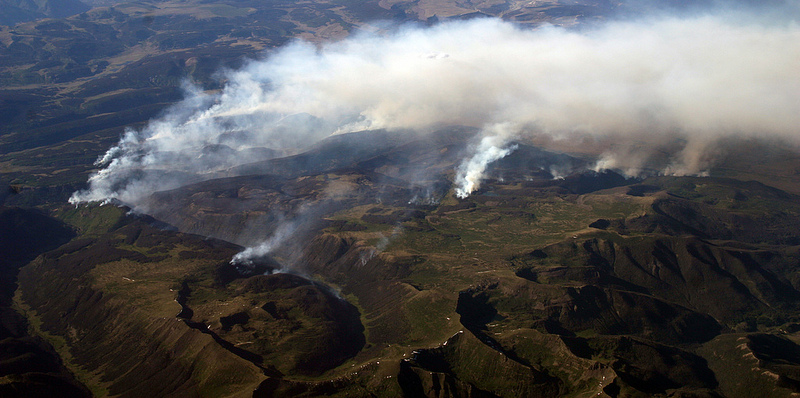
    On my way back to New York from Sydney on Wednesday, while flying east over the San Juan National Forest and the Rio Grande National Forest in southern Colorado, I shot what at first I though was a controlled burn, but later realized was the West Fork Fire. I knew it was a big one when I watched the smoke fan out to the east, starting with the San Luis Valley, where some of it pooled over the Great Sand Dunes National Park, and against the Sagre de Cristo Mountains. (Here are pictures of those in clearer conditions.)

    But it went far beyond there, coloring the skies over Kansas and beyond. (More when I put up the rest of the photos from the trip.) Here is a story on the fire’s visibility from space. And here’s a link to a search for “West Fork Fire”.

    Photography, Places, problems, Science, Travel, weather
  • June 26, 2013

    2013_06_26 Link Pile

    3 lessons for newsrooms from UsVsTh3m and The Guardian’s Firestorm project. By Craig Silverman in Poynter.

    FCC Announces Application Window for New Low PowerFM Stations. By Cody Duncan in Future of Music Coalition. Fact sheet.

    What’s the ‘Internet of Everything’ worth? $613 billion, Cisco reckons: In 2013, Cisco calculates that companies could produce $613 billion of mostly incremental profit by harnessing the growing networked world of people and things. By Dan Farber in CNet

    Tech companies fret over loss of consumers’ trust after NSA revelations, byJennifer Martinez in The Hill‘s Hillicon Valley blog.

    Data models for the Internet of Things. By Michael Koster.

    Why Pandora bought an FM radio station. By Deborah Newman in The Hill.

    On the surveillance thing

    • F.T.C. Member Starts ‘Reclaim Your Name’ Campaign for Personal Data. By Natasha Singer in The New York Times. Leverages this speech by Julie Brill of the FTC.
    • Gore Vidal in 1998 on the National Security State, on CSPAN.
    • Top Ten Ways US TV News are Screwing us Again on NSA Surveillance Story (Iraq Redux), by Juan Cole.
    • Facebook’s Creepy Data-Grabbing Ways Make It The Borg Of The Digital World. By Natasha Lomas in TechCrunch.
    • The Newsonomics of Spies vs. Spies, by Ken Doctor in Neimann Journalism Lab.

    On advertising and marketing

    • The Death of Social Media. By Kate Jones in The Age. “And as far as my time goes, the return on investment is not worth it.”
    • The Future of Advertising. By Danielle Sacks in Fast Company. “Step one of their therapy, of course, is admitting there is a problem.”
    • Enterprises want to capture customers. VRM will blow that philosophy apart., by Which-50.

    Watch air traffic vs. weather via FlightAware at:

    • Newark (EWR)
    • New York (JFK, LGA)
    • Boston (BOS)
    • Chicago (ORD)
    • Philadelphia (PHL)
    • Washington (IAD)
    • … or just swap your airport’s 3-letter handle with the last four letters of this URL: http://flightaware.com/live/airport/KEWR.
    Links
  • June 26, 2013

    2013_06_24 Link Pile

    How to value personal data, by Ctrl-Shift

    World Economic Forum Sharing Economy Position Paper, at Collaborative Consumption

    Attention Economy vs. Intention Economy, a diagram by Robert Bashor. Also part of The system dynamics of an intention economy.

    How does GHCQ’s Internet surveillance work? by Ewen MacAskill, Julian Borger, Nick Hopkins, Nick Davies and James Ball in The Guardian.

    Uncategorized
  • June 26, 2013

    Aviation vs. Weather

    flightawaremap
    20 December 2025—This post has been read often since it went up more than 12 years ago, including 104 times in the past week. Meanwhile, the resources have changed, so here are some updates:

    1. Intellicast is gone, but there are many alternatives. The mobile apps I like best are Windy, Weatherbug, MyRadar, and Storm Radar.
    2. FlightAware is still terrific, and its MiseryMap is hugely helpful, at least for flying between major airports within the U.S. 
    3. Now that Internet connectivity is possible at altitude, and in many cases free (such as for T-Mobile customers on United), you can follow your flight using the FlightRadar24 site and mobile app. It’s hugely interesting just to peruse and watch.
    4. If aviation fascinates (or just concerns) you, some of the best writing and thinking you’ll find on the subject is in James Fallows newsletter. It’s not his only topic, but he is a veteran pilot who covers the What’s Going On in aviation better than anyone else. IMHO.

    Yesterday we were in Melbourne. Then we flew to Sydney, got some sleep, and caught flights to Auckland, Los Angeles and Newark.

    Except, we’re not in Newark. A storm there delayed things, and we’re on the ground getting re-fueled at Dulles, near D.C. This kind of thing happens with aviation and weather. That planes fly at all is a kind of miracle. That flying has become as mundane as bus travel — and far safer — would also be miraculous if it weren’t so routine. Except for times like this.

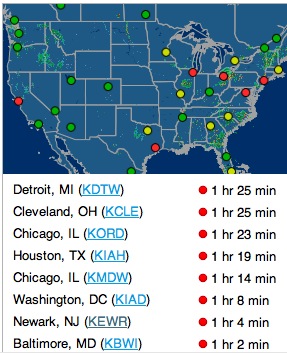
    See the line of red dots over there on the right? Those are the airports with delays caused by storms that were beautiful to watch as our eastbound United 757 flew past them to the south. I got some pictures, but they aren’t very good.

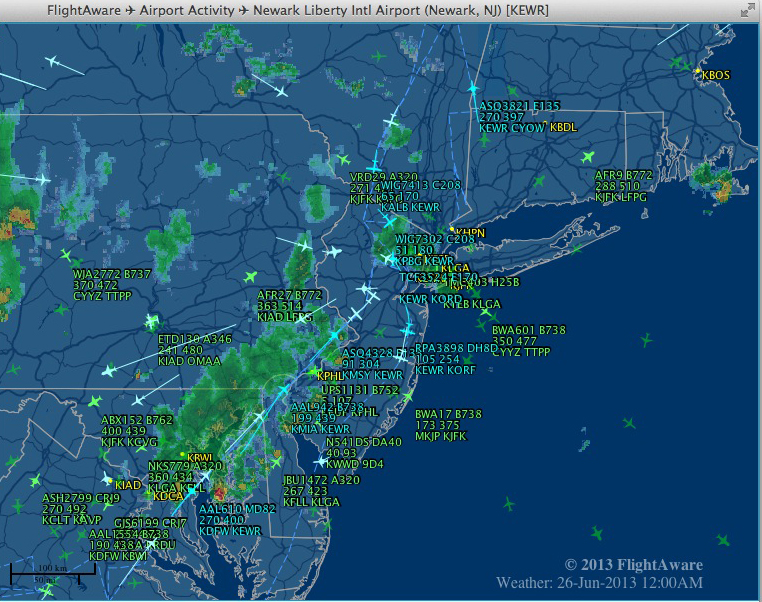
    Now, here on the ground, I’m watching Flightaware and Intellicast to see what’s up with aviation and weather. Flightaware is an amazing site. If you have any interest in aviation, or just need to know what’s currently screwed up with air travel, it’s the best of its breed. Intellicast has great maps, which project into the future while also running through the recent past. Right now I see by Flightaware’s map below that flights are getting in and out of Newark as the current storm (the green blotch) passes.

    I also see by Intellicast that the line of storms I observed south of the Great Lakes and across Pennsylvania will arrive in New York in a few hours. So our window of opportunity isn’t large there.

    It would be nice if Intellicast has links to maps, but they don’t, or I’d link to the one for New York. The good thing about Intellicast is that it is somewhat less crufty with promotional jive than Weather.com and some other weather sites.

    Another passenger is grumbling about United’s flight operations. “Worst in the business,” he says. I don’t agree. After well over a million miles with United, I have no evidence that their flight operations is anything other than fine. And, given the size of the fleet they manage, that’s a compliment.

    And hey, while I’d love to be in New York now, I’d rather be safe than any of the many kinds of sorry I can imagine.

    Postscript: We got to Newark eventually, and then took another few hours to await a bus and a delayed subway before arriving at our place around 7:30am. This was close to 40 hours after departing Sydney. Got a little sleep, and now we’re ready to go again. 🙂

    Aviation, infrastructure, Places, weather
  • June 23, 2013

    Opposites distract

    Just discovered by Antipodr that Bermuda and Perth are antipodes: located at the exact other ends of the Earth from each other.

    I’m in Melbourne, Australia, which is the antipode of a spot on the h of North Atlantic Ocean on Antipodr’s map. By the end of tomorrow I’ll be back in New York, a couple thousand miles west of there, after flying most of the way around the world on four different planes and three different airlines. New York’s antipode is a spot not far southwest of Australia — maybe about as far from the coast as Brisbane is from Sydney, as you can see from the upside-down image of North America on the amazing map around which this text wraps.

    The map is from Wikimedia Commons, and illustrates perfectly how little land is antipodal from other land. The sum, in fact, is just 4%. As Wikipedia currently puts it, “The largest antipodal land masses are the Malay Archipelago, antipodal to the Amazon Basin and adjoining Andean ranges; east China and Mongolia, antipodal to Chile and Argentina; and Greenland and the Canadian Arctic Archipelago, antipodal to East Antarctica.”

    Click on the map three times and you’ll find yourself at a large version of the map that lets you discover these other antipodes:

    • Auckland and Tangier
    • Chatham Islands and southern France
    • Île Saint-Paul and a spot southwest of Cheyenne Wells, Colorado
    • Île Amsterdam and Kerguelen Island and two other places I don’t have time to figure. The latter also overlaps with Canada.

    Those last three are the sum of U.S. antipodes, at least for the lower forty-eight. Most of Hawaii is antipodal to Botswana, while the northern edge of Alaska is antipodal to an edge of Antarctica. Same with the most northern parts of Canada.

    So that’s a little fun in the early hours before my last day of meetings here. It’s been a fun trip.

    A question on parting: Have the link piles been useful or interesting? They’ve been all I’ve posted on this trip, because it’s easy and I sometimes feel like sharing what I’m reading. But I’ve had just one piece of feedback so far, and it was negative. So, if you care, lemme know.

    Aviation, Fun, Science, Strange stuff, Travel
  • June 20, 2013

    2013_06_20 link pile

    The Deteriorata, which parodies The Desiderata, much as The Gluetrain Manifesto parodied The Cluetrain Manifesto. My fave line from another parody, perhaps by the same guy, of the “Markets are conversations” line: “Markets are money.”

    QR codes aren’t dead yet. By yours truly in Harvard Business Review.

    I’ll also be keynoting an upcoming iAB thing, on 15 July in New York.

    Enjoying listening to 2MCR here in North Sydney.

    Web’s Reach Binds N.S.A. and Silicon Valley Leaders, by James Risen and Nick Wingfield in The New York Times.

    Most online users don’t care about privacy – Aussies even more so, by Graeme Phillipson in ITWire.

    Amdocs Survey: Consumers Will Share Personal Data… at a Price. Source: Amdocs press release.

    It’s over: All private data is public: Enough about the NSA — any hacker worthy of the name can snatch your ‘private’ data. Either stop entrusting it to anyone or chill out. By Roger A. Grimes in InfoWorld.

    Associated Press: Sources Won’t Talk Anymore. By DSWright in Firedog Lake.

    Now anyone can buy the NSA’s database tech. By Derek Harris in Gigaom. Stars Sqrrl.

    Wireless Internet 101 Fact Sheet. By Lisa Gonzalez of the Institute for Local Self-Reliance.

    Uncategorized
  • June 18, 2013

    2013_06_18 Link Pile

    Quote of the Day: There is no way to build a mirror world without a network of decentralized cooperating agents. — Phil Windley

    My keynote talk at KuppingerCole‘s EIC conference in May. (Registration required.)

    American Customer Satisfaction Index

    Google’s Loon Project Puts Balloon Technology in Spotlight: Future stratospheric systems could change how the world goes online, by Brian Handwerk in National Geographic.

    Gartner trends for 2013. Lots of VRooMy and Personal Cloud related stuff in there.

    Why the FISA Court Is Not What It Used To Be, by Nina Totenberg on NPR.

    Bank robbery suspect wants NSA phone records for his defense, by Paula McMahon in the Sun Sentinel

    The influence of spies has become too much. It’s time politicians said no, by John le Carré in The Guardian

    I fear the chilling effect of NSA surveillance on the open internet, by Jeff Jarvis in The Guardian

    Why The Tech Industry Should Be Furious About NSA’s Over Surveillance, in TechDirt. Also Rep. Grayson: Let Me Tell The NSA: There Is No Threat To Our Nation When I Call My Mother and Former NSA Whistleblower Bill Binney: The NSA Is Making Itself Dysfunctional With Too Much Data.

    Biden in 2006 schools Obama in 2013 over NSA spying program, by the EFF.

    President Obama orders government spectrum to be opened for wireless broadband, by Carl Franzen in The Verge

    The Internet’s Fractured Foundations, by Martin Geddes.

    The NSA Versus the Global Internet: How Online Surveillance Could Impact Internet Governance, by Allan Friedman of Brookings

    Uncategorized
  • June 17, 2013

    2013_06_17 Link Pile

    Edward Snowden Q&A with readers at The Guardian. An amazing and historic moment happening, right now.

    Surveillance blowback, by Bruce Schneier

    Body scanner ruling could squelch NSA domestic spying: Electronic Privacy Information Center organizes request by leading technologists to halt National Security Agency’s domestic surveillance. They’re trying a novel argument from a 2011 lawsuit. By Declan McCullagh

    New Zealand weather radar. Watching this currently, in fear or hope for snow in Queenstown later this week.

    Internet interruption, in XKCD. Roll over the fourth frame.

    The Two Centers of Unaccountable Power in America, and Their Consequences, by Robert Reich

    “Let it be Done” An Alternative Narrative for Building what America Needs, by Devin Smith in New Economic Perspectives.

    An NSA big graph experiment (.pdf), by Paul Burkhardt, Chris Waring, U.S. National Security Agency

    Moyers & Company: Big Brother’s Prying Eyes. Bill interviews Larry Lessig.

    Police are now using driver’s license photos in the US to identify suspects in criminal cases, by Nick Summers in The Next Web

    Google’s Internet balloons, in Wired.

    NYT Introspects on Snowden, by Dave Winer. Also by Dave: The Quiet War in Tech.

    Links
  • June 15, 2013

    2013_06_16 link pile

    NPR on the NSA’s giant data farm.

    E-Commerce’s Future Is in Creating ‘Swift Guanxi,’ or Personal and Social Rapport, in Science Daily. Good one, especially for providing VRM context. It begins,

    Despite the reputation of online marketplaces being distant and impersonal, through social technologies such as instant messaging, they can create the sense of personal and social relationships between buyers and sellers, termed “swift guanxi” in China, to facilitate loyalty, interactivity and repeat transactions, according to new research by Temple University Fox School of Business Professor Paul A. Pavlou.

    Three researchers — in addition to Pavlou, Tilburg University’s Carol Xiaojuan Ou and Robert M. Davison of the City University of Hong Kong — studied data from TaoBao, China’s leading online marketplace, to examine the efficacy of using computer-mediated-communication (CMC) technology to build guanxi and turn impersonal one-time shoppers into loyal and committed long-term customers through personal rapport.

    Guanxi is a Chinese concept “broadly defined as a close and pervasive interpersonal relationship” and “based on high-quality social interactions and the reciprocal exchange of mutual benefits,” Ou, Pavlou and Davison wrote.

    The Collaborative Economy. A report by Altimiter.

    Bummed to hear both Doc Rivers and Kevin Garnett may be traded to the Clippers. Shit, maybe Paul Pierce too.

    Weather sucks right now here in New Zealand. Oh well. I’ll be working indoors anyway.

    Links
  • June 14, 2013

    2013_06_14 link pile

    Where TIME Lost the Plot on Snowden and Spying

    Guardian pieces

    • The NSA surveillance fallout should be a turning point for the tech industry, by Dan Gillmor
    • On PRISM, partisanship and propaganda: Addressing many of the issues arising from last week’s NSA stories, by Glenn Greenwald
    • Investigate Booz Allen Hamilton, not Edward Snowden: The firm that formerly employed both the director of national intelligence and the NSA whistleblower merits closer scrutiny, by Pratap Chatterjee

    There’s more than one tech, by Dave Winer

    … and now I’m off to .nz & .au, where it’s already tomorrow.

    Uncategorized
  • June 13, 2013

    2013_06_13 link pile

    Apple beefs up privacy protections in iOS 7. Here’s one reason: iOS 7 users aren’t just consumers; they are customers — of Apple. And, with its finger on the pulse of the market, Apple knows that customers don’t like being tracked like animals. (Note: I’m no fan of silos, and Apple has one here. But still, this move by Apple is worth noting because it’s in alignment with the human beings using their products, and not with the marketing world. You can’t abuse customers the way you can abuse mere consumers.)

    The Trajectory of Television—starting with a big history of the small screen: From surrogate storyteller to high-def streaming infotainment, TV has come a long way, by Lee Hutchison in Ars Technica

    How accurate are fitness monitors? by Gretchen Reynolds in the New York Times. …the lesson at the moment for anyone who owns an accelerometer is that the device’s measurements are likely to be imperfect.

    Sweden’s data protection Authority bans Google cloud services over privacy concerns, by Simon Davies in The Privacy Surgeon

    Court finds NSA surveillance unconstitutional. Administration’s response: keep the ruling secret and carry on, in 57un, an Anonymous site.

    Merkley waves Verizon phone, demands NSA chief share grounds for seizing data, by Justin Sink in The Hill.

    Not Just the NSA: Politicians Are Data Mining the American Electorate, by John Nicholsin The Nation

    TV B-Gone

    Top secret clearance holders so numerous they include ‘packers/craters’, by Max Fisher in the Washington Post.

    Did Obama just destroy the U.S. Internet industry? by David Kirkpatrick in Techonomy. In a word, no. In two words, it’s complicated. For example, the Patriot Act salted the common ground between the U.S. and the rest of the world, starting a decade ago.

    SCOTUS plays Solomon on gene patents, by John Wilbanks.

    The five stages of living in a national surveillance state, by Tom Tomorrow

    Federal Communications Bar Association (FCBA) Panel on the FCC Incentive Auction Proceeding at T-Mobile NYC on June 5 2013. Via the ISOC-NY list, which says, This was a highly informative event on the Government’s scheme to transfer spectrum from television to wireless communication networks. The panel included, as well as reps from those industries,  a consumer advocate and a financial analyst.

    This abuse of the Patriot Act must end: President Obama falsely claims Congress authorised all NSA surveillance. In fact, our law was designed to protect liberties, by Jim Sensenbrenner in The Guardian. Sensenbrenner is a Republican congressman and former Chairman of the House Judiciary Committee, and says in this piece, The administration claims authority to sift through details of our private lives because the Patriot Act says that it can. I disagree. I authored the Patriot Act, and this is an abuse of that law.

    Uncategorized
  • June 12, 2013

    2013_06_12 link pile

    Free customers are more valuable than captive ones, in HBR

    Big tech firms urge openness on NSA probes, by Craig Timberg and Cecilia Kang Washington Post, in the St. Louis Post-Dispatch

    National Security FISA Secrecy: Hiding from the American People, by Lauren Weinstein.

    Maybe this is why the feds are spying on people. A bit paranoid, methinks, but sometimes the paranoids are right. Another one.

    Persona and surveillance, by Ben Adida at the Identity at Mozilla blog. Well put. Hands off to StopWatchingUs.

    DroneNet pizza delivery, by John Robb.

    The Secret War, by James Bamford in Wired

    More Intrusive Than Eavesdropping? NSA Collection of Metadata Hands Gov’t Sweeping Personal Info, on Democracy Now

    FISC Orders on Illegal Government Sureveillance, by the EFF

    Links
  • June 11, 2013

    2013_06_11 link pile

    To the internet giants, you’re not a customer. You’re just another user. — Yahoo, Microsoft, Google et al don’t really offer ‘free’ email and it’s naive to expect any form of customer service from them, by John Naughton in The Guardian

    Monster gas cloud could unveil Milky Way’s black-hole hub, in Physics World.

    Exclusive Testimony on Unlocking: Beware Cellphone Companies’ ‘Red Herring’ by Derek Khanna in Wired.

    Don’t treat consumers like criminals, by Ajit V. Pai in the New York Times.

    Using metadata to find Paul Revere, by Kieran Healy

    I favor the Pats bringing in Tim Tebow, at the WBZ poll.

    Asked @AppleSupport about why its reservation system for stores seemed not to be working. Needed to make an appointment for a crashy laptop. (Finally got through.) Meanwhile, interesting that both @AppleSupport and @TheAppleInc seem to be kinda thin on Twitter.

    Senators: NSA Phone Sweeping has been going on since 2007, by Alexander Bolton in The Hill

    Why PRISM kills the cloud, by Jonny Evans in Computerworld.

    Setting the record straight, by Ron Bell, General Counsel, Yahoo!

    Analyzing Yahoo’s PRISM non-denial, by Chris Saghoian.

    Majority Views NSA Phone Tracking as Acceptable Anti-terror Tactic: Public Says Investigate Terrorism, Even If It Intrudes on Privacy, in Pew Research Center for People and the Press. Yes, but the majority doesn’t publish or dissent.

    Spy agencies have turned our digital lives inside out. We need to watch them, by Ronald Deibert in The Globe and Mail.

    Where in the world is Edward Snowden?, by Connor Simpson in Atlantic Wire.

    Lee Clow on advertising then and now, by Rupal Parekh in AdAge. (Lee was a legend at Chiat|Day, back in the decade. One of the heroes of the business.

    FLAC Gets First Update in 6 Years, in Slashdot.

    Another Government Data Broker Inquiry Is Underway: Study Comes Amid Escalating Data Collection Scandal, by Kate Kaye in AdAge

    Beware trading privacy for convenience, by Ray Wang in HBR

    Uncategorized
  • June 9, 2013

    Terror as a second or third order effect of personal communication surveillance by governments

    Several years ago, during a session at Harvard Law School led by a small group of Google executives, I asked one of those executives about his company’s strategy behind starting services in categories where there was no obvious direct business benefit. The answer that came back fascinated me. It was, “We look for second and third order effects.” (Earlier JP Rangaswami and I came up with another term for that: “because effects.” That is, you make money because of something rather than with it.) I hadn’t thought about it until now, but I believe Google’s ability to monitor online activities by individuals on a massive scale serves as a model for governments to do the same.

    I bring this up not because I believe Google models government surveillance (even though, without intending to, it does), but because I believe surveillance by governments inevitably causes second and third order effects. The least of those is to chill personal expression. The greatest of those is terror.

    The more I think about those effects, the more Hannah Arendt comes to mind. Arendt studied totalitarianism in depth, and its use of terror as a technique for state control of citizens.

    I read and re-read Arendt’s The Origins of Totalitarianism when I was in college, in the late 1960s. That was a time of revolt in the U.S. (most notably against institutionalized racism and the Vietnam war), and both of Arendt’s totalitarian state examples — Hitler’s Germany and Stalin’s Soviet Union — operated in recent memory, and still served as models. While I don’t believe we are headed to a totalitarian end in the U.S., I do believe the current news suggests a vector of policy and action ratcheting gradually in that direction.

    So I encourage revisiting what Arendt said about the paralyzing unease that state monitoring of personal communication induces in a population. And also what she says here:

    The ideal subject of totalitarian rule is not the convinced Nazi or the dedicated communist, but people for whom the distinction between fact and fiction, true and false, no longer exists.

    Check your feelings for a reaction to this question raised both by Snowden and blow-back against him: Do we really know what’s going on?

    Without that question, we wouldn’t have an NSA. Or a CIA.

    What we need is to take the third order effects of total surveillance into account. Because one of those effects is to put the population itself into a state of terror. And chilling effects are just the first step in that direction.

    So, while the feds may be looking for the needles of bad actors and actions in the haystack of all people and their communications, knowing that all of us are subject to suspicion is bound to make us think more than twice, as for example I am right now, about using the terms “terror” and “terrorism” in something I publish online.

    Here are some links I’m accumulating on the topic of PRISM and other forms of government surveillance here in the U.S.:

    • Jacob Applebaum, of Tor, giving the 29C3 Keynote: Not My Department, December 2012, about the surveillance state.
    • The Homeland Security Apparatus: Fusion Centers, Data Mining and Private Sector Partners, by Beau Hodai, May 22, in the Center for Media and Democracy’s PR Watch.
    • Boundless Informant: the NSA’s secret tool to track global surveillance data – Revealed: The NSA’s powerful tool for cataloguing global surveillance data – including figures on US collection : the original Guardian story by Glenn Greenwald and Ewen MacAskill, published 6 June and updated since. (Greenwald’s series on security and liberty, including the above and much of the below.)
    • The government response (.pdf) and the Guardian’s window on on it.
    • Tech companies concede to surveillance program, by Claire Cain Miller in the New York Times.
    • Edward Snowden: the whistleblower behind the NSA surveillance revelations. The 29-year-old source behind the biggest intelligence leak in the NSA’s history explains his motives, his uncertain future and why he never intended on hiding in the shadows. Q&A with NSA whistleblower Edward Snowden: ‘I do not expect to see home again’ Glenn Greenwald, Ewen MacAskill and Laura Poitras in Hong Kong guardian.co.uk, Sunday 9 June 2013 16.17 EDT. Contains a video. The kid looks solid and sane.
    • Spy agency seeks a criminal probe in to leaks, by Timothy Gardner and Mark Hosenball in Reuters.
    • Sources: NSA sucks in data from 50 companies, by Marc Ambinder in The Week (6 June) More about the NSA from Ambinder’s book, Deep State: Inside the Government’s Secrecy Industry.
    • Cowards! by Michael Arrington in Uncrunched (lots of links there)
    • Silicon Valley Joins the Surveillance State, by Bloomberg’s editors
    • We are shocked, shocked…, by David Simon (yes, that David Simon)
    • White House petition: Create a new privacy-focused amendment to the constitution that gives citizens equal rights to government for privacy (100,000 needed, 9 so far)
    • Privacy matters — even if you think it doesn’t, by Joseph Ratliff (also with lots of links)
    • You’re a suspect, by Tristan Louis. Bottom lines: The issue is not whether data was gathered but transparency and the right of every citizen or resident to review their own personal data. That ability will continue to maintain our reputation as a a beacon of freedom and a country of personal choice, not an Orwellian nightmare standing side by side with more repressive governments.
    • NSA Prism: Why I’m boycotting US cloud tech – and you should too, by Trevor Pott in The Register. “When a country goes off the rails, why should we trust its computing systems?”
    • Lauren Weinstein looks toward absent “back-doors” to Net company servers. Also Internet shattered by spies, spooks and disgust.
    • The Guardian says PRISM enables “collection directly from the servers” of a bunch companies
    • Greenwald: Some Parts Of NSA Story Won’t Be Published: “We’re not engaged in a mindless, indiscriminate document dump, and our source didn’t want us to be,” said Glenn Greenwald, the author of the Guardian story about the government monitoring phone and Internet records, in BuzzFeed.
    • Marcy Wheeler on the “cyberwar directive”
    • The real story in the NSA scandal is the collapse of journalism — Summary: A bombshell story published in the Washington Post this week alleged that the NSA had enlisted nine tech giants, including Microsoft, Google, Facebook, and Apple, in a massive program of online spying. Now the story is unraveling, and the Post has quietly changed key details. What went wrong?
    • NSA Data-Scooping: A Coming Backlash in Europe? The same big U.S. Internet companies that reportedly handed over data wholesale to the NSA have been promising compliance with tough EU privacy standards. By David Talbot in MIT Technology Review
    • How the U.S. Uses Technology to Mine More Data More Quickly, by James Risen and Eric Lichtblau in the New York Times
    • Assange: US rule of law suffering ‘calamitous collapse’ by AFP
    • NSA’s backdoor key from Lotus Notes, at Cypherspace.org
    • Why Does a Terry Standard Apply to Querying the NSA Call Records Database? by Orin Kerr in The Volokh Conspiracy
    • Q&A on the NSA Leak, by the Heritage Foundation. (This one defends the government, and says it’s no big deal.)
    • PRISM vs. Tor, from the blog of the Tor Project.
    • My thoughts on the NSA scandal, by danah boyd.
    • DOJ Argues Secret Ruling Over Secret Unconstitutional Surveillance Must Remain Secret Because It’s Secret, in TechDirt.
    • Government Secrets and the Need for Whistle-blowers, by Bruce Schneier. We know all of this not because the government is honest and forthcoming, but mostly through three backchannels — inadvertent hints or outright admissions by government officials in hearings and court cases, information gleaned from government documents received under FOIA, and government whistle-blowers.
    • “Terrorism” in Google Ngram Viewer, 1800-2008.
    • Larry Hunter, the Cassandra of Digital Privacy, in the Boston Globe
    • ‘Big Brother’ and Big Data, a Wall Street Journal editorial, behind a paywall. Its final words: What our self-styled civil libertarians should really fear is another successful terror attack like 9/11, or one with WMD. Then the political responses could include biometric national ID cards, curfews, surveillance drones over the homeland, and even mass roundups of ethnic or religious groups. Practices like data-mining save lives, and in doing so they protect against far greater intrusions on individual freedom.
    • Okay, I’m cutting it off here. There’s plenty enough already.
    Berkman, Books, Business, Ideas, Internet, News, problems, Technology
  • June 8, 2013

    2013_06_08 link pile

    The Buccaneer® – The 3D Printer that Everyone can use! gets nearly 8x the $100k it asked for on Kickstarter

    When digital marketing gets too creepy, by Michael Schrage in HBR

    Why Google Reader died and why mobile and social news is replacing it, by Michael Mayday in iTechNews. It’s about RSS and Digg, actually.

    Big Data! No Signal!, by T.Rob. Explains VRM vs. Big Data this way:

    • So to me, VRM is equivalent to giving up calculating your gas mileage using log books and receipts and instead using tools that measure the desired number directly, in real time, using much better quality source data. In data terms it is about providing vastly stronger signal, greatly reduced noise, or both, thus enabling useful outcomes from sample sizes of as little as one person. Thanks to Personal Clouds, VRM breaks the privacy barrier to allow correlation across data categories that have traditionally been isolated silos, and this will usher in a new era of smart commerce on the consumer side of the economy. Vendors and merchants who respect their customers and have earned our trust can participate in that new data economy. Not by surreptitiously gathering up all our data and correlating it, but rather by supplying tools that run in personal clouds and that provide compelling functionality, an opt-in ability to feed some of that data back to you, and transparency about the whole arrangement. For that you get much better quality of data in near real time. For that you get Big Signal.

    Ordering Pizza, a video by the ACLU

    Links
  • June 5, 2013

    2013_06_06 link pile

    Price-gouging cable companies are our latter-day robber barons: Monopolistic cable providers make internet access an unaffordable luxury for tens of millions of Americans, by Heidi Moore in The Guardian.

    A cool conference I’d like to attend, but probably won’t.

    How to destroy the future: From the Cuban missile crisis to a fossil fuels frenzy, the US is intent on winning the race to disaster, by Noam Chomsky in The Guardian.

    How Patent Trolls Are Undermining The Economy, by Andrea Peterson

    Local Laundromat Employs Social Media Coordinator, in The Onion

    Datapalooza Report on Data Economics and a Call for Reciprocity, by Adrian Gropper.

    CMOs: Build Digital Relationships or Die, by James L. McQuivey in HBR.

    Motomic stuff. Thinking of discovery via QR codes and squaretags here.

    Privacy Self-Management and the Consent Dilemma, by Daniel Solove in SSRN

    Half an Earth sandwich. Euan Semple had the other half, in Singapore.

    Blogginess, by Tim Bray

    Study shows how easy it is to determine someone’s identity with cell phone data, by Lisa Zyga in Phys.org

    New ‘Sun-skirting’ comet could provide dazzling display in 2013, by Nancy Atkinson Phys.org

    NSA Prism program taps in to user data of Apple, Google and others, by Glenn Greenwald and Ewen MacAskill in The Guardian

    Wanna get depressed about writing, and much more? Try this: Are coders worth it? In today’s world, web developers have it all: money, perks, freedom, respect. But is there value in what we do?, by James Somers in Aeon.

    Uncategorized
  • June 4, 2013

    2013_06_03 link pile

    Personal cloud innovation happens at the edges, by Jeff Kramer

    Gartner Says the Personal Cloud Will Replace the Personal Computer as the Center of Users’ Digital Lives by 2014. A bit aggressive. From March 2012.

    Photos of Florence, shot from about 25,000 feet up, en route from Newark to Rome via Munich

    Innovations in Digital and Mobile Marketing, in HBR. I’m writing a piece for this collection.

    Mary Meeker’s State of the Internet: Good, Bad or Somewhere In-Between? by Marisa Wong

    The geography of tweets. More along those lines from Mashable.

    #sotn (State of the Net) tweets

    Anonymous crowd-funds a news site

    Why Big Data Is Not Truth, by Quintin Hardy in the New York Times.

    Disruptions: The Echo Chamber of Silicon Valley, by Nick Bilton in the New York Times.

    McKinsey: The $33 Trillion Technology Payoff, by Steve Lohr in the New York Times.

    3rd International Summit on the Future of Health Privacy: The Value of Health Data vs. Privacy — How can the Conflict Be Resolved? I’ll be on a panel moderated by Natasha Singer of the New York Times. Bonus linkage: The Health Care Blog, and Adrian Gropper.

    Uncategorized
«Previous Page Next Page»

Author, journalist, and a leading blogger since 1999. More on the About page.

Recent Posts

  • Everwhen
  • Watching the Strait
  • The Kids Take Over
  • Operation Desert Furry
  • What Companies Deserve a Free Customer award?
  • Unday
  • TGI Day
  • Fendsday

Archives

Recent Comments

  1. Lyn Brooks on Unday
  2. Shooting for the World – ProjectVRM on On taking personalized ads personally
  3. Shooting for the World – ProjectVRM on Privacy is a Contract
  4. BestPhotos on Clearing things up
  5. Doc Searls on The News Business

GET NEW POSTS BY EMAIL


Recent Posts

  • Everwhen
  • Watching the Strait
  • The Kids Take Over

©

Doc Searls Weblog

All Rights Reserved.

Designed with WordPress. Hosted by Pressable.