• If you hate Big Government, fight SOPA.

    Nobody who opposes Big Government and favors degregulation should favor the Stop Online Piracy Act, better known as SOPA, or H.R. 3261. It’s a big new can of worms that will cripple use of the Net, slow innovation on it, clog the courts with lawsuits, employ litigators in perpetuity and deliver copyright maximalists in the “content” business a hollow victory for the ages.

    A few years back, a former government official confidentially issued a warning to a small group I was part of, which favored some kind of lawmaking around technology. While this isn’t a verbatim quote, it’s pretty close, because it has been burned in my mind ever since: “In the course of my work I have met with nearly every member of Congress. And I can tell you that, with only a handful of exceptions, there are two things none of them understand. One is economics and the other is technology. Now proceed.”

    Know-nothing lawmakers are doing exactly that with SOPA. As Joshua Kopstein says, Dear Congress, It’s No Longer OK To Not Know How The Internet Works.

    SOPA is a test for principle for members of Congress. If you wish to save the Internet, vote against it. If you wish to fight Big Government, vote against it. If you wish to protect friends in the “content” production and distribution business at extreme cost to every other business in the world, vote for it. If you care more about a few businesses you can name and nothing about all the rest of them — which will be whiplashed by the unintended consequences of a bill that limits what can be done on the Internet while not comprehending the Internet at all, vote for it.

    Rivers of ink and oceans of pixels have been spilled by others on this subject, so I’ll confine my case to a single section of the bill:

    SEC. 103. MARKET-BASED SYSTEM TO PROTECT U.S. CUS- TOMERS AND PREVENT U.S. FUNDING OF SITES DEDICATED TO THEFT OF U.S. PROPERTY.

    (I tried copying and pasting the whole section here, but it’s a @#$%^& .pdf, a proprietary format that has been Web-hostile from the start, but beloved of the “content” folks, as well as Congress and lawyers in general. If somebody can find us a .html or a .txt version, please let me know.)

    There is nothing “market-based” about this section of the bill. “Market-based” is a paint job on more regulation, more restriction, more bureaucracy, more federal meddling, more litigation. Weighing in at nearly 17,000 words, is not only clueless about the nature of the Net and the Web, mischaracterizing both from front to back, but features the word “plaintiff” 100 or more times (I lost count). Oh, and lots of new work for this bureaucrat:

    INTELLECTUAL PROPERTY ENFORCEMENT COORDINATOR.—The term ‘‘Intellectual Property Enforcement Coordinator’’ means the Intellectual Property Enforcement Coordinator appointed under section 301 of the Prioritizing Resources and Organization for Intellectual Property Act of 2008 (154 U.S.C. 8111)

    Yes, it exists.

    We don’t need SOPA. What we do need is for Congress — along with lawmakers and regulators everywhere, right down to public utilities commissions and town councils — to at least begin to understand what the Internet is, and what it does for everybody, before it starts making laws protecting one business at the expense of all the rest.

    If you want to see who is behind SOPA, just follow the money.

    A couple days ago, David Weinberger told me Jimmy Wales was mulling the wisdom of shutting off Wikipedia for a day.  David blogged about it. So did Cory Doctorow. Later Torrent Freak spilled the beans as well. For some perspective on this, consider these two facts: 1) Jimbo is an economic Libertarian—about as pro-business and pro-“market-based” as you can get; and 2) Wikipedia remains the only search result for anything that consistently rises above the tide of gimmickry that has corrupted the commercial Web and buried more and more “organic” (non-commercial) results under an avalanche of promotional jive.

    Julian Sanchez of the Cato Institute presents a solid Libertarian case against SOPA on YouTube. If it passes, he says, “the only difference between the U.S. and China is what’s on the blacklist.”

    Sure, “piracy” is a problem. So are a zillion other afflictions you can name. New laws — especially ones that are written by regulatory captives and feared by real businesses in the marketplace — are not a solution. They compound the problem they purport to solve and cause untold new problems as unintended but certain consequences. Any conservative worthy of the label should be dead-set against SOPA.

    Futhter reading, compiled mostly by Zemanta:

  • Broadband vs. Internet

    By design, the Internet supports everything you can do with it. As deployed, it is no more capable than the infrastructures that carry it. Here in the U.S. most of the infrastructures that carry the Internet are owned by telephone and cable companies. Those companies are not only in a position to limit use of the Internet for purposes other than those they favor, but to reduce the Net itself to something less, called “broadband.” In fact, they’ve been working hard on both.

    We’ll talk about broadband shortly. But first let’s look at the clobbering the Internet took last week when Verizon, the only large provider of fiber optic Internet connections to homes in the U.S., put an end to expansion of FiOS, their fiber-to-the-home telephone, Internet and cable TV system.

    This matters hugely, because the connections with the greatest data-carrying capacities are fiber optic ones. In terms of raw capacity, cable TV and copper telephone lines can’t compete. But then, they don’t need to compete if fiber is off the table as a competitor. That’s what Verizon just did.

    In speedtestVerizon ends satellite deal, FiOS expansion as it partners with cable, Cecelia Kang reports in the Washington Post that the telco giant “will stop its buildout of FiOS television and Internet services in the next couple years.”

    When a company says they plan to stop growing a business, they mean they have given up on it. (Hey, what business, especially a big one, doesn’t want to grow?) It’s also often a sign that the business is for sale, in this case probably to competitors in the cable business. Clues in that direction come from Cecelia’s following sentence: “The moves come as Verizon Wireless forges a new partnership with cable giants to cross-market phone, video, Internet and cellular services.” In that piece, she says “Verizon will pay $3.6 billion to Comcast, Time Warner and Bright House Networks to use a swath of cellphone airwaves that the cable giants own but do not use.”

    At the business +/vs. business level, here’s how it sorts out (to me, at least):

    1. Verizon was never a cable TV company, and didn’t do a good-enough job at that with FiOS. Straight-up, it should have beaten the crap out of all its cable competitors, just based on superior video and a much higher channel count, thanks to fiber’s much higher data capacity. But Comcast and the others — even Dish Network and DirectTV — were better at the cable game. But Verizon is king of the hill in cellular wireless, with the best coverage and service in most cities. (See the latest Consumer Reports for details.) A lot of what used to be TV is moving to wireless, both over cellular connections and wi-fi. In cellular, Verizon holds aces.
    2. Cable has no cellular wireless business, and its auction winnings for spectrum haven’t yet yet paid off. But the spectrum is worth money to rent out, in ways that get cable into the cellular wireless business, so they can now sell “quadruple play” — cable TV, landline phone, Internet (increasingly called “broadband”… more about that below) and cellular.
    3. Verizon (along with cable, satellite, Apple, Google, Microsoft, Amazon and everybody else) wants to be in the “content distribution” game, which is the future of television, publishing and every other business the Internet has both threatened and transformed.
    4. For the most popular technically demanding “content” — video — 100Mbps downstream is enough. You don’t need fiber for that. Cable can do the job well enough. For DVD-quality video (such as Netflix and TV from Google and Apple) it already is.
    5. TV is body-snatching personal computing, and it’s good to get in on progress there. Take a look at all the cheap screens you can buy now at Cosco and Staples. Their default dimensions are 1920 x 1080: the native resolution of HDTV.
    6. As an informal quid pro quo with the cable companies, Verizon agreed to halt FiOS expansion. Don’t be surprised to see Verizon’s whole FiOS business leased or sold off to a cable competitor in the next few months or years. We’ll all be better off if it gets sold to Google or Apple, but that’s unlikely to happen.

    The deal sucks for everything and everybody outside the content distro business, including the rest of the Internet. The sum of the lost or prevented business (and social benefits as well) is incalculable. But nobody seems to be counting. We’re just boiling frogs here.

    As of today, your chance of getting fiber to your home is zero, unless you are lucky enough to live in LafayetteChatanoogaPulaski, or one of too-few other places where public and private interests align long enough for fiber service to get built out before brutal opposition by phone and cable companies prevents it — mostly by lobbying up state regulations making build-out difficult or impossible for entities other than phone and cable companies that aren’t going to bother building what they’ve already prevented anyway.

    The appetite for fiber is there. We chose to rent our part-time apartment here near Boston because the street is served by FiOS. (Also RCN, a weaker fiber competitor.) Many businesses see places like the towns listed above as port cities on the Internet’s sea of bits.  The speedtest above is typical of what we get from FiOS, which offers speeds up to 150Mbps down and 50Mbps up. Fiber’s native capacity is actually much higher, which is why Chatanooga offers up to 1Gbps, as will Google’s new project in Kansas City. If you live in one of fourteen Utah cities fibered up by Utopia, you have a choice of providers of 100Mbps symmetrical service that will cost you less than what I pay ($70/mo) for my 25Mbps from Verizon.

    Last I heard, the fastest cable offering in the upstream direction was 12Mbps. Cox, our cable provider in Santa Barbara, gives us about 25Mbps down, but only 4Mbps up. Last time I talked to them (in June 2009), their plan was to deliver up to 100Mbps down eventually, but still only about 5Mbps up. That’s competitive as long as all you want is “content delivery.” But what about when you want to live “in the cloud,” and all your data is elsewhere? In the long run you’ll need a lot more upstream as well as downstream capacity for that. Internet service optimized for media delivery (where TV especially wants to go) won’t cut it. But then, most people aren’t looking at that. They’re looking at TV on their iPads over broadband, and thinking that’s way cool enough.

    So here we are, smack up against what John Perry Barlow warned us about in Death From Above, way back in early 1995. There he wrote, “The cable companies and Baby Bells have a model for developing the next phase of telecom infrastructure which, were it applied to the design of physical superhighways, would have us building them with about five thousand lanes in one direction and one lane in the other.”

    Internet speeds over cable aren’t that lopsided, but they are that biased. And the name for that bias is broadband. So let’s look at the difference between the Internet and broadband, because that difference matters.

    While the Internet is often called a “network of networks,” what defines the “network of” is a suite of protocols and standards that transcend individual networks and give the whole a single and coherent way of working. Broadband is an old telecommunications term which, as Wikipedia puts it, “became popularized through the 1990s as a vague marketing term for Internet access.”

    The Internet’s protocols are NEA:

    • Nobody owns them.*
    • Everybody can use them, and
    • Anybody can improve them.

    Like the periodic table, the Net’s protocols occur in nature — in this case a human one — which is why the Net’s founding capacities can be limitless in size and scope.

    For business this means the Net and the Web (which is an application on the Net) are building materials with leverage as boundless as those of hydrogen, copper, oxygen, iron and other real-world elements, but without the scarcity. This is why the Net’s open protocols and standards support $trillions in business without making a dime for themselves, and without promoting the wealth-inducing facts of the matter.

    We call these kinds of leverage “because effects“: you make money because of them, rather than with them.

    But, since the Internet is not out to make money for itself, it is easily dismissed either as passé, or as having little or no business value. This is what George Colony of Forrester Research did in his recent speech at LeWeb, where he spoke about “the death of the Web,” and why I followed up with Be careful what you call dead. Although I’m sure he didn’t mean it that way, George’s speech was a win for the forces out to subordinate the Internet and the Web to their own parochial businesses and business models.

    Right now most of us are unaware that this is going on, and fail to see the risk it presents for everybody who depends on a capacious Internet for future growth and prosperity.

    The phone and cable operators are not working alone to limit the Net’s because effects. At this point their allies include lawmakers, regulators, and professional organizations like the International Telecommunications Union (ITU).

    A subtle and pernicious part of that campaign has been an effort to shift the nobody-owns-it Internet conversation to one about “broadband,” which is something the operators own and rent out. Governments are enlisted in this campaign, and now so are the rest of us. (I’ve used the term “broadband” plenty myself, for example, here.) I began to get hip to this trick in the Summer of 2010, at a conference where a spokesman for the International Telecommunications Union (ITU) gave a talk about the goodness of broadband without once uttering the word “Internet.” Recently the ITU has been further sanitizing this rhetorical body-snatch by talking up broadband as a “basic human right”.

    Bob Frankston (co-father of spreadsheet software and much more) has been on this case at least since 2009, when he wrote The Broadband Internet? One sample: “Today we are used to the ‘broadband’ Internet in which we achieve connectivity despite the services and twisting passages our connections travel.” Bob’s preference is that we look to maximize connectivity, rather than to increase our dependency on carriers with more interest in maintaining telephony and cable TV service and billing models than in maximizing all the other businesses and business models the Net’s founding protocols were built to support.

    The division is between what communications wonks crudely characterize as “net-heads” and “bell-heads.” Think of conflict as one betwee any and only. Net-heads want the Net to support anything. Bell-heads want communications systems optimized only for the businesses they prefer — namely, their own — and to avoid even talking about the Internet. (Bell-heads have never been comfortable with the Net, because it was not made to bill. TV and telephony are easy to bill, and so is “content” in general. Thanks to Apple’s and Google’s pioneering work —mostly in league with the operators — so now are apps.)

    To see how sharp this distinction is, read The New Digital Divide, by Susan Crawford, an alpha net-head, in The New York Times. Nowhere in the piece does she use the word “broadband.” She does, however, use the word “Internet” twenty-six times. In his letter to the editor responding to Susan’s piece, Verizon CEO and alpha bell-head Ivan B. Seidenberg uses the term “broadband” six times and  “Internet” just once, and only because he can’t say “The 2011 World Economic Forum global survey ranks the United States first in Internet competition” without it. (One wonders if the U.S. will continue to rank first, now that Verizon has given up on FiOS build-out.)

    At this point the only entities still trying to bring fiber to your home are Google in Kansas City, brave small operators such as Vermont’s ECFiber.net and some scattered municipalities. Helping where fiber can’t make it (and, in many cases, where broadband can’t either) are Wireless Internet Service Providers, or WISPs. Here’s hoping that these net-headed entities can prove that a wide open and supportive infrastructure for the Internet will do more for business and society than “broadband” alone can provide.

    Here are Zemanta‘s related links:


    * Technically, nobody restricts use based on ownership. The Ethernet protocol, for example, succeeded where IBM’s Token Ring and other purely proprietary alternaties failed, because Intel, Digital and Xerox, which owned Ethernet’s patents, chose to to make Ethernet open. There were no restrictions on how hardware manufacturers (who deployed Ethernet) could implement it.

  • Be careful about what you call dead

    In The Web is on life support: Forrester Research, Marketwatch reports on a speech titled “Three Social Thunderstorms,” by Forrester CEO George Colony at LeWeb. Sourcing both the Marketwatch report and George’s slides, this appears to be what he said*…

    Thunderstorm One is “The Death of the Web.” Marketwatch:

    Colony said that several models of thinking about the Web/Internet space are dead or outmoded.

    Colony distinguished between the Web, which he said is a software architecture, and the Internet, which is a larger organizing framework.

    He said technology is migrating away from the PC/Desktop model, as well as what he called the Web cloud.

    Thunderstorm Two is “Social Saturation.” George’s slide:

    • Yes, we are in a bubble…for social startups
    • We are moving to a post social (POSO) world
    • POSO startups will dominate

    Marketwatch again:

    Colony asked LeWeb attendees to consider “what we will hold in our hands 5 years from now.”

    Forrester Research thinks the answer to that question is the so-called App Internet, which offers a “faster, simpler and better Internet experience.”

    The App Internet market is worth $2.2 billion, according to Forrester Research.

    And decision makers at 41% of companies are now moving away from Web-based software toward the App Internet, Colony said…

    He also said that adoption of social media in urban areas was now extremely high and “running out of hours and people.”

    Declaring, in effect, that we are socially saturated.

    That means “we are in a bubble,” he said, adding that a post-social world was on its way that would “sweep away some of the nonsense like Foursquare.

    Thunderstorm Three is “Enterprise.” George’s summary slides:

    What enterprise means

    • Beyond Sharepoint…lies the next wave of social opportunity
    • A rich and growing professional service market emerges
    • A major test of marketing and BT collaboration

    When the skies clear…

    • A new social platform – App Internet
    • New social players – POSO
    • New social opportunities – Enterprise
    • Social will thrive, but in an evolved form

    Declaring things dead is always an attention-grabber, and George grabbed a lot with this one, as you can see from the links below. Forrester’s market (and George’s primary audience), however, is the enterprise. For that audience George is right to call for thinking beyond today’s Web and social strategies, and to develop app-based ones. But calling the Web dead along the way has the effect of a red herring, diverting attention away from real risks both to the Net and to the Web — risks that extend to enterprises as well, and that all of us (including Forrester) should also be caring about. More about those in my next post.

    Meanwhile, here are Zemanta‘s related articles:


    Fred Wilson has since put up Sunday Debate: Is Social Peaking?, which includes George’s full speech. Watch it and compare with what I was able to glean above from the Marketwatch report and George’s slides, which were all I had to go by at the time. That alone is a lesson in the insufficiencies of all sources other than one’s own direct witness.

    Now let’s look at what George says abut the “death of the Web,” and about the larger topic of “the network.”

    Starting at 3:10 George says “Yes, the network is improving in power, but not at the same speed as processing and storage.” And, “If you had to build an architecture based only around the network — move all your bits to the network — you would be wasting over time all this extraordinary processing power and storage.” As an example of how the network is moving slowly, he cites the slow uptake of 4G mobile data in Europe. Other nuggets:

    • The periphery of the network is becoming ever more intelligent.” (that is, “what we hold in our hands” e.g. the iPad.)
    • (I’ll add more when I have time. Other stuff has jumped in the way.)

    What matters here is the reason why the network is growing slower than either processing or storage: because it’s trapped inside what Bob Frankston calls The Regulatorium, which is the collusive space co-occupied by the phone and cable operators and their regulatory captives. While we might be impressed that our downstream speeds from Comcast have gone from 3Mbps to 50Mbps, that progress masks the limits that all the carriers put on forward Internet growth, and connectivity in general. For more on that, go to my next post, Broadband vs. Internet.

  • What’s popular vs. What’s used

    In terms of sales, Android is tops in smarphones. According to this ComScore press release, Google had a 46.3% market share of U.S. smartphone platform sales (with Android) in October, up 4.4% from July. At 28.1%, Apple’s iOS share was up 1%. Apple’s share of total subscribers was 10.8%, up 1% from July.

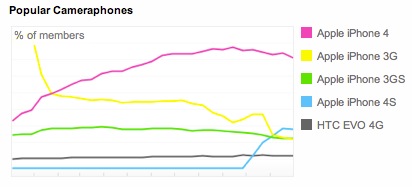
    Yet when you take a look at this graphic from Flickr

    … usage seems to be another matter.

    Far as I know, there is nothing about Flickr that discriminates against non-iOS smartphones. But that graphic squares with something I’ve heard from develpers: that the same apps on Android and iOS tend to get used more on iOS.

    I don’t say that to advocate Apple. In fact, I’d much rather advocate Android — or any open platform. Just saying it’s interesting.

    From Zemanta, here’s a list of related articles:

  • Remembering Ray

    Ray SimoneRay Simone, my good friend and long-time business partner, died this morning. He was 63 years old. He is survived by his wife Gillian, his daughter Christina, and many good friends for whom he remains an inspiration and a delight.

    Ray was one of the most creative people I have ever known. Though we originally shared the Creative Director title at our agency, Hodskins Simone & Searls, Ray was the Main Man. While I was a good copywriter, Ray could do it all: come up with killer campaigns, clever headlines, great design and art, tight scripts, whatever. His knowledge of art, of typography, of technologies and sciences — actually, pretty much everything — was encyclopedic. He worked his ass off, and he was great to work with as well.

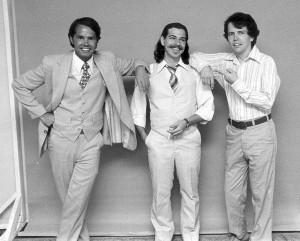
    We met in the mid-’70s in Durham, North Carolina, when I was still “Doctor Dave,” an occasional comic radio character for WDBS and columnist for the station’s magazine (see the visual below), and Ray was an artist whose own comic work appeared in the same publication. We both circulated in the same low-rent Hippie creative-art-music-dance-weekend-party crowd surrounding Duke University. Ray was working with Hodskins Simone and Searls 1978David Hodskins and some other folks at small “multiple media” shop (decades ahead of its time) that had somehow spun out of the Duke Media Center. One day, when I called up Ray to talk about collaborating on an ad for an audio shop I was working for part-time, Ray put me on hold and told David that Doctor Dave was on the line. David told Ray to arrange a lunch. A team was born over that lunch, and in 1978 we became an advertising agency: Hodskins Simone & Searls. The photo on the right dates from that time.
    By 1980 we were specializing in high tech clients up and down the East Coast, and after several years decided to open a satellite office in Silicon Valley.

    After winning some major West Coast

    Hillbilly Jazzaccounts we moved the whole agency to Palo Alto, and by the early 90s HS&S was one of the top shops there. (Huge props to David Hodskins for his leadership through all that. David was the agency President and another truly brilliant dude.)

    Twenty years after its founding,  HS&S was acquired. By then I had moved on to other work, and after awhile so had David and Ray. While I went back to journalism, Ray went back to art, teaching at Ocean Shore School in Pacifica, as well as at Brighton Preschool, which he and Gillian, his wife and soulmate, ran in the same town. He was Sting Ray to the kids there. Says Gillian, “He made story time come alive.”

    He also went back to painting. But his full portfolio of accomplishments includes much, much more. For example, Ray designed covers for dozens of major country and bluegrass albums, mostly for Sugar Hill Records. Two samples, one for Vassar Clements and the other for the Red Clay Ramblers, are on the left and right. Here is a partial discography (drawn from here and other places), in alphabetical order:

    Ray was a musician as well. When he was a student at what is now Virginia Commonwealth University in Richmond, he played keyboards in a band that traveled to gigs in a used hearse. Some of the stories he told about those days were beyond wild and very funny.

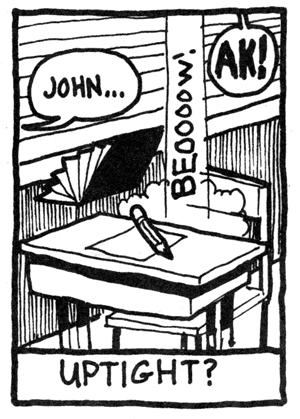
    Ray also designed countless t-shirts and posters, most of which were worthy of collection. Panel from Ray Simone Hassle House poster(Wish I still had some, but alas.) Old friends from Durham will fondly remember the Forklift Festival at the late Plantation (an run-down mansion on North Roxboro that should have been preserved). Forklift was a play on the Folklife Festival (now Festival for the Eno) that took place across the road. Ray also helped the Good Time Boogie, an annual gathering in Eastern North Carolina for which there was huge attendance, pass-the-hat funding and no publicity beyond Ray’s brilliant t-shirt art.
    Ray’s cartoon poster for a place called Hassle House, done in the style of MAD’s Will Elder by way of Vaughn Bodé, was the first thing that turned me on to Ray. It was funny as hell, and I can still remember every panel of it. (Rob Gringle provides more background in a comment below, and also reminds us that Ray did many covers for The Guide, the monthly published by WDBS. I still have a stack of Guides somewhere.)

    [Later…] Big thanks to Jay Cunningham for providing scans to the poster. That’s one panel, there on the right.

    Ray was a born athlete, though he never exploited his talents beyond casually (but never maliciously) humiliating anybody who took him on at ping-pong, darts, softball or whatever. I remember one softball game where he grabbed a hard grounder bare-handed at third base, and — while falling down — threw out the runner at first base. All in one move. Like it was no big deal. It was awesome.

    He took up fencing when we were still in North Carolina, and quickly won trophies.

    A student of fun history, he was active for years in the Society for Creative Anachronism. In that capacity he once served “stargazy pie” at Monkeytop, the rambling Victorian urban commune where he, David Hodskins and many others lived at various times on Swift Street. (It’s now the restored E.K. Powe House.)

    When Ray and Gillian (also an artist) were married at a California ranch in 1991, everybody was costumed as cowboys and cowgirls. That was huge fun too.

    A devoted reader of science fiction and watcher of movies, Ray could expound with insight and authority on either subject, plus too many others to list.

    Yet what matters most is that Ray was a loving guy and a first-rate friend. Back at the turn of the ’90s, when I had sworn off dating after a series of failed relationships, Ray pulled me out of my shell. As a direct result I’ve now been happily married for more than twenty years, with a wonderful teenage son. I know Ray had similar influences on others as well.

    I could add much more (such as a backstory on my nickname, which Ray illustrated with the character on the right),docdave but I want to post this today. I’m sure other old friends will weigh in as well. Additions and corrections of course are welcome. Here are a few I failed to string among the pearls above:
        • His full name: Raymond George Simone. Most of his album credits are for Raymond Simone.
        • Simone is pronounced with three syllables and a long e:—Simonē: the correct Italian way, Ray said.
        • He was born in Potsdam, New York, and grew up in High Point, North Carolina.
        • He had one brother, Jim, who died of throat cancer many years ago. Ray’s malady was lung cancer, no doubt an effect, as with Jim, of smoking. Ray quit many years ago, but it still caught up with him.
        • His mother, born and raised in Oklahoma, was (as I recall) half Cherokee. Both his parents passed in recent years.
        • He sometimes called himself The Weasel (others shortened that to “The Weez”), and drew himself in cartoons as a weasel with a mustache. For most of the early years we worked together, Ray’s signature look was long hair and a mustache, sometimes waxed at the tips.
        • He learned and worked in deep-sea diving out of San Clemente, California.
        • He was into cars and motorcycles, in various ways at various times. Among other feats he once rode alone across Canada on the biggest ride Honda made.
        • Here is Ray’s Facebook page, with a self-portrait from when he was more full-bodied, a couple years back.

    The photo at the top of this post is cropped from this one, shot by Gillian last Friday when David and I came to visit Ray at their home. Ray knew he didn’t have much time left, but was still in good humor. That was the day after Thanksgiving. So I’m thankful that I was in town and that these three old partners could get together one last time.

  • The Continuing End of TV

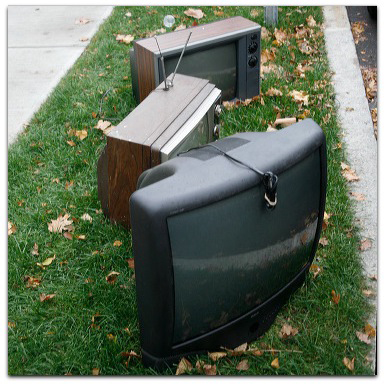
    Tossed TVsI’m sitting in a medical office (routine stuff) where a number of people, myself included, are doing our best to ignore the flat TV screen on the wall. Most of us are reading magazines, using our phones or tablets, or (in one case — mine) working on a laptop.
    When I arrived around 8am, I found the flat screen interesting, because it was showing a radio show I like: Dennis & Callahan, of WEEI. While most sports talk shows sound like human beer cans yelling at each other, D&C is always thoughtful and informative, even (or especially) when it veers off the sports groove, as it often does. I’d never seen John Dennis or Gerry Callahan before, so it was interesting to see them at work. I also like their long 8am conversation with Boomer Esiason every Monday during the NFL season. So digging all that was cool. Then, at 9am, when the show ended, the first of a series of half-hour-long ads began to run. Says here on the NESN schedule page that “paid programming” will continue until noon. Nobody in the room is watching. It wouldn’t be a stretch to say that most of them find the non-stop pitches annoying.

    NESN is the New England Sports Network. I’d never seen it before, except maybe in a bar or another place like this one. Nothing I’ve seen so far this morning would make me want to see it again. (I’m still in the Waiting Room, waiting.) While it was nice seeing D&C, I don’t need a TV for that. And, while “paid programming” fills the time between D&C and sports news later in the day, it’s otherwise one big value-subtract for everybody but the station and the advertiser (and, I suppose the people who buy the crap being advertised — currently some kind of electronic “Amish fireplace.”). But then, so might be pretty much everything else on TV that isn’t news or sports you can’t get anywhere else.

    That’s being unfair, of course. There is plenty of worthwhile stuff on TV. Talent shows. Sit-coms. Dramas and comedies. Even some reality shows. (I know people who love “Dancing With the Stars.”) My point is that none of it needs to be on TV, because today TV = Cable, and only Cable needs Cable. What we call “channels” and “networks” are just sources of programs, most of which are just files or streams that can be stored as files. We have the Net for that now.

    Programs should be made available to pay for and watch on an a la carte basis, or as part of subscription packages that make sense to viewers. Apple does some of that, but most of the programs are too expensive at this point.

    Sure, NBC, ABC, TNT, AMC and the rest of them have “brands” as sources of programs. But why should they be stuffed inside so much packing material, like D&C gets stuffed between “paid programming” nobody watches? Why not buy what’s worth more than $zero at prices that also exceed $zero, without also buying all the pure crap that serves as filler?

    Mostly because the flywheels of Business As Usual in TV are enormous, and are sustained by FCC regulations for over-the-air, Cable and Satellite (a variety of Cable) that remain anchored in the nearly-vanished Antenna Age. (Speaking of which, there is an excellent exhibition called TV in the Antenna Age, in Terminal 3 at SFO. Check it out if you’re flying United in or out of there.)

    Conveniently, all Cable companies offer Internet service as well. TV on the Net they call “over the top.” But in the long run, “over the top” will be the whole thing. The writing is already on the wall. Progress toward the inevitable is slow, but we can see how it ends. What used to be TV will just be files and streams, some of which we’ll pay for, and some of which will be free. Meanwhile, more of the usual crap will just be ignored.

    [Later…] Brett (below) makes a good point about the high efficiency of broadcast (cable) for streaming. I should add that cable broadcast as a way of delivering video will make sense for a long time. But the business and technical model as it stands is obsolete and out of alignment with the marketplace. “TV” will become as obsolete as telegraphy. Video will never be.

  • Happy birthday, Grandma

    Among friends and relatives there is an unusual concentration of birthdays in November. For example, the 12th, 13th and 14th are birthdays of my wife, my daughter (plus Chris Locke and JP Rangaswami) and my grandmother, respectively.

    That’s Grandma Searls, on the left. Born in 1882, she would have been 129 years old today. She died in 1990, just short of 108. Her daughter Grace Apgar, my aunt, will be 100 next June.

    I like this picture of Grandma, because that’s how I remember her best. The shot was taken in Ju;y, 1953. Grandma was 70 at the time.

    It’s a close-up from this group shot, at her little summer place back in the woods of South Jersey. Our little summer place was at the other end of a winding path through the blueberries. The third point of our summer home triangle was Aunt Florence and Uncle Jack Dwyer‘s place. Paths led from both of the other houses to that one. Aunt Florence was Grandma’s younger sister. Uncle Jack took the picture with one of those large-format bellows cameras. I’m the curly-headed kid in the front row with the beer. I turned six at the end of July, the month this was shot.

    Grandma was the third of the four Englert Sisters, all of whom were also in fine health then (and lived many more years as well). Here they are as kids, with their dad, Henry Roman Englert, then head of the Steel & Copperplate Engravers Union in New York. Here they are again, that same summer of ’53, at the beach.

    Grandma grew up at 732 E. 142nd Street in The Bronx, which looked like this in 1885 and is today a parking lot. The house where Grandma raised three kids in Fort Lee, New Jersey, at 2063 Hoyt Avenue, is also gone. In fact, the whole street is wiped out. Too close to the George Washington Bridge, which my father helped build, as a cable rigger. All three of our summer places are gone too, replaced by a bank and a shopping center.

    But what lives is the love. Grandma was one of the most loving people I’ve ever known. Pop told me she was a tough mom when he was growing up, but for us grandkids she was a saint. She loved kids totally, always welcomed and fed us, loved to read us stories (in her warm Bronx accent) and tuck us into bed when we spent the night (which was always a treat). She never had a critical word to say, and was always full of encouragement and support.

    This is all strong in my mind right now as my own two grandkids sleep upstairs in their house here in Baltimore, where I’ve been visiting.

    Grandparenting is different than parenting. Even these many years later, Grandma is still teaching me that.

  • What could be more social than a real marketplace?

    When we say “social” these days, we mostly mean the sites and services of Facebook, Twitter, LinkedIn, Foursquare and other commercial entities. Not talking on the phone or in person. Not meeting at a café. Not blogging, or emailing or even texting. Those things are all retro and passé. Worse, they’re not what marketers get high off of these days. Meaning they’re outside the Big Data ecosystem, most of which is devoted to improving the vast business of guesswork we call advertising, flowing outward increasingly through digital media.

    The marketplace where all the Big Bux are being spent these day is not the public one where culture is made and goods are bought and sold. It’s the marketing marketplace.

    Go to SelectOut.org. See who and what is tracking you right now. Chances are it’s more than a few of the hundreds of companies listed here. The market they’re in is putting better crosshairs on your back and your wallet. Not the one where you live and you shop.

    Their market is in selling your ass to advertisers. So is Twitter’s, for that matter. It’s not serving you as a customer. You are a consumer. Your job is to consume “content,” and hopefully every once in awhile also click on stuff you might buy. That’s it. Yes, it’s a trade-off, but it’s not a very conscious one, and it’s not very “social,” either. Not when you don’t really know the company, or have a relationship with human beings there. Ever tried to call customer service at Facebook? Or hell, at Google? They don’t do that. They don’t want to get personal with you, even if they give you free personal services. Again, you’re not the customer. You’re inventory.

    What’s missing here is real innovation in the real marketplace. (Besides what’s going on in VRM, of course.)

    This became clear to me yesterday when John Wilbanks mentioned an amazing idea he had posted recently, titled Consumption Offsets and Sustainable Loyalty Cards. Here are the key paragraphs:

    I had two ideas today. One is that if we can trade emissions at a corporate level, we should be able to trade consumption. So if we can track consumption of goods, and the sustainability of those goods, we have the rudiments of a market for consumption. So why not offer (wealthy, western, northern) people the chance to pay extra for an offset for their iPad like they do with their plane ticket?

    My other idea was based on the ever present loyalty cards for grocery stores, pharmacies, and even cupcake shops in the US. You give away your personal data in return for lower prices (although I often use the algorithm of [local area code of store] + 867-5309). Why not something similar for sustainable goods? Either you pay the full price, or you pony up your data to save the world. Also you get a sticker to put on your computer to show how much better you are than other people – and that’s big, because being proud of being a sustainable consumer is currently, and unfortunately, densely tied to being one.

    Both here and in conversation, John posed an interesting question: If personal data really is an “asset class,” as the World Economic Forum says it is, shouldn’t we be able to sell it? Or to make it fungible in some other way?

    John’s second idea raises two interesting questions:

    • Who would buy your personal data?
    • What would they use it for?

    Especially when, right now, lots of companies you don’t know (and a few you do) are getting that data for free. Would they pay more than nothing for it? If not, is it possible that it really is worth nothing?

    When I ask questions like the two above, the answer I usually get is marketers and marketing. Some of the data you shed in the course of surfing and shopping helps sellers remember and serve you. Amazon always comes up as a canonical example. But even there Amazon is often suggesting books I’ve already bought or would hardly be interested in. Grocery stores, meanwhile, mostly use my shopping data to push coupons for stuff I bought once and might never buy again. The whole loyalty card game is one reason we do most of our grocery shopping at Trader Joe’s, which doesn’t bother with any gimmicks, and gives great service as well.

    Here’s where I’m going with this: The marketplace that matters is the primary one where we live and work and shop. Not the secondary one where people we don’t know are sniffing our digital butts to see what we’ve consumed and might want to consume instead (or again).

    I’m about to lead a session at the Social Business Jam, on Seamless Integration of Social. In the spirit of Dave Winer’s bailing from Facebook today, I’d like to suggest that we look at how social works in real markets, and why we keep mistaking closed private markets on the Web for real ones.

    For evidence of how far off base we are, here’s Zemanta‘s list of articles related to what I’ve been writing about here:

    Related articles

    And, as a small counterweight to that dollarfall of investment and buzz, A Sense of Bewronging.

    See ya at the jam.

  • Fall for trees

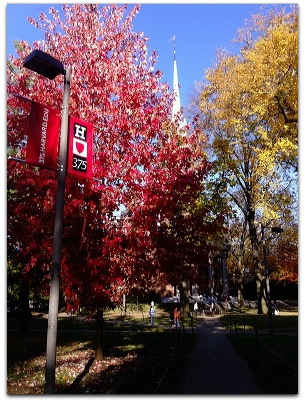
    Harvard Yard thinks it’s October. The Red, Sugar and Norway maples, the Scarlet and Pin oaks, the dogwoods and hawthorns, have all been at peak Fall color around Boston the last few days. The weather has been glorious too, hovering around 70° in the afternoons. Lots of people walking around in shorts, the sidewalk cafés packed with customers eating sandwiches and drinking coffee. If it weren’t for the freak snowstorm and a mild frost a couple weeks back, the predominant foliage might still be green. It’s been a warm Fall.

    After attending a great talk by John Wilbanks at lunch yesterday (and my latest $25 ticket for going several minutes over the 2 hour limit on my parking meter), I moved the car, poured another $2 into another meter, and walked around Cambridge, just enjoying the warmth and the scenery. I took a bunch of pictures with my phone as well, which joined this batch here, which includes shots taken with a real camera, plus some with a scanner.

    My interests in Science as a kid were organized as a series of obsessions. Their order went something like this:

    1. Trees
    2. Oceans and sea life
    3. Weather
    4. Astronomy
    5. Paleontology
    6. Radio

    The first four were primarily informed by Golden Guide books my parents bought for my sister and me. The titles were Trees, Fishes, Weather and Stars. Amazingly, I still have Trees, “@1956, 1952, by Western Publishing Company, Inc.” (That last link goes to the current version, on Amazon.) I turned nine years old in the Summer of 1956. I remember being so obsessed with trees that I would spend hours at the end of our street, identifying the sycamores, elms, beeches, hickories, oaks and maples of Borg’s Woods, then still decades away from becoming Hackensack‘s pride of a nature preserve. Thanks to fellow obsessives and the Web, anyone in the world can see those trees too.

    My old Trees book was helpful in identifying some of the leaves in those shots I’ve taken the last few days. So has Ryan Lynch’s Crimson Canopy, with it’s excellent Harvard Yard Trees. I only discovered the site late yesterday after I got home. If I had the time, I’d walk around again with the iPad and Ryan’s maps to check again on which trees were which.

    Perhaps readers inclinded to horticulture, plant taxonomy and dendrology can help puzzle out and correct identification of leaves such as this one here, which on Map 6 of Crimson Canopy is identified as a Red maple, but looks to me more like a Silver maple. (There’s a lot of variation among the Reds, though, I’ve noticed.) I should point out that it’s a big leaf.

    So today it’s supposed to rain, and I’m busy, so that’ll be it for this year’s walks among Fall colors. Tomorrow starts several weeks of travel.

    Bonus links:

  • Back to Blogging

    Today is the first day in months when my first question wasn’t, “What can I do to finish (or improve) the book today?” That’s because I turned in the (hopefully) final draft yesterday morning.

    Details: The book is The Intention Economy: When Customers Take Charge and the publisher is Harvard Business Review Press. You can pre-order it on Amazon.

    There are still hurdles to cross (copy editing, a few quote approvals), but all balls are in courts other than mine at the moment. So I can get back to all the stuff I’ve neglected in the meantime, including this: blogging.

    I think it was twelve years ago today that I put up the first post on this blog. Here it is. Funny, it mentions that this new Cluetrain book is going to come out, and is available for pre-order on Amazon. I didn’t remember that until just now.

    Note that the image of me in the title bar at the top of this page is taken from the photo in that first post. The other three guys still look like they did back then, but I’ve moved on. Meanwhile that old picture has become my “brand” now, I guess. Kind of like Colonel Sanders, Uncle Ben, Betty Crocker and Aunt Jemimah. With the goatee I’ve grown since then, it’s now Colonel Sanders I most resemble. Except I’m still alive and stopped wearing glasses full-time not long after that shot was taken. (Nothing medical was involved. I just quit wearing them and my eyes got better.)

    From 1999 until I found Tweeting easier, I generally posted several times a day, almost every day. Posting was easier on that old platform: Dave Winer‘s Manila. And I mostly wrote in one of Dave’s outliners — or sometimes in HTML with a simple text editor. Writing in WordPress is more complicated, but my favorite blogging tool is still OPML.

    Once tweeting came along, a lot of the stuff I once blogged about I began tweeting about instead. I still tweet, but blogging is more substantive, and the results are more like real publishing and less like snow on pavement. (I was going to say “snow on the water,” but that’s what radio is.) For example, you can still find everything I’ve ever blogged. Can’t say the same about everything I’ve ever tweeted. At least not easily. (If there is an easy way to search back through your own tweets, even to ones you wrote several years ago, let me know.)

    After I started bearing down on the book, in the Summer of last year, I found that blogging no longer worked as a steam valve on the side of whatever else I was doing. At least not in respect to the book. Writing a book, at least for me, required a level of focus and concentration I had never put into anything, ever. Self-discipline has never been my strong suit, and still isn’t; but I had to become much more self-disciplined to write this thing. Alas, one diversion that became essential to deny was blogging. Even though I could blurt out a blog post in a few minutes, returning to the Task At Hand wasn’t easy.

    It was also hard to write what I knew wouldn’t appear in print for many months. Blogging was live and engaging. Writing a book required being engaged with The Work Itself, which was new to me. It wasn’t until the book started to look and feel like a book — and not a series of long blog posts — that I could get down and groove with it. Once that started to happen, early this year, the book became something I enjoyed doing and got energy from as I did it. By the end of the project I found myself wanting to go straight on to the next book. Turns out I liked running marathons and not just sprinting. As a writer, that is.

    But I also became much more of a desk potato than I already was. Not good.

    So now here I am, ready both to sprint again in print and to go back outside, ride a bike, play basketball, take walks… anything to get my butt back into something close to “shape.” Got a ways to go with that.

    Anyway, bear with me as I work my way back into my old grooves, and try to find a balance between all the too many things I’ve always done, to which I’ve now added book writing. Gonna be an interesting challenge.

  • Need help with a Word bug

    I need help debugging this.

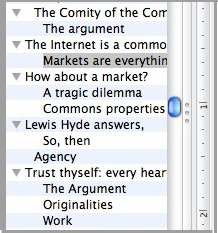
    word bugThe image on the left is a screenshot of Word 2011 bug effects that are standing in the path of a book am finishing. If you click on it you’ll go to a larger image with mouse-over notes explaining the problem, which I’ll detail here in slightly greater length.

    While the Print view looks fine, and clicking on any text shows the correct style in the Styles toolbox, the Outline view has big problems. Lines of normal text, regardless of formatting, show up in the Outline view as Level 1. They also show up as Level 1 or 2 in the Document Map Pane sidebar, which is the pane on the left.

    “The Comity of the Commons” is Heading 2. So is “Agency,” though it shows up as something between Level 2 and 3. The other items flush-left are all normal text that Word has elevated to Heading 1, even though they are not.

    I use this pane to navigate around the book, which is close to 300 pages and over 80,000 words. Having so many illegitimate Heading 1’s and Heading 2’s makes navigating nearly impossible using the Document Map Pane sidebar.

    I can very temporarily fix the problem by clicking on the line of text incorrectly seen by word as Heading 1 or 2, clearing the formatting, and re-formatting it if necessary. But that takes me about an hour each time this happens, and it’s a huge PITA. And then it goes back to this state anyway.

    Word’s AutoRecovery works rarely, and when it does, the AutoRecovered file has the same problem. FWIW, I don’t use any fancy formatting, instead relying on Word’s own default Headings and other styles.

    Bonus problem: If I view and save in Outline view, ALL TEXT gets turned into Level 1, and the document is hosed. I just have to go back to the last good copy.

    I have wasted my time on the phone already with Microsoft support, which was useless.

    I have invested some time with Craig Burton on the phone. He opened one of my screwed-up book drafts in his Windows version of Word 2011, and the doc was screwed up in exactly the same way.

    So the docs (.docx) are being screwed up, somehow. It’s not a display issue. It’s embedded in the file itself. And unscrewing the problem doesn’t help, because the file screws up again anyway. The document doesn’t appear to be screwed in Print view; but in Outline view, and in the Document View Pane sidebar, it is screwed. So, as it’s going now, I’ll be turning in a document that can only be used in Print view.

    Any clues or help you can provide would be greatly appreciated. And please don’t tell me not to use Word. I wish I didn’t have to; but it’s a requirement if I want to get this book finished and in.

    Thanks in advance for any help you can give.

    [Later…] Autoflowering, below, gave me an answer I tried before — saving the file as a .doc instead of a .docx — and seeing if that worked. It didn’t the first time, but it did this time, and has been working for more than a day now. I’m not convinced that the file isn’t still corrupted in some way, but it seems to work fine. So, thanks to everybody for your help.

  • Circular quoting

    So I’m writing about financialization. Kevin Phillips‘ prophetic book on the subject, Bad Money, is open on my desk. (He published it in early 2007, in advance of The Crash.) But it doesn’t contain the definitional quote that I need. So I turn to Wikipedia. There, in the Financialization entry, we are treated to this quote:

    Financialization may be defined as: “the increasing dominance of the finance industry in the sum total of economic activity, of financial controllers in the management of corporations, of financial assets among total assets, of marketised securities and particularly equities among financial assets, of the stock market as a market for corporate control in determining corporate strategies, and of fluctuations in the stock market as a determinant of business cycles” (Dore 2002)

    Nice, but there is no citation for Dore; just some “further reading”:

    Dore, R (2000). Stock Market Capitalism: Welfare Capitalism: Japan and Germany vs. the Anglo-Saxons. Oxford: Oxford University PressISBN 0-19-924061-2.

    So I go look that up, find it on Amazon, and look inside. I choose to search for “determinant,” a fairly rare word, and get five results. None are what’s quoted in Wikipedia. But, since Ronald Dore is a scholar, I figure he must have written that definition somewhere. But when I go to look, the results are a cascade of Wikipedia citations. Not the original Dore.

    This drives me just as nuts as I get when I go to look up, say, a geographical feature and get pages of commercial businesses associated with the feature, but not the feature itself. Google Maps is one offender here. Look up “Comb Ridge”, and you get this: http://g.co/maps/syspr. (Here are my own many shots of Comb Ridge.) The difference in this case is that I can still find Comb Ridge, while the provenance of the original Dore quote remains a mystery to me.

    And, since I want to finish my book today, I’m not going to fool around any more with it. I’ll find some other definition. Still, I need to gripe a bit. Sloppy citing is a curse that keeps on cursing. Or causing it, anyway.

  • CRM and IIW

    It just occurred to me that everything being worked on at IIW is meaningful to CRM. I had been thinking that only the VRM stuff was meaningful, but I realize now that all the IIW stuff is, because — from a CRM perspective — it’s all about customer empowerment. And empowered customers are entities that CRM will welcome, sooner or later.

    Here’s the list of IIW topics on the IIW home page:

    • Open Standards that have been born and developed at IIW – OpenID, OAuth, Activity Streams, Portable Contacts, Salmon Protocol, SCIM, UMA ….
    • The Federated Social Web
    • Vendor Relationship Management
    • Personal Data Services –  collection, storage and value generation
    • Anonymity Pseudonymity and Reputation Online (think google+ controversy)
    • Legal Innovation including, Information Sharing Agreements, Data Ownership Agreements and the development of “trust” frameworks.
    • NSTIC – the National Strategy for Trusted Identities in Cyberspace (it uses the term “user-centric identity” 4 times & “citizen-centric identity” once)
    • Cloud Identity and the intersection of enterprise ID and people (consumer) ID

    With this in mind we (a bunch of VRM and IIW people) decided that Wednesday afternoon is when we’ll have the VRM+CRM session, although we can have CRM sessions anytime, because the whole workshop is an unconference and participants choose the topics. But if you’re into the future of CRM, that afternoon session will be a good one to hit.

    There is also the whole next day, currently thus described:

    Thursday is Yukon Day: One of the longtime themes of IIW is how identity and personal data intersect.  Many important discussions about Vendor Relationship Management (VRM) have also taken place at IIW.  In recognition of how personal data and identity are intertwined, the third day of the IIW, will be designated “IIW + Yukon” and will stress the emerging personal data economy.  The primary theme will be personal data control and leverage, where the individual controls and drives the use of their own data, and data about them held by other parties.

    This isn’t social. It’s personal.  This day you can expext open-space style discuss ions of personal data stores (PDS), PDS ecosystems, and VRM.  One purpose of Yukon is to start to focus on business models and value propositions, so we will specifically be reaching out to angels and VC’s who are interested in personal data economy plays and inviting them to attend.

    Yukon” is a play on “You Control.”

    So, if CRM is your thing, IIW would be a good place to see what’s coming in CRM’s direction.

    Look forward to seeing some of ya’ll there.

    Enhanced by Zemanta
  • The journey was the reward

    I was in the midst of late edits on The Intention Economy this afternoon, wondering if I should refer to Steve Jobs in the past tense. I didn’t want to, but I knew he’d be gone by the time the book comes out next April, if he wasn’t gone already. So I decided to make the changes, and stopped cold before the first one. I just couldn’t go there.

    Then the bad news came a few minutes ago, through an AP notification on my iPhone. Tonight we all have to go there.

    Thirteen years, one month and one day ago, I wrote an email to Dave Winer, in response to a DaveNet post on Steve’s decision to kill off Apple’s clones. (Dave had also posted notes from an interview with Steve himself.) Dave published the email. Here’s the part that matters:

    So Steve Jobs just shot the cloners in the head, indirectly doing the same to the growing percentage of Mac users who prefered cloned Mac systems to Apple’s own. So his message to everybody was no different than it was at Day One: all I want from the rest of you is your money and your appreciation for my Art.

    It was a nasty move, but bless his ass: Steve’s art has always been first class, and priced accordingly. There was nothing ordinary about it. The Mac “ecosystem” Steve talks about is one that rises from that Art, not from market demand or other more obvious forces. And that art has no more to do with developers, customers and users than Van Gogh’s has to do with Sotheby’s, Christie’s and art collectors.

    See, Steve is an elitist and an innovator, and damn good at both. His greatest achievements are novel works of beauty and style. The Apple I and II were Works of Woz; but Lisa, Macintosh, NeXT and Pixar were all Works of Jobs. Regardless of their market impact (which in the cases of Lisa and NeXT were disappointing), all four were remarkable artistic achievements. They were also inventions intended to mother necessity — and reasonably so. That’s how all radical innovations work. (Less forward marketers, including Bill Gates, wait for necessity to mother invention, and the best of those invent and implement beautifully, even though that beauty is rarely appreciated.)

    To Steve, clones are the drag of the ordinary on the innovative. All that crap about cloners not sharing the cost of R&D is just rationalization. Steve puts enormous value on the engines of innovation. Killing off the cloners just eliminates a drag on his own R&D, as well as a way to reposition Apple as something closer to what he would have made the company if he had been in charge through the intervening years.

    The simple fact is that Apple always was Steve’s company, even when he wasn’t there. The force that allowed Apple to survive more than a decade of bad leadership, cluelessness and constant mistakes was the legacy of Steve’s original Art. That legacy was not just an OS that was 10 years ahead of the rest of the world, but a Cause that induced a righteousness of purpose centered around a will to innovate — to perpetuate the original artistic achievements. And in Steve’s absence Apple did some righeous innovation too. Eventually, though, the flywheels lost mass and the engine wore out.

    In the end, by when too many of the innovative spirts first animated by Steve had moved on to WebTV and Microsoft, all that remained was that righteousness, and Apple looked and worked like what it was: a church wracked by petty politics and a pointless yet deeply felt spirituality.

    Now Steve is back, and gradually renovating his old company. He’ll do it his way, and it will once again express his Art.

    These things I can guarantee about whatever Apple makes from this point forward:

    1. It will be original.
    2. It will be innovative.
    3. It will be exclusive.
    4. It will be expensive.
    5. It’s aesthetics will be impeccable.
    6. The influence of developers, even influential developers like you, will be minimal. The influence of customers and users will be held in even higher contempt.
    7. The influence of fellow business artisans such as Larry Ellison (and even Larry’s nemesis, Bill Gates) will be significant, though secondary at best to Steve’s own muse.

    Turns out Steve’s muse was the best in the history of business. No one-hit wonders. We’re talking about world-changing stuff. Again and again and again.

    Watch this clip from Robert X. Cringeley’s “Triumph of the Nerds” public TV special, filmed back when Steve was still running NeXT. This one too. Then look at what Steve did after coming back. Not just the iPod, iPhone, iPad, Pixar and the laptops we see with glowing apples all over the place. Look at the Apple Stores. I’ve been told that Apple Stores are top-grossing retail shops in every mall they occupy. Even if that’s not true, it’s believable.

    I’ve also been told that Apple Stores were Steve’s idea. I don’t know if that’s true either, but it makes sense, because they succeeded where nearly every other attempt at the same thing failed. To get there, Steve and Apple had to look past the smoking corpses of Gateway, Circuit City, Computerland, Radio Shack and all the other computer stores that had failed, and do something very different and much better. And they did.

    I was wrong about one thing in my list above. I don’t think Steve regarded customers and users with contempt, except in the sense that he believed he knew better than they did. As an elitist, he also knew that calling the smartest and most employable Apple users “geniuses” was great bait for employment serving customers at Apple Stores.

    There is no shortage of quotes by and about Steve Jobs tonight. But the best quote is the one he uttered so long ago I can’t find a source for it (maybe one of ya’ll can): The journey is the reward.

    His first hit, the Apple II, was “The computer for the rest of us.” So now is his legacy.

  • Train tracking

    I just ran across some research I did in December 2008, while working on the 10th Anniversary edition of The Cluetrain Manifesto:

    • Google Book Search results for cluetrain — 666[1]
    • Google Book Search results for markets are conversations — 2610
    • Google Web Search results for cluetrain — 394,000
    • Results for Web searches for markets are conversations — 626,000

    [1] Increasing at more than one per day. The numbers were 647 on November 15, 2008 and 666 on December 1, 2008. Results passed 600 on September 30, 2008.

    Here are the results today:

    I added two more, with quotes, because I’m not sure if I used quotes the first time or not, for that phrase. I would like to have the exact URLs for the earlier searches too, but I don’t. To get useful, non-crufty URLs this time, I needed to fire up a virgin browser and scrape out everything not tied to the search itself (e.g. the browser name, prior searches, other context-related jive irrelevant to this post).

    Of course, Google guesses about most of this stuff. (Though possibly not for the first item: a word in a book). Not sure how much any of it matters. I just thought it was interesting to share before I wander off and forget where I found these few bits of sort-of-historical data.

    Bonus link (found via a Twitter search for #cluetrain): Jonathan Levi‘s The Cluetrain Manifesto — Manifested Today.

  • Advertimania

    “If you don’t like the news, go out and  make some of your own,” Scoop Nisker says. (I first heard him say that when he did news for M. Dung‘s morning show on KFOG in 1985. Great show. Sorry most of you missed it.)

    The same goes for words. Today I wanted one for advertising mania, so I made one up: advertimania, which I’ll define, provisionally (though simply), as excessive enthusiasm for advertising. If it succeeds, it may one day deserve an entry here in Douglas Harper‘s brilliant Online Etymology Dictionary.

    Why not advermania? Because it’s already used by many advertising sites (hyping advertising, of course), while “+advertimania” comes up with no results on Google or Bing. (The ‘+’ makes the engines cough up results only for the intended word.)

    Let’s see how long it takes for either engine to index the find.

    [21 minutes later…]

    Tweeted this:

    @dsearls Doc Searls
    New word: #advertimaniahvrd.me/qQHtlv Help me see how long it takes for Bing and Google to index that entry, made 1 minute ago.
    20 minutes ago via web

    Then came this:

    aswath 41 Aswath Rao
    @dsearls Bing got it via this Twitter; Google has not yet
    5 minutes ago

    Now Bing shows nothing with the + sign in front of “advertimania”. When I take that away, it has this:

    ALL RESULTS  1-3 of 3 results· Advanced
    Advertimania 26 minutes ago

    Sep 28, 2011 · “If you don’t like the news, go out and make some of your own,” Scoop Nisker says. (I first heard him say that when he did news for M. Dung‘s …

    blogs.law.harvard.edu/doc/2011/09/28/advertimania · Cached page

    Doc Searls (@dsearls) on Twitter

    • 14,623 followers ·
    • 4,405 tweets ·
    • Cambridge, Mass ·
    • Following 1,574 others

    Writer with ties to Linux Journal, the Berkman Center at Harvard and CITS at UCSB. – New word: #advertimania: hvrd.me/qQHtlv Help me see how long it takes for Bing …
    twitter.com/dsearls · Cached page
    Please Review My Site: http://www.techfocus.co.uk – BioRUST Forums

    Please stop the adverti-mania. (Infraction + Reported + A PM to Tamlin. Damn, I’m evil) @profitbysearch: I like the site, but I think the layout is a bit too busy.

    forums.biorust.com/marketplace/6139-please-review-my-site-http-www-techfocus-co-uk.html · Cached page

    Meanwhile Google has this:

    Did you mean: +vertimania

    Search Results
    [Doc Searls]: Advertimania.
    friendfeed.com/friendsofdave/aa74466d/doc-searls-advertimania
    [Doc Searls]: Advertimania.

    Bing wins, folks. (But right now I can’t see this, because there’s some funky html I copied and can’t fix. Grr.)

  • Beanstalk Connectivity

    Logan Airport’s free wi-fi isn’t doing the job. (Latencies up to a second and a half, 7% packet loss.) In fact, the only reason I can continue with this post is that I’ve switched to my iPhone’s “personal hot spot,” which turns AT&T’s 3G data network to wi-fi I can use. On Logan’s connection I couldn’t do anything over the Net, other than that ping test.

    Now on AT&T’s 3G, I’m getting a “D+” grade from Speedtest.net, but I’m also able to function over a connection it rates at 2.67Mbps down and .67Mbps up. I’m only here for an hour, so I can live with that.

    But I also have to live with knowing that the data is costing me $25/mo. for 2Gb, plus $10 for each additional 1Gb. Or is it $45 for using the tethering (as I am now)? And it’s a pain in the butt to keep worrying about whether I’m running up a big bill. (Never mind that I’m going to Canada, where I won’t use any telco data, thanks to onerous “roaming” charges if I try.)

    Just here in the States, there’s a tug-of-billing-plans between Apple and AT&T. What started as $25 for unlimited data (very Steve Jobs, that simplicity) is now this:

    Data Plans
    Data will allow you to access the internet, surf the Web, and check email.
    Data 200MB 2GB 4GB and Mobile Hotspot**
    Additional Data $15 per 200MB $10 per 1GB $10 per 1GB
    Per Month $15 $25 $45

    ** Tethering allows you to share the 3G connection on your iPhone with your Mac notebook or PC laptop and connect to the Internet. When your iPhone is tethered, you can still send and receive data and make phone calls.

    Very telco, that; though not nearly as complex as it would have been if Apple weren’t a party to the deal.

    My point, however, is about clouds. If we’re going to “live in the cloud,” as we are so often told, we’re going to need better routes than rented beanstalks that fray and fail.

    By the way, I don’t begrudge AT&T making money. In fact, I’m happy for them (and Apple, and anybody in the Net infrastructure business) to make money, and want to encourage them to build out as much capacity as they can.

    I just know how telcos work, which is primarily as billing systems and secondarily as plain infrastructure. We also pay for other utilities — water, electricity, gas —but in less sphinctered ways. And un-sphinctered service is what we’ll need if we really are going to live in the clouds.

    [Later…] Dig David Scott WilliamsRain From the Cloud Doesn’t Fall in This Desert, and his comments below. I especially like “drinking the milkshake of the cloud internet through my coffee stirrer,” which links back to that same post.

    Open connections are as important as having roads, water and electricity. In too much of the world — and remarkably, too much of the U.S. — the long- promised “information superhighway” still isn’t paved.

  • Ten years later

    I’ve been listening to the repeat broadcast of the Howard Stern Show, recorded live in New York as the 9/11 events unfolded. It’s been a transporting experience. The anger, bewilderment, confusion and fear are all there.

    I was at our house in Montecito, California when it happened. My sister Jan called right after the first tower was hit, and we watched the rest on TV. Then I switched to the radio and blogged a number of posts through the day. Here they are (in reverse chronological order):

    Stars. Just stars. 

    Walking back from a meeting at school this evening, the kid and I looked up at the sky, as always. But it was … different. What was that behind the high branches of an Oak tree? A star or an — no, it couldn’t be an airplane. There were no airplanes in the sky tonight. Only stars: a condition we haven’t seen in nearly a century.
    “Why aren’t the planes flying, Papa?” he asked. I explained. He asked again. I explained again. I stopped the questioning when the count got to four.
    But it won’t stop.

    What’s down? 

    I get a steady flow of email, up to hundreds per day. But after 5:13 tonight, nothing. Is it just that everybody’s watching CNN now? No idea. Seems creepy.

    More perspective 

    Here’s Morgan Stanley, which had 3500 people working in the World Trade Center:
    Because of the enormous emotional and physical toll that these events have taken and will take among many of our employees and their families…

    Close to home 

    We just lost power for a few minutes. No idea why.

    One answer 

    Here’s Eric S. Raymond on our “First Lessons” about terrorism.

    Ironytrack 

    Dean points out that today the United Nations opens in New York on the International Day of Peace.

    Blogtracks 

    Here are Blogger sites mentioning “World Trade” or “terrorist.”

    How? 

    BBC says the pilots would surely have been killed first, since they would never follow orders to fly into a building. I notice that all four planes involved were 757s and 767s, which have roughly identical cockpits.
    Odd how we mull details like these to get a small grip on an immense tragedy. Right now I don’t even want food. Just details.

    Now it gets personal 

    Our West Coast family members check in fine. One is in Ohio, and will probably drive home to L.A. So far we’re lucky. East Coast, not so sure. I have a cousin who works in the Pentagon. My sister is a retired Navy officer, recently moved from Arlington to North Carolina. “I lost friends today,” she tells me. But who? So far we also don’t know very much about who lived, who died, who’s lost, trapped or worse.
    Dave points to a press release reporting the death of Danny Lewin. He was on the American flight from New York to Los Angeles that crashed into the World Trade Center. I didn’t know Danny, but I’ve met him. He was a good guy. According to his bio, he was also a member of the Israeli Defense Forces. I imagine he would have done his best, as a passenger, to stop this thing.
    And there were so many others lost today. So many families waiting, right now, for loved ones to call, to show up at the door.

    The deepest human substance 

    Now is the time to give blood, not take it. Wherever you are, please give some. For New York, call 1 800 933-blood or visit http://nybloodcenter.org/.

    Declaration of Peace 

    One of the surprising things to me about blogging is how much I don’t say. I tend to be a very disclosing guy, but if anything I tend to disclose less personal stuff than I ever thought I would have when I started this thing in 1999.
    But today I’ll tell you where I come from on the matter of war.
    I am a pacifist. I applied for contientious objector status during the Vietnam War, and I would have served in that capacity if I hadn’t received a medical deferment.
    I went to a Quaker college, and have always felt most at home, philosophically and morally, with the Society of Friends. Although I currently attend a Catholic Church, my beliefs are the same.
    What happened today brings out the pacifist in me, and the linguist as well. Just about everything we believe, and say, is framed up by conceptual metaphors. In the words of George Lakoff, written at the height of the Gulf War, metaphors can kill.
    We have a choice about the ones we use. For the sake of those still with us, and the souls of those we’ve lost, choose your conceptual frameworks carefully.

    Perspective 

    We hear that 50,000 people worked in the World Trade Center alone. Consider these numbers:
    • 4,435 U.S. soldiers died in the Revolutionary War, and another 2,260 in the War of 1812.
    • Including civilians, 373,458 died in the Civil War.
    • 53,513 combat deaths in World War I, plus 63,195 “other.”
    • 292,131 combat deaths in Word War II, plus 115,185 “other.”
    • 33,651 combat deaths in the Korean War (no “other” listed)
    • 47,369 combat deaths in the Vietnam War, and 10,799 “other.”
    • And for the Gulf war, the respective numbers were 148 and 145.
    Here’s another summary.

    Loverolling 

    ZeldmanDeanAdamDaveCamEricAkamaiRichardBrentSusan. Grant.East/WestUltrasparky. QuesoKottkeMegMetafilterEvGlennScoble.
    I need to pick up the kid from school soon. This morning he wanted to know why his parents were crying. We couldn’t begin to explain.

    Open choices 

    What happened today may have been an act of war, but it was also an act of insanity.
    Many people we know are dead. Many more are dying. This is a time to open our hearts, our homes, our wallets and our minds.
    There is only one sane choice open to us all: What can we do to help?
    If there is anything you think I can do, let me know. I just added AIM instant messaging to my suite of contacts. My handle, no longer a joke, is “Celeprosy.”

    A time for love and mourning 

    Pray, find your loved ones. Give help.
    And God help us all.

    Maybe because I have it 

    Wanted to test out the latest AOL Instant Messenger today, so I downloaded it. But first I had to come up with a name. Searls, Dsearls, Dsearls1 and Zdilmidgi were all taken, by me, in the past. But AOL wouldn’t make them available to me because they had to clear it with the now-dead email address I used when I registered those identities. So I gave up on those and tried all kinds of names, finally going with “Celeprosy.” It took. Haven’t installed it yet, though.

    What’s the commercial model for your toilet? Your light socket? Your floors? 

    I was asked today what the ‘commercial model’ was for a blog hosted on a home computer. It amazes me that the Net is still being asked to justify itself commercially.
    But as long as it is, we need Larry Lessig to rant about it. (Thanks to Tom for that link.)
    And while we’re on the blog subject, check out the Lockergnome interview with Evan Williams. I ran into Chris Pirillo at TechTV when I was up there recently. Great guy. And he really does look like that Lockergnome dude in the illo.

    Well, obviously 

    Says here I’m infatuated with Google search results. Actually, amazed is a bit more like it.
    Curious: what real competition does Google have these days? Looking here, it’s as if nobody has even bothered reviewing the matter in almost a year. At this point Google rivals the browser itself as a Web interface. It’s a portal that doesn’t act the part.
    Is it making money yet? I have no idea.

    Because smart people don’t always do that 

    Eric Raymond: How to ask questions the smart way.

    Blogging was young then. There was no Twitter, no Facebook. Yet blogging felt, and was, far more social — at least for me — than anything else we’ve seen since.

    Some thoughts, ten years later:

    • Yes, everything changed that day.
    • We did go to war, as I expected we would, given the president we had and the mood of the country after being attacked. But the war, billed as one against “terrorism,” has been one of “regime change” in two countries. Since then other regimes have changed that needed changing, without our intervention, and at approximately zero $ cost to the U.S.
    • The cost of going to war has been many $trillions, and has nearly (or perhaps actually) bankrupted the country. There was a rope-a-dope strategy behind the attack, and we took the bait.
    • The U.S. hasn’t been attacked in the same way again, and for that I am grateful.
    • The results of the War on Terrorism are debatable, although they are not much debated.
    • The motivations for the attacks on the U.S., besides “they hate us and our way of life” and similar staples of talk radio, have not been visited at much depth, at least by sources the American people pay much attention to. That anybody might have a legitimate gripe against the U.S. is a question no politician wants to ask. And not many ordinary citizens, either.
    • Many young men and women in my extended family have served in these wars. I am proud of them. I also wish they hadn’t needed to go.
    • The peace movement, in which I played a small part during the Vietnam War, is now dormant. Almost nobody questions the need for war now.
    • The hate we felt for Al Qaeda, the self-appointed enemy that attacked on 9/11, has since shifted to each other. I’ve been alive for a long time, and I can’t remember any period, including the Vietnam War, when it has been harder for political opponents to listen to each other, much less understand what the other is saying. Ad hominem arguments rule.
    • One reason for our uncompromising political posturing and rhetoric is the loss of the moderate center that was held in place by the mainstream media, and especially by the evening network news. Even as late as 2001, we turned en mass to network TV and newspapers for reporting and analysis that at least tried to be unbiased, accountable and responsible to the whole country and not just to partisan factions. Now even CNN looks like an informercial to me.

    I can’t shake the feeling that, in ways we don’t want to admit, the terrorists have won something. 9/11 gave us fear, and the will to attack. It changed our hearts and minds.

    When I look back on human history, starting with our diaspora out of Africa only a few dozen millennia ago, I see persisting through it all a will to kill and dominate that is hardly diminished by civilization. We have hated and killed The Other for the duration. For all its many virtues, our species remains a violent and homicidal one. We’ve killed others who looked or spoke differently than we do. We’ve killed for land and religion and resources, which included each other, whom we often kidnapped and made into slaves. Even in our own country we killed each other by the dozens of thousands, over differing notions of freedom. (The Civil War is only two generations back on my father’s side. One great aunt, whom I remember well, was twelve years old when Lincoln was shot, and told stories about it. She was born when slavery was still more than legal in the U.S.)

    How many people have died because of 9/11, since that day? Have their deaths been worthwhile? Have they bought peace, really? Will anything, ever? I have my doubts, and those started ten years ago today.

    [Later…] Deaths in the War on Terror, according to Wikipedia, as of today:

    • Iraq: 62,570 to 1,124,000
    • Afghanistan: between 10,960 and 49,600
    • Pakistan: between 1467 and 2334
    • Somalia: 7,000+

    And then,

    Total American casualties from the War on Terror
    (this includes fighting throughout the world):

    US Military killed 5,921[109]
    US Military wounded 42,673[109]
    US Civilians killed (includes 9/11 and after) 3,000 +
    US Civilians wounded/injured 6,000 +
    Total Americans killed (military and civilian) 8,800 +
    Total Americans wounded/injured 46,000 +
    Total American casualties 54,800 +

    Draw, or re-draw, your own conclusions. I still don’t have any. Or many. The older I get, the less certain I am of my own opinions, especially about War, the reasoning methods for which which seem to be hard-coded into human nature. In my heart I’m still a pacifist, but in my mind I’m not so sure.

    Here’s what I wrote in Deliberate Explosive Devices last year:

    I think there lurks in human nature a death wish — for others, even more than for ourselves. We rationalize nothing better, or with more effect, than killing each other. Especially the other. Fill in the blank. The other tribe, the other country, the other culture, the other religion, whatever.  “I’ve seen the future,”Leonard Cohen sings. “It is murder.” (You can read the lyrics here, but I like thevideo version.)

    Yet we also don’t. The answer to Matt’s question — How did we keep from blowing ourselves up for all those years? —is lieutenant colonel Stanislav Petrov, and others like him, unnamed. Petrov had the brains and the balls to say “No” to doing the crazy thing that only looked sane because a big institution was doing it.

    We’re still crazy. You and I may not be, but we are.

    War is a force that gives us meaningChris Hedges says. You can read his book by that title, (required reading from a highly decorated and deeply insightful former war correspondent). You can also watch the lecture he gave on the topic at UCSB in 2004. The mystery will be diminished by his answer, but not solved.

    Still, every dose of sanity helps.

    Still true.

    Bonus link from Euan Semple.

  • Truly public radio

    Rochester, Vermont

    My favorite town in Vermont is Rochester. I like to stop there going both ways while driving my kid to summer camp, which means I do that up to four times per summer. It’s one of those postcard-perfect places, rich in history, gracing a lush valley along the White River, deep in the Green Mountains, with a park and a bandstand, pretty white churches and charm to the brim.

    My last stop there was on August 20, when I shot the picture above in the front yard of Sandy’s Books & Bakery, after having lunch in the Rochester Cafe across the street. Not shown are the 200+ cyclists (motor and pedal) who had just come through town on the Last Mile Ride to raise funds for the Gifford Medical Center‘s end-of-life care.

    After Hurricane Irene came through, one might have wondered if Rochester itself might need the Center’s services. Rochester was one of more than a dozen Vermont towns that were isolated when all its main roads were washed out. This series of photos from The Republican tells just part of the story. The town’s website is devoted entirely to The Situation. Here’s a copy-and-paste of its main text:

    Relief For Rochester

    Among the town’s losses was a large section of Woodlawn Cemetery, much of which was carved away when a gentle brook turned into a hydraulic mine. Reports Mark Davis of Valley News,

    Rochester also suffered a different kind of nightmare. A gentle downtown brook swelled into a torrent and ripped through Woodlawn Cemetery, unearthing about 25 caskets and strewing their remains throughout downtown.

    Many of the graves were about 30 years old, and none of the burials was recent.Yesterday, those remains were still outside, covered by blue tarps.

    Scattered bones on both sides of Route 100 were marked by small red flags.

    “We can’t do anything for these poor people except pick it up,” said Randolph resident Tom Harty, a former state trooper and funeral home director who is leading the effort to recover the remains.

    It was more than 48 hours before officials in Rochester — which was cut off from surrounding towns until Tuesday — could turn their attention to the problem: For a time, an open casket lay in the middle of Route 100, the town’s main thoroughfare, the remains plainly visible.

    I found that article, like so much else about Vermont, on VPR News, one of Vermont Public Radio‘s many services. When the going gets tough, the tough use radio. During and after natural disasters, radio is the go-to medium. And no radio service covers or serves Vermont better than VPR. The station has five full-size stations covering most of the state, with gaps filled in by five more low-power translators. (VPR also has six classical stations, with their own six translators.) When I drive around the state it’s the single radio source I can get pretty much everywhere. I doubt any other station or network comes close. Ground conductivity in Vermont is extremely low, so AM waves don’t go far, and there aren’t any big stations in Vermont on AM anyway. And no FM station is bigger, or has as many signals, as VPR.

    One big reason VPR does so much, so well, is that it serves its customers, which are its listeners. That’s Marketing 101, but it’s also unique to noncommercial radio in the U.S. Commercial radio’s customers are its advertisers.

    VPR’s services only begin with what it does on the air. Reporting is boffo too. Here’s VPR’s report on Rochester last Thursday, in several audio forms, as well as by transcription on that Web page. They use the Web exceptionally well, including a thick stream of tweets at @vprnet.

    I don’t doubt there are many other media doing great jobs in Vermont. And at the local level I’m sure some stations, papers and online media do as good a job as VPR does state-wide.

    But VPR is the one I follow elsewhere as well as in Vermont, and I want to do is make sure it gets the high five it deserves. If you have others (or corrections to the above), tell me in the comments below.

    Some additional links:

  • Following Irene Live

    WTKR/3 in Norfolk has live coverage streaming on the Web. So does WGNT. It’s the same show, also being carried on WHRV radio (streaming at that link). So if you want to see and hear live coverage where the action is, from mainstream media, those are the places.  WVEC, WAVY, WHRO and WVBT all have pretty much the usual static sites. (Correct me if I’m wrong.)

    WTKR and WGNT get a high five for casting globally by streaming locally. This is something they can do, but the Weather Channel cannot, because it’s tied up with obligations to broadcast live only over cable. Local stations aren’t encumbered by the same obligations, outside of network programming. (They just used some uStream video from cage-free journalists in North Carolina, and keep thanking their Facebook friends, which is cool. Some props should go to blogs and tweets too, though.)

    [Later…] Here is a list of all TV stations now streaming live on the Net:

    • Tidewater Virginia —WTKR and WGNT. Also carried on WHRV radio.
    • Richmond — WTVR
    • Washington DC — none
    • Baltimore — WMAL
    • Philadelphia — none
    • New York — WNYW
    • Boston — none so far
    • Hartford-New Haven — WTNH

    [Later still: midnight Eastern…] With the storm passed, WTKR/WGNT went off. WMAL doesn’t seem to be on. WNYW is still up (with the storm approaching). WNYC‘s stream is quite good on radio.

    Here are another bunch of streams.

    For visualization of the storm itself, it’s hard to beat Intellicast:

    Click on the image, mouse over the map that comes up, and move it to position it where you like. Click on “press play to start” to see the image animated.

    Irene appears to have no clear and open eye right now, as she moves north up along Virginia Beach, Norfolk, Tidewater Virginia and the Delmarva peninsula.

    [later still…] Last but far from least: the state that seems to have gotten the worst of Irene was off the mainstream radar but right up her final alley: Vermont. The flooding has been terrible.