• A new window of the sole

    monofocal interocular lens“I see,” we say, when we mean “I understand.” To make something “clear” is to make it vivid and unmistakable to the mind’s eye. There are no limits to the ways sight serves as metaphor for many good and necessary things in life. The importance of vision, even for the sightless (who still use language), is beyond full accounting. As creatures we are exceptionally dependent on vision. For us upright walkers sight is, literally and figuratively, out topmost sense.

    It is also through our eyes that we express ourselves and make connections with each other. That eyes are windows of the soul is so well understood, and so often said, that no one author gets credit for it.

    Yet some of us are more visual than others. Me, for example. One might think me an auditory or kinesthetic type, but in fact I am a highly visual learner. That’s one reason photography is so important to me. Of the many ways I study the world, vision is foremost, and always has been.

    But my vision has been less than ideal for most of my adult life. When I was a kid it was exceptional. I liked to show off my ability to read license plates at great distances. But in college, when I finally developed strong study habits, I began getting nearsighted. By the time I graduated, I needed glasses. At 40 I was past minus-2 dioptres for both eyes, which is worse than 20/150. That was when I decided that myopia, at least in my case, was adaptive, and I stopped wearing glasses as much as possible. Gradually my vision improved. In 1999, when the title photo of this blog was taken, I was down to about 1.25 dioptres, or 20/70. A decade later I passed eye tests at the DMV and no longer required corrective lenses to drive. (Though I still wore them, with only a half-dioptre or so of correction, plus about the same for a slight astigmatism. They eye charts said I was then at about 20/25 in both eyes.

    My various eye doctors over the years told me reversal of myopia was likely due to cataracts in my lenses. Whether or not that was the case, my cataracts gradually got worse, especially in my right eye, and something finally needed to be done.

    So yesterday the lens in my right eye was replaced. That one was, in the words of the surgeon, “mature.” Meaning not much light was getting through it. The left eye is still quite functional, and the cataract remains, for now, mild.

    Cataract surgery has become a routine outpatient procedure. The prep takes about an hour, but the work itself is over in fifteen minutes, if nothing goes wrong, which it usually doesn’t. But my case was slightly unusual, because I have a condition called pseudoexfoliation syndrome, or PEX, which presents some challenges to the surgery itself.

    As I understand it, PEX is dandruff of the cornea, and the flakes do various uncool things, such as clog up the accordion-like pleats of the iris, so the eye sometimes doesn’t dilate quickly or well in response to changing light levels. But the bigger risk is that these flakes sometimes weaken zonules, which are what hold the lens in place. Should those fail, the lens may drop into the back of the eye, where a far more scary and complicated procedure is required to remove it, after which normal cataract surgery becomes impossible.

    In the normal version, the surgeon makes a small incision at the edge of the cornea, and then destroys and removes the old lens with through a process called phaceomulsification. He or she then inserts an intraocular lens, or IOL, like the one above. In most cases, it’s a monofocal lens. This means you no longer have the capacity to focus, so you need to choose the primary purpose you would like your new lens to support.  Most choose looking at distant things, although some choose reading or using a computer screen. Some choose to set one eye for distance and the other for close work. Either way you’ll probably end up wearing glasses for some or all purposes. I chose distance, because I like to drive and fly and look at stars and movie screens and other stuff in the world that isn’t reading-distance away.

    The doctor’s office measured the dimensions of my eye and found that I wouldn’t need any special corrections in the new lens, such as for astigmatism — that in fact, my eyes, except for the lens, are ideally shaped and quite normal. It was just the lenses that looked bad. They also found no evidence of glaucoma or other conditions that sometime accompany PEX. Still, I worried about it, which turned out to be a waste, because the whole thing went perfectly. (It did take awhile to get my iris to fully dilate, but that was the only hitch.)

    What’s weird about the surgery is that you’re awake and staring straight forward while they do all this. They numb the eye with topical anesthetic, and finally apply a layer of jelly. (They actually call it that. “Okay, now layer on the jelly,” the doctor says.) Thanks to intravenous drugs, I gave a smaller shit than I normally would have, but I was fully conscious the whole time. More strangely, I had the clear sense of standing there on my retina, looking up at the action as if in the Pantheon, watching the hole in its dome. I could see and hear the old lens being emulsified and sucked away, and then saw the new lens arriving like a scroll in a tube, all curled up. As the doctor put it in place, I could see the lens unfurl, and studied one of the curved hair-like springs that holds it in place. Shortly after that, the doctor pronounced the thing done. Nurses cleaned me up, taped a clear shield over my eye, and I was ready to go.

    By evening the vision through that eye became clearer than through my “good” left eye. By morning everything looked crystalline. In my follow-up visit, just 24 hours after the surgery, my vision was 20/20. Then, after the doctor relieved a bit of pressure that had built up inside the cornea, it was better than that — meaning the bottom line of the eye chart was perfectly clear.

    Now it’s evening of Day 2, and I continue to be amazed at how well it’s going. My fixed eye is like a new toy. It’s not perfect yet, and may never be; but it’s so much clearer than what I saw before — and still see with my left eye — that I’m constantly looking at stuff, just to see the changes.

    The only nit right now is  little rays around points of light, such as stars. But the surgeon says this is due to a bit of distortion in my cornea, and that it will vanish in a week or so.

    The biggest difference I notice is color. It is now obvious that I haven’t seen pure white in years. When I compare my left and right eyes, everything through my left — the one with the remaining cataract — has a sepia tint. It’s like the difference between an old LCD screen and a new LED one. As with LED screens, whites and blues are especially vivid.

    Amazingly, my computer and reading glasses work well enough, since the correction for my left eye is still accurate and the one for my right one isn’t too far off. For driving I removed the right lenses from my distance glasses, since only the left eye now needs correction.

    But the experience of being inside my eye watching repairs in the space of the eye alone — sticks with me. All vision is in the brain, of course, and the world we see is largely a set of descriptions we project from the portfolio of things we already know. We can see how this works when we disconnect raw sensory perception from our descriptive engines. This is what happens with LSD. As I understand it (through study and not experience, alas), LSD disconnects the world we perceive from the nouns and verbs we use to describe it. So do other hallucinogens.

    So did I actually see what I thought I saw? I believe so, but I don’t know. I had studied the surgical procedure before going into it, so I knew much of what was going on. Maybe I projected it. Either way, that’s over. Now I don’t see that new lens, but rather the world of light refracting through it. That world is more interesting than my own, by a wider margin than before yesterday. It’s a gift I’m enjoying to the fullest.

  • Al Jazeera English to be buried in cable

    Two years ago I called Al Jazeera’s live coverage of the revolution in Egypt a “Sputnik moment” for cable in the U.S. Turns out it wasn’t. Not since Al Jazeera agreed to pay half a $billion, plus their live internet stream, to sit at U.S. cable’s table. Losing Al Jazeera English reduces to a single source — France24 — the number of live streams available on the Net from major video news channels. It also terminates years Al Jazeera English’s history on the Net at 5.25 years.

    It’s a huge victory for cable and an equally huge loss for the open Net. I dearly hope Al Jazeera feels that loss too. Because what Al Jazeera screws here is a very loyal audience. Just, apparently, not a lucrative one.

    In Al Jazeera Embraces Cable TV, Loses Web, The Wall Street Journal explains,

    …to keep cable operators happy, Al Jazeera may have to make a difficult bargain: Giving up on the Web.

    The Qatar government-backed television news operation, which acquired Current TV for a few hundred million dollars from investors including Al Gore, said Thursday that it will at least temporarily stop streaming online Al Jazeera English, its global English-language news service, in about 90 days. That’s when it plans to replace Current TV’s programming with Al Jazeera English.

    Al Jazeera plans later to launch an entirely new channel, Al Jazeera America, that will combine programming from the existing English-language service with new material. The new channel likely won’t be streamed online either, a spokesman said.

    And it is unclear whether the original English service will reappear online: the spokesman said Thursday a decision about that was dependent on negotiations with cable operators.

    The network’s decision to pull its service off the Web is at the behest of cable and satellite operators. It reflects a broader conflict between pay television and online streaming that other TV channels face. Because cable and satellite operators pay networks to carry their programming, the operators don’t want the programming appearing for free online. Aside from older series available through services like Netflix, most cable programming is available online only to people who subscribe to cable TV.

    You won’t find better proof that television is a captive marketplace. You can only watch it in ways The Industry allows, and on devices it provides or approves. (While it’s possible watch TV on computers, smartphones and tablets, you can only do that if you’re already a cable or satellite subscriber. You can’t get it direct. You can’t buy it à la carte, as would be the case if the marketplace were fully open.)

    For what it’s worth, I would gladly pay for Al Jazeera English. So would a lot of other people, I’m sure. But the means for that are not in place, except through cable bundles, which everybody other than the cable industry hates.

    In the cable industry they call the Net “OTT,” for “over the top.” That’s where Al Jazeera English thrived. But now, for non-cable subscribers, Al Jazeera English is dead and buried UTB — under the bottom.

    Adverto in pacem, AJE. For loyal online viewers you were the future. Soon you’ll be the past.

    Bonus links:

  • Android as a life management platform

    Nearly all smartphones today are optimized to do three things for you:

    1. Run apps
    2. Speak to other people
    3. Make you dependent on a phone company

    The first two are features. The third is a  bug. In time that bug will be exterminated. Meanwhile it helps to look forward to what will happen with #1 and #2 once they’re liberated from #3.

    Both features are personal. That’s key. Our smartphones (or whatever we end up calling them) should be as personal as our clothing, wallets and purses. In other words, they should work as extensions of ourselves.

    When this happens, they will have evolved into what Martin Kuppinger calls life management platforms, good for all these things —

    — in addition to the stuff already made possible by the zillion apps already out there.

    What kinds of smartphones are in the best position to evolve into Life Management Platforms? The short answer is: open ones. The longer answer is: open ones that are already evolving and have high levels of adoption.

    Only one platform qualifies, and that’s Android. Here’s what Wikipedia says (as of today) about Android’s open-ended evolutionary position:

    Historically, device manufacturers and mobile carriers have typically been unsupportive of third-party firmware development. Manufacturers express concern about improper functioning of devices running unofficial software and the support costs resulting from this.[81] Moreover, modified firmwares such as CyanogenMod sometimes offer features, such as tethering, for which carriers would otherwise charge a premium. As a result, technical obstacles including locked bootloaders and restricted access to root permissions are common in many devices. However, as community-developed software has grown more popular, and following a statement by the Librarian of Congress in the United States that permits the “jailbreaking” of mobile devices,[82] manufacturers and carriers have softened their position regarding third party development, with some, including HTC,[81] Motorola,[83] Samsung[84][85]and Sony Ericsson,[86] providing support and encouraging development. As a result of this, over time the need to circumventhardware restrictions to install unofficial firmware has lessened as an increasing number of devices are shipped with unlocked or unlockable bootloaders, similar to the Nexus series of phones, although usually requiring that users waive their devices’ warranties to do so.[81] However, despite manufacturer acceptance, some carriers in the US still require that phones are locked down.[87]

    The unlocking and “hackability” of smartphones and tablets remains a source of tension between the community and industry, with the community arguing that unofficial development is increasingly important given the failure of industry to provide timely updates and/or continued support to their devices.[87]

    But the community doesn’t just argue. It moves ahead with implementations. For example, Ubuntu for Android and custom ROMs for Google’s Nexus 7.

    The reason there is an aftermarket for Nexus hardware is that Google intended for Android to be open and generative from the start, pointedly saying that Nexus is “unlocked and contract free.” This is why, even though Google does lots of business with mobile phone company operators, it is those operators’ friend only to the degree it helps lead those operators past current customer-entrapment business models and into a future thick with positive economic externalities. Amidst those externalities, phone companies will still enjoy huge built-out infrastructure and other first-mover advantages. They will wake up and smell the infinity.

    While Apple deserves huge credit for modeling what a smartphone should do, and how it should work (Steve Jobs was right to see Android as something of a knock-off) the company’s walled-garden remains a monument of feudality. For a window on how that fails, read Barbara Lippert’s Samsung vs. Apple: Losing My Religion in MediaPost. Barbara is an admitted member of the “cult of Cupertino,” and is — along with droves of other Apple serfs — exiting the castle.

    Samsung, however, just happens to be (deservedly) the maker of today’s most popular Androids. The Androids that win in the long run will be true life management platforms. Count on it.

    For a window on that future, here are the opening paragraphs of  The Customer as a God, my essay in The Wall Street Journal last July:

    It’s a Saturday morning in 2022, and you’re trying to decide what to wear to the dinner party you’re throwing that evening. All the clothes hanging in your closet are “smart”—that is, they can tell you when you last wore them, what else you wore them with, and where and when they were last cleaned. Some do this with microchips. Others have tiny printed tags that you can scan on your hand-held device.As you prepare for your guests, you discover that your espresso machine isn’t working and you need another one. So you pull the same hand-held device from your pocket, scan the little square code on the back of the machine, and tell your hand-held, by voice, that this one is broken and you need another one, to rent or buy. An “intentcast” goes out to the marketplace, revealing only what’s required to attract offers. No personal information is revealed, except to vendors with whom you already have a trusted relationship.

    Within a minute offers come in, displayed on your device. You compare the offers and pick an espresso machine to rent from a reputable vendor who also can fix your old one. When the replacement arrives, the delivery service scans and picks up the broken machine and transports it to the vendor, who has agreed to your service conditions by committing not to share any of your data with other parties and not to put you on a list for promotional messages. The agreement happened automatically when your intentcast went out and your terms matched up with the vendor’s.

    Your hand-held is descended from what they used to call smartphones, and it connects to the rest of the world by whatever ambient connection happens to be available. Providers of commercial Internet connections still make money but not by locking customers into “plans,” which proved, years ago, to be more trouble than they were worth.

    The hand-held itself is also uncomplicated. New technologies and devices are still designed by creative inventors, and there are still trade secrets. But prototyping products and refining them now usually involves actual users at every stage, especially in new versions. Manufacturers welcome good feedback and put it to use. New technology not only evolves rapidly, but appropriately. Ease of use is now the rule, not the exception.

    OK, now back to the present.

    Everything that I just described can be made possible only by the full empowerment of individuals—that is, by making them both independent of controlling organizations and better able to engage with them. Work toward these goals is going on today, inside a new field called VRM, for vendor relationship management. VRM works on the demand side of the marketplace: for you, the customer, rather than for sellers and third parties on the supply side.

    It helps that Android is already huge. It will help more when makers of Android devices and apps squash the phone company dependency bug. It will also help that the “little square code” mentioned above already exists. For a pioneering example, see SquareTag.com. For examples of how individuals can program logical connections between other entities in the world, see Kynetx and Iffft. (Kynetx is for developers. Ifttt is for users.)

    As for investors, startups and incumbent big companies, it will help to start looking at the world from the perspective of the individual that each of us happens to be. The future is about liberating us, and equipping us with means for managing our lives and our relationships with other entities in the open marketplace. Personal independence and empowerment is what the PC, the Internet and the smartphone have all provided from the start. Trying to rein in that independence and empowerment comes naturally to big companies, and even some startups. But vector of progress to the future has always been along the line of personal freedom and empowerment. Free customers will be more valuable than captive ones. Android’s success is already starting to prove that.

  • Digging Blackhawk Slide

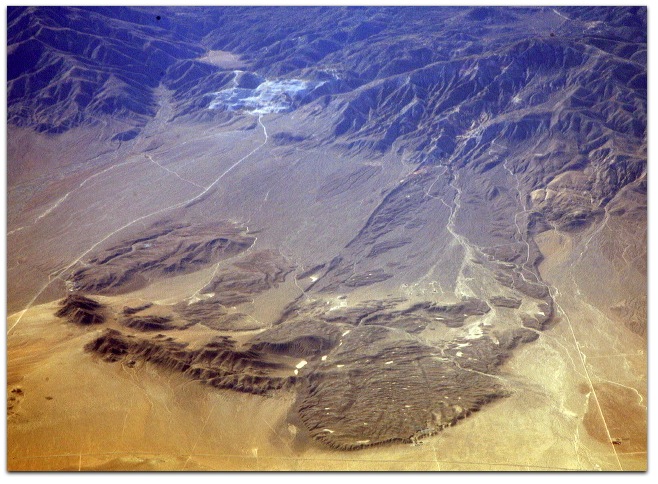
    One day, back around 15,000 BCE, half a mountain in Southern California broke loose and slid out onto what’s now the Mojave desert. The resulting landform is called the Blackhawk Slide. Here it is:

    It’s that ripple-covered lobe on the bottom right. According to Robert Sharp’s Geology Underfoot in Southern California, it didn’t just flow off the mountain, as would happen with a typical landslide. It actually slid intact, like a toboggan, four and a half miles, on a slope of only two to three degrees. It could not have traveled so far, and have remained so intact (with rock layers preserved, in order, top to bottom), if it had merely flowed.

    Geologists can tell it slid because it didn’t just heap at the base of the mountain from which it detached. Instead it soared, at low altitude, four and a half miles, on the flat, on a cushion of air, out across the desert, before plopping down.

    To get some perspective on this, here are two facts to consider. First, we’re talking about ten billion cubic feet of detached mountain face here. Second, in order to travel that far out onto the desert, shattered but essentially in one piece, it had to glide on a cushion of air, at speeds up to 270 miles per hour. Or so goes the theory.

    One wonders if humans were there to see it happen. Ancestors of native Americans were already on the continent by then, thanks to the last glacial maximum, which still had several thousand more years to go. There may have been some ice on the mountains themselves, and perhaps that helped weaken the rock, which was already raised to the sky by pressures on the San Andreas Fault, which lies on the back side of the San Bernardino Mountains, a couple dozen miles from here.

    I came along a bit late, but was glad to get my first chance to gander at the slide, the day after Thanksgiving, on a United flight from San Jose to Houston. I was shooting against the sun, and it was a bit hazy, but I was still able to get a good look, and this photo set too.

    Additional links:

  • Threading the year end

    From Dave‘s Threads outline of posts…

    Pointing to those, in a way, makes good on the first installment of one of my resolutions.

  • The costs of celebrity

    On the way back from a concert in Brooklyn yesterday we shared the subway with a well-known filmmaker. He’s one of those people who look ordinary enough to blend in with the rest of us, which is lucky for him. Still, he’s not anonymous. We know his name. We’ve seen his movies. We also did our best not to pay him special attention. That is, to let him have the form of privacy we call anonymity. Even if he is hardly anonymous.

    I thought it was cool that he took the subway rather than a taxi. There was a woman with him, obviously a friend. They had an energetic conversation. His voice also was familiar. She got off one stop before he did, a couple stops later.

    Our home base since ’01 has been Santa Barbara. If you hang out on State Street in Santa Barbara, or on Coast Village or Valley Road in Montecito, you’re bound to run into celebrities fairly often, since lots of them live there. The correct and courteous thing to do is ignore them: to pretend, as best you can, that they have not made the Faustian trade of anonymity for fame. I’ve known a few celebs in my time and without exception they’ve found being known to everybody mostly a drag.

    This stuff is close to my mind these days because privacy is a Big Issue. See, online we are all celebrities to the advertising personalizers. That’s why sites plant cookies and tracking beacons in our browsers to follow us around like invisible paparazzi. Fixing it won’t be easy; but we will fix it, sooner or later. Simple courtesy demands it. And it is on simple courtesies that civilization stands.

  • Wanted: truly crowd-sourced NBA all-star voting

    Interested in the NBA all-star game? Go to the latter (at that link) and you’ll see a panel for AllStarBallot.NBA.com. Go there and you’ll find Step 1:

    Sign in or create an account as an NBA.com All-Access member.

    SIGN IN TO VOTE

    CREATE AN ACCOUNT

    Click the second link and you’ll find a pop-over form with lots of personal stuff to type in to boxes, followed by this:


    By clicking the Sign Me Up to Vote button, (1) you acknowledge that we may communicate with you at the email address you have supplied regarding your membership benefits and that we reserve the right to change membership terms, benefits and access at our sole discretion and (2) you accept and agree to our Terms of Useand our updated Privacy Policy..

    Yo, NBA. Let me talk a little trash here.

    First, creating an account is fine, even if it’s very 1995.

    Second, don’t pre-check something to make opt-out look like opt-in. That move doesn’t sell anything to my defense.

    Third, you’re not scoring shit with that small print. Yeah, I know it’s the usual stuff. I don’t care. It gives me nothing but junk mail and exposure to stuff I don’t want, including stuff I don’t even know I don’t want until it happens and I may not even be able to tell it happened because you let it happen. Enough of that crap.

    You want to crowd-source all-star voting by fans? Let them come up with their own system. This one is as old-fashioned and broken as the no-dunk rule.

  • Catching up

    Some links and thoughts on a Saturday night…

    The Matrix is still my favorite movie of all time. I explained why here in Linux Journal, back in 2006.

    Spoke to the Chief of Naval Operations Strategic Studies Group, of the U.S. Naval War College earlier this week, in Southbridge, Mass. The session was three hours long, with additional conversations before and after. The challenge was to present a view of the connected world from five decades back in the past to several more into the future. The discussion was one of the best I’ve had with any group, which wasn’t surprising, given the high level of competence and curiosity required of CNO fellows and other personnel, starting with Admiral Hogg, who runs the show there. Sometime soon I’ll put up an essay summarizing what I came up with there.

    Google Maps for iOS rocks. I’ve tested it driving from Southbridge to Manhattan, and for walking and riding public transportation around Manhattan as well. On the way down in the car it had me going from 84 to 91 to 95 — my usual route — but then re-routed me over to 15/Merritt Parkway when traffic started to back up on ’95 thirty miles ahead. I assume that was the reason, anyway. Oh, it also vocalized. Huge improvement over the old Google and the new Apple Maps app. And today it got us to Brooklyn, the Village, Eatery on 23rd & 5th, and then back home to “upstate” Manhattan, with precision and clarity. Well done.

    I also want to give Nokia’s NAVTEQ-based Here.com and its Here app props, even though, as of today, Google’s Maps app beats it. That’s because  NAVTEQ welcomes user input. I suppose Google and Apple do too, at least to some degree. But my fantasy here is making a connection between Open Street Map and Nokia/NAVTEQ. The timing wasn’t right for that in the past; but I think it might be soon — especially after Nokia (inevitably) starts offering Android-based phones.

    Google’s Lost Social Network, by Rob Fishman in BuzzFeed. Long piece, still sinking my mental teeth into it.

    Season Has Changed, but the Drought Endures, by John Eligon in the New York Times. I took some shots of the dry Mississippi last month on a flight from Houston to Boston. Here they are. Compare those to Google Earth’s view of the same scene in wetter times.

    How Much It Would Cost Google To Become A National Cable Company Like Comcast? asks the headline above Jay Yarow‘s story in Business Insider. How about … To Become a National Internet Company Like Comcast Never Will Be? The answer, from Goldman Sachs, is $140 billion. So how about Google and Apple chipping in and doing it together? Hey, why not?

    In a related matter, here’s Time Warner Cable: Demand Not There for Google Fiber: Insists That if People Want 1 Gbps, They’ll Provide it, by Karl Bode in Broadband. This reminds me of a conversation Craig Burton once had with a honcho at a BigCo to whom Craig explained a huge opportunity. The honcho at the BigCo said, “We’ll do it when there’s a demand for it.” To which Craig responded, “When somebody says something like that, they mean one of two things: either ‘Over my dead body,’ or ‘I don’t understand what you said.’” With Time Warner, it’s the first of those. By the way, I just ordered Time Warner’s Internet service here in New York City, after it became clear that Verizon FiOS, which provides me with 25Mbps symmetrical service in Boston, won’t be coming through here for a few more months. I want more than the 5Mbps upstream that Time Warner provides, so there is at least one customer’s demand for something better what they offer with their best package — at least from me. And I’m sure I’m not alone. Not if “the cloud” means anything. (The cost for 50/5Mbps, btw: $85/month.)

    Federal agency wants black boxes in every new car by September 2014, by Cyrus Farivar in ArsTechnica. The idea is to help the car companies and feds toward “understanding how drivers respond in a crash and whether key safety systems operate properly.” Correctly, Cyrus asks in a subhead, “Who owns the black box data?” How about the car owner? Here ya go:

    As per NHTSA’s proposed rule, the collected data would include vehicle speed, whether the brake had been activated, crash forces at the moment of impact, the state of the engine throttle, airbag deployment timing, and whether or not seatbelts were in use.

    Since 2006 the NHTSA established recommended guidelines for EDRs, but did not mandate them. As we reported in April 2012, car manufacturers have been required to disclose the presence and physical location of an EDR in a car’s owner’s manual since 2011. Seven years earlier, California became the first state to mandate such disclosure.

    The NHTSA has a policy that EDR data would be treated as the property of the vehicle owner and not accessed without his or her permission. The agency also noted in its new 56-page document (PDF) that it “does not have any authority to establish legally-binding rules regarding the ownership or use of a vehicle’s EDR data.”

    Copyright: Holding back the torrent. In TheNextWeb. Grist for many mills.

    The Power of Selling Out: Customers as Political Capital. As only The Onion can put it. Close to home.

    D.O.A.: Death of Advertising, by Edward Montes in MediaPost. It lauds RTB, without explaining what it is. (Answer: Real Time Bidding.) The gist (just to pick one paragraph among others like it):

    RTB empowers the tailoring of every aspect of a brand’s communication with a consumer, transforming mass media to direct communication between brand and consumer. The ability to buy individual advertising impressions, based on large quantities of data about that impression and inevitably about the consumer of that impression, enables the concept of “customization at scale.” This notion is not advertising as most recognize it using mass media, but rather the death of advertising, because it alters the interaction in the intermediate communication layer between brand and consumer. This level of close interaction imposes a tremendously more difficult environment for marketers, as every single media brand exposure has the opportunity to be definitively more valuable and thus requires much more detailed planning and purchase. It also rewards marketers able to learn, adapt and generally be dynamic. Interestingly, this does not pose a new paradigm for publishers or producers of content — but rather, in maturity, should place even higher values on publishers that can deliver high value audiences via quality content and quality environments.

    Speaking as the human target of this kind of shit, let me put it the way The Cluetrain Manifesto did, almost fourteen years ago:

    we are not seats or eyeballs or end users or consumers. we are human beings and our reach exceeds your grasp. deal with it.

    The next Web will grow faster. By Dave Winer. Comment there by yours truly.

    And with that I’m going to bed. More in the morning.


  • “is dead” isn’t dead, but needs to die

    All these living things have been declared dead…

    … and then some. Look up any subject with “is dead” as its direct object and there’s a good chance somebody will have said exactly that. It’s one of the most overworked clichés in all of journalism (if that’s still alive enough to use as a label). Let’s move on.

  • Remembering Peter Sklar, placeblogging pioneer

    This is a hard one to write. Peter Sklar, the founder, editor and chief-everything of Edhat, Santa Barbara’s original onine daily, has died.

    Peter was the Steve Jobs of placeblogging. Like Steve, he was an original genius and nobody’s fool. He could be prickly and sarcastic, and he did things his way. He was also a fun guy, great to hang out with and to talk to at any depth on any subject. Thus, in character, he had a clear and steady vision of local journalism that was equally serious and felicitous — a combination that served as a model for placeblogs across the country.

    What made Edhat so wonderful, from the start, was Peter’s light touch. There was always gentleness, humor, and a strong aesthetic sense of what’s right for the town, its people, its businesses, its unique and quirky civic qualities. Peter wrote most of Edhat in the early days, and I assume until recently as well. Edhat’s voice has remained Peter’s, always been a delight to read.

    As an original and highly principled genius, Peter could be less than sweet to others he thought were horning in on his turf, either with competing publications or with the larger concepts of placeblogging and journalism. (In fact, Peter liked neither the term “blogging” nor any of the blogging or content management systems in the market. As an alpha programmer, he home-brewed Edhat from the start. He also did it on old versions of Windows, which drove me nuts as an open source and Linux guy.*) But again, the main thing with Peter was fun. It says something that, among all the advice we gave him back in Edhat’s formative years, the one piece he took was holding a party. When I get a chance later I’ll dig up and share the pictures. Meanwhile, here’s how Craig Smith, another friend and local blogger, describes Peter and his work:

    A mathematician by training and a dedicated runner, Peter always struck me as being quirky (kind of like Edhat) and he could at times be temperamental. He liked numbers (as in, “we counted the number of horses in the Fiesta parade”) and he liked rules. (Ever notice how many rules there are about posting comments on Edhat?) He could fairly have been described as a my-way-or-the-highway type guy. But you could also say that about Steve Jobs. But like Jobs, Peter was a genius at what he did. Never mind that guys like me didn’t like some of his rules about what kind of stories Edhat would link to (he would link to news stories but not “opinion pieces” or newspaper columns) or the fact that the comments section on Edhat often seemed to be in need of some serious adult supervision, Peter always knew what his community of readers wanted and he made sure that they got it.

    With newspapers on the decline, Peter was a champion of “citizen journalism” and Edhat was a place where a lot of breaking news in this town first got (and still gets) reported. And many times that reporting is done by the Edhat community of readers. Skeptical of mainstream media, he once told me, “Remember, the word ‘professional’ only means that they are getting paid.”

    It’s meaningful that Craig and I both compare Peter to Steve. (Note: I didn’t see Craig’s post until I started writing this one.)

    I only got the news about Peter over breakfast a few minutes ago, from my wife, who knew him better than I did. It clobbered us both. Santa Barbara is home for us, but our work takes us elsewhere so much that we don’t get to see our friends there often enough. I was looking forward to catching up with Peter on our next return to town over the holidays. Even though I kept up with Santa Barbara through Edhat, I missed learning that Peter had been sick with inoperable brain cancer for over a year. Now he leaves a huge hole in our hearts, an in our town.

    But Edhat lives, and not just in Santa Barbara. I can’t begin to tell you how much tenacity and grace it takes to do what Peter and his crew have done with Edhat.

    Here’s a picture Peter and Molly, in a nice obituary by The Independent, the local weekly paper (and a competitor with whom Peter enjoyed a happy symbiosis). And another, by Leah Etling, who worked with Peter at Edhat. More at KEYT, Noozhawk and the Santa Barbara Review. Also this from David Powdrell.

    Our hearts are with Sue, Nick, Zack, Molly and the larger Edhat family, including the great town Peter left better than he found it.

    * Few know that “Edhat” as a name actually had a Linux connection. Maybe you can guess it.

  • The biggest picture

    NYC

    I want to plug something I am very much looking forward to, and encourage you strongly to attend. It’s called The Overview Effect, and it’s the premiere of a film by that title. Here are the details:

    Friday, December 7, 2012 – 5:30pm – 7:00pm
    Askwith Lecture Hall
    Longfellow Hall
    13 Appian Way
    Harvard University
    Cambridge, MA

    The world-premiere of the short documentary film Overview, directed by Guy Reid, edited by Steve Kennedy and photographed by Christoph Ferstad. The film details the cognitive shift in awareness reported by astronauts during spaceflight, when viewing the Earth from space.

    Following the film screening, there will be a panel discussion with two NASA astronauts, Ronald J. Garan Jr. and Jeffrey A. Hoffman, discussing their experience with the filmmakers and with Douglas Trumbull, the visual effects producer on films such as 2001: A Space OdysseyClose Encounters of the Third Kind, and Star Trek: The Motion Picture. The event will be moderated by Harvard Extension School instructor Frank White, author of the book The Overview Effect, which first looked at this phenomenon experienced by astronauts.

    This event will take place on the 40th anniversary of the Blue Marble, one of the most famous pictures of Earth, which was taken by the crew of the Apollo 17 spacecraft on December 7, 1972.

    Seating is limited and will be assigned on a first-come first-serve basis. The event will also be streamed live at http://alumni.extension.harvard.edu/.

    The Overview Effect is something I experience every time I fly, and why I take so many photos to share the experience (and license them permissively so they can be re-shared).

    The effect is one of perspective that transcends humanity’s ground-based boundaries. When I look at the picture above, of the south end of Manhattan, flanked by the Hudson and East Rivers, with Brooklyn below and New Jersey above, I see more than buildings and streets and bridges. I see the varying competence of the geology below, of piers and ports active and abandoned. I see the palisades: a 200-million year old slab of rock that formed when North America and Africa were pulling apart, as Utah and California are doing now, stretching Nevada between them. I see what humans do to landscapes covering them with roads and buildings, and celebrating them with parks and greenways. I see the the glories of civilization, the race between construction and mortality, the certain risks of structures to tides and quakes. I see the Anthropocene — the geological age defined by human influence on the world — in full bloom, and the certainty that other ages will follow, as hundreds have in the past. I see in the work of a species that has been from its start the most creative in the 4.65 billion year history of the planet, and a pestilence determined to raid the planet’s cupboards of all the irreplaceable goods that took millions or billions of years to produce. And when I consider how for dozens of years this scene was at the crosshairs of Soviet and terrorist weapons (with the effects of one attack still evident at the southern tip of Manhattan), I begin to see what the great poet Robinson Jeffers describes in The Eye, which he saw from his home in Carmel during WWII.

    But it is astronauts who see it best, and this film is theirs. Hope it can help make their view all of ours.

  • FiOS is in my street. Can I have some?

    [4 December: I got a call from Verizon and an answer. For that, skip down to *here.]

    We have a new apartment in Manhattan. Washington Heights. Verizon FiOS is here. FiOS trucks roam the streets. They set up little tables in front of apartments where FiOS is now available, to sign customers up. My wife talked to a guy at one of those recently, and he told us Verizon would bring FiOS to any apartment building where a majority of tenants welcomed it, provided the fiber is in the street. Our street has it, but we can’t get through to Verizon by the usual means (website, phone number). Checking with those is a dead end. They say it’s not available. But I want to know for sure, either way. Because I’ll bet I can sell a majority of tenants on going with FiOS. I know FiOS, because I’ve been a customer near Boston since 2007. So can somebody from Verizon please contact me? Either here or through @dsearls. Thanks.

    * Had a good talk with a Verizon rep who called me today (4 December). Here’s what she said:

    1. FiOS is not ready on our street yet, but it will be.
    2. When it is, building owners will be notified, both by mail and in person if possible. So alert the building owner to this eventuality, if the owner is not you.
    3. Meanwhile also go on the website and navigate to where you can request service. Even if they say it’s not available now, the request will be remembered when the service actually rolls out.
    4. Right now Verizon has stopped pushing or building out any new services while existing ones are down or damaged due to Sandy. Since there was a lot of damage, and many customers affected, the company’s first priority is restoring that service. This will take awhile. No telling how long yet.
    5. When the Sandy restoration job is complete, the company will go back to expanding services to both new and existing customers.

    So I’ll call Time Warner tomorrow. Meanwhile, maybe the information above will help you too.

  • Journalism is outlining

    Jackson Pollock[Updated 1 December to add the addendum below. If you’re new to this post, start here. If you’ve read it already, start down there.]

    In Journalism as service: Lessons from Sandy, Jeff Jarvis says, “After Sandy, what journalists provided was mostly articles when what I wanted was specifics that those articles only summarized. Don’t give me stories. Give me lists.”

    Journals aren’t going to stop giving us stories, because stories are the main attraction. But lists are the service. They are also the frontier, because journals on the whole suck at lists. That’s what we’ve been learning over and over and over again, every time something Too Big happens. (Sandy, Katrina, the Arab Spring, the financial meltdown, yada yada.) We get plenty of stories, but not enough lists. Or, not the lists we need if we’re affected by the event.

    Back when Sandy was going on, I stayed in Boston and blogged it live. One of my main sources was The Weather Channel, aka TWC — on TV, more than the Net. (My “TV” was an iPad channeling our Dish Network set top box in Santa Barbara.) As I recall, TWC had two main reporters on two scenes: one in Point Pleasant, New Jersey and one at Battery Park in Manhattan. Both had lots of stories to tell and show, but as a service TWC missed approximately everything other than what happened in those two places. I say approximately because the damage being done at the time was widespread, huge, and impossible for any one news organization to cover. (And TWC actually did a pretty good job, as TV channels go.) Seen as an outline, TWC looked like this:

    SANDY

    • General coverage from studios
      • TWC
      • National Hurricane Center
    • Field coverage
      • Battery Park
      • Point Pleasant

    That’s far simpler than what TWC actually did at the time, of course. But I’m trying to illustrate something here: that coverage itself is an outline. Also that cover, as both noun and verb, is something no single news organization can create, or do. They all do a partial job. The whole job, especially for a massive phenomenon such as Sandy, requires many journals of many kinds.

    In a way we have that with the Web. That is, if you add up all the stuff reported about Sandy — in newspapers, on radio and TV, in blogs, in tweets, on social media — you’ve got enough info-splatter to call “coverage,” but splatter isn’t what Jeff needs. Here are his specifics:

    I wanted lists of what streets were closed. I wanted lists of what streets the power company was finally working on. Oh, the utility, JCP&L, gave my town, Bernards Township, lists of streets, but they were bald-faced lies (I know because my street was on that list but their crews weren’t on my street). The town and our local media outlets only passed on these lists as fact without verifying. I wanted journalists to add value to those lists, going out to verify whether there were crews working on those streets. In a word: report.

    I wanted media organizations or technology platforms to enable the people who knew the facts — my fellow townspeople — to share what they knew. Someone should have created a wiki that would let anyone in town annotate those lists of streets without power and streets — if any — where power crews were working. Someone should have created a map (Google Maps would do; Ushahidi would be deluxe) that we could have annotated not only with our notes and reports of what we knew but also with pictures. I’d have loved to have seen images of every street blocked by trees, not just for the sake of empathy but also so I could figure out how to get around town … and how likely it was that we’d be getting power back and how likely it would be that buses would be able to get through the streets so schools could re-open.

    But instead, we got mostly articles. For that’s what journalists do, isn’t it? We write articles. We are storytellers! But not everything should be a story. Stories aren’t always the best vehicle for conveying information, for informing the public. Sometimes lists, data bases, photos, maps, wikis, and other new tools can do a better job.

    What Jeff wanted was a painting, or set of puzzle pieces that fit together into a coherent and complete painting. A good outline does that, because it has structure, coherency, and whatever level of detail you need. Instead Jeff got something out of Jackson Pollock (like the image above).

    We need outlines, we get splatter. Even the stories, high-level as they often are, tend to work as just more splatter.

    How do we get outlines? Here are some ways:

    1. If you’re a journal, a journalist, a reporter, a blogger… start responding to the demand Jeff lays out there, especially when a Big Story like Sandy happens. Provide lists, or at least point to them. It’s a  huge hole. Think about what others are bringing to the market’s table, and how you can work with them. You can’t do it all yourself. Nor should anybody.
    2. Listen to Dave Winer, who has been working this frontier since the early ’80s, and has given the world lots of great stuff already. (Here’s his latest in outline form.)
    3. Start looking at the world itself as a collection of outlines, and at your work as headings and subheadings within that world — even as you don’t wish to be confined to those, and won’t be, because the world is still messy.
    4. Go deeper than wikis. Wonderful as they are, wikis are very flat as outlines go. They are only one level deep. So is search, which is worse because every search is temporary and arcane to whatevever it is you search for at the moment, and whatever it is the engine is doing to personalize your search.

    It’s not easy to think of the world as outlines. But seeing the plain need for lists is a good place to start.

    Addendum

    After reading the comments, I should make a few things clearer than I did above.

    First, Jeff’s line, “Don’t give me stories, give me lists,” does not mean stories are wrong or bad or without appeal. Just that there are times when people need something else. Badly. Giving somebody a story when they need a list is a bit like giving somebody who’s fallen overboard a meal rather than a life preserver. It’s best to give both, at the right time and place. One of my points above is that no one journal, or journalist, should have to do it all. A related point I didn’t make is that pulling together lists, and linking lists together, is less thankful work than writing stories. True, writing stories isn’t always easy. But story-writing is rewarding in ways that compiling lists are not. Yet lists may save lives — or at least hassles — in ways that stories may not.

    Second, seeing “the world as outlines” does not require that any one person, site or journal produce lists or outlines for anything. The totally flat and horizontal nature of hyperlinks (and, not coincidentally, wikis) makes it at least possible for everything to be within a link or few from everything else. While this linky flatness can excuse what I call “splatter” above, it also suggests a need for mindfulness toward coherency, and the absent need for anybody to do everything. As structure goes, the Web is more like scaffolding than like a building. If we see journalism as outlining, and lists as an essential part of any outline, and hyperlinks as a way of connecting multiple lists (and stories) together, we can make multiple scaffolds function together as a coherent whole, and ease the labor required, say, for piecing one’s life back together after a storm.

    Third, we are dealing with a paradox here. Outlines are hierarchical, and — as David Weinberger put it so well in Cluetrain — hyperlinks subvert hierarchy. Thus one of the things that makes the Web a web also makes it a poor place for persistent structure. Yes, we can create buildings of sorts. (For example, anything with a domain name.) But all are temporary and vulnerable to future failings or repurposings. Big as Facebook is, there is nothing about the nature of its mission or corporate structure, much less of the Web beneath it, to assure the site’s permanence. (I have exactly this concern about Flickr, for example.) Built into the Web’s DNA, however, is a simple call to be useful. That too is a call of journalism. It is a more essential calling than the one to be interesting, or provocative, or award-worthy, or any of the other qualities we like to see in stories. A dictionary is poor literature, but a highly useful document. It is also a list. A bookshelf with several dictionaries on it is an outline. So is a library.

    Fourth, there are many reasons that outlining hasn’t taken off as a category. Some are accidents of history. Some have to do with the way we are taught outlining in school. (Poorly, that is.) But the biggest, I’m convinced (at least for now) is that we fail in general, as a species, to see larger pictures. We fail to see them in the present moment, or in the present situation (whatever it is), and we fail to see them across time. This is why even people called “conservatives” see little reason to conserve finite resources for which there are no substitutes after they run out.

    Fifth, we need new development here. My point about wikis is that they don’t cover all the ground required for outlining the world. Nothing does, or ever will. But we can do other things, and do them better. It’s still early. The Web as we know it is only seventeen years old. The future, hopefully, is a lot longer than that.

    Meanwhile, a grace of a storm like Sandy is that it can make a serious journalist call out for something serious that isn’t journalism-as-usual. And that the result might be better scaffolding to hold together the temporary undertakings we call our lives.

  • Read on

    First, ICANN, Make a Difference: The $100 million raised by the sale of new Web domains should be used to wire Africa, by Sascha Meinrath and Elliot Noss. Ambitious and worthy, if it can actually be done. (I always like betting on optimists.)

    Second, a raft of advertising coverage. We’ll start with  several from Don Marti:

    Don blogs linkily, and you can spend a productive day just following the ones he puts in his posts (including all the above).

    Speaking of AdAge, there’s quite a pile of links worth visiting there too:

    The third  item above is based on an error, but not an uncommon one. “DNT should have made me invisible to ad trackers,” Kate writes. This is not the case. In a comment below that post I wrote, “Do Not Track is not an invisibility cloak. It is a ‘preference expression’ in a browser that a site can respect or ignore. The default for most commercial sites is to ignore the expression.” Go to the W3C pages on DNT and you’ll see it’s still under development as well. That alone is surely an excuse to many sites for ignoring it.

    Alan Harrell also has a strongly-worded response to this earlier post of mine, which also visits DNT. One pull-quote: “The back end of the web is turning into a nightmare of data mining that on its best day will be sold for a Minority Report style pre-buy and on its worst pre-crime.”

    Now, from the tab collection:

    Also digging all the good work being done by Pro Publica:

    About results: How Pro Publica changed investigative reporting, by Frédéric Filloux in The Guardian.

  • The evolution of radio from waves to streams

    WMVY is mvyradioa delightful music station on Martha’s Vineyard, with a great history, that I always enjoy tuning in when I head down that way to visit friends in Falmouth or Woods Hole. Alas, like so many other good small radio stations, it’s is going off the air. The station’s signal on 92.7fm has been sold to WBUR, one of Boston’s two big public radio stations. (WGBH is the other.)

    Here’s WBUR’s press release, issued early this morning. The gist:

    The sale of the 92.7 FM signal paves the way for WBUR to reach listeners on Martha’s Vineyard and most of Cape Cod and Nantucket, as well as the Massachusetts ‘SouthCoast’ including New Bedford, Fall River, Falmouth, Westport and Marion. WMVY, known on air and online as mvyradio, plans to create a non-profit, commercial-free business model going forward.

    WBUR will now have all these signals:

    1. WBUR-FM/90.9 in Boston. (Coverage Map.)
    2. WBUR-AM/1240 in West Yarmouth (Coverage Map.)
    3. WSDH-FM/91.5 in Sandwich (Coverage Map.)
    4. WCCT-FM/903 in Harwich  (Coverage Map.)
    5. WMVY-FM/92.7 in Tisbury (Coverage Map.)

    WMVY will remain on the Web. If you go to their website, a brief message directs you to this page, where an all-text message says,

    This is real. We must evolve. Or face extinction.

    By early 2013, mvyradio will either become a non-commerical, listener-supported operation or go silent. It’s that urgent and that simple.

    For almost 30 years, mvyradio has broadcast on 92.7FM, bringing the Cape, Islands and Southcoast an eclectic mix of music and a spirit deeply rooted in our surroundings. It’s also been a fixture on listeners’ home computers, smart phones, tablets and internet radios.

    Despite a devoted listenership, mvyradio has not been solvent.

    We’ve been fortunate. Aritaur Communications has covered our losses, but that is no longer feasible.

    As a result, Aritaur has sold the 92.7FM frequency to WBUR, Boston’s NPR news station. Once approved by the FCC in early 2013, WBUR will be heard on 92.7FM.

    This is both an opportunity and a pretty gigantic challenge.

    First, the opportunity. Only the FM signal has been sold to WBUR. Aritaur is contributing mvyradio’s programming, online content, equipment and staff to the non-profit Friends of mvyradio. So, the core is there.

    That means mvyradio, as you know it — all the music, personalities, shows and web content — can live on as a non-commercial, internet public radio station.

    That’s the opportunity. The future. Commercial-free.

    Now the challenge. We need — the Friends of mvyradio needs — to raise $600,000 in pledges by the end of January.

    Yes, that’s an enormous lift. But, one well worth making to keep an independent radio gem like mvyradio on the air.

    Do you want mvyradio to live on? Or will it die like so many other independent broadcast treasures?

    Please click through to the pledge page and help save mvyradio.

    It goes on, but that’s the pitch.

    Now let’s say you live on the Cape and like noncommercial radio. In addition to WBUR and mvyradio, you also have WCAI, the Cape And Islands station. Located in Woods Hole, it broadcasts from Martha’s Vineyard on 90.1fm, plus over WZAI/94.3 in Brewster and WNAN/91.1 in Nantucket. While WCAI is “a service of WGBH,” it operates independently, and is very much a regional station. Its only drawback is its dinky home station signal, which radiates from the same tower as WMVY. While WMVY is 300o watts, horizontal and vertical, at 315 feet above average terrain (height matters at least as much as power), WCAI is 1300 watts at 249 feet.It also radiates only in the vertical plane, and at full power only to the north, toward Woods Hole. In other directions it’s as little as 234 watts. (You can see the directional pattern here and the coverage here.) WCAI does have a construction permit for 12500 watts at 241 feet, from a different tower in the same location. That signal is directional too, but the dent is smaller and only toward the northeast, where the notch in its null is still 5087 watts. WZAI and WNAN are also good-size signals.

    Then there is noncommercial classical WNCK in Nantucket, with these translators on Cape Cod:

    1. W230AW-FM/93.9 in Centerville (Coverage Map.)
    2. W246BA-FM/100.7 in Harwich Port (Coverage Map.)

    WNCK carries WGBH’s classical programming from WCRB. It wants funding too.

    That’s a lot of radio mouths for listeners to feed. I’m curious to see how it all sorts out, with WBUR horning in on WCAI’s home turf, and with mvyradio going Internet-only. As a “statutory webcaster,” mvyradio’s music royalty rates might be a bit higher at first. (See here.) In any case, they’ll have serious costs. They’ll also be competing with every other webcaster in the world.

    This is a liminal time for radio, as the bulk of usage gradually tilts between over-the-air and over-the-Net. In the long run, the latter will outperform the former, just as FM outperformed AM back when the difference began to fully matter.

    Coverage via the Net is worldwide: basically, anywhere with a good mobile data connection. Right now navigating one’s way to a stream is still complicated. Even good “tuners” on phones, such as TuneIn, can be frustrating to use. And without the old “dial” positions or “channels,” stations can be hard to find. And then there’s the whole matter of data charges by mobile phone companies, “caps” on usage and the rest of it. But we’ll work that out in time.

    Meanwhile, check out the ratings (from Radio-Info.com) for the top markets. Look closely at Washington, D.C. (where I’m headed on Amtrak while I write this). WAMU a public station, has the top position with an 8.7 share. By radio standards, that’s just huge. And it’s ahead of all-news WTOP, which is the top-billing station in the whole country. Then scan down to the low-rated stations. WAMU’s stream gets an 0.3 share. That’s tied with several AM stations and 3 times the share of bottom-rated WFED, Federal News Radio, which transmits from WTOP’s original 50,000-watt powerhouse transmitter on 1500am. That’s a harbinger if I ever saw one.

    Curious to know if any readers are following this, and how they weigh in on the changes. I can’t help writing about it, because I know the field — so well, in fact, that I can see whole parts of it going away.

  • Maybe we’re the only hope for Apple maps

    Take a look at these screenshots of maps on my iPhone 4, running iOS 6:

    maps

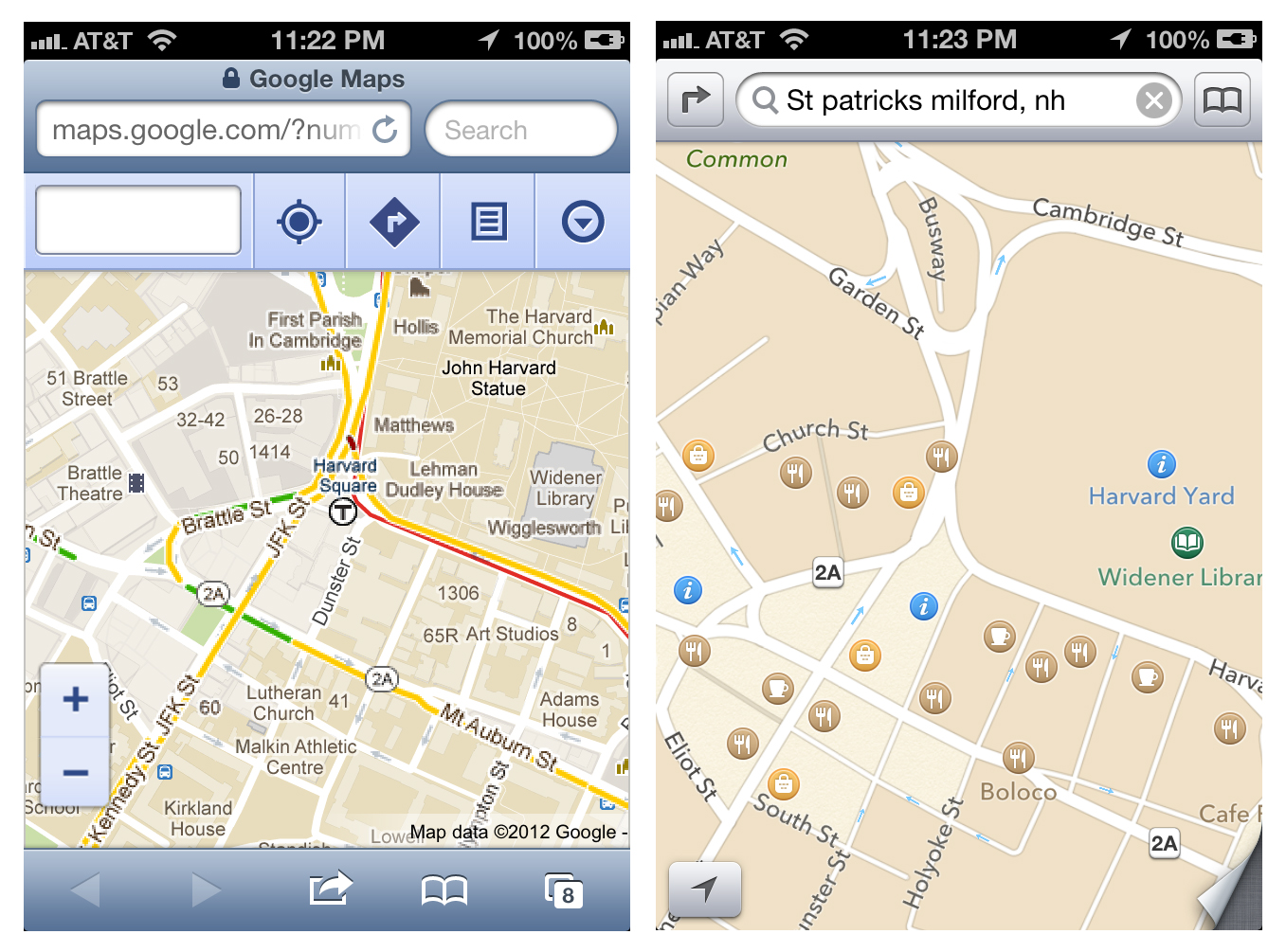
    On the left, maps.google.com, made mobile. On the right, Apple’s new Maps app, which comes with iOS 6. The location in both cases is Harvard Square, not far from where I am right now.

    Note how the Apple app not only lacks the Harvard Square T stop (essential information for any map of this type), but traffic information as well. (Not to mention a bunch of other stuff, such as landmarks and street names. (Neither is perfect at the last two, but Google is way better.)

    This is beyond inexcusable, especially now that it’s going on two months since Tim Cook apologized for Apple’s Maps fail and promised improvements. How hard can it be, just to add essential subway info? Very, apparently.

    I go a bit deeper in this response to this post by Dave a few hours ago. To sum it up, I think only two things will save Apple’s bacon with maps. One is that Nokia/Navteq, Google and others provide maps on iOS that are better than Apple’s, saving Apple the trouble of doing it all. The other is crowd-sourcing the required data, simply because Apple by itself can’t replicate the effort both Google and Nokia/Navteq have put into what they’ve already got. But with the rest of us, Apple can actually do better. It’ll take a sex change for them to un-close their approach to mapping. But they’ll leapfrog the competition in the process, and win loyalty as well.

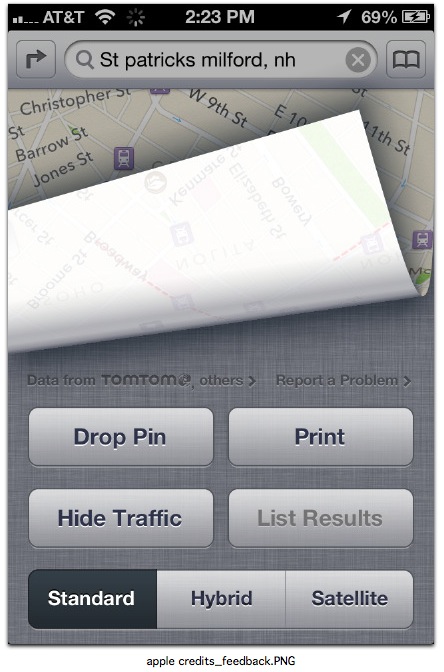
    [Later…] Here is a screenshot that helps enlarge some points I make below in response to Droidkin’s comment:

    apple credits and feeback

    Note how dim, dark and hidden the small print is here. “Data from TomTom, others” goes to this list of credits. Also “Report a Problem” is simplex, not duplex, far as I know. You can tell them something but it’s like dropping a pebble into the ocean. Who knows what happens to it?

  • An open letter on patents, 12 years later

    I’m on a list where the subject of patents is being discussed. While thinking about how I might contribute to the conversation, I remembered that I once cared a lot about the subject and wrote some stuff about it. So I did some spelunking through the archives and found the following, now more than twelve years old. It was written during Esther Dyson‘s PC Forum, and addressed via blog to those present there. So, rather than leave it languishing alone in the deep past, I decided to run it again here. I’m not sure if it contributes much to the patent debate, but it does surface a number of topics I’ve been gnawing on ever since. 

    — Doc


    I think I could turn and live awhile with the animals…
    Not one is demented with the mania of owning things.

    Walt Whitman


    PC Forum 2000,
    Phoenix, AZ. March 15, 2000.

    Source Coders

    Six years ago, at PC Forum 94, John Gage of Sun Microsystems stood on stage between a twitchy Macintosh Duo and a huge projection screen, and pushed the reset button on our lives.

    He showed us the Web.

    It was like he took us on a tour of the Milky Way — a strange, immense and almost completely alien space. With calm authority and the deep, warm voice of a Nova narrator, he led us from the home page of a student in Massachusetts to a Winter Olympics report archive in Japan, then to a page that showed everything useful piece of data about every broadcast satellite, compiled and published by a fanatic in North Carolina.

    We all knew it was fabulous, but why? How could you make money in a world of ends where nobody owns the means? How could you make sense of a network that is nobody’s product and everybody’s service? And where the hell did it come from?

    • Not Compuserve, AOL, Prodigy or any of the other online services
    • Not Novell, 3Com, Crisco, or any of the infrastructure companies
    • Not AT&T, MCI, Nortek or any of the phone companies.
    • Not Microsoft, Apple, Sun or any of the other platform companies.

    Sure, it ran on all of them; but it belonged to none of them. And since they couldn’t own it, they never would have made it. So who the hell did make it?

    In a word, Hackers. Programmers. Guys who were real good at writing code. Lots of those guys worked for companies, including the companies we just listed. Lots more worked in the public sector, for schools and government organizations. What they shared was a love of information, and of putting it to work. They put both passions into building the Net, working cooperatively in what Eric Raymond calls a “gift culture,” like Amish farmers raising a barn.

    Hackers didn’t build the Net for business. They built it for research. They wanted to make it easy for people to inform each other, no matter who or where they were.

    Several days ago Tim O’Reilly and I were talking about information, which is a noun derived from the verb to form. We use information, literally, toform each other. So, if we are in the market for information, we are asking to be formed by other people. In other words, we are authors of each other. It follows that the best information is the kind that changes us most. If we want to know something — if we are in the market for knowledge — we demand to be changed.

    That change is growth. Our identity persists, yet who-we-are becomes larger, because we know more. And the more we know, the more valuable we become. This value isn’t a “brand” (a nasty word that comes to us from the cattle industry). It’s reputation.

    What these hackers made was an extraordinarily vast and efficient market for knowledge — a wide-open marketspace for information — where everybody gets to participate, to contribute, to grow, and to increase the value of their own reputations.

    Utopia

    It turns out that the Net is also good for business, even though it was not written for business. In fact, “good” is too weak a word. The Net is a Utopia for business.Think about it. This is a place where —

    • The threshold of enterprise is approximately zero.
    • All you need to get millions of dollars is an idea that looks like it could be worth billions more.
    • You can create those billions of dollars in value just by impressing people with your idea.
    • The value of your idea can grow from zero to billions in a matter of hours.
    • You see investment as income, because you’re obligated to burn it, and you don’t need to hock your house or your car to get it.
    • Promise of reward far out-motivates fear of punishment, because there is no punishment.
    • Failure informs and therefore qualifies you for more money to fund your next idea, because both your knowledge and your reputation have grown in the process

    To succeed in this world, your business only needs to be Utopia-compatible. That is, your people need to be in the market for information — or, in the parlance of The Cluetrain Manifesto — in the market for clues.

    Yet many companies, especially traditional industrial ones, are not in the market for clues. They neither supply nor demand them. They put up a Web site, strictly as a pro forma measure. The corporate face is blank, the voice robotic. David Weinberger writes, “Companies that cannot speak in a human voice make sites that smell like death.”

    The medium is the metaphor

    Their problem is conceptual. They literally concieve markets — including the vast information market of the Net — in obsolete terms. They see them as real estate, as battlefields, as territories, as theaters, as animal forces. And none of those metaphors work for the Net.

    Three years ago, at PC Forum 97, George Lakoff told us how metaphors work (a good source is his 1980 book, Metaphors We Live By). We were taught in school that metaphors were poetic constructions. In fact, metaphors scaffold our understanding of the world. Conceptual metaphors induce the vocabularies that describe every subject we know.

    Take life. In a literal sense, life is a biological state. But that’s not how we know life. If we stop to look at the vocabulary we use to describe life, we find beneath it the conceptual metaphor life is a journey. We cannot talk about life without using the language of travel. Birth is arrival. Death is departure. Choices are crossroads. Troubles are potholes or speed bumps. Mistakes take us off the path or onto dead end streets.

    Take time. Our primary conceptual metaphor for time is time is money. We save, spend, budget, waste, hoard and invest it.

    Conceptual metaphors are equally ubiquitous and unconscious. They are the aquifers of meaning beneath the grounds of our consciousness. Think about how we turn what we mean into what we say. When we speak, we usually don’t know how we will finish the sentences we start, or how we started the sentences we finish. Think about how hard it is to remember exactly what somebody says, yet to know exactly what they mean. Conceptual metaphors are deeply involved in this paradox. They help us agree that we all understand a subject in the same metaphorical terms.

    Now lets look at markets. This morning Steve Ballmer told us that Microsoft’s first principle was “to compete very hard, do your best job, study ideas, move forward aggressively.” What is the conceptual metaphor here? Easy: markets are battlefields. There are two sets of overlapping vocabularies induced by this metaphor: war and sports. So you can talk about “blowing away” competition and “level playing fields” in the same sentence. (Microsoft’s problems derive from a confusion between the war and sports metaphors. “All’s fair” in war, but not sports.)

    There are related metaphors. One is markets are real estate. By this metaphor, companies can own market territory, or lease rights to it. To a large extent, both the battle and playing field metaphors derive from the real estate metaphor.

    There are unrelated metaphors. One is markets are beings. The investment community describes markets as bullsbears, and invisible hands. They growand shrink. They have moods. They get nervouscalm or upset. Another is markets are theaters. Companies perform there, for audiences, who they would like to enjoy a good experience.Another is markets are environmentsIn The Death of Competition, James Moore speaks of markets as ecosystems where companies and categories evolvecompete in a habitat, for resources like plants and animals, and evolve or become extinct.

    So what the hell is a market, really? The answer isn’t complicated when we subtract out all the modern metaphors.

    Markets are markets

    The first markets were markets. They were real places where people gathered to talk about subjects that mattered to them, and to do business. Supply and demand, selling and buying, production and consumption, vendor and customer —all those reciprocal roles and processes that describe market relationships — were a handshake apart. Our ancestors’ surnames — Smith, Hunter, Shoemaker, Weaver, Tanner, Butcher — derived from roles they played in marketplaces. They were literally defined by their crafts.

    Yet the balance of power favored the buy side: the customers, buyers and consumers who were one and the same. The noun “market” comes from the Latin mercere, which means to buy. That’s why we call malls “shopping centers.” Not “selling centers.”

    The industrial revolution changed everything. Our ancestors left their farms and shops and got jobs in the offices and factories of industry. On the sell side, they became labor, and on the buy side they became consumers. As the Industrial Age advanced, the distance between production and consumption grew so wide that we came to understand business itself in terms of a new metahor: business is shipping. Now we had content that we loaded into a distribution system or a channel, and addressed for delivery to an end user or a consumer. Eventually, industry came to treat market as a verb as well as a noun. Marketing became the job of moving products across the complex distribution deltas that grew between a few suppliers and vast “markets,” where demand was perceived categorically, rather than personally. Every categorical subject or population — consumer electronics, cosmetics, yachting, 18-34 year old men, drivers, surfers — were all “markets.”

    My work as a journalist flanks twenty-two years in marketing, advertising and public relations. These are professions which, in spite of good advice of gurus from Theodore Levitt to Regis McKenna, conceived marketing as the military wing of industry’s shipping system. Marketing’s job was to develop “strategies” for “campaigns” to wage against “targets” with munitions called “mesages” which would succeed by “impact” and “penetration. Those targets were not customers, but “consumers,” “eyeballs” and “seats.” There was no demand by those people for messages, but that didn’t matter because those people were not paying for the messages we insisted on lobbing at them.

    So, by the end of the Industrial Age, we had not only forgotten what a market really was, but we had developed new and often hostile meanings for both the noun and the verb. We also understood both in terms of conceptual metaphors that were far removed from markets as places and as activities that defined those places.

    Around the turn of the 90s, I began to float a new metaphor: markets are conversations. I liked it for two reasons: 1) it worked as a synonmym (try substiting conversation for market everywhere the latter appears and you’ll see what I mean); and 2) every other metaphor — with the notable exception of markets are environments — insulted the true nature of markets, especiallly in a networked world built by a gift economy, where product categories and their competing occupants all grow, often at nobody’s expense.

    The idea didn’t catch on until it was put to work as Thesis #1 in The Cluetrain Manifesto. Now it’s all over the place. But it also has a long way to go. Conceptual metaphors such as markets are battlefields are huge reservoirs of bad meaning. Even highly clueful e-businesses make constant use of them.

    Which brings us to patents, which operate on the conceptual metaphor inventions are property. This metaphor worked, more or less, through the entire Industrial Age; but it runs into trouble with the Net. While patents and properties may have been involved in the development of the Net, we don’t see them among the credits. As Larry Lessig puts it, the Net grew in the context of regulation, but regulation that broaded access to the very limits of plausibility, essentially by making cyberspace a form of public property — or, more accurately, nobody’s property.

    But when we frame the argument over patents in terms of property, we must use the conceptual metaphor on which patents depend, and which also that deny the nature of the Net. We will also argue in terms of market metaphors that employ property concepts: war, games, real estate, theater, and shipping. We will not talk in terms of knowledge, information and conversation.

    The challenge

    This is where we found ourselves today, when Larry Lessig spoke to us. He said,

    “…In the context of patents, the passion to regulate rages. Some 40,000 software patents now float in the ether; a new industry of patent making was launched by a decision of the federal circuit in 1998 — the business method patent. Gaggles of lawyers, my students, now police the innovation process in Internet industry. 5 years ago, if you had a great idea, you coded it. Today, if you have a great idea, you call the lawyers to check its IP.

    “This change is the product of regulation. And while in principle, I’m in favor of patents, we should not ignore the nature of the change that this creates. Unlike open access, the regulations of patent don’t decentralize the innovative process. They do the opposite. Unlike open access, the regulations of patent don’t increase the range of those who might compete; for the most part, they narrow it. Unlike open access, patents don’t broaden the architecture of innovation. They narrow it. They are part of an architecture — a legal architecture — that narrows innovation.” (You’ll find this and many other speeches at his site.)

    A year ago I defected from marketing. I went over to the other side, joining markets in their fight against Business as Usual. That’s why I write for Linux Journal. It’s also why I co-wrote The Cluetrain Manifesto.

    Linux is the Amish barn operating system. It was conceived and built on the same principles as the Net. Not surprisingly, much of what we see on the Net is served up by Linux and other software described as “open” and “free.”

    Cluetrain insists that we start to understand the Net on its own terms. This means we have to go back to our founding hackers and look at the virtues embodied in the Utopia donated to business by the hackers’ gift culture.

    I suggest we start with these three:

    • Nobody owns it
    • Everybody can use it
    • Anybody can improve it

    Eric Raymond suggests many more. So do Bryan Pfaffenberger (who also writes for Linux Journal), Larry LessigRichard Stallman,Tim O’Reilly,James Gleick and Dave Winer, to name just a few.

    Let’s start there.

    If we start with the industrial world, we’ll stay there. And we can kiss Utopia good-bye.

  • The kontroversial kittehs of Rome

    Strays Amid Rome Set Off a Culture Clash says The New York Times. On one side, archaeologists who wish to save ruins from occupation by cats. On the other side, the cats’ lovers, including tourists who marvel more at the abundance of serene kittehs, lounging atop walls and columns than at the historic site itself:  a place called Largo di Torre Argentina, or just “Argentina” to the locals.

    It looks like Rome’s exposed basement, excavated down to one floor below street level. The broken-down walls and columns of Argentina contain no less than four Republican Roman temples and a corner of Pompey’s Theatre, beside which Julius Caesar was assassinated — perhaps within this very space. The whole thing lies within the Campus Martius, of which the main surviving structure is the nearby Pantheon.

    I was there with the family two summers ago, and shot some kitteh pictures. To help anybody who wants pix for their own kitteh-vs-whomever stories, I’ve put those shots in a photo set here. All are Creative Commons licensed for attribution only (the least restrictive license available on Flickr).

  • Do we really want the Web to be a strip mall when it grows up?

    On FlightAware I see three spaces filled with the same message. That’s a screenshot of one, on the right.

    The guilty extension, I am sure, is Adblock Plus for Chrome. What that extension blocks is an ad, not a page. I can tell it’s an ad by looking on other browsers without that extension.

    The block is also not an error. It is intentional, on my part. I’d rather not see the ads, or wait for them to load before I do.

    On other sites in Chrome, such as the New York Times, blocked ads are just blank or closed spaces. On Firefox, where I also run AdBlock Plus, the same spaces are blank. So, what causes that image to appear? Is it Google (maker of Chrome) saying a blocked ad is a blocked page? Is it FlightAware? Does it appear only for Google-placed display ads? Or is there some other mechanism involved that has nothing to do with the Chrome brand? (Which is diminished by this practice, regardless of who’s doing it.)

    [Later… It’s a bug. Thanks to Hanan Cohen in the comments below for digging up that fact.]

    The unclarity of all this testifies to the opacity of the whole advertising system to users, and even to the media through which ads are placed.

    For example, an ad for laundry detergent that appears next to a story about little league baseball on the YourTown Journal site may not be placed by the detergent maker, its ad agency or the YourTown Journal. Its provenance might be any combination of ad networks, ad exchanges, dynamic auctions with real time bidding (RTB), demand side platforms (DSPs), supply side platforms (SSPs), or or some other arcane mechanism inside the millworks of online advertising placement.

    In many — perhaps most — cases, no one person has the whole picture of how a given ad gets placed at any given time. That’s why you don’t know whether the detergent ad is meant for all the readers of the YourTown Journal, or if the ad was targeted to you personally. Or, in the latter case, if it was targeted because you have kid who plays baseball or because the system at the moment “thinks” it knows some other personal facts about you.

    In the case of Flightaware, on another browser (without ad blocking) I see three ads in the three spaces occupied by “error” messages such as the one above in Chrome. Those ads are for Fisher Investments, Verizon FiOS and Target Stores‘ weekly savings. All three are wasted on me, except as brand messages. I already have FiOS, I’ll probably never use Fisher Investments (though now I’ve heard of them) and sometimes I shop at Target (but would never want to get into their promotional mill, which clicking on the ad would likely do).

    For what it’s worth, which is more than zero, I love FlightAware, and would gladly pay them for the services they provide.

    And, for what it’s also worth, which is $billions more than zero, it is important to understand the distinction between brand and direct response advertising:

    1. Brand advertising is not personal. It is broadcast to whole populations, and conveys what economists call a signal of sufficiency. That signal says “we are substantial enough to afford advertising.”
    2. Direct response advertising, which began decades ago as direct mail, and then grew to become direct response marketing in general, is personal. That’s an economic signal that says “this is for you.”

    On broadcast and print media, which are not personal, the distinction is clear. Here on the Web, which for each of us is personal, the line between brand and direct response advertising is fully blurred. It is very hard — or impossible — to tell if an ad is just for you or for lots of people that some system thinks resemble you — or for everybody, because the advertiser and its agency happen to like the site where the ad is displayed.

    I want to make clear here that I don’t dislike advertising or marketing. I was in that business for most of my adult life, made a good living at it, and am proud of the work we did. Our agency was Hodskins Simone & Searls. It was born in 1978 in North Carolina and headquartered in Silicon Valley from 1985 to 1998, when it was acquired by Publicis. One of our core principles was to “respect the media environment.”

    Lack of respect for the Web is a big reason I have a problem with the blurred distinction between brand and direct response advertising there, and with the extreme liberties that are taken by sites and services with our personal spaces and our personal data. They take those liberties because they enjoy a lopsided power advantage over users — an advantage that has turned an ordinary distributed computing model called client-server into a complex but hardened system of obfuscation and entrapment we call calf-cow. We users are the calves and the sites are the cows. We go to the cows for the milk of HTML, plus cookies and other tracking files we neither want nor ask for.

    The market is pushing back on bad practices by the cows of the world. For evidence look at the Mozilla stats for AdBlock Plus:

    • 176,853,243 Downloads
    • 3,442,720 in last 30 days
    • 14,781,239 Average Daily Users
    • 14,645,444 average in last 30 days

    Look also at ClarityRay’s report on ad blocking. While the company has an interest in the subject, the figures seem close enough to real for me, because advertising on the Web is clearly out of control — namely, ours.

    The original browser was like a car: a private vehicle that was operated by the individual for his or her own purposes. Like a car its spaces and operations were ours. We drove it around, “browsing” and “surfing” up and down the “information superhighway,” seeing and collecting only what we wanted to see and collect.

    Today the Web has gone almost fully commercial, becoming a vast strip mall. In it the browser has morphed from a car into a shopping cart that gets skinned afresh at each commercial site we visit. As a shopping cart, the browser is no longer private. Its spaces are those of the sites we visit, and so are the liberties taken with those spaces when we are there. That’s why sites feel free to infest our browsers with tracking files that we carry around the way a deer carries fleas and ticks. Those files report our travels, choices and behaviors back to the sites and their third parties, most of which are advertising mills. Operators of today’s online marketing mills are now urged by vendors of big data analytics to imagine that constructing a “portrait” of us is a worthy substitute from knowing us directly, and that this portrait — rather our real and human selves — is the “chief executive customer.” (More about that.)

    Here is what I said about all this in The Wall Street Journal, back in July:

    …the Internet is young, and most development work has been done to improve the supply side of the marketplace. Individual customers have benefited, but improving their own native technical capacities has attracted relatively little interest from developers or investors.

    As a result, big business continues to believe that a free market is one in which customers get to choose their captors. Choosing among AT&T, Sprint, T-Mobile and Verizon for your new smartphone is like choosing where you’d like to live under house arrest. It’s why marketers still talk about customers as “targets” they can “acquire,” “control,” “manage” and “lock in,” as if they were cattle. And it’s why big business thinks that the best way to get personal with customers on the Internet is with “big data,” gathered by placing tracking files in people’s browsers and smartphone apps without their knowledge—so they can be stalked wherever they go, with their “experiences” on commercial websites “personalized” for them.

    It is not yet clear to the perpetrators of this practice that it is actually insane. Think about it. Nobody from a store on Main Street would follow you around with a hand in your pocket and tell you “I’m only doing this so I can give you a better shopping experience.” But that is exactly what happens online (as The Wall Street Journal has shown at length in its investigative series “What They Know”).

    It’s easy to forget that a founding and persistent grace of Google is the relative lack of promotional cruft on its index page. For a brief sweet moment before we search there, we don’t see ads for anything. Its brand value at that moment is maximally “thick” (as Umair Haque explains here).

    We need to get back into that headspace and zero-base our thinking about advertising. Leave business-as-usual outside the door and look again at what a site or a service was born to do. In most cases it’s not advertising.. Peter Drucker says a company doesn’t go into business to make a profit, but “to make shoes.”

    Most businesses don’t call themselves “advertisers.” If they do advertise, they see that as one activity among many, and as a form of overhead. It’s mostly people in the advertising business who call companies advertisers.

    What makes FlightAware valuable is not its ads. Same goes for Google, Facebook and Twitter. None of them went into business just so they could run ads. They created their services to do other things, and only later came to rely on advertising as a business model.

    The Web as we know it is only seventeen years old. That’s old enough to develop some bad habits and young enough to change them.

    Do we want the Web to be a strip mall when it grows up? Or what it was born to be in the first place?

    Bonus linkage: Don Marti’s business posts.

  • Riding out the storm

    Hurricane flag

    7:30am Tuesday morning: I can tell the storm is over by tuning in to the Weather Channel and finding it back to the normally heavy load of ads, program promotions and breathless sensationalism. So I’ll turn ya’ll back over to your irregularly scheduled programs. Rock on.

    11:14pm The Weather Channel just said 4.1 million homes are without power now. The numbers bounce around. For a good list of outages, check with Edward Vielmetti’s blog.

    11:07pm Bitly stats for this page (http://hvrd.me/YerGzj). Interesting: 442 clicks, 30 shares. Below, two comments other than my only one. Life in the vast lane, I guess. FWIW, I can’t see stats for this site, and generally don’t care about them; but I put some work into this post and the list over at Trunk Line, so some feedback is helpful.

    10:48pm When you look up “Sandy” on Bing images, shouldn’t you see at least one hurricane picture? Instead, a sea of pretty faces. Here’s Sandy + hurricane. Credit where due: I can figure a way to shorten the tracking cruft out of the URL with Bing. Not so with Google’s Sandy search, which looks like … well, I killed it, because it f’d up this page royally. Please, Google, have mercy. Make the search URL’s sensible again.

    10:42pm Glad I stayed in Boston, with power running and a solid Verizon FiOS fiber connection (25mbps upstream and down), right through the storm. Looks like the New York place is powerless right now, and the Verizon DSL connection there is awful even in good weather. Got lots of stuff to do here too, through Thursday.

    9:54pm TV stations with live streams online:

    In a city-by-city rundown, Hartford wins with four stations, Washington and New York is second with three each, Boston, Baltimore and Philadelphia come in third with one station each, and Providence loses, with no live stations online at all. (Thanks for the corrections, which I keep adding.)

    All the CBSlocal.com stations have “listen live.” C’mon, guys. You’re TV stations.

    Some TV stations, e.g. WFXT in Boston, have pages so complicated that they don’t load (again, for me). On the whole, everybody’s site is waaay too complicated. At times like this they need three things:

    1. Live video
    2. Rivers of news
    3. Links to files of stories already run

    Better yet, they should just have an emergency page they bring up for crises, since it’s obviously too hard for many of them to tweak their complicated (often crap-filled) CMSes (Content Management Systems) to become truly useful when real news hits the fan.

    9:50pm When you go to bed tonight in #Sandy territory, take the good advice of Ready.gov, with one additional point I picked up in California for earthquake prep: have shoes nearby, and upside down, so they don’t take glass if any breaks nearby.

    9:46pm What’s the ad load right now on the Weather Channel? Usually it seems like it has more ads than programming. Clearly there is less advertising now. How much less? Are the advertisers paying more? Anybody know the answers?

    9:37pm A moment of calm. Rain slowing. intellicast map

    The current weather map, via Intellicast, on the right. Note the snow and ice in West Virginia. Eye-less, #Sandy is currently spinning around the juncture of Maryland, Delaware and Pennsylvania. BTW, this is Intellicast’s “old” map, which I like better.

    9:29pm A friend runs outage totals from many sources:

    • Total out 3,0639,62:
    • Maine 65,817
    • New Hampshire 120,687
    • Vermont 14,482
    • Massachusetts 378,034
    • Connecticut 254643
    • New York 836,931
    • New Jersey 929,507
    • Pennsylvania
    • Delaware
    • Maryland 279,396
    • Virginia 118,766
    • DC 16,608
    • West Virginia
    • North Carolina
    • Ohio 49,091
    • Michigan
    • Illinois

    With so many blank TBDs, the numbers must be higher.

    9:18pm Please, radio stations, stop streaming in highly proprietary formats (e.g. Silverlight and Windows Media) that require annoying user installs (which won’t work on some platforms, e.g. Linux). Right now I’d like to listen to WOND in Atlantic City, but it wants me to get Silverlight. Not happening.

    9:12 Via @WhoaNancyLynn, boardwalklooks like the Boardwalk is without boards in Atlantic City. Bonus link from Philly.com.
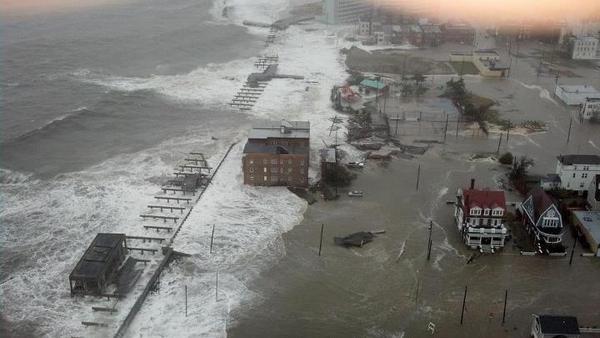
    9:06 Water covering the runway at LaGuardia, says the Weather Channel. (Which I’m still watching here in Boston over our Dish TV connection in Santa Barbara. Amazing how solid it has been.)

    8:54 Added newspapers to the list of sources at Trunk Line.

    8:49 Courant: More than 500,000 without power in Connecticut. Boston Globe: 350,ooo out in Mass. Weather Channel: “More than 3 million without power.” Kind of amazed our house isn’t among those. Winds have been just as big in gusts as the microburst from last summer, which caused this damage here. One big difference: leaves. Fall was post-peak to begin with, and remaining color has mostly been blown away. In the summer, trees weren’t ready to give up their leaves, and many got blown over or torn up.

    8:03 Just heard Con Edison has shut down the power in lower Manhattan. Con Ed outage map“Completely dark down toward Wall Street.” No specific reports on the Con Ed site. But here’s an outage map (on the right).

    7:56 Listening to WCAI (Cape and Islands radio), on which I hear locals saying that things aren’t as bad as had been expected.

    7:54 The Christian Science Monitor has a story on the sinking of the Bounty off Cape Hatteras. Two crew are still missing. What was it doing out in that storm? The story says they left Connecticut last week for Florida and was in touch with the National Hurricane Center; but Sandy was already on the radar then, wasn’t it? Maybe not. Dunno. In any case, bad timing.

    7:38 Heard a loud pop across the street, followed by a flickering orange light between the houses, and reflected on the windows. Wondering if a fire had started I went out in the wind and rain, found it was nothing and got thoroughly soaked — and almost hit by a car. This is a quiet street that should have no traffic under the conditions, but there it was. Fortunately, we spotted each other just in time.

    7:33 Curious: what’s up with JFK, LGA,EWR, BOS. If the seas rise enough, some runways may be under water. But… haven’t heard anything yet.

    7:31 Water continues to rise, etc. Yet… Not seeing or hearing about any Big Disasters. The Weather Channel is reporting lots of storm surge levels, all-time records… but no unusual damage reports yet.  Their reporters are still standing on dunes, walking on sea-walls. In a real big-time storm surge, they’d be long gone, along with geology and structures. You can almost hear a bit of disappointment for lack of devastation to show. “We still have hours and hours and hours left…” Translation: “and time to fill.”

    7:28 @TWCbreaking: “The water level at the Battery in #NYC has reached 11.25 feet, surpassing the all-time record of 11.2 feet set in 1821.#Sandy

    7:25 Big winds, long ping times over my FiOS connection.

    7:21 List of mainstream live media covering #Sandy.

    7:17 I wonder if the main effects of #Sandy will be like #Irene‘s: while most of the media attention was on the coast, Vermont was quietly destroyed.

    7:12pm The Weather Channel just said that #Sandy has lost her (or is it his?) hurricane status, and is now just a “superstorm.” I also notice that Crane 9 quit reporting winds at 4pm. 🙁 Meanwhile Huffpo says on Twitter than #Sandy has it down.

    6:41pm Here’s a “before” shot of the crane on 57th Street that’s now broken. (@DaveWiner has a closer shot here.) I took it on 27 August. Between staying in hotels (e.g. the Salisbury, twice), going to meetings, shopping and other stuff, I’ve gone back and forth in front of this construction site more times than I can count. So, naturally, I shot some pictures of it. Fun fodder: the OUT and IN liquid concrete vats that the crane hauled up and down for many months. These shots are Creative Commons licensed for attribution only, so feel free to re-use them.

    6:22pm Just heard on the Weather Channel that up to 10 million people may be without power soon. This “will take a big bite out of retail in November.”

    5:59pm Dark now. Just in time for the biggest winds yet. Whoa. House is shaking. Tree pieces flying by.

    5:46pm More evidence that station-based radio is declining: the great WBZ, which still carries three of the most august call letters in radio history, is http://cbsboston.com on the Web and @cbsboston on Twitter. Same goes for CBS stations in Washington, New York and elsewhere. Clear Channel meanwhile is blurring all its station brands behind iHeartRadio.

    5:43pm @WNYC reports that many of New York’s major bridges are soon to close. Earlier I heard on WBZ that toll booths are abandoned, so feel free to ride through without paying if you’re busy disobeying advice to stay off the roads.

    5:22pm Five “creative newsjacks” of #Sandy by “savvy marketers”. At Hubspot. Explanation: “Newsjacking is the practice of capitalizing on the popularity of a news story to amplify your sales and marketing efforts. The term was popularized thanks to David Meerman Scott’s book Newsjacking.” All are, in the larger scheme, trivial, if not in bad taste. For that, nothing beats The Onion:

    5:12pm Crane 9 in New Jersey (see the graphic below) now reports steady winds of 46mph from the northeast with peak gusts of 63mph.

    4:45pm I have some “before” shots of the crane that broke on 57th Street. I’ll put those up soon.

    4:40pm Right now we have the highest winds since a microburst in July took out hundreds of trees in a matter of seconds across East Arlington, Mass. Here’s a photo tour of the damage that I took at the time. In fact I have a lot more shots that I haven’t put up yet. I might do that when I get a break.

    4:38pm A gust just peeled back some siding on the house across the street. Watched some pieces of trees across the street break off and fall.  The trees taking it hardest are the ones with leaves, which increases the wind loading. Interesting to see how the red maples give up their colored leaves while the black oaks do not. Same with the silver and norway maples. The leaves on those seem to resist detachment.

    2:55pm Given the direction of the storm, it will continue longer in New England than elsewhere, even though the hit is not direct.

    2:52pm Just heard a crane on W. 57th Street went down. That’s the site next to the Salisbury Hotel, I believe. Across from the Russian Tea Room.

    2:45pm Now it’s getting scary here near Boston. Very high wind gusts, shaking the house, along with heavy rain. Check out the increasing peak winds at Crane 9 at the New York Container Terminal in New Jersey, on the right.

    2:21pm Thinking about fluid dynamics and looking at a map of the New Jersey and Long Island coasts, which in two dimensions comprise a funnel, with Raritan Bay and New York Harbor at the narrow end. High tide will hit about 8pm tonight there. Given the direction of the storm, and the concentrating effects of the coastlines toward their convergence point, I would be very surprised if this doesn’t put some or all of the following under at least some water:

    • All three major airports: JFK, LaGuardia and Newark.
    • The New York Container Terminal.
    • The tower bases of New York’s AM radio stations. Most of them transmit from the New Jersey Meadows, because AM transmission works best on the most conductive ground, which is salt water. On AM, the whole tower radiates. That’s why a station with its base under water won’t stay on the air. At risk: WMCA/570, WSNR/620,  WOR/710, WNYC-AM/820,  WINS/1010, WEPN/1050, WBBR/1130, WLIB/1190, WADO/1280 and several others farther up the band. WFAN/660 and WCBS/880 share a tower on High Island in Long Island Sound by City Island, and I think are far enough above sea level. WMCA and WNYC share a three-tower rig standing in water next to Belleville Pike by the  New Jersey Turnpike and will be the first at risk.
    • [Later… According to this story, WINS was knocked off the air.]
    • [Later still… Scott Fybush’s Northeast Radio Watch says WMCA and WNYC were knocked offAnd the WNYC site says it was knocked off too. He has a long list of silenced stations there.]

    Funnel #2, right where the eye will hit: Delaware Bay. Watch out Philly/Camden/Wilmington.

    Funnel #3, Massachusetts Bay and Boston Harbor.

    1:03pm: I forgot to bring a portable radio, so I got a new little “travel radio” for $39.95 from Radio Shack, along with some re-chargeable batteries. After charging them overnight, I put the batteries in, and… nada. The clock comes on at 12:00, but nothing else happens. None of the buttons change anything. The time just advances forward from the imaginary noon. So, it’s useless. Oh well. I have other radios plugged into the wall. But if the power goes out, so do they.

    12:48pm: In a crisis like #Sandy, one of the great failures of public television is exposed: there is almost no live local coverage of anything, despite a boundless abundance of presumably willing helpers in the Long Tail. Public TV’s connection with What’s Actually Happening is astoundingly low, and ironic given its name. Scheduled programs throb through the calendar with metronomic precision. About the only times they ever go live is during pledge breaks, which always give the impression of being the main form of programming. If they were as good at actual journalism as they are at asking for money*, they would kick ass. I’ve included local public stations in my list here. None of them are go-to sites for the public. I just scanned through them, and here’s the rundown:

    • Maryland Public Television displays no evidence that a hurricane is going on.
    • WHYY Philadelphia-Wilmington: Pointage to Radio Times with Marty Moss-Coane, which ran from 10-Noon today. The top Special Announcement is “Visit NewsWorks.org or follow @NewsWorksWHYY on Twitter for continuing coverage of Hurricane Sandy.”
    • WNET in New York is itself almost inert. But it does have links to its three broadcast outlet pages. thirteen.org in Metro Focus has a scary visual of likely flooding in New York, last updated at 7:38pm Sunday. WLIW, another of its stations, has the same pointage. That’s about it. Its NJTV site is a bit more current. They post this: “Committed to serving Garden State residents during what is predicted to be an exceptional storm in Hurricane Sandy, NJTV will provide updates throughout the day plus Gov. Chris Christie’s next press conference. Monday night, join Managing Editor Mike Schneider for full storm analysis during live NJ Today broadcasts at 6 pm, 7:30 and 11 pm. Residents can also expect ongoing weather-related news updates on the network’s Facebook andTwitter sites. NJTV is also planning a joint broadcast with WNET’s MetroFocus news program on Tuesday night at 9:30 pm, to assess the effect of the storm on the Tri-State area.” Can’t wait.
    • WETA in Washington, D.C. has exactly nothing. WHUT appears to be down.
    • CPBN, the Connecticut Public Broadcasting Network, has nothing.
    • WGBH in Boston points to a show about the great hurricane of ’38. Almost helpful, that.

    * See Jan Hooks’ legendary Tammy Jean show on the old Tush program, which ran on Ted Turner’s original cable station back at the turn of the ’80s. It was a perfect parody of a low-end religious program that seemed to exist only for seeking money, which viewers were told to put in the “money font”: a fish bowl on a pedestal. Watch here, starting around 2:50 into the show. Bonus show, with the pitch point arriving about five minutes in.

    12:43pm: Normally I’d be headed this afternoon to Jay Rosen‘s Studio 20 journalism class at NYU. But after NYU announced its closures yesterday,  I decided to stay here in Boston and report on what some corners of journalism are up to, as Sandy hits New York. To help with that, I’ve put up a roster of what I’m calling “infrastructural” sources, on Trunk Line, a blog that Christian Sandvig and I set up at the Berkman Center, and which is coming in handy right now. I have websites, feeds, radio and TV stations. Haven’t added newspapers yet. Stay tuned.

    12:38pm: A Weather Channel reporter on the beach in Point Pleasant, New Jersey just said, live, “We’ve been told to get out of the shot. Sorry. Gotta cut it off.”

    12:28pm: Getting our first strong wind gusts here, from the north. The fall colors, which were right at peak on our street, just flew past my window here in the attic.

    12:19pm: We have no TV here at the Boston place. Normally I carry an EyeTV Hybrid thingie to watch over-the-air TV on a laptop, but the thingie is at our New York place (yes, we’re there too; just not now). But we have Dish Network back home in Santa Barbara, so that’s what I’m watching, over our iPad here in Boston, thanks to the Slingbox on the Dish set top box. (Which is actually in a hall cabinet, since “sets” these days don’t have tops. They have edges, none of which supports a box.) Consider the route here. TWC distributes to Dish over a 50,ooo mile round trip to a satellite. Then Dish sends the signal to Santa Barbara over another round trip through a satellite just as far away. Then I’m watching 3000 miles away over a wireless connection at our place in Boston. Credits en route go to Cox for the cable connection in Santa Barbara, and to Verizon FiOS for the connection here. This will work until the power goes out here.

    12:12pm: Finally heard somebody on the Weather Channel mention that there is a full moon today, which means maximized tide swings. Here’s the tide chart for the Battery, at the lower end of Manhattan.

    11:20am Weather Channel gets all ominous, sez InsideTV at Entertainment Weekly.

    11:18a: Slate is on top of Frankenstorm coverage in the papers.

    11:05am: Radio stations should list their stream URLs as clearly as they list their dial positions. None do. Some have many steams but not enough links. WNYC, for example, has a nice help page, but the links to the streams are buried in a pop-up menu titled “other formats” (than the “Listen Now” pop-up page).

    11:00am: How New Nersey Broadcasters Have Prepared for Sandy, at RadioINK. It begins,

    New Jersey Broadcasters Association President and CEO Paul Rotella tells Radio Ink stations in his state have been preparing for Hurricane Sandy since Friday. “This is a perfect example of how only  local radio and TV can provide the critical information our audiences need to know in times of emergency. Sure, you can get a “big picture” overview from some media sources, but our citizens need to know much more detailed and salient information that only local broadcasters can provide.”

    No links. Anybody have evidence of that yet? I’m listening to WKXW, aka New Jersey 101.5, After a lot of ads, they have lots of weather-related closings, followed by live talk, where they’re talking about other media at the moment.

    10:56am: I’ve put up a fairly comprehensive list of infrastructure-grade Sandy information sources over on the Trunk Line blog. Much of what I’ll write about here will come from checking over there. Note that all the TV and radio stations from DC to Boston carrying live (or nearly live) coverage are listed, plus a number of live streams from stations providing them.

    NOAA has Sandy headed straight at New Jersey and Delaware. The Weather Channel has a prettier map:

    I was going to go to New York today, but decided to stay around Cambridge instead. All the media are making dire sounds, and there is lots of stocking up going on. Home Depot, Costco, all the grocery stores have had packed parking lots all day. Schools are closed all over the East Coast. New York City is shutting down the subways and Mayor Bloomberg has advised everybody to stay inside. Huge storm surges are expected.

    I’m a natural event freak, so I’m on the case, but also need some sleep, in the calm before The Storm. More in a few hours.