One day, back around 15,000 BCE, half a mountain in Southern California broke loose and slid out onto what’s now the Mojave desert. The resulting landform is called the Blackhawk Slide. Here it is:
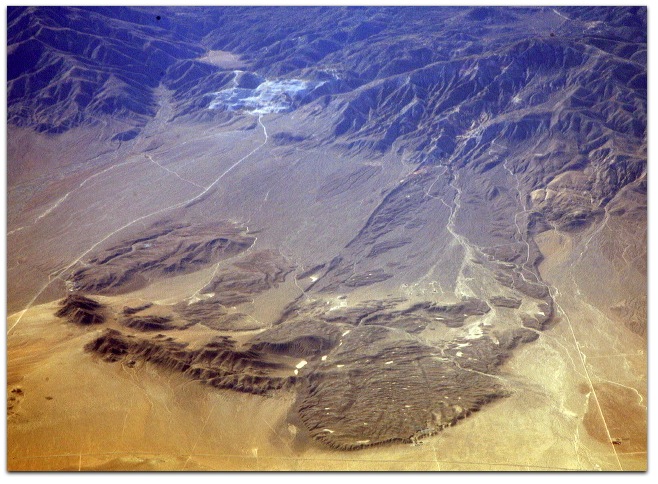
It’s that ripple-covered lobe on the bottom right. According to Robert Sharp’s Geology Underfoot in Southern California, it didn’t just flow off the mountain, as would happen with a typical landslide. It actually slid intact, like a toboggan, four and a half miles, on a slope of only two to three degrees. It could not have traveled so far, and have remained so intact (with rock layers preserved, in order, top to bottom), if it had merely flowed.
Geologists can tell it slid because it didn’t just heap at the base of the mountain from which it detached. Ten billion cubic feet of rock soared, at low altitude, four and a half miles, on a cushion of air, out across the desert, before plopping down. Frank Rodrigue in LucerneValley.net puts it this way:
As the slide moved down the canyon (at about 170 mph), it passed over a resistant gneissic ridge that crosses the canyon, and was thus launched into the air—a geologic version of a flying carpet. Calculations indicate that sheet of moving breccia was probably as high as 400 feet above the canyon floor immediately after becoming airborne, but that it settled quickly, compressing the air trapped beneath to a frictionless blanket less than a meter thick. While airborne, the slide possibly attained velocities of 270 mph, and the entire distance from launching point to resting place were covered in about 80 seconds.
Or so goes the theory, sourced from f Robert M. Norris (1921-2012), a much-revered geologist at UCSB.
One wonders if humans were there to see it happen. Ancestors of native Americans were already on the continent by then, thanks to the last glacial maximum, which still had several thousand more years to go. There may have been some ice on the mountains themselves, and perhaps that helped weaken the rock, which was already raised to the sky by pressures on the San Andreas Fault, which lies on the back side of the San Bernardino Mountains, a couple dozen miles from here.
I came along a bit late, but was glad to get my first chance to gander at the slide, the day after Thanksgiving, on a United flight from San Jose to Houston. I was shooting against the sun, and it was a bit hazy, but I was still able to get a good look, and this photo set too.
Additional links:
- Ronald L. Shreve, Leakage and Fluidization in Air-Layer Lubricated Avalanches
- Frank Rodrigue, The Blackhawk Landslide
Update on 17 May 2026—Dating the slide more recently gives a less precise time. They’re just saying late Pleistocene. Studies more recent than Shreve’s 1968 paper (such as this one) also offer other theories for how the slide formed and slid so far from the mountain face.


Leave a Reply