• Link outline for 2013_04_01

    VRM, Privacy, Personal Clouds

    Outlining, programming, business

    Marketing

    Journalism

    Not yet classified


  • And Earth is a bigger target

    A comet is headed for Mars. impactNow approaching at 125,000 miles per hour, it will explode with the force of 35 million megatons of TNT if it hits. That’s a third the size of the collision that caused the Cretaceous-Paleogene extinction event, which famously erased the dinosaurs and ended the Mesozoic, around 66 Million B.C. It also left a 110-mile wide crater next to what is now Mexico. This Mars impact, should it occur, will also be larger than many other impact events that changed life on Earth utterly, causing mass extinctions countless times in in ages before ours.

    The chance that this comet will hit Mars is one in two thousand. The chance that its tail will graze Mars and produce an impressive sky show there are high. Earth-made probes on the surface of Mars will be watching, if they survive. So expect some impressive news, either way.

    By the way, my favorite comet of all time was Comet West, which glided slowly through our skies through several weeks in the Winter of 1976. It was beautiful. So was Hale-Bopp, in 1997. Here is an excerpt from what I wrote at the time:

    By Doc Searls
    March 6, 1997

    It’s 5:15AM as I write this. A few minutes ago, after the kid woke us for his breakfast, I walked to the kitchen to fetch a glass of water. When I arrived at the sink, I looked up and saw the most amazing thing: Hale-Bopp, the comet, brighter than any star, hanging from the Northeast sky over San Francisco Bay.

    I’ve seen five comets in my life. None have been more spectacular than this one is, right now. It’s astonishing. Trust me: this one is a Star of Bethlehem-grade mother of a comet.

    Considering the comet’s quality, publicity has been kind of weak. Which makes sense, since I have noticed an inverse relationship between comet quality and notoriety.

    KahoutekThe most promoted comet in recent history was Kahoutek, in 1971. Kahoutek was supposed to be the biggest comet since Halley last appeared in 1910. But after all the hype, Kahoutek was nearly invisible. I can’t even say I saw it. At least I can say I looked and that maybe I sawsomething. (But hey, I lived in Jersey at the time. Whaddaya ‘spect?)

    Comet WEstIn fact, Kahoutek was such a big no-show that when Comet West appeared in 1975, it received almost no publicity at all. But it was a wonderful comet. First it appeared as a morning star with a bright little tail about one moon long, above the Eastern horizon. Then, after it whipped around the Sun and flew back out toward its own tail, the comet spread into a wide V that graced the evening sky like God’s own logo. At the time I lived in a rural enclave outside Chapel Hill, North Carolina, and every night for several weeks a few of us would wander out and marvel at the show.

    HalleyThe next comet was Halley, in 1986. Astronomers had rightly mixed feelings about Halley. On the one hand, they knew this would be one of Halley’s least visible visits. On the other hand, they knew it would raise interest in astronomy. Well, Halley was nearly as big a bust as Kahoutek. At best the “Great Comet” was a tiny smudge in the sky. Can you see it in this picture? Right. My friend Jerry Solfvin and I had about the same luck when we joined a 3AM traffic jam of about 10,000 people who went to the far side of Mt. Diablo to look at this. By the way, this picture is from the Hyuktuke Gallery at the NEFAS (Northeast Florida Astronomical Society) site.

    Comet Hyuktake showed up about a year ago, and enough time had passed since the Halley disappointment to allow the new comet a fair measure of publicity. And Hyuktake was a beauty. When it skirted the North Star, the comet’s tail stretched across a sixth of the sky. The best image I’ve found is this cool 3-D number by Dave Crum. Click on it to visit a larger version at the NEFAS site.

    And now we have Hale-Bopp. Although Hale-Bopp won’t come nearly as close to Earth as Hyuktake did, it’s putting on a bigger show, mostly because it’s a bigger comet. lot bigger. This thing is more than 200 times larger than Halley: about 40km across. You can actually see some shape to it, even with the naked eye. To spot it, look to the Northeast in the early morning, when it’s still dark. You’ll see it below and to the left of Cygnus (the Northern Cross), pointing straignt down toward the horizon. It’ll be brighter than any other star in the sky, and with a tail that stretches across the Milky Way. On the 6th you’ll also see the last sliver of moon down to the East, and on succeeding days the moon will move out of the way long enough for a great view.

    Bonus links: Comet Ison, which might become “the comet of the century” later this year. After looping close to the Sun, it may become as bright as the moon, and visible in daylight. And Comet Panstarrs, which is visible now.

  • Blogging outlines of public bookmarks

    Here are some of my open tabs, now closing as I list them here in outline form:

    I’m working in WordPress here, going back and forth between the Visual and HTML tabs in WordPress’s UI for composing posts. I do this by making a plain unordered (bulleted) list, and then hacking it in HTML to make the list into a two-level outline. Labor-intensive, it is.

    I would rather do this with an outliner. Which I will, thanks to the Little Outliner that Dave Winer and friends are working on. I’m one of those friends, and I’m looking forward to lots of fun with this. I’m an outlining freak going all the way back to when I first encountered Dave, in 1984, when he was working on Think Tank.

    Outlining is one of those practices that are hard to get but easy to do once you get them. With the Little Outiner, people finally will. The right people, anyway. 🙂

  • Why does Dish Network’s HD look so Low-D?

    artifacty HD[Later (7 April)… The issue has been resolved, at least for now. We never did figure out what caused the poor video resolution in this case, but it looks better now. Still, it seems that compression artifacts are a mix of feature and bug for both cable and satellite television. One of these weeks or months I’ll study it in more depth. My plan now is just to enjoy watching the national championship game tomorrow night, between Louisville and Michigan.]

    What teams are playing here? Can you read the school names? Recognize any faces?  Is that a crowd in the stands or a vegetable garden? Is the floor made of wood or ice?

    You should be able to tell at least some of those things on an HD picture from a broadcast network. But it ain’t easy. Not any more. At least not for me.

    Used to be I could tell, at least on Dish Network, which is one reason I got it for our house in Santa Barbara. I compared Dish’s picture on HD channels with those of Cox, our cable company, and it was no contest. DirectTV was about the equal, but had a more complicated remote control and cost a bit more. So we went with Dish. Now I can’t imagine Cox — or anybody — delivering a worse HD picture.

    The picture isn’t bad just on CBS, or just during games like this one. It sucks on pretty much all the HD channels. The quality varies, but generally speaking it has gone down hill since we first got our Sony Bravia 1080p “Full HD” screen in 2006. It was the top of the line model then and I suppose still looks good, even though it’s hard to tell, since Dish is our only TV source.

    Over-the-air (OTA) TV looks better when we can get it; but hardly perfect. Here’s what the Rose Bowl looked like from KGTV in San Diego when I shot photos of it on New Years Day of 2007. Same screen. You can see some compression artifacts in this close-up here and this one here; but neither is as bad as what we see now. (Since I shot those, KGTV and the CBS affiliate in San Diego, KFMB, moved down from the UHF to the VHF band, so my UHF antenna no longer gets them. Other San Diego stations with UHF signals still come in sometimes and look much better than anything from Dish.)

    So why does the picture look so bad? My assumption is that Dish, to compete with cable and DirectTV, maximizes the number of channels it carries by compressing away the image quality of each. But I could be wrong, so I invite readers (and Dish as well) to give me the real skinny on what’s up with this.

    And, because I’m guessing some of you will ask: No, this isn’t standard-def that I’m mistaking for high-def. This really is the HD stream from the station.

    [Later…] I heard right away from @Dish_Answers. That was quick. We’ll see how it goes.

  • Surf’s down. For now.

    I was talking with @ErikCecil yesterday about the sea change we both detect in people’s tolerance for unwanted tracking. They’re getting tired of it. So are lawmakers and regulators. (No, not everybody. But not a small percentage. And it’s growing.) See here, here,  here, here, here, here, here, here and here.

    Somewhere in the midst of our chat, Erik summarized the situation with a metaphor that rang so true that I have to share it. Here’s roughly what he said: “The backwash that’s coming is a tsunami that hasn’t hit yet. Right now it’s a wide swell over deep water. But you can tell it’s coming because the tide is suspiciously far out. So we have all these Big Data marketing types, out there on the muddy flats, raking up treasures of exposed personal data. They don’t see that this is not the natural way of things, or that it’s temporary. But the tidal wave is coming. And when it finally hits, watch out.”


  • Remembering Mom

    Eleanor SearlsMom would have turned 100 this week. She got to celebrate her 90th ten years ago, though it seems like yesterday. She died several months later, of a stroke while recovering from a botched gall stone removal procedure. The stroke was preventable, I believe; but I won’t lay blame. Mom lived a long and full life, and wouldn’t have wanted to make a stink about it. That wasn’t her style.

    She was a smart, fun, loving and thoroughly wonderful woman. I remember once, when I was in my twenties, sitting around a fire in the little commune-like community where I lived near Chapel Hill. One of the others asked, “Who is the most sane person you know?” When I answered “My mother,” the rest were amazed. Not many people our age said things like that about either of their parents. But there was no doubt in my mind. Mom was profoundly sane. There wasn’t a crazy cell in her mind.

    She was raised in Napoleon, North Dakota, the middle child among five. Her parents were from large Swedish homesteading families. (For the genealogists, Oman — or Ohman — and Sponberg.) She could read as a small child and entered school early, graduating high school at sixteen. Her colleges were North Dakota State and the University of Chicago. For a while she taught in a one-room schoolhouse, starting at age 19. She was doing social work  in Alaska when she met the man who became my father, and who proposed to her by mail while in Europe fighting in WWII. They married when he returned in 1946 . I showed up a year later, and my sister Jan two years after that. We lived in Maywood, New Jersey, during the year, and in Brick Township, by the Jersey Shore, in the summers. Mom’s last and longest job was teaching 3rd and 4th grade in the Maywood school system. She and Pop retired to Graham, North Carolina in 1974. Pop died in 1979, and Mom carried on as a pillar of the local community — just as she was a pillar of everything she supported in her life.

    I could go on, but instead I’ll share what I posted on my blog on the day she died:

    1953 Wanigan:
    Except for school, I had a happy childhood. That means my summers were idylls.
    In the summer of 1949, a couple months after my sister was born and while I was turning two, my parents bought an acre and a half of land near Cedarwood Park on the edge of the pine barrens in South Jersey (near The Shore, pronounced Da Shaw), bought a small wooden building, towed it to a clearing on a flat-bed truck, sat it on a shallow foundation, built a kitchen out of cast-off boards and windows, erected an ourdoor privy over a pit, pounded a pipe into the ground for well water, screwed a hand-pump on the top of the pipe, furnished the place with garage sale items, hung a pair of Navy surplus canvas hammocks between scrub oak trees, and called our new summer home “The Wanigan,” which they said was “Eskimo” for “house that moves.” (Apparently the derivation is Ojibwa, but so what.)
    It was paradise. Grandma and Aunt Ethel had a place nearby. So did my great aunt Florence and Uncle Jack. Aunt Grace, Uncle Arch and my cousins Ron, George and Sue all lived in Marlboro, not too far away. They’d bunk in Grandma’s garage. Other friends and relatives summered nearby, or would come visiting from near and far, sometimes staying for weeks. Over the next thirteen years the Wanigan got an additional room and indoor plumbing, but was otherwise blissfully unimproved. We never had a TV. For years our only phone ran on DC batteries and connected only to Grandma’s house.
    We went to Mantoloking Beach almost every day. For a change we swam the beaches and lagoons of Kettle Creek (we had a little land with a dock on Cherry Quay Cove) or the Metedeconk River on Barnegat Bay. We fished and crabbed in small boats. On the way home we stopped at roadside farm stands, bought tomatoes and corn, and enjoyed perfect suppers. We rode our bikes through the woods to the little general store about a mile away, bought comic books and came home to read them on our bunk beds. We grazed on blueberries, three varieties of which comprised the entire forest floor. We built platforms in the oak trees, collected pine cones and played hide-and-seek in the woods. Bedtime came when the whip-poor-wills started calling. We fell asleep to a cacaphony of tree frogs and crickets.
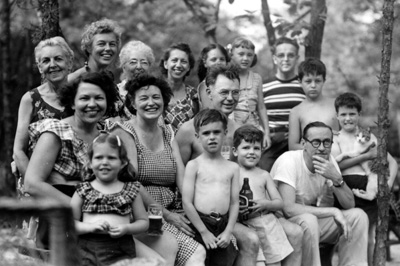
    The picture above was shot in the summer of 1953, when I was turning six (that’s me with the beer in the front row), behind “Bayberry,” the house Grandma Searls shared with her daughter, our Aunt Ethel. That’s Grandma at the top left. Aunt Ethel is in the next row down next to Mom. Behind both are Aunt Grace Apgar and my great Aunt Florence Dwyer (Grandma’s sister). Then Aunt Catherine Burns, cousin Sue Apgar, Mary Ellen Wigglesworth (a neighbor visiting from back in Maywood, our home town), then Uncle Arch Apgar. In front of Arch is George Apgar. Pop (Allen H. Searls) is in the middle. In the front row are my sister Jan Searls, Kevin Burns, myself, Uncle Donald Burns and Martin Burns (who today remembers being scratched by that cat).
    Grandma lived to 107. Aunt Florence made it to her 90s too, as I recall. Aunt Grace is now 91 and in great health. (Here we are at Mom’s 90th birthday party last April.) Aunt Katherine is still with us too, as is everybody from my generation (now all in their 50s and 60s).
    I’m waxing nostalgic as I plan a return visit this weekend to North Carolina, probably for the last time in Mom’s life.
    I’m also remembering what late August was like back then, as we prepared to end another perfect summer. It was wanting paradise never to end — and knowing, surely, that it would.

    As a postscript, I should add that Grace is still doing fine at age 100. Katherine made it to 99. My cousin Ron Apgar (one of Grace’s two sons, who opted out of the picture above when he was eleven) died early this year at 70. He was an awesome dude and like a big brother to me when we were growing up. The rest of us are all well. Life is good.

  • Apple, please give up on Maps

    It’s been more than six months since Apple introduced iOS 6, and nearly as long since Tim Cook issued a public apology for the company’s Maps app, which arrived with iOS 6 and replaced the far better version powered mostly by Google. Said Tim,

    …The more our customers use our Maps the better it will get and we greatly appreciate all of the feedback we have received from you.

    While we’re improving Maps, you can try alternatives by downloading map apps from the App Store like Bing, MapQuest and Waze, or use Google or Nokia maps by going to their websites and creating an icon on your home screen to their web app.

    Everything we do at Apple is aimed at making our products the best in the world. We know that you expect that from us, and we will keep working non-stop until Maps lives up to the same incredibly high standard.

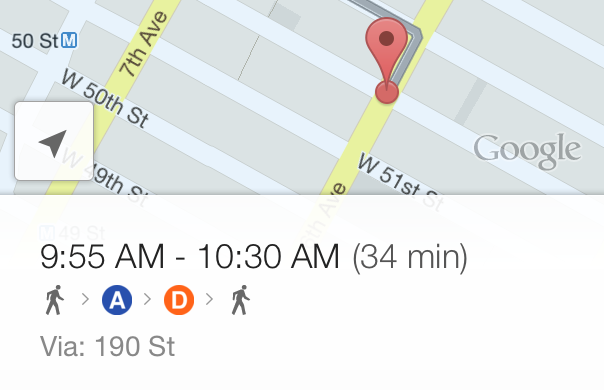
    In spite of slow and steady improvements, and a few PR scores, Apple’s Maps app still fails miserably at giving useful directions here in New York — while Google’s new Maps app (introduced in December) does a better job, every day. For example, yesterday I needed to go to a restaurant called Pranna, at 79 Madison Avenue. On my iOS Calendar app, “79 Madison Avenue” was lit up in blue, meaning if I clicked on it, Apple’s Maps, by default (which can’t be changed by me) would come up. Which it did. When I clicked on “Directions to here,” it said “Did you mean…” and gave two places: one in Minster, Ohio and another in Bryson City, North Carolina. It didn’t know there was a 79 Madison Avenue in New York. So I went to Google Maps and punched in “79 Madison Avenue.” In seconds I had four different route options (similar to the screen shot here), each taking into account the arrival times of subways at stations, plus walking times between my apartment, the different stations, and the destination. For me as a user here in New York, there is no contest between these two app choices, and I doubt there ever will be.

    Credit where due: Apple’s Maps app finally includes subway stations. But it only has one entrance for each: a 9-digit zip code address. In reality many stations have a number of entrances. At the north end of Manhattan, the A train has entrances running from 181st to 184th, including an elevator above 184th with an entrance on Fort Washington. Google’s app knows these things, and factors them in. Apple’s app doesn’t yet.

    On the road, Apple’s app still only shows slow traffic as a dotted red line. Google’s and Nokia’s (called Here) show green, yellow and red, as they have from the start. Google’s also re-routes you, based on upcoming traffic jams as they develop. I don’t know if Apple’s app does that; but I doubt it.

    But here’s the main question: Do we still need an Apple maps app on the iPhone? Between Google, Here, Waze and others, the category is covered.

    In fact Apple did have a good reason for rolling their own Maps app: there were no all-purpose map apps for iOS that did vocalized instructions and re-routing of turn-by-turn directions. Google refused to make those graces available on the Apple Maps app, which was clearly galling to Apple. Eventually Apple’s patience wore out. So they said to themselves, “The hell with it. We’re not getting anywhere with these guys. Let’s do it ourselves.” But then they failed hard, and Google eventually relented and made its own iOS app with those formerly missing features, plus much more.

    Bottom line: we no longer need Apple to play an expensive catch-up game. (At least on iPhone. Google still doesn’t have a Maps app for iPad. Not sure if that’s because Google doesn’t want it, or because Apple won’t let them distribute it.)

    Unless, of course, Apple really can do a better job than Google and Here (which has NAVTEQ, the granddaddy of all mapping systems, behind it). Given what we’ve seen so far, there is no reason to believe this will happen.

    So here’s a simple recommendation to Apple: give up. Fold the project, suck up your pride, and point customers toward Google’s Maps app. Or at least give users a choice on set-up between Google Maps, Here, Waze or whatever, for real-world navigation. Concentrate instead on what you do best. For example, flyover and Siri. Both are cool, but neither requires that you roll your own maps to go with them. At least, I hope not.


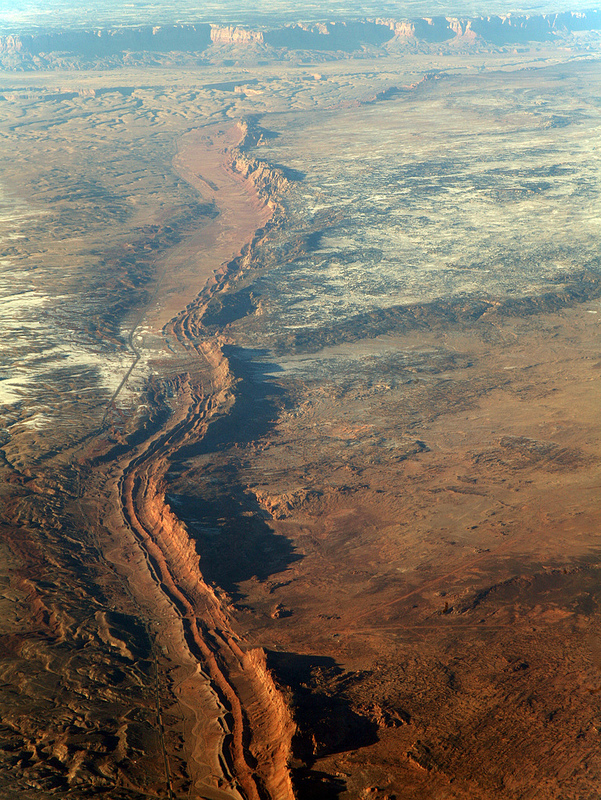
  • Let’s put Echo Cliffs and the Kaibito Plateau in Wikipedia

    Echo Cliffs

    I say that because I didn’t find those entries when I went looking for them yesterday, when I was putting up and annotating this photo set here.

    If I get a chance later I’ll put some links here.

    [Later…] And now there is a Wikipedia entry, thanks to Phllip Stewart, @pmsyyz, who improves Wikipedia as http://en.wikipedia.org/wiki/User:Pmsyy. I just made a few additional edits myself as well.

  • Facebook’s shark-jump advertising moves

    I just looked up facebook advertising on Google News, and got these results:

    More Facebook Ads Are Coming, Your Friends Will Finally Hit Delete
    Forbes-8 hours ago
    Now, Facebook is doing a pretty smart thing here rolling out the more prominent advertising along with an updated user experience, but will…

    Facebook’s New News Feed Is a Binder Full of Advertising The Atlantic Wire-4 hours ago

    Disruptions: As User Interaction on Facebook Drops, Sharing  New York Times (blog)-Mar 3, 2013

    Facebook Isn’t Your Platform. You’re Facebook’s Platform -Businessweek-Mar 5, 2013

    Facebook’s advertising strategy cannot win
    USA TODAY-Mar 5, 2013 Facebook presumably did not purposefully create a freeadvertising vehicle (that is, the standard posting function) that’s more effective than its … 

    all 84 news sources »

    Facebook may charge users to remove ads, patent application reveals GigaOM-by Janko Roettgers-Mar 5, 2013 Facebook may offer users to get rid of ads, highlight custom messages or even select the friends displayed on their personal profile in 

    Mostly negative stuff.

    But there are some plusses, down below the fold. For example, Facebook advertising works, and couldn’t be more fair, by Rocco Pendola in TheStreet. His gist:

    Roughly five months into my job as TheStreet’s director of social media, I can tell you — firsthand — that Facebook advertising works incredibly well for a brand/multimedia organization such as TheStreet. In fact, I argue that if Facebook’s platform doesn’t work for you, you’re simply not doing it right.

    Well, good for them. Over here on the receiving end it isn’t so pretty. For example, here’s my latest ad pile at Facebook:

    A few questions:

    1. Where does Facebook get the idea that I want to cheat on my wife, to whom it knows I’ve been married for almost 23 years?
    2. Why would Facebook sell an ad to an advertiser that would rudely suggest that there is a chance in hell that I’d ever cheat on my wife?
    3. And why would anybody want to be told, over and over again, as the AARP ads always do, that they’re old?

    Maybe it’s because they’ll sell anything to anybody. Or maybe it’s that SeniorPeopleMeet and SeniorsMeet simply buy exposures across the entire “senior” demographic, regardless of what Facebook’s intelligence might say about individuals in that demographic. Clearly Facebook doesn’t mind, regardless of the reasons, which is worse than insulting: it’s stupid and wrong.

    It’s hard to imagine a company that has more “big data” about its users than Facebook does, or better means for delivering truly relevant ads to individuals. And yet Facebook’s advertising is mostly ignored, unwelcome or worse. Yes, its advertising program has made Facebook financially successful. But that success masks other failures, such as the very high percentage of misses, many of which have negative results. I see no reason to believe that these failings won’t also be leveraged into the company’s new advertising ventures, covered in the news above.

    I’ve been told by adtech professionals that a funny thing about their business is that Google and Facebook are terribly jealous of each other: Google is jealous of Facebook because Facebook can get especially personal with its users, while Facebook is jealous of Google because Google can advertise all over the Web. And yet both are missing real human relationships with their users, because the users are not customers. They are the products being sold to the companies’ real customers, which are advertisers.

    What’s keeping Facebook from offering paid services to individuals — or Google from offering more than the few they do? Here’s one reason I got from a Google executive: it costs too much money to serve individual human customers. This isn’t verbatim, but it’s close: If our users were actually customers, we would have to support them with human beings, and we don’t want to make less than $1 million per employee (Yes, that was the number they gave.) And yet, all advertising-supported businesses could benefit a great deal by having at least some of their users become subscribers.

    Start with the money. How much would Facebook make if the company offered a subscription service that came with both no advertising and better privacy protections? Depends on the subscription price, of course, multiplied by the number of people who go for the deal. Maybe one of ya’ll can give us some run-ups in the comments below.

    Then look at to the signaling issue. Real customers can send much better signals to Facebook than mere “users” can. They can offer real feedback, and good ideas for improving services — the kind of stuff you get when you have a real relationship, rather than a vast data milking operation. For example, a company with human customers can hear, personally, how they’re screwing up, from people who care enough to pay for services.

    I’ve dealt with a lot of highly successful companies, and they all risk the same problem: getting high from smoking their own exhaust, and thinking their shit doesn’t stink. Facebook is there right now. And they are making the same mistake that AOL, Compuserve, Prodigy, MySpace and countless other online services did when they were high and thought their shit didn’t stink. They assumed that occupants of their private habitats love being there, and wouldn’t leave. In fact many inhabitants of Facebook only tolerate it, or are there because it’s what works for now, or because lots of their friends and relatives are there. But they can leave, and so can their friends and relatives, as soon as attractive other choices appear. Which is inevitable.

    Everybody has limits. Facebook is hell-bent on testing them, apparently.

    Bonus link.

  • Toward opt-in advertising

    In Google Bringing TrueView Ads to Apps, Games Marks the first time users will be able to skip ads outside video Tim Peterson (in AdWeek) begins,

    Seventy percent of YouTube’s in-steam ad views are those skippable TrueView ads, Google’s svp of advertising Susan Wojcicki told attendees of the Interactive Advertising Bureau’s Annual Leadership Meeting on Tuesday in Phoenix, Ariz. And consumers should expect a lot more of TrueView, as Wojcicki announced that now users will soon be seeing—or not seeing—such skippable ads in apps and games.

    The move marks the first time Google will run TrueView ads against nonvideo inventory,Wojcicki said, and is intended to “enable users to have more choice.”

    In Google sees the value of free customers, Joe Andrieu, writes,

    Even though it is the same old advertising game–something that could use some fixing–what’s impressive is that with the ad-skipping feature Google saw “a 40 percent reduction in the number of people who click away from a video when shown a pre-roll” ad.

    It’s real-world proof that a free customer is more valuable than a captive one. Give people the freedom to leave and more will stay than if you had forced the issue.

    I agree. Read the whole thing.

    Bonus link.


  • How advertising can regulate itself

    When you see an ad for Budweiser on TV, you know who paid for it and why it’s there. You also know it isn’t personal, because it’s brand advertising.

    But when you see an ad on a website, do you know what it’s doing there? Do you know if its there just for you, or if it’s for anybody? Hard to tell.

    However, if it’s an ad for a camera showingng up right after you visited some photography sites, it’s a pretty good guess you’re being tracked. It’s also likely you are among millions who are creeped out by the knowledge that they’re being tracked.

    On the whole, the tracking-driven online advertising business (aka “adtech”) assumes that you have given permission to be followed, at least implicitly. This is one reason tracking users and targeting them with personalized ads is more normative than ever online today. But there is also a growing concern that personal privacy lines are not only being crossed, but trampled.

    Ad industry veterans are getting creeped out too, because they know lawmakers and regulators will be called on for protection. That’s the case George Simpson — an ad industry insider — makes in  Suicide by Cookies, where he starts with the evidence:

    Evidon measured sites across the Internet and found the number of web-tracking tags from ad servers, analytics companies, audience-segmenting firms, social networks and sharing tools up 53% in the past year. (The ones in Mandarin were probably set by the Chinese army.) But only 45% of the tracking tools were added to sites directly by publishers. The rest were added by publishers’ partners, or THEIR partners’ partners.

    Then he makes a correct forecast government intervention, and concludes with this:

    I have spent the better part of the last 15 years defending cookie-setting and tracking to help improve advertising. But it is really hard when the prosecution presents the evidence, and it has ad industry fingerprints all over it — every time. There was a time when “no PII” was an acceptable defense, but now that data is being compiled and cross-referenced from dozens, if not hundreds, of sources, you can no longer say this with a straight face. And we are way past the insanity plea.

    I know there are lots of user privacy initiatives out there to discourage the bad apples and get all of the good ones on the same page. But clearly self-regulation is not working the way we promised Washington it would.

    I appreciate the economics of this industry, and know that it is imperative to wring every last CPM out of every impression — but after a while, folks not in our business simply don’t care anymore, and will move to kill any kind of tracking that users don’t explicitly opt in to.

    And when that happens, you can’t say, “Who knew?”

    To get ahead of the regulatory steamroller, the ad business needs two things. One is transparency. There isn’t much today. (See Bringing Manners to Marketing at Customer Commons.) The other is permission. It can’t only be presumed. It has to be explicit.

    We — the targets of adtech — need to know the provenance of an ad, at a glance. It should be as clear as possible when an ad is personal or not, when it is tracking-based or not, and whether it’s permitted. That is, welcomed. (More about that below.)

    This can be done symbolically. How about these:

     means personalized.

    ↳ means tracking-based.

    ☌ means permitted.

    I picked those out of a character viewer. There are hundreds of these kinds of things. It really doesn’t matter what they are, so long as people can easily, after awhile, grok what they mean.

    People are already doing their own policy development anyway, by identifying and blocking both ads and tracking, through browser add-ons and extensions. Here are mine for Firefox, on just one of my computers:
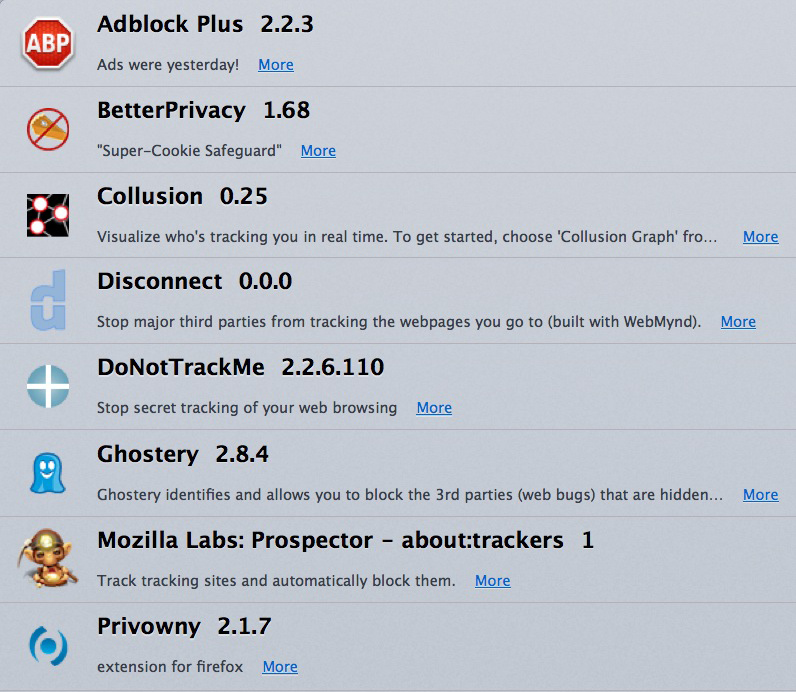
    All of these, in various ways, give me control over what gets into my browser. (In fact the Evidon research cited above was gained by Ghostery, which is an Evidon product installed in millions of browsers. So I guess I helped, in some very small way.)

    Speaking of permission, now would be a good time to revisit Permission Marketing, which Seth Godin published in May 1999,  about the same time The Cluetrain Manifesto also went up. Here’s how Seth compressed the book’s case nine years later.

    Permission marketing is the privilege (not the right) of delivering anticipated, personal and relevant messages to people who actually want to get them.

    It recognizes the new power of the best consumers to ignore marketing. It realizes that treating people with respect is the best way to earn their attention.

    Pay attention is a key phrase here, because permission marketers understand that when someone chooses to pay attention they are actually paying you with something precious. And there’s no way they can get their attention back if they change their mind. Attention becomes an important asset, something to be valued, not wasted.

    Real permission is different from presumed or legalistic permission. Just because you somehow get my email address doesn’t mean you have permission. Just because I don’t complain doesn’t mean you have permission. Just because it’s in the fine print of your privacy policy doesn’t mean it’s permission either.

    Real permission works like this: if you stop showing up, people complain, they ask where you went.

    Real permission is what’s needed here. It’s what permission marketing has always been about. And it’s what VRM (Vendor Relationship Management) is about as well.

    Brand advertising is permitted in part because it’s not personal. Sometimes it is even liked.. The most common example of that is Super Bowl TV ads. But a better example is magazines made thick with brand ads that are as appealing to readers as the editorial content. Fashion magazines are a good example of that.

    Adtech right now is not in a demand market on the individual’s side. In fact, judging from the popularity of ad-blocking browser extensions, there is a lot of negative demand. According to ClarityRay, 9.23% of all ads were blocked by users surveyed a year ago. That number is surely much higher today.

    At issue here is what economists call signaling — a subject about which Don Marti has written a great deal over the last couple of years. I visit the subject (with Don’s help) in this post at Wharton’s Future of Advertising site, where contributors are invited to say where they think advertising will be in the year 2020. My summary paragraph:

    Here is where this will lead by 2020: The ability of individuals to signal their intentions in the marketplace will far exceed the ability of corporations to guess at those intentions, or to shape them through advertising. Actual relationships between people and processes on both sides of the demand-supply relationship will out-perform today’s machine-based guesswork by advertisers, based on “big data” gained by surveillance. Advertising will continue to do what it has always done best, which is to send clear signals of the advertiser’s substance. And it won’t be confused with its distant relatives in the direct response marketing business.

    I invite everybody reading this to go there and jump in.

    Meanwhile, consider this one among many olive branches that need to be extended between targets — you and me — and the advertisers targeting us.

     

  • How PR is as bad is it ever was

    In 2013 – Beginning Of The End For PR Boomers, David Bray actually says this…

    The media landscape is evolving rapidly, and baby boomers are about to be left behind because of their inability to keep up with technology and the changing times. The days of the self-proclaimed experts (those who profess to be “thought leaders” as a result of reading and hearing about new advancements that clients can take advantage of) are long gone.

    Media today is all about authenticity — and largely dominated by participatory media and consumers, who see right through advertising and marketing hyperbole and shut it out. Participating in these media is the only way to gain a “true” understanding of how and which work, and which don’t. Clients are demanding that their PR counsel and support teams are in the conversation, and that they themselves use the media where their content is being created and distributed.

    Take, for example, the use of social media for online business networking or lead generation. As the saying goes, “it’s hard to teach an old dog new tricks.” The old dog in this instance — baby boomers — use traditional, in-person offline meetings as their primary source of building their business networks, while the younger generations are building their own brands and businesses more quickly, and reaching a much wider audience by leveraging new digital tools like LinkedIn and Twitter to run full-on campaigns.

    … giving his profession some bad PR that gets worse as you read down through the comments. Here’s mine:

    No person is just a demographic, just a race, or just a category. Nor does any person like to be dismissed as a stereotype, especially if that stereotype is wrong about them personally. I have 972 friends on Facebook, 19,061 followers on Twitter, 801 connections on LinkedIn, a Klout score of 81 and a PeerIndex of 81. That I’m also 65 is not ironic. If I weren’t this old, those stats wouldn’t be this high. I got the hell out of PR several demographics ago — and into the far more helpful work I do now — exactly because of shallow and dismissive stereotyping that has been a cancer in PR, and all of marketing, for the duration. It only makes the problem worse to drive out of the business people who have been young a lot longer than you have.

    PR’s problems are old news and not getting any younger. Here is what I wrote for Upside in 1992. Alas, Upside erased itself when it died, the Wayback Machine only traces it back to 1996, and the text is stuck for now in a place where search engines don’t index it.  So I’ll repeat the whole thing here:

    THE PROBLEM WITH PR
    TOWARD A WORLD BEYOND PRESS RELEASES & BOGUS NEWS

    There is no Pulitzer Prize for public relations. No Peabody. No Heismann. No Oscar, Emmy or Eddy. Not even a Most Valuable Flacker award. Sure, like many misunderstood professions, public relations has its official bodies, and even its degrees, awards and titles. Do you know what they are? Neither do most people who practice the profession.

    The call of the flack is not a grateful one. Almost all casual references to public relations are negative. Between the last sentence and this one, I sought to confirm this by looking through a Time magazine. It took me about seven seconds to find an example: a Lance Morrow essay in which he says Serbia has “the biggest public relations problem since Pol Pot went into politics.” Since genocide is the problem in question, the public relations solution can only range from lying to cosmetics. Morrow’s remark suggests this is the full range of PR’s work. Few, I suspect, would disagree.

    So PR has the biggest PR problem of all: people use it as a synonym for BS. It seems only fair to defend the profession, but there is no point to it. Common usage is impossible to correct. And frankly, there is a much smaller market for telling the truth than for shading it.

    For proof, check your trash for a computer industry press release. Chances are you will read an “announcement” that was not made, for a product that was not available, with quotes by people who did not speak them, for distribution to a list of reporters who considered it junk mail. The dishonesty here is a matter of form more than content. Every press release is crafted as a news story, complete with headline, dateline, quotes and so forth. The idea is to make the story easy for editors to “insert” with little or no modification.

    Yet most editors would rather insert a spider in their nose than a press release in their publication. First, no self-respecting editor would let anybody else — least of all a biased source — write a story. Second, press releases are not conceived as stories, but rather as “messages.”

    It is amazing how much time, energy and money companies spend to come up with “the right message.” At this moment, thousands of staffers, consultants and agency people sit in meetings or bend over keyboards, straining to come up with perfect messages for their products and companies. All are oblivious to a fact that would be plain if they paid more attention to their market than their product.

    There is no demand for messages.

    There is, however, a demand for facts. To editors, messages are just clothing and make-up for emperors that are best seen naked. Editors like their subjects naked because facts are raw material for stories. Which brings up another clue that public relations tends to ignore.

    Stories are about conflict.

    What makes a story hot is the friction in its core. When that friction ceases, the story ends. Take the story of Apple vs. IBM. As enemies, they made great copy. As collaborators, they are boring as dirt.

    The whole notion of “positive” stories is oxymoronic. Stories never begin with “happily ever after.” Happy endings may resolve problems, but they only work at the end, not the beginning. Good PR recognizes that problems are the hearts of stories, and takes advantage of that fact.

    Unfortunately, bad PR not only ignores the properties of stories, but imagines that “positive” stories can be “created” by staging press conferences and other “announcement events” that are just as bogus as press releases — and just as hated by their audiences.

    Columnist John Dvorak, a kind of fool killer to the PR profession, says, “So why would you want to sit in a large room full of reporters and publicly ask a question that can then be quoted by every guy in the place? It’s not the kind of material a columnist wants — something everybody is reporting. I’m always amazed when PR types are disappointed when I tell them I won’t be attending a press conference.”

    So why does PR persist in practices its consumers hold in contempt?

    Because PR’s consumers are not its customers. PR’s customers are companies who want to look good, and pay PR for the equivalent of clothing and cosmetics. If PR’s consumers — the press — were also its customers, you can bet the PR business would serve a much different purpose: to reveal rather than conceal, clarify rather than mystify, inform rather than mislead.

    But it won’t happen. Even if PR were perfectly useful to the press, there is still the matter of “positioning” — one of PR’s favorite words. I have read just about every definition of this word since Trout & Ries coined it in 1969, and I am convinced that a “position” is nothing other than an identity. It is who you are, where you come from, and what you do for a living. Not a message about your ambitions.

    That means PR does not have a very good position. It’s identity is a euphemism, or at least sounds like one. While it may “come from” good intentions, what it does for a living is not a noble thing. Just ask its consumers.

    Maybe it is time to do with PR what we do with technology: make something new — something that works as an agent for understanding rather than illusion. Something that satisfies both the emperors and their subjects. God knows we’ve got the material. Our most important facts don’t need packaging, embellishment or artificial elevation. They only need to be made plain. This may not win prizes, but it will win respect.

    That was 21 years ago. Now PR doesn’t just spin the press, but “influencers” of all kind. These days I sometimes find myself on the receiving end of that spin: a vantage from which I can see how much the fundamental disconnects in PR have remained the same, while the methods used, and the influencers targeted, have changed. (Mostly by adding new methods to old ones that haven’t changed at all.)

    Even the “social media” David Bray finds so young and modern embody the same disconnect between consumers and customers that have afflicted old media, such as TV and radio, from the beginning. Only now the consumers are called users while the customers are still called advertisers. Thus PR maintains the age-old dysfunction of stereotyping populations, and of dealing with whole populations through categorical prejudices, rather than engaging real human beings in real ways, with a minimum of bullshit, even when one party is spinning and the other is just listening. That’s what being “in the conversation” actually means.

  • Following Nemo

    6:42am — Flights are starting to land at JFK, I see by Flightaware. Not yet at LGA, EWR or the New England airports. More links:

    It’s getting light out, and the snow has stopped.

    6:10am — Dig:

    5:58am — Fittingly (given the local coverage concentration below), Maine appears to be hardest hit, though farthest from news outside the area. CNN and The Weather Channel are all about Boston, Providence, Hartford and New York.

    5:30am — Looking for live local coverage from TV stations. Here’s what I’ve found so far:

    That’s it. One in New York, one in Hartford, none in Boston and three in Portland. Maine wins! Corrections, of course, are welcome.

    Also: the NYTimes and the Wall Street Journal have both dropped their paywalls for storm coverage. The Boston Globe‘s is still up.

    03:30am — This is as quiet as New York gets. No traffic flowing. No horns blowing. No jets on approach to anywhere, or taking off. From our encampment in “upstate” Manhattan, there is just the sound of snowplows scraping Broadway clean.

    The Weather Channel (aka Weather.com, aka TWC on my Dish Network channel list, aka @WeatherChannel), calls the storm #Nemo, as they said they would last Fall. The National Weather Service, aka Weather.govisn’t playing along. Neither is AccuWeather.

    They should. I’m sure the success of the Nemo nickname has their sphincters in a knot, but they should loosen up. This isn’t just another nor’easter. For parts of Connecticut and Massachusetts, it might be the biggest storm since the last glaciation, named after Wisconsin. (Probably not, but still.) Earthquakes get named after epicenters. And hey, we live in networked times. These days the vernacular wins, fast. Best to get ahead of that curve.

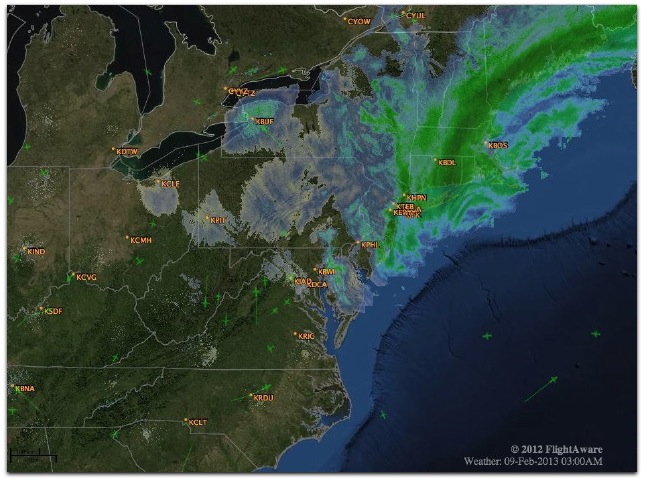
    Here’s a view of aviation, as of 3:00am this morning:

    Normally thin anyway at this hour, it’s absent in the Northeast entirely. The nearest named flight is a United one inbound to Dulles (UAL981). An un-named plane is passing over Philadelphia, and another over Binghamton. That’s it. (The green color is not for rain, by the way. It’s precipitation density. That’s snow there.)

  • Snow chance

    It’s raining here now, in Manhattan. It was snowing earlier, but then came the sleet, and now the rain, and the slush. Here’s what I shot with my phone a few minutes ago, on my way back from the subway:

    Blcch on broadway

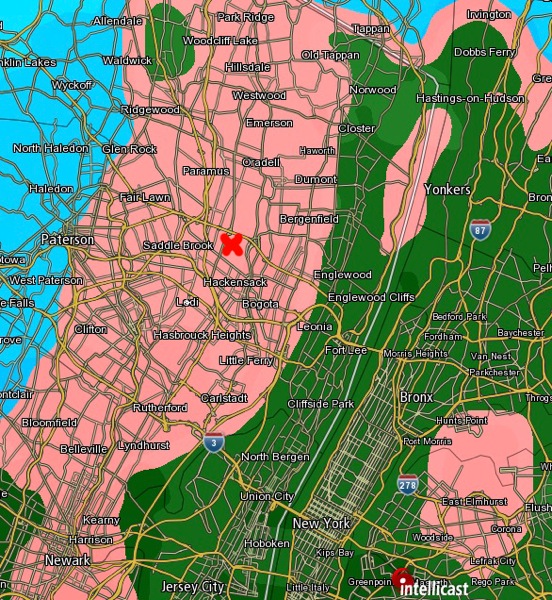
    And here’s what this kind of thing looks looks like on Intellicast‘s radar:

    Blcch map

    The red X marks where I grew up, on Woodland Ave in Maywood, New Jersey, about 5 miles from the George Washington Bridge and Manhattan. Woodland Avenue was (and still is) a hill. Not a big one; just one ideal for sledding. It had a nice steep slope at the top, and a long flat stretch at the bottom, so you could get up some good speed and glide a long way. Sometimes the town would designate Woodland Ave as the sledding hill, and block off the top and the bottom except for residential traffic. If the snow was deep enough, cars would pack it down and make sledding better.

    Terrace Ave, one street over, was good for sledding too: steeper at the top, with a shorter glide path at the bottom. So was the back yard of the Borg house on Summit Ave in Hackensack, which was a short walk through Borg’s Woods, also owned by the family. (It’s now a nature preserve.) The Borg family owned the Bergen Evening Record (now just The Record).

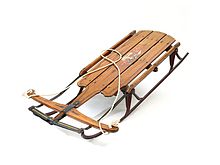
    This was back in the 1950s, which were simpler times. There was no cable, no Weather Channel. Almost nobody in our social stratum went skiing. Few civilians had four-wheel (or even front-wheel) drive vehicles. For kids, sledding was the favored recreational activity in snow, and the best sleds were Flexible Flyers. The family had a big old heavy one, good for seating two or three people. It looked like the one on the right (from 1936), but a bit longer. It may have been that old too. We also had a smaller one, good for solo flights.

    If snowy weather threatened, as it does now, we’d be glued to our radios, eager to hear a forecast that did not include the dreaded word “rain.” The most disappointing forecast was this one: “Snow mixed with and then changing to rain.” It was also the most typical for New York. An inch or few of snow would fall, and then it would turn to sleet, or drizzle, and then rain, and the street would turn to slush. These days they call snow/rain combo “wintry mix.” That’s the pink on the map. Almost always the forecast would say something like “significant accumulations in the outlying suburbs.” Those are the areas in blue already.

    So my heart’s is back in Maywood today, while my ass is in Manhattan, watching the blizzard fail to happen — at least here. On the iPad is the Weather Channel, tuned in to our Dish Network box in Santa Barbara. The forecast, as always with TWC, is breathless and dire. They (or somebody) have named the storm “Nemo.” Oy.

    In a slightly more ideal world, we would have already rented a four-wheel drive, thrown a suitcase and ski clothes in the back, and have driven up to Hunter Mountain, or some place in Vermont. I’ll bet the skiing up there will be perfect for the next few days. But we’re busy, and not in a position to indulge.

    TWC says it’s still going to snow later, with accumulations even as close as Maywood. So, for the sake of the kids out there, I hope the pink turns blue.

  • Old skool influential software

    I came late to personal computing, which was born with the MITS Altair in 1975.

    The first PC I ever met — and wanted desperately, in an instant — was an Apple II, in 1977. It sold in one of the first personal computer shops, in Durham, NC. Price: $2500. At the time I was driving one of a series of old GM cars I bought for nothing or under 1/10th what that computer cost. So I wasn’t in the market, and wouldn’t buy my first personal computer until I lived in California, more than a decade later.

    By ’77, Apple already had competition, and ran ads voiced by Dick Cavett calling the Apple II “The most personal computer.”

    After that I wanted, in order, an Osborne, a Sinclair and an IBM PC, which came out in ’82 and, fully configured, went for more than $2000. At least I got to play with a PC and an Apple II then, because my company did the advertising for a software company making a game for them . I also wrote an article about it for one of the first issues of PC Magazine. The game was Ken Uston’s Professional Blackjack.

    Then, in 1984, we got one of the very first Macs sold in North Carolina. It cost about $2500 and sat in our conference room, next to a noisy little dot matrix printer that also cost too much. It was in use almost around the clock. I think the agency had about 10 people then, and we each booked our time on it.

    As the agency grew, it acquired more Macs, and that’s all we used the whole time I was there.

    So I got to see first hand what Dave Winer is driving at in MacWrite and MacPaint, a coral reef and What early software was influential?

    In a comment under the latter, I wrote this:

    One thing I liked about MacWrite and MacPaint was their simplicity. They didn’t try to do everything. Same with MacDraw (the first object- or vector- based drawing tool). I still hunger for the simplicity of MacDraw. Also of WriteNow, which (as I recall) was written in machine, or something, which made it very very fast. Also hard to update.

    Same with MultiPlan, which became (or was replaced by) Excel. I loved the early Excel. It was so simple and easy to use. The current Excel is beyond daunting.

    Not sure what Quicken begat, besides Quickbooks, but it was also amazingly fast for its time, and dead simple. Same with MacInTax. I actually loved doing my taxes with MacInTax.

    And, of course, ThinkTank and MORE. I don’t know what the connection between MORE and the other presentation programs of the time were. Persuasion and PowerPoint both could make what MORE called “bullet charts” from outlines, but neither seemed to know what outlining was. Word, IMHO, trashed outlining by making it almost impossible to use, or to figure out. Still that way, too.

    One thing to study is cruft. How is it that wanting software to do everything defeats the simple purpose of doing any one thing well? That’s a huge lesson, and one still un-learned, on the whole.

    Think about what happened to Bump. Here was a nice simple way to exchange contact information. Worked like a charm. Then they crufted it up and people stopped using it. But was the lesson learned?

    Remember the early Volkswagen ads, which were models of simplicity, like the car itself? They completely changed advertising “creative” for generations. Somewhere in there, somebody in the ad biz did a cartoon, multi-panel, showing how to “improve” those simple VW ads. Panel after panel, copy was added: benefits, sale prices, locations and numbers, call-outs… The end result was just another ugly ad, full of crap. Kind of like every commercial website today. Compare those with what TBL wrote HTML to do.

    One current victim of cruftism is Apple, at least in software and services. iTunes is fubar. iCloud is beyond confusing, and is yet another domain namespace (it succeeds .mac and .me, which both still work, confusingly). And Apple hasn’t fixed namespace issues for users, or made it easy to search through prior purchases. Keynote is okay, but I still prefer PowerPoint, because — get this: it’s still relatively simple. Ugly, but simple.

    Crufism in Web services, as in personal software, shows up when creators of “solutions” start thinking your actual volition is a problem. They think they can know you better than you know yourself, and that they can “deliver” you an “experience” better than you can make for yourself. Imagine what it would be like to stee a car if it was always guessing at where you want to go instead of obeying your actual commands? Or if the steering wheel tugged you toward every McDonalds you passed because McDonalds is an advertiser and the car’s algorithm-obeying driver thought it knew you were hungry and had a bias for fast food — whether you have it or not.

    That’s the crufty “service” world we’re in now, and we’re in it because we’re just consumers of it, and not respected as producers.

    The early tool-makers knew we were producers. That’s what they made those tools for. That’s been forgotten too.

    I wrote that in an outliner, also by Dave.

    Interesting to see how far we’ve come, and how far we still need to go.

    Bonus link, on “old skool”.

  • Appreciating Mike Auldridge

    I was at a friend’s house in Chapel Hill, one warm day in 1975, listening to WDBS, the Duke radio station where I worked at the time. As often happened with ‘DBS, a great tune came on: “Bottom Dollar,” sung by Mike Auldridge, with Linda Ronstadt singing high harmony. What blew us away, though, was not Mike’s honey baritone, but his dobro playing. It was beyond sublime. We learned the song came from the album “Blues and Bluegrass,” and promptly drove into town to buy it.

    Later I gave the album to Ray Simone, to help him prep for doing Mike’s Eight String Swing album cover. It disappeared after that, and many years went by before I replaced it when  a double-CD of Mike’s old albums came out. It wasn’t easy to get then. I had to send off to somewhere in Europe, as I recall. Now its at that last link on Amazon. Cheap too, considering.

    I actually became acquainted with Mike earlier, when he played with The Seldom Scene. But I had no idea he was so damn good solo until I heard that song, and that album.

    A few minutes ago, when I was searching for something else, I ran across this tribute site, which was created just a couple months before he passed away, one day short of his 74th birthday, on December 29. This was bad news. We lost a treasure.

    So was his music. Go listen.

  • A crowd for personal clouds

    Tomorrow evening, Tuesday, will be a meetup I wish I could attend in San Francisco. The subject is personal clouds.

    We’re not talking about storage here, though that’s part of it, just like storage is part of your PC or your phone. We’re talking about your own personal space, which you control, on the Net, and not just on your devices. We’re talking about your own personal operating system: the platform for your enterprise of one. We’re talking about the place where you stand as you manage not just your own data, but your relationships with other people, various services, the Internet of Things, and your contacts—meaning your real social network (the one you define, your own way). It might be self-hosted, or physically elsewhere on the Net; doesn’t matter, long as it’s yours alone, and secure. That is, not contained in somebody else’s service. (Though you can engage one for that, if you like. On your terms.)

    Personal clouds are a new concept, but central to what I (and many others) have been working on for years with ProjectVRM and related efforts. (Some of those will be there too.) It’s where personal computing, personal networking, personal storage and personal autonomy and control all meet — or should, once the tech gets built out.

    It’s early in the history of wherever this thing is going to go, which is why going to this thing is a good idea.

    Register here.

  • Apple rot

    In The Lost Luster of the Juicy Apple Rumor, Steve Smith writes, “Most of the current rumors surrounding the fabled company involve Apple catching up to trends.” Ouch. In Samsung vs. Apple: Losing My Religion, which ran in AdAge last month, Barbara Lippert, a longtime member of the “Cult of Cupertino,” wrote, “The truth hurts.” That was in reference to Samsung ads that made fun of Apple, which she called “open for parody” — especially after the iPhone 5 turned out to be “a bit of a ‘meh.’” (I know: it’s not, but if that’s the perception…)

    Look around the world today and you see a lot of Apple. If you’re making apps, you need a good reason not to make them for iPhones and iPads, just like you needed a good reason not to write for Windows late in the last millennium. There are just too damn many Apple thingies out there.

    But we’re talking about high-turnover consumer electronics here. The life expectancy of a phone or a pad is 18 months. If that. Meanwhile, look at what Apple’s got:

    • The iPhone 5 is a stretched iPhone 4s, which is an iPhone 4 with sprinkles. The 4 came out almost 3 years ago. No Androids are as slick as the iPhone, but dozens of them have appealing features the iPhone lacks. And they come from lots of different companies, rather than just one.
    • The only things new about the iPad are the retina screen (amazing, but no longer unique) and the Mini, which should have come out years earlier and lacks a retina screen.
    • Apple’s computer line is a study in incrementalism. There is little new to the laptops or desktops other than looks — and subtracted features. (And models, such as the 17″ Macbook Pro.) That goes for the OS as well.
    • There is nothing exciting on the horizon other than the hazy mirage of a new Apple TV. And even if that arrives, nothing says “old” more than those two letters: TV.

    Yes, there is a good chance Apple will have a big beautiful screen, someday. Maybe that screen will do for Apple what Trinitron did for Sony. But it will not be an innovation on the scale of the Mac, the iPod, the iPhone or the retail stores, all of which debuted in the Steve Age.

    Steve built Apple on the model of a Hollywood studio — or, more specifically, Pixar. Apple’s products are like what Hollywood calls “projects.” And, like Pixar, Apple has very few of them. The business model — yea, the very nature of the company — requires each project to be a blockbuster: one after another, coming out a year or few apart. This model is suited to movie studios and the old computer industry. But it isn’t to consumer electronics, which is where Apple lives today.

    There hasn’t been one Apple blockbuster since Steve died. Dare we consider the possibility that there won’t be another? It’s more than conceivable.

    And let’s not forget how iOS 6 default-forces you to use Apple’s still-awful Maps app, which may be the biggest value-subtract in the history of computing. It still sees no subways in New York. (Stops, yes; but nothing more at any of them than links to the MTA website.) As fails go, it has few equals.

    Apple’s job is to make trends, not to chase them. At that it is failing today.

    This can change, of course. For the sake of Apple and its nervous shareholders I hope it does. But for now, Apple is getting ripe.

  • Aaron Swartz and Freedom

    [Update on 18 January: A memorial service will be held tomorrow in the Great Hall at Cooper Union in New York. Many will speak, me included. Register at the first link. I’ve also added many more links to the stack below. I’ve also put together a too-short collection of photos I’ve taken of Aaron over the years. They are all Creative Commons licensed to encourage re-use. So take ’em away. I’ll add more as I find them.]

    Aaron Swartz’ funeral is today, and I can’t get him out of my mind. None of us who knew him ever will.

    That’s not just because he was a great guy, which he was. It’s because Aaron stood for something.

    That thing is freedom. It won’t die, and never will.

    Look up “Aaron Swartz” +freedom. Bookmark it. Go back often. Watch what happens.

    Nobody was more native to the Net than Aaron, or more determined to save it from those who would limit the freedom it embodies and supports.

    The Net is free because it embodies virtues we call NEA:

    • Nobody owns it
    • Everybody can use it
    • Anybody can improve it

    Like air, oceans, sunlight, gravity and the periodic table, the Net is free for us all. Both socially and economically, it has positive externalities beyond calculation.

    Yet pieces of the Net’s physical infrastructure, and much of what flows over it, are either property outright, or subject to property claims. Aaron was good at drawing distinctions between the two, and — far more importantly — building tools and services that made it easier to understand those distinctions and do more within the boundaries they provide. Creative Commons, for example. Aaron’s fingerprints on that one were applied when he was just fourteen years old.

    David Weinberger writes, “Aaron Swartz was not a hacker. He was a builder.” In that post, David highlights Aaron’s many contributions — a remarkable sum for a man on Earth for less than 27 years.

    Aaron is gone, and that won’t change. But his influence, like the freedom he loved, will only grow, thanks to the good work he did when he was here.

    As I did in my last post, I’m going to add recollections of Aaron here. Unlike that other list, all these will deal with Aaron’s life, rather than just his death: