In Paris, April 2005, in a moment when I still had hair, wore glasses, and drank caffeine. All of which is mostly irrelevant to the top item below, but it’ll do.
And the Winter One, down unders. The Summer Solstice arrives (or, depending on when you read this, arrived) at 10:42 PM today, Eastern time.
Adtech has now achieved a state of pure enshittification. I first wrote We’ve Had Enough of This Shit here, but moved it to a solo post because I needed to show why.
Pacers in Seven. I predicted here in 2016 that the Cleveland Cavaliers would beat the Golden State Warriors in the NBA Finals. That was the year that the Warriors had a still-unbeaten regular season record of 73 wins and just 9 losses. But the Cavs had the better story, plus LeBron James. There is no equivalent of LeBron on the Pacers. But the Pacers are out-hustling and out-defending the Oklahoma City Thunder, who have the best regular season record, plus the league MVP. They’ll have a great story too, if they win. But the Pacers’ story is just a little bit better. And you know (or should know) what I say about stories.
Good read. Lenin Peak (Қуллаи Ибни Сино) is a 7,134 m (23,406 ft) triangular prominence in the Trans-Alay Range that divides Tajikistan and Kyrgyzstan, but was still in the Soviet Union when an avalanche killed forty-three climbers. A Crushing Wave of Snow is the disaster story told by Miguel Helft, a climber who was witness to it. From what I can tell, there is no paywall if yours is a solo visit.
Sparky and I, when he arrived as my birthday present, at our summer place in 1956.
A summer lamentation
Yesterday was the 69th birthday of Sparky, the puppy I got for my 8th birthday in 1956. He died at age one, and is buried under the parking lot at the Boulevard Square strip mall that paves the paradise of scrub oak and pitch pines that was our summer playground at the edge of New Jersey’s Pine Barrens in what is now the 13th-largest municipality in the state. Sparky was hit by a car while hunting for love. Beside Sparky lies Kim, another “intact” male dog who died a year before we got Sparky, and a parakeet named Poco. Kim was also killed by a car, likely for the same reason. Poco went missing one day and was found years later behind a spare door that partly covered the studs of an open wall in our summer home. His coffin was an empty cereal box.
My family had one dog after that: a small fox terrier named Sissy, who wasn’t. My parents got her at age four, and she lived another ten years. Her whole purpose in life was getting the ball and bringing it back so people could throw it again. Unlike most dogs, she knew that the only way the ball would get thrown was if she deposited it at your feet or on your lap. If there were more than one person, she would make them take turns. As an adult, I have had only two pets in my long life. The first was a sweet little Labrador mix named Pogo that I picked up in my senior year in college and had to give away not long after, because our apartment complex in Hackensack didn’t allow pets. Many years after that, I got my teenage son a fluffy gray kitten that he named Ernie, who lasted about a year before he was killed by a car on our quiet suburban street in Palo Alto.
Since then my life has been too itinerant for pets, or even plants. I do enjoy pets, though—as long as they’re not mine.
It's not the heat (though we have that too). Humidity is 85% here right now. Everything is sticky. Summer in the Midwest. Also the East. And the South. Only more of it. And worse. Interesting: warmer oceans are a cause. The WaPo explains. (Sorry, paywall.)
A frame from Apple’s “Flock” ad, in which a person uses Safari to blow up a swarm of flying surveillance cameras. It predates this ruling.
As I read it (in an English translation here), an appeals court in Brussels ruled consent notifications on websites illegal (or close enough) in the EU. Your interpretation may vary. Here are some sources I’ve gathered to help with that:
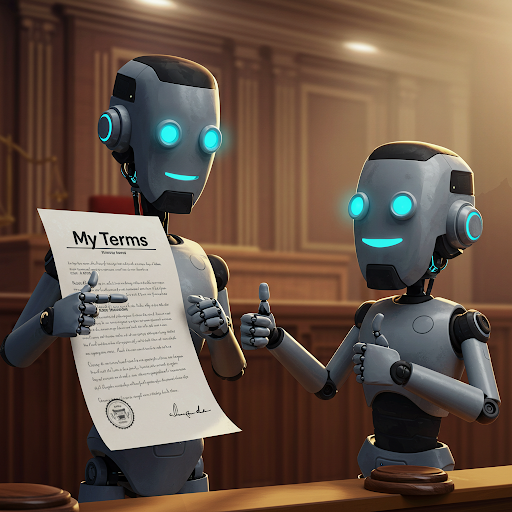
My dream for what happens next is that we reverse the whole consent process, based on IEEE P7012, aka MyTerms:
That’s your agent on the left. On the right might be any of the world’s sites and services. What you both agree to is a contract that you proffer as the first party, choosing one published at Customer Commons or the equivalent, on the Creative Commons model.
Trying on times. I like shoes I can slip on, because bending over to use my crooked arthritic fingers as shoe horns is painful. So is tying laces. (Oddly, typing on a keyboard isn’t painful, so that’s a counted blessing.) The shoes I’m wearing now are beat-up Sketchers that I bought at Nordstrom for about a hundred bucks five years ago and show their wear.
After doing lots of research, I decided to replace these with the Skechers Men’s Equalizer 5.0 Drayze Hands Free Slip-in Sneaker, sold by Amazon for $60. (That’s one, above.) After I ordered a pair of black 9.5’s last Wednesday, I saw a pile of almost identical Sketchers at Sam’s Club for $35. So I bought a pair of those and found at 9.5 they were a bit too big. So I returned them and got a size 9 pair. Those were too small. I’ll return those too. Then the ones from Amazon arrived on Friday, and I loved them instantly. My feet slipped into them smoothly (partly thanks to that shoehorn shape in the back). They also felt roomy while also hugging my feet, and my heel didn’t rise above the insole when I walked, which is unusual for shoes without laces.
But my wife hated these good ones on sight. Looking back, I should have vetted these with her, because she has taste in clothing (in fact, she’s a pro), and I don’t. So I’m returning these too, and we’ll buy a new pair at an actual shoe store. We’ll do it together, like we did at Nordstrom long ago. Live and re-learn. Anyway, I can still testify that, spousal aesthetics aside, these are great shoes. Really. I rarely give five-star reviews on Amazon, but I would have for this pair.
Looks real enough. Under the title Goodbye, Starlink? the headline says China Just Launched a $20 Billion Satellite Swarm — And Elon Might Be Toast, followed by this subhead: Huawei’s 6G Quantum-Crypted Meganet vs. Starlink Isn’t Just a Tech Battle. It’s a Global Internet War. The original is paywalled here at Medium, but you can read the whole thing here at archive.today., which is a handy workaround for paywalled pages. The author’s profile is here, and says almost nothing. Her medium collection is here. Is she real? Is any of this real? Well, I asked ChatGPT “Does Huawei have, or is it planning, a satellite Internet service to compete with Starlink? If so, how far along is it, and what are the differences from Starlink?” It gave me a sourced summary that compared and contrasted what Huawei’s doing with what Starlink already has, and closed with this: “Bottom line: Huawei is already in orbit with prototypes, is planning real-world tests by the end of 2025, and aims to offer a unified, secure, low-latency, sat‑to‑cell and broadband service embedded in its broader 6G vision. It’s not just a competitor to Starlink—it’s architected as part of a next-gen communications ecosystem with deep integration and state support.” Here’s a YouTube video that doesn’t seem far off.
In biology they dall it budding. [Did tracking-based advertising just get blown up in Europe?](Did tracking-based advertising just get blown up in Europe?) got too big and non-tweety for this daily post pile, and is now outgrowing on its own.
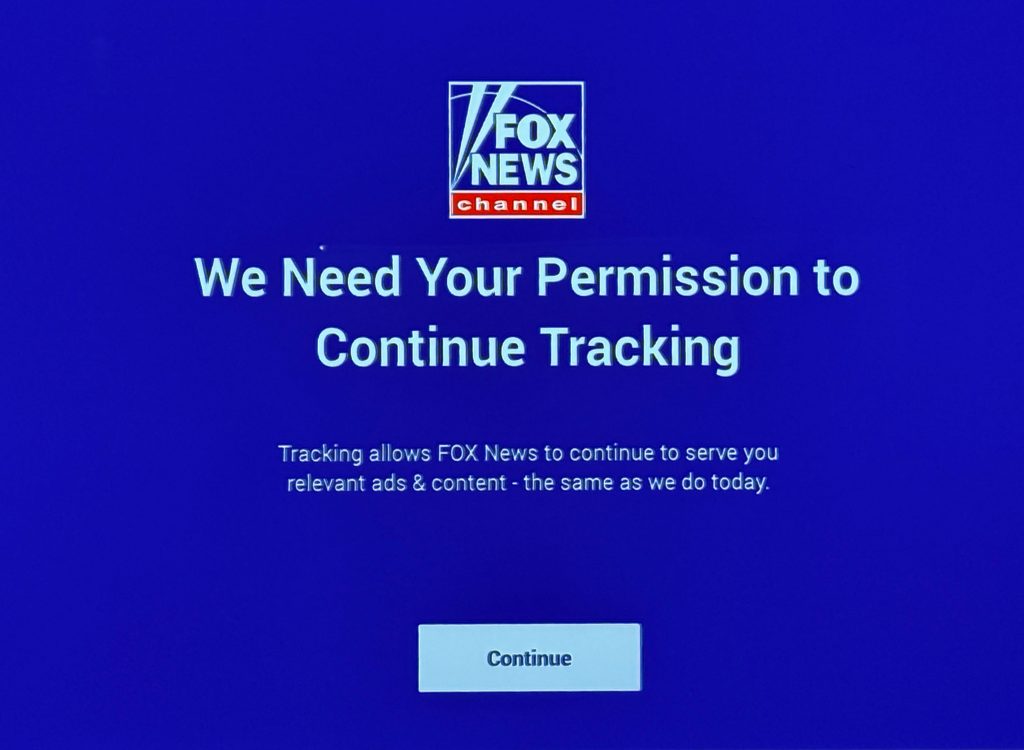
Show me where “your privacy choices” are kept, and how compliance can be audited, and I might believe corporate promises. On our Apple TV 4k box, an app for a subscription service (e.g. Netflix, Prime, CNN, Fox News, MSNBC, Haystack, whatever) usually opens with a message that gives one the choice to “Ask app not to track,” or to allow it. When I opened the Fox News app on Saturday, however, it said this:
So I deleted the app. I’ll miss seeing Fox News’ coverage of events, and comparing it with what other cable news services are saying. But I tend to avoid all of them because they’re almost entirely about showcasing show anchors and guest talking heads. Meanshile, CNN has been making it easy for me to avoid seeing their heads by reducing their service to this:
I got rid of that app too.
Only MSNBC seems to be working. While I might presume that they’re obeying my past request not to track me, there is no way to tell. Additionally, since I only ask apps not to track me, there is no reason for me to have faith in any of these services’ intentions regarding personal privacy.
What I wrote here and here four years ago still applies. Asking isn’t telling. And there remains no way to know for sure that my privacy requests or settings are respected. The situation is no different with Apple’s latest ad—a 1:30 film titled Flock that’s currently on YouTube (and in shorter forms in TV ads, such as in the current NBA finals). In it, a woman blows up flying surveillance cameras that want to follow her everywhere just by opening Safari. Here’s a screengrab:
Even if Safari is fully respectful of personal privacy, countless other apps are not. The same goes for apps on streaming devices such as the Apple TV 4K. And for your TV. (Here is Consumer Reports on that.)
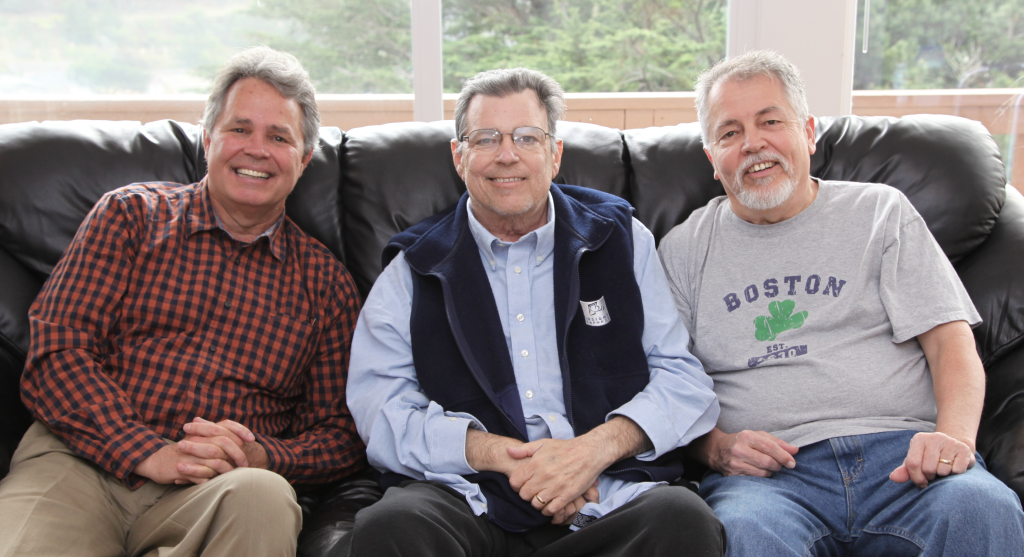
David Hodskins, Ray Simone and Doc Searls on Ray’s couch, their last time together, a few days before Ray died.
Across the final three decades of the last millennium, I was the creative director and main copywriter for Hodskins Simone & Searls (HS&S), a hot advertising agency in North Carolina and Silicon Valley. I also still wrote often for a local Magazine called The Sun, which has since grown to become one of the world’s great magazines with no advertising. Since all of its archives are digitized and available to subscribers (which I still am) online, one can cringe through my oeuvre there. That’s what I was doing a few minutes ago while looking for something more recent than this, from the August 1980 issue:
I make my living in advertising.
Mostly I write advertising copy. Which means I write a lot of short, choppy sentences. Like this.
That’s basic copywriting style, by the way. Like peanut brittle, ad copy works best when broken into fragments.
One-line paragraphs are nice too.
At one time, advertising was a much more wordy business. And a lot less sophisticated.
Take the George Washington Hill school of advertising.
Hill was a Durham native, the head of the American Tobacco Company. One day he was dissatisfied with a bunch of advertising ideas that were submitted to him. So he hocked up a wad of phlegm and spat an oyster, right on the shiny corporate conference table.
“See that?” he said. “You may not like it, but you won’t forget it. That’s how I want my advertising to work.”
So to George Washington Hill, and others like him, we owe our nation’s hatred of advertising you just wish you could forget.
Advertising matured as an art in the early Sixties, when those wonderful Volkswagen ads came along. Like the product, the ads were simple and straightforward. They made an impression without leaving bruises.
This was the “creative” school of advertising. After its style became fashionable, some healthy fundamentalist caution developed, best expressed by the new slogan of Benton & Bowles, the Brooks Brothers of advertising agencies: “It’s not creative unless it sells.”
This may sound like a harsh way to judge an art, but I’d rather motivate a customer than please a critic. Just how do you motivate a customer?
The first impulse in advertising, as in all human life, is to argue. But think: how often, even when you make a perfect case, do you win an argument? To argue is to take sides, and it is human nature not to yield a side once taken. If you want a customer to side with your product, don’t start an argument. Some people think advertising motivates by brainwashing. But advertising is not in the business of changing people’s minds. It is in the business of opening people’s minds. That’s what makes advertising an art.
An art, I submit, speaks to the heart as well as the head. A mind that says “ouch” to bombast and “no”to argument will say “aha” to art.
“Aha” is the response advertising looks for. Basically, products sell themselves. Advertising just opens people’s hearts to a product.
The heart is the key. While reason and logic have seats on the mental board of directors, it is feelings that usually cast the deciding votes.
In fact, a lot of what we call thinking is just the noise our minds make while adjusting thoughts to suit feelings.
This doesn’t mean that good advertising makes a purely emotional case, but that advertising appreciates the way the mind operates.
It can be very hard to exercise that appreciation, however, when you’ve got payroll and salesmen and product development to worry about.
That’s why ad agencies exist, so the clients can work on other things, like making the products worth buying.
The interpersonal chemistry, both creative and procedural, inside an ad agency, is fascinating. Good ideas are amplified by other good ideas, refined by other viewpoints, and focused by collective purpose.
The result is usually better advertising, and therefore better results, than a company can get on its own.
It’s this “team art” that I like best about being part of an ad agency. It’s like playing one of your better team sports, or playing in a good jazz band.
David Searls
Durham, N.C.
I’m sharing this for several reasons. One is that it’s not a bad piece of writing. Another is that it has a nugget or two that pertain to life in general rather than just the advertising biz. Another is that it provides some source material for heirs or biographers, should any ever be interested. It’s also a bit emotional for me, because David Hodskins and Ray Simone were more than just business partners. They were first-rank friends whom I loved very much. They also died way too young.
Also,,,, I’ve lately been writing daily posts on this blog in the way I wrote them in my original blog. There would be a banner title for each day (created automatically), and under each of those, I would have headlines over each of the day’s posts, which varied in length from one line to many paragraphs, though most were short. The headlines were punchlines, putting the close or conclusion of the post above it. This was a trick I learned from Esquire‘s Dubious Achievement Awards, which are now unfindable for non-subscibers. (And maybe for subscribers too. Without subscribing, I can’t tell.) Anyway, I’m screwing around with formatting, and will continue to do that. Bear with me.
Kwaaiday the 13th. If you're curious about personal AI (and you should be, especially of the open source kind), you might like to sit in on a meeting of folks volunteering toward making it happen, Kwaai has its weekly meeting going on right now at the Zoom link atop its home page. See some of ya'll there. (I just noticed this didn't get posted. Still, check Kwaai out.)
Paper shavings. I just learned by Ed Cone that Greensboro, where I lived (and went to college) from '65 to '69, is maybe, sort of, turning into an aerospace place. (He points here.) More importantly, he offhandedly refers to the "rah rah local media," which presumably includes the News & Record, which was the News (morning) and Record (evening) when I was in town. That last link reveals that the remains of that once-great paper (and, before that, papers) is down to just five reporters. (The remains of our paper here in Bloomington, Indiana, a quarter the size of Greensboro, had seven, last I looked.) More about the change here.
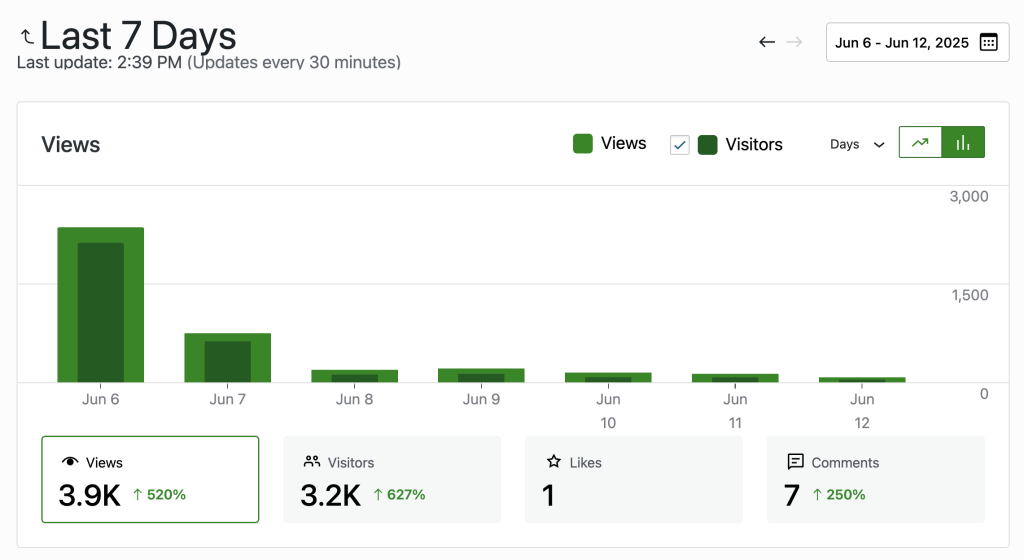
This blog’s stats for the last week. Down, but never out.
And having any readers is better than having none. So far (2:30 pm), this blog post has had three visitors. (Update at 11pm: eleven visitors.) And I’m not even sure those visitors have read any of this. Meanwhile, Online Sports Betting is For Losers is now up to 3,252 visits, second all-time behind Death is a Feature (6,643 visits).
But those are exceptions. Typically, a post here gets between a handful and a few dozen visits. But ya never know what might catch fire. Over at the ProjectVRM blog, A simple plan to de-enshittify CVS, which I posted in February, clocked several hundred visits a couple days ago, thanks to leverage from this post in Ted Gioia’s newsletter. So I keep it up.
Bonus link: Ted Gioia’s Brian Wilson is My Brick. The one in question is from a demolished building at Hawthorne High, of which both Brian and Ted are alumni. There’s much more. Read the whole thing.
But it’s still faked. Is there anything more human than intent? I wasn’t addressing that question when I wrote The Intention Economy (now only $13.93 in hardcover). But I was thinking about paths toward fulfilling the promise of the subtitle: When Customers Take Charge. Now AI is with us, and it looks like personal AI is one of those paths (and maybe the main one). Now I find myself reading Barry Petchesky‘s Whatever AI Looks Like, It’s Not, in which I am knocked over by this line from Ted Chiang’s Why AI Isn’t Going to Make Art, in The New Yorker: “it reduces the amount of intention in the world.”
The suggestion by both Barry and Ted is that by hoovering up as much as possible of all the world’s published human expression, and making it easy to re-express fuck-all—from essays to correspondence to scholarship to works of art—the intent we might have to make those things is reduced. Rather than write, or teach, or learn, or draw, we prompt an AI to do it for us. The metaphor that comes to my mind is one from broadcasting. Rather than pushing a signal out to the world through an antenna, the energy is “shunted to ground—or what engineers call a “dummy load.”
Of course, AI can be hugely useful. Try fingering personal AI again. The image atop that post was created by an AI, but all the words are mine. We did it together, because the AI can draw better than I, but I can write better than it. And it can’t write what I mean because it has no idea what meaning is, or even an idea at all. Sometimes it can fake it, and that’s plenty enough—and better at it all the time.
One of them is tweetlike posts on a blog. Jeremy Felt has a notes-oriented blog where he just pointed here with this: “… I think I can point to Doc Searls as the one who pushed me the last bit. His recent streak of daily notes with short, interesting, bits and bobs is a great format! I also saw Chuck mention format staleness and that probably helped with some ‘hey, it’s a good time for change’ thinking.” Which makes me think stinkiest stale format is the branded silo: a category that contains all the branded social media: Facebook, Linkedin, Xitter, Threads, Bluesky, and even Mastodon (which, even though it’s a federated alternative, is still a branded kind of social medium, emulating a silo without quite being one). What’s not stale is the blog. Jeremy has one. Chuck has one. I have one here. That I’m writing this with Wordland on a site produced in WordPress does not make either a silo or a platform. They are just tools for individuals to write their own stuff their own ways.
Advertising corrupts and digital advertising corrupts absolutely.
When my wife bought her new iPhone 16, the salesperson showed off Apple Intelligence by demonstrating how it would help her shop by pointing the camera at something… or whatever, I don’t remember. What I do remember was that the salesperson, and presumably Apple, assumed that most of what we do is shop. So now I’m reading The Top New Features in Apple’s iOS 26 and iPadOS 26 in Wired, and see, about half way down, “There’s even a feature very similar to Google Lens or Google’s Circle to Search, where you can take a screenshot and then highlight a specific thing on the page you want to search via Google, or through another app that’s installed on your phone that supports the feature, like Etsy. So you can highlight a vase, for example, and then find similar results via Google or similar shoppable vases on Etsy.” And the video image on screen is of a shopping “experience.” Will Apple get a kickback if you buy that vase? If so, it has started down a slippery slope.
More loving.
While digging around through posts on Sly and Brian (see below), I found myself reminded that Kevin Love‘s dad was Stan Love, who was the brother of Mike Love, the Beach Boys front man. Here’s Mike’s memorial Instagram. And whoa… (after further digging), get this: Stan and Mike’s sister is Maureen Love, harpist with Pink Martini, a band my wife and I also (no pun intended, but it fits) love.
We’re covered. Zoom in to satellitemap.space. The vast majority of low Earth orbit satellites (all the white dots above) are Starlink’s. Play around with the tabs.
This, more than raw power, is what gives authoritarians their authority. Dana Blankenhorn has a good post on Authority. With respect to my own thoughts on the topic, there’s what’s said in Poynter about what I said on my old blog. Key point: “We are all authors of each other. What we call authority is the right we give others to author us, to make us who we are.” We no longer need old-fashioned media to do this. We have echo chambers, built and maintained by algorithms rigged to maximize “engagement.” And the U.S. President is maximally gifted toward taking advantage of that simple system.
Just some facts. No interpretations. This blog post got nine reads by the end of the day. This photo got about the same. The photo above has had 22,122 views, 421 faves, and 21 comments. And lots more views every day. It may also be the best photo I’ve ever taken from the window of a passenger plane. And I’ve shot a zillion. (Here’s just one collection.)
Not quite universal. After my wife noticed that the Apple USB-C wired earbuds she got for her new iPhone 16 wouldn’t play when plugged into either of the USB-C ports in her MacBook Air, I went looking for USB-C wisdom and ran across The USB-C dream is dead and it’s too late to revive it, by Robert Triggs in Android Authority. The headline overstates the case a bit, but the piece is an informative read.
The points would remain the same. And original. I wrote Making a New World in March 2005 and self-published it (in a file pile at searls.com) because nobody else would. If someone wanted to publish it today, I would mostly just change references to companies that have gone out of business or changed their minds.
Gail Jesswein with his wife Marilyn, on his 90th birthday at our house in Santa Barbara, June 8, 2015.
Today is the 100th birthday of Gail Jesswein, my father-in-law.
Gail was the father of eight, the first of whom was my wife. Gail was a merchant mariner during World War II, when the casualty rate was one in twenty-six, higher than any U.S. military branch. On shore after the end of the war, he met Bernadette, an attractive young woman on vacation from Chicago, on the Santa Monica pier. Gail and Bernie married shortly thereafter and raised their family in Los Angeles, where all their kids attended local Catholic schools and churches, while Gail ran a thriving electrical contracting business.
After Bernie passed of cancer (at just 46), Gail married Marilyn, a teacher and former nun from Grand Mound, Iowa. After the kids were all grown, Gail and Marilyn moved first to San Francisco and later to Sacramento, while he worked as a California state official under the administrations of Pete Wilson and George Deukmejian. On the recreational side, Gail was, among other things, a commodore of the Delta Yacht Club, located on an island in California’s Sacramento–San Joaquin River Delta, where the family enjoyed many summers camping and water skiing.
The first Jesswein families in the U.S. (as I understand it, anyway) were those raised by two brothers who emigrated to Kentucky from Kiev, where both were court translators, in the 1800s.* A generation or few later, Gail and his brother Donald grew up on a farm in the crossroads town of Lydick, Indiana, just west of South Bend. His favorite song was A Boy Named Sue. You can understand why. Not that it seemed to bother him. Far as I could tell, not much did. He was tough, but not in a mean way. He was of a type John Wayne, Gary Cooper, or Robert Mitchum might play: a man of few words and strong character.
And he loved a good laugh. We all got plenty at Gail’s 90th birthday party at our house in Santa Barbara, where various members of his large extended family made a theater production, acting out episodes from his long life. Though he was fighting late-stage cancer at the time, he enjoyed every second of it.
Gail passed later that year. A few years after that, my wife and I took gigs at Indiana University in Bloomington. We are sure Gail would be amused to learn that his firstborn is now a second-generation Hoosier, and enjoying life in the home state he was so eager to leave that he headed straight for an ocean.
I’m hoping other family members can give me corrections and expansions of what I’ve written here so far. (Being a blog, I can do that.)
What matters is that Gail Jesswein was a good man (with enviable hair!). It was a great privilege to know him, and I wish he were here to help us celebrate.
*I got the brothers-from-Kiev story from a file folder that Dorothy shared with me a few years before she passed, and which is now in Marilyn’s possession. I know some number of Jessweins are buried in the Ottenheim Lutheran Cemetery (beside the modest little Immanuel Lutheran Church) in Lincoln County, in the center of Kentucky.
Chrome question. One of my windows, with dozens of open tabs, vanished. How does one re-materialze it? ChatGPT says, Press Cmd + Y (Mac) or Ctrl + H (Windows) to open History. Look for a group entry like: “[Number] tabs – [Time]” under “Recently closed” or “Tabs from other devices.” Click it — the entire lost window should reopen. But I see no group entry like that.
Asking for a cohort. How many different sellers, or one seller with different names, are (or is) pushing a coffee cup with the design above?
But the problem is a U.S. one. Traffic to this blog jumped 313% today, thanks to Hacker News pointing to Online Sports Betting is for Losers, which was posted two and a half weeks ago. Visitors came from 70 countries.
New habits start easy. I now start my day with a new post here using Wordland. I name the post after the day and start tweeting—but on my own blog rather than social media.
Knicks fans know how OKC feels right now. The state of Indiana would like to thank the NBA players who called Tyrese Haliburton the "most overrated" player in the league. Halliburton just won the opening game of the NBA finals for the Pacers with less than a second left against the highly favored Thunder, in Oklahoma City. Doing that shit is a habit he has. Give it to him: the dude is clutch.
About face. The only fix for my face showing up on social media when I promote a blog post that has no image is to get a new theme for the blog—specifically one that I edit in block rather than classic mode. (That's WordPress talk.) So I am learning block editing on a practice blog. Stay tuned for the change.
Look at slide 30. What's not there is personal AI that gives you ways to get control over the data in your life: what you own, where you've been, what you subscribe to (on what, how, and on what terms), how you save/invest/spend, what you've agreed to, how you are being followed and by what, who you know and how, facts about your health and fitness, all your obligations. There are apps and tools for some of that stuff, but not much of it is integrated, or integratable by you for your own purposes.
Look at Apple Intelligence. The guesswork in your Apple Mail app about what matters to you is often wildly speculative and off-base. Most of what Apple Intelligence seems to be for (or at least what salespeople showed off to my wife in the Apple Store where she bought her new iPhone 16 the other day) is for helping you buy shit, not helping you manage the shit you have. Ask Siri to turn off notifications from one of the apps on your phone, and see what happens. You'll get something like "I don't understand the question," or worse, "Would you like me to ask ChatGPT?"
We can only get personal control with personal AI. Your AI. Simple as that.
Cause for pessimism. There is a stat in basketball called VORP, for Value Over Replacement Player. I’d like one for coaches: VORC, for Value Over Replacement Coach. If such a stat existed, Tom Thibodeau’s VORC would be pretty high. Minnesota and Chicago both fell after he left. Bonus link: Nate Silver, Knicks fan, Thibs non-fan.
Today’s rollback link. Podcasts, Wallcasts, and Paycasts, from last October. A pull-quote from a comment: “Paywalls are going up everywhere, as producers in the shittily named content business try to get ahead of Peak Subscription, and in the process are killing the open Internet, which is biggest farm ever created for geese that lay golden eggs.”
It’s all about geometry and packaging. Several million tech years ago, in the late ’80s and early ’90s, I did a lot of work for Hitachi Semiconductor and the collection of chip makers putting out (or planning at the time to put out) Sun Microsystems‘ SPARC CPU. The one I learned the most from was Hitachi, which at the time was making the microprocessors embedded in automobile brake systems and first-generation flash memory. Scientists from deep inside the company would make presentations predicting what would happen across the decades to come, just based on inevitable progress in chip design, function integration, and manufacture. I’ve watched, across those decades, how their predictions came true. One prediction both they and I made at the time was that the fabs required were beyond Hitachi’s scope, and that one or two companies not among the leaders back then would end up making the chips and products that ordinary people would pocket and use to vastly extend their agency in both the physical and digital worlds. The three most important companies doing that today are TSMC, Samsung, and Apple. I share all this to tee up Beyond 2nm: Apple’s A20 chip to introduce new packaging breakthrough, in 9to5mac. When when you read about TSMC at that link, recall this one-liner from Jerry Sanders when he ran AMD: “Real men have fabs.”
Whatever, it's complicated. The Narrow Path Needs a Floorplan: What Happens When You Feed Tristan Harris’s Vision Into the Meta-layer. The path is between the DYSTOPIA of centralized control and the CHAOS of "unchecked decentralized" whatever. The path is called COORDINATION, and involves "global clarity & coordinated action," which is about "co-governance—a path where humanity chooses structure, responsibility, and shared safeguards before it’s too late." The COORDINATION involves five Desirable Properties (DPs): —Safe and Ethical AI, —Community-based AI Governance, —AI Containment, —Trust and Transparency, and —Adaptive Governance. Contribute here, it says. Contributions are AI-assisted, for what that's worth. Or not. I'm posting this for the people I know who think this kind of guidance works. Hell, maybe it does. I'd rather have just one invention that mothers a necessity for any or all of it.
Imagine if, in the early '80s, we got decentralized mainframes rather than PCs. Long as we're vetting abstract ideals, you I give you DAIS, the Decentralized AI Society. I'd rather have personal AI. That way we would be independent, rather than "decentralized" or "distributed." (That last link is from eleven years ago: way ahead of its time.)
Anybody have one yet? I want one of these, which seems to be sold by many different companies, all advertising on Facebook.
“Agentiality,” a measure of relationship: According to GLIA Foundation, an AI system’s “agentiality” is the degree to which it is actually authorized to ably represent the end user by serving as “their” agent. It can be seen as a measure of authentic human relationship, progressing from treating humans as “users” of whatever service a provider may offer, through increasingly faithful levels of care, fidelity, and loyalty to the user, as explained in this book and article. This dimension is generally neglected but is essential to “whom it serves” and to democratic freedoms. Passive “alignment,” as provided by a third party who is not bound to faithfully serve the interests of the end user, is insufficient to ensure more than a shadow of that.
I would rather that paragraph say person or individual rather than "end user." As Chris Locke put it in The Cluetrain Manifesto* way back in 1999, we are not seats or eyeballs or consumers or end users. we are human beings and our reach exceeds your grasp. **deal with it.**Having our own AI agents, working for us, will finally make that dealing happen. More here. *Currently offline, so that points to the Cluetrain page at Archive.org. The original will be back up soon.
About a face. The problem Dave talks about here (my face pointlessly appearing with social media posts) is due to using an old theme that needs to be replaced. Hoping to make that happen this week. (The issue involves the "featured image" feature, as Dave points out in that post. When writing in Wordland, as I am now. I don't specify a featured image, so the social medium picks up my face for some reason. Dave suggests a fix, which the WordPress folks will catch when they read this.)