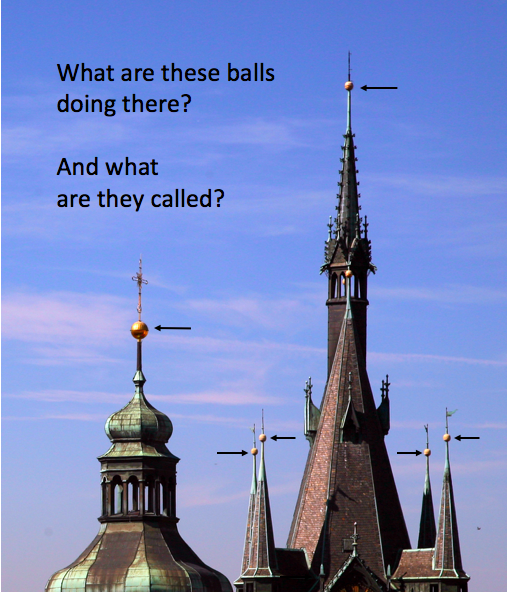
One of the things that fascinates me about Prague are the skewers atop the spires of its many iconic buildings, each of which pierces a shiny ball. It’s a great look.
I am sure there’s a reason for those things, other than the look itself.
I am also sure there is a word for the ball. The skewer too.
I know it’s not spire, because that labels any conical or tapered point on the roof of a building. Prague is said to be the city of a hundred, or a thousand, spires. Most of those have these balls too, and I’ve become obsessed, while I’m here, with finding out what the hell they’re called.
I’m sure more than a few people out there on the lazyweb know. So tell me.
Thank you.
Later: good answers in the comments below.
And later still (13 June 2026): Here is an authoritative source that surfaced after I wrote this post:
Towers with Golden Orbs. Motif of CupolaedSpires with Spherical Supports, by Zygmunt ŁUNIEWICZ, Wrocław University of Science and Technology, Faculty of Architecture
https://orcid.org/0000-0003-2461-3031
ABSTRACT The article is devoted to the hitherto overlooked architectural motif of spherical supports in tower spires, observed in northern Europe since the early 17th century. Probably derived from the obelisk ball-based motif popular in iconography. It first appeared within the spire of the Westerkerk tower designed by Hendrik de Keyser, and later in the realizations of his students in Denmark. Graphic representations of the towers also played a role in popularizing the motif. The article investigates the potential routes of the motif ’s spread and explores possible connections between the different objects. Due to the various forms and contexts in which the motif was used, it is difficult to determine any additional ideological content beyond the prestigious functions associated with dominant tower structures. KEYWORDS tower, Welsche Haube, cupolaed spire, Hendrik de Keyser, Baltic Sea region, Danish Renaissance
I don’t find evidence that any of the balls were filled with mercury, but I’ll keep looking.


Leave a Reply