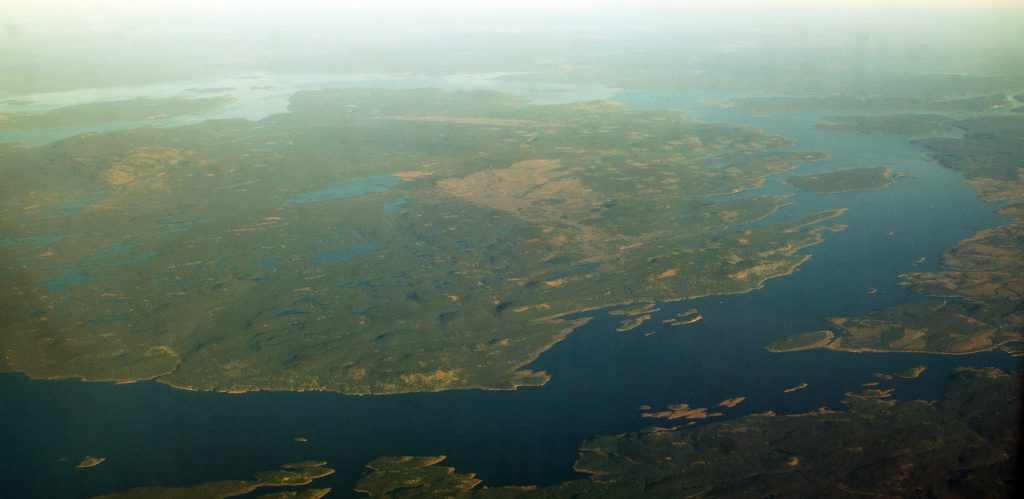
Lake Manicougan, which I shot while vectored from London to Chicago in September 2009. It’s a circular lake filling the inside walls of a crater formed by a meteor 214 million years ago.
Anna’s Blog saysAnna’s Archive has backed up Spotify’s entire music library: “This release includes the largest publicly available music metadata database with 256 million tracks and 186 million unique ISRCs. It’s the world’s first “preservation archive” for music which is fully open (meaning it can easily be mirrored by anyone with enough disk space), with 86 million music files, representing around 99.6% of listens.”
So It Begins
The Winter Solstice happened this morning at 7:03 AM Pacific Time (where I happen to be for the holidays). That was about exactly when the Sun came up here. But we were in fog. That’s a July thing in Santa Barbara, and out of character for December, when it would rather be clear or rain. Christmas, they say, will be very wet.
TVs for sale two days ago at a Costco in Goleta, California.
You can now get a huge 4K TV for not much more than an ATM withdrawal. (Remember those? They gave you paper rectangles called “cash.”) You’ve already got Netflix, and probably four or five other subscription TV services, plus (or, increasingly, minus) cable.
You can also get good-enough surround-sound speakers to go with the TV. Put them all together in the room where you watch movies, and you’re not far from the theater experience. Also, you can hit pause, rewind, and chow down on cheaper snacks while you watch. And you don’t need to drive there or get tickets. Not much of a contest.
Of course, you’ll want to replace it all when 8K gets real, but your new 65″, 85″, or 100″ screen will look fine until that happens.
Meanwhile, grass will continue to grow in the cracks of the parking lot at your nearby multiplex theater. (Remember those?)
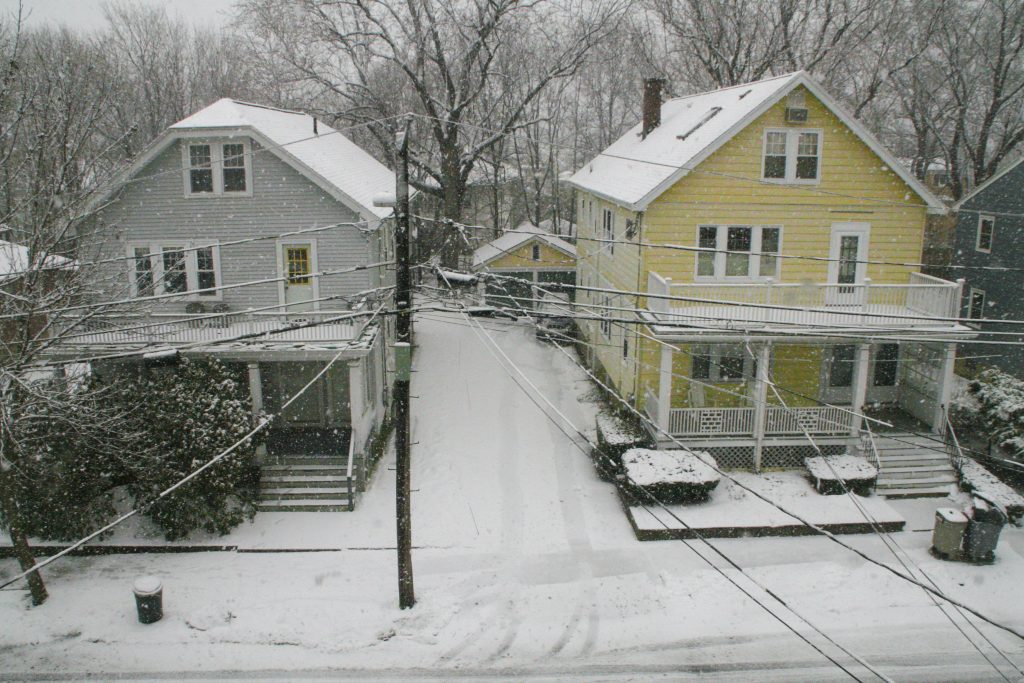
A view of Winter from my attic office in Arlington, MA in 2009. Still miss living there.
Nows
[5 January update] For some reason, this set of posts I wrote last Saturday appeared on 20 November of last year. Dunno why. Anyway, right now I am in San Marino, California, where it is finally sunny and paradisal, after monsoons soaked the holidays. Tomorrow I’ll be back in Bloomington, Indiana, which (seriously) moved half its population to the Rose Bowl for the Hoosier football team’s victory over Alabama. There is no snow on the ground right now in Indiana, but it’s Winter, so there will be. That’s my excuse for the photo above.
Feel and Look
First, Ethan Mollick’s latest on AI is thoughtful and informative. It also introduced me to Nano Banana Pro, Google’s Gemini-based image creator/editor. This comes at a time when I have sworn off using AI-generated art, because all of it looks like AI-generated art. My own arc with AI-generated art has gone like this: interested—>fascinated—>practiced—>expert-ish—>tired—>avoidant. That last stage is easy for me, because I have a library of half a million photos of my own to choose from, and I’d rather raid that for an image that works.
I’ll try NBP. (Is it called that yet?) But not soon. I’m too busy looking for ways a personal AI can help me find exactly what I’m looking for inside those half-million photos. And yes, I know Apple has “intelligence” for that. But I think it sucks, and I want an extra brain that’s all mine.
It’s earlier than it appears.
One of my readers tells me another reader (they’re social!) told him she liked it when this blog was all long posts, rather than almost-daily sets of tweet-like ones, such as I posted yesterday and the day before.
My original blog was a mix of both. But my writing streams branched when I started blogging here using WordPress in 2007. Social media was taking off, and writers began using Twitter, Facebook, Linkedin, and other social media platforms for publishing short stuff. In the midst, tweet became a verb. So I wrote long stuff here, and tweeted the short stuff elsewhere.
What I’m doing now with Wordland is shifting my short-burst bloggings from social media platforms that are not mine to this blog, which is mine: going from dependence to independence. Dave, father of Wordland and much else, is leading that shift, and I advise paying attention to what he’s writing and doing.
First, I hate liquid glass, with its water-stain lettering and deeply cropped and rounded window and icon corners (which give you fewer pixels to click on and harder corners to grab and pull.) I’ll say more about it after the holidays. Meanwhile, if you’re with me, this will help.
Second, I continue to insist that the Internet and the Web should always be capitalized as proper nouns. Because they are names. Both are also a one-and-only, like the Sun, the Moon, and the Earth. You can’t find other examples of them.
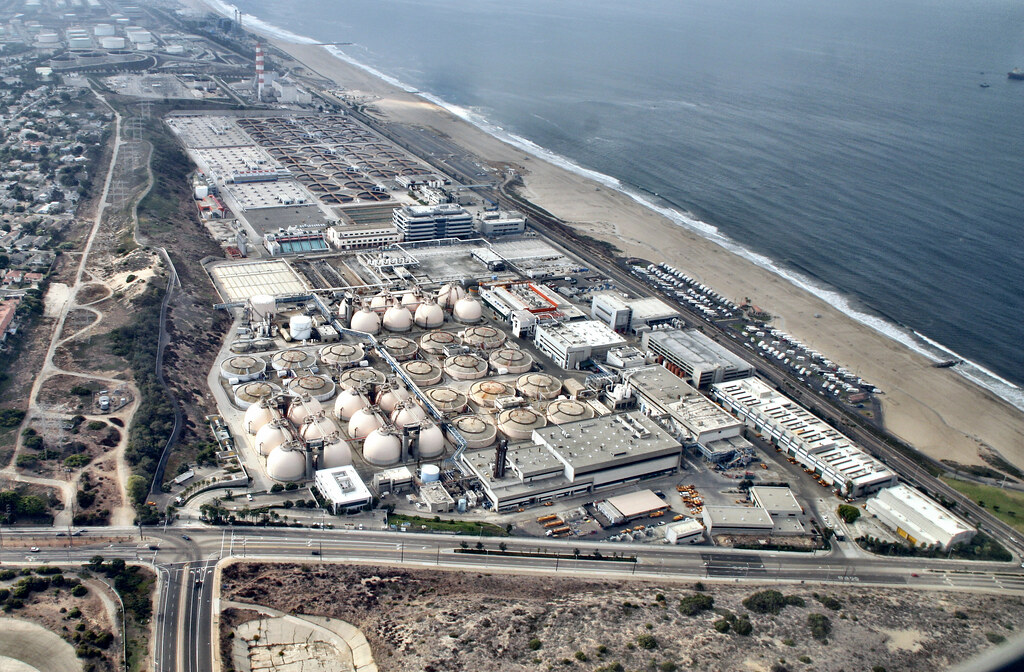
When you crap in Los Angeles, it goes to the ocean through what you see above: the Hyperion sewage processing plant on the south side of LAX. Now imagine this plant as the heart of a fecosystem that takes an ocean of personal data gathered by surveillance, and uses it to push personalised advertising up the asses of everyone sharing the same plumbing. That’s what we have on the Internet today. And it will get worse before it gets better. Unless we nuke it. There is a way.
Near-universal surveillance of our digital lives (and in some places our natural ones) has been with us for two decades or more. John Robbsees this expanding to surveillance by the state, with systems in the U.S. coming to resemble China’s: “As this system matures, the desire to profile, grade, and target people, on and offline, will emerge. To do that, AI ‘minders’ will be built to monitor every individual, creating detailed profiles that can predict behavior, assign scores (from threat level to deviation from authorized norms), and punish infractions. Punishments span unsuitability for employment to law enforcement action to limiting access to public services.”
He also suggests remedies:
Data ownership. You own your own data. Your (our) data drives AI development. We should benefit from that ownership and have a say. Unfortunately, the data ownership ship has largely sailed. The time to take action on that was during my testimony to the Senate, just before AI emerged publicly. There is still some room to demand ownership with copyrights and in corporate settings, but the easy fix isn’t possible anymore.
AI ownership. You have an ownership stake in the AIs you train as coworkers, assistants, household workers, and so on. This ownership means that AIs shouldn’t be delivered as a service running on a centralized platform. Instead, AI should run in private instances or on local hardware that you own or control.
Choice. You should have the option to pick the alignment (values, viewpoint, etc.) of the AIs you have an ownership stake in. You should be able to choose (from the templates available) or, through training, configure the alignment of the AIs you interact with. For example, you should be able to set the values of the AIs tutoring your kids, caring for your home, working in your community, or interacting with you at work (that’s a negotiation between you and your employer).
We need personal AI’s, just like we need personal shoes, bikes, and computers. I’ve been writing about this since May 2023. Check it out.
I also just ran A New Era Beginsthrough an edit to tighten up the case for MyTerms, which is the only way we’ll get real privacy online. If we want to blow up Ye Olde Fecosystem—and build something that’s much better for business and ourselves, MyTerms is where we start.
Paolo once told me that cats came to Earth to enslave the standing monkeys. While funny and in some ways true, cats can be more and other than that. They can be as loyal as dogs (and both species far more loyal than grown humans to each other), and friends (again, like dogs) in the truest sense.
In The Cat Who Woke Me Up, Sy Safransky shares a story that I wish typified the pets who have co-occupied my life. Only one of those beings lived a long life, and none meant as much to me (or me to them) as Sy’s cat Cirrus meant to him. If you want to know how well a companion’s soul exceeds the dimensions imposed by the label “pet,” read that piece.
What matters most to me about Sy’s story is that he is not just one of the best writers I have ever known, but by far the best editor. No other model or mentor has meant more to me and my writing than Sy. I’d submit a piece and get back an edited version that was half as long and ten times better.
For a while Sy also edited a magazine called Theta for the Psychical Research Foundation, which studied the possibility of life after death and at the time was hanging off the side of Duke University. Wanting fewer distractions, Sy handed Theta off to me. “You can do it in your sleep,” he said. “I only spend a day a month on it.” Editing every Theta took me a month. But getting involved in the PRF also changed my life. I credit Sy for that too.
I met Sy half a century ago, when he was selling copies of The Sun for 25¢ apiece in front of the Post Office on Franklin Street in Chapel Hill. On that spot he turned me from a customer to a contributor. Since then (and owing very little to me), The Sun has become (IMHO) the best magazine on Earth. One reason for that is the quality of its writing and imagery. Another is its absence of advertising. But the biggest reason is Sy himself. Hats off.
How about them Knicks!
I might say the Spurs did the Knicks a favour by ending the Thunder’s winning streak and making it easier than it might have been for the Knicks to win the NBA Cup. But the Knicks are better than that. They are the cream that has risen to the top of The East, and (mark my words) the team that will face the Thunder at season’s end and win the championship. In my biased opinion, they really are that good. And fun to watch.
Please go to hell. Seriously.
That’s what I want Microsoft to do with Copilot.
Like Rob Reiner did for movies
Colleen Kenny: “The future belongs to whoever can translate that heart-level understanding into language that machines can parse and serve. It’s not about dumbing down art for algorithms… It’s about making the mercurial whimsy of the human heart more understandable to the bots who connect the dots.”
IOW, same shit, new chamber pot
In respect to the item above, Col also says,
“Marketing teams are still trying to talk at humans with 2010 media tactics, rather than tuning into their frequency and ensuring their content is legible to 2025 machines… Content owners need to stop thinking about “beating” the algorithm and start thinking about teaching it. This is Artificial Intelligence Optimization (AIO), and it means ensuring your entire digital ecosystem speaks human vernacular and fluent LLM. To be found, creators must not optimize for machines, but rather optimize for meaning across math-friendly representations of context, and be clear about their core identity. This requires: Semantic Metadata: Architecture built around how people actually speak to each other (”Show me a fast-paced thriller that isn’t too violent”), not how marketers write Tweets, Insta posts, and press releases.”
Dana Blankenhorn: “There’s a demographic cliff ahead. We’re racing toward it with all speed. Japan has fallen off it, its centenarians finally succumbing to the pull of entropy. They have empty houses, even abandoned towns. That’s the reality coming to America, to Europe, and to China. It’s coming faster as we build walls against the South Asians, Africans, and Latin Americans who might like to bail us out.All this means that at some point, housing prices will fall, hard.”
That last item was the first when I started this day’s tweet-ish bloglings. That’s why the headline was originally Shitting Us Not. But as the bloglings added up, the headline didn’t work, so I changed it to Taking It Slower. In retrospect (I’m writing this on 5 March 2026) that also doesn’t work, and the URL still ends with shitting-us-not, so I’ve changed the headline back to the original.
Bing gives me (no shit) L”ago Baikal (Rússia) – Na Sibéria, o lago mais profundo do mundo também é conhecido por fenômenos estranhos. Pescadores e mergulhadores relatam luzes submersas e aparições de figuras humanoides nas águas geladas. Durante a Guerra Fria, militares soviéticos registraram eventos …” elipsis and all, in a large white space above an even more useless list of search results than Google’s. Fifth down on the list is J. Doyne Farmer – Wikipedia. At the bottom of that result it says, “Missing: Doc Searls · “What does the Internet make of us?” Must include: Doc Searls · ‘What does the Internet make of us?’”
There is also is an enshittifying popover obscuring the bottom left quarter of the search results that says “Turn your searches into gift cards with the Microsoft Rewards Extension.” Way to sell, Microsoft.
At least Google’s results are all for pieces I’ve written here that include links to the Medium piece. Some of Bing’s do, some don’t.
When I asked Gemini to find the piece, it did, and then naturally asked a bunch of shit it assumed I might be interested in but was not. Then I asked it why it found what I wanted and Google didn’t. Translated from Bullshit, its answer said, “Stuff Doc Searls wrote about a piece Doc Searls wrote matters more than the piece Doc Searls wrote.”
Angels of Cities
On the ground now (context) in Los Angeles (actually San Marino, but all this sprawl is Los Angeles), reminded afresh that I love this place. I just took a walk in 57° weather. It’s clear, the sun is up, and the expected high is 82°. Perfect. I also drove to the Pasadena Peet’s to fetch a couple of breve cortados (which Peet’s has had far longer than Starbucks), renewing a ritual not possible anywhere in Indiana (though there is good coffee to be had, just not Peet’s).
We’re heading to our house in Santa Barbara tomorrow. While not perfect (no place is), Santa Barbara comes closer to perfect than any other city I know. It’s no exaggeration that a Special Weather Statement would be “It’s not perfect today. It might rain.”
Mostly we’re elsewhere, but it’ll be good to be back for the holidays. And while I enjoy the city and our many friends there, I also feel the same about Boston, Cape Cod, the Bay Area, North Carolina, Seattle, New York, Indiana, and all the other places we’ve lived and gathered friends across the decades. All of their cities and regions yearn toward perfection, too. So hats off.
I'm 30 kilofeet above the Missouri River, westbound from IND to DEN, with (United tells me) eight minutes to get from Gate B24 to Gate…?. It's blank. Doesn't say. I guess we'll find out.
Update over Nebraska: We need to get from B45 to B25 in 8 minutes or less. It'll be fun if we make it. [Update later: we made it, just under the wire, and it was—perhaps also for others in the thick crowds who might be amused by the sight of a geezer with a packpack ambulating at speed down long concourses (one with an inconveniently disabled moving sidewalk between gates.]
Meanwhiles
I tend to use seatback screens on planes only to show a map of where we are, while I look out the window and shoot photos. (Here are 19,411 examples.) But the ground between IND and DEN was undercast, so I thought I'd try a movie, since on new and refurbished planes United now provides a bluetooth connection to one's headphones and ear pods. The first movie I tried to watch was Spinal Tap: II the End Continues. I liked the original too much to stick with it, and thought of more funny things they could have done with the script than they did, so I punched out after about ten minutes. Then I tried Mission Impossible: The Final Reckoning. I had trouble figuring out what was going on while all the time studying Tom Cruise's 63-year old face (seemingly always in close-up) for signs of aging. I didn't see any and got bored anyway, so I went back to the map and listened to a podcast on my phone, providing an example of what I wrote about on Tuesday.
Oh my god!
I know Louis CK got canceled and all, but what he said here before that happened is still true. I'm living it now. In a chair. In the sky.
Predicting the predicting
I fear I will come to hate coverage of politics through prediction markets as much as I hate coverage of sports through gambling. So does this guy.
That’s what MyTerms does. Since I don’t have a photo of my own shot here in the natural world, the AI image above represents the degree of agentic scale MyTerms gives to a human meeting a company they want to respect the human’s privacy requirements and also do business.
I try to publish interesting and useful stuff every day. And yet. And yet. Of the 17+ million views my photos on Flickr have had since 2004, the most-viewed, by far, is the scary one above*. Second-most is this one. Less dental, but just in-your-face (and mine).
*All those gold crowns and inlays were done by dental students John Berry (now retired in Durham), and Steve Herring (now in practice here in Fayetteville). Great guys, both. (Ask me someday to tell you about my experience accompanying Steve on his first solo flight as a small plane pilot.)
The answer to the headline is Almost Everywhere Else.
The new wheres are uncountable, and their number and variety are growing.
The transition is from
the natural world where the contents of media were distributed by static sources built for the natural world’s natural constraints, to
the digital world, where content can be produced and distributed by anyone to anywhere on the Internet at costs that lean hard toward zero.
Think about the word station. That’s where we got our audio and video before the Internet came along. Some of that audio and video was distributed by or though stations over networks that were closed and private: NBC, CBS, ABC, Fox. Both stations and networks were static and unmoving. The words “range” and “coverage” had meaning. Now they don’t. We are on the verge of ubiquitous connectivity that one can presume anywhere. (Just wait until every car comes with Starlink and you’ll have one you can keep in your backpack. The Starlink Mini is to the future what the iPod was to the iPhone.)
In the digital world, media choices have gone from static to dynamic, and from few to endless. And our appetite for what we call content is served across buffet tables that stretch past horizons in all directions. That some of it is only available by subscription does not diminish the plain fact that all the rest of it is free for the gobbling.
And the plethorization of fuck-all continues. Given where it can go in the long run, we’ve hardly started.
In the meantime, however, getting people interested in what we’ve got is only going to get harder. Not saying this is a bad thing. Just that it is a thing.
Hard evidence for the change is trends in visits to my photo collection over time. Softer evidence is a decline in listens and views to a podcast I hosted for several years, and to this and other blogs.
Let’s start with photos. I’ve been posting those here on Flickr since 2004. Almost all of them are Creative Commons licensed to encourage re-use. For a passive collection (it just sits there and grows), it has always had a lot of traffic. In a typical week my main site there would get 5,000 to 15,000 visits a day. For example, here’s a slice of 2014:
Now it looks like this:
I’ve more than quadrupled the cumulative number of visits while attracting a quarter of what I did eleven years ago.
One reason, of course, is AI. My photo collection is a huge library of photos that I’ve licensed to encourage re-use. But, thanks to AI, fewer people are using search to find useful images, while also using ChatGPT, CoPilot, Midjourney, Gemini and other robot AI artists to create whatever. Me too, though I’ve mostly stopped because I think by now people dismiss it on sight. I don’t want somebody arriving here to think “that looks like AI.”
But the bigger reason is that there is so much more stuff of all kinds available on the Internet.
I saw the same trend for the podcast I did on TWiTfrom 2020 to 2023. As I recall ,consumption dropped from about 15,000 per episode when I started to about half that by the end of my hosting on the show. I might blame myself, but I thought the show actually got better while I was there. The audience had simply moved on to other choices, of which there was an infinitude.
This blog is a more radical example. In the ’00s, when blogging was hot and authors were few, this blog’s predecessor got up to 50,000 readers per day. Maybe more. (I barely watched stats back then.) When I moved to this blog in ’07, it dropped to about 7,000 a day, and held steady for years after that. But as social media grew past huge, podcasting took off, and it became possible to watch video on rectangles of all sizes, readership fell to between a few dozen and a few hundred per day. That’s where it is now. But I’m not complaining. This is just life in the vast lane.
For public stats on declines in consumption of content from static sources, consider public radio. Shares for public radio stations have been going up in New York, Chicago, San Francisco (strong #1), Atlanta, Washington (often #1), Seattle (also #1), Philadelphia, Boston, Raleigh-Durham (strong #1) and many other places. In Santa Barbara, six public radio stations together total 24.2% of all listening. Yet public radio listening as a whole has been going down. See here, here, and here. Classical music radio too. (Most classical stations are also public, meaning noncommercial.) This means radio on the whole is declining faster than public radio, which is gaining a larger share of a smaller pie.
I speak from experience. MyTerms is a project run by Customer Commons, a US-based 501(c)3 nonprofit. Prior to the change of government in the US., one could operate something with worldwide scope from here. Now we need to base most of our MyTerms work in the EU. That's actually a good thing, strategically, because Europe gives a much larger shit about privacy than the US generally (thank WWII and the Holocaust), and that's where most of the interest in MyTerms is spinning up. But it is a huge downer to hear from friends and co-workers elsewhere that one reason we need to make the move is that the US government is hostile to the EU and the rest of the world. (It doesn't matter that there are arguments against that assertion. Logic and reason may sit on the mental board of directors, but emotions cast the deciding votes. And this is an emotional matter now.)
The Right to Privacy is a brief written by Louis Brandeis and Samuel Warren and published in the Harvard Law Review in 1890. It has not been improved upon since, because what it says is so damn obvious and simple: that the right to privacy is “the right to be let alone.”
Those six words are well understood by everyone in the natural world, and have been for the history of civilized life. Hell, probably before that as well. But they are alien in the digital world.
Here’s why: Our knowledge of privacy in the natural world is tacit, meaning we know what it is but can’t easily explain it. Meanwhile, the digital world is entirely explicit. It is made of bits and code.
We don’t yet have a way to make explicit our wish to be let alone in the digital world. Or how we might not, and for what purposes.
“Consents” such as those provided by cookie notices can’t do it, because all the agency you have is what they provide, and they have little or no interest in obeying whatever “choices” you’ve made about being tracked. They might not even be able to do more than put up one of those notices. To see how total the suckage is, read this, this, this, this, or this. It’s a fecosystem, folks. 100-proof bullshit.
MyTerms is for privacy what TCP/IP is for the Internet and HTTP/HTTPS is for the Web: a foundation atop which an infinitude of products and services can be built—ones that can’t be built so long as privacy is a corporate grace and not a personal right, and all customer-company relationships are exclusively under company control. Simply put, if your privacy is in the hands of others alone, you don’t have any.
The way MyTerms works could hardly be more simple. (That’s one reason developing the standard took so damn long.)
You (the person), acting as the first party, proffer a personal privacy agreement to every site or service you meet, or know.
If they, as the second parties, agree, you both keep identical records of the agreement, so compliance can be audited or disputed (if need be) in the future. Since MyTerms are contracts, enforcement follows contract law.
You will choose the agreement from a short list posted on the Web by a disinterested nonprofit such as Customer Commons, which was created for that purpose. (The model for this is Creative Commons. MyTerms will be for personal privacy what Creative Commons is for personal copyright. We thank them for tilling that field for us.)
Both parties use agents. These can be as simple as a browser and Web server (e.g. WordPress or Drupal) plug-ins, or as fancy as AI agents on both sides (such as many companies use to work out B2B agreements).
The flow looks like this:
In the sense that these are manners, this is a protocol. But it’s not a technical one. All the tech is up to developers.
To help imagine out how this goes, here is one way MyTerms might look in a browser with a MyTerms plugin that manifests a couple of buttons in the browser header (DuckDuckGo‘s in this case):
The left ⊂ is your side of a potential or actual agreement, and the right ⊃ is the website’s side. With colors, additional symbols (for example within the ⊂ and ⊃, or other UI hacks, these might show states —
Willingness to engage by either side
State of engagement
Additional information (including agreements built on top of the original MyTerms one), such as VRM + CRM relationships
The symbols might have pop-down menus with choices and links that go elsewhere. The possibilities are wide open.
I choose ProjectVRM for an example, because it’s ready to agree to a visitor’s proffered MyTerm, and a bunch of us did a lot of thinking and working on this problem (and opportunity) back in the ’00s and early ’10s. For one example, look here.
We started ProjectVRM, created Customer Commons, and developed MyTerms, all to open markets to far horizons that cannot be imagined, much less seen, from inside silos and walled gardens built to keep people captive while harvesting vast amounts of personal data just so people can be guessed at by parasites (such as what most advertisers have now become).
By starting with privacy—real privacy—we can finally civilize the digital world. We can also set countless new tables in the marketplace. These are tables across which demand and supply can converse, relate, and transact in countless ways that are simply impossible in the consent-to-surveillance fecosystem.
When I headed to the Bay Area in 1984, years of success and championships followed for the 49ers, the A's, and the Giants.
When I came to Boston in '07, the Patriots went undefeated (except for the Super Bowl), and the Red Sox and Celtics won championships. Then the Pats and the Sox continued on that path.
I avoid politics here, but I can't resist pointing to this post by Daniel Barkhuff, emergency room MD, former Navy SEAL, and A-1 writer.
An additional thought is that after political conservatism recovers from MAGA fever, it will be much sharper than it was before. It may take longer for the Left. Just a guess.
We need both. We need the Right's sense of how business works, the value of thrift, and other stuff like that. We need the Left's sense of how government works and can care for people. We also need AND logic between the two. OR logic is a big fail.
We only have a little while to live. Such a precious time to be here. Wherever here is. To see each other and this awesome, incredible world. So let us not talk falsely now. Let us be what we truly are, which is human, and try to get our heads and hearts around what that might conceivably mean.
And mostly, miracles of science notwithstanding, let us not take ourselves too overfuckingseriously.
Walter Cronkite, in a 1963 photo by Bernard_Gotfryd
And that’s the way it is, Friday, December 6, 2025
I try to come up with unique headlines for my daily bloggings through Wordland. I can’t call the day’s blog the date, because the blog already puts the date above the headline. So today it would stack like this
December 5, 2025
December 5, 2025
with the upper one in the theme’s blue-green type and the lower one in headline bold. Can’t have that. But I also need the headline to work with all I put below it, which might be anything. Anyway, that’s an explanation of yet another whatever on the edge of your life that you didn’t need to know. Cue Walter Cronkite.
I like Dave’s Pluribus theories. I do agree that there is a love story to be had between Carol and Zosia. And I think it would be cool if what’s under the tarp is the missing child in Down Cemetery Road. But, since future seasons are planned…
Here’s the flyer for the next talk in our salon series here at Indiana University:
Elettra is one of the most interesting, smart, accomplished, caring, and effective people I know. She is also all of those in English, French, Italian, and German. I met her through our overlapping work around the Berkman Klein Center at Harvard, where she is today a Faculty Associate.
Her day job is as Assistant Professor of Law and Computer Science at Northeastern University’s School of Law and at the Khoury College of Computer Sciences at Northeastern University, doing research on antitrust, privacy, data and the overlap between platform governance and the digital economy.
Her credentials are beyond notable:
SJD and LLM degrees from Harvard Law School and LLB (Hons) from University College London.
Diploma in Intellectual Property Law and Practice at Oxford University.
Affiliated Fellow at the Information Society Project at Yale Law School.
Alumnus Fellow at NYU School of Law and at Cornell Tech in New York.
Qualified to practice law in New York, plus England and Wales.
If all of that doesn’t get your attention, you may already be infected, if not afflicted, by wanton and unconscionable (except by the perps) extraction of personal data from and about you and your life. You need to attend this talk.
Ever notice that? Probably not. Me either. We wait for somebody—or many bodies—to write it down. Or to podcast it.
Remember “What’s on”? Not if you’ve never watched or listened to live news on a schedule. At this point in history, most of us don’t any more. If we care at all, we subscribe to podcasts for that. News commentary podcasters feed us the kind of stuff we want to hear. Same for what’s left of TV news. That the mainstream is now the redstream is beside the point.
Which is that it’s all digital. As Marshall McLuhan is said to have said (he didn’t exactly, but meant it), we shape our tools and then our tools shape us. He also said we live at all times in a media environment. The environment we live in now, far more than we ever lived in stone, aural, scribal, print or broadcast media, is digital.
Only it goes farther than that. We are now digital as well as physical beings. (To see how much, try living for a week without your phone.) The digital world we occupy is no less real than the natural one.
But, while we are natives of the digital world, we can hardly say we know it as well as we do the natural one, because it changes constantly. In fact, its business, to the degree it has one, is changing us—shaping us—for its own purposes. We are milk cows in its dairy farms.
This is why my wife and I, both visiting scholars with the Ostrom Workshop at Indiana University, have been putting on a salon series every academic year since 2021. We want to liberate the digital world’s inhabitants from its dairy farms.
This year our theme is After Analog, as it says in the banner above.