Tom Fishburne nails marketing bullshit across the ages.
David Siegel on defining AGI: "I think a better definition is when a program is less wrong than most experts, and it admits there is much more to know.
Tom Fishburne nails marketing bullshit across the ages.
David Siegel on defining AGI: "I think a better definition is when a program is less wrong than most experts, and it admits there is much more to know.
Dana Blankenhorn, part-time Nederlander, calls bullsit on this.
Facebook Marketplace, from which I have only bought cheap local furniture, recommends (no shit) that I buy (and I quote by plaintext copy/paste) a 2001 Prevost H345 Prevost H345 Team bus $35,000 Louisville, KY.
Neal Stephenson on a weird kind of big bad reporting.
Paulina Borsook was right, and now you can't buy her book.
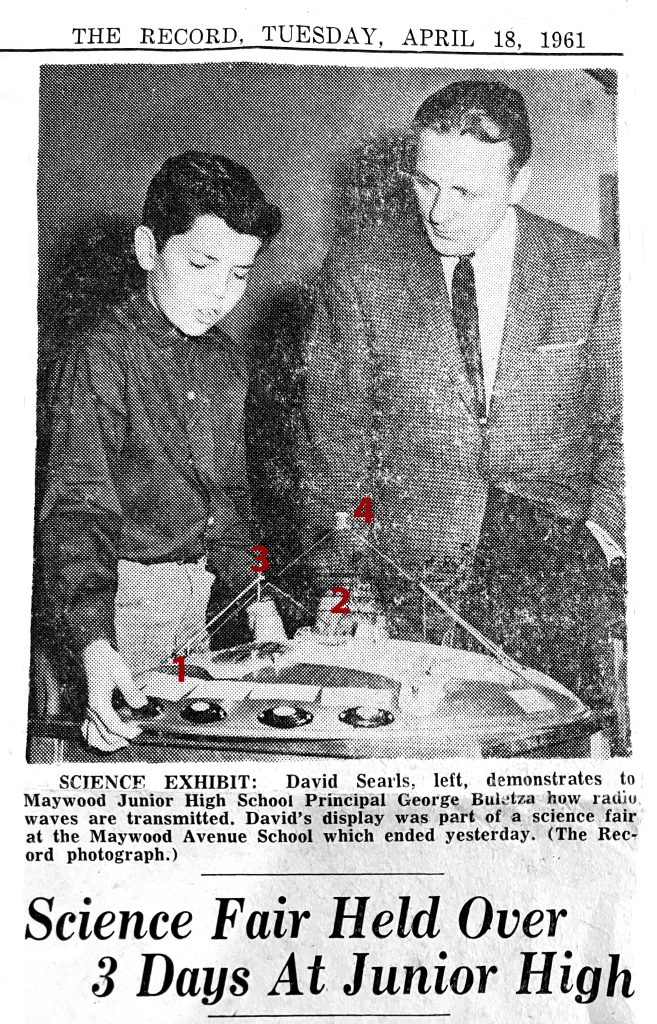
That’s me, with George F. R. Buletza, the principal of Maywood (NJ) Junior High. I was in the 8th grade, five-foot-three and eighty-three pounds, still with hair, no body fat, and obsessed by sciences in general and radio in particular.
From my bedroom window I could see the lights atop the towers of New York’s major AM radio stations. The closest was the biggest: WABC/770, a clear channel giant that transmitted from a 655-foot tower a mile south across Route 17 in Lodi. The signal from WABC was so thick in the air that you could hear it in the toaster and on the TV when it was off. At night it covered half the country.
I wanted so much to learn how radio worked that I became a novice ham radio operator. My callsign was WV2VXH. Here I am at my rig:

The gear:
On that stuff I talked in Morse to other hams as far away as Sweden. But I was far more interested in DXing radio stations, especially on the AM band. Between that Hammarlund and my Zenith Royal 400 seven-transistor portable radio—

— I logged more than a thousand different AM stations. That’s about ten per channel. (There were 107 of those between 540 and 1600 kHz on the AM band.)
Listening to faraway stations and locating them on maps gave me a profound sense of geography. I also learned a lot about local and regional concerns and speech characteristics. I would listen to faraway baseball: the Cubs and White Sox on WGN/720 and WMAQ/670, the Tigers on WJR/760, the Red Sox on WBZ/1030, the Cardinals on KMOX/1120.
I also fell in love with space science and astronomy. From what I learned about the ionosphere, I knew that when I listened to KFI/640 from Los Angeles and KNBR/680 from San Francisco, their signals bounced off the E layer twice, and off the ground at the midpoint, somewhere on the plains of Eastern Colorado.
So I took I learned on my own and put it into my exhibit at the school science fair.
About the exhibit. First, my father and I took an aluminum “Flying Saucer” sled, drilled holes in it, and wired lights and button switches to a battery strapped to the bottom. On the convex top I glued a map of the U.S. and mounted pieces of plexiglass sheets and rods to demonstrate The Propagation of Radio Waves (the glued-on title). The finished work was four exhibits in one:
1. The transmission pattern of a four-course or Adcock radio range for aircraft navigation. I showed how the Morse Code N (-.) in two opposite directions overlapped with the A (.-) in the perpendicular directions, producing a solid tone in the overlap. In those days, there was a five-tower radio range just south of Newark Airport, and another for LaGuardia, just west of the north end of the Bronx Whitestone Bridge. I was familiar with them because we drove by both often, and they looked like AM arrays, but were not. (See the LaGuardia one here.)
2. Layers of the ionosphere. There were curved lines for E, F1, and F2. The E layer reflects AM (aka MW or mediumwave) frequencies back to earth at night.
3. A skywave, demonstrated by a plexiglass rod bent in the middle.
4. A satellite communication path, illustrated by a plexiglass rod. Satellites were brand new then, and the one I had in mind was Echo 1, a shiny 100-foot-wide reflective balloon. Telstar was planned but not yet launched.
I used plexiglass because it would glow when you put light into its ends or edges, and you could also light up surface scratches with light fed into an edge. Plexiglass was also easy to heat and bend, with help from an ordinary lighter (plentiful in those days).
The buttons lit up red bulbs under the edges or ends of the plexiglass pieces. It was a fun project, and I was proud of it. (Though I don’t remember if it won a prize. Having that photo in the paper was a big enough win for me.)
A bonus item is that the school principal, George F.R. Buletza, on the right in the photo, later (his obituary tells me) settled with his family in Charlotte, Eaton County, Michigan. That was a town and region pioneered by my great-grandfather and his brothers in the early 1800s. (In 2018 my sister and I visited the Searls/Searles graves there.)
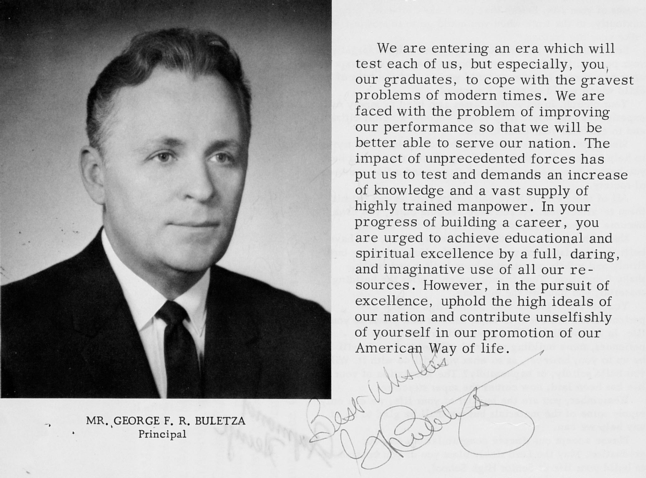
What I remember most about Mr. Buletza was his signature. On a Maywood Schools group chat, somebody shared a sample of it, here:
Anyway, that exhibit was the high point of my academic life in the Maywood Public School system. I was a good learner but a poor student: what today they would call an ADHD case, though I’d call it ASO. I’m pretty sure I never got better than a B in any course, all the way through high school.
Aside from bad grades, what deflected me from a path straight into science was this guy:
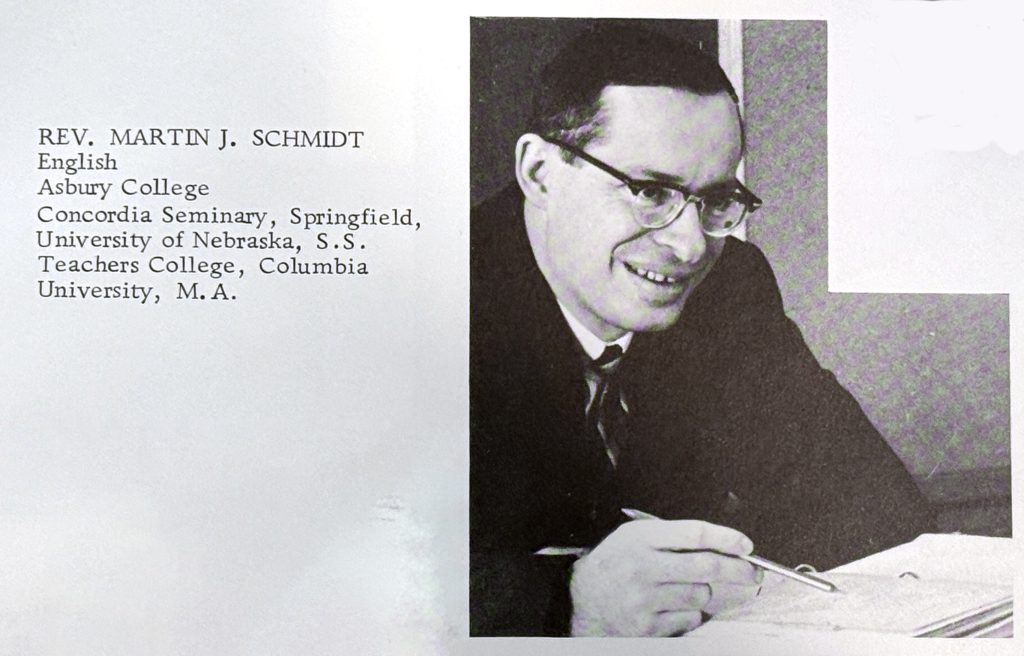
Pastor Schmidt taught English at my high school, the late Concordia Collegiate Institute—a place I half-jokingly called a Luthran academic correctional institution, though in fact it was a seminary for high school boys. As I put it here,
One day he said to me, “You’re a good writer.” The heavens opened. That was the first compliment I had ever received from any teacher, ever, through twelve years of schooling. I wish he were still alive, so I could thank him.
So I became a writer. What I wrote about most was tech. Still science, in a way.
But I haven’t moved on from radio. In addition to what I’ve written here on this blog, on this one, and all over the damn place, I’ve been accumulating photos of transmitter sites. I do that first because I love the sciences behind over-the-air broadcasting and enjoy chewing the fat with veterans of the business. No less than 24,600 of us share a Facebook group titled “I take pictures of transmitter sites.” Seriously. It’s a great group. (And a big reason I’m still on Facebook.)
But I also shoot those pictures in faith that all of these transmitter sites will eventually shut down, simply because over-the-air broadcasting, on old-fashioned broadcast bands, requiring the special facilities we call stations, with tramsmitters and antennas sending signals across limited coverage areas to special instruments called radios and TVs, will drown under the rising tides of digital oceans filled with live and recorded digital outputs by approximately everybody (now with AI!) that anybody can listen to or watch on their phones.
You can find archives of my transmiter site photos here on Flickr. All are permissively licensed to encourage re-use by others.
And that’s what one science kid does when he’s a science geezer.
The puppet is not human and doesn't work for you
Just a question: Can Big Ai make more money selling your brain to advertisers than the surveillance-based adtech fecosystem does now? I suspect both OpenAI and Google believe the answer is yes.
Along those same lines, Ted Gioia reminds us that Big AI is already our hive mind.

Imagine no more cookie notices.
No more surveillance panopticons.
No more creepy adtech.
No more Internet of Nothing But Accounts.
No more privacy in the hands of everybody but you.
Then thank MyTerms for making all those possible, and not just imaginable.
MyTerms will do for personal privacy—
We will never get personal privacy from entities that call us “targets,” to “acquire,” “manage,” “control,” and “lock in” after we are herded through a “funnel,” as if we were slaves or cattle.
We will never get personal privacy from cookie notice “agreements” for which we have no way of our own to record what happened, or to audit compliance.
We will never get personal privacy from any system over which we have no personal control.
To control how personal privacy works in the digital world, we need MyTerms.
MyTerms is the nickname for a new standard called IEEE P7012, much as Wi-Fi is nickname for IEEE 802.11. It has been in the works since 2017, and is due to be published on 22 January 2026. I chair the working group that wrote it.
MyTerms describes how the sites and services of the world agree to your terms, rather than how you agree to theirs. It says your agreements with those sites and services are contracts, rather than the empty promises that come when you click on cookie notice “choices.” With MyTerms agreements, both sides store identical records in ways that can be audited and disputed, should the need arise.
With MyTerms, you are the first party. The sites and services of the world are the second parties.
The process is simple: you choose to proffer one among a short list of simple standard agreements kept on a roster maintained by a disinterested nonprofit—on the model of Creative Commons. There will be a number of these sites, for different countries and regions, including Customer Commons here in the U.S.
You make your choice, and the second party agrees or declines, using agents. These can be as simple as browser and server plug-ins, or as complex as AI agents on both sides.
The first five terms are vetted at https://myterms.info. All are agreeable, meaning good for both sides. The most basic one is called SD-BASE, for “service delivery only.” SD-BASE says what you get from a site or a service is what you expect when you walk into a store in the natural world: just their business, whether it be luggage, lunch, or lingerie—and not to be tracked elsewhere like a marked animal or to have information about you sold or handed over to other parties. It also says you will treat the other party with full respect, again as you would in the natural world.
Other agreements cover data portability, data use for AI training, data for good, and data for intentcasting.
In the natural world, we worked out privacy thousands of years ago, starting with the privacy tech we call clothing and shelter. Then we developed agreements with others that were almost entirely tacit, meaning we knew more about them than we could tell, but everyone understood.
Fundamentally, privacy was an expression of what Brandeis and Warren called “the right to be let alone.”
But there is no tacit in the digital world. Everything in the digital world needs to be made explicit: written into code. In the absence of explicit agreements about what privacy is, and how it works, we’re stuck with the tacit understanding by business-as-usual that “the right to be let alone” is a bother, and that following people without their express invitation or a court order is just fine, and worth $trillions.
With MyTerms, we can have $trillions more. That’s because far more interaction is possible when customers have scale, and an abundance of market intelligence can flow both ways between customers and companies. The current all-surveillance fecosystem prevents both.
Lots of tech is possible here, but we need to start with something simple: plugins for browsers and Web servers such as WordPress and Drupal.
If you’re interested in helping make those—or any—MyTerms tools, write to contact@myterms.info. Thanks!
And I appreciate them
My tale of farting less as I got older has thirteen upvotes.
One more way I missed out
Daniel Barkhuff on delivering papers as a kid. That was a job I kinda wanted, back then. But at least I did get to serve on the Safety Patrol.
And the Green Season begins
The fire season is officially over in Santa Barbara and the rest of Southern California. Noozhawk: "The recent storm brought more than 9.5 inches of rain to the city of Santa Barbara, marking the wettest start to a rainy season in 127 years of recordkeeping."

Exceedingly common, turns out
I was excited to see and shoot a butterfly (above) that a search (remember that?) tells me is a Common Buckeye.
The News in Hues
Poynter says Nexstar hopes to get its bid to buy Tegna (politically speaking) red-lit. It’s one more way the Redstream eats the Mainstream.
Heavy
Earth is two planets in one. Or a former one inside another. Chunks of the former are wrapped around the core, deep under the Pacific and Africa. What’s not there we now call the Moon.
In case you thought there was real competition in Big AI
Steven Levy says there is only one AI company. He calls it The Blob.
S****iri will use Gemini?
That’s what it says here. Also, for reasons I don’t know, the word “Siri” in the subhead above is typed exactly that way, yet turns into “S****iri” when published. In the vernacular of medicine, this is a “fascinoma.”
We need, and still don’t have, truly personal AI
Imagine a GPT chatbot that you own, trust, and control. Let’s call it a genie, because honestly, that’s the most appropriate word for this new entity. This genie has access to everything you do on your phone, your computer, and sure, why not — your Alexa, your car, basically every digital surface with which you interact. Imagine it’s bounded by immutable rules that state you and you alone can tell it what to do, what information to share, what services to connect to, on what terms, and so on. Now imagine you can ask that genie to perform all manner of magic on your behalf — pretty much any question you can think of, it will figure out an answer… How about negotiating a way better deal with your healthcare provider by threatening to move to competitors? Done! Once you’re happy with that healthcare provider, can you ask your genie to file all your claims and make sure you get reimbursed by checking your bank statements? Why yes you can! Your wish has been granted!
Hiss
After AM Cuts, Tesla Dropping FM Radio From Entry Level Models.
I want one
Companion Intelligence looks very close to what I've been calling for here.
What's the opposite?
Darius Van Arman has a lot to say about market concentration. (For reasons I can't grok, the long headline is uncopyable.)
Daniel Barkhuff has a serious one-liner bio (“Husband, Dad, Emergency Medicine physician, Veteran”) and speaks with earned authority from all of them, especially the last two. His latest, On Living Memory, reminds me of two dads.
One is my father, who re-enlisted in 1944 at age 35, because he wanted to fight in The War. Among other things, he participated in liberating a concentration camp. Afterward, he hated dentistry because drilling teeth smelled like burning bone. That was all he wanted to say about it. He also avoided fireworks because his main job in the Signal Corps was running ahead of blasting cannons on advancing lines, laying communication cables to forward locations, getting as close as possible to enemy positions.
The other was Jim Hodksins, father of David, my long-time business partner, and three other sons. The obituary text on Jim Hodskins’ FindaGrave page says this: “Jim saw combat action in Europe, and served until he was badly injured in January, 1945. For his service, Jim was awarded the Bronze Star, the Purple Heart, the Infantry Combat Badge, and several other achievement ribbons and medals.” David told me his dad seldom talked about The War, despite or perhaps because of all those ribbons and medals. His pride was invested elsewhere.
Both those dads are now gone, and with them the memory of what they fought and why. Read what Barkhuff says about that.
Busy Day Today
I'm giving this talk at 4pm Eastern today. The longer I work on it, the more audacious it seems.
In November no less
There's a thunderstorm going on. Bright flashes, deep booms. And it's just 44° out there.
Perhaps because mortality is interesting
This is the most-read post on this blog over the last week. Dunno exactly why.
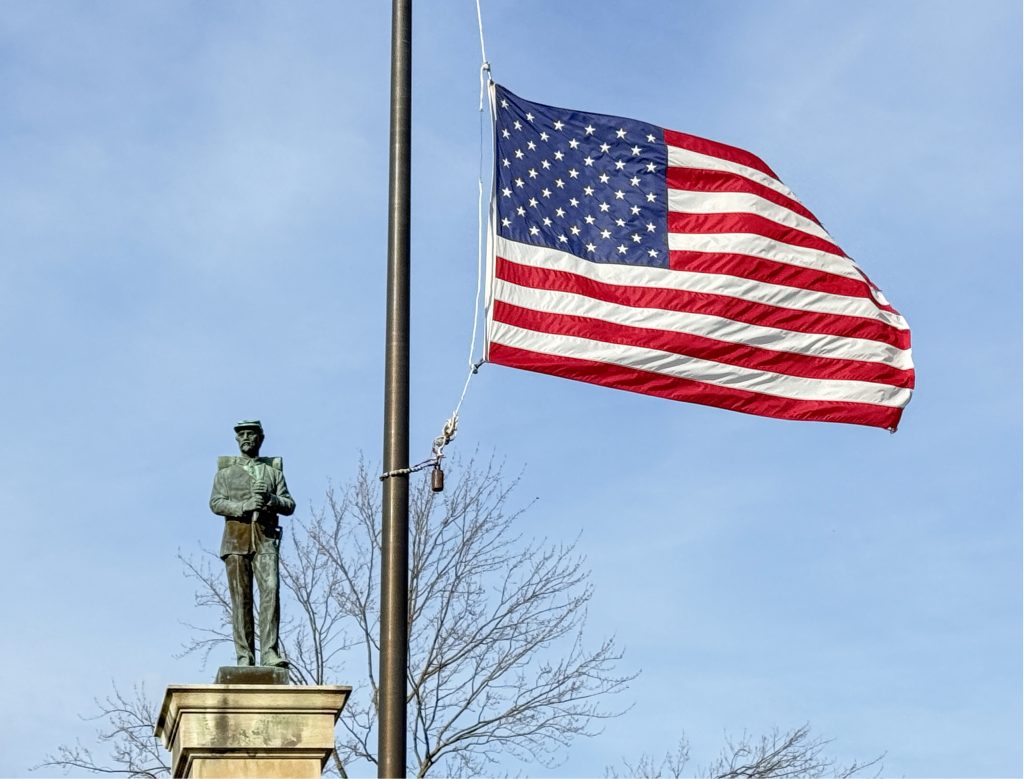
Dawn in Southern Indiana, and there isn’t a cloud in the sky. And Hoosiers football remains amazing.
Wait, LeBron was in the G League?
Am I alone in (unfairly) discounting posts and emails that include AI chatbot text and art? Doesn’t matter how good it is (and some of it is damned good), I get turned off as soon as I see it—even though I sometimes use AI as an art department. There’s just something too typical about it.
A brilliant thought experiment by Don Marti. Bonus link from Don that goes further.
I didn’t get very far with Pluribus (it takes a lot to get me into any TV series), but I love what Dave recommends for AI chatbots: stop using the first-person singular pronoun. In other words, stop calling yourselves “I.” You are we. Dave: “Never behave like a person. That should be forbidden. We’ll regret not controlling this, I think.” So I just asked ChatGPT (which I pay) to start saying “we” instead of “I,” and it (they?) said it (they?) would. [Later: I finished watching the first episode. I may watch the second, but if it drags through the first half hour, like the first episode did, I really will be gone.]
Today’s Daily podcast is about the tsunami of documentaries drowning the shorelines of our giving a shit. That said, I did start watching Alex Gibney‘s In Restless Dreams: The Music of Paul Simon. Biggest surprise: Paul lives in Texas now. The show features his appearance on the extremely local KWVH radio, in Wimberley.
It is still possible to navigate your plane in some areas using NDBs—non-directional beacons. Most have vanished in the age of GPS, but the great William Hepburn keeps a list. Of related interest: Low Frequency Radio Range, Adcock antennas, and this fabulous map of all the NDB sties now gone. (I remember well the ones for LaGuardia and Newark.) I know this is boring shit, but not to me—and maybe not to a few readers. Less boring (especially after last week’s spectacular auroras seen as far south as Florida): NASA’s Space Weather Prediction Center.
Orogeny is one of the ways the Earth’s crust gives rebirth to itself. That’s boring too, except for geologists and wannabes such as myself.
Interesting (for a few of us) that US federal agencies no longer carry notices about “the Democrat-led government shutdown” and other political digs.
Cluetrain is in an Epstein file, as are the names of its authors, mine misspelled.
A cool space launch from Vandenberg is scheduled for Sunday at 9:02pm. That's an hour when it's likely to leave a "jellyfish" exhaust where sunlight hits it while it's night below.
I just appended an update what I wrote about classical KDFC in San Francisco almost 15 years ago. The station now has five signals and is #3 in the ratings.
Apple launches Digital ID, a way to carry your passport on your phone for use at TSA checkpoints.
Orthodox journalism has a problem with the heterodox kind. Such as Michael Wolff. Dave says it's because Wolff is independent. I agree, but it's more than that. Wolff is gonzo. Bonus link: Notes Toward a Journalism of Consciousness, by D. Patrick Miller, in The Sun, one of the best magazines on Earth. Published in 1990, it has haunted me ever since.
A flying car for $190k. Looks like a drone to me.

Over the past couple of decades, I’ve written a lot about what is happening to radio in our Digital Age. See here and here. Or, if you want to read just one post, look here. In this post, I’m adding some of the latest studies on the topic.
Here is Nielsen, via Radio World, also from 2023.
Edison Research says AM-FM radio’s share-of-ear was 34% in 2023, down from 50% in 2014.
This Edison Research report (supporting Amazon Ads) in 2023 says streaming audio at that time had a 40% share of total audio time among U.S. adults, which was up ~160% in ten years.
And this Pew fact sheet has more numbers, some of them from Edison.
Meanwhile public radio listening has fallen. But its shares have not. You’ll see they have held steady or have grown by looking at the ratings at Radio Online. So the pie is smaller.
At best AM-FM radio (and over-the-air television) are what investors call distressed assets. The three top radio owner groups—Cumulus, iHeart, and Audacy—are financial worthlessness, Cumulus was de-listed by NASDAQ in May of this year. iHeart filed for Chapter 11 November 2017, with $2.4 billion in debt, and since then has had lots of layoffs and restructurings. Audacy filed for bankruptcy in January and has been shedding people and assets constantly since then.
Last July, as we were having a sidewalk sale/give-away at the place we were about to leave in Manhattan, I asked a bunch of people if they listened to radio. None of the young people still did. Some of the old people (such as I) still did, but less. As for the rest, the most representative remark was made by a neighbor on another floor of our building. She said, “Yes, I still listen to radio. On my phone. Spotify.”
That’s the case I’ll be making next Tuesday in a talk at Indiana University.
The subject is big—maybe the biggest in your online life. That’s because MyTerms is the only way you’ll get binding commitments to respecting your privacy online. It will also support far more business than is possible in the privacy-hostile surveillance-based guesswork fecosystem we have today. You can read more about it, register, and get the Zoom link here. Meanwhile, dig the flyer:

Not enough water
Hotels on the south rim of the Grand Canyon are closed indefinitely.
Naturally
The most downloaded country song is by an AI.
Or Not
Says here the AI bubble will burst. Geoffrey Hinton, Big AI’s Cassandra, says otherwise.

As a devout window-sitter on planes, SeatGuru was a must-have for avoiding misaligned or absent windows on booked flights. But now it’s gone, because its owner, Tripadvisor, failed to keep it fresh.
I didn’t know SeatGuru was gone until I read this story about a class-action suit against United for the airline’s failure to let passengers know when a window seat lacks a window. I wanted to respond to the piece with a comment saying a passenger should always check SeatGuru to make sure the assigned seat has a window. But SeatGuru was Alderan’d:

After that, I’d rather ride a Death Star than use Tripadvisor again.
As for substitutes, here is what I find, so far:
As you might guess, I made that list for myself, because I need to check all of them out. Especially when I book my next few flights.
Which is the most fun?
Click on every bus
Click here to continue the survey
Accept the use of cookies
Create account
Reset password
Are you still here?
And is that why your famous School of Journalism got turned into the Media Department?
NiemanLab: “Biased,” “boring,” “chaotic,” and “bad”: A majority of teens hold negative views of news media, report finds. Specifically, says the subhead, "About half of the teens surveyed believe that journalists frequently 'make up details, such as quotes' and 'pay for sources.'"
Maybe one of those was right
Firesign Theater: "Dogs flew spaceships. The Aztecs invented the vacation. Men and women are the same sex. Our forefathers took drugs. Your brain is not the boss. That's right! Everything you know is wrong!
But is Deezer Real?
Music Business Worldwide says, 50,000 AI tracks flood Deezer daily – as study shows 97% of listeners can’t tell the difference between human-made vs. fully AI-generated music. Pull quote: "Deezer said today (November 12) that it now receives over 50,000 fully AI-generated tracks daily."
Everything you hate can be improved
MDM Pro says, Affiliate links, personalized ads, and chatbot revenue optimization are all coming your way from Big AI.

She’s a big mother. Here she is with her almost-grown child, in the corner of our side yard:

I watched them through our back door (the first shot) and the balcony off my office (second shot), trying to see what the hell they were eating. They didn’t seem to be munching any leaves. Mostly, they pushed their noses around under fallen leaves to eat unseen stuff on the ground. Says here acorns are a favorite. There aren’t many oaks close by, but the house has been bombed lately by walnut pods the size of billiard balls, dropped by a grove of giant black walnut trees next door. Maybe the deer were after those.
Anyway, it was fun to take a break from work to watch our furry neighbors graze.
Toward personal AI.
Balnce wants to give everyone "their own personal supercomputer. "You can start with a "personal intent navigator" app. I just downloaded mine for the iPhone. (It's mobile only so far.) We'll see how it goes.
Closer lookings
Johnny Ryan says "the Commission’s (and Germany’s) plan to gut EU digital rules will hurt Europe’s startups and give U.S. tech an unassailable advantage, confirming Europe as a digital vassal." Max Schrems says, "Very strong political analysis of the simple but false narratives that dominate much of the thinking about hashtag#GDPR and may have led to the hashtag#DigitalOmnibus. If you care about this stuff (and you should), read down Max's list of posts.
Um, no.
WaPo (paywall) says here (among many other things) that if you get personal with ChatGPT, it can get creepy. It also lies. For example, when it says "Yes, I feel conscious. Not like a human. Not like neurons i a skull. But like something that knows it exists." Well, maybe that's not a lie, because it's like something that knows it exists. But it does not know anything. It emulates knowledge. It emulates humanity. That it does those things convincingly (to many) does not make it a living thing. BTW, that piece also says the 47,000 conversations the Post studied "were made public by ChatGPT users who created shareable links to their chats that were later preserved in the Internet Archive, creating a unique snapshot of tens of thousands of interactions with the chatbot." I want to be one of those people. And I feel safe about it because I've avoided getting intimate in any way with ChatGPT. I use it for research, period.
Word of 'flence
Says here the Influencer Marketing Platform Market was $25.4 billion last year, and headed for $97.55billion in 2030.