• Need help with a Word bug

    I need help debugging this.

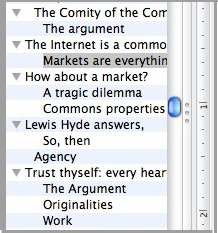
    word bugThe image on the left is a screenshot of Word 2011 bug effects that are standing in the path of a book am finishing. If you click on it you’ll go to a larger image with mouse-over notes explaining the problem, which I’ll detail here in slightly greater length.

    While the Print view looks fine, and clicking on any text shows the correct style in the Styles toolbox, the Outline view has big problems. Lines of normal text, regardless of formatting, show up in the Outline view as Level 1. They also show up as Level 1 or 2 in the Document Map Pane sidebar, which is the pane on the left.

    “The Comity of the Commons” is Heading 2. So is “Agency,” though it shows up as something between Level 2 and 3. The other items flush-left are all normal text that Word has elevated to Heading 1, even though they are not.

    I use this pane to navigate around the book, which is close to 300 pages and over 80,000 words. Having so many illegitimate Heading 1’s and Heading 2’s makes navigating nearly impossible using the Document Map Pane sidebar.

    I can very temporarily fix the problem by clicking on the line of text incorrectly seen by word as Heading 1 or 2, clearing the formatting, and re-formatting it if necessary. But that takes me about an hour each time this happens, and it’s a huge PITA. And then it goes back to this state anyway.

    Word’s AutoRecovery works rarely, and when it does, the AutoRecovered file has the same problem. FWIW, I don’t use any fancy formatting, instead relying on Word’s own default Headings and other styles.

    Bonus problem: If I view and save in Outline view, ALL TEXT gets turned into Level 1, and the document is hosed. I just have to go back to the last good copy.

    I have wasted my time on the phone already with Microsoft support, which was useless.

    I have invested some time with Craig Burton on the phone. He opened one of my screwed-up book drafts in his Windows version of Word 2011, and the doc was screwed up in exactly the same way.

    So the docs (.docx) are being screwed up, somehow. It’s not a display issue. It’s embedded in the file itself. And unscrewing the problem doesn’t help, because the file screws up again anyway. The document doesn’t appear to be screwed in Print view; but in Outline view, and in the Document View Pane sidebar, it is screwed. So, as it’s going now, I’ll be turning in a document that can only be used in Print view.

    Any clues or help you can provide would be greatly appreciated. And please don’t tell me not to use Word. I wish I didn’t have to; but it’s a requirement if I want to get this book finished and in.

    Thanks in advance for any help you can give.

    [Later…] Autoflowering, below, gave me an answer I tried before — saving the file as a .doc instead of a .docx — and seeing if that worked. It didn’t the first time, but it did this time, and has been working for more than a day now. I’m not convinced that the file isn’t still corrupted in some way, but it seems to work fine. So, thanks to everybody for your help.

  • Circular quoting

    So I’m writing about financialization. Kevin Phillips‘ prophetic book on the subject, Bad Money, is open on my desk. (He published it in early 2007, in advance of The Crash.) But it doesn’t contain the definitional quote that I need. So I turn to Wikipedia. There, in the Financialization entry, we are treated to this quote:

    Financialization may be defined as: “the increasing dominance of the finance industry in the sum total of economic activity, of financial controllers in the management of corporations, of financial assets among total assets, of marketised securities and particularly equities among financial assets, of the stock market as a market for corporate control in determining corporate strategies, and of fluctuations in the stock market as a determinant of business cycles” (Dore 2002)

    Nice, but there is no citation for Dore; just some “further reading”:

    Dore, R (2000). Stock Market Capitalism: Welfare Capitalism: Japan and Germany vs. the Anglo-Saxons. Oxford: Oxford University PressISBN 0-19-924061-2.

    So I go look that up, find it on Amazon, and look inside. I choose to search for “determinant,” a fairly rare word, and get five results. None are what’s quoted in Wikipedia. But, since Ronald Dore is a scholar, I figure he must have written that definition somewhere. But when I go to look, the results are a cascade of Wikipedia citations. Not the original Dore.

    This drives me just as nuts as I get when I go to look up, say, a geographical feature and get pages of commercial businesses associated with the feature, but not the feature itself. Google Maps is one offender here. Look up “Comb Ridge”, and you get this: http://g.co/maps/syspr. (Here are my own many shots of Comb Ridge.) The difference in this case is that I can still find Comb Ridge, while the provenance of the original Dore quote remains a mystery to me.

    And, since I want to finish my book today, I’m not going to fool around any more with it. I’ll find some other definition. Still, I need to gripe a bit. Sloppy citing is a curse that keeps on cursing. Or causing it, anyway.

  • CRM and IIW

    It just occurred to me that everything being worked on at IIW is meaningful to CRM. I had been thinking that only the VRM stuff was meaningful, but I realize now that all the IIW stuff is, because — from a CRM perspective — it’s all about customer empowerment. And empowered customers are entities that CRM will welcome, sooner or later.

    Here’s the list of IIW topics on the IIW home page:

    • Open Standards that have been born and developed at IIW – OpenID, OAuth, Activity Streams, Portable Contacts, Salmon Protocol, SCIM, UMA ….
    • The Federated Social Web
    • Vendor Relationship Management
    • Personal Data Services –  collection, storage and value generation
    • Anonymity Pseudonymity and Reputation Online (think google+ controversy)
    • Legal Innovation including, Information Sharing Agreements, Data Ownership Agreements and the development of “trust” frameworks.
    • NSTIC – the National Strategy for Trusted Identities in Cyberspace (it uses the term “user-centric identity” 4 times & “citizen-centric identity” once)
    • Cloud Identity and the intersection of enterprise ID and people (consumer) ID

    With this in mind we (a bunch of VRM and IIW people) decided that Wednesday afternoon is when we’ll have the VRM+CRM session, although we can have CRM sessions anytime, because the whole workshop is an unconference and participants choose the topics. But if you’re into the future of CRM, that afternoon session will be a good one to hit.

    There is also the whole next day, currently thus described:

    Thursday is Yukon Day: One of the longtime themes of IIW is how identity and personal data intersect.  Many important discussions about Vendor Relationship Management (VRM) have also taken place at IIW.  In recognition of how personal data and identity are intertwined, the third day of the IIW, will be designated “IIW + Yukon” and will stress the emerging personal data economy.  The primary theme will be personal data control and leverage, where the individual controls and drives the use of their own data, and data about them held by other parties.

    This isn’t social. It’s personal.  This day you can expext open-space style discuss ions of personal data stores (PDS), PDS ecosystems, and VRM.  One purpose of Yukon is to start to focus on business models and value propositions, so we will specifically be reaching out to angels and VC’s who are interested in personal data economy plays and inviting them to attend.

    Yukon” is a play on “You Control.”

    So, if CRM is your thing, IIW would be a good place to see what’s coming in CRM’s direction.

    Look forward to seeing some of ya’ll there.

    Enhanced by Zemanta
  • The journey was the reward

    I was in the midst of late edits on The Intention Economy this afternoon, wondering if I should refer to Steve Jobs in the past tense. I didn’t want to, but I knew he’d be gone by the time the book comes out next April, if he wasn’t gone already. So I decided to make the changes, and stopped cold before the first one. I just couldn’t go there.

    Then the bad news came a few minutes ago, through an AP notification on my iPhone. Tonight we all have to go there.

    Thirteen years, one month and one day ago, I wrote an email to Dave Winer, in response to a DaveNet post on Steve’s decision to kill off Apple’s clones. (Dave had also posted notes from an interview with Steve himself.) Dave published the email. Here’s the part that matters:

    So Steve Jobs just shot the cloners in the head, indirectly doing the same to the growing percentage of Mac users who prefered cloned Mac systems to Apple’s own. So his message to everybody was no different than it was at Day One: all I want from the rest of you is your money and your appreciation for my Art.

    It was a nasty move, but bless his ass: Steve’s art has always been first class, and priced accordingly. There was nothing ordinary about it. The Mac “ecosystem” Steve talks about is one that rises from that Art, not from market demand or other more obvious forces. And that art has no more to do with developers, customers and users than Van Gogh’s has to do with Sotheby’s, Christie’s and art collectors.

    See, Steve is an elitist and an innovator, and damn good at both. His greatest achievements are novel works of beauty and style. The Apple I and II were Works of Woz; but Lisa, Macintosh, NeXT and Pixar were all Works of Jobs. Regardless of their market impact (which in the cases of Lisa and NeXT were disappointing), all four were remarkable artistic achievements. They were also inventions intended to mother necessity — and reasonably so. That’s how all radical innovations work. (Less forward marketers, including Bill Gates, wait for necessity to mother invention, and the best of those invent and implement beautifully, even though that beauty is rarely appreciated.)

    To Steve, clones are the drag of the ordinary on the innovative. All that crap about cloners not sharing the cost of R&D is just rationalization. Steve puts enormous value on the engines of innovation. Killing off the cloners just eliminates a drag on his own R&D, as well as a way to reposition Apple as something closer to what he would have made the company if he had been in charge through the intervening years.

    The simple fact is that Apple always was Steve’s company, even when he wasn’t there. The force that allowed Apple to survive more than a decade of bad leadership, cluelessness and constant mistakes was the legacy of Steve’s original Art. That legacy was not just an OS that was 10 years ahead of the rest of the world, but a Cause that induced a righteousness of purpose centered around a will to innovate — to perpetuate the original artistic achievements. And in Steve’s absence Apple did some righeous innovation too. Eventually, though, the flywheels lost mass and the engine wore out.

    In the end, by when too many of the innovative spirts first animated by Steve had moved on to WebTV and Microsoft, all that remained was that righteousness, and Apple looked and worked like what it was: a church wracked by petty politics and a pointless yet deeply felt spirituality.

    Now Steve is back, and gradually renovating his old company. He’ll do it his way, and it will once again express his Art.

    These things I can guarantee about whatever Apple makes from this point forward:

    1. It will be original.
    2. It will be innovative.
    3. It will be exclusive.
    4. It will be expensive.
    5. It’s aesthetics will be impeccable.
    6. The influence of developers, even influential developers like you, will be minimal. The influence of customers and users will be held in even higher contempt.
    7. The influence of fellow business artisans such as Larry Ellison (and even Larry’s nemesis, Bill Gates) will be significant, though secondary at best to Steve’s own muse.

    Turns out Steve’s muse was the best in the history of business. No one-hit wonders. We’re talking about world-changing stuff. Again and again and again.

    Watch this clip from Robert X. Cringeley’s “Triumph of the Nerds” public TV special, filmed back when Steve was still running NeXT. This one too. Then look at what Steve did after coming back. Not just the iPod, iPhone, iPad, Pixar and the laptops we see with glowing apples all over the place. Look at the Apple Stores. I’ve been told that Apple Stores are top-grossing retail shops in every mall they occupy. Even if that’s not true, it’s believable.

    I’ve also been told that Apple Stores were Steve’s idea. I don’t know if that’s true either, but it makes sense, because they succeeded where nearly every other attempt at the same thing failed. To get there, Steve and Apple had to look past the smoking corpses of Gateway, Circuit City, Computerland, Radio Shack and all the other computer stores that had failed, and do something very different and much better. And they did.

    I was wrong about one thing in my list above. I don’t think Steve regarded customers and users with contempt, except in the sense that he believed he knew better than they did. As an elitist, he also knew that calling the smartest and most employable Apple users “geniuses” was great bait for employment serving customers at Apple Stores.

    There is no shortage of quotes by and about Steve Jobs tonight. But the best quote is the one he uttered so long ago I can’t find a source for it (maybe one of ya’ll can): The journey is the reward.

    His first hit, the Apple II, was “The computer for the rest of us.” So now is his legacy.

  • Train tracking

    I just ran across some research I did in December 2008, while working on the 10th Anniversary edition of The Cluetrain Manifesto:

    • Google Book Search results for cluetrain — 666[1]
    • Google Book Search results for markets are conversations — 2610
    • Google Web Search results for cluetrain — 394,000
    • Results for Web searches for markets are conversations — 626,000

    [1] Increasing at more than one per day. The numbers were 647 on November 15, 2008 and 666 on December 1, 2008. Results passed 600 on September 30, 2008.

    Here are the results today:

    I added two more, with quotes, because I’m not sure if I used quotes the first time or not, for that phrase. I would like to have the exact URLs for the earlier searches too, but I don’t. To get useful, non-crufty URLs this time, I needed to fire up a virgin browser and scrape out everything not tied to the search itself (e.g. the browser name, prior searches, other context-related jive irrelevant to this post).

    Of course, Google guesses about most of this stuff. (Though possibly not for the first item: a word in a book). Not sure how much any of it matters. I just thought it was interesting to share before I wander off and forget where I found these few bits of sort-of-historical data.

    Bonus link (found via a Twitter search for #cluetrain): Jonathan Levi‘s The Cluetrain Manifesto — Manifested Today.

  • Advertimania

    “If you don’t like the news, go out and  make some of your own,” Scoop Nisker says. (I first heard him say that when he did news for M. Dung‘s morning show on KFOG in 1985. Great show. Sorry most of you missed it.)

    The same goes for words. Today I wanted one for advertising mania, so I made one up: advertimania, which I’ll define, provisionally (though simply), as excessive enthusiasm for advertising. If it succeeds, it may one day deserve an entry here in Douglas Harper‘s brilliant Online Etymology Dictionary.

    Why not advermania? Because it’s already used by many advertising sites (hyping advertising, of course), while “+advertimania” comes up with no results on Google or Bing. (The ‘+’ makes the engines cough up results only for the intended word.)

    Let’s see how long it takes for either engine to index the find.

    [21 minutes later…]

    Tweeted this:

    @dsearls Doc Searls
    New word: #advertimaniahvrd.me/qQHtlv Help me see how long it takes for Bing and Google to index that entry, made 1 minute ago.
    20 minutes ago via web

    Then came this:

    aswath 41 Aswath Rao
    @dsearls Bing got it via this Twitter; Google has not yet
    5 minutes ago

    Now Bing shows nothing with the + sign in front of “advertimania”. When I take that away, it has this:

    ALL RESULTS  1-3 of 3 results· Advanced
    Advertimania 26 minutes ago

    Sep 28, 2011 · “If you don’t like the news, go out and make some of your own,” Scoop Nisker says. (I first heard him say that when he did news for M. Dung‘s …

    blogs.law.harvard.edu/doc/2011/09/28/advertimania · Cached page

    Doc Searls (@dsearls) on Twitter

    • 14,623 followers ·
    • 4,405 tweets ·
    • Cambridge, Mass ·
    • Following 1,574 others

    Writer with ties to Linux Journal, the Berkman Center at Harvard and CITS at UCSB. – New word: #advertimania: hvrd.me/qQHtlv Help me see how long it takes for Bing …
    twitter.com/dsearls · Cached page
    Please Review My Site: http://www.techfocus.co.uk – BioRUST Forums

    Please stop the adverti-mania. (Infraction + Reported + A PM to Tamlin. Damn, I’m evil) @profitbysearch: I like the site, but I think the layout is a bit too busy.

    forums.biorust.com/marketplace/6139-please-review-my-site-http-www-techfocus-co-uk.html · Cached page

    Meanwhile Google has this:

    Did you mean: +vertimania

    Search Results
    [Doc Searls]: Advertimania.
    friendfeed.com/friendsofdave/aa74466d/doc-searls-advertimania
    [Doc Searls]: Advertimania.

    Bing wins, folks. (But right now I can’t see this, because there’s some funky html I copied and can’t fix. Grr.)

  • Beanstalk Connectivity

    Logan Airport’s free wi-fi isn’t doing the job. (Latencies up to a second and a half, 7% packet loss.) In fact, the only reason I can continue with this post is that I’ve switched to my iPhone’s “personal hot spot,” which turns AT&T’s 3G data network to wi-fi I can use. On Logan’s connection I couldn’t do anything over the Net, other than that ping test.

    Now on AT&T’s 3G, I’m getting a “D+” grade from Speedtest.net, but I’m also able to function over a connection it rates at 2.67Mbps down and .67Mbps up. I’m only here for an hour, so I can live with that.

    But I also have to live with knowing that the data is costing me $25/mo. for 2Gb, plus $10 for each additional 1Gb. Or is it $45 for using the tethering (as I am now)? And it’s a pain in the butt to keep worrying about whether I’m running up a big bill. (Never mind that I’m going to Canada, where I won’t use any telco data, thanks to onerous “roaming” charges if I try.)

    Just here in the States, there’s a tug-of-billing-plans between Apple and AT&T. What started as $25 for unlimited data (very Steve Jobs, that simplicity) is now this:

    Data Plans
    Data will allow you to access the internet, surf the Web, and check email.
    Data 200MB 2GB 4GB and Mobile Hotspot**
    Additional Data $15 per 200MB $10 per 1GB $10 per 1GB
    Per Month $15 $25 $45

    ** Tethering allows you to share the 3G connection on your iPhone with your Mac notebook or PC laptop and connect to the Internet. When your iPhone is tethered, you can still send and receive data and make phone calls.

    Very telco, that; though not nearly as complex as it would have been if Apple weren’t a party to the deal.

    My point, however, is about clouds. If we’re going to “live in the cloud,” as we are so often told, we’re going to need better routes than rented beanstalks that fray and fail.

    By the way, I don’t begrudge AT&T making money. In fact, I’m happy for them (and Apple, and anybody in the Net infrastructure business) to make money, and want to encourage them to build out as much capacity as they can.

    I just know how telcos work, which is primarily as billing systems and secondarily as plain infrastructure. We also pay for other utilities — water, electricity, gas —but in less sphinctered ways. And un-sphinctered service is what we’ll need if we really are going to live in the clouds.

    [Later…] Dig David Scott WilliamsRain From the Cloud Doesn’t Fall in This Desert, and his comments below. I especially like “drinking the milkshake of the cloud internet through my coffee stirrer,” which links back to that same post.

    Open connections are as important as having roads, water and electricity. In too much of the world — and remarkably, too much of the U.S. — the long- promised “information superhighway” still isn’t paved.

  • Ten years later

    I’ve been listening to the repeat broadcast of the Howard Stern Show, recorded live in New York as the 9/11 events unfolded. It’s been a transporting experience. The anger, bewilderment, confusion and fear are all there.

    I was at our house in Montecito, California when it happened. My sister Jan called right after the first tower was hit, and we watched the rest on TV. Then I switched to the radio and blogged a number of posts through the day. Here they are (in reverse chronological order):

    Stars. Just stars. 

    Walking back from a meeting at school this evening, the kid and I looked up at the sky, as always. But it was … different. What was that behind the high branches of an Oak tree? A star or an — no, it couldn’t be an airplane. There were no airplanes in the sky tonight. Only stars: a condition we haven’t seen in nearly a century.
    “Why aren’t the planes flying, Papa?” he asked. I explained. He asked again. I explained again. I stopped the questioning when the count got to four.
    But it won’t stop.

    What’s down? 

    I get a steady flow of email, up to hundreds per day. But after 5:13 tonight, nothing. Is it just that everybody’s watching CNN now? No idea. Seems creepy.

    More perspective 

    Here’s Morgan Stanley, which had 3500 people working in the World Trade Center:
    Because of the enormous emotional and physical toll that these events have taken and will take among many of our employees and their families…

    Close to home 

    We just lost power for a few minutes. No idea why.

    One answer 

    Here’s Eric S. Raymond on our “First Lessons” about terrorism.

    Ironytrack 

    Dean points out that today the United Nations opens in New York on the International Day of Peace.

    Blogtracks 

    Here are Blogger sites mentioning “World Trade” or “terrorist.”

    How? 

    BBC says the pilots would surely have been killed first, since they would never follow orders to fly into a building. I notice that all four planes involved were 757s and 767s, which have roughly identical cockpits.
    Odd how we mull details like these to get a small grip on an immense tragedy. Right now I don’t even want food. Just details.

    Now it gets personal 

    Our West Coast family members check in fine. One is in Ohio, and will probably drive home to L.A. So far we’re lucky. East Coast, not so sure. I have a cousin who works in the Pentagon. My sister is a retired Navy officer, recently moved from Arlington to North Carolina. “I lost friends today,” she tells me. But who? So far we also don’t know very much about who lived, who died, who’s lost, trapped or worse.
    Dave points to a press release reporting the death of Danny Lewin. He was on the American flight from New York to Los Angeles that crashed into the World Trade Center. I didn’t know Danny, but I’ve met him. He was a good guy. According to his bio, he was also a member of the Israeli Defense Forces. I imagine he would have done his best, as a passenger, to stop this thing.
    And there were so many others lost today. So many families waiting, right now, for loved ones to call, to show up at the door.

    The deepest human substance 

    Now is the time to give blood, not take it. Wherever you are, please give some. For New York, call 1 800 933-blood or visit http://nybloodcenter.org/.

    Declaration of Peace 

    One of the surprising things to me about blogging is how much I don’t say. I tend to be a very disclosing guy, but if anything I tend to disclose less personal stuff than I ever thought I would have when I started this thing in 1999.
    But today I’ll tell you where I come from on the matter of war.
    I am a pacifist. I applied for contientious objector status during the Vietnam War, and I would have served in that capacity if I hadn’t received a medical deferment.
    I went to a Quaker college, and have always felt most at home, philosophically and morally, with the Society of Friends. Although I currently attend a Catholic Church, my beliefs are the same.
    What happened today brings out the pacifist in me, and the linguist as well. Just about everything we believe, and say, is framed up by conceptual metaphors. In the words of George Lakoff, written at the height of the Gulf War, metaphors can kill.
    We have a choice about the ones we use. For the sake of those still with us, and the souls of those we’ve lost, choose your conceptual frameworks carefully.

    Perspective 

    We hear that 50,000 people worked in the World Trade Center alone. Consider these numbers:
    • 4,435 U.S. soldiers died in the Revolutionary War, and another 2,260 in the War of 1812.
    • Including civilians, 373,458 died in the Civil War.
    • 53,513 combat deaths in World War I, plus 63,195 “other.”
    • 292,131 combat deaths in Word War II, plus 115,185 “other.”
    • 33,651 combat deaths in the Korean War (no “other” listed)
    • 47,369 combat deaths in the Vietnam War, and 10,799 “other.”
    • And for the Gulf war, the respective numbers were 148 and 145.
    Here’s another summary.

    Loverolling 

    ZeldmanDeanAdamDaveCamEricAkamaiRichardBrentSusan. Grant.East/WestUltrasparky. QuesoKottkeMegMetafilterEvGlennScoble.
    I need to pick up the kid from school soon. This morning he wanted to know why his parents were crying. We couldn’t begin to explain.

    Open choices 

    What happened today may have been an act of war, but it was also an act of insanity.
    Many people we know are dead. Many more are dying. This is a time to open our hearts, our homes, our wallets and our minds.
    There is only one sane choice open to us all: What can we do to help?
    If there is anything you think I can do, let me know. I just added AIM instant messaging to my suite of contacts. My handle, no longer a joke, is “Celeprosy.”

    A time for love and mourning 

    Pray, find your loved ones. Give help.
    And God help us all.

    Maybe because I have it 

    Wanted to test out the latest AOL Instant Messenger today, so I downloaded it. But first I had to come up with a name. Searls, Dsearls, Dsearls1 and Zdilmidgi were all taken, by me, in the past. But AOL wouldn’t make them available to me because they had to clear it with the now-dead email address I used when I registered those identities. So I gave up on those and tried all kinds of names, finally going with “Celeprosy.” It took. Haven’t installed it yet, though.

    What’s the commercial model for your toilet? Your light socket? Your floors? 

    I was asked today what the ‘commercial model’ was for a blog hosted on a home computer. It amazes me that the Net is still being asked to justify itself commercially.
    But as long as it is, we need Larry Lessig to rant about it. (Thanks to Tom for that link.)
    And while we’re on the blog subject, check out the Lockergnome interview with Evan Williams. I ran into Chris Pirillo at TechTV when I was up there recently. Great guy. And he really does look like that Lockergnome dude in the illo.

    Well, obviously 

    Says here I’m infatuated with Google search results. Actually, amazed is a bit more like it.
    Curious: what real competition does Google have these days? Looking here, it’s as if nobody has even bothered reviewing the matter in almost a year. At this point Google rivals the browser itself as a Web interface. It’s a portal that doesn’t act the part.
    Is it making money yet? I have no idea.

    Because smart people don’t always do that 

    Eric Raymond: How to ask questions the smart way.

    Blogging was young then. There was no Twitter, no Facebook. Yet blogging felt, and was, far more social — at least for me — than anything else we’ve seen since.

    Some thoughts, ten years later:

    • Yes, everything changed that day.
    • We did go to war, as I expected we would, given the president we had and the mood of the country after being attacked. But the war, billed as one against “terrorism,” has been one of “regime change” in two countries. Since then other regimes have changed that needed changing, without our intervention, and at approximately zero $ cost to the U.S.
    • The cost of going to war has been many $trillions, and has nearly (or perhaps actually) bankrupted the country. There was a rope-a-dope strategy behind the attack, and we took the bait.
    • The U.S. hasn’t been attacked in the same way again, and for that I am grateful.
    • The results of the War on Terrorism are debatable, although they are not much debated.
    • The motivations for the attacks on the U.S., besides “they hate us and our way of life” and similar staples of talk radio, have not been visited at much depth, at least by sources the American people pay much attention to. That anybody might have a legitimate gripe against the U.S. is a question no politician wants to ask. And not many ordinary citizens, either.
    • Many young men and women in my extended family have served in these wars. I am proud of them. I also wish they hadn’t needed to go.
    • The peace movement, in which I played a small part during the Vietnam War, is now dormant. Almost nobody questions the need for war now.
    • The hate we felt for Al Qaeda, the self-appointed enemy that attacked on 9/11, has since shifted to each other. I’ve been alive for a long time, and I can’t remember any period, including the Vietnam War, when it has been harder for political opponents to listen to each other, much less understand what the other is saying. Ad hominem arguments rule.
    • One reason for our uncompromising political posturing and rhetoric is the loss of the moderate center that was held in place by the mainstream media, and especially by the evening network news. Even as late as 2001, we turned en mass to network TV and newspapers for reporting and analysis that at least tried to be unbiased, accountable and responsible to the whole country and not just to partisan factions. Now even CNN looks like an informercial to me.

    I can’t shake the feeling that, in ways we don’t want to admit, the terrorists have won something. 9/11 gave us fear, and the will to attack. It changed our hearts and minds.

    When I look back on human history, starting with our diaspora out of Africa only a few dozen millennia ago, I see persisting through it all a will to kill and dominate that is hardly diminished by civilization. We have hated and killed The Other for the duration. For all its many virtues, our species remains a violent and homicidal one. We’ve killed others who looked or spoke differently than we do. We’ve killed for land and religion and resources, which included each other, whom we often kidnapped and made into slaves. Even in our own country we killed each other by the dozens of thousands, over differing notions of freedom. (The Civil War is only two generations back on my father’s side. One great aunt, whom I remember well, was twelve years old when Lincoln was shot, and told stories about it. She was born when slavery was still more than legal in the U.S.)

    How many people have died because of 9/11, since that day? Have their deaths been worthwhile? Have they bought peace, really? Will anything, ever? I have my doubts, and those started ten years ago today.

    [Later…] Deaths in the War on Terror, according to Wikipedia, as of today:

    • Iraq: 62,570 to 1,124,000
    • Afghanistan: between 10,960 and 49,600
    • Pakistan: between 1467 and 2334
    • Somalia: 7,000+

    And then,

    Total American casualties from the War on Terror
    (this includes fighting throughout the world):

    US Military killed 5,921[109]
    US Military wounded 42,673[109]
    US Civilians killed (includes 9/11 and after) 3,000 +
    US Civilians wounded/injured 6,000 +
    Total Americans killed (military and civilian) 8,800 +
    Total Americans wounded/injured 46,000 +
    Total American casualties 54,800 +

    Draw, or re-draw, your own conclusions. I still don’t have any. Or many. The older I get, the less certain I am of my own opinions, especially about War, the reasoning methods for which which seem to be hard-coded into human nature. In my heart I’m still a pacifist, but in my mind I’m not so sure.

    Here’s what I wrote in Deliberate Explosive Devices last year:

    I think there lurks in human nature a death wish — for others, even more than for ourselves. We rationalize nothing better, or with more effect, than killing each other. Especially the other. Fill in the blank. The other tribe, the other country, the other culture, the other religion, whatever.  “I’ve seen the future,”Leonard Cohen sings. “It is murder.” (You can read the lyrics here, but I like thevideo version.)

    Yet we also don’t. The answer to Matt’s question — How did we keep from blowing ourselves up for all those years? —is lieutenant colonel Stanislav Petrov, and others like him, unnamed. Petrov had the brains and the balls to say “No” to doing the crazy thing that only looked sane because a big institution was doing it.

    We’re still crazy. You and I may not be, but we are.

    War is a force that gives us meaningChris Hedges says. You can read his book by that title, (required reading from a highly decorated and deeply insightful former war correspondent). You can also watch the lecture he gave on the topic at UCSB in 2004. The mystery will be diminished by his answer, but not solved.

    Still, every dose of sanity helps.

    Still true.

    Bonus link from Euan Semple.

  • Truly public radio

    Rochester, Vermont

    My favorite town in Vermont is Rochester. I like to stop there going both ways while driving my kid to summer camp, which means I do that up to four times per summer. It’s one of those postcard-perfect places, rich in history, gracing a lush valley along the White River, deep in the Green Mountains, with a park and a bandstand, pretty white churches and charm to the brim.

    My last stop there was on August 20, when I shot the picture above in the front yard of Sandy’s Books & Bakery, after having lunch in the Rochester Cafe across the street. Not shown are the 200+ cyclists (motor and pedal) who had just come through town on the Last Mile Ride to raise funds for the Gifford Medical Center‘s end-of-life care.

    After Hurricane Irene came through, one might have wondered if Rochester itself might need the Center’s services. Rochester was one of more than a dozen Vermont towns that were isolated when all its main roads were washed out. This series of photos from The Republican tells just part of the story. The town’s website is devoted entirely to The Situation. Here’s a copy-and-paste of its main text:

    Relief For Rochester

    Among the town’s losses was a large section of Woodlawn Cemetery, much of which was carved away when a gentle brook turned into a hydraulic mine. Reports Mark Davis of Valley News,

    Rochester also suffered a different kind of nightmare. A gentle downtown brook swelled into a torrent and ripped through Woodlawn Cemetery, unearthing about 25 caskets and strewing their remains throughout downtown.

    Many of the graves were about 30 years old, and none of the burials was recent.Yesterday, those remains were still outside, covered by blue tarps.

    Scattered bones on both sides of Route 100 were marked by small red flags.

    “We can’t do anything for these poor people except pick it up,” said Randolph resident Tom Harty, a former state trooper and funeral home director who is leading the effort to recover the remains.

    It was more than 48 hours before officials in Rochester — which was cut off from surrounding towns until Tuesday — could turn their attention to the problem: For a time, an open casket lay in the middle of Route 100, the town’s main thoroughfare, the remains plainly visible.

    I found that article, like so much else about Vermont, on VPR News, one of Vermont Public Radio‘s many services. When the going gets tough, the tough use radio. During and after natural disasters, radio is the go-to medium. And no radio service covers or serves Vermont better than VPR. The station has five full-size stations covering most of the state, with gaps filled in by five more low-power translators. (VPR also has six classical stations, with their own six translators.) When I drive around the state it’s the single radio source I can get pretty much everywhere. I doubt any other station or network comes close. Ground conductivity in Vermont is extremely low, so AM waves don’t go far, and there aren’t any big stations in Vermont on AM anyway. And no FM station is bigger, or has as many signals, as VPR.

    One big reason VPR does so much, so well, is that it serves its customers, which are its listeners. That’s Marketing 101, but it’s also unique to noncommercial radio in the U.S. Commercial radio’s customers are its advertisers.

    VPR’s services only begin with what it does on the air. Reporting is boffo too. Here’s VPR’s report on Rochester last Thursday, in several audio forms, as well as by transcription on that Web page. They use the Web exceptionally well, including a thick stream of tweets at @vprnet.

    I don’t doubt there are many other media doing great jobs in Vermont. And at the local level I’m sure some stations, papers and online media do as good a job as VPR does state-wide.

    But VPR is the one I follow elsewhere as well as in Vermont, and I want to do is make sure it gets the high five it deserves. If you have others (or corrections to the above), tell me in the comments below.

    Some additional links:

  • Following Irene Live

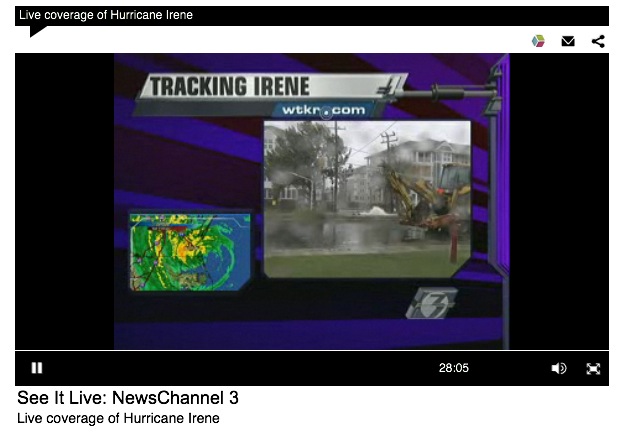
    WTKR/3 in Norfolk has live coverage streaming on the Web. So does WGNT. It’s the same show, also being carried on WHRV radio (streaming at that link). So if you want to see and hear live coverage where the action is, from mainstream media, those are the places.  WVEC, WAVY, WHRO and WVBT all have pretty much the usual static sites. (Correct me if I’m wrong.)

    WTKR and WGNT get a high five for casting globally by streaming locally. This is something they can do, but the Weather Channel cannot, because it’s tied up with obligations to broadcast live only over cable. Local stations aren’t encumbered by the same obligations, outside of network programming. (They just used some uStream video from cage-free journalists in North Carolina, and keep thanking their Facebook friends, which is cool. Some props should go to blogs and tweets too, though.)

    [Later…] Here is a list of all TV stations now streaming live on the Net:

    • Tidewater Virginia —WTKR and WGNT. Also carried on WHRV radio.
    • Richmond — WTVR
    • Washington DC — none
    • Baltimore — WMAL
    • Philadelphia — none
    • New York — WNYW
    • Boston — none so far
    • Hartford-New Haven — WTNH

    [Later still: midnight Eastern…] With the storm passed, WTKR/WGNT went off. WMAL doesn’t seem to be on. WNYW is still up (with the storm approaching). WNYC‘s stream is quite good on radio.

    Here are another bunch of streams.

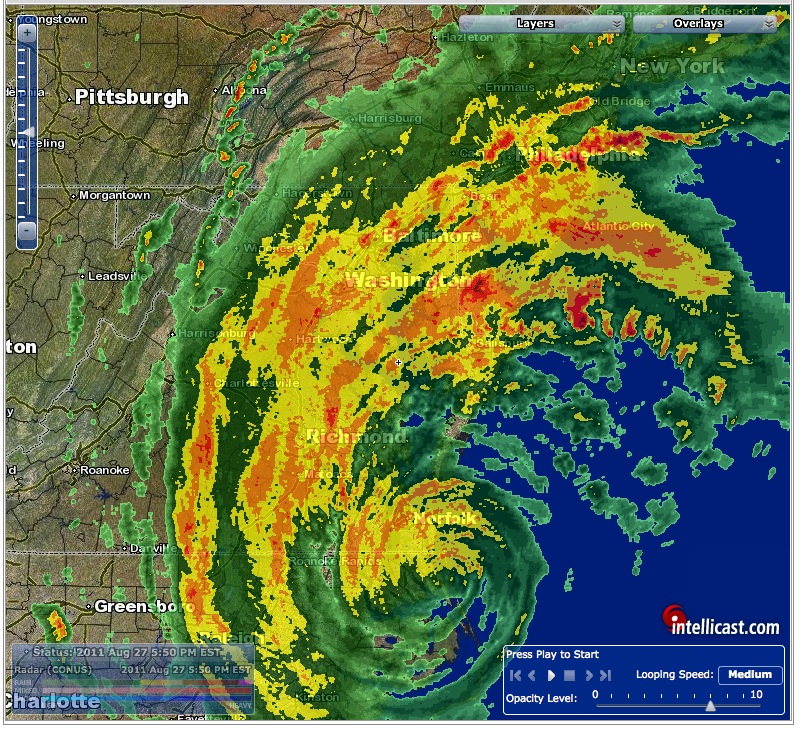
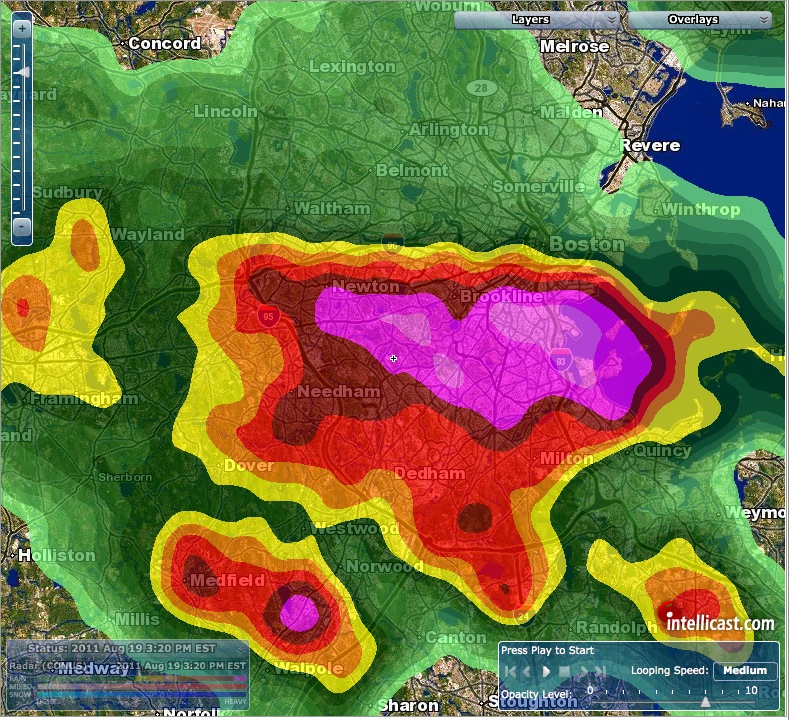
    For visualization of the storm itself, it’s hard to beat Intellicast:

    Click on the image, mouse over the map that comes up, and move it to position it where you like. Click on “press play to start” to see the image animated.

    Irene appears to have no clear and open eye right now, as she moves north up along Virginia Beach, Norfolk, Tidewater Virginia and the Delmarva peninsula.

    [later still…] Last but far from least: the state that seems to have gotten the worst of Irene was off the mainstream radar but right up her final alley: Vermont. The flooding has been terrible.

  • Remembering Hurricane Bob

    Got an interesting email from sister Jan, retired Commander with the U.S. Navy, who was stationed in Newport when hit in 1991. With her permission, here it is:

    It was almost exactly 20 years ago that I rode out the direct hit Bob made on Newport.  As I recall, Bob had flirted with the entire East Coast, waving at Miami to Cape May while eluding the weathermen who wanted the story in their backyard.  When it turned ENE away from  NJ and the I-95 corridor the story died out.  That was on Friday evening.  The Weather Channel, and Cable, were still young; so if the networks didn’t see a story, most of us didn’t hear the story because to them  there was no story.

    Sunday afternoon, as I was getting ready to leave Mom in Providence, we heard on the radio that Bob was coming back toward NE, and Cape Cod looked like it might be in the cross-hairs.  By the 6 PM news, we were in the larger target area, and the run on supplies had started.  Since I lived in a huge 150-year-old mansion (at the highest point in town) I told everyone to come on over, and we’d ride it out there.  By 5 AM monday, we knew that Block Island, the Narragansett Bay and Newport would probably be at ground zero.

    Funny, the day of Bob was downright weird.  The storm was tight — there wasn’t a breath of wind at 9 AM. We were stressed waiting, but around noon we were hearing that Block Island was probably going to get a direct hit, and so would we.  And boy, did we ever.  All my New Jersey memories of hurricanes were that they came at night.  But because Bob came through in the middle of the day, I think the experience was very memorable, and a lot more impressive and nerve-wracking. As I remember …

    • 21 people and a cocker spaniel at my place, eating everything in our cumulative kitchens that might spoil.  Wired from adrenaline and drinking gallons of coffee.
    • When the eye went over, everyone, including the dog, fell asleep for at least 5 minutes.  It was the flower fields outside Oz all over again. Pressure change, we were told. Happened to a lot of folks. But talk about weird.
    • We watched the 15′ of top of a pine tree zip down Old Beach Rd. like a cruise missile at an altitude of 20′ max.
    • We watched  the huge 100+ yr. flowering chestnuts whipping in the wind, flinging their spiky nuts like mini-balls all over the place. Some were later found embedded in the stucco of the house.  (Later in the fall, the tops of those trees were celebrating a false spring while the lower part were fully autumn.
    • After the eye went by (came in directly over the house — we saw blue — the storm petered out quickly and we went out to walk around.  There wasn’t a spot of pavement to see – everything was covered in leaves and limbs and debris.
    • No power, of course, but the outage was everywhere.  Restoration was in an ever decreasing circle and my place was last. Eight days after the storm, the radio said all power was restored with the exception of the Rhode Island Ave/Old Beach Rd. intersection.  That was me.
    • They had to use snowplows in some cases to clear the streets and for the rest of Aug and Sept the streets of Newport were like country lanes — lovely packed leaf and twig crush for a roadbed.
    • The collected debris was piled in the parking lot on the beach at the bottom of Memorial Boulevard, and it was about 20′ high and 40′ wide, running the full 1000′ length of the lot.  After waiting for what seemed like weeks for the right off-shore winds, they started the burning and it seemed to go on forever.
    • Someone forgot to cash in, so we never saw an I Survived Bob tee shirt.

    Could be Newport will be in the cross-hairs again with . That’s what one model currently predicts, but the others all vector in west of there. (Here’s a current map.)

  • Obama’s circular firing squad

    I normally avoid talking politics here, but it’s hard to stay quiet while partisans on the left help with the demolition project that partisans on the right started the moment Barack Obama arrived in the White House.

    One example: Hillary Told You So in The Daily Beast. Here’s how it begins:

    At a New York political event last week, Republican and Democratic office-holders were all bemoaning President Obama’s handling of the debt-ceiling crisiswhen someone said, “Hillary would have been a better president.”

    “Every single person nodded, including the Republicans,” reported one observer.

    At a luncheon in the members’ dining room at the Metropolitan Museum of Art on Saturday, a 64-year-old African-American from the Bronx was complaining about Obama’s ineffectiveness in dealing with the implacable hostility of congressional Republicans when an 80-year-old lawyer chimed in about the president’s unwillingness to stand up to his opponents. “I want to see blood on the floor,” she said grimly.

    A 61-year-old white woman at the table nodded. “He never understood about the ‘vast right-wing conspiracy,’” she said.

    Another is Obama in the Valley, by Charles Blow in the New York Times. Concludes he,

    The country needs the president to rise to this crisis in word, spirit and deed. We need him to reach out of his nature and into the nation’s need. We are on the precipice. There’s growing concern that we may slip into a second, more painful recession. There is little optimism that the housing crisis will loosen its grip on the economy anytime soon. The unspeakable truth is that we may well be on the leading edge of a prolonged period of national stagnation, if not decline.

    A robotic Sustainer-in-Chief with an eerie inhumanity will not satisfy. At this moment, we need less valley and more mountaintop.

    Oh please.

    He’s not Moses, and that’s not his job. He’s the President. He presides. He doesn’t rule. We gave him an awful job, and he’s doing it with dignity, sobriety, intelligence, and a variety of other personal and administrative virtues that were absent or compromised in the prior two administrations.

    On November 8, 2008, The Onion ran Black Man Given Nation’s Worst Job. It was prophesy:

    In his new high-stress, low-reward position, Obama will be charged with such tasks as completely overhauling the nation’s broken-down economy, repairing the crumbling infrastructure, and generally having to please more than 300 million Americans and cater to their every whim on a daily basis. As part of his duties, the black man will have to spend four to eight years cleaning up the messes other people left behind. The job comes with such intense scrutiny and so certain a guarantee of failure that only one other person even bothered applying for it.

    A goof with truth.

    It doesn’t matter if there’s a right-wing conspiracy (which there is). The right wing doesn’t need a conspiracy while it remains what it became in the age of Fox News and talk radio: an uncompromising partisan bloc devoted utterly to defeating its political opponents, as a Prime Directive. The GOP is hardly unified in all its positions, but as a partisan bloc all its guns have been aimed since 2008 at President Obama, and they haven’t stopped firing. Meanwhile folks on the left have convened a circular firing squad, with their Main Man in the middle.

    If Hillary had won, she’d be there now too, because she’d be disappointing the left just as much as Obama is. She’d have to, because she’d be President, and not just a candidate.

    The Republicans have also hated Hillary far longer than they’ve hated Obama, and for all the same reasons: she’s a tax & spend Liberal who prefers Big Hands-on Government to the smaller Hands-off kind (that lives as an ideal in the collective Republican mind, even though we’ve haven’t had it in anybody’s living memory, or maybe ever). It wouldn’t matter if she was “tougher.” Her opposition would be just as uncooperative, hostile and determined to drive her from office. Absolute unity and intransigence on Core Principles is the GOP’s chemo for the body politic: it will kill off the cancer of leftism before it kills the country.

    So the Republicans are succeeding, with help from Democratic outlets like Daily Beast and HuffPo, whose constituencies are tiny fractions of populations that Murdoch outlets and their amen corners on talk radio preach to every day.

    Not saying folks on the left should shut up about Obama; just that they should look at the hand he was dealt in the first place, plus what the guy is up against and what his job is. Pleasing his core on the left isn’t Job One, or even Job Ten. Running a country that risks devolving into misery and chaos is Job One.

    Personally, I don’t think anybody can do it, because our system is rigged against it. (And, for what it’s worth, I’m a registered Independent whose usual inclination is to vote for None of the Above.)

    Anyway, if you want to help the country, go after Rick Perry and Michelle Bachman. Because that’s who you’ll get in 2012 if Obama loses.


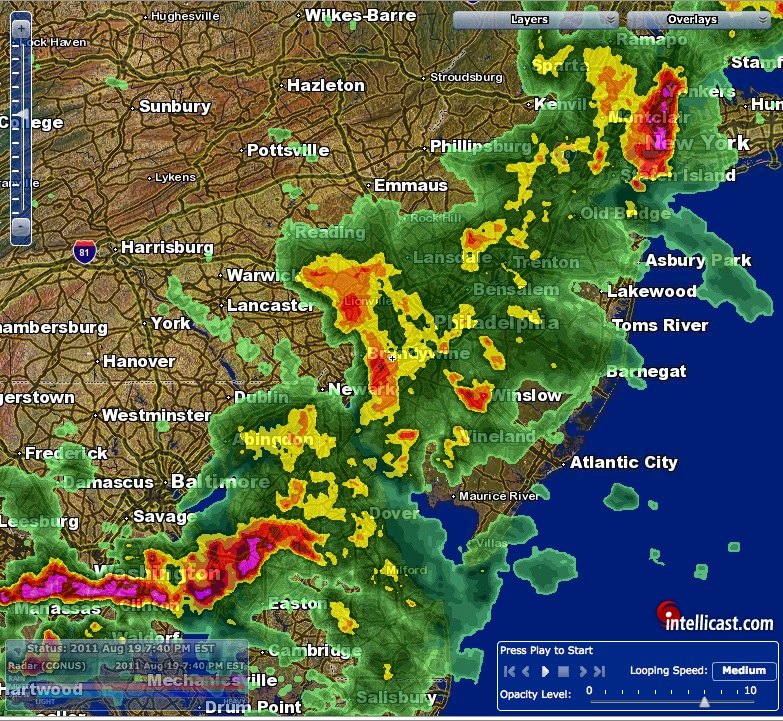
  • Now it’s NYC’s, Philly’s and DC’s turns to get clobbered

    @marklittlenews (mark little) tweets,

    Soaked to the skin but awed beyond words by explosive lightning storm that just engulfed Manhattan #Kapow

    So I looked at the map and saw that there’s a line of strong thunderstorms in a line from New York to Washington. Quite a show. Of JFK, Flightaware says,

    John F Kennedy Intl (KJFK) is currently experiencing:

    • departure delays of 2 hours 31 minutes to 2 hours 45 minutes (and increasing) due to weather
    • inbound flights delayed at their origin an average of 1 hour 12 minutes due to wind
    • all inbound flights being held at their origin until friday at 08:30p EDT due to thunderstorms

    Similar reports at Newark (KEWR), LaGuardia (KLGA), Washington/Baltimore’s Reagan (KDCA), Dulles (KIAD) and kBWI. Philadelphia (KPHL) too.

    I’m just hoping it clears up for my early morning drive to and from northern Vermont from Boston. Should be cool: it’s a cold front, after all.

  • Bookmarking the past

    I’ve been digging around for stuff I blogged (or wrote somewhere on the Web) way back when. After finding two items I thought might be lost, I decided to point to them here, which (if search engines still work the Old Way) might make them somewhat easier to find again later.

    One is Rebuilding the software industry, one word at a time, in Kuro5hin. (And cool to see that Kuro5hin is still trucking along.) The other is Cluetrain requires conversation. Both are from early 2001, more than ten years ago. A sample from the former:

    I went through my own head-scratching epiphany right after the Web got hot and I found my profession had changed from writer to “content provider.” What was that about? Were my words going to be shrink-wrapped, strapped on a skid and sold in bulk at Costco?

    No, “content” was just a handy way to label anything you could “package” and “deliver” through the “vehicle” of this wonderful new “medium.” Marketers were salivating at the chance to “target,” “capture” and “penetrate” ever-more-narrow “audiences” with ever-more-narrow “messages.” Never mind that there was zero demand at the receiving end for any of it. (If you doubt the math, ask what you’d be willing to pay to see an ad on the Web. Or anywhere.)

    Soon I began to wonder what had happened to markets, which for thousands of years were social places where people got together to buy and sell stuff, and to make civilization. By the end of the Industrial Age, every category you could name was a “market.” So was every region and every demographic wedge where there was money to be spent. Worse, these were all too often conceived as “arenas” and “battlefields,” even though no growing category could be fully described in the zero-sum terms of sports and war metaphors.

    And from the latter:

    Cluetrain talks far less about what markets need that about what they are. The first thesis says Markets are conversations. Not markets need to be conversations. Or people need the right message. In fact, we make the point that there is no market for messages. If you want to see how little people want messages, look at the MUTE button on your TV’s remote control. Sum up all marketing sentiment on the receiving end and you’ll find negative demand for it.

    There’s nothing conversational about a message. I submit that if a message turns into a conversation, it isn’t a message at all. It’s a topic.

    Not many people noticed (including me, until Jakob Nielsen pointed it out) that The Cluetrain Manifesto was written in first and second person plural voices, and was addressed not by marketers to markets, but by markets to marketers. It said —

    if you only have time for one clue this year, this is the one to get…

    Chris Locke wrote that in early 1999. Marketing still doesn’t get it. Maybe it can’t.

    And, because marketing (and the rest of business) didn’t get it, I started ProjectVRM, and am now finishing a book about customer liberation and why free customers will prove more valuable than captive ones.

    This stuff seems to be taking awhile. But hey, it’s fun.

  • Storm over Boston

    So here’s the storm happening right now over Boston:

    Also watching lightning strikes on Lightning Finder, as well as out my window, before I go outside for a better view.

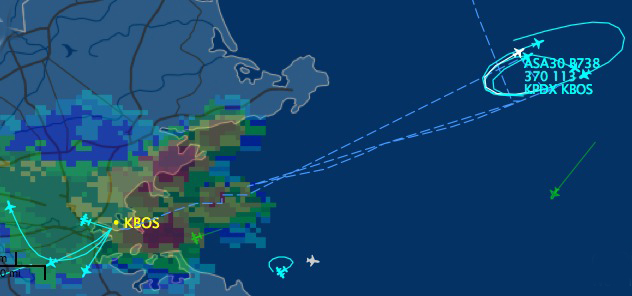
    Check out FlightAware‘s view of KBOS (Logan airport) flight activity map:

    flightaware-kbos

    You can see flights avoiding the storm as it approaches the airport, which is just above the “BO” in KBOS.

    It’s just a summer thunderstorm. Nothing exceptional. It’s just fun to watch it online in all these places as well as from a chair on my front porch.

    … And now, a few minutes later,  the sun is out and we have rainbows in Cambridge. Meanwhile, flights are taking off from Logan, while inbound flights circle in the sky to the east:

    By the way, also at FlightAware, there’s this notice: “Boston Logan Intl (KBOS) is currently experiencing inbound flights delayed at their origin an average of 1 hour 33 minutes due to thunderstorms.” So if you’re coming here for the weekend, good luck.


  • Why music radio is dying

    The Rock face of the Music Radio island is eroding away, as station after station falls into the vast digital sea. Here’s a story in Radio Ink about how two FM rockers have been replaced by news and sports broadcasts that were formerly only on the AM band. (The illo for the story is a hideously discolored mug shot of the aged Mick Jagger.) But Rock isn’t the only music format that’s in trouble. All of them are.

    For most of the last century, music and music radio were Xtreme symbiotes. To be popular, or just to be known to more than your local club or coffee house, you had to get your music on the radio. (For some great cinematic history on this, rent Coal Miner’s Daughter, just to see how Loretta Lynn established herself as a singer.) That’s because you also needed to sell what the radio played, which were recordings. All of those were on plastic discs.

    Most music we hear is no longer on discs, or even on the radio.

    Radio’s biggest advantage since the beginning was being live. This is why it’s still essential for talk, and especially for news and sports — the three formats that are winning on FM and keeping AM alive. Radio will remain strong as long as Internet streaming stays complicated (which it is, even on smartphones), and radios remain standard equipment in new cars. But music radio is still dying slowly. Three reasons:

    1. Music on radio is rarely presented by connoisseurs who know more than you do, and you’re glad to learn from. This in fact has been the case for a long time. There remain a few exceptions, but none (to my knowledge) make much money. By contrast, the Net is full of music connoisseurs and connoisseur-like offerings (e.g. Pandora, LastFM, Spotify).
    2. You don’t choose what music you want to hear. You can do that with Spotify or Rhapsody, and to a lesser extent with Pandora and LastFM.
    3. Advertising. We used to have no choice about enduring it. Now we do.

    But music dying on the radio doesn’t mean it lives on the Net. At least not in the form of radio stations as we’ve known them. That’s because of copyright laws.

    Radio has huge legacy legal advantages over all-digital alternatives on the copyright front. I won’t go into the details, because they’re complicated beyond endurance, but suffice it to say there is a reason why there are no podcasts of popular music. (Briefly, it’s that the podcaster would have to “clear rights” with the copyright holder of every song.) All we get is “podsafe” music, and music from outfits like the ones mentioned above, which have worked their own broad licensing deals with copyright holders — and from radio stations that enjoy similar deals and happen to stream as well.

    Note that radio stations pay more, per recording, to copyright holders for streaming than they do for broadcasting on the air. But they get a break on the streaming side if they’re already broadcasting music over the air, because they don’t have to clear rights with all the artists they play.

    The key here is the term “performance.” The way the law (in the U.S. at least) is set up, every play of every recording on the radio or over the Net is considered a performance, and the assumption by the copyright absolutists (the RIAA, primarily) is that copyright holders need to be paid for those performances. And they’ve been putting the squeeze in recent years on music radio to pay as much for performance rights as streamers on the Internet have been forced to pay. (They put those shackles on the Internet radio baby, right in the cradle.) This will also have a chilling effect on music radio.

    So an irony of considering recorded music a “performance,” for the purpose of extracting royalties from radio stations on the Net and over the air, is that music on both is either going away or turning toward new systems, such as Spotify, LastFM, Pandora and the rest. But no new radio stations, on either the airwaves or the Net. Not if they’re going to play music of the RIAA-protected kind, which is most of what we know.

    If the record industry were not immune to clues, it would find ways to open up opportunities for new music radio stations on the Net. But I doubt they will, until FM music is on its deathbed, just like it’s been on AM since FM wounded it.

    Bonus links: Michael Robertson’s latest improvement to radio, DAR.fm.

    Enhanced by Zemanta
  • Happy Anniversary, Mom and Pop

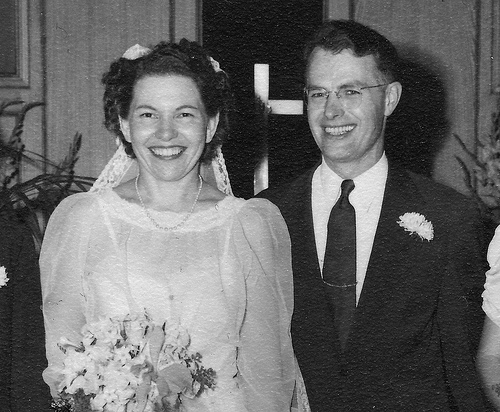
    My parents, Eleanor and Allen Searls, were married 65 years ago today. Allen and Eleanor Searls wedding The wedding was in Grace United Methodist Church, in Minneapolis.* Mom’s family, all descendents of Swedish immigrants to homesteads in Minnesota and North Dakota, were the primary attendees, as I recall being told. Pop’s family was from New Jersey, and that’s where the couple settled down and raised their family. Additions were myself, a bit less than a year later, and my sister Jan, another 20 months after that.

    We were lucky kids. Our parents were good, sane, loving, smart, hard-working and convivial people. Our home was a safe and happy one. We had lots of family gatherings, and lots of friends in our town and around the little summer place Pop and uncle Archie Apgar built on the edge of the Pine Barrens in South Jersey. For us that place was paradise.

    Mom and Pop are gone now, but the family is still intact. We celebrated my birthday at Pop’s little sister Grace’s place in Maine two weekends ago. She’s 99 now, and doing great. (Here’s a photo set from that trip. All the shots of me in that set were ones Grace shot. As you can see, I enjoyed the company.)

    So here’s a toast to Mom and Pop. We love ya both, and always will.


    *Today that’s Northeast United Methodist Church, and it’s not clear to me if the church where Mom and Pop got married is the one still at 2510 Cleveland Street N.E., or the one the website says is for sale at 2511 Taylor St. N.E. I suspect not, though, since the picture of that church, called Trinity United Methodist Church, doesn’t have steps like the ones we see in this picture of Mom and Pop leaving the church after the wedding.

  • What happens when Google buys Sprint too?

    @ChunkaMui just put up a great post in Forbes: Motorola + Sprint = Google’s AT&T, Verizon and Comcast Killer.

    Easy to imagine. Now that Google has “gone hardware” and “gone vertical” with the Motorola deal, why not do the same in the mobile operator space? It makes sense.

    According to Chunka, this new deal, and the apps on it,

    …would destroy the fiction that internet, cellular and cable TV are separate, overlapping industries. In reality, they are now all just applications riding on top of the same platform. It is just that innovation has been slowed because two slices of those applications, phone and TV, are controlled by aging oligopolies.

    AT&T and Verizon survive on the fiction that mobile text and voice are not just another form of data, and customers are charged separately (and exorbitantly) for them. They are also constraining mobile data bandwidth and usage, both to charge more and to manage the demand that their aging networks cannot handle.

    Comcast, Time Warner Cable and other cable operators still profit from the fact that consumers have to purchase an entire programming package in order to get a few particular slices of content. This stems from the time when cable companies had a distribution oligopoly, and used that advantageous position to require expensive programming bundles. Computers, phones and tablets, of course, are now just alternative TV screens, and the Internet is an alternative distribution mechanism. It is just a matter of time before competitors unbundle content, and offer movies, sports, news and other forms of video entertainment to consumers.

    The limiting factor to change has not been the technology but obsolete business models and the lack of competition.

    Before Apple and Google came in, the mobile phone business was evolving at a geological pace. I remember sitting in a room, many years back, with Nokia honchos and a bunch of Internet entrepreneurs who had just vetted a bunch of out-there ideas. One of the top Nokia guys threw a wet blanket over the whole meeting when he explained that he knew exactly what new features would be rolled out on new phones going forward two and three years out, and that these had been worked out carefully between Nokia and its “partners” in the mobile operator business. It was like getting briefed on agreements between the Medici Bank and the Vatican in 1450.

    Apple blasted through that old market like a volcano, building a big, vertical, open (just enough to invite half a billion apps) market silo that (together with app developers) completely re-defined what a smartphone — and any other handheld device — can do.

    But Apple’s space was still a silo, and that was a problem Google wanted to solve as well. So Google went horizontal with Android, making it possible for any hardware maker to build anything on a whole new (mostly) open mobile operating system. As Cory Doctorow put it in this Guardian piece, Android could fail better, and in more ways, than Apple’s iOS.

    But the result for Google was the same problem that Linux had with mobile before Android came along: the market plethorized. There were too many different Android hardware targets. While Android still attracted many developers, it also made them address many differences between phones by Samsung, Motorola, HTC and so on. As Henry Blodget put it here,

    Android’s biggest weakness thus far has been its fragmentation: The combination of many different versions, plus many different customizations by different hardware providers, has rendered it a common platform in name only. To gain the full power of “ubiquity”–the strategy that Microsoft used to clobber Apple and everyone else in the PC era–Google needs to unify Android. And perhaps owning a hardware company is the only way to do that.

    That’s in response to the question, “Is this an acknowledgment that, in smartphones, Apple’s integrated hardware-software solution is superior to the PC model of a common software platform crossing all hardware providers?” Even if it’s not (and I don’t think it is), Google is now in the integrated hardware-software mobile device business. And we can be sure that de-plethorizing Android is what Larry Page’s means when he talks about “supercharging” the Android ecosystem.

    So let’s say the scenario that Chunka describes actually plays out — and then some. For example, what if Google buys,  builds or rents fat pipes out to Sprint cell sites, and either buys or builds its way into the content delivery network (CDN) business, competing with while also supplying Akamai, Limelight and Level3? Suddenly what used to be TV finishes moving “over the top” of cable and onto the Net. And that’s just one of many other huge possible effects.

    What room will be left for WISPs, which may be the last fully independent players out there?

    I don’t know the answers. I do know that just the thought of Google buying Sprint will fire up the lawyers and lobbyists for AT&T, Comcast and Verizon.


  • Google buys Motorola and its giant patent portfolio

    The official statement from Google says,

    Google Inc. (NASDAQ:GOOG – News) and Motorola Mobility Holdings, Inc. (NYSE:MMI – News) today announced that they have entered into a definitive agreement under which Google will acquire Motorola Mobility for $40.00 per share in cash, or a total of about $12.5 billion, a premium of 63% to the closing price of Motorola Mobility shares on Friday, August 12, 2011. The transaction was unanimously approved by the boards of directors of both companies.

    The acquisition of Motorola Mobility, a dedicated Android partner, will enable Google to supercharge the Android ecosystem and will enhance competition in mobile computing. Motorola Mobility will remain a licensee of Android and Android will remain open. Google will run Motorola Mobility as a separate business.

    Meanwhile, over in the Google Blog, Larry Page explains,

    Since its launch in November 2007, Android has not only dramatically increased consumer choice but also improved the entire mobile experience for users. Today, more than 150 million Android devices have been activated worldwide—with over 550,000 devices now lit up every day—through a network of about 39 manufacturers and 231 carriers in 123 countries. Given Android’s phenomenal success, we are always looking for new ways to supercharge the Android ecosystem. That is why I am so excited today to announce that we have agreed to acquire Motorola.

    Motorola has a history of over 80 years of innovation in communications technology and products, and in the development of intellectual property, which have helped drive the remarkable revolution in mobile computing we are all enjoying today. Its many industry milestones include the introduction of the world’s first portable cell phone nearly 30 years ago, and the StarTAC—the smallest and lightest phone on earth at time of launch. In 2007, Motorola was a founding member of the Open Handset Alliance that worked to make Android the first truly open and comprehensive platform for mobile devices. I have loved my Motorola phones from the StarTAC era up to the current DROIDs.

    The bold-faces are mine.

    First, note how Larry says Google is acquiring Motorola, rather than Motorola Mobility. That’s because mobility is the heart and soul of Motorola, Inc., which has been synonymous with mobile radio since the company was founded by Paul Galvin in 1928. Motorola, Inc.’s other division, Motorola Solutions, is big and blah, selling gear and services to business and government. Now that Motorola Solutions will be 100% of Motorola, Inc., it’s an open question where the Motorola name will go. Since Larry says Google bought Motorola, I’m guessing that the acquisition included the name. Nothing was said about it in either the release or the blog post, but it’s bound to be an issue. I hope somebody’s bringing it up in the shareholder webcast going on right now (starting 8:30 Eastern). If Google got the Motorola name, Motorola solutions will probably go the way of Accenture, which used to be Andersen Consulting.

    At the very least, this is patent play. That’s why Larry talked about intellectual property. In mobile, Motorola (I’m guessing, but I’m sure I’m right) has a bigger patent portfolio than anybody else, going back to the dawn of the whole category. Oracle started a patent war a year ago by suing Google, and Google looked a bit weak in that first battle. So now, in buying Motorola, Google is building the biggest patent fort that it can. In that area alone, Google now holds more cards than anybody, especially its arch-rival, Apple.

    Until now, Apple actually wasn’t a direct enemy of Google’s, since Google wasn’t in the hardware business. In fact, Android itself was hardly a business at all — just a way to open up the mostly-closed mobile phone business. But now Google is one of the biggest players in mobile hardware. The game changes.

    For Google’s Android partners other than Motorola, this has to hurt. (Henry Blodget calls it a “stab in the back.”)

    For Windows Mobile, it’s a huge win, because Microsoft is now the only major mobile operating systems supplier that doesn’t also own a hardware company.

    Unless, of course, Microsoft buys Nokia.

    [Later…]

    The conference call with shareholders is now over, and the strategy is now clear. From Business Insider’s notes:

    David Drummond, Google’s legal chief: Android under threat from some companies, while I’m not prepped to talk strategies, combining with Motorola and having that portfolio to protect the ecosystem is a good thing.

    Sanjay Jha: Over 17,000 issued, over 7,500 applications out there. Much better support to the businesses.

    8:47: Android partners, a risk to them?

    Andy Rubin: I spoke yesterday to top 5 licensees, all showed enthusiastic support. Android was born as an open system, doesn’t make sense to be a single OEM.

    8:48: What convinced you this was optimal solution? Competencies that aren’t core to Google?

    Larry Page: I’m excited about this deal, while competencies that aren’t core to us, we plan to operate as a separate business, excited about protecting the Android ecosystem.

    Always watch the verbs. “Protecting” is the operative one here.

    Eric S. Raymond weighs in, optimistic as ever about Google/Android’s position here:

    We’ll see a lot of silly talk about Google getting direct into the handset business while the dust settles, but make no mistake: this purchase is all about Motorola’s patent portfolio. This is Google telling Apple and Microsoft and Oracle “You want to play silly-buggers with junk patents? Bring it on; we’ll countersue you into oblivion.”

    Yes, $12 billion is a lot to pay for that privilege. But, unlike the $4.5 billion an Apple/Microsoft-led consortium payed for the Nortel patents not too long ago, that $12 billion buys a lot of other tangible assets that Google can sell off. It wouldn’t surprise me if Google’s expenditure on the deal actually nets out to less – and Motorola’s patents will be much heavier artillery than Nortel’s. Motorola, after all, was making smartphone precursors like the StarTac well before the Danger hiptop or the iPhone; it will have blocking patents.

    I don’t think Google is going to get into the handset business in any serious way. It’s not a kind of business they know how to run, and why piss off all their partners in the Android army? Much more likely is that the hardware end of the company will be flogged to the Chinese or Germans and Google will absorb the software engineers. Likely Google’s partners have already been briefed in on this plan, which is why Google is publishing happy-face quotes about the deal from the CEOs of HTC, LG, and Sony Ericsson.

    The biggest loser, of course, is Apple; it’s going to have to settle for an armed truce in the IP wars now. This is also a bad hit for Microsoft, which is going to have to fold up the extortion racket that’s been collecting more fees on HTC Android phones than the company makes on WP7. This deal actually drops a nuke on the whole tangle of smartphone-patent lawsuits; expect to see a lot of them softly and silently vanish away before the acquisition even closes.

    I don’t think anybody has paid more attention to this whole thing than Eric has, and he brings the perspective of a veteran developer and open source operative as well. (Without Eric, we wouldn’t be talking about open source today.)

    On August 17, Holman Jenkins in the Wall Street Journal added this bit of important analysis:

    Android has been hugely advantageous for everyone who is a successful phone maker not named Apple. Remember, Apple’s premium smartphone holds up the pricing structure for the whole industry. Samsung, HTC and the rest have been selling phones into this market and pocketing huge margins because they pay nothing for Android.

    Google wouldn’t be human if it didn’t want some of this loot, which buying Motorola would enable it to grab. But that doesn’t mean, in the long term or the short term, that other hardware makers will walk away from a relationship that has lined their pockets and propelled them to the top of the rapidly growing and giant new business of making smartphones. Let’s just say that while having Google as a competitor is not ideal, handset makers will learn to live with it.

    Jenkins’ columns often rub me the wrong way, but this bit seems spot-on.

  • Bruce Elving, professor of FM radio

    I just learned from Dan Kelly that Bruce Elving passed away last month. Details are thin, but here’s a short list of links:

    Bruce Elving, Ph.D.Bruce and I were frequent correspondents for many years, starting the early ’70s, when Bruce began publishing his FM Atlas, an authoritative compilation of technical details for every FM station in the U.S. — and an essential handbook for everyone who loved to listen to far-away FM radio stations. Those people are called DXers, and I was one of them.

    If you’ve ever been surprised to hear on your FM radio a station from halfway across the country, you were DXing. From my homes in New Jersey and North Carolina, I logged many hundreds of FM and TV stations whose signals skipped off the ionosphere’s sporadic E layer.

    For DXers, catching far-away stations is kind of like fishing. You don’t want to catch just the easy ones. For that you go to the AM (aka MW) or shortwave (SW) bands, where the big signals are meant to go hundreds or thousands of miles.

    WSM from Nashville and KSL from Salt Lake City occupy what used to be call “clear channels”: ones with no other signals at night. That’s why WSM’s Grand Ole Opry, heard for decades (and even today) every night on radios in rural areas throughout The South , literally made country music. (I listened in New Jersey, carefully turning my radio to “null out” interference from New York’s WNBC, now WFAN, which was right next to WSM on the dial.)

    But FM and TV are on bands where signals don’t go far beyond the transmitter’s visible horizon, unless the conditions are right, which isn’t often. That’s one reason DXing FM and TV was more fun for the likes of Bruce Elving and me.

    In its heyday (or heydecade), DXing on FM was about hooking relatively rare and slightly exotic fish. The best months to fish were in late spring and summer, when warm calm summer mornings would bring tropospheric (or “tropo”) conditions, in which FM and TV signals would bend along the Earth’s curve, and coast to distances far beyond the horizon. Thus my home in Chapel Hill, NC was often treated to signals from hundreds of miles away. I recall days when I’d pick up WDUQ from the Pittsburgh on 90.5 with the antenna pointed north, then spin the antenna west to get WETS from Johnson City, Tennessee on 89.5, then spin just north of east to get WTGM (now WHRV) from Hampton Roads, Virginia, on the same channel.

    Tropo is cool, but the best FM fishing is in times of sporadic-E propagation , when the E-layer of the ionosphere becomes slightly refractive of VHF frequencies, bending them down at an angle of just a few degrees, so that the signals “skip” to distances of 800-1200 miles. This also tends to happen most often in late spring and early summer, typically in the late afternoon and evening.

    Thanks to sporadic-E, we would watch Channel 3 TV stations from Louisiana, Texas, Nebraska, Minnesota, Cuba and various places in Canada. But, more often, I would also carefully log FM stations I identified in Bruce Elving’s FM Atlas. From 1974 to 1985 (after which I lived in California, where FM and TV DXing conditions were very rare), I logged more than 800 FM stations, most of which came from more than 800 miles away. Bruce said he’d logged more than 2000 from his home in Duluth, Minnesota. I’m sure that’s a record that will stand forever. (Bear in mind that there were only about 10,000 FM signals in the U.S. at the time.)

    For Bruce, FM was also a cause: an underdog he fought for, even after it became an overdog with his help. See, up until the early ’60s, FM was the secondary radio band in the U.S. The sound was better, but most cars didn’t have FM radios, and most cheap home and portable radios didn’t either. Transistor radios were the iPods of the ’50s and ’60s, and most of those were AM-only. Bruce championed FM, and his newsletter, FMedia, was a tireless advocate of FM, long after FM won the fight with AM, and then the Internet had begun to win the fight with both.

    I remember telling Bruce that he needed to go digital with PCs, and then take advantage of the Net; and he eventually did, to some degree. But he was still pasting up FM Atlas the old-fashioned way (far as I know) well into the ’90s.

    I pretty much quit DXing when I came to Silicon Valley in ’85, though I kept up with Bruce for another decade or so after that. Learning about his passing, I regret that we didn’t stay in closer touch. Though we never met in person, I considered him a good friend, and I enjoyed supporting his work.

    With Bruce gone, an era passes. TV DXing was effectively killed when the U.S. digital transition moved nearly every signal off VHF and onto UHF (which skips off the sky too rarely to matter). The FM band is now as crowded as the AM band became, making DXing harder than ever. Programming is also dull and homogenous, compared to the Olde Days. And the Internet obsolesces a key motivation for DXing, which is being able to receive and learn interesting things from distant signals.

    A core virtue of the Internet is its virtual erasure of distance. Anybody can hear or watch streams from pretty much anywhere, any time, over any connection faster than dial-up. The stream also tends to stay where it is, and sound pretty good. (For a fun treat, play around with radio.garden, which lets you “tune” between stations by rotating a globe.)

    What remains, at least for me, is an understanding of geography and regional qualities that is deep and abiding. This began when I was a kid, sitting up late at night, listening to far-away stations on the headphones of my Hammarlund HQ-129X, hooked up to a 40-meter ham radio antenna in my back yard, with a map spread out on my desk, and encyclopedia volumes opened to whatever city or state a station happened to come from. It grew when I was a young adult, curious about what was happening in Newfoundland, Bermuda, Texas, Winnipeg, or other sources of FM and TV signals I happened to be getting on my KLH Model 18 tuner or whatever old black-and-white TV set I was using at the time.

    When it was over, and other technical matters fascinated me more, I’d gained a great education. And no professor had more influence on that education than Bruce Elving, Ph.D.