• The Real Story of Send

    sendWith The Story of Send, Google follows a single email as it travels through wires, under streets, through an ISP’s high-rise, in and out of Google’s various gear, including one of its vast data centers, and finally up a tower and out via a telco’s data system into a smartphone. What happens in the data center is explained in a video that lasts more than seven minutes, with a sped-up voice-over like you hear in disclaimers at the ends of ads for car dealers and pharmaceuticals. There are lots of other promotional side-trips like that one, along the way.

    What it doesn’t tell is the real story of email as we use it today. That story starts with RFC 821, by Jon Postel, posted in August 1982. It begins,

    The objective of Simple Mail Transfer Protocol (SMTP) is to transfer mail reliably and efficiently.
    SMTP is independent of the particular transmission subsystem and requires only a reliable ordered data stream channel.

    What makes SMTP so useful and universal today is that it intentionally transcends any intermediator’s silo or walled garden. It simply assumes a connection. So do the POP (RFC918 and IMAP (RFC1064) protocols (used at the receiving end), for which the relevant RFCs were issued in 1984 and 1988.

    Those protocols ended up winning — for all of us — after it became clear that their simplicity, and their oblivity to the parochial interests of network owners and operators, were what we really needed. That was in 1995. In the meantime, a pile of proprietary and corporate email systems competed in a losing battle with each other. Compuserve, Prodigy, MCI Mail, AppleLink, and a host of others were all obsoleted by the obvious advantage of having nobody own the means by which we simply send electronic mail to each other.

    The main intended message of The Story of Send is a green one: Google saves energy. A secondary message is that Google is a big nice company that treats your mail well and has good security practices. But the main unintended message — or at least the one that comes across — is that email is a big complicated business, and you need big complicated companies to do it right. It also ignores the real story, which is about a handful of simple protocols.

    Two voices in the wilderness of corporate rah-rah that ought to be heard on this are Phil Windley and Bob Frankston.

    Phil has a terrific blog post called Ways, not Places, in which he makes a good straightforward case for understanding the Internet in term of ways (protocols) rather than places (e.g. domains, with locations, addresses, and the rest). Because it’s the ways that make everything else possible.

    In his essay on Ambient Connectivity, Bob says, “The nuanced definition of Ambient Connectivity is that we can view connectivity as infrastructure but we need to take responsibility if we find ourselves disconnected. This is in contrast with today’s telecom industry in which we’ve shifted responsibility to providers and can only assume connectivity where a third party has subscribed to a service and there is an unbroken chain of providers all the way to your destination.” The latter is the case that Google makes. Its also the case argued by every bill we get from our phone and cable companies.

    But we need to keep hearing the all-but-silent argument for the Net and its protocols. Because without those we wouldn’t have the rest.


  • So long, and thanks to the bird

    Independent commercial alternative rock radio in Boston is heading to the grave. The Boston Phoenix‘ WFNX has been sold to Clear Channel, which — says the press release — will expand its “footprint” in Boston. (Bambi vs. Godzilla comes to mind.) Boston Business Journal suggests the signal’s fate will be to carry country music or Spanish programming. But it doesn’t matter. FNX is done.  In Thanks For The Memories You’re Fired, Radio INK puts the end this way:

    Independently owned WFNX has been competing in the Boston market for nearly 30 years. Until yesterday that is, when Stephen Mindich notified his staff he was selling to Clear Channel. He then fired 17 of the 21 employees. Mindich said, “Despite its celebrated history, its cutting edge programming , its tradition of breaking new music, its ardent fans among listeners and advertisers, for some time it has been difficult to sustain the station  — especially since the start of the Great Recession.”

    NECN reports,

    The sale also means 17 of the 21 people working at FNX were suddenly let go Wednesday. The remaining three full-timers and one part-timer will keep the station on air until the sale goes through in next couple of months.

    WFNX Program Director Paul Driscoll said, “I think of it as a two month Irish wake, so we’re going to send this legendary station off the right way.”

    That will mean celebrating the station’s roots and its 29 year run – one that had a hand in bringing groups like Nirvana and Pearl Jam to wider audiences.

    Driscoll said, “The community, the artists that we’ve developed relationships with, the listeners, it’s more than just a spot on the FM dial.”

    No doubt the change has been coming for a long time. WBCN went away (actually to an HD subchannel, which is pretty much the same thing) a couple years back after 41 years as one of the country’s landmark rock stations. FNX was always more alternative than BCN. WBOS and WAAF still fly the rock flags; but there was only one FNX, and now it’s headed out the door.

    Since coming to Boston in ’06 I’ve been surprised to see FNX continuing to make it. The ratings in both March and April had dropped to nil (literally, nada). You can’t sell advertising with that.

    The signal is also sub-second-tier. Licensed to Lynn as a Class A station (maximum of 3000 watts at 300 feet above average terrain), it radiates with 1700 watts at 627 feet (equivalent to 3000 watts, trading watts for height), from atop One Financial Center, but with far less power in most directions other than north:

    Meanwhile, most competing Boston commercial stations are Class B: 50,000 watts at 500 feet, or the equivalent. (Most radiate with fewer watts at higher elevations, on either the Prudential Building or out at Boston’s antenna farm in Needham, where a collection of towers exceed 1000 feet in height.)

    Presumably WFEX, which simulcasts WFNX from Mt. Monadnock in New Hampshire, will also go to Clear Channel. (See the engineering and ownership details here.)

    There’s a lot of tweeting on the matter. The most poignant so far is this one from David Bernstein (@dbernstein):

    Why #WFNX mattered (photo taken by @CarlyCarioli) http://pic.twitter.com/dIjOjsfT

    Make that minus seven now.

    [Later…] The sale price is $14.5 million.

  • Won and done

    Okay, my foursquare experiment is over. I won, briefly…
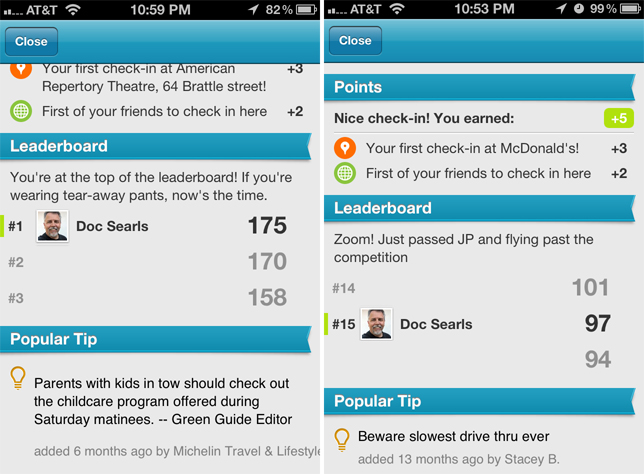
    4sq… and, about 24 hours later (the second screenshot) I was back in the pack somewhere.

    So now I’m done playing the leaderboard game. I’d like to say it was fun, and maybe it was, in the same way a hamster in a cage has fun running in its wheel. (Hey, there’s a little hamster in all of us. Ever tried to “win” in traffic? Same game.)

    The experiment was to see what it would take to reach #1 on the leaderboard, if only for a minute. The answer was a lot of work. For each check-in I needed to:

    1. Wake up the phone
    2. Find foursquare (for me it’s not on the front page of apps)
    3. Tap the app
    4. Dismiss the “Rate foursquare” pop-over window
    5. Tap on the green “Check In” button
    6. Wait (sometimes for many seconds) while it loads its list of best guesses and actual locations
    7. Click on the location on the list (or type it in, if it’s not there)
    8. Click on the green “Check In Here” button
    9. Take a picture and/or write something in the “What are you up to?” window
    10. Click on the green “Check In” button, again.

    And to do that a lot. For example, at Harvard Square a few days ago, I checked in at the Harvard Coop, Radio Shack, Peets Coffee, the Cemetery, Cambridge Common and the Square itself. For just those six places we’re talking about 60 pokes on the phone. (Okay, some of the time I start at #5. But it’s still a lot of pokes.)

    To make sure I had the poke count right, I just did it again, here at the Berkman Center. Now my phone says, “Okay. We’ve got you @ Berkman Center for Internet & Society. You’ve been here 45 times.”

    Actually, I’ve been here hundreds of times. I only checked in forty-five of those times. The difference matters. What foursquare says in that statement is, If you haven’t checked in on foursquare, you haven’t really been there. Which is delusional. But then, delusion is part of the game. Being mayor of the 77 bus (which I have been, a number of times) confers no real-world advantages to me at all. I even showed a driver once that I was mayor of the bus. She looked at my phone, then at me, like I was a nut case. (And, from her perspective, I surely was.) Being the mayor of some food joint might win you a discount or a freebie if the establishment is so inclined. But in most cases the establishment knows squat about foursquare. Or, if it does know something, squat might be what it does.

    That was my surreal experience after checking in at a Brookstone at Logan Airport last October. I coudn’t miss the large placard there…
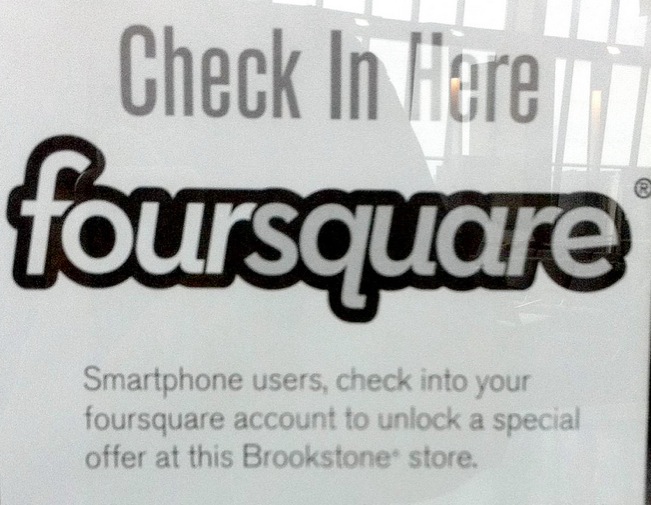
    … and asked the kid at the cash register what the “special” would be. He replied, “Oh, that’s just a promotion.” At the other end of the flight, while transferring between concourses in Dallas-Fort Worth, I saw this ad on the tram:

    On my way to the next plane I checked into as many places as I could, and found no “great deals.” (Here is my whole mini-saga of foursquare screenshots.)

    But, credit where due. An American Express promo that I ran across a number of times at SXSW in Austin earlier this year provided $10 off purchases every place it ran, which was more than a few. (Screenshots start here.) We also recently got a free upgrade from Fox, the car rental company, by checking in with foursquare. And I agree with Jon Mitchell of RWW, in What Is the Point of… Foursquare?, that the service has one big plus:

    Isn’t Foursquare just for spamming Twitter and Facebook with what Geoloqi’s Amber Case calls “geoloquacious” noise about your trip to the grocery store? It can be, and for too many users, it is.

    But turn all that off. Forget the annoying badges and mayorships, too. There’s one useful thing at which Foursquare is very, very good: recommendations.

    So I’ll keep it going for that, and for notifying friends on foursquare that I’m in town, and am interested in getting together. (This has worked exactly once, by the way, with the ever-alert Steve Gillmor.)

    But still, you might ask, why have I bothered all this time?

    Well, I started using foursquare because I like new stuff and I’ve always been fascinated by the Quantified Self (QS) thing, especially around self-tracking, which I thought might also have a VRM benefits, somewhere down the line. I’m also a born geographer with a near absolute sense of where I am. Even when I’m flying in the stratosphere, I like to know where I am and where I’ve been, especially if photography is also involved. Alas, you can’t get online in the air with most planes. But I’ve still kept up with foursquare on the ground, patiently waiting for it to evolve past the hamster-wheel stage.

    But the strange thing is, foursquare hasn’t evolved much at all, given the 3+ years they’ve been around. The UI was no bargain to begin with, and still isn’t. For example, you shouldn’t need to check in always in real time. There should be a setup that keeps track of where you’ve been, without the special effort on your part. If there are specials or whatever, provide alerts for those, on an opt-in basis.

    But evolution is planned, in a big way. Foursquare Joins the Coupon Craze, a story by Spencer E. Ante last week in The Wall Street Journal, begins with this:

    Foursquare doesn’t want to be another popular—but unprofitable—social network. Its new plan to make money? Personalized coupons.

    The company, which lets users alert their friends to their location by “checking in” via smartphone from coffee shops, bars and other locations, revealed for the first time that it plans to let merchants buy special placement for promotions of personalized local offers in July in a redesigned version of its app. All users will be able to see the specials, but must check into the venue to redeem them.

    “We are building software that’s able to drive new customers and repeat visitors to local businesses,” said Foursquare co-founder and Chief Executive Dennis Crowley.

    This tells me my job with foursquare is to be “driven” like a calf into a local business. Of course, this has been the assumption from the start. But I had hoped that somewhere along the way foursquare could also evolve into a true QS app, yielding lat-lon and other helpful information for those (like me) who care about that kind of thing. (And, to be fair, maybe that kind of thing actually is available, through the foursquare API. I saw a Singly app once that suggested as much.) Hey, I would pay for an app that kept track of where I’ve been and what I’ve done, and made  that data available to me in ways I can use.

    Meanwhile, there is one big piece of learning that I don’t think anybody has their head fully wrapped around, and that’s the willingness of people to go to all this work, starting with installing the app in the first place.

    Back in the early days of ProjectVRM, it was taken as fact amongst developers that anything requiring a user install was problematic. Now most of us have phones with dozens or hundreds of apps or browser extensions that we’ve installed ourselves. Of course Apple and the browser makers have made that kind of thing easier, but that’s not my point. My point is that the conventional wisdom of today could be old-hat a year from now. We can cite example after example of people doing things which, in the past, it was said they were unlikely to do.

  • An AR treat

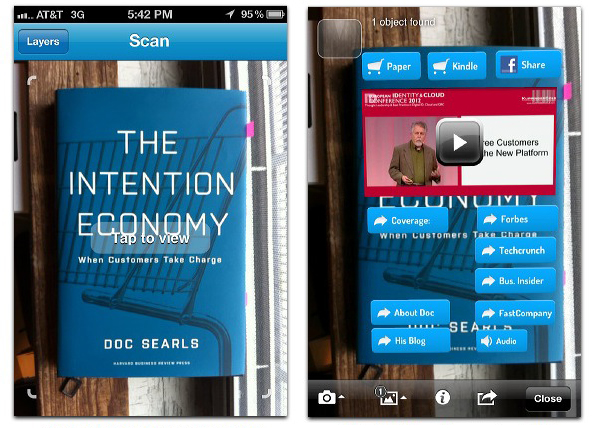
    Enticed by Maarten Lens-Fitzgerald (aka @DutchCowboy) in this tweet, I fired up Layar (an AR — Augmented Reality — browser from the company by that name, which he co-founded), and aimed it at the cover of my new book. What followed is chronicled in this Flickr set. Start here, then follow the links at the end of each caption.

    It’s a fun way to see what linky stuff might be found with any image you can visit in the world. Right now its purposes are mostly commercial. But I’d love to see the technology applied to questions we might have in the much larger non-commercial world, answering questions like…

    • What kind of flower is this?
    • What breed of dog is this?
    • What’s the name of this bridge?
    • What’s the history behind this building?
    • This crystal is produced by what chemical compound?
    • Show me older photos of this same scene
    • What is the geology beneath this scene?
    • Where else can I buy this?
    • What are all the news stories about this?
    • Who made this, and what went into it?
    • Show me the standard information sharing label for this

    The biggest one for me — and maybe one I could actually work on — is this:

    • What am I seeing out the window of this airplane?

    Given that planes are moving, usually at speeds of hundreds of miles or kilometers per hour, this might be hard to do. But what about after the fact? I’d love it if my own captions (or better ones) to photos such as these…

    … could pop up when somebody looks at them, whether on a browser, a phone or any other device.

    Just one more way I keep learning that it’s still very early in whatever it is we’re making of the digital world that coexists with the physical one.

  • A way to see what you get

    According to The Cost of Reading Privacy Policies, a paper by Aleecia M. McDonald and Information Sharing LabelLorrie Faith Cranor of Carnegie Mellon University, “national opportunity cost for just the time to read policies is on the order of $781 billion.”

    This is based on reading 1462 policies with a median length of 2518 words, taking about ten minutes per policies, adding up to 76 work days per year, or a total of 53.8 billion hours for the U.S. population reading those polcies. This number, observes Alexis Madrigal, senior editor of The Atlantic, exceeds the GDP of Florida.

    So, Joe Andrieu and Iain Henderson think, why not eliminate the cost of that work by adopting a Standard Information Sharing Label — like the nutrition label you see on foods of all kinds? So they’ve started a Kickstarter project to do exactly that. Their funding goal, $12,500, is, by my calculations, 1/00000001600512th of the opportunity costs we already run up every year.

    Joe and Iain are already quite a bit downstream, having worked for some time on the Information Sharing Workgroup at Kantara, where they are already underway with a draft specification for the label.

    So give the a hand, in the form of a pledge.


  • Tsé Bitʼaʼí

    That’s the Navajo name for what everybody else calls Shiprock. It’s a rock spire that rises out of the desert southeast of Four Corners in the far northwestern corner of New Mexico. Elevation at the peak is 7,177 feet, with a prominence of 1,583 feet.

    Technically, it’s what geologists call a monadnock, an inselberg, or a volcanic neck or plug. By whatever name, it’s what remains of a volcano that was active 27 million years ago, in the Oligocene epoch, one among many volcanic perforations of what later became the American southwest. Radiating in three directions from the center are long volcanic dikes,: walls of intrusive rock that formed from lava, as did Shiprock itself. From the air, they give Shiprock the look of a giant symbol.

    I’ve been wanting to shoot pictures of Shiprock for years, but flights east to and from LAX tend to go a bit north of there, and since I like to shoot out the shady (usually northern) side of the plane, I’ve tended to miss it. But my flight from LAX to BOS on Sunday took an unusually southern route, and I got a good view, though it was hazy.

    Got lots of other good stuff too, but it was easy to put this one up first.

    [Later…] Just remembered that I’ve shot it before, from the north side, in 2008. See here.

  • Department of Corrections

    One nice thing about blogging is that you get to correct what you write.

    Tonight I put up a long post that I had second, third, fourth and fifth and additional thoughts about, and finally decided to kill.

    I do that a lot, actually. Just not usually with stuff I’ve already put up. But I did it this time.

    Maybe tomorrow I’ll have another go at the same subject. Meanwhile I’ll grab some much-needed sleep.

  • Take us to The Rivers

    News rivers were a brilliant idea in the first place. Perhaps, now that at least one high-profile publisher has embraced them, the rest might follow. New York RiversBut first, some history, in the best chronological order I can muster —

    1. Sometime way back there, Dave Winer created rivers of news for the NY Times and the BBC (NYTimesriver.com and BBCriver.com). Being RSS-fed and in plain formatting, they loaded instantly, and were so Web 1.0+ compliant that they even looked great and loaded fast on phones (such as my Treo) that were not yet smart in the iOS/Android manner, or fed by 3+G data connections. Hoorays and encouragement flowed (non-ironically, since that’s what you’d expect) from everywhere but the very publications that benefitted from the free work that Dave did for them.
    2. The River of News, by Jeff Jarvis, in August, 2006.
    3. Newspapers 2.0, in October, 2006. It recommended ten things. Here is the last:, “Tenth, publish Rivers of News for readers who use Blackberries or Treos or Nokia 770s, or other handheld Web browsers. Your current home page, and all your editorial pages, are torture to read with those things. See the examples Dave Winer provides with rivers of news from the NY Times and the BBC. See what David Sifry did for the Day Fire here in California. Don’t try to monetize it right away. Trust me, you’ll make a lot more money — and get a lot more respect from Wall Street — because you’ve got news rivers, than you’ll make with those rivers.”
    4. A year later I repeated the list in Still at Newspapers 1.x.
    5. Future to Newspapers: Jump in a River, in August, 2007.
    6. The Future History of Newspages, in April, 2008.
    7. A Newspaper Progress Report, Sort of, in June 2010.

    The BBC river is gone, but the Times‘ river is still going strong, and as good as ever. (Not that the Times is actually doing anything other than keeping its RSS feed alive. The river is Dave’s.) So is the very idea of the news river, which remains as uncomplicated and hyper-useful as the Web’s own uncomplicated original purpose (publishing, linking) and protocols.

    But publishers are complicators, and for the most part have never understood the Net or the Web. Nor have they fully embraced its inherent simplicities, with the remarkable exception of RSS (which Dave made into Really Simple Syndication — a purpose that could not possibly be misunderstood by publishers, and which now brings up 4,270,000,000 results on Google).

    The bigger and older the industry, the harder it is to make fundamental reforms, or to embrace disruption. Publishing, including newspapers, had been working the same way for many generations, so it has taken awhile for the obvious to sink in. But that’s what we see in Jason Pontin’s Why Publishers Don’t Like Apps, which is must-reading for everybody in the business. Its concluding paragraphs:

    Today, most owners of mobile devices read news and features on publishers’ websites, which have often been coded to detect and adapt themselves to smaller screens; or, if they do use apps, the apps are glorified RSS readers such as Amazon Kindle, Google Reader, Flipboard, and the apps of newspapers like the Guardianwhich grab editorial from the publishers’ sites. A recent Nielsen study reported that while 33 percent of tablet and smart-phone users had downloaded news apps in the previous 30 days, just 19 percent of users had paid for any of them. The paid, expensively developed publishers’ app, with its extravagantly produced digital replica, is dead.

    Here, the recent history of the Financial Times is instructive. Last June, the company pulled its iPad and iPhone app from iTunes and launched a new version of its website written in HTML5, which can optimize the site for the device a reader is using and provide many features and functions that are applike. For a few months, the FT continued to support the app, but on May 1 the paper chose to kill it altogether.

    And Technology Review? We sold 353 subscriptions through the iPad. We never discovered how to avoid the necessity of designing both landscape and portrait versions of the magazine for the app. We wasted $124,000 on outsourced software development. We fought amongst ourselves, and people left the company. There was untold expense of spirit. I hated every moment of our experiment with apps, because it tried to impose something closed, old, and printlike on something open, new, and digital.

    Last fall, we moved all the editorial in our apps, including the magazine, into a simple RSS feed in a river of news. We dumped the digital replica. Now we’re redesigning Technologyreview.com, which we made entirely free for use, and we’ll follow the Financial Times in using HTML5, so that a reader will see Web pages optimized for any device, whether a desktop or laptop computer, a tablet, or a smart phone. Then we’ll kill our apps, too.

    An aside. I am a paid subscriber to a number of publications both on the Web and through Apple’s iTunes store. While I do appreciate being able to read them on the iPad in a plane or on a subway, I much prefer reading linky text to reading the linkless kind, on an electronic device. As Jason Pontin puts it earlier in his essay,

    But the real problem with apps was more profound. When people read news and features on electronic media, they expect stories to possess the linky-ness of the Web, but stories in apps didn’t really link. The apps were, in the jargon of information technology, “walled gardens,” and although sometimes beautiful, they were small, stifling gardens. For readers, none of that beauty overcame the weirdness and frustration of reading digital media closed off from other digital media.

    Now back to Dave, who today wrote this in River of News — FTW! —

    Now while I have your attention, let me point in the next direction. Once you have a river, do something bold and daring. Add the feeds of your favorite bloggers and share the resulting flow with your readers. Let your community compete for readership. And let them feel a stronger bond to you. Then when you learn about that, do some more. (And btw, you’re now competing, effectively with your competitors, Facebook and Twitter. Don’t kid yourselves, these guys are moving in your direction. You have to move in theirs and be independent of them. Or be crushed.)
    I wish I could work with the teams of the best publications. If that could happen, we’d kick ass. But I’m here on the sidelines giving advice that you guys take on very very slowly. It’s frustrating, because it’s been clear that rivers are the way to go, to me, for a very long time. A lot of ground has been lost in the publishing business while we wait. There’s a lot of running room in front of this idea. We can move quickly, if publishers have the will.

    Please, this time, listen to the man. While you still can.

    [Later…] Bonus link: Facebook social readers are all collapsing. HT to Euan Semple (@Euan) with this tweet.


  • Radio news (and vice versa) in DC and Baltimore

    I have no photos of transmitters for any of the stations in this post, but I do have this one: the iconic 997-foot red candelabra on TV Hill in Baltimore. It holds aloft most of that city’s TV and FM stations’ antennas.

    A few days ago RadioInk reported that WTOP, the all-news radio station in Washington, D.C., is now the top-billing station in the nation. Two surprising things there. One is that Washington is the #7 market (behind New York, Los Angeles, Chicago, San Francisco, Dallas-Fort Worth and Houston-Galveston), and that in the latest ratings WTOP is #2 overall, behind WAMU, the top local public station. (WAMU gets an 8.2% AQH, or Average Quarter Hour share, to WTOP’s 6.9%,)

    One non-surprise is new competition, from WNEW — “all-news 99-1,” created by CBS, which owns the top news stations in New York (WCBS and WINS), Chicago (WBBM), Los Angeles (KNX and KFWB), San Francisco (KCBS) and elsewhere. Of the ten top billing stations (according to that same RadioINK story), five are all-news, and all but WTOP are owned by CBS. So clearly CBS would like to compete in a town that makes more news than any other.

    So far, however, WNEW has been all but nowhere in the ratings. WTOP has slipped a bit (a month earlier it was #1 with a 7.5% AQH share), but WNEW went from 0.3% to a “-“. Not good. Still, according to this piece by Ben Fischer in the Washington Business Journal, CBS says things are going “according to plan.”

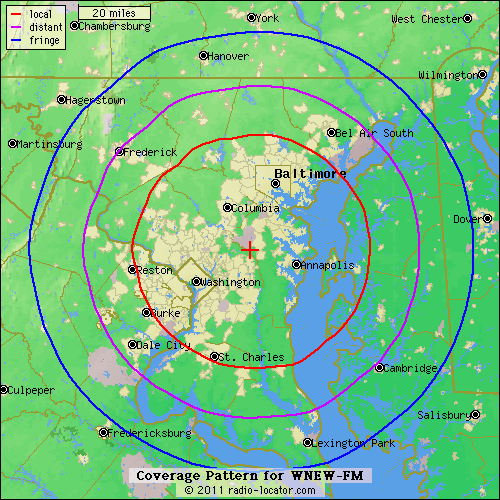
    wnewAs an old radio guy with a transmitter obsession that I’ll never fully repress, I’m wondering if the signal is an issue. WNEW, which is licensed to Annapolis, transmits from a tower in the woods near near Patuxent River Park, between Bowie and Crofton, in Maryland, about four miles east of the 197 exit off the Baltimore-Washington Expressway (295). The maxium power allowed for FM stations in the Northeast is 50,000 watts at 500 feet (above average terrain), and WNEW puts out the equivalent of that with 45,000 watts at 515 feet. (Coverage results from a combination of power and height. You need less power at higher antenna heights to achieve the same coverage. Most FM stations in New York radiate from atop the Empire State Building with 6,000 wats at 1361 feet.)
    Could be the idea is to cover both Washington and Baltimore, which it does, as you can see from the Radio-Locator.com map on the right. The red line is the calculated extent of strong signal coverage. But signal strength still falls off with distance from the transmitter, and it helps to be in the middle of town, as WTOP is.

    Recently I drove around both cities, and WNEW sounded fine there in a car. Homes and offices are another matter, though. Car radios tend to be pretty good. Home radios and portables much less so. On a kitchen radio in Baltimore, about the same distance from WNEW as, say, Arlington, Virginia, WNEW was all but inaudible.

    Some history.

    WTOP began life at 1500 on the AM dial, with a powerful directional signal pumped out by its three-tower 50,000-watt facility in Wheaton, Maryland. The signal on the ground covered most of the metro area by day, though it left out places to the west, especially at night. (Thanks to the reflective qualities of the ionosphere at night, the station could also be heard well from North Carolina to the Maritimes.) The Washington Post, the primary owner of the station back then, made WTOP all-news in the mid-1960s. (Around that same time, the Post also made a royally dumb decision to donate its FM station, on 96.3fm, to Howard University, where it thrives today as WHUR — because the Post didn’t believe people were going to listen much to FM.) Then, to make a long story short, the station went through a series of ownership changes and facilities proliferations until it arrived at this current state (first links go to coverage maps):

    • WTOP, the namesake, radiates on 103.5fm, with 44,000 watts at 518 feet above average terrain, from the American University tower it shares with WAMU, WKYS, WMMJ and WPFW. This is equivalent to the legal maximum of 50,00o watts at 500 feet; except that the station has a directional signal, with a dent to about half that power in the Baltimore direction.
    • WTLP, on 103.9, with 350 watts at 950 feet above average terrain, on a ridge alongside Gambrill Park Road, overlooking Frederick, Maryland.
    • WWWT, on 107.7, with 29,000 watts at 646 feet, also equivalent to the legal max of 50,000 watts at 500 feet. on a hill overlooking Warrenton, Virginia.
    • W282BA, on 104.3, a 100-watt translator on a tower in downtown Leesburg, VA.
    • All four simulcast and identify as WTOP.

    Meanwhile the old signal on 1500 is now WFED, called FederalNewsRadio. It is simulcast on WWFD on 820am in Frederick, MD. That transmitter is a two-tower rig, alongside I-70 just west of Frederick. It’s 4,300 watts by day and 430 watts at night, when its signal is aimed east over Frederick. Both WTOP and WFED are owned by Hubbard Broadcasting, which recently bought them from Bonneville.

    Maybe CBS will buy up a fleet of secondary stations around the edge of the market(s), like WTOP did. That might help. Meanwhile, I think that signal is a problem.

    I could say more, but I’d rather just put this up. It’s been languishing in my pile of drafts for long enough, waiting for me to say more. Rather than that, I’ll just leave the rest of that up to those of you who care.

  • Book week

    The Intention Economy came out on Tuesday, and coverage has been spreading. Meanwhile, while I’ve been busy at IIW, where VRM mojo has been major. Notes from the many VRM sessions at #IIW14 will appear on this page soon. Meanwhile here are some excerpts pieces that ran this week.

    From Selling You: Not Just on Facebook, by Haydn Shaughnessy in Forbes —

    The reality is we need a different way of thinking about data, and in an age marked by innovation we shouldn’t find a reframe too difficult. We shouldn’t but we do. Generations of marketers have been brought up on an adversarial view of the customer, the target, the win…

    In all the discussions we’ve had here in Forbes about social business we have yet to stray into the use and purpose of social data, as if we too largely accept that the adversarial view is the only one.

    A couple of days back I tried to reflect an alternative view in for, example, how we might use LinkedIn data – it’s not only my view of course and I don’t want to claim any originality in it. For five years or more, maybe as far back as The ClueTrain Manifesto, people like Doc Searls have been arguing that the web makes a better commerce engine if we recognize all the power symmetries it brings. And there is an increasing number of projects that are taking up that logic.

    CRM type data is old school – Tesco in the UK had signed up more than 15 million people to its ClubCard by 2009, that is over a third of the adult population of the country. It’s what companies did before the web. But it seems to be continuing even now that we have new possibilities.

    There is no need to collect inference data on people and their possible choices. There is no adversary called customer. We have scaled up human interaction online where we can get closer to asking people, suggesting to them, and interacting with them.

    So the future actually belongs to companies that take a symmetrical view of power…

    From Another Bubble; Not Housing, by Francine Hardaway of Stealthmode Blog in Business Insider:

    Guys, we ARE in a bubble. I don’t care what you say. As an outsider, I can see it…

    Like Facebook, Pinterest and Instgram have valuations that are guesses about the future of advertising.Will they be the next great places to advertise as we shift to mobile?

    Pinterest may be worth more “nothing” than Instgram, however, because as Scoble pointed out, women have buying power, which is why brands cozy up to mommy bloggers. But they haven’t bought BlogHer, the platform on which those women express opinions, have they? Lisa, Jory and Elisa were pioneers in bringing women’s voices to the marketplace, and no one has offered them a billion. That’s because BlogHer is not a tool. But it should expose also the fact that simply being favored by women doesn’t confer $7b in value on a company.

    More worrisome is the supposition that these apps will someday be good carriers of mobile advertising, even though as yet the advertising industry hasn’t solved the online ad effectiveness problem and even Facebook reported diminished revenues this quarter.

    The advertising industry is in upheaval, over the value of online advertising per se, before it even tackles mobile. Publishers are going under right and left because customers don’t want to see ads online, and truly hate them on mobile . Here, especially, the user will control the conversation.

    So the valuations of Pinterest and Instgram/FB are merely expensive guesses about the future of advertising, about whether the ad tech industry will figure out mobile in a non-invasive way. Yes, the open graph will be part of it, and the advertising will be targeted. But I am guessing that Doc Searls will be quoted here gain and again: markets are conversations, and customers will control them.

    In Doc Searls Wants You to Join Him in The Intention Economy, Scott Merrill writes in Techcrunch,

    The book is easy to read, written in Searls’ first-person voice. He explains in the opening that he’s used to writing online and furnishing lots of links. While he can’t directly link from the content of the book, each chapter contains numerous footnotes with additional information and URLs to further reading. Searls uses plenty of personal anecdotes and examples, and quotes an astonishing number of conversations he’s had with people through the years.

    I’m not an economist, so I was marginally worried that the book would be heavy on economic theory. There is some, as well as historical analysis of the evolution of markets and their effects, but all of this is done in a very accessible way. Searls does a great job presenting complex (and often crushingly boring) economic theory in ways that make sense to casual readers.

    I purposefully read the book slowly, to allow the concepts to penetrate my thoughts. It didn’t take long for me to start looking much more critically at all the business transactions in which I participate every day and wonder how VRM and the intention economy might change them.

    The Intention Economy represents the fruition of several years of lively discussion on this subject. The book is far from definitive, though: the groundwork for the intention economy is only just now being laid, and it’ll be a long time before it becomes an everyday reality.

    He also says this about my response (in an email interview) to a question about “…bad actors (on either side of a transaction), and about the likelihood of malicious fourth parties: someone sneakily providing some kind of personal data store only to misuse the data collected”:

    On the whole, I’m actually very excited about the possibilities implied by the intention economy, but this reply really worries me. Yes, we didn’t worry about spam or malware when the core Internet protocols were forming. But we’ve learned an awful lot since then, and it seems to me a glaring omission that reasonable safeguards not be considered at the beginnings of any new Internet construction project.

    I should have put that question to the fourth party developers on the ProjectVRM list. In fact I’m sure safeguards are being considered, and it was an error on my part not to make at least that much clear.

    Fast Company ran two pieces: one from the book, and one about the book. Give Up The Gimmicks: How Groupons And Coupons Can Damage Your Brand is an excerpt from Chapter 25 of the book, titled  “The Dance”. One pull-quote:

    An old saying goes, “Cocaine makes you feel like a man. Problem is, the man wants more cocaine.” Coupons are cocaine for business.

    To get off the discounting drug, it helps to know that businesses can survive–and thrive–without Groupons, or coupons, or any gimmick at all.

    Doc Searls On Becoming Part Of The Intention Economy is an interview by Drake Baer. An excerpt:

    …we need to start loving through the marketplace. Start loving where your customers are autonomous, sovereign, individual free agents who bring far more to you than money and loyalty. They have signals, they have intelligence, they have all kinds of things they can bring that you’re ignoring right now because you’re running closed systems in which you know almost nothing about them.

    In the long run, individual autonomy is going to be a persistent state, and getting along with customers and being true cooperators with customers is going to be what helps retail, aviation, you name it, to adapt fully to what the Internet has been implying from the beginning.

    In Will Facebook Drive the New Intention Economy? Ryan MacRay Jones of m-cause writes,

    Doc Searls, in his excellent new book The Intention Economy, discusses how shoppers online will eventually move beyond action buttons (e.g. “Like”) and exercise their consumer power by broadcasting their intent via a sort of online RFP (Request for Proposal).  In the Intention Economy, the buyer will notify the market of his/her intent to buy and then sellers will compete for the buyer’s purchase.

    While RFPs are not yet happening within Facebook, the giant social network is making a move to learn more about our intent as shoppers online.

    Part of Doc Searls vision of the intention economy involves “fourth parties” that protect a consumer/shopper and act on his/her behalf within the intention economy.  Personal.com is an early form of this type of company.   Fourth parties collect our intent, but instead of broadcasting it broadly and selling it to advertisers, they look out for the consumer and their interests on the web.  If, as Mark Zuckerberg states in his SEC filing letter, Facebook is trying to be a force for good and social change, won’t they be looking to help consumers transparently understand how and when their data is being used to drive ad sales?  Could Facebook actually pivot and evolve into a real trusted 4th party over time?

    Quick answer: Not unless their consumers become customers.

    In What if We Tossed Out the Advertising Model, Rawn Shah of Forbes writes,

    There are number of secondary effects of this model as well: it shifts the business of customer data collection and business analytics in a different direction; it elevates the level of security of information; it creates new feature needs in online retailing and commerce systems; and if Doc is right, it may even transform the banking industry by creating a whole new business opportunity line for them.

    This approach creates the multi-way dialogue with customers, their networks, and people of like interest that we need to see happen in the world of marketing, transforming the model towards greater efficiency. In doing so, IT directly becomes a stronger part of the business function of marketing, as well as impacting how we manage inventory and distribute goods and services. It contributes to the integrated, cross-functional future as we move away from the Value chain model of the enterprise, and into a social business world.

    Rawn will run his interview with me in a future post.

    Two other audio interviews are also up. HBR’s Winning in the Intention Economy (note: HBR is the book‘s publisher) and Big Data: How Personal Clouds and ‘VRM’ will revolutionise Customer Relationships, from Telco 2.0 Research.

  • Off to a good start

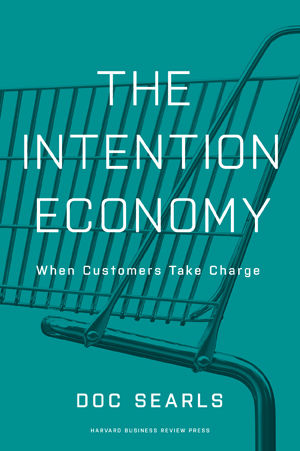
    coverToday is the official release date for The Intention Economy: When Customers Take Charge, my new book from Harvard Business Review Press. It’s been available from Amazon for the last couple of weeks, and is already doing well.

    There are two reviews there so far (both 5 stars), and yesterday Oliver Marks gave the book a big thumbs up at ZDNet. He calls it “a thoughtful, hype free book worth reading about digital marketing, the relationships we have with vendors and a vision for a better future where we have greater control of our personal data.” Oliver also gives props to The Cluetrain Manifesto, correctly surmising that one motivation behind the VRM work this book describes was the getting business back on the track down which Cluetrain pointed, more than twelve years ago:

    I normally steer clear of utopian futurism, which Searls freely admits he is practicing in ‘The Intention Manifesto’, but given the track record and respect ‘Cluetrain’ has, along with my familiarity with Searls and colleagues great work around ‘Vendor Relationship Management‘ over the last five years this book deserves to be taken seriously.

    Cluetrain author Chris Locke commented on my ‘The Groundswell of Social Media Backlash‘ post here in May of 2009, which lamented the quality of clumsy social media marketing

    I wrote a goodly chunk of The Cluetrain Manifesto and I hate seeing it invoked to hawk the same old crap the same old way.

    The Intention Economy gets perspectives back on track with a credible vision of a world where you are in complete control of your digital persona and grant permission for vendors to access it on your terms and pitch bids for products or services you are interested in buying…

    Yesterday we had a great meeting of VRM folk here in Silicon Valley, in advance of IIW — the Internet Identity Workshop — at the Computer History Museum in Mountain View. (Big thanks to the kind folks at Ericsson for providing us the time and space for that in their terrific facility in San Jose.) Among other things we came up with a long list of discussion and development topics for IIW — an unconference where participants make their own agenda.

    Looking forward to seeing many of you there.


  • What and who are we?

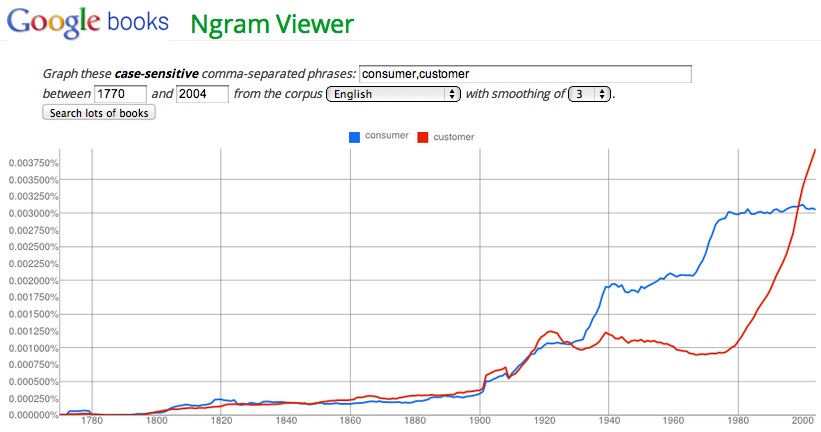
    Out in the marketplace — that place where we do business as buyers and sellers — what and who are we, as individuals? Here’s a graphic that might help frame the what question:

    Consumer vs. Customer ngram

    It’s a Google Ngram that plots the prevalence of two terms — consumer and customer — in books between 1770 and 2004.

    I suspect that the first little bump followed publication of Adam Smith’s The Wealth of Nations, in 1776. The words consumer and consumers in sum appear forty-nine times in his text. The word customer appears four times. (Thanks to the Library of Economics and Liberty for making those searches possible.) Yet the two terms were used in about equal amounts through subsequent books, until the early 1930s, which was when mass marketing (with the help of broadcasting) began to prevail — and with it the sense that the masses, now generally called “consumers” were the populations that mattered. The term “customer” began to fall off for awhile there.

    Things turned positive for customer in the mid-1990s, I suspect because the Internet and e-commerce showed up and got huge.

    But both words are still with us, and are still usually used interchangeably.

    Yet they do mean different things, and we should pull them apart.

    Take Google, Facebook and Twitter, for example. Those companys’ consumers and customers are different populations. The consumers are the users. The customers are the advertisers. In fact, our consumption is what’s sold to advertisers. “If it’s free, then you’re the product,” the saying goes. It’s not exactly right, but it’s close enough to make some points, one of which is that your influence on those companies is far less than it would be if you were paying for services rather than merely using (or consuming) them.

    On the who side, it helps to start with this fact: out in the brick-and-mortar marketplace, we are by default anonymous most of the time. That is, nameless. As it says in the Free Dictionary,

    a·non·y·mous  (-nn-ms)

    adj.

    1. Having an unknown or unacknowledged name: an anonymous author.
    2. Having an unknown or withheld authorship or agency: an anonymous letter; an anonymous phone call.
    3. Having no distinctive character or recognition factor: “a very great, almost anonymous center of people who just want peace” (Alan Paton).

    [From Late Latin annymus, from Greek annumosnameless : an-without; see a-1 + onumaname (influenced by earlier nnumnos,nameless); see n-men- in Indo-European roots.]

    When we go into a store to buy a shirt or a screwdriver, or when we buy a meal at a restaurant, we usually don’t say “Hi, I’m Jill, I’ll be buying here today,” and the person serving us usually doesn’t call us by name, even after we’ve handed them a credit card.

    In fact, the default protocol for merchants is to not to give special attention to the name on a credit card, because that card is for use in a payment protocol, not a social one.

    Thus we tend to use names only when we need them, for example when the person behind the cash register at Starbucks needs to write a name on the paper coffee cup handed to the barista after you give your order. Or when we get into serious dealings, such as when we’re buying a car, and a personal relationship is required.

    Note that when we do name ourselves, we’re the ones doing the naming. We don’t say, “Hi, the DMV calls me Paul,” or “The IRS calls me Cheryl.” We say, “I’m (whatever I choose to call myself).” The vector of identification goes outward from the self. The sovereign that matters, the one with sole volition, is the human self. Not an administrative entity. And not society, either. (Not unless we are a celebrity — meaning a person whose name and face are known to countless strangers, and who is therefore nonymous by default. Whether by intent or circumstance, the fact remains that celebrity is by nature a Faustian trade: anonymity is the price paid for fame. And it’s a high one. Even in polite places like Santa Barbara, where celebrities can wander about with a low risk of being bothered by strangers, people still notice. One is not anonymous.)

    There is a distinction here too, and it is between what Moxy Tongue describes as one’s sovereign source and one’s administrative identities. One is ours, and the other isn’t. Put another way, one is human, and the other is calf-cow. In the latter we are the calves, and we are what the cows call us. I’ve written about this before; but the difference this time is that we’ll be gathering to talk about it, along with many other related subjects, at IIW, the Internet Identity Workshop, which runs Tuesday-Thursday of this week. Let’s pick up the discussion then. Moxy himself will be there to help lead the way.

    Is there a connection between the customer/consumer distinction and the sovereign source/administrative one? That is, between what we are and who we are? Put them together and there’s a lot more to talk about. I believe there is much more autonomy and power to claim for ourselves — for the good of the whole marketplace — if we come to a broad understanding here.


  • Lives and times

    Music was a huge part of my life when I was growing up. It’s still big, but not the same. My life today does not have a soundtrack. As a kid my life was accompanied by music from start to finish. At that finish was another start, as a grown-up. From that point forward, music was less of a soundtrack and more of a break from conversations and silence, and a devotion of its own. The transition was not a sharp one, but rather a growing independence from music radio. Accompanying me the whole way, though I hardly knew it, was Carole King.

    She was the composer behind dozens of songs I still hum or sing along to. She wrote or co-wrote 118 Billboard top 100 songs, between 1955 and 1999.  Though I always enjoyed her music and appreciated her talent, I hadn’t thought much about why they were appealing before listening this morning to this Fresh Air interview with Terry Gross (who, it turns out, was a neighbor of Carole’s when they were both growing up in Brooklyn). When I heard that some old videos of Carole had leaked out on YouTube, I went there and was blown away by this performance of Chains, a hit she and Jerry Goffin wrote for the Cookies, which was then Little Eva‘s back-up group.

    What you see on that video is pure fun. The song is a simple one, almost a throw-away. But the energy is amazing. Watching and listening to that performance, it’s hard not to fall in love with her. The Carole King I got to know through Tapestry, and other mature works, was more seasoned and complete. But what I see here is something I also realized I knew all along: that her work was also play.

    I’m also sold on her memoir, A Natural Woman. Looking forward to checking it out.

  • At last

    Amazon is now shipping my new book, The Intention Economy. Yes, the Kindle version too. They even have the first chapter available for free. You can “look inside” as well.

    Thanks to Amazon’s search, you can even find stuff that’s not in the index, such as the acknowledgements. Those include a lot of people, including everybody who has ever been active on the ProjectVRM list.

    The book isn’t for me. It’s for customers. All customers, that is. Not just the ones buying the book. The first paragraph of the Introduction explains,

    This book stands with the customer. This is out of necessity, not sympathy. Over the coming years customers will be emancipated from systems built to control them. They will become free and independent actors in the marketplace, equipped to tell vendors what they want, how they want it, where and when—even how much they’d like to pay—outside of any vendor’s system of customer control. Customers will be able to form and break relationships with vendors, on customers’ own terms, and not just on the take-it-or-leave-it terms that have been pro forma since Industry won the Industrial Revolution.

    That’s what the VRM development community has been working toward since I launched ProjectVRM at the Berkman Center in 2006. Now that community is getting kinda large. Here at the European Identity and Cloud Conference (#EIC12) in Munich, I have met or learned about a bunch of VRM developers I hadn’t known  before. Pretty soon I won’t be able to keep up, and that’s a good thing.

    The book has four main parts:

    1. Customer Captivity
    2. The Networked Marketplace
    3. The Liberated Customer
    4. The Liberated Vendor

    In a way it follows up on work begun with The Cluetrain Manifesto. The subtitle there was The End of Business as Usual. The subhead for The Intention Economy is When Customers Take Charge. Hey, when one thing ends, another must begin. This is it.

    We’re not there yet. If The Intention Economy speeds things up, it will do its job.


  • Aerial map mashing

    Newtown Creek

    Thanks to Jeff Warren (also here) of GrassRootsMapping and  Public Laboratory, I now know — and am highly turned on by — the possibilities of mapping in the wild. That is, mapping by the 99.xxx+% of us who are not in the mapping business, and are in the best multiple positions to map the world(s) in four running dimensions.

    Check Jeff’s latest post at MapKnitter for what extra good can come from the series of shots I took of New York from altitude recently, and blogged about here. Pretty damn cool.

    The thought now of what can be done with my many thousands of aerial photos is both exhiliarating and daunting. Fortunately, the work won’t be just mine — or any one person’s. And that’s what’s most cool about it.

  • Portraits of New York from altitude

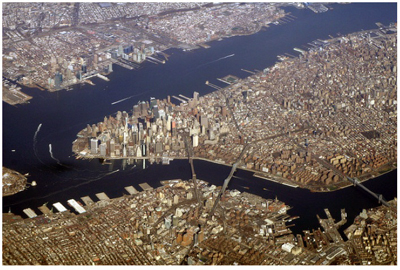
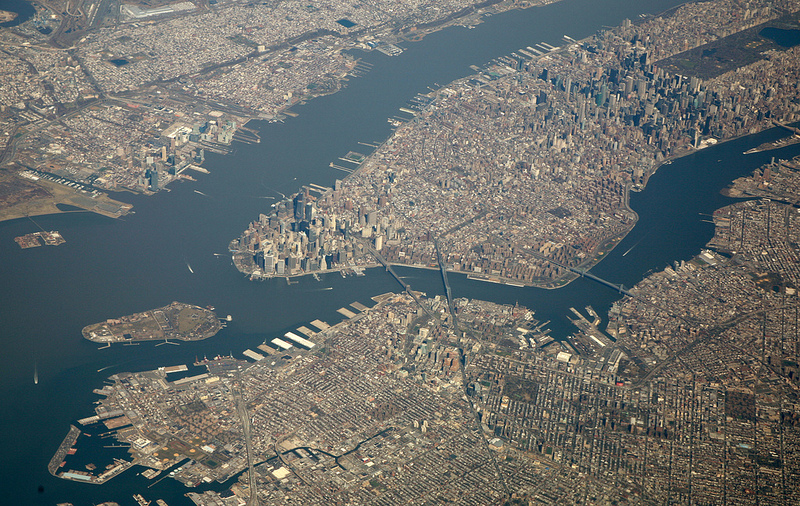
    On my way back from SXSW a couple weeks ago, I got some terrific shots of many things, including portions of Arkansas, Tennessee, Kentucky (including mountaintop mining), Virginia, Washington, D.C., Baltimore, Philadelphia, Trenton and Providence.

    Most of those aren’t uploaded yet, but I just put up the best of the bunch: this series of New York, with adjacent parts of New Jersey. The day wasn’t quite as clear as the pictures suggest, so I enhanced them a bit. But I love the detailed view they provide of what the David Letterman Show calls “the greatest city in the world.” It will always be home for me. Even though I’m from the Jersey side of “the rivva,” I was born, and grew up, closer to midtown than parts of all the other boroughs.

  • NCAA basketball is now officially the NBA’s farm system

    I enjoyed watching the Kentucky-Kansas NCAA Championship game last night, but not nearly as much as I have earlier finals, such as the Butler-Duke game two years ago. That game was in doubt even during the final second, when Gordon Hayward came inches away from winning it for Butler with a 45-foot shot released microseconds before the buzzer.

    Here’s the difference. Duke-Butler was a college basketball game. The stars were college players, most of which might have had NBA fantasies, but only four of which were drafted: Gordon Hayward, Shelvin Mack, Lance Thomas and Kyle Singler. Three still play in the NBA. Singler plays in Europe. Of the NBA players, only Hayward is a starter. [Later… see corrections in the comments below.]

    The Kansas-Kentucky final was a pro game. By that I mean that the game showcased a lot of future NBA talent. “What I’m hoping is there’s six first-rounders on this team.” Kentucky coach John Calipari told the LA Times. “We were the first program to have five, let’s have six.” On the Kansas side, there’s Thomas Robinson for sure. Others likely to be drafted, when available, are Jeff Withey and Elijah Johnson. Another way of looking at it: Kansas-Kentucky was a college-pro game. Kansas was the college team, and Kentucky was the pro team.

    But still, all the perennial high-seed college teams — including Kansas — have become showcases for NBA-bound talent. UNC, which many (including President Obama) expected to win it all this year, just saw three of their starters declare for the NBA draft. Last year’s top draft pick was Kyrie Irving, who played less than one year for Duke (he was injured some of the time). Austin Rivers, a freshman star at Duke this year, has also just declared for the NBA draft.

    Part of me wants to believe that every great team takes years to assemble, even given the yearly attrition of talented underclassmen and graduating seniors. Yet the Kentucky team that won the championship this year was a very tight, well-coached and utterly unselfish team. They played some of the best team defense I’ve ever seen. I’d bet that John Calipari could put together an all-freshman team and get more than 30 wins in a season. Of course talent is required, but so is coaching, and a program that’s geared for one-and-done players prepping for their NBA careers by putting in a year at Kentucky. Even though most of those players won’t last, even if they do get drafted.

    The 2012 Early Entry List at NBAdraft.net tells a story by itself. A handful of the the 107 players listed there will make it in the NBA. And that makes the unspoken sub-story of the tournament even more poignant. The Onion, as usual, surfaces those stories, with Totally Predictable Ending To Wild NCAA Tournament Prepares Student-Athletes For The Rest Of Their Miserable, Ho-Hum Lives and Nation Abuzz With Prospect Of 18-Year-Old Boys Having Their Dreams Crushed.

    Which means that the NIT is now the only true college tournament, because — being comprised of teams that couldn’t make the NCAA playoff cut — they feature few future NBA players. Stanford won this year, and none of its players are on NBAdraft.net’s list.

    I’m not wringing my hands over this. Only pointing out a fact that just became clearer.

  • Why the new iPad screen is the future of display

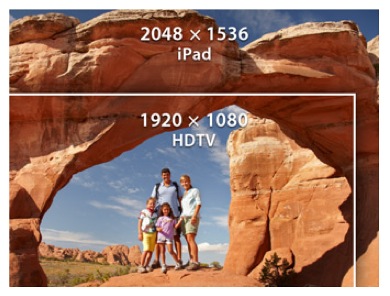
    1920x1080While everybody else is stuck in 1080p — aka “full HD” — Apple is thinking and developing on a bigger canvas than that — starting with the new iPad‘s 2048 x 1536 screen. They are always looking to move standard usage forward by large steps (where they change the whole market and win big in the process), and you can bet they’re doing that again with display. The iPad display won’t be the last Apple one to break out of the 1080p mold.

    For a snapshot of where we are now, go shop for a computer monitor . Most of what you’ll find is 1920 x 1080: the dimensions of HDTV, and the continued embodiment of ATSC standards for TV that were adopted in the early 1990s in anticipation of the fully digital age. That age is now here, and in the process TV is getting slowly absorbed into the Internet. So, at this point in history, your computer monitor can be your TV, and vice versa. Digital movie production is also now standardized on 1080p24 (24 frames per second) standard. So it looks like everything is settled, right? Well, I am sure Steve Jobs and friends looked at that situation several years ago and saw “stuck” instead of “settled.” The new iPad is the first clear clue that this was the case.

    In the long roster of display resolutions, the iPad’s dimensions are QXGA, which is among the breed of 3×4 resolutions. 1080p is 16×9. What matters here, however, isn’t the standard being used, or the dimensions, but breaking out of a currently defaulted (or stuck) mode.

    The main question for me is whether or not Apple will succeed in building a walled garden for everything new that breaks out of the old 1080p mold. I doubt they’ll succeed, but I’ll bet they’ll try.

    (Oh, and in case you doubt my prophetic powers regarding Apple, check out what I wrote to Dave Winer in 1997.)

  • A small market fail

    Airport wi-fi isn’t the biggest business, or the smallest. I’m not even sure it’s a discrete category. Some of it is a phone company side business (T-mobile, AT&T). Some of it is a business in itself (Boingo). Some of it is just a supply of overhead to airports or lounges that want to provide free wi-fi or to charge for access under their own brand.

    Here in Boston, Logan Airport has a complicated thing where you have a choice of many for-pay access options, or free access if you jump over a small hurdle. For my phone it was watching a video that the phone wouldn’t play. But at least the Web page said “If the video doesn’t run, click here to connect.” I did and it worked. But it was not so easy on my computer, where it provided a choice of watching the video or answering a survey. The video, an ad for BMW that has been running for months (I fly a lot out of here), was followed by a page with an error code. I closed the window, re-started the browser and did the survey. Same result. So I changed browsers. This time there was just a video, provided by HP, and “powered by AWG” it said. I muted the sound and watched the video, which promoted an HP netbook. Without the sound the ad was fairly worthless. More interesting was the countdown to the connection, which ran above the ad. After running from 30 seconds to zero, I got a page with a big spinning wheel that ran and ran. Another fail.

    Then I saw there’s an access point called AWGwifi and tried that. It failed too.

    Meanwhile here at the United Club, the T-Mobile access they’ve provided for many years also failed as soon as I clicked on the link for club members. Of course the people behind the desk are not in charge of that. All they can do is report the problem, which I guess is one of the many that have come up through the long slow merger between United and Continental.

    So I’m getting on through my phone’s 3G data plan. But I won’t be uploading the photos I had wanted to, because I don’t want to hit a cost jump if I go over my monthly allotment of bits.

    The best airport wifi system I’ve seen so far is the one at the Continental club, and a few scattered airports I don’t recall: the wi-fi just works. It’s open, free and requires no logging in or going through a promotional gauntlet. Maybe that’s not “secure,” but are any of these paid systems secure either? One can be a bad actor over any of them.

    I would think there is a market opportunity here for a creative approach — one that might be paid but doesn’t require becoming a member of something. Making it possible to just get on the Net with no hassle and no promotional BS would make a lot of travelers happy.

  • Abate and switch

    Newspapers got off on the wrong foot when they started publishing on the Web, by giving away what was valuable on the newsstand, and charging for last year’s fishwrap. That is, they gave away the news and charged for the olds.

    This was understandable, because the papers wanted to participate in this new Web thing, which was very live and now and all that; and the Joneses they needed to keep up with were mostly doing the same thing. And, since selling archives had been a business all along — though not a very big one — they stuck with charging $2.95 or $3.95 for, say, a sports story from 1973.

    Now the big papers, led by the The New York Times, are charging for at least some of the news in their digital versions, but also still charging for the old stuff. So they’re not quite charging for the news and giving away the olds (as I recommended back in 2006), but they seem to be moving slowly in that direction. More about that later. What I’d rather talk about first is their bait-and-switch game. It’s not bait-and-switch by the letter of the law, but the spirit is there, because the true costs are hidden.

    Today, for example, the Times announced it will be cutting in half the number of articles readers on the Web can view for free in a given month, starting on April Fools Day. The old number was twenty. The new one is ten. Specifics for non-subscribers:

    • Get 10 articles each month on NYTimes.com, as well as access to the home page, section fronts, blog fronts and classifieds.
    • Articles, blog posts, slide shows, video and other multimedia will continue to count against your free monthly limit.
    • If you’ve already read your 10 free articles, you can still read our content through links from Facebook, Twitter, search engines and blogs.

    Digital subscribers will —

    • Enjoy unlimited access to the full range of reporting from the world’s most respected journalists in their fields.
    • No limit on the number of articles, videos, blogs and more on your computer, smartphone or tablet.
    • Access to 100 Archive articles every four weeks.
    • Access to Election 2012, our exclusive politics app for iPhone and Android as well as The Collection, our fashion app for iPad — depending on the subscription you choose.

    Home subscribers get free digital access.

    The boldest print on that same page says “pay just 99¢ for your first 4 weeks.” That’s your bait. Below that it says “subscription options,” which links to this page here. Nowhere on either page does it say what happens after those first four weeks. For that info you need to select a button next to one of the three 99¢ choices, then click on the “GET UNLIMITED ACCESS” button. This takes you to the order page where you enter your credit card info. There it also says,

    TRY IT TODAY FOR JUST $0.99  NYTimes: All Digital Access Unlimited access to NYTimes.com, and the NYTimes smartphone and tablet apps.* $0.99 for your first 4 weeks ($8.75 / week thereafter)

    The asterisk is unpacked at the bottom of the page, where the it says,

    Your order (applicable taxes may be added)
    First 4 Weeks $0.99
    Thereafter $35.00 every 4 weeks

    So the real price is about $455 per year, after that first month. (Math: $8.75 x 52 weeks.) It’s an old game, and lots of sellers play it, but it’s still icky. If the Times is bold enough to be blunt about the value it’s subtracting from its free product, why not be bold enough to say the price goes up $35.01 after the first $.99?

    Maybe because they’ve had that same pitch for awhile, and it’s working fine. In this Poynter storyAndrew Beaujon writes, “The New York Times Media Group says it has ‘approximately 454,000 paid subscribers’ to its digital products.” That comes to about $206,570,000 per year, after the first month. Pretty good. I have no problem with that, if the market bears the cost, which it seems to be doing. And maybe now more subscribers will get tired of being cut off after 10 views, or using multiple browsers to get around the limit a bit.

    But why keep charging for the old stuff — especially the really old stuff? Wouldn’t it be a Good Thing make all of it easily reachable?

    Well, they do, to some degree. Here are the details from the Times‘ digital archive page:

    Accessing and Purchasing Articles

    Digital Subscribers:

    • — 1923–1986: Your digital subscription includes 100 archive articles every four weeks in this date range (from January 1, 1923 through December 31, 1986). After you’ve reached the 100-article limit for the month, articles from 1923 through 1986 are $3.95 each.
    • — Pre-1923 and post-1986: Articles published before January 1, 1923 or after December 31, 1986 are free with your digital subscription and are not limited in any way.

    Learn more about digital subscriptions »

    Nonsubscribers:

    • — 1923–1986: Articles in this date range (from January 1, 1923 through December 31, 1986) are available for purchase at $3.95 each.
    • — Pre-1923 and post-1986: Articles published before January 1, 1923 or after December 31, 1986 are free, but they count toward your monthly limit.

    Learn more about your monthly limit as a nonsubscriber »

    I don’t know how much the Times makes on $3.95/article for the 1923-1986 time frame, but I suspect it’s not much. Why not make everything before (pick a date) free, each with a permanent link? This would throw off many scholastic, cultural and economic benefits. On the economic front, it would draw more inbound traffic to the Times‘ site, with lots of opportunities to advertise to visitors. In fact, I’ll bet the paper would make more off advertising to traffic arriving at archived articles than it makes off those $3.95 purchases.

    But, maybe I’m wrong. Corrections welcome.

    In any case, I’m not yet in the market. I love the Times, and often buy it on the newsstand. But $455 per year is steep for me. Plus, I’m already paying the Times‘ parent company for my printed copies of the Boston Globe. I’d like to read the digital edition of that too, because it’s free for print subscribers; but the login/password thing has yet to work for me.

    Off the top of my head, here are some other paid subscriptions around here:

    • Consumer Reports
    • The Wall Street Journal (both print and online)
    • Forbes
    • Fortune
    • Bloomberg BusinessWeek
    • The Economist
    • Vanity Fair
    • Vogue
    • The Sun
    • The New Yorker
    • Linux Journal (which I get free, actually, because I write for it)

    All but The Sun have digital editions, and I read those as well. The only one I don’t read digitally, so far, is the Globe. I’ll try to fix that again tomorrow and see where it goes. I’ll let you know.

    Meanwhile, I urge all those pubs to make the old stuff free on the open Web, while we still have one. It’ll help.