• Aurora time!

    The storm is hitting right now:

    Remember that auroras can be a thousand miles high. So even if they’re over Canada, they can still be visible in the upper part of the lower U.S. 48. Or even sometimes south of there.

    And maybe that’s a better place to be, since it stays light up there overnight this time of year. Not so down here.

    I’m going to go out and  check now. Here in Boston the light pollution is so strong it’ll be hard to spot. The moon won’t help either. Still, worth a try. Those in upper Midwest, prairie and mountain states… doesn’t look here like there’s much cloud cover. So looking might work well for you. Worth a try.

  • Why we have Silicon Valley

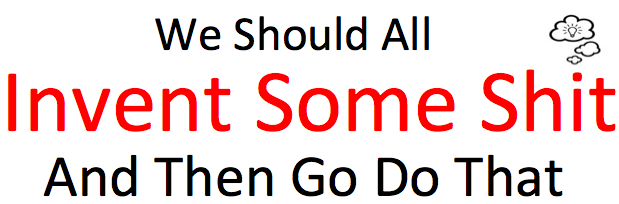
    My son remembers what I say better than I do. One example is this:

    I uttered it in some context while wheezing my way up a slope somewhere in the Reservation.

    Except it wasn’t there. Also I didn’t say that. Exactly. Or alone. He tells me it came up while we were walking across after getting some hang time after Mass at the . He just told me the preceding while looking over my shoulder at what I’m writing. He also explains that the above is compressed from dialog between the two of us, at the end of which he said it should be a bumper sticker, which he later designed, sent to me and you see above.

    What I recall about the exchange, incompletely (as all recall is, thanks to the graces and curses of short term memory), is that I was thinking about the imperatives of invention, and why my nature is native to Silicon Valley, which exists everywhere ideas and ambition combine and catch fire.

  • Checking in, 16.5 years later

    I fired up Searls.com in early 1995, and began publishing on it immediately. A lot of that writing is at a subdomain called Reality 2.0. Here is one piece from that early list, which I put up just days before Bill Gates’ famously (at the time) “declared war” on the browser market (essentially, Netscape). Interesting to look back on what happened and what didn’t. — Doc


    THE WEB
    AND THE NEW REALITY
    By Doc Searls
    December 1, 1995 

    Contents


    Reality 2.0

    The import of the Internet is so obvious and extreme that it actually defies valuation: witness the stock market, which values Netscape so far above that company’s real assets and earnings that its P/E ratio verges on the infinite.

    Whatever we’re driving toward, it is very different from anchoring certainties that have grounded us for generations, if not for the duration of our species. It seems we are on the cusp of a new and radically different reality. Let’s call it Reality 2.0.

    The label has a millenial quality, and a technical one as well. If Reality 2.0 is Reality 2.000, this month we’re in Reality 1.995.12.

    With only a few revisions left before Reality 2.0 arrives, we’re in a good position to start seeing what awaits. Here are just a few of the things this writer is starting to see…

    1. As more customers come into direct contact with suppliers, markets for suppliers will change from target populationsto conversations.
    2. Travel, ticket, advertising and PR agencies will all find new ways to add value, or they will be subtracted from market relationships that no longer require them.
    3. Within companies, marketing communications will change from peripheral activities to core competencies.New media will flourish on the Web, and old media will learn to live with the Web and take advantage of it.
    4. Retail space will complement cyber space. Customer and technical service will change dramatically, as 800 numbers yield to URLs and hard copy documents yield to soft copy versions of the same thing… but in browsable, searchable forms.
    5. Shipping services of all kinds will bloom. So will fulfillment services. So will ticket and entertainment sales services.
    6. The web’s search engines will become the new yellow pages for the whole world. Your fingers will still do the walking, but they won’t get stained with ink. Same goes for the white pages. Also the blue ones.
    7. The scope of the first person plural will enlarge to include the whole world. “We” may mean everybody on the globe, or any coherent group that inhabits it, regardless of location. Each of us will swing from group to group like monkeys through trees.
    8. National borders will change from barricades and toll booths into speed bumps and welcome mats.
    9. The game will be over for what teacher John Taylor Gatto labels “the narcotic we call television.” Also for the industrial relic of compulsory education. Both will be as dead as the mainframe business. In other words: still trucking, but not as the anchoring norms they used to be.
    10. Big Business will become as anachronistic as Big Government, because institutional mass will lose leverage without losing inertia.Domination will fail where partnering succeeds, simply because partners with positive sums will combine to outproduce winners and losers with zero sums.
    11. Right will make might.
    12. And might will be mighty different.

    Polyopoly

    The Web is the board for a new game Phil Salin called “Polyopoly.” As Phil described it, Polyopoly is the opposite of Monopoly. The idea is not to win a fight over scarce real estate, but to create a farmer’s market for the boundless fruits of the human mind.

    It’s too bad Phil didn’t live to see the web become what he (before anyone, I believe) hoped to create with AMIX: “the first efficient marketplace for information.” The result of such a marketplace, Phil said, would be polyopoly.

    In Monopoly, what mattered were the three Ls of real estate: “location, location and location.”

    On the web, location means almost squat.

    What matters on the web are the three Cs: contentconnections and convenience. These are what make your home page a door the world beats a path to when it looks for the better mouse trap that only you sell. They give your webfront estate its real value.

    If commercial interests have their way with the Web, we can also add a fourth C: cost. But how high can costs go in a polyopolistic economy? Not very. Because polyopoly creates…

    An economy of abundance

    The goods of Polyopoly and Monopoly are as different as love and lug nuts. Information is made by minds, not factories; and it tends to make itself abundant, not scarce. Moreover, scarce information tends to be worthless information.

    Information may be bankable, but traditional banking, which secures and contains scarce commodities (or their numerical representations) does not respect the nature of information.

    Because information abhors scarcity. It loves to reproduce, to travel, to multiply. Its natural habitats are wires and airwaves and disks and CDs and forums and books and magazines and web pages and hot links and chats over cappuccinos at Starbucks. This nature lends itself to polyopoly.

    Polyopoly’s rules are hard to figure because the economy we are building with it is still new, and our vocabulary for describing it is sparse.

    This is why we march into the Information Age hobbled by industrial metaphors. The “information highway” is one example. Here we use the language of freight forwarding to describe the movement of music, love, gossip, jokes, ideas and other communicable forms of knowledge that grow and change as they move from mind to mind.

    We can at least say that knowledge, even in its communicable forms, is not reducible to data. Nor is the stuff we call “intellectual property.” A song and a bank account do not propagate the same ways. But we are inclined to say they do (and should), because we describe both with the same industrial terms.

    All of which is why there is no more important work in this new economy than coining the new terms we use to describe it.

    The Age of Enlightenment finally arrives

    The best place to start looking for help is at the dawn of the Industrial Age. Because this was when the Age of Reason began. Nobody knew more about the polyopoly game — or played it — better than those champions of reason from whose thinking our modern republics are derived: Thomas Paine, Thomas Jefferson and Benjamin Franklin.

    As Jon Katz says in “The Age of Paine” (Wired, May 1995 ), Thomas Paine was the the “moral father of the Internet.” Paine said “my country is the world,” and sought as little compensation as possible for his work, because he wanted it to be inexpensive and widely read. Paine’s thinking still shapes the politics of the U.S., England and France, all of which he called home.

    Thomas Jefferson wrote the first rule of Polyopoly: “He who receives an idea from me receives instruction himself without lessening mine; as he who lights his taper at mine, receives light without darkening me.”

    He also left a live bomb for modern intellectual property law: “Inventions then cannot, in nature, be a subject of property.” The best look at the burning fuse is John Perry Barlow’s excellent essay “The Economy of Ideas,” in the March 1994 issue of Wired. (I see that Jon Katz repeats it in his paean to Paine. Hey, if someone puts it to song, who gets the rights?)

    If Paine was the moral father of the Internet, Ben Franklin’s paternity is apparent in Silicon Valley. Today he’d fit right in, inventing hot products, surfing the Web and spreading his wit and wisdom like a Johnny Cyberseed. Hell, he even has the right haircut.

    Franklin left school at 10 and was barely 15 when he ran his brother’s newspaper, writing most of its content and getting quoted all over Boston. He was a self-taught scientist and inventor while still working as a writer and publisher. He also found time to discover electricity, create the world’s first postal service, invent a heap of handy products and serve as a politician and diplomat.

    Franklin’s biggest obsession was time. He scheduled and planned constantly. He even wrote his famous epitaph when he was 22, six decades before he died. “The work shall not be lost,” it reads, “for it will (as he believed) appear once more in a new and more elegant edition, revised and edited by the author.”

    One feels the ghost of Franklin today, editing the web.

    Time to subtract the garbage

    Combine Jefferson and Franklin and you get the two magnetic poles that tug at every polyopoly player: information that only gets more abundant, and time that only gets more scarce.

    As Alain Couder of Groupe Bull puts it, “we treat time as a constant in all these formulas — revolutions per minute, instructions per second — yet we experience time as something that constantly decreases.”

    After all, we’re born with an unknown sum of time, and we need to spend it all before we die. The notion of “saving” it is absurd. Time can only be spent.

    So: to play Polyopoly well, we need to waste as little time as possible. This is not easy in a world where the sum of information verges on the infinite.

    Which is why I think Esther Dyson might be our best polyopoly player.

    “There’s too much noise out there anyway,” she says in ‘Esther Dyson on DaveNet‘ (12/1/94). “The new wave is not value added, it’s garbage-subtracted.”

    Here’s a measure of how much garbage she subtracts from her own life: her apartment doesn’t even have a phone.

    Can she play this game, or what?

    So what’s left?

    I wouldn’t bother to ask Esther if she watches television, or listens to the radio. I wouldn’t ask my wife, either. To her, television is exactly what Fred Allen called it forty years ago: “chewing gum for the eyes.” Ours heats up only for natural disasters and San Jose Sharks games.

    Dean Landsman, a sharp media observer from the broadcast industry, tells me that John Gresham books are cutting into time that readers would otherwise spend watching television. And that’s just the beginning of a tide that will swell as every medium’s clients weigh more carefully what they do with their time.

    Which is why it won’t be long before those clients wad up their television time and stick it under their computer. “Media will eat media,” Dean says.

    The computer is looking a lot hungrier than the rest of the devices out there. Next to connected computing, television is AM radio.

    Fasten your seat belts.

    Web of the free, home of the Huns

    Think of the Industrial world — the world of Big Business and Big Government — as a modern Roman Empire.

    Now think of Bill Gates as Attilla the Hun.

    Because that’s exactly how Bill looks to the Romans who still see the web, and everything else in the world, as a monopoly board. No wonder Bill doesn’t have a senator in his pocket (as Mark Stahlman told us in ‘Off to the Slaughter House,’ (DaveNet, 3/14/94).

    Sadly for the the Romans, their empire is inhabited almost entirely by Huns, all working away on their PCs. Most of those Huns don’t have a problem with Bill. After all, Bill does a fine job of empowering his people, and they keep electing him with their checkbooks, credit cards and purchase orders.

    Which is why, when they go forth to tame the web, these tough-talking Captains of Industry and Leaders of Government look like animated mannequins in Armani Suits: clothes with no emperor. Their content is emulation. They drone about serving customers and building architectures and setting standards and being open and competing on level playing fields. But their game is still control, no matter what else they call it.

    Bill may be our emperor, but ruling Huns is not the same as ruling Romans. You have to be naked as a fetus and nearly as innocent. Because polyopoly does not reward the dark tricks that used to work for industry, government and organized crime. Those tricks worked in a world where darkness had leverage, where you could fool some of the people some of the time, and that was enough.

    But polyopoly is a positive-sum game. Its goods are not produced by huge industries that control the world, but by smart industries that enable the world’s inhabitants. Like the PC business that thrives on it, information grows up from individuals, not down from institutions. Its economy thrives on abundance rather than scarcity. Success goes to enablers, not controllers. And you don’t enable people by fooling them. Or by manipulating them. Or by muscling them.

    In fact, you don’t even play to win. As Craig Burton of The Burton Group puts it, “the goal isn’t win/win, it’s play/play.”

    This is why Bill does not “control” his Huns the way IBM controlled its Romans. Microsoft plays by winning support, where IBM won by dominating the play. Just because Microsoft now holds a controlling position does not mean that a controlling mentality got them there. What I’ve seen from IBM and Apple looks far more Monopoly-minded and controlling than anything I’ve seen from Microsoft.

    Does this mean that Bill’s manners aren’t a bit Roman at times? No. Just that the support Microsoft enjoys is a lot more voluntary on the part of its customers, users and partners. It also means that Microsoft has succeeded by playing Polyopoly extremely well. When it tries to play Monopoly instead, the Huns don’t like it. Bill doesn’t need the Feds to tell him when that happens. The Huns tell him soon enough.

    market is a conversation

    No matter how Roman Bill’s fantasies might become, he knows his position is hardly more substantial than a conversation. In fact, it IS a conversation.

    I would bet that Microsoft is engaged in more conversations, more of the time, with more customers and partners, than any other company in the world. Like or hate their work, the company connects. I submit that this, as much as anything else, accounts for its success.

    In the Industrial Age, a market was a target population. Goods rolled down a “value chain” that worked like a conveyor belt. Raw materials rolled into one end and finished products rolled out the other. Customers bought the product or didn’t, and customer feedback was limited mostly to the money it spent.

    To encourage customer spending, “messages” were “targeted” at populations, through advertising, PR and other activities. The main purpose of these one-way communications was to stimulate sales. That model is obsolete. What works best to day is what Normann & Ramirez (Harvard Business Review, June/July 1993) call a “value constellation” of relationships that include customers, partners, suppliers, resellers, consultants, contractors and all kinds of people.

    The Web is the star field within which constellations of companies, products and markets gather themselves. And what binds them together, in each case, are conversations.

    How it all adds up

    What we’re creating here is a new economy — an information economy.

    Behind the marble columns of big business and big government, this new economy stands in the lobby like a big black slab. The primates who work behind those columns don’t know what this thing is, but they do know it’s important and good to own. The problem is, they can’t own it. Nobody can. Because it defies the core value in all economies based on physical goods: scarcity.

    Scarcity ruled the stone hearts and metal souls of every zero-sum value system that ever worked — usually by producing equal quantities of gold and gore. And for dozens of millennia, we suffered with it. If Tribe A crushed Tribe B, it was too bad for Tribe B. Victors got the spoils.

    This win/lose model has been in decline for some time. Victors who used to get spoils now just get responsibilities. Cooperation and partnership are now more productive than competition and domination. Why bomb your enemy when you can get him on the phone and do business with him? Why take sides when the members of “us” and “them” constantly change?

    The hard evidence is starting to come in. A recent Wharton Impact report said, “Firms which specified their objectives as ‘beating our competitors’ or ‘gaining market share’ earned substantially lower profits over the period.” We’re reading stories about women-owned businesses doing better, on the whole, because women are better at communicating and less inclined to waste energy by playing sports and war games in their marketplaces.

    From the customer’s perspective, what we call “competition” is really a form of cooperation that produces abundant choices. Markets are created by addition and multiplication, not just by subtraction and division.

    In my old Mac IIci, I can see chips and components from at least 11 different companies and 8 different countries. Is this evidence of war among Apple’s suppliers? Do component vendors succeed by killing each other and limiting choices for their customers? Did Apple’s engineers say, “Gee, let’s help Hitachi kill Philips on this one?” Were they cheering for one “side” or another? The answer should be obvious.

    But it isn’t, for two reasons. One is that the “Dominator Model,” as anthropologist (and holocaust survivor) Riane Eisler calls it, has been around for 20,000 years, and until recently has reliably produced spoils for victors. The other is that conflict always makes great copy. To see how seductive conflict-based thinking is, try to find a hot business story that isn’t filled with sports and war metaphors. It isn’t easy.

    Bound by the language of conflict, most of us still believe that free enterprise runs on competition between “sides” driven by urges to dominate, and that the interests of those “sides” are naturally opposed.

    To get to the truth here, just ask this: which has produced more — the U.S. vs. Japan, or the U.S. + Japan? One produced World War II and a lot of bad news. The other produced countless marvels — from cars to consumer electronics — on which the whole world depends.

    Now ask this: which has produced more — Apple vs. Microsoft or Apple + Microsoft? One profited nobody but the lawyers, and the other gave us personal computing as we know it today.

    The Plus Paradigm

    What brings us to Reality 2.0 is the Plus Paradigm.

    The Plus Paradigm says that our world is a positive construction, and that the best games produce positive sums for everybody. It recognizes the power of information and the value of abundance. (Think about it: the best information may have the highest power to abound, and its value may vary as the inverse of its scarcity.)

    Over the last several years, mostly through discussions with client companies that are struggling with changes that invalidate long-held assumptions, I have built table of old (Reality 1.0) vs. new (Reality 2.0) paradigms. The difference between these two realities, one client remarked, is that the paradigm on the right is starting to work better than the paradigm on the left.

    Paradigm Reality 1.0 Reality 2.0
    Means to ends Domination Partnership
    Cause of progress Competition Collaboration
    Center of interest Personal Social
    Concept of systems Closed Open
    Dynamic Win/Lose Play/Play
    Roles Victor/Victim Partner/Ally
    Primary goods Capital Information
    Source of leverage Monopoly Polyopoly
    Organization Hierarchy Flexiarchy
    Roles Victor/Victim Server/Client
    Scope of self-interest Self/Nation Self/World
    Source of power Might Right
    Source of value Scarcity Abundance
    Stage of growth Child (selfish) Adult (social)
    Reference valuables Metal, Money Life, Time
    Purpose of boundaries Protection Limitation

    Changes across the paradigms show up as positive “reality shifts.” The shift is from OR logic to AND logic, from Vs. to +:


    Reality 1.0 Reality 2.0
    man vs nature man + nature
    Labor vs management Labor + management
    Public vs private Public + private
    Men vs women Men + women
    Us vs them Us + them
    Majority vs minority Majority + minority
    Party vs party Party + party
    Urban vs rural Urban + rural
    Black vs white Black + white
    Business vs govt. Business + govt.

    The Plus Paradigm comprehends the world as a positive construction, and sees that the best games produce positive sums for everybody. It recognizes the power of information and the value of abundance. (Think about it: the best information may have the highest power to abound, and its value may vary as the inverse of its scarcity.)

    For more about this whole way of thinking, see Bernie DeKoven’s ideas about “the ME/WE” at his “virtual playground.”]

    This may sound sappy, but information works like love: when you give it away, you still get to keep it. And when you give it back, it grows.

    Which has always been the case. But in Reality 2.0, it should become a lot more obvious.

  • Music you can’t sit to

    Started listening to Bill Clark’s amazing oldies show on WATD/95.9 on the way back from dinner this evening, and continued on the Web after getting back. Talk about deep cuts. Some of those songs I hadn’t heard in 50 years, if ever. All good stuff, familiar or not.

    One tune, the name of which I missed, reminded me of two contemporary songs by young artists with roots in bed-Rock. One is Dynamo, by Si Cranstoun, who is the living incarnation of Jackie Wilson, even though he’s a young dude from the U.K. The other is North Side Gal, which you can download free at  J.D. MacPherson‘s site. Here’s J.D.’s backstory. And a review. He’s a punk veteran and former art teacher from Broken Arrow, Nebraska.  Not sure who he embodies, other than the whole of rock’s deepest geology.

    Both are happy, super-upbeat songs that demand dancing. Great, great stuff.

  • Helping one who helped our selves

    is one of the world’s truly great guys. Besides being smart, funny, caring, hard-working, a good husband and father — and pretty much all the other positive stuff you could pack into a bio, Michael was one of the first people to not only dig  , but to grok it thoroughly at every level, including the multiple ironies at all of them. And to continue doing so through all the years since.

    Like three of Cluetrain’s authors, Michael was a marketing guy who was never fully comfortable with the label or the role, and broke every mold that failed to contain him. Unlike those three, however, he continued to labor inside the business, which still needs many more like him. Because, from the start, Michael has always stood up for the the user, the customer, the individual whose reach should rightly exceed others’ grasp.

    His labors are suspended, however, while he takes on a personal battle with .

    Friends of Michael’s have put up SupportMichaelOCC.ca, so all of us who care about him and his family can easily lend support. He’s a sole breadwinner with four kids, so this is a tall order. Whether you know Michael or not, please do what you can.

    Bonus links:

  • One of the world’s great craters

    dome
    When I visited the Upheaval Dome in 1987, I was sure it was an impact crater. But roadside displays and printed literature from Canyonlands National Park said otherwise. Clearly, they reported, this was collapsed salt dome. Since then German researchers have found evidence, through shocked quartz, of an impact. That now appears to be the prevailing theory. The crater is approximately 5 km in diameter and must be Jurassic in age or younger, given the ages of the rock it hammered. From bottom to top, those rocks are:

    Navajo Sandstone also stars in Zion and Capitol Reef National Parks, in Comb Ridge, San Rafael Reef and the Red Rock country overlooking Las Vegas from the west (where it is called Aztec Sandstone). Its cross-bedding strata suggests windblown sand, which is exactly what comprises the rock. The whole formation is the fossilized remains of a Sahara that once covered much of  The West. Think of it as a fossil desert within a desert.

    So I was flying over the area last week, and got some good shots of the thing, including the one above. There are many more in that series, which stretches from Boston to San Francisco, by way of Newark. I’ll put up other segments soon, I hope.


  • Bridges covered

    My sister and I received a durable lesson in generosity in the summer of 1963, in the heart of Iowa. That was where our family’s 1957 Ford Country Sedan station wagon, towing our Nimrod pop-up camper trailer, broke down.

    It was on a Sunday morning in late June, heading south from Des Moines on I-35 when the engine made a loud bang, and there was smoke and steam everywhere. We pulled over to shoulder and sat there for a long time while the engine cooled off and the day heated up. Then we topped off the radiator with some of the water from our cache, started the car back up and knew right away that the engine was in very bad shape. Pop figured that fewer than car’s straight-six engine’s cylinders were working, and that water was leaking through the head gasket  (since steam as well as smoke and unburned gas fumes were coming out the exhaust). There was no traffic to flag down on the highway, which was still new.  So all we could do was limp on, while limping was all the car could do.

    At the top of the first exit was a sign that pointed west to St. Charles, and east to St. Mary’s. The former was closer, it said, so we turned right. We pulled up in front of a general store with some old guys on the porch out front, and asked if there was a service station nearby.

    “Deane fixes cars,” one of them said, and told us which house was Deane’s. It was down the road on the left.

    Turns out this was Deane Hoskins, a master mechanic with a complete garage in his garage. His day job was working for GM’s diesel division in Des Moines. His wife was Arlouine, a teacher like Mom. They also had a bunch of kids: Carolyn, Linda, Janet, Karen and Robert. All were friendly and eager to help. Deane told us to pull in. So Pop and I disconnected the camper, left it in the street, and went up the driveway to help Deane as best we could while he tore down the broken engine.

    At the peak of the Hoskins garage’s roof, facing down the driveway, was a thermometer in the shape of a big clock. It said 112°. Sweat poured off Deane’s nose and chin. I remember that his eyes were blue, though one was a mix of blue and brown. The whole time he talked to us about engine design, how they worked, and what they were built do do. This Ford, he explained, was built to fail.

    The policy was called “planned obsolescence,” and you could see it in the cooling tubes in the engine block, flanking the cylinders. Water cooled by the radiator flows through these tubes, keeping an engine from overheating. The pistons in the first and sixth cylinders looked fine. The ones in the second and fifth were pitted on the top. The pistons in the third and fourth cylinders had holes blown through their tops. That was because the cooling tubes flanking the third and fourth cylinders had metal plugs in them, causing the pistons to overheat and eventually fail. The plugs were the opposite of necessary, unless the necessity was a blown engine, eventually. In our case the eventuality was sixty thousand miles.

    This was a huge blow to Pop, a committed Ford Man. This wagon was the first new car he had ever bought, and it had been nothing but trouble from Day One. Even before this last failure he figured the car cost $60 per month on average to fix, and this was in 1950s dollars. It was also clear and present evidence of customer-hating corporate venality. To this day it amazes me to see nothing written about Ford’s (or anybody’s) practice of plugging an engine block’s cooling tubes. Were all of Ford’s inline-6 blocks crippled like this? Or was this an experiment by Ford with just a few engines to see what happened? How could a worker in good conscience have put the plugs in there, when the result would obviously be a short life span for the engine?

    Deane drilled out the plugged tubes, removed the bad pistons, honed out the two center cylinders, called up a friendly Ford dealer, and drove us over to pick up some new pistons and a fresh head gasket. The dealer was closed on Sunday, but opened up just for us. On the way over we went through a covered bridge, one of those later made famous by The Bridges of Madison County.

    By evening Deane had the engine back together, and the car running fine. We spent the night as the Hoskins’ house guests, and in the morning went on our way. For years Mom kept up with the Hoskins family through Arlouine. It was what moms did in those days. Mom was from a small town two states away: Napoleon, North Dakota. St. Charles and its friendly ethic was familiar to her.

    Pop’s partisan loyalties were simple and clear. Three of the biggest were to the Brooklyn Dodgers, the Ford Motor Company and the Republican Party. So this was the second time he felt betrayed. The first was when the Dodgers moved to Los Angeles. The third was Watergate.

    Leaving St. Charles on Monday morning, we drove west. In Griswold, barely bigger than St. Charles, we found a Chevy dealer. It wasn’t that Pop was suddenly a believer in Chevy, but that he had become a disbeliever in Ford. He also took Deane’s word that GM didn’t play the planned obsolescence game. There were just two new cars in the showroom: a minimal white Biscayne and a  blue Bel-Air. Pop and Mom wanted to get the Biscayne, but my sister and I talked them into getting the Bel-Air, which had a 283 v-8 rather than the Biscayne’s straight six. Better for pulling the trailer, we argued, successfully. Pop’s compromise was to make sure the car had no radio and no air conditioning. That car was almost trouble-free until the transmission went, at 125,000 miles — a lot in those days. That’s when we sold it, in 1969.

    And that’s Griswold, above. I spotted it last week while looking out the window of the plane from Newark to Los Angeles. It doesn’t look much different from above than it did on the ground forty-nine years ago. The dealer was small, with just two cars in the showroom: our Bel-Air and the Biscayne. No Impalas. I don’t remember the name, but there are no Chevy dealers in Griswold today.

    I see that Deane died in 1991 and Arlouine in 2005. And, at the second link, that Linda is also gone. But our encounter with the Hoskins family isn’t forgotten, half a century later. To me the “flyover” states are places where good people live and lucky people drive through. Turns out our bad luck in St. Charles with a bum Ford was the best thing that could have happened.


  • Tonight in Santa Clara

    … I’ll be speaking about The Intention Economy at the Hyatt Regency Santa Clara, in the Winchester Ballroom, courtesy of the good people at Weber Shandwick Here’s a link to the invite. (It’s open and free, but ya gotta RSVP.)

    The book covers a lot of topics, and the one I’m going to focus on tonight is marketing. Right now the big bux in marketing are going toward Big Data, with a lesser emphasis on Big Engagement. This needs to be reversed.

    What marketing needs to do now is get personal, and not just social. Marketing needs to start truly listening and interacting with customers on a personal level. Crunching numbers to improve guesswork. won’t cut it any more.

    I’ve got more to say about that, but I’m saving it for tonight. Look forward to seeing you there.

  • Yes, please meet the Chief Executive Customer

    Looks like IBM and I Bookare in agreement. Last week the first image you saw at IBM’s site (at least here in the U.S.) was a larger version of the one on the left, with the headline “Meet the new Chief Executive Customer. That’s who’s driving the new science of marketing.”*

    At the “learn more” link, the headline reads, “The new CMO and the science of giving people what they want.” In the copy there’s this:

    In this highly connected world of commerce and communication, you can no longer market broadly to a demographic. A consumer doesn’t want to be a “segment.” She’s an individual. To capture and keep her business, she must be treated as one.

    The onus of this evolution has landed on the doorstep of the Chief Marketing Officer. And that means that the mind-set, as well as the skill set, of a CMO has to evolve right along with it. IBM has identified the three mandates for the new CMO.

    The first of those is “Harness data to paint a predictive picture of each customer as an individual—on a massive scale.” The second is “Create ‘systems of engagement’ so you do more than shape desire—you predict it. The third is “Design your culture and brand so they are authentically one.”

    Above that last one it says this:

    Your brand is tested in every interaction. Today, the same transparency that allows you to understand each customer as an individual; conversely allows each customer to understand everything about your company. And gaps between what the brand promises and what it delivers are known―not just by those who experience them, but by others in their social network. Thus how authentically a culture lives its brand becomes the measure of success. This is the heart of becoming a social business. Marketing’s role is to close the gaps by building a system so that in every interaction brand and culture are one.

    Two problems with that. Also two opportunities:

    1. Transparency isn’t what allows a company to understand each customer as an individual. Direct interaction is. Better yet, direct interaction that the customer drives, in her own way.
    2. “Becoming a social business” is very 2011. Business was personal in the first place, and it will be personal again. What the hell is a Chief Executive Customer if she doesn’t have direct personal influence with the company?

    IBM is familiar with CRM: Customer Relationship Management. Now it needs to get familiar with VRM: Vendor Relationship Management. Because it’s with VRM tools and services that customers will have the means to tell companies exactly what IBM’s headline welcomes: what they want.

    Meanwhile, here’s the bad news for Big Data: what customers don’t want, most of the time, is to be told constantly what they want. Or to be told that their Chief Executive status with a company derives from a “predictive picture” derived from “harnessed data” about one’s individual self — least of all “on a massive scale” in which desire is not only “shaped” but “predicted.” IBM continues,

    Today’s abundance of data helps companies understand each customer in multiple dimensions. This leads to insights which, when combined, help build a clearer understanding of each customer as an individual. With that, marketers can make better decisions about the mix that will serve customers more completely—based on needs, desire, likely next action, opinions. Today’s marketing practice requires building this capability of understanding customers as individuals across millions of interactions.

    There is no clearer sign that a relationship has gone bad than this statement: “We don’t need to talk. I already know what you’re going to say.” Or worse, “I can also shape your desire.” Hell, that’s a relationship headed for divorce, and it’s hardly begun.

    But that’s what Big Data marketing is about — so far — and why it will fail if the customer is not truly involved as an independent and autonomous human being, and not just as a “million points of data:+” (IBM’s term), and then as a target for messages and offers, based on the crunching of that data.

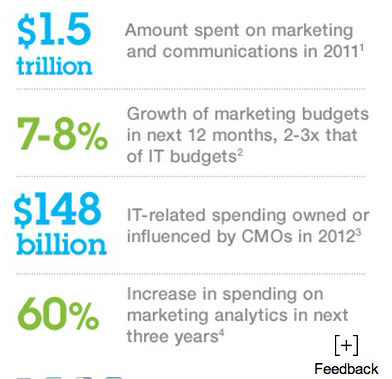
    On that same page IBM posts this short pile of Big Data stats:

    Earth to IBM and CMOs: The next era isn’t social. It’s personal. No amount of marketing analytics will out-perform knowing exactly what the customer wants, intends, or wishes to contribute to the company’s intelligence about the marketplace —in her own ways, and on her own terms.

    If a brand wants to be fully understood and respected — and if it deserves both — it needs to be ready for customers to truly engage, and not just be told what they’re like, and then guessed at.

    The means for that will be provided by both sides, not just by one. Until IBM and CMOs welcome independent customers, operating at full agency, outside any company’s silo or walled garden, all this mandating will be the sound of one hand shaking.

    *The links have 404’d or changed. Here’s what I can find in March, 2016:


  • Missing Elinor Ostrom

    Through my work over the years I have often been directed to the worlds of Elinor OstromElinor Ostrom, and toward speaking to her in person. Alas, the latter choice is now off the table. She died yesterday, at 78, of pancreatic cancer.

    On Monday evening, in the Q&A during my talk, I was asked about the relevance of Ostrom’s work to mine around VRM and The Intention Economy. I answered, with regret, that my sourcing of Ostrom was limited to a bibliography entry, after I had to reduce the curb weight of the book from 120,000 words to 80,000. So here’s one section, recovered from the cutting room floor:

    In Governing the Commons (1990), Elinor Ostrom says Hardin’s argument is not new:

    Aristotle long ago observed that “what is common to the greatest number has the least care bestowed upon it. Everyone thinks chiefly of his own, hardly at all of the common interest” (Politics Book II, ch. 3). Hobbes’s parable of man in a state of nature is a prototype of the tragedy of the commons: Men see their own good and end up fighting one another…[1]

    She goes on to cite a long list of other sources, the growing sum of which have long since snowballed into a single widely held conclusion: “Much of the world is dependent on resources that are subject to the possibility of a tragedy of the commons.”[2]

    Yet Hardin’s model, she explains, is an argument of one very narrow kind: a prisoner’s dilemma, “conceptualized as a noncooperative game in which all players possess complete information … When both players choose their dominant strategy… they produce an equlibrium that is the third-best result for both.” The game is fascinating for scholars because “The paradox that individually rational strategies lead to collectively irrational outcomes seems to challenge the fundamental faith that rational beings can achieve rational results.” She adds, “The deep attraction of the dilemma is further illustrated by the number of articles written about it. At one count, 15 years ago, more than 2,000 papers had been devoted to the prisoner’s dilemma game (Grofman and Pool 1975).”[3]

    Ostrom, however, doesn’t challenge Hardin’s assumption that common pool resources and a commons are the same thing.[1] Lewis Hyde does. In Common as Air (2010), he makes a thoroughly argued case against both Hardin’s tragedy-prone commons and idealized models, such as what he calls John Locke’s “aboriginal first condition” and Lawrence Lessig’s “dreams of pentitude.” What Hyde argues for is something much more complex, subtle and—I believe—important to understand if we are to make the most of the Internet.

    “I take a commons to be a kind of property,” Hyde writes, “and I take ‘property’ to be, by one old dictionary definition, a right of action,” noting “that ownership rarely consists of the entire set of possible actions.”


    [1] Elinor Ostrom, Governing the Commons: The evolution of institutions for collective action. (New York, Cambridge University Press, 1990) 2-3. [2] Ibid., 3. [3] Ibid, 4-5.

    [4] In fairness, Hyde notes, “Garret Hardin has indicated that his original essay should have been titled ‘The Tragedy of the Unmanaged commons,’ though better still might be ‘The Tragedy of Unmanaged, Laissez-Faire, Common-Pool Resources with Easy Access for Noncommunicating, Self-Interested Individuals.” (Common as Air, 44.) [Links added.]

    The final version focuses entirely on Lewis Hyde’s work, which I believe encompasses Elinor Ostrom’s, at least for my purposes in the book. Still, leaving her out seems especially regrettable now.

    And I encourage study of her work. Our common pool resources, which are many and of transcendant importance, are well served by her original thinking about them.

    Bonus linkage:

  • How Apple will turn the Net’s top into TV’s bottom

    Apple TV (whatever it ends up being called) will kill cable. It will also give TV new life in a new form.

    manhole coverIt won’t kill the cable companies, which will still carry data to your house, and which will still get a cut of the content action, somehow. But the division between cable content and other forms you pay for will be exposed for the arbitrary thing it is, in an interactive world defined by the protocols of the Internet, rather than by the protocols of television. It will also contain whatever deals Apple does for content distribution.

    These deals will be motivated by a shared sense that Something Must Be Done, and by knowing that Apple will make TV look and work better than anybody else ever could. The carriers have seen this movie before, and they’d rather have a part in it than outside of it. For a view of the latter, witness the fallen giants called Sony and Nokia. (A friend who worked with the latter called them “a tree laying on the ground,” adding “They put out leaves every year. But that doesn’t mean they’re standing up.”)

    I don’t know anything about Apple’s plans. But I know a lot about Apple, as do most of us. Here are the operative facts as they now stand (or at least as I see them):

    1. Apple likes to blow up categories that are stuck. They did it with PCs, laptops, printers, mp3 players, smartphones, music distribution and retailing. To name a few.
    2. TV display today is stuck in 1993. That’s when the ATSC (which defined HDTV standards) settled on the 16:9 format, with 1080 pixels (then called “lines”) of vertical resolution, and with picture clarity and sound quality contained within the data carrying capacity of a TV channel 6MHz wide. This is why all “Full HD” screens remain stuck at 1080 pixels high, no matter how physically large those screens might be. It’s also why more and more stand-alone computer screens are now 1920 x 1080. They’re made for TV. Would Steve Jobs settle for that? No way.
    3. Want a window into the future where Apple makes a TV screen that’s prettier than all others sold? Look no farther than what Apple says about the new iPad‘s resolution:
    4. Cable, satellite and over-the-air channels are still stuck at 6MHz of bandwidth (in the original spectrum-based meaning of that word). They’re also stuck with a need to maximize the number of channels within a finite overall bandwidth. This has resulted in lowered image quality on most channels, even though the images are still, technically, “HD”. That’s another limitation that surely vexed Steve.
    5. The TV set makers (Sony, Visio, Samsung, Panasonic, all of them) have made operating a simple thing woefully complicated, with controls (especially remotes) that defy comprehension. The set-top-box makers have all been nearly as bad for the duration. Same goes for the makers of VCR, DVD, PVR and other media players. Home audio-video system makers too. It’s a freaking mess, and has been since the ’80s.
    6. Steve at AllThingsD on 2 June 2010: “The only way that’s ever going to change is if you can really go back to square one and tear up the set-top-box and redesign it from scratch with a consistent UI, withall these different functions, and get it to the consumer in a way they are willing to pay for. We decided, what product do you want most? A better tv or a better phone? A better TV or a tablet? … The TV will lose until there is a viable go-to-market strategy. That’s the fundamental problem.” He also called Apple TV (as it then stood) a “hobby”, for that reason. But Apple is bigger now, and has far more market reach and clout. In some categories it’s nearly a monopoly already, with at least as much leverage as Microsoft ever had. And you know that Apple hasn’t been idle here.
    7. Steve Jobs was the largest stockholder in Disney. He’s gone, but the leverage isn’t. Disney owns ABC and ESPN.
    8. The main thing that keeps cable in charge of TV content is not the carriers, but ESPN, which represents up to 40% of your cable bill, whether you like sports or not. ESPN isn’t going to bypass cable — they’ve got that distribution system locked in, and vice versa. The whole pro sports system, right down to those overpaid athletes in baseball and the NBA, depend on TV revenues, which in turn rest on advertising to eyeballs over a system made to hold those eyeballs still in real time. “There are a lot of entrenched interests,” says Peter Kafka in this On the Media segment. The only thing that will de-entrench them is serious leverage from somebody who can make go-to-market, UI, quality, and money-flow work. Can Apple do that without Steve? Maybe not. But it’s still the way to bet.

    Cable folks have a term for video distribution on the net Net. They call it “over the top“. Of them, that is, and their old piped content system.

    That’s actually what many — perhaps most — viewers would prefer: an à la carte choice of “content” (as we have now all come to say). Clearly the end state is one in which you’ll pay for some stuff while other stuff is free. Some of it will be live, and some of it recorded. That much won’t be different. The cable companies will also still make money for keeping you plugged in. That is, you’ll pay for data in any case. You’ll just pay more for some content. Much of that content will be what we now pay for on cable: HBO, ESPN and the rest. We’ll just do away with the whole bottom/top thing because there will be no need for a bottom other than a pipe to carry the content. We might still call some  sources “channels”; and surfing through those might still have a TV-like UI. But only if Apple decides to stick with the convention. Which they won’t, if they come up with a better way to organize things, and make selections easy to make and pay for.

    This is why the non-persuasiveness of Take My Money, HBO doesn’t matter. Not in the long run. The ghost of Steve is out there, waiting. You’ll be watching TV his way. Count on it.

    We’ll still call it TV, because we’ll still have big screens by that name in our living rooms. But what we watch and listen to won’t be contained by standards set in 1993, or by carriers and other “stakeholders” who never could think outside the box.

    Of course, I could be wrong. But no more wrong than the system we have now.

    Bonus link.

    Another.

  • The absent market for personal data

    I was interviewed for a story recently. (It’s still in the mill.) In the correspondence that followed, the reporter asked me to clarify a statement: “that the idea of selling your data is nuts.” I didn’t remember exactly what I said, so I responded,

    I think what I meant was this:

    1) The use value of personal data so far exceeds its sale value that it’s insane to compare the two.

    Especially because …

    2) There never has been a market for selling personal data, and to create one now, just because marketers are sneakily getting that data for free, doesn’t mean there should be one.

    Especially because …

    3) The sums paid by marketers for personal data are actually tiny on a per-person basis.

    4) Selling one’s personal data amounts to marketing exposure of one’s self. It’s like stripping, only less sexy. And for a lot less money.

    And added a pointer to For personal data, use value beats sale value.

  • On bubbles within bubbles

    In When bubbles burst…, Dave writes,

    When any hamster-based startup can raise $50 million on a $1 billion market cap, there’s not much market for new ideas. Why bother, when the same-old-stuff can make you rich. But when the bubble fades, it’s time to get creative. Because techwill reboot. The question is, what’s the next wave.

    I followed the link to FACEBOOK FALLOUT: Y Combinator’s Paul Graham Just Emailed Portfolio Companies Warning Of ‘Bad Times’ In Silicon Valley, in which Nicholas Carlson begins,

    Facebook has flopped on the public markets, and now we have vivid evidence of how badly Silicon Valley is reeling in the fallout.
    Paul Graham, cofounder of Silicon Valley’s most important startup incubator, Y Combinator, has sent an email to portfolio companies warning them “bad times” may be ahead.

    He warns: “The bad performance of the Facebook IPO will hurt the funding market for earlier stage startups.

    “No one knows yet how much. Possibly only a little. Possibly a lot, if it becomes a vicious circle.”

    Among the comments is this one:

    Adam Lavine:

    One dinner with a dour VC does not a Silicon Valley liquidity crisis make.

    With that said: would be nice for all of these startups to find CUSTOMERS willing to PAY for their services. The fact that startups that have “easy money built into their models” is an obvious bubble sign in itself.

    To which I replied,

    @Adam Lavine:

    Exactly.The tightening of VC sphincters is an issue, but it’s a lesser one than the paucity of VC-funded business models that make companies accountable to users as customers.

    Facebook, Google and Twitter have consumers and customers that are different populations. Users are the consumers, and advertisers are the customers. This does work as a business: for commercial broadcasting it has worked for the duration. But it works at the cost of having minimized accountability to the millions of individuals who use the service but pay nothing for it. Ever tried to get personal service from Google or Facebook? Good luck with that.

    Our dependency on Google alone today verges on the absolute. Facebook envies operating Google-grade user containment systems (e.g. Gmail, Google docs, etc.) on the same scale. But neither company is financially accountable to their users (only to their advertisers and stockholders), and neither have worthy competitors, and that’s not good for the markets they contain either.

    The whole ad-supported commercial Web we have today is a collection of monocultural silos, each of which is a bubble in itself. (Think of every giant silo as a single point of failure and therefore a giant bubble.)

    Another angle: every company deals with two markets — one for its goods and services, and one for itself. In Silicon Valley the latter has overrun the former, time and again. Now is no exception.

    Bonus link: http://www.linuxjournal.com/magazine/eof-google-exposure

    Just wanted to share that here, and not just there.

  • Hard drivings

    The hard drive is crapping out on my main laptop. I’m backed up, so that much is cool. Installing a Seagate Momentus XT 750 GB drive later today. We’ll see how it goes.

    [Later…] Lot of dependencies and such to clean up, but performance-wise, it’s like a new computer.

  • Writing with Bitly

    Markets are conversations, they say. So yesterday I had one with MRoth, head of product for , the company whose service changes the other day caused a roar of negative buzz, including some from me, here.

    Users were baffled by complexities where simplicities used to be. Roger Ebert lamented an “incomprehensible and catastrophic redesign” and explained in his next tweet, “I want to shorten a link, tweet it, and see how many hits and retweets it got. That’s it. Bit.ly now makes it an ordeal.”

    That was my complaint as well. And it was heard. A friend with Bitly connections made one between  and me, and good conversation followed for an hour.

    We spent much of that time going over work flows. Turns out Roger’s and mine are not the only kind Bitly enables, or cares about, and that’s a challenge for the company. Compiling, curating and sharing bookmarks (which they now call “bitmarks”) is as important for some users as simply shortening URLs is for others. Bitly combined the two in this re-design, and obviously ran into problems. They are now working hard to solve those.

    I won’t go into the particulars MRoth shared, because I didn’t take notes and don’t remember them well enough in any case. What matters is that it’s clear to me that Bitly is reaching out, listening, and doing their best to follow up with changes. “Always make new mistakes,” Esthr says, and they’re making them as fast and well as they can.

    I will share something I suggested, however, and that’s to look at the work flows around writing, and not just tweeting and other forms of “social” sharing.

    We need more and better tools for writing linky text on the Web. Much as I like and appreciate what WordPress and Drupal do, I’m not fond of either as writing systems, mostly because “content management” isn’t writing, and those are content management systems first, and writing systems second.

    As an art and a practice, writing is no less a product of its instruments than are music and painting. We not only need pianos, drums and brushes, but Steinways, Ludwigs and Langnickels. Microsoft doesn’t cut it. (Word produces horrible html.) Adobe had a good early Web writing tool with GoLive, but killed it in favor of Dreamweaver, which is awful. There are plenty of fine text editors, including old standbys (e.g. vi and emacs) that work in command shells. Geeky wizards can do wonders with them, but there should be many other instruments for many other kinds of artists.

    Far as I know, the only writer and programmer working on a portfolio of writing and publishing instruments today is , and he’s been on the case for thirty years or more. (I believe I first met Dave at the booth at Comdex in Atlanta in 1982, when the program was available only on the Apple II). One of these days, months or years, writers and publishers are going to appreciate Dave’s pioneering work with outlining, sharing linksflowing news and other arts. I’m sure they do to some extent today (where would we all be without RSS?), but what they see is exceeded by what they don’t. Yet.

    The older I get, the earlier it seems. For artist-grade writing and publishing tools, it’s clear to me that we’re at the low narrow left end of the adoption curve: not far past the beginning. That spells opportunity for lots of new development projects and companies, including Bitly.

    I think the main thing standing in everybody’s way right now is the belief that writing and publishing need to be “social,” as defined by Facebook and Twitter, rather than by society as a whole, which was plenty social before those companies came along. Also plenty personal. Remember personal computing? We hardly talk about that any more, because it’s a redundancy, like personal phoning, or personal texting. But personal, as an adjective, has taken a back seat while social drives.

    Here’s a distinction that might help us get back in the driver’s seat: Publishing is social, but writing is personal. The latter is no less a greenfield today than it was in 1982. The difference is that it’s now as big as the Net.

  • After Bitly’s fail

    [This post was read by Bitly folks, who reached out appreciatively. The thread continues with a follow-up post here.]

    Last night huge thunderstorms moved across New Hampshire, and later across Boston. NOAA radarThere was even a tornado watch (the red outline north of Keene, in the radar image on the left, from the NOAA.) So I thought I’d tweet that.

    It has been my practice for quite a while, when tweeting, to use the Bit.ly extension in my Chrome browser.

    But then came a surprise. The little Bitly image had changed, and the pop-down word balloon, rather than giving me the shortlink I had expected, told me that Bit.ly was improving. I thought, “Oooh, shit.” Because there was nothing wrong with the old Bit.ly. It was simple and straightforward. You could either copy the shortlink from a window, or know it was on your clipboard after you clicked on the “copy” button, and it said “copied.”

    The new and improved Bitly looks like this:

    WTF? Ya gotta work to get this many things wrong. My personal list, from the top:

    1. I don’t know what a bitmark is and I don’t want to know. I want a shortlink.
    2. My Twitter handle is there, with my face. Why?
    3. Does the blue “x” close the whole thing or just my twitter handle?
    4. Why is it telling me the URL I want shortened? I see that one already. I want the short bit.ly URL.
    5. Why is it telling me the title of the page? I know that too.
    6. Why would I add a note? And to what? Is this a kind of Delicious move? I hardly ever used Delicious because it was too complicated. Now this is too.
    7. Why “Public?”
    8. What’s the “bundle” I would add this to?
    9. “CANCEL” what? Is something already in progress I don’t know about? (In this brief but intense Age of Facebook, when sites and services — e.g. Facebook Connect — silently provide means for advertisers and third parties to follow your scent like a cloud of flies, that’s a good bet.)
    10. What is Save+ for? To what? Why?
    11. What is “Save and share…” and what’s the difference between that and save? Why would I want a shortlink if not to share it on something that requires it, like Twitter?
    12. What are the symbols next to “Public” and “Save and share…”?
    13. And if, as I suspect, the only way I can get to the shortlink is to hit “Save and share…”, why make me go through that extra click — or, for that matter, ford the raging river of kruft above it to get there?

    That was as far as I got before I had to go out to an event in the evening; and when I came back the storm (or something) had knocked my ISP’s Net connection off. So this morning, naturally (given all the above), there’s a tsunami of un-likes at https://twitter.com/#!/search/bitly, as well as out in the long-form blogosphere.

    In URL Shortener Bitly Announces Big Update (Unfortunately, It Sucks, And Everybody Hates It), Shea Bennett of All Twitter at MediaBistro writes,

    Yesterday, URL shortener of choice Bitly, which has generated more than 25 billion shortened links since inception, announced a change to their platform. A big change. New Bitly, they’re calling it.

    Great. There’s only one small problem: everybody, and I mean everybody*, hates it.

    Why? Because it’s taken what was a really useful and fast service into something that is bloated with unnecessary add-ons and buzzword crap, and made a one-click share into something that now takes at least three clicks, and is really, really confusing.

    In the good old days, which we’ll refer to from now on as BNB (Before New Bitly), shortening links on Bitly was a breeze. A pleasure. It was fast, responsive and if you used an extension you could crunch down the URL of any webpage in a matter of seconds. If you had a Bitly account, you could then share that shortened link straight to Twitter via Bitly using the title of your choice.

    So simple. So effective. So perfect.

    And so gone.

    The Bitly announcement is long: too long for a URL-shortening company. But this excerpt compresses the meat of it:

    So what’s new? Now you can…

    • Easily save, share and discover links — they’re called bitmarks, like bookmarks.
    • Instantly search your saved bitmarks.
    • Curate groups of bitmarks into bundles and collaborate on bundles with friends.
    • Make any bitmark or bundle private or public.
    • See what friends are sharing across multiple social networks, all in one place.
    • Save and share links from anywhere with our new bitmarklet, Chrome extension and iPhone app.

    It doesn’t stop here. We have big plans for bitly, and we want to build this neighborhood with our community. So get in there, start bitmarking and please tell us what you think!

    So they want to be Delicious. And they want to play the social game. Or, as Samantha Murphy in Mashable puts it,

    Bit.ly — which has more than 25 billion links saved since 2008 and gets about 300 million link-clicks each day — launched a redesign to not only expand its presence but give users more curation power. Among the most notable of the new tools is a profile page and what the company is calling “bitmarks,” which are similar to bookmarks.

    I just checked Dave Winer, who, as I expected, weighs in with some words from the wise:

    Based on what I see in their new product release it looks like they’re taking a step toward competing with Twitter. But they didn’t do it in an easy to use way. And the new product is not well user-tested. It looks like they barely used it themselves before turning it on for all the users. Oy. Not a good way to pivot.

    Here’s some free advice, what I would do if I were them.

    1.  Immediately restore the old interface, exactly as it was before the transition.
    2. Concurrently, issue a roadmap that goes as follows, so everyone knows where this thing is going.
    3. Take a few weeks to incorporate the huge amount of feedback they’ve gotten and streamline the new UI.
    4. Instead of launching it at bitly.com, launch it at newbetaworksserver.com…

    The list goes on, and it’s exactly what they should do. At the very least, they should take Step #1. It’s the only way to restore faith with users.

    Meanwhile, three additional points.

    First is that URL shortening has always been a fail in respect to DNS — the Domain Name System, which was invented for ARPANET in 1982, and has matured as into hardened infrastructure over the decades since. (It’s essentially NEA: Nobody owns it, Everybody can use it, and Anybody can improve it.) On the other hand, URL shortening, as we know it so far, puts resolving the shortened URL in private hands, and those hands can (and will) change. That’s exactly what we’re seeing here with Bitly, and what we tend to see with all private infrastructures that serves public purposes.

    Second is that Bitly, like Facebook, Twitter, Google and other advertising-supported businesses with millions (or billions) of users that pay nothing to those companies for the services performed, has a problem that has been familiar to commercial broadcasting since it was born in the 1920s: its consumers and its customers are different populations, and they are financially accountable only to the customers. Not to the consumers. In Bitly’s case its customers, so far, are enterprises that pay to have customized, or branded, short URLs. Could they make their consumers into customers as well, with a freemium model? Possible. I’d recommend it, because it would make the company financially accountable to those users.

    Third is that people want their own curation power. The Cloud is a good and necessary form of utility infrastructure. But it’s a vulnerable place to have one’s own digital goods. True, everything, even the physical world, is ephemeral in the long run. But digital ephemera can be wiped out in an instant. We should have at least some sense of control over “what’s mine.” Bitly shortlinks are not really “mine” to begin with. As Yahoo showed with Delicious, commercially curated links are especially vulnerable. And, after this last move, Bitly has given us no new reason to trust them. And many new reasons not to.

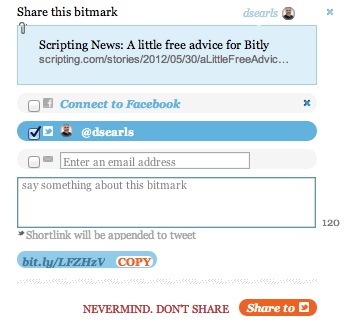
    So, will I use the new Bitly? Let’s look at what comes up when I hit the “Save and share…” button for Dave’s piece:

    This is no less f’d than the other one. Let’s run it down.

    1. Okay, I’ve done the Delicious thing, I guess, if this is saved somewhere. Curation achieved, maybe. Guess I have to go Bitly.com to see. I’ll do that later.
    2. At first I thought the saved link (or whatever) might be under my @ handle on the upper right, but that just brings up a “sign out” option.
    3. I have no intention of connecting to Facebook.
    4. When I click on the blue bar with the checkmark in it, changes happen in the window, but I’m not sure what they are, other than getting un-checked.
    5. I have no intention of emailing it to anybody in this case. And actually, when I email a link, I tend to avoid shortlinks, because they obscure the source. And I’m also not dealing with a 140-character space limit. (Hmm… while we’re on short spaces subject, why not offer texting through SMS?)
    6. Did something get tweeted when I hit the blue bar? I dunno. Checked with Twitter. Nothing there, so guess not.
    7. I see “Shortlink will be appended to tweet,” but does that mean I tweet something if I put it in the box? Guess so, but not sure.
    8. I see the “Copy” next to the almost-illegible shortlink in the blue button. Okay, guess that’s what I should use. But I don’t yet because I want to understand the whole thing first.
    9. What does “NEVERMIND. DON’T SHARE” mean, except as a rebuke? Translated from the passive-aggressive, it says, “You don’t want to play this game? Okay, then fuck off.”
    10. The symbol in the orange “Share to” is barely recognizable as Twitter’s. I think. Not sure. I just clicked on it, and something came up briefly then went away.

    When I clicked on it again, I got this:

    I don’t want to try again, because I’m not sure it failed. So I check Twitter, and see this:

    Damn! I didn’t want that!

    This tweet has no context other than me and Bitly. Worse, it looks like a spam. Or like I’d been phished or hijacked in some way. At no time in the history of my blogging or tweeting have I ever uttered a single URL, let alone a shortened one. Or, if I did, I’m sure the context was clear.

    This isn’t even a “copy.” It should say “tweet,” if it were to have any meaning at all. I guess I should have written something in the box above. But would that have worked? I dunno.

    So I just went through the routine again, this time hitting the blue button that says COPY in orange. I did that for Dave’s post, and this one after I published it, and the result is this normal-form tweet: https://twitter.com/dsearls/status/207856808012951553

    It is also now clear to me that the box is for writing a tweet to which the shortlink will be appended. But usually I don’t like to append links, but to work them into the text of the tweet.

    Bottom lines:

    1. As Rebecca Greenfield says in The Atlantic Wire, Bit.ly Isn’t Really a Link Shortener Any More. Too bad.
    2. It still works, but the new routine now takes three clicks rather than two, and is far more complicated. The curation does work,, for now. When I go to Bitly.com, below “Welcome to the new bitly,” I see “1–10 OF 900 BITMARKS.” I can also search them. That’s cool. But I’d rather have something in my own personal cloud. And I’d pay Bitly, or anybody who values my independence, for helping me build that.

    Mark these words: The next trend is toward independence for individuals, whether they be users or customers. Yet another new dependency is not what anybody wants. Dependencies like Bitly’s new one are a problem, not a solution. Bitly, Facebook, Google and Twitter making their APIs work together does not solve the dependency problem, any more than federations among plantations makes slaves free.

    The end-to-end nature of the Net promised independence in the first place. When client-server became calf-cow in 1995, we sold out that promise, and we’ve been selling it out, more and more, ever since.

    Now we need to take it back. Hats off to Bitly for making that abundantly clear.

  • Lessons

    When Underwood typewriterour kid started using a computer in the seventh grade, I got him a copy of Mavis Beacon so he’d learn how to touch-type.

    I didn’t see him using the program, but I did see him typing. So I asked him what was up with that. He said “I looked at it a couple of weeks ago. It was good.” I asked, “Did you learn to touch type from it?” “Sure,” he said. “It has tests. I used them. I did fine.”

    So I asked him to show me. He did. First try: 30 words per minute. Second, 45 wpm.

    I took typing in the seventh grade ,which ran from September 1959 to June 1960. work keyboardIt was a year-long class, one period per day. My typewriter at school was an early-Fifties Underwood Rhythm-Touch like the one on the left. For practice at home my parents got me a WWII-era Underwood that looked exactly like the code machine.

    I got an F in my first semester of typing class, because I made a lot of mistakes. I got a D in my second semester, for the same reason. For what it’s worth, I doubt anybody in that class has done more typing since then than I have.  Or have worn out more keyboards. Such as the one on the right, which I’m using now.

    My handwriting, long neglected, looks about as good.

    Some old habits died hard. Here they are:

    • Returning the carriage after the bell five spaces before the end of a line.
    • Wanting to set tabs the old-fashioned way, feeling the physical insertion, literally, of a metal tab into the carriage path.
    • Double-spacing between sentences. Not doing this was my most common error, back in typing class.
    • Hyphenating long words at the ends of lines.
    • Indenting the first line of a paragraph, with a tab five spaces in.

    For years I hated word processing without hyphens, and double-returns between paragraphs with no indents. But after awhile I became accustomed to that new norm, and came to appreciate its benefits as well. (For example, when copying and pasting a bunch of text and not having to take out the hyphens and indents that only made sense in the old layout.) I also taught myself to restore my original proclivity to single spaces between sentences.

    As for typing speed, I have no idea how fast I am now. What I love about not knowing is that it truly doesn’t matter.

  • After Facebook fails

    Making the rounds is , a killer essay by in MIT Technology Review. The gist:

    At the heart of the Internet business is one of the great business fallacies of our time: that the Web, with all its targeting abilities, can be a more efficient, and hence more profitable, advertising medium than traditional media. Facebook, with its 900 million users, valuation of around $100 billion, and the bulk of its business in traditional display advertising, is now at the heart of the heart of the fallacy.

    The daily and stubborn reality for everybody building businesses on the strength of Web advertising is that the value of digital ads decreases every quarter, a consequence of their simultaneous ineffectiveness and efficiency. The nature of people’s behavior on the Web and of how they interact with advertising, as well as the character of those ads themselves and their inability to command real attention, has meant a marked decline in advertising’s impact.

    This is the first time I have read anything from a major media writer (and Michael is very much that — in fact I believe he is the best in the biz) that is in full agreement with The Advertising Bubble, my chapter on this very subject in The Intention Economy: When Customers Take Charge. A sample:

    One might think all this personalized advertising must be pretty good, or it wouldn’t be such a hot new business category. But that’s only if one ignores the bubbly nature of the craze, or the negative demand on the receiving end for most of advertising’s goods.  In fact, the results of personalized advertising, so far, have been lousy for actual persons…

    Tracking and “personalizing”—the current frontier of online advertising—probe the limits of tolerance. While harvesting mountains of data about individuals and signaling nothing obvious about their methods, tracking and personalizing together ditch one of the few noble virtues to which advertising at its best aspires: respect for the prospect’s privacy and integrity, which has long included a default assumption of anonymity.

    Ask any celebrity about the price of fame and they’ll tell you: it’s anonymity. This wouldn’t be a Faustian bargain (or a bargain at all) if anonymity did not have real worth. Tracking, filtering and personalizing advertising all compromise our anonymity, even if no PII (Personally Identifiable Information) is collected.  Even if these systems don’t know us by name, their hands are still in our pants…

    The distance between what tracking does and what users want, expect and intend is so extreme that backlash is inevitable. The only question is how much it will damage a business that is vulnerable in the first place.

    The first section of the book opens with a retrospective view of the present from a some point in the near future — say, five or ten years out. A relevant sample:

    After the social network crash of 2013, when it became clear that neither friendship nor sociability were adequately defined or managed through proprietary and contained systems (no matter how large they might be), individuals began to assert their independence, and to zero-base their social networking using their own tools, and asserting their own policies regarding engagement.

    Customers now manage relationships in their own ways, using standardized tools that embrace the complexities of relationship—including needs for privacy (and, in some cases, anonymity). Thus loyalty to vendors now has genuine meaning, and goes as deep as either party cares to go. In some (perhaps most) cases this isn’t very deep, while in others it can get quite involved.

    When I first wrote that, I said 2012. But I decided that was too aggressive, and went with the following year. Maybe I was right in the first place. Time will tell.

    Meanwhile, here’s what Michael says about the utopian exhaust Facebook and its “ecosystem” are smoking:

    Well, it does have all this data. The company knows so much about so many people that its executives are sure that the knowledge must have value (see “You Are the Ad,” by Robert D. Hof, May/June 2011).

    If you’re inside the Facebook galaxy (a constellation that includes an ever-expanding cloud of associated ventures) there is endless chatter about a near-utopian (but often quasi-legal or demi-ethical) new medium of marketing. “If we just … if only … when we will …” goes the conversation. If, for instance, frequent-flyer programs and travel destinations actually knew when you were thinking about planning a trip. Really we know what people are thinking about—sometimes before they know! If a marketer could identify the person who has the most influence on you … If a marketer could introduce you to someone who would relay the marketer’s message … get it? No ads, just friends! My God!

    But so far, the sweeping, basic, transformative, and simple way to connect buyer to seller and then get out of the way eludes Facebook.

    The buyer is a person. That person does not require either a social network or absolutely-informed guesswork to know who she is or what she wants to buy. Obviously advertising can help. It always has. But totally personalized advertising is icky and oxymoronic. And, after half a decade or more at the business of making maximally-personalized ads, the main result is what Michael calls “the desultory ticky-tacky kind that litters the right side of people’s Facebook profiles.”

    That’s one of mine on the right. It couldn’t be more wasted and wrong. Let’s take it from the top.

    First, Robert Scoble is an old friend and a good guy. But I couldn’t disagree with him more on the subject of Facebook and the alleged virtues of the fully followed life. (Go to this Gillmor Gang, starting about an hour in, to see Robert and I go at it about this.) Clearly Facebook doesn’t know about that. Nor does any advertiser, I would bet. In any case, Robert likes so many things that his up-thumb has no value to me.

    I have no interest in Social Referrals, and if Facebook followed what I’ve written on the subject of “social” (as defined by Facebook and its marketing cohorts), it wouldn’t imagine I would be interested in extole.com.

    I’m 64, but married. “Boyfriend wanted” is a low-rent fail as well as an insult.

    I get the old yearbook pitch every time I go on Facebook, which is as infrequently as I possibly can. (There are people I can only reach that way, which is why I bother.) I don’t even need to click on the the ad to discover that, as I suspected, 60s.yearbookarchives.com is a front for the scammy Classmates.com.

    I’ve never been fly flishing, and haven’t fished since I was a kid, many decades ago.

    And I don’t want more credit cards, of any kind, regardless of Scoble’s position on Capital One.

    In a subchapter of  titled “A Bad Theory of You,”  calls both Facebook’s and Google’s data-based assumptions about us “pretty poor representations of who we are, in part because there is no one set of data that describes who we are.” He also says that at best they put us into the  — a “place where something is lifelike but not convincingly alive, and it gives people the creeps.” But what you see on the right isn’t the best, and it’s not uncanny. It’s typical, and it sucks, even if it does bring Facebook a few $billion per year in click-through-based revenues.

    The amazing thing here is that business keeps trying to improve advertising — and always by making it more personal — as if that’s the only way we can get to Michael’s “sweeping, basic, transformative, and simple way to connect buyer to seller and then get out of the way.” Three problems here:

    1. By its nature advertising — especially “brand” advertising — is not personal.
    2. Making advertising personal changes it into something else that is often less welcome.
    3. There are better ways to get to achieve Michael’s objective — ways that start on the buyer’s side, rather than the seller’s.

    Don Marti, former Editor-in-Chief of Linux Journal and a collaborator on the advertising chapters in my book, nails the first two problems in a pair of posts. In the first, Ad targeting – better is worse? he says,

    Now, as targeting for online advertising gets more and more accurate, the signal is getting lost. On the web, how do you tell a massive campaign from a well-targeted campaign? And if you can’t spot the “waste,” how do you pick out the signal?

    I’m thinking about this problem especially from an IT point of view. Much of the value of an IT product is network value, and economics of scale mean that a product with massive adoption can have much higher ROI than a niche product…. So, better targeting means that online advertising carries less signal. You could be part of the niche on which your vendor is dumping its last batch of a “boat anchor” product. This is kind of a paradox: the better online advertising is, the less valuable it is. Companies that want to send a signal are going to have to find a less fake-out-able medium.

    In the second, Perfectly targeted advertising would be perfectly worthless, which he wrote in response to Michael’s essay, he adds this:

    The more targeted that advertising is, the less effective that it is. Internet technology can be more efficient at targeting, but the closer it gets to perfectly tracking users, the less profitable it has to become.

    The profits are in advertising that informs, entertains, or creates a spectacle—because that’s what sends a signal. Targeting is a dead end. Maybe “Do Not Track” will save online advertising from itself.

    John Battelle, who is both a first-rate journalist and a leader in the online advertising industry, says this in Facebook’s real question: What’s the native model?:

    Facebook makes 82% of its money by selling targeted display advertising – boxes on the top and right side of the site (it’s recently added ads at logout, and in newsfeeds). Not a particularly unique model on its face, but certainly unique underneath: Because Facebook knows so much about each person on its service, it can target in ways Google and others can only dream about. Over the years, Facebook has added new advertising products based on the unique identity, interest, and relationship data it owns: Advertisers can incorporate the fact that a friend of a friend “likes” a product, for example. Or they can incorporate their own marketing content into their ads, a practice known as “conversational marketing” that I’ve been on about for seven or so years (for more on that, see my post Conversational Marketing Is Hot – Again. Thanks Facebook!).

    But as many have pointed out, Facebook’s approach to advertising has a problem: People don’t (yet) come to Facebook with the intention of consuming quality content (as they do with media sites), or finding an answer to a question (as they do at Google search). Yet Facebook’s ad system combines both those models – it employs a display ad unit (the foundation of brand-driven media sites) as well as a sophisticated ad-buying platform that’d be familiar to anyone who’s ever used Google AdWords.

    I’m not sure how many advertisers use Facebook, but it’s probably a fair guess to say the number approaches or crosses the hundreds of thousands. That’s about how many used Overture and Google a decade ago. The big question is simply this: Do those Facebook ads work as well or better than other approaches? If the answer is yes, the question of valuation is rather moot. If the answer is no…Facebook’s got some work to do.

    But Facebook isn’t the real issue here. Working only the sell side of the marketplace is the issue. It’s now time to work the buy side.

    The simple fact is that we need to start equipping buyers with their own tools for connecting with sellers, and for engaging in respectful and productive ways. That is, to improve the ability of demand to drive supply, and not to constantly goose up supply to drive demand, and failing 99.x% of the time.

    This is an old imperative.

    In , which Chris Locke, David Weinberger, Rick Levine and I wrote in 1999, we laid into business — and marketing in particular — for failing to grok the fact that in networked markets, which the Internet gave us, individuals should lead, rather than just follow. So, since business failed to get Cluetrain’s message, I started in mid-2006 at Harvard’s Berkman Center. The idea was to foster development of tools that make customers both independent of vendors, and better able to engage with vendors. That is, for demand to drive supply, personally. (VRM stands for .)

    Imagine being able to:

    • name your own terms of service
    • define for yourself what loyalty is, what stores you are loyal to, and how
    • be able to gather and examine your own data
    • advertise (or “intentcast”) your own needs in an anonymous and secure way
    • manage your own relationships with all the vendors and other organizations you deal with
    • … and to do all that either on your own or with the help of that work for you rather than for sellers (as most third parties do)

    Today there are dozens of VRM developers working at all that stuff and more — to open floodgates of economic possibility when demand drives supply personally, rather than “socially” as part of some ad-funded Web giant’s wet dream. (And socially in the genuine sense, in which each of us knows who our friends, relatives and other associates really are, and in what contexts our actual social connections apply.) I report on those, and the huge implications of their work, in The Intention Economy.

    Here’s the thing, and why now is the time to point this out: most of those developers have a hell of a time getting laid by VCs, which on the whole have their heads stuck in a of the Web, and can’t imagine a way to improve the marketplace that does not require breeding yet another cow, or creating yet another ranch for dependent customers. Maybe now that the bloom is off Facebook’s rose, and the Filter Bubble is ready to burst, they can start looking at possibilities over here on the demand side.

    So this post is an appeal to investors. Start thinking outside the cow, and outside the ranch. If you truly believe in free markets, then start believing in free customers, and in the development projects that make them not only free, but able to drive sales at a 100% rate, and to form relationships that are worthy of the word.

    Bonus links:

    HT to John Salvador, for pointing to Life in the Vast Lane, where I kinda predicted some of the above in 2008.

  • The Real Story of Send

    sendWith The Story of Send, Google follows a single email as it travels through wires, under streets, through an ISP’s high-rise, in and out of Google’s various gear, including one of its vast data centers, and finally up a tower and out via a telco’s data system into a smartphone. What happens in the data center is explained in a video that lasts more than seven minutes, with a sped-up voice-over like you hear in disclaimers at the ends of ads for car dealers and pharmaceuticals. There are lots of other promotional side-trips like that one, along the way.

    What it doesn’t tell is the real story of email as we use it today. That story starts with RFC 821, by Jon Postel, posted in August 1982. It begins,

    The objective of Simple Mail Transfer Protocol (SMTP) is to transfer mail reliably and efficiently.
    SMTP is independent of the particular transmission subsystem and requires only a reliable ordered data stream channel.

    What makes SMTP so useful and universal today is that it intentionally transcends any intermediator’s silo or walled garden. It simply assumes a connection. So do the POP (RFC918 and IMAP (RFC1064) protocols (used at the receiving end), for which the relevant RFCs were issued in 1984 and 1988.

    Those protocols ended up winning — for all of us — after it became clear that their simplicity, and their oblivity to the parochial interests of network owners and operators, were what we really needed. That was in 1995. In the meantime, a pile of proprietary and corporate email systems competed in a losing battle with each other. Compuserve, Prodigy, MCI Mail, AppleLink, and a host of others were all obsoleted by the obvious advantage of having nobody own the means by which we simply send electronic mail to each other.

    The main intended message of The Story of Send is a green one: Google saves energy. A secondary message is that Google is a big nice company that treats your mail well and has good security practices. But the main unintended message — or at least the one that comes across — is that email is a big complicated business, and you need big complicated companies to do it right. It also ignores the real story, which is about a handful of simple protocols.

    Two voices in the wilderness of corporate rah-rah that ought to be heard on this are Phil Windley and Bob Frankston.

    Phil has a terrific blog post called Ways, not Places, in which he makes a good straightforward case for understanding the Internet in term of ways (protocols) rather than places (e.g. domains, with locations, addresses, and the rest). Because it’s the ways that make everything else possible.

    In his essay on Ambient Connectivity, Bob says, “The nuanced definition of Ambient Connectivity is that we can view connectivity as infrastructure but we need to take responsibility if we find ourselves disconnected. This is in contrast with today’s telecom industry in which we’ve shifted responsibility to providers and can only assume connectivity where a third party has subscribed to a service and there is an unbroken chain of providers all the way to your destination.” The latter is the case that Google makes. Its also the case argued by every bill we get from our phone and cable companies.

    But we need to keep hearing the all-but-silent argument for the Net and its protocols. Because without those we wouldn’t have the rest.


  • So long, and thanks to the bird

    Independent commercial alternative rock radio in Boston is heading to the grave. The Boston Phoenix‘ WFNX has been sold to Clear Channel, which — says the press release — will expand its “footprint” in Boston. (Bambi vs. Godzilla comes to mind.) Boston Business Journal suggests the signal’s fate will be to carry country music or Spanish programming. But it doesn’t matter. FNX is done.  In Thanks For The Memories You’re Fired, Radio INK puts the end this way:

    Independently owned WFNX has been competing in the Boston market for nearly 30 years. Until yesterday that is, when Stephen Mindich notified his staff he was selling to Clear Channel. He then fired 17 of the 21 employees. Mindich said, “Despite its celebrated history, its cutting edge programming , its tradition of breaking new music, its ardent fans among listeners and advertisers, for some time it has been difficult to sustain the station  — especially since the start of the Great Recession.”

    NECN reports,

    The sale also means 17 of the 21 people working at FNX were suddenly let go Wednesday. The remaining three full-timers and one part-timer will keep the station on air until the sale goes through in next couple of months.

    WFNX Program Director Paul Driscoll said, “I think of it as a two month Irish wake, so we’re going to send this legendary station off the right way.”

    That will mean celebrating the station’s roots and its 29 year run – one that had a hand in bringing groups like Nirvana and Pearl Jam to wider audiences.

    Driscoll said, “The community, the artists that we’ve developed relationships with, the listeners, it’s more than just a spot on the FM dial.”

    No doubt the change has been coming for a long time. WBCN went away (actually to an HD subchannel, which is pretty much the same thing) a couple years back after 41 years as one of the country’s landmark rock stations. FNX was always more alternative than BCN. WBOS and WAAF still fly the rock flags; but there was only one FNX, and now it’s headed out the door.

    Since coming to Boston in ’06 I’ve been surprised to see FNX continuing to make it. The ratings in both March and April had dropped to nil (literally, nada). You can’t sell advertising with that.

    The signal is also sub-second-tier. Licensed to Lynn as a Class A station (maximum of 3000 watts at 300 feet above average terrain), it radiates with 1700 watts at 627 feet (equivalent to 3000 watts, trading watts for height), from atop One Financial Center, but with far less power in most directions other than north:

    Meanwhile, most competing Boston commercial stations are Class B: 50,000 watts at 500 feet, or the equivalent. (Most radiate with fewer watts at higher elevations, on either the Prudential Building or out at Boston’s antenna farm in Needham, where a collection of towers exceed 1000 feet in height.)

    Presumably WFEX, which simulcasts WFNX from Mt. Monadnock in New Hampshire, will also go to Clear Channel. (See the engineering and ownership details here.)

    There’s a lot of tweeting on the matter. The most poignant so far is this one from David Bernstein (@dbernstein):

    Why #WFNX mattered (photo taken by @CarlyCarioli) http://pic.twitter.com/dIjOjsfT

    Make that minus seven now.

    [Later…] The sale price is $14.5 million.