[Later…] Since I’ve been told that the above (the one-paragraph tweetlike post this used to be) has been misunderstood by a few folks, here’s some context missing in the original: 1) Dan is deservedly notable for referring to “the former audience” and saying “my readers know more than I do”; and 2) I’m the “markets are conversations” guy. So we don’t wish to hog the stage we’ve been given. Hope that helps.
This issue isn’t just close to home for me. I lived in North Carolina for nearly two decades, and I have more blood relatives there than in any other state. (Not to mention countless friends.) Not one of them tells me how great their broadband is. More than a few complain about it. And I can guarantee that the complaints won’t stop once the Governor signs the misleadingly-named “Level Playing Field/Local Gov’t Competition act” (H129), which the cable industry has already been lobbied through the assembly.
The “free market” the phone and cable companies claim to operate in, and which they mostly occupy as a duopoly, is in fact a regulatory zoo where the biggest animals run the place. Neither half of the phone/cable duopoly has ever experienced anything close to a truly free market; but they sure know how to thrive in the highly regulated one they have — at the federal, state and local levels. Here’s Ars on the matter:
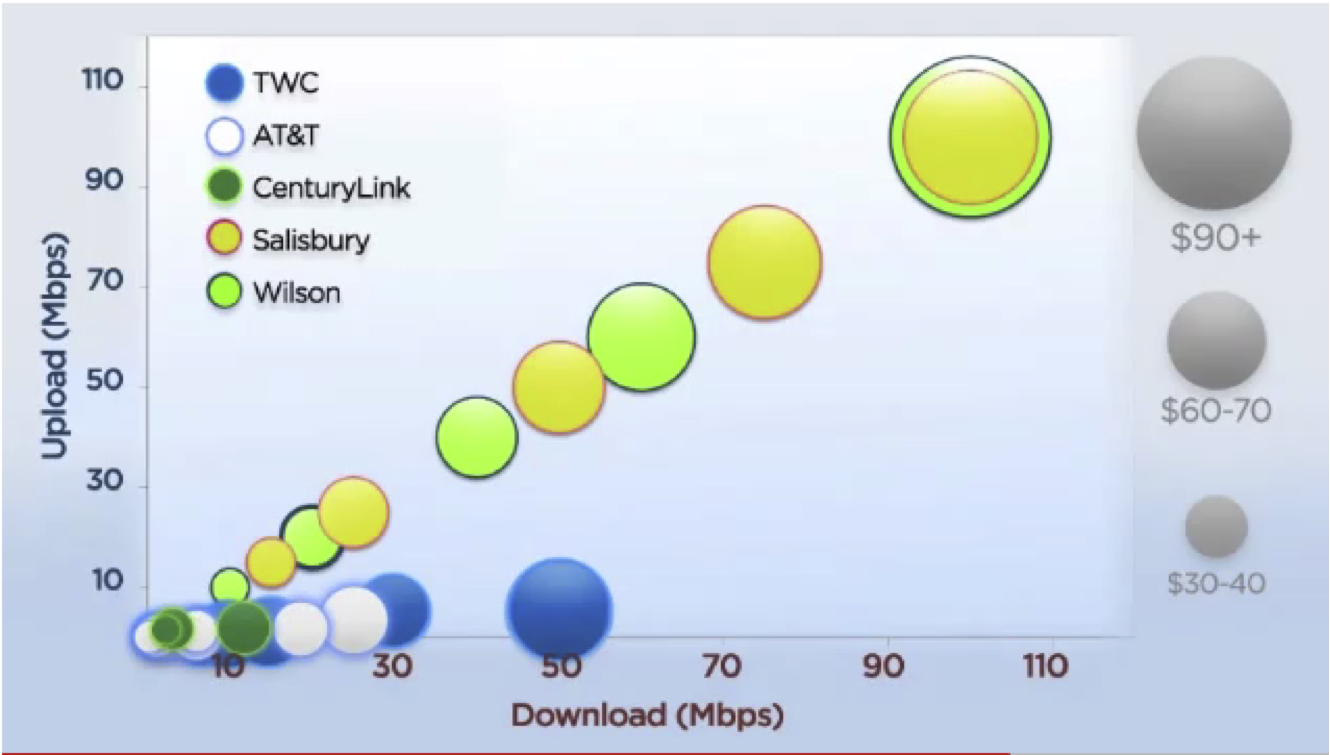
Let’s be even clearer about what is at stake in this fight. Muni networks are providing locally based broadband infrastructures that leave cable and telco ISPs in the dust. Nearby Chattanooga, Tennessee’scity owned EPB Fiber Optics service now advertises 1,000Mbps. Wilson, North Carolina is home to the Greenlight Community Network, which offers pay TV, phone service, and as much as 100Mbps Internet to subscribers (the more typical package goes at 20Mbps). Several other North Carolina cities have followed suit, launching their own networks. In comparison, Time Warner’s Road Runner plan advertises “blazing speeds” of 15Mbps max to Wilson area consumers. When asked why the cable company didn’t offer more competitive throughput rates, its spokesperson told a technology newsletter back in 2009 that TWC didn’t think anyone around there wanted faster service. When it comes to price per megabyte, GigaOm recently crunched some numbers and found out that North Carolina cities hold an amazing 7 of 10 spots on the “most expensive broadband in the US” list.
North Carolina has a long tradition of self-help and self-reliance, from founding the nation’s first public university to building Research Triangle Park. Befitting the state’s rural heritage, North Carolinians routinely take self-help measures to foster economic growth and provide essential local services such as drinking water and electric power. Statesville built the state’s first municipal power system in 1889, and over the years 50 North Carolina cities and towns followed suit. In 1936, the state’s first rural electric cooperative was launched in Tarboro to serve Edgecombe and Martin counties. Today, 26 nonprofit electric networks serve more than 2.5 million North Carolinians in 93 counties. Strangely, this self-help tradition is under attack. The General Assembly just passed a bill to restrict municipalities from building and operating broadband Internet systems to attract industry and create local jobs. Although pushed by the cable and telephone lobby, similar bills were defeated in previous legislative sessions. But the influx of freshmen legislators and new leadership in both houses created an opening for the dubiously titled “Level Playing Field” bill (HB 129).
No one disputes the importance of broadband access for economic growth and job creation. That’s why five cities – Wilson, Salisbury, Morganton, Davidson and Mooresville – invoked their self-help traditions to build and operate broadband systems after years of neglect from for-profit providers, which focus their investments in more affluent and densely populated areas. Not coincidentally, all five cities own and operate their own power systems or have ties to nonprofit electric cooperatives. (While the bill does not outlaw these five municipal networks, it restricts their expansion and requires them to make annual tax payments to the state as if they were for-profit companies.) How does a state that values independence, self-reliance and economic prosperity allow absentee-owned corporations to pass a law essentially granting two industries – cable and telephone – the power to dictate North Carolina’s broadband future? This question will be moot if Gov. Beverly Perdue exercises her veto power and sends this bill where it belongs: to the dustbin of history.
We don’t need more laws restricting anything around Internet infrastructure build-outs in the U.S. That’s the simple argument here.
We need the phone and cable companies to improve what they can, and we need to encourage and thank them for their good work. (As I sometimes do with Verizon FiOS, over which I am connected here in Massachusetts.)
We also need to recognize that the Internet is a utility and not just the third act (after phone and TV) in the “triple play” that phone and cable companies sell. The Net is more like roads, water, electricity and gas than like TV or telephony (both of which it subsumes). It’s not just about “content” delivered from Hollywood to “consumers,” or about a better way to do metered calls on the old Ma Bell model. It’s about everything you can possibly do with a connection to the rest of the world. The fatter that connection, the more you can do, and the more business can do.
Cities and regions blessed with fat pipes to the Internet are ports on the ocean of bits that now comprise the networked world. If citizens can’t get phone and cable companies to build out those ports, it’s perfectly legitimate for those citizens to do it themselves. That’s what municipal broadband build out is about, pure and simple. Would it be better to privatize those utilities eventually? Maybe. But in the meantime let’s not hamstring the only outlet for enterprise these citizens have found.
Here’s a simple fact for Governor Perdue to ponder: In the U.S. today, the leading innovators in Internet build-out are cities, not phone and cable companies. Look at Chatanooga and Lafayette — two red state cities that are doing an outstanding job of building infrastructure that attracts and supports new businesses of all kinds. Both are doing what no phone or cable companies seems able or willing to do. And both are succeeding in spite of massive opposition by those same incumbent duopolists.
The Internet is a rising tide that lifts all economic boats. At this stage in U.S. history, this fact seems to be fully motivating to enterprises mostly at the local level, and mostly in small cities. (Hi, Brett.) Their customers here are citizens who have direct and personal relationships with their cities and with actual or potential providers there, including the cities themselves. They want and need a level of Internet capacity that phone and cable companies (for whatever reason) are not yet giving them. These small cities provide good examples of The Market at work.
It isn’t government that’s competing with cable and phone companies here. Its people. Citizens.
No, these new build-outs are not perfect. None are, or can be. Often they’re messy. But nothing about them requires intervention by the state. Especially so early in whatever game this will end up being.
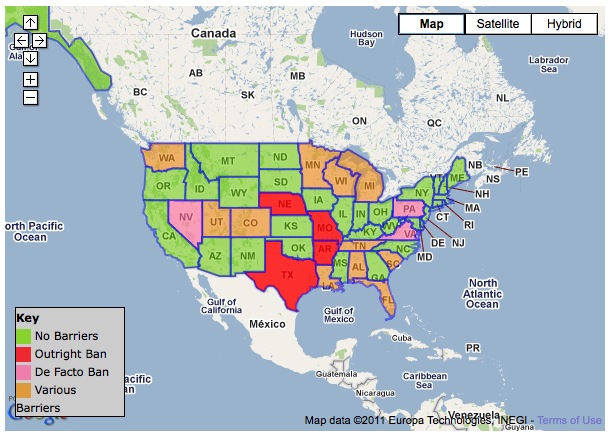
I urge friends, relatives and readers in North Carolina to Call Governor Perdue at (800) 662-7952, and to send her emails at governor.office@nc.gov. Tell her to veto this bill, and to keep North Carolina from turning pink or red on the map above. Tell her to keep the market for broadband as free as it’s been from the beginning.
On your desk is a bill passed by the overwhelmingly Republican North Carolina legislature to ban local communities from building or supporting community broadband networks. (H.129). By midnight tonight, you must decide whether to veto that bill, and force the legislature to take a second look.
North Carolina is an overwhelmingly rural state. Relative to the communities it competes with around the globe, it has among the slowest and most expensive Internet service. No economy will thrive in the 21st century without fast, cheap broadband, linking citizens, and enabling businesses to compete. And thus many communities throughout your state have contracted with private businesses to build their own community broadband networks.
These networks have been extraordinarily effective. The prices they offer North Carolinians is a fraction of the comparable cost of commercial network providers. The speed they offer is also much much faster.
This single picture, prepared by the Institute for Local Self Reliance, says it all: The yellow and green dots represent the download (x-axis) and upload (y-axis) speeds provided by two community networks in North Carolina. Their size represents their price. As you can see, community networks provide faster, cheaper service than their commercial competitors. And they provide much faster service overall.
Local competition in broadband service benefits the citizens who have demanded it. For that reason, community after community in North Carolina have passed resolutions asking you to give them the chance to provide the Internet service that the national quasi-monopolies have not. It is why businesses from across the nation have opposed the bill, and business leaders from your state, including Red Hat VP Michael Tiemann, have called upon you to veto the bill.
Commercial broadband providers are not happy with this new competition, however. After spending millions in lobbying and campaign contributions in North Carolina, they convinced your legislature to override the will of local North Carolina communities, and ban these faster, cheaper broadband networks. Rather than compete with better service, and better prices, they secured a government-granted protection against competition. And now, unless you veto H. 129, that protection against competition will become law.
Opponents of community broadband argue that it is “unfair” for broadband companies to have to compete against community-supported networks. But the same might be said of companies that would like to provide private roads. Or private fire protection. Or private police protection. Or private street lights. These companies too would face real competition from communities that choose to provide these services themselves. But no one would say that we should close down public fire departments just to be “fair” to potential private first-responders.
The reason is obvious to economists and scholars of telecommunications policy. As, for example, Professor Brett Frischmann argues, the Internet is essential infrastructure for the 21st century. And communities that rely solely upon private companies to provide public infrastructure will always have second-rate, or inferior, service.
In other nations around the world, strong rules forcing networks to compete guarantee faster, cheaper Internet than the private market alone would. Yet our FCC has abdicated its responsibility to create the conditions under which true private broadband competition might flourish in the United States. Instead, the United States has become a broadband backwater, out-competed not only by nations such as Japan and Korea, but also Britain, Germany and even France. According to a study by the Harvard Berkman Center completed last year, we rank 19th among OECD countries in combined prices for next generation Internet, and 19th for average advertised speeds. Overall, we rank below every major democratic competitor — including Spain — and just above Italy.
In a world in which FCC commissioners retire from the commission and take jobs with the companies they regulate (as Commissioner Baker has announced that she will do, by joining Comcast as a lobbyist, and as former FCC Chairman Powell has done, becoming a cable industry lobbyist), it is perhaps not surprising that these networks are protected from real competition.
But whether surprising or not, the real heroes in this story are the local communities that have chosen not to wait for federal regulators to wake up, and who have decided to create competition of their own. No community bans private networks. No community is unfairly subsidizing public service. Instead, local North Carolina communities are simply contracting to build 21st-century technology, so that citizens throughout the state can have 21st-century broadband at a price they can afford.
As an academic who has studied this question for more than a decade, I join many in believing that H.129 is terrible public policy…
Be a different kind of Democrat, Governor Perdue. I know you’ve received thousands of comments from citizens of North Carolina asking you to veto H.129. I know that given the size of the Republican majority in the legislature, it would be hard for your veto to be sustained.
But if you took this position of principle, regardless of whether or not you will ultimately prevail, you would inspire hundreds of thousands to join with you in a fight that is critical to the economic future of not just North Carolina, but the nation. And you would have shown Republicans and Democrats alike that it is possible for a leader to stand up against endless corporate campaign cash.
There is no defeat in standing for what you believe in. So stand with the majority of North Carolina’s citizens, and affirm the right of communities to provide not just the infrastructure of yesterday — schools, roads, public lighting, public police forces, and fire departments — but also the infrastructure of tomorrow — by driving competition to provide the 21st century’s information superhighway.
With respect,
Lawrence Lessig
To contact the governor, you can email her. If you’re from North Carolina, this link will take you to a tool to call the governor’s office. You can follow this fight on Twitter at @communitynets
You can follow similar fights on Twitter by searching #rootstrikers.
A few minutes ago I saw Stephen Hawking trending on Twitter, clicked on the link, and found myself on the Twitter Search page, where the two top tweets from news organizations were these:
HuffPo’s link goes to a brief story with no links to any sources. I see there’s a tiny AP symbol next to the dateline. Does this mean it’s an AP story? I guess so, but the AP symbol is not linked to anything. So I go to the AP site, look it up, and sure enough: it is an AP story. Here’s the second paragraph:
In an interview published Monday in The Guardian newspaper, the 69-year-old says the human brain is a like a computer that will stop working when its components fail.
No link to the Guardian story there, either. Or to anything.
So I go to the CBS News tweet, and find the shortlink leads to this story, where the second paragraph reads,
In an interview published in the Guardian, Hawking – author of the bestselling “A Brief History of Time” – said that when the brain ceases to function, that’s it.
Kudos to CBS for linking to a source, and especially for breaking ranks with other news outfits that only (or mostly) link to their own stuff. The NYTimes and the Washington Post are two familiar offenders, but not-linking and self-linking are the norms. (Less so for Guardian, which has always been much farther ahead of the curve than other major papers. Blogs at the papers, such as Andrew Revkin’s, link generously. But these are exceptions to the rules that seem to govern the paper’s ink-based sections.)
On the whole, mainstream media have had a passive-aggressive approach to the Web ever since they were first challenged by it, in the mid-’90s. Even now, in 2011, they’re still trying to shove the Web’s genie back in the old ink bottle. They do it with paywalls, with schemes to drag your eyes past pages and pages of advertising, and (perhaps worst of all) by leaving out hyperlinks. Never mind that the hyperlink is a perfect way to practice one of journalism’s prime responsibilities: citing sources. Or, by another verb, attriibuting.
Maybe they take too seriously David Weinberger‘s “Hyperlinks subvert hierarchy” thesis (#7) in The Cluetrain Manifesto, and want to stay on (or crawl to the) top of whatever heaps they occupy.
The reasons I’ve usually heard for not linking, or for only linking to internal pages, is that the journal’s site “needs” to be “sticky,” to “drive traffic” past ads, and to maximize the time spent by readers on the site. (Nobody defends the tracking of readers.) Whatever the rationale, not-linking compromises an online journal’s editorial mission — especially if not-linking is policy and not just habit. (I think, for example, that with Fast Company it’s policy. For example, all the links in this story go to other Fast Company stories.)
So now I’m wondering if anybody has researched, or would be interested in researching, the practice of linking to sources by online journals — especially by mainstream news sites. Would this be a job for Media Cloud, I wonder? (I’ll bring it up with my friends there at the Berkman Center when I’m there tomorrow.)
The Santa Barbara Arts Collective is looking for worthy photographs to hang in the Mayor’s office. And my friend Joe just called to suggest I submit some candidates.
I could go on, but I’d rather leaving the chosing up to you. (If you think any of them are worthy.) Votes?
By the way, most of those shots were taken with a 5-megapixel Nikon CoolPix 5700. Not my newer (but now also old) Canon 30D or 5D cameras. None of my cameras or lenses are especially desirable, by Real Photographer standards. Someday I’ll get the gear I’d like, starting with lenses. Meanwhile, like they say, the best camera is the one you’ve got. And what you see in those collections is from what I had at the time.
Oh, and all are Creative Commons licensed just to require attribution. Feel free, because they pretty much are exactly that.
Just about everybody I know who has heard about the sale of Skype to Microsoft has groaned about it. Myself included.
No doubt it makes sense for the entities involved. eBay, various investors and the founders all make money on the deal. Microsoft/Nokia now gets to be Microsoft/Nokia/Skype. Those not involved, including Google, Apple, and all carriers other than those partnering with SkypeNoSoft get nothing.
What the world will get is a set of services that work best only on Nokia’s Windows Mobile devices. Also count on fees for new and old Skype services, with complicated and confusing plans from the carriers.
Add involvements by the ITU (a Microsoft site, Silverlight and all) and governments that like tariffs on calls and data services, and we’ll see the Internet further subordinated to the same telecom business we’ve had since telegraphy. Same meatloaf, new gravy.
Also count on appealing alternatives coming out of Apple and Google, sooner rather than later.
As for Facebook, I have no idea. They’re well-placed to become some kind of player in the telecom business, whatever it becomes, but I don’t see them doing much more than continuing to be AOL 2.x.
I’d say more, but I have a book to finish. If you’re wondering why blogging has been slow lately, that’s why.
Really, this is good news. While users are trying to figure out whether to download “Skype Live Small Business Edition” or “Skype For Windows Professional Platinum 7.0”, some startup will eat their lunch.
We’re doing something different at next week’s IIW: inviting investors. So here’s a pitch that should resonate with investors — especially in Silicon Valley, where IIW happens (appropriately, at the Computer History Museum in Mountain View)…
Here’s a chance to check in on development work on a huge new disruptive market play: empowering customers as independent players in the marketplace, and building new businesses that serve liberated customers who want choices other than those between silos and walled gardens.
We’re talking here about equipping demand to drive supply, rather than just the reverse. (Which is fine and necessary, but it’s been done. A lot.)
We’re talking about creating tools and services proving at last that free customers are more valuable than captive ones.
We’re talking about how much more can happen in a marketplace where customers collect, control and selectively share their own data, for their own purposes — which nobody on the vendor side needs to guess about, because the customer knows, has the intent, and has the money.
We’ve been working on these tools for awhile now. My own work, both through IIW (which I help organize) and ProjectVRM at Harvard’s Berkman Center, has been to encourage development of tools that liberate and empower customers in the marketplace. Thanks also to the good work of allied efforts, many of these tools now exist, and more are coming along.
These tools fall into many categories. Some are open source efforts that equip developers with essential building material. Some are commercial efforts at the angel or pre-angel stages. Some are already funded. Some are existing businesses looking for partners. Whatever breed they are, all should be interesting to investors looking to place bets on customers, and on companies that align with customer interests and intentions in the marketplace.
IIW — which stands for Internet Identity Workshop — has always been about development. Since 2005 we’ve been getting together twice a year to share ideas and move work forward. As a workshop, it’s organized as an unconference. No speakers, no panels. Participants suggest topics and everybody breaks out to rooms and tables where those topics get discussed, whiteboards get marked up, and in many cases code gets shown and improved.
On Tuesday and Wednesday, May 3 and 4, the workshop will follow the usual routine. But on Thursday, May 5, we’ll visit a new topic which we’re calling “Yukon”: a one-word play on the line, “You control your own data.” As it says here,
Something New: IIW + Yukon: One of the longtime themes of IIW is how identity and personal data intersect. Many important discussions about Vendor Relationship Management (VRM) have also taken place at IIW. In recognition of how personal data and identity are intertwined, the third day of the IIW, May 5, will be designated “IIW + Yukon” and will stress the emerging personal data economy. The primary theme will be personal data control and leverage, where the individual controls and drives the use of their own data, and data about them held by other parties.
This isn’t social. It’s personal. This day you can expext open-space style discussions of personal data stores (PDS), PDS ecosystems, and VRM. One purpose of Yukon is to start to focus on business models and value propositions, so we will specifically be reaching out to angels and VC’s who are intersted in personal data economy plays and inviting them to attend.
Whether or not you’re an investor, or just friends with some (as pretty much all of us are these days), you’re invited. Looking forward to seeing you there.
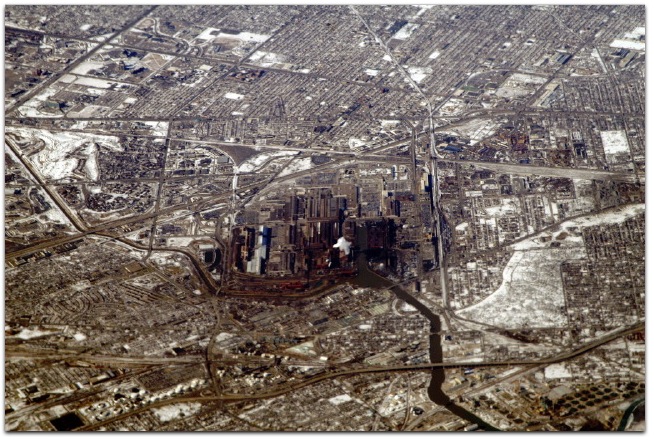
Got my first good clear look at Detroit and Windsor from altitude on a recent trip back from somewhere. Here’s a series of shots. What impressed me most, amidst all that flat snow-dusted spread of city streets, a patch of grids on the flatland of Michigan and Ontario, flanking the Detroit River and its islands, was what looked like a dark smudge. Looking at it more closely, and matching it up with Reality, I discovered that this was Ford’s famous River Rouge Complex in the city of Dearborn.
Says Wikipedia,
The Rouge measures 1.5 miles (2.4 km) wide by 1 mile (1.6 km) long, including 93 buildings with nearly 16 million square feet (1.5 km²) of factory floor space. With its own docks in the dredgedRouge River, 100 miles (160 km) of interior railroad track, its own electricity plant, and ore processing, the titanic Rouge was able to turn raw materials into running vehicles within this single complex, a prime example of vertical-integration production. Over 100,000 workers were employed there in the 1930s.
As an inveterate infrastructure freak, I would love to see this thing sometime.
The Royal Weddingisn’t my cup of tedium, but olde blog buddies Eric and Dawn Olsen will be covering the show for The Morton Report, so I urge you to follow it there. I’ll do my best as well.
Not speaking of which, I am old enough to remember the last Royal Wedding, which happened on my birthday in 1981. What sticks most in my mind about that event is an exceptionally funny send-up of the whole thing: a book titled Not the Royal Wedding, by Sean Hardie and John Lloyd. My sister, who (I’ll let her explain) served “on the personal staff of the Commander-in-Chief, US Naval Forces Europe as the Protocol Officer, living in a mews flat in Chelsea, working on Grosvenor Square and having the best time of my life”, brought the book back to the states, and I laughed my rocks off reading it, even though I’m sure many of the jokes sailed past me. One item that stands out is a large spread on the royal silverware, including a “bitchfork.” The price on Amazon at that last link is also pretty good: “5 used from £0.01”, it says.
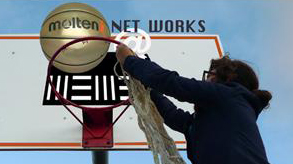
As a (literally) old basketball player, I have always hated dealing with net-less hoops. Full satisfaction for a shot well made requires a net. But nets do wear out. Schools and cities fail to replace them. So I sometimes take matters into my own hands, and replace nets personally.
MOLTENi NET WORKS function simply. Participants will hand-crochet basketball nets to be installed on hoops where such are missing or damaged. I’ve created a blog and gmap to keep track of spaces where nets have been installed or have yet to be. Contributors may follow the progress of the project, reporting sightings and requests for nets in their own neighborhoods. Efforts have begun locally, and spread to additional projects such as artist Kevin Clancy’s “Portable Utopia” in Johannesburg. I aim to engage other creative enthusiasts collaborating via workshops and skill shares to fabricate nets and exchange new design ideas.
This good work is what earned MOLTENI NET WORKS an Awesome Foundation award in February from the Boston chapter, of which I am a trustee. We have never had a more deserving recipient. Here’s what Kara Brickman reports in our latest blog post:
The MOLTENi NET WORKS project is well underway with a recent exhibit at Cambridge’sMEME Gallery in Central Square that also included workshops where participants were able to hand-crochet basketball nets to be installed on bare hoops. Efforts have begun locally in Allston, MA and there are several local organizations (Boston include Artists for Humanity, Villa Victoria Center for the Arts, Design Studio for Social Intervention, and Massart’s Fibers Department) interested in putting on more workshops.
If you’d like to get pitch in, there are a few ways you can get involved.
Blogging, emailing and messaging aren’t owned by anybody. Tweeting is owned by Twitter. That’s a problem.
In all fairness, this probably wasn’t the plan when Twitter’s founders started the service. But that’s where they (and we) are now. Twitter has become de facto infrastructure, and that’s bad, because Twitter is failing.
There is not yet an agreed-upon definition. Bell-heads think it’s a “network of networks,” all owned by private or public entities that each need to protect their investments and interests. Net-heads (that’s us) think it’s a collection of protocols and general characteristics that transcend physical infrastructure and parochial interests. If you disagree with either of the last two sentences, you demonstrate the problem, and why so many arguments about, say, “net neutrality,” go nowhere.
The idea is to assign defining the Internet to students in different disciplines: linguistics, urban planning, computer science, law, business, engineering, etc. Then bring them together to discuss and reconcile their results, with the purpose of informing arguments about policy, business, and infrastructure development. The result will be better policy, better business and better deployments. Or, as per instructions, “a better place for everyone.”
There should be fun research possibilities in the midst of that as well.
It’s a Berkman project, but I applied in my capacity as a CITS fellow at UCSB. I’ll be back in Santa Barbara for the next week, and the focus of my work there for the duration has been Internet and Infrastructure. (And, if all goes as planned, the subject the book after the one I’m writing now.)
So we’ll see where it goes. Even if it’s nowhere, it’s still a good idea, because there are huge disagreements about what the Internet is, and that’s holding us back.
I know Chicago well — from the air. I’ve flown in and out of O’Hare countless times, always enjoying the view from my window seat. I’ve also flown over Chicago a lot, en routes from cities east and west. And I’ve shot a lot of pictures, which I usually used to put up on Flickr; but I’ve slacked off since concentrating on a book and getting the willies about Flickr’s own survival.
I’ve also studied its roads, its infrastructure, usually by looking at the pictures I’ve taken and studying their subjects. Examples here, here and here.
Yet I’ve spent very little time in the town itself. Back in the early ’90s, when I consulted the late Zenith Data Systems, Bruce Fryer once took me downtown to show me around. Linda Hayes (also with ZDS at the time) once took me on a tour of the Lake View area. And I think I went to exactly one trade show at McCormick Place (the white thing near the bottom of the shot above). That’s about it.
So I’d like to fix that, one of these years. Meanwhile, I thought it worth sharing the latest fly-by, en route from Salt Lake City to Boston by way of Phoenix. Click on the shot above for the whole series.
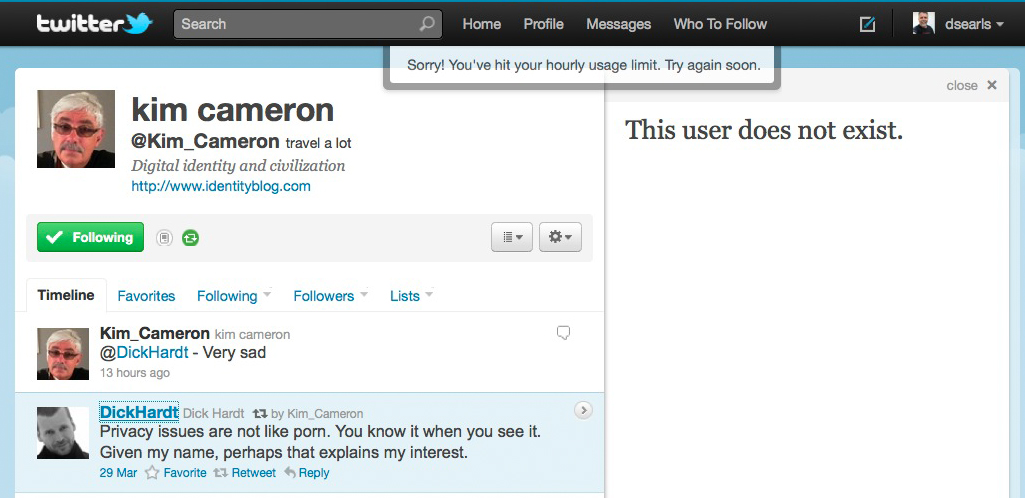
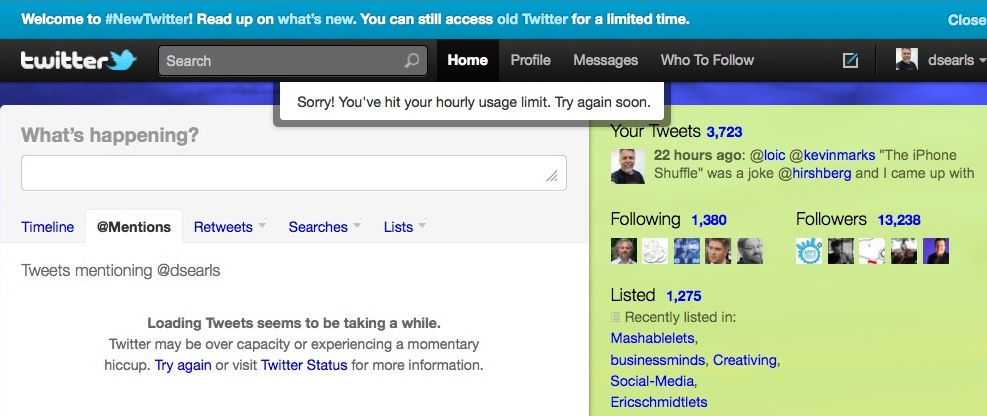
The first time I went to Twitter this morning, I got this:
Before that, the computer had been asleep all night.
I still haven’t tweeted anything this morning.
There must be some meaning behind the message, but the message itself says nothing useful.
When I’ve seen this before, I thought perhaps Twitter in my browser had been hitting the API too hard for updates or something. But I didn’t even have my browser open. Neither my computer nor I had been doing anything with Twitter — as far as I know.
This story says, “Twitter restricts the amount you can access the service to a set rate in an effort to prevent apps from mercilessly pinging Twitter every x number of seconds.” But what apps are pinging the server? How? What can a user do to get an app to back off — or even see which app needs to back off?
I have many dozens of apps on my phone. Could it be one of those? Since the computer was asleep and the phone was on I’d guess so, but I have no idea. When I look at the apps that might be open, in the “tray” (or whatever that is) at the bottom of my iPhone screen (which only appears if I double-click on the button), I see nothing obvioius that might hit Twitter. Clock? Calendar? Voice Memos? Foursquare? Of those I’d guess Foursquare, but I can’t find where in Foursquare I could control how it hits Twitter’s API, or have anything to do with Twitter. Its settings say nothing about Twitter.
Could it be the Twitter app? I just noticed that it was open too. I can’t think of any other culprit at this point.
Adds Chad, “Some API clients, including Twitter’s own products, have additional rate limit allowances.” What those ‘additional rate limit allowances’ are, only Twitter knows.”
Whatever the trouble is, Twitter doesn’t provide an easy way to shoot it.
Here’s the bigger problem: We have come to treat Twitter as infrastructure, and clearly it is not. It is a huge single point of failure, and it sorely needs to be substitutable.
By that I mean you can tweet on other sites, or on your own server, and have those tweets followed by anybody. It means your followers don’t need Twitter to follow you — they don’t need anybody other than you.
[Later…] I turned off the Twitter app on my iPhone, and haven’t run into the usage limit again yet. Coincidence?
If the Twitter app really is to blame, there needs to be a way it can warn the user that it’s hitting the API too often, and offer a way to reduce that form of background traffic.
[Later again…] Well, it’s now the 13th. I haven’t had the Twitter app open on the phone, I’ve turned off a number of other services on the Web that might be hitting the Twitter API on my behalf, and I hardly looked at Twitter at all today before making one tweet. And I got the “hourly usage limit” message again.
This is fucked up.
By the way, I would pay Twitter to avoid this hassle. I that the idea? If so, maybe it’s working. But it’s a shitty shakedown, if true.
What started as plain old Web search has now been marginalized as “organic”. That’s because the plain old Web — the one Tim Berners-Lee created as a way to hyperlink documents — has become commercialized to such an extent that the about the only “organic” result reliably rising to first-page status is Wikipedia.
Let’s say your interest in “granite” and “Vermont” is geological, rather than commercial. The first page of Google results won’t help much if your interest goes beyond visiting a headstone mine. Same goes for Bing. I notice this change because it’s becoming harder and harder for me to do casual research on geology (or most other topics that interest me) on the Web.
Yesterday Vivek Wadhwa tweeted a perfect line: “Google is paying content farms to pollute the web”. This is true, yet the problem is bigger than that. The Web is changing from a world wide library with some commercial content to a world wide mall with intellectually interesting publications buried under it, in virtual catacombs. Google’s mission of “organizing all the world’s information” is still satisfied. The problem is that most of that information — at least on the Web — is about selling something. The percentage of websites that are Web stores goes up and up. SEO only makes the problem worse.
The Berkman Center and Stanford Law School are pleased to announce a new initiative in which we invite the world to submit their ‘Ideas for a Better Internet.’ We are seeking out brief proposals from anyone with ideas as to how to improve the Internet. Students at Harvard and Stanford will work through early next year to implement the ideas selected. Interested parties should submit their ideas at http://bit.ly/i4bicfp by Friday, April 15. Please spread the word far and wide, and follow us on Twitter at http://twitter.com/Ideas4BetterNet.
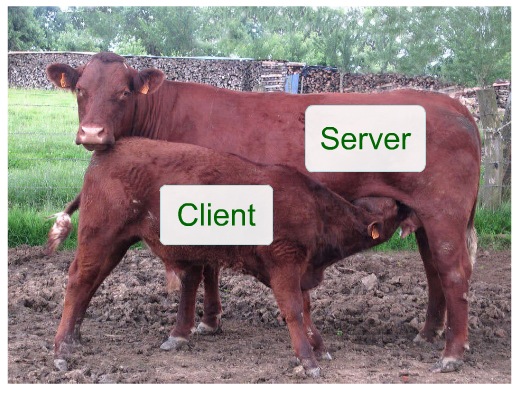
“Social networks” are getting out of control. And I don’t mean their control. I mean your control and mine. Here’s an image to keep in mind while you read the rest of this post:
The calf is you or me. The cow is just one of our many social networks. Here’s how the situation looks from my browser…
I have 840 contacts on Facebook. I won’t call them friends, though some of them are. A few are relatives, but most are neither. They’re people I’ve met or had contact with, somehow, somewhere. I also have 675 “friend requests.” If you’re on that list and want to contact me, find another way, since I avoid Facebook for all but the unavoidable (such as, say, a reunion that’s being organized by relatives).
I have 480 contacts on Linkedin, most of which I know about as well as my contacts on Facebook. I also belong to one Linkedin discussion group that I haven’t figured out how to deal with yet, mostly because I prefer my discussion groups in email, where I can sort them out into boxes of my own making. I see that Linkedin now also has updates on the Twitter model (and via Twitter). I see why they do it, but I don’t need it.
I have 212 contacts on Flickr (plus more through threeotheraccounts). I don’t know and don’t follow most of those contacts, because to me Flickr is is for sharing photos with the world in organized ways. While I appreciate the groups there, I’ve organized none, and when my photos show up in some, it’s always because other people — most of which I don’t know — have put them there. I also know few if any of the people who have put more than 200 of my photos on Wikimedia Commons, a gallery of photos eligible for inclusion in Wikipedia articles. (And, in fact, most of my shots in the Commons are also in Wikipedia.) Again, this is not a social effect. Also note that in the Wikipedia case that there isn’t a business model anywhere in sight (aside from the $50/year I gladly pay for my two “pro” Flickr accounts).
I follow 1352 entities (most are people, some are companies or organizations) on Twitter, and am followed by 13,096 others. I am sure most of us, whoever (and whatever) we are, don’t know each other. I use Twitter to find and share interesting stuff in short postings. This may be “social,” but only in a very loose sense.
I don’t know how many “friends” or contacts I have on Google, because I can’t find a number, or a list. My iGoogle page (which I view in just one of the four browsers I use) lists eight alphabetically before it runs out out of space at the letter N. I don’t know how to scroll down to see the rest, and I’m not much interested in trying. In any case the number is a tiny subset of lists elsewhere. For what it’s worth, I use Google’s services for many different things (docs, self-organized groups, mail de-spamming), but “social” stuff is not among them.
The address book on my computer lists 1162 cards, including a growing number of dead people, dead companies, and dead numbers from live companies. Yesterday I weeded the number of Verizon contact numbers down from six to one.
My main chat client, which spans four different contact lists and accounts (AIM-iChat, Google, Linux Journal and the Berkman Center), currently shows 35 available. I don’t know what the total number of contacts there is. Several hundred, I guess.
My other chat account, Skype, doesn’t integrate with those in the last paragraph and doesn’t give me a count of people online and off. I’m guessing I have about fifty contacts there.
The job of integrating all of these is mine, and I don’t bother, because the tools for doing that don’t yet exist — at least not in sufficient maturity for me to contemplate using them. Thus I am not yet what Joe Andrieu calls the point of integration for my own data. In fact I can’t be, because most of the data in these “social networks” is not mine. Functionally (if not also legally), it’s theirs. And I’m just a calf for each of them.
Of course, all these companies want to help me do everything, by leveraging the “social” data they have about me. Mostly they give me advertising that doesn’t help, but sometimes they just try to improve their meat and potatoes with “social” gravy. The latest example is Google, with “+1” recommendations. These augment Google’s thirdimprovement to social search, through a button “to publicly give something your stamp of approval.” The idea: “Your +1’s can help friends, contacts, and others on the web find the best stuff when they search,” because “sometimes it’s easier to find exactly what you’re looking for when someone you know already found it.”
Why does Google think we want to “find the best stuff” all the time — as if all we do is shop, or something like it? Sure, they make their money with advertising, but I think the real reason is that they can’t resist the temptation to route “social” signals into everything else. Hey, it’s what the other kids are doing.
Since so much of what those kids do is invisible to us, they try to get away with all kinds of stuff. For more on what they’re doing, read The Wall Street Journal‘s What They Know series (http://wsj.com/wtk), and Joe Andrieu’s ISharedWhat Facebook login simulation site, which shows you how much personal data — yours and your friends’ — might get spilled every time you click on one of these:
They get away with it because the calf-cow system allows it. Also because the World Wide Ranch is getting really freaking huge. By some counts there are more than a billion commercial sites on the Web. Just by the sheer numbers involved, the default assumption is that most searches have commercial purposes. That’s what you’re likely to find in any case.
It’s interesting that non-advertising search results are now called “organic,” as if they were some kind of marginalized exception, of interest only to to a few obsessive purists.
Says Wikipedia, “Organic search results are listings on search engine results pages that appear because of their relevance to the search terms, as opposed to their being advertisements. In contrast, non-organic search results may include pay per click advertising.” How quaint and retro, to think that some search results should simply be relevant to search terms, without commercial prejudice by the search engine.
In respect to Google’s recent search improvements, I submit that organic searches are still what people want most, and that “social” help is marginal at best and distracting at worst.
Take yesterday morning, when I was wondering what accounts for ground conductivity. This was, admittedly, an idle distraction of the sort I wrote about later in the day, in World Wide Puddle. I mean, I didn’t really need to know what accounts for ground conductivity, especially since it’s a question I’ve had for about fifty years, and I haven’t suffered for lack of an answer. But search engines are here for a reason, so I looked again.
Google says it finds more than six million results in a search for “ground conductivity”. The top result is the FCC’s M3 maps page, which I’d expect. These maps explain why, for example, WNAX, a 5000-watt radio station on 570am in Yankton, South Dakota, has a signal that reaches from Canada to Oklahoma, while WWNC, a station on the same channel in Asheville, North Carolina, operating with the same power, covers an area only a fraction the size of WNAX’s. For a broadcast engineering junkie like me, this is catnip, but it doesn’t explain why ground conductivity varies from one region to another. I mean, why does flat ground in Long Island have almost no ground conductivity (0.5 mhos/meter) while equally flat ground around Dallas has very high ground conductivity (30 mhos/meter). Why do mountains in New England have low conductivity (2-4 mhos/meter) while mountains in coastal California have high conductivity (8-30 mhos/meter)? The M3 maps don’t say.
The third result, from Tom K1JJ, tells how to measure ground conductivity, but doesn’t explain the cause.
Next is a Facebook page on the subject, with a write-up lifted straight out of Wikipedia. It is recommended to me, with thumbs up, by two people I know: a nephew of mine and a fellow broadcast engineering obsessive. There is no discussion, and the page says “0 people like this”.
Two decades ago, when Compuserve hosted a large variety of excellent forums, I belonged to a broadcast engineering social network of sorts (though few of us met in real life). But today I don’t have one, even on Facebook — and the rest of my many “social networks” are no help with searches like this one.
Hmm… I just thought, “maybe Quora could provide some help. I just went there in the browser where Quora’s cookies for me are parked. It still wants me to log in, and a minute has passed while the progress thing on the bottom of the page says “Waiting for Facebook.” Okay, I’m there now, and I just put up the question, “What causes ground conductivity?”. According to Quora, I have “981 Followers, 485 Following” and “6 @Mentions” there. Will one or more of them get me an answer? Interesting experiment. We’ll see.
Whatever happens on Quora, I have no faith that my searches on Google will be improved by anybody’s “+1,” any more than my searches have been improved by “social” whatever. Here’s why: usually I’m looking for something very specific. And often what I’m looking for is not for sale.
In most cases I use Google and Bing the way I use a dictionary: to look something up. I don’t need a “recommendation” when I just want to know how to spell “mocassin”. Stand back, everybody. I think the dictionary should have it. Thank you.
I learned about Google’s “+1” feature only this morning, on Sheila Lennon’s blog. There she quotes the same Google post about “+1”:
So how do we know which +1’s to show you? Like social search, we use many signals to identify the most useful recommendations, including things like the people you are already connected to through Google (your chat buddies and contacts, for example). Soon we may also incorporate other signals, such as your connections on sites like Twitter, to ensure your recommendations are as relevant as possible. If you want to know who you’re connected to, and how, visit the “Social Circle and Content” section of the Google Dashboard.
To get started +1’ing the stuff you like, you’ll need to create a Google profile—or if you already have one, upgrade it. You can use your profile to see all of your +1’s in one place, and delete those you no longer want to recommend. To see +1’s in your Google search results you’ll need to be logged into your Google Account.
I just clicked on the Google Dashboard link, and found I had to log in, even though I was already logged in on a different tab in the same browser. This got me into my Google Accounts page, which has a LOT of information in a lot of contexts — all provided by Google. At the top is Gmail. Slightly edited (for the privacy of others), and with links removed, it says,
Gmail
Inbox 5000 conversations
Most recent: [18] new discussions, [15] new comments… at 9:22 AM
All mail 5000 conversations
Most recent: [18] new discussions, [15] new comments… at 9:22 AM
Sent mail 70 conversations
Most recent: ____ on Mar 31, 2011
Saved drafts 46 conversations
Most recent: progress & title on Mar 9, 2011
Chat history 60 conversations
Most recent: Chat with __________ on Mar 11, 2011
Spam 17000 conversations
Most recent: Copy of a Gucci watch is what you need … at 9:40 AMTrash 60 conversationsMost recent: Re: Sharing my TEDx Talk: The Unclear Path at 11:01 PM
First, I almost never go to Gmail in a browser. In fact, few people know my actual Gmail address (which is silly and has nothing to do with my real name). All mail to me at Searls.com gets routed to my Gmail account, which I use to filter out spam. I then pick up mail there from my IMAP account, which keeps copies at the server, or “in the cloud” as we now like to say.
Second, what makes Spam or Trash “conversations”? I’ll go to my grave being known as the main guy responsible for the “markets are conversations” meme, but usage like this makes me regret it.
Following Gmail on my Accounts page are:
Google Video (nothing uploaded)
Groups (33 total, mostly inactive, and not including two I just killed off)
Health (1 profile, which I gave up filling out long ago)
iGoogle (14 gadgets, 1 tab)
Latitude (disabled, because I like not being tracked)
Product search (shopping list has two items: the most recent of which reads “Most recent: Canon EOS 30D on May 27, 2006″ — a camera I bought long ago)
Profile (16 “about me” items, most of which I have kept vague)
Reader (36 subscriptions, following 11)
Sidewiki (no entries)
Sites (1 “shared with me” that I don’t know)
Social Circle and Content (which says,
Direct connections from Google chat and contacts 4 connections with content; Direct connections from links listed on your Google profile 200 connections with content; Secondary connections 1788 connections with content; and Social content 3 links — and I have no idea wtf that all means)
Talk (23 contacts, which settles a guess I made above)
Web history (most recent for Web, Images, News, Products, Video, Maps, Blogs and Books — but only with this one browser, on this one laptop)
YouTube (a profile, plus a paucity of stuff under uploads, history, favorites, subscription, contacts and personal messages)
Other products (“11 additional products are not yet available in this dashboard – Show all”)
So I just spent twenty minutes weeding through and cleaning up all that stuff. I could spend similar sums of time doing the same on Linkedin, Flickr and other services. But I would rather have my own way of keeping personal information straight with myself, and sharing it selectively and when I felt like it. That’s what VRM development going on in the Personal Data Ecosystem is about. I won’t go into all the projects, but the idea they share is that each of us, as sovereign individuals, are (as Joe says) the best points of integration for our own data. None of these social sites, no matter how well-intended they may be, can do the job, simply because nothing, and nobody, can be personal for me on my behalf. If puppets are involved, they need to be mine. Not the reverse.
Now that the world’s information is posted, linked, indexed and searchable, and friends are connecting, sharing, liking, and following, the quest is on to streamline the noise and give the Web another dimension – one not measured by the data, or who led you to the data, but you as an individual. The third wave of the Web, I believe, is going to be about personalization by individual based on that individual’s preferences – explicitly stated or otherwise.
The declaration of the next wave of the Web being personal is not shared universally, of course. Some say the next wave is all about mobile. Others may say the next wave is all about location. But the right approach to ‘personal’ absolutely encompasses each of these things. With our smartphones and tablets being increasingly powerful, they are practically an extension of us, and we are relying on them to discover relevant things, content, places and products for us as individuals. Similarly, our location is an ingredient of who we are – for where we are impacts our decisions, and what tips are relevant, be it for news, for restaurants, lodging, dating or anything else. So “personal” as an individual is both local and mobile.
Excellent. I especially like how smartphones and tablets are extensions of ourselves in the world. (A little more about that here.) Then he adds,
Personal As In Me.
A lot of services say they are “personal”, when in fact, most of what they do is actually social.
These services may leverage your social graph to provide personalized recommendations based on what friends or other people similar to you may like – much like television shows group people of similar demographics to guess what commercials are best suited for which episodes in which time slots. The hope may be that the more your friends like something, the more likely you are to click it or buy it. Peer pressure, you know. Meanwhile, other services say they are personal because you have specifically provided them with information about you and what you like, which goes partway to discovering your interests, but is incomplete, and possibly inaccurate, as you may want to indicate that you are something that you are not, or you may have overlooked some of your own interests in the name of rapid completion.
Beyond these initial attempts is a new wave of companies trying to crack the code of the real you. Of course, my6sense is one of those companies. Our goal is to deliver a personalized experience in all possible aspects of your life, finding the right information for you at the right time in the right context, based on you as an individual. But we are not alone. Take, for example, Hunch.com, which is talking about personalizing the Internet, and says they can build a taste profile for you, based on your own unique interests and tastes. Also, in October, Mike Arrington of TechCrunch previewed Gravity, founded by former MySpace executives. In that piece, which he headlined as “The Personalization War”, he said “I saw my own Interest Graph based only on my Facebook and Twitter streams over the last several months and it’s scary-accurate.”
Louis doesn’t go off the personal rails here. He just doesn’t quite get on, staying instead on the corporate ones:
Which makes sense: My6sense is his company. Then finally,
The continuing rapid growth of information creation and sharing, combined with pervasive connectivity, increased capability of smartphones and other mobile devices and the growth of location is all pointing us into a direction where the services on the other end have more potential to know you than those of years past, and you have the ability to be inspired by the right information in the right place more than ever before. This is a wave, one that benefits from all these mega-changes in the Web, that small companies and big ones alike are seeing. Maybe there’s another big winner in there, just like there was in the last two. Regardless, the direction is clear. Show me my Web for me.
Sorry, but no. My Web is not their Web. I’m tired of being shown. I’m tired of “experiences” that are “delivered” to me. I’m tired of bad guesswork — or any guesswork. I don’t want “scarily accurate” guesses about me and what I might want.
What I crave is independence, and better ways of engaging — ones that are mine and not just theirs. Ones that work across multiple services in consistent ways. Ones that let me change my data with all these services at once, if I want to.
I want liberation from the commercial Web’s two-decade old design flaws. I don’t care how much a company uses first person possessive pronouns on my behalf. They are not me, they do now know me, and I do not want them pretending to be me, or shoving their tentacles into my pockets, or what their robots think is my brain. Enough, already.
I spoke at Kynetx Impact the night before Louis’ talk. The visuals are on Slideshare. Here is slide 25, which illustrates the problem with the commercial Web’s long-defaulted client-server design:
Wikipedia says, “The client–server model of computing is a distributed application structure that partitions tasks or workloads between the providers of a resource or service, called servers, and service requesters, called clients.”
So, while the Net itself has an end-to-end design, in which all the ends are essentially peers, the Web (technically an application on the Net) has a submisive-dominant design in which clients submit to servers. It’s a calf-cow model. As calves, we request pages and other files from servers, usually getting cookie ingredients mixed in, so the cow can remember where we were the last time we suckled, and also give us better services. Especially advertising.
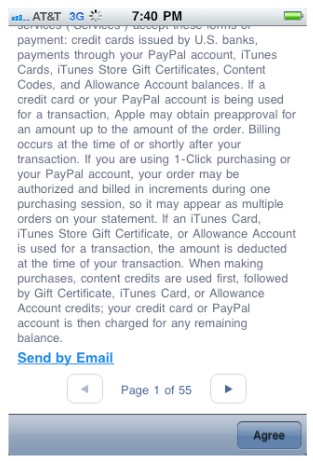
We have no choice but to agree with this system, if we want to be part of it. And, since the cows provide all the context for everything we do with them, we have onerous “agreements” in name only, such as what you see on your iPhone every time Apple makes a change to their store:
A type of contract, a legally binding agreement between two parties to do a certain thing, in which one side has all the bargaining power and uses it to write the contract primarily to his or her advantage.
An example of an adhesion contract is a standardized contract form that offers goods or services to consumers on essentially a “take it or leave it” basis without giving consumers realistic opportunities to negotiate terms that would benefit their interests. When this occurs, the consumer cannot obtain the desired product or service unless he or she acquiesces to the form contract.
Here’s the thing: client-server’s calf-cow model requires this kind of thing, because the system is designed so the server-cows are in complete control. You are not free. You are captive, and dependent.
This system has substantiated a business belief that has been around ever since Industry won the industrial revolution: that a captive customer is more valuable than a free one. We’ve built systems that tendentiously affirm that belief, and the commercial Web is chief among those systems today. Correspondingly, on the customer side, we actually believe that a free market is your choice of captor. Even champions of the free market, such as The Wall Street Journal, seem to think this is okay. (Or they wouldn’t keep talking about how telecom giants — occupants of a regulatory zoo they all but own and control — comprise the “free market” at work.)
If the next wave is personal, then we have to bring our own contexts.
Think for a moment about the context of renting a wheelbarrow. If you sign an agreement for that, it’s only to put up a deposit, pay a certain amount, assume liability for whatever harms you might cause with it, and return the thing in good condition. That’s about it.
Or think about what happens when you walk into a shoe store. You don’t have to sign a damn thing. (If you’re lucky, the store won’t require that you belong to their “loyalty” program just to get a “discount” that’s nothing more than a normal price, rather than a higher price they charge to punish non-“members”.) Your context is shopping for shoes. Laws apply, of course. You aren’t allowed to steal things or act in a disturbing way. But nobody stands at the door telling you to stop and sign an agreement — least of all one with clauses (which nearly all adhesive contracts have) saying they have the right to change the terms, and they can do that whenever they please.
We won’t get rid of calf-cow systems, nor should we. They work, but they have their limits, and those become more apparent with every new calf-cow service we join. But we can work around these things, and supplement them with other systems that give us equal power on equal footings, including the ability to proffer our own terms, express our own preferences and policies, and make independent choices.
Louis Gray’s personal wave is for real, and it’s just starting. It’s also what we’ve been building through the last four years with ProjectVRM. And it’s starting to catch on. The number and variety of VRM development projects has grown a lot lately, as has the activity level as well.
Naturally, VRM has attracted the interest of major players on the sell side of the marketplace. A month ago I spoke on stage with John Battelle on stage at the Internet Advertising Bureau conference. (John’s insightful post about “digital plumage” ran in the same timeframe.) Next week I’ll speak at SugarCon in San Francisco and to a meeting with Best Buy and General Mills in Minneapolis. It’ll be fun.
The message I’m bringing is not about how these companies can improve the cow systems everybody has done so much to build and improve already. It’s about how buyers and sellers are no longer just cattle, and how we now need to prove something we’ve known all along: that free customers are more valuable than captive ones.
A spear point from a culture whose technology didn’t change for thousands of years. It’s relevant, and I’ll explain why below.
Nicholas Carr is ahead of his time again. The Big Switch nailed computing as a utility, long before “the cloud” came to mean pretty much the same thing. His latest book, The Shallows, explored the changes in our lives and minds caused by moving too much of both online, again, before others began noticing how much the Net was starting to look like a handbasket.
I have the sensation, as do my friends, that to function as a proficient human, you must both “keep up” with the internet and pursue more serious, analog interests. I blog about real life; I talk about the internet. It’s so exhausting to exist on both registers, especially while holding down a job. It feels like tedious work to be merely conversationally competent. I make myself schedules, breaking down my commute to its most elemental parts and assigning each leg of my journey something different to absorb: podcast, Instapaper article, real novel of real worth, real magazine of dubious worth. I’m pretty tired by the time I get to work at 9 AM.
In-person communication feels binary to me now: subjects are either private, confessional, and soulful or frantically current, determined mostly by critical mass, interesting only in their ephemeral status. Increasingly these modes of talk seem mutually exclusive. You can pull someone aside—away from the party, onto the fire escape—and confess to a foible or you can stay inside with the group and make a joke about something everyone’s read online. “Maybe you keep the wrong company,” my mother suggests. Maybe. But I like my friends! We can sympathize with each other and feel reassured that we’re not alone in our overeager consumption, denigrated self-control, and anxiety masked as ambition.
Here’s Nick:
On the Net, we face many information faucets, all going full blast. Our little thimble overflows as we rush from tap to tap. We transfer only a small jumble of drops from different faucets, not a continuous, coherent stream.
Psychologists refer to the information flowing into our working memory as our cognitive load. When the load exceeds our mind’s ability to process and store it, we’re unable to retain the information or to draw connections with other memories. We can’t translate the new material into conceptual knowledge. Our ability to learn suffers, and our understanding remains weak. That’s why the extensive brain activity that Small discovered in Web searchers may be more a cause for concern than for celebration. It points to cognitive overload.
The Internet is an interruption system. It seizes our attention only to scramble it. There’s the problem of hypertext and the many different kinds of media coming at us simultaneously. There’s also the fact that numerous studies—including one that tracked eye movement, one that surveyed people, and even one that examined the habits displayed by users of two academic databases—show that we start to read faster and less thoroughly as soon as we go online. Plus, the Internet has a hundred ways of distracting us from our onscreen reading. Most email applications check automatically for new messages every five or 10 minutes, and people routinely click the Check for New Mail button even more frequently. Office workers often glance at their inbox 30 to 40 times an hour. Since each glance breaks our concentration and burdens our working memory, the cognitive penalty can be severe.
The penalty is amplified by what brain scientists call switching costs. Every time we shift our attention, the brain has to reorient itself, further taxing our mental resources. Many studies have shown that switching between just two tasks can add substantially to our cognitive load, impeding our thinking and increasing the likelihood that we’ll overlook or misinterpret important information. On the Internet, where we generally juggle several tasks, the switching costs pile ever higher.
The Net’s ability to monitor events and send out messages and notifications automatically is, of course, one of its great strengths as a communication technology. We rely on that capability to personalize the workings of the system, to program the vast database to respond to our particular needs, interests, and desires. We want to be interrupted, because each interruption—email, tweet, instant message, RSS headline—brings us a valuable piece of information. To turn off these alerts is to risk feeling out of touch or even socially isolated. The stream of new information also plays to our natural tendency to overemphasize the immediate. We crave the new even when we know it’s trivial.
And so we ask the Internet to keep interrupting us in ever more varied ways. We willingly accept the loss of concentration and focus, the fragmentation of our attention, and the thinning of our thoughts in return for the wealth of compelling, or at least diverting, information we receive. We rarely stop to think that it might actually make more sense just to tune it all out.
Try writing about the Net and tuning it out at the same time. Clearly, Nick can do that, because he’s written a bunch of books about the Net (and related matters) while the Net’s been an available distraction. Meanwhil,e I’ve spent most of the past year writing just one book, fighting and often losing against constant distraction. It’s very hard for me to put the blinders on and just write the thing. In the last few months, what I’ve succeeded in doing, while wearing the blinders and getting most of my book writing done, is participating far less in many things that I help sustain, or that sustain me, including projects I’m working on, time with my wife, kids, and grandkids, and this very blog. (Lotta white spaces on the calendar to the right there.)
On the whole I’ve been dismissive of theories (including Nick’s) about how the Net changes us for the worse, mostly because my own preoccupations, including my distractions, tend to be of the intellectually nutritive sort — or so I like to believe. That is, I’m curious about all kinds of stuff, and like enlarging the sum of what I know, and how well I know it. The Net rocks for that. Still, I see the problem. I can triangulate on that problem just from own struggles plus Alice’s and Nick’s.
Mom used to say, “Great minds discuss ideas, mediocre minds discuss events, and small minds discuss people.” (Attributed, with some dispute, to Eleanor Roosevelt.) The Net feeds all three, but at the risk of dragging one’s mind from the great to the small. “What else are we doing on the internet if not asserting our rank?” Alice writes. (Would we ask the same about what we’re doing in a library?) Later she adds,
Sometimes I can almost visualize parts of myself, the ones I’m most proud of, atrophying. I wish I had an app to monitor it! I notice that my thoughts are homeopathic, that they mirror content I wish I weren’t reading. I catch myself performing hideous, futuristic gestures, like that “hilarious” moment three seconds into an intimate embrace in which I realize I’m literally rubbing my iPhone screen across his spine. Almost every day at 6 PM my Google Alert tells me that an “Alice Gregory” has died. It’s a pretty outdated name, and most of these obituaries, from family newsletters and local papers, are for octogenarians. I know I’m being tidy-minded even to feel a pang from this metaphor, but still . . .
It’s hard not to think “death drive” every time I go on the internet. Opening Safari is an actively destructive decision. I am asking that consciousness be taken away from me. Like the lost time between leaving a party drunk and materializing somehow at your front door, the internet robs you of a day you can visit recursively or even remember. You really want to know what it is about 20-somethings? It’s this: we live longer now. But we also live less. It sounds hyperbolic, it sounds morbid, it sounds dramatic, but in choosing the internet I am choosing not to be a certain sort of alive. Days seem over before they even begin, and I have nothing to show for myself other than the anxious feeling that I now know just enough to engage in conversations I don’t care about.
The internet’s most ruinous effect on literacy may not be the obliteration of long-format journalism or drops in hardcover sales; it may be the destruction of the belief that books can be talked and written about endlessly. There are fewer official reviews of novels lately, but there are infinitely more pithily captioned links on Facebook, reader-response posts on Tumblr, punny jokes on Twitter. How depressing, to have a book you just read and loved feel so suddenly passé, to feel—almost immediately—as though you no longer have any claim to your own ideas about it. I started writing this piece when the book came out at the end of July, and I started unwriting it almost immediately thereafter. Zeno’s Paradox 2.0: delete your sentences as you read their approximations elsewhere. How will future fiction work? Will details coalesce into aphorism? I wonder if instead of scribbling down in my notebook all the familiar aspects of girls I see on the street, as I used to, I’ll continue doing what I do now: snapping a picture and captioning it, in the words of Shteyngart, “so media.”
I’ll grant that we have problems here, but is literacy actually being ruined? Is long-format journalism actually obliterated? The New Yorker is as thick as ever, with six to eight thousand-word essays. Books still move through stores online and off. Our fourteen-year-old kid still reads piles of books, even as he spends more time online, watching funny YouTube videos and chatting with a friend three time zones away. Is he worse for that? Maybe, but I don’t think so. Not yet, anyway.
What I am sure about is this: Twitter, Facebook and Tumblr are temporary constructions on the Web, like World’s Fairs used to be, when we still had them. The Internet is a world where all four seasons happen at once. New sites and services are like plants that germinate, grow, bud, bloom and die, over and over. Even the big trees don’t grow to the sky. We need their fruit, their shade, their wood, and the humus to which they return. Do we need the other crap that comes along with it those stages? Maybe not, but we go for it anyway.
Last Tuesday Alice Marwick gave an excellent Berkman Lunch talk titled Status Update: Celebrity, Publicity and Self-Branding in Web 2.0. The summary:
In the mid-2000s, journalists and businesspeople heralded “Web 2.0” technologies such as YouTube, Twitter, and Facebook as signs of a new participatory era that would democratize journalism, entertainment, and politics. By the decade’s end, this idealism had been replaced by a gold-rush mentality focusing on status and promotion. While the rhetoric of Web 2.0 as democratic and revolutionary persists, I will contend that a primary use of social media is to boost user status and popularity, maintaining hierarchy rather than diminishing it. This talk focuses on three status-seeking techniques that emerged with social media: micro-celebrity, self-branding, and life-streaming. I examine interactions between social media and social life in the San Francisco “tech scene” to show that Web 2.0 has become a key aspect of social hierarchy in technologically mediated communities.
I’ve been in and out of that scene since 1985, and I know personally a large percentage of Alice’s sources. One of them, Tara Hunt, provided Alice with some terrific insights about how the status system works. Tara also punched out of that system not long ago, moving to Montreal and starting a company. She has also been very active in the VRM development community, for which I am very grateful. She’s on a helluva ride.
A Route of Evanescence,
With a revolving Wheel –
A Resonance of Emerald
A Rush of Cochineal –
And every Blossom on the Bush
Adjusts it’s tumbled Head –
The Mail from Tunis – probably,
An easy Morning’s Ride –
The World is like a ride in an amusement park, and when you choose to go on it you think it’s real, because that’s how powerful our minds are. And the ride goes up and down and round and round, and it has thrills and chills and is very brightly colored, and it’s very loud. And it’s fun, for a while.
Some people have been on the ride for a long time, and they’ve begun to question, ‘Is this real, or is this just a ride?’, and other people have remembered, and they’ve come back to us and they say ‘Hey, don’t worry. Don’t be afraid, ever, because this is just a ride.’ and we KILL THOSE PEOPLE.
“Shut him up! We have alot invested in this ride! SHUT HIM UP! Look at my furrows of worry. Look at my big bank account, and my family. This has to be real.”
It’s just a ride.
But we always kill those good guys who try and tell us that. You ever noticed that? And let the demons run amok. But it doesn’t matter, because … It’s just a ride.
And we can change it anytime we want. It’s only a choice. No effort, no work, no job, no savings of money. A choice, right now, between fear and love. The eyes of fear wants you to put bigger locks on your door, buy guns, close yourself off. The eyes of love, instead see all of us as one.
Social media, social networking — all of it — is just practice. It’s just scaffolding for the roller coaster we keep re-building, riding on, falling off, and re-building. That’s what we’ve been making and re-making of civilization, especially since Industry won the Industrial revolution. (That’s why we needed world’s fairs, to show off how Industry was doing.)
You go back before that and, on the whole, life didn’t change much, anywhere. Most of our ancestors, for most of the Holocene, lived short, miserable lives that were little different than those of generations prior or hence.
Back in the ’70s, I lived in a little community called Oxbow, north of Chapel Hill. My house was one off what’s now called Wild Primrose Lane, in this map here. In those days, the bare area in the center of that map was a farm that was plowed fresh every Spring. One day, while we were walking there, I picked up a six-inch spear point (or hand-held scraper) that now resides at the Alamance Museum. That’s it, above.
I brought it to friends in the anthropology department at UNC — associates of the great Joffre Coe — who told me it was a Guilford point, from the Middle Archaic period, which ran from 6000 to 3000 B.C. (The material is slate, and the original color was gray, as you can see from the chipped parts. The surface color comes from what’s called patination.)
What fascinates me about this date range, which is similar to the date ranges of other kinds of stone tools everywhere in the world, is how little technology changed over such a long period of time. Generation after generation made the same kinds of stone tools, the same way, for thousands of years and hundreds of generations. Why were they so incurious and non-inventive in their tool-making?
Today, we change everything we make, pretty much constantly. There was no Moore’s Law operating among the Guilford people, or anywhere, in 5000 B.C. Today Moore sometimes seems slow.
I don’t have a conclusion here, other than to say that maybe Nick and both Alices are right, and the Net is not so ideal as some of us (me especially) tend to think it is. But I also think the Net is something we make, and not just something that makes us.
Clearly, we could do a better job. We have the tools, and we can make many more.
If you can’t read the above, it says “Sorry! You’ve hit your hourly usage limit. Try again soon.” That’s above a message that says “This user does not exist.” The user in question is @DickHardt, who does exist, as you can see.
Twitter has frozen me out, so I can’t check shit, but I’ll bet I haven’t tweeted more than maybe four times today.
I kinda doubt this is an April Fools thing, since faking a fail isn’t Twitter’s style. (Outright failing is another matter, whales withstanding.)
Clues, anybody?
And if anybody feels like tweeting this, please do. The short URL is http://bit.ly/gqSgMr.
FWIW, some people have asked if I use a tool other than a browser to interact with Twitter. The answer is no. Sometimes I use the Twitter app on the iPhone, but not today.
One hundred and fifty years ago yesterday, the scene above had no water in it, besides the Santa Ynez river, which barely flowed most of the year. Looking down on that scene was William Brewer, who led a survey sent out by Josiah D. Whitney, who had recently been named California’s state geologist, and whose surname was later given to the state’s highest mountain. Brewer wrote many letters from the survey, which are collected and parsed out, exactly 150 years after they were written, by Tom Hilton in Up and Down California. Tom has been using a few of my many photos to illustrate Brewer’s blog posts. Yesterday’s contained the picture above.
Tom’s own shots are here. He explains the project here and here. It’s a cool thing. Check it out.
I happen to love the sensual experience of walking into a bookstore and examining the wares, picking up books, smelling them, admiring the covers, reading the first page or two. In 15 minutes, I can always find at least five books that really deeply interest me. I can’t do that online. It just doesn’t excite my viscera the way physical books do. This is a learned pleasure going back to when I was 10 and rode my bike downtown and walked into the reading rooms of the Minneapolis Public Library. It’s not a pleasure I can transfer to a digital image on a screen, just as I can’t get as excited about a picture of a naked woman as I do about one who is walking across the floor toward me.
A few days ago at The Coop on Harvard Square a book that deeply interested me was Garrison’s latest, titled simply Good Poems. So I bought it. From his introduction:
I looked at a truckload of poems to find the few thousand I’ve read on the radio, and it’s an education. First of all, most poems aren’t memorable, in fact, they make no impression at all. Sorry, but it’s true. There are brave blurbs on the back cover (“writes with a lyrical luminosity that reconceptualizes experience with cognitive beauty”) but you open up the goods and they’re like condoms on the beach, evidence that somebody was here once and had an experience but not of great interest to the passerby.




 Before that, the computer had been asleep all night.