• Why the new iPad screen is the future of display

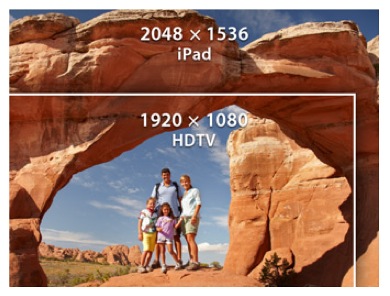
    1920x1080While everybody else is stuck in 1080p — aka “full HD” — Apple is thinking and developing on a bigger canvas than that — starting with the new iPad‘s 2048 x 1536 screen. They are always looking to move standard usage forward by large steps (where they change the whole market and win big in the process), and you can bet they’re doing that again with display. The iPad display won’t be the last Apple one to break out of the 1080p mold.

    For a snapshot of where we are now, go shop for a computer monitor . Most of what you’ll find is 1920 x 1080: the dimensions of HDTV, and the continued embodiment of ATSC standards for TV that were adopted in the early 1990s in anticipation of the fully digital age. That age is now here, and in the process TV is getting slowly absorbed into the Internet. So, at this point in history, your computer monitor can be your TV, and vice versa. Digital movie production is also now standardized on 1080p24 (24 frames per second) standard. So it looks like everything is settled, right? Well, I am sure Steve Jobs and friends looked at that situation several years ago and saw “stuck” instead of “settled.” The new iPad is the first clear clue that this was the case.

    In the long roster of display resolutions, the iPad’s dimensions are QXGA, which is among the breed of 3×4 resolutions. 1080p is 16×9. What matters here, however, isn’t the standard being used, or the dimensions, but breaking out of a currently defaulted (or stuck) mode.

    The main question for me is whether or not Apple will succeed in building a walled garden for everything new that breaks out of the old 1080p mold. I doubt they’ll succeed, but I’ll bet they’ll try.

    (Oh, and in case you doubt my prophetic powers regarding Apple, check out what I wrote to Dave Winer in 1997.)

  • A small market fail

    Airport wi-fi isn’t the biggest business, or the smallest. I’m not even sure it’s a discrete category. Some of it is a phone company side business (T-mobile, AT&T). Some of it is a business in itself (Boingo). Some of it is just a supply of overhead to airports or lounges that want to provide free wi-fi or to charge for access under their own brand.

    Here in Boston, Logan Airport has a complicated thing where you have a choice of many for-pay access options, or free access if you jump over a small hurdle. For my phone it was watching a video that the phone wouldn’t play. But at least the Web page said “If the video doesn’t run, click here to connect.” I did and it worked. But it was not so easy on my computer, where it provided a choice of watching the video or answering a survey. The video, an ad for BMW that has been running for months (I fly a lot out of here), was followed by a page with an error code. I closed the window, re-started the browser and did the survey. Same result. So I changed browsers. This time there was just a video, provided by HP, and “powered by AWG” it said. I muted the sound and watched the video, which promoted an HP netbook. Without the sound the ad was fairly worthless. More interesting was the countdown to the connection, which ran above the ad. After running from 30 seconds to zero, I got a page with a big spinning wheel that ran and ran. Another fail.

    Then I saw there’s an access point called AWGwifi and tried that. It failed too.

    Meanwhile here at the United Club, the T-Mobile access they’ve provided for many years also failed as soon as I clicked on the link for club members. Of course the people behind the desk are not in charge of that. All they can do is report the problem, which I guess is one of the many that have come up through the long slow merger between United and Continental.

    So I’m getting on through my phone’s 3G data plan. But I won’t be uploading the photos I had wanted to, because I don’t want to hit a cost jump if I go over my monthly allotment of bits.

    The best airport wifi system I’ve seen so far is the one at the Continental club, and a few scattered airports I don’t recall: the wi-fi just works. It’s open, free and requires no logging in or going through a promotional gauntlet. Maybe that’s not “secure,” but are any of these paid systems secure either? One can be a bad actor over any of them.

    I would think there is a market opportunity here for a creative approach — one that might be paid but doesn’t require becoming a member of something. Making it possible to just get on the Net with no hassle and no promotional BS would make a lot of travelers happy.

  • Abate and switch

    Newspapers got off on the wrong foot when they started publishing on the Web, by giving away what was valuable on the newsstand, and charging for last year’s fishwrap. That is, they gave away the news and charged for the olds.

    This was understandable, because the papers wanted to participate in this new Web thing, which was very live and now and all that; and the Joneses they needed to keep up with were mostly doing the same thing. And, since selling archives had been a business all along — though not a very big one — they stuck with charging $2.95 or $3.95 for, say, a sports story from 1973.

    Now the big papers, led by the The New York Times, are charging for at least some of the news in their digital versions, but also still charging for the old stuff. So they’re not quite charging for the news and giving away the olds (as I recommended back in 2006), but they seem to be moving slowly in that direction. More about that later. What I’d rather talk about first is their bait-and-switch game. It’s not bait-and-switch by the letter of the law, but the spirit is there, because the true costs are hidden.

    Today, for example, the Times announced it will be cutting in half the number of articles readers on the Web can view for free in a given month, starting on April Fools Day. The old number was twenty. The new one is ten. Specifics for non-subscribers:

    • Get 10 articles each month on NYTimes.com, as well as access to the home page, section fronts, blog fronts and classifieds.
    • Articles, blog posts, slide shows, video and other multimedia will continue to count against your free monthly limit.
    • If you’ve already read your 10 free articles, you can still read our content through links from Facebook, Twitter, search engines and blogs.

    Digital subscribers will —

    • Enjoy unlimited access to the full range of reporting from the world’s most respected journalists in their fields.
    • No limit on the number of articles, videos, blogs and more on your computer, smartphone or tablet.
    • Access to 100 Archive articles every four weeks.
    • Access to Election 2012, our exclusive politics app for iPhone and Android as well as The Collection, our fashion app for iPad — depending on the subscription you choose.

    Home subscribers get free digital access.

    The boldest print on that same page says “pay just 99¢ for your first 4 weeks.” That’s your bait. Below that it says “subscription options,” which links to this page here. Nowhere on either page does it say what happens after those first four weeks. For that info you need to select a button next to one of the three 99¢ choices, then click on the “GET UNLIMITED ACCESS” button. This takes you to the order page where you enter your credit card info. There it also says,

    TRY IT TODAY FOR JUST $0.99  NYTimes: All Digital Access Unlimited access to NYTimes.com, and the NYTimes smartphone and tablet apps.* $0.99 for your first 4 weeks ($8.75 / week thereafter)

    The asterisk is unpacked at the bottom of the page, where the it says,

    Your order (applicable taxes may be added)
    First 4 Weeks $0.99
    Thereafter $35.00 every 4 weeks

    So the real price is about $455 per year, after that first month. (Math: $8.75 x 52 weeks.) It’s an old game, and lots of sellers play it, but it’s still icky. If the Times is bold enough to be blunt about the value it’s subtracting from its free product, why not be bold enough to say the price goes up $35.01 after the first $.99?

    Maybe because they’ve had that same pitch for awhile, and it’s working fine. In this Poynter storyAndrew Beaujon writes, “The New York Times Media Group says it has ‘approximately 454,000 paid subscribers’ to its digital products.” That comes to about $206,570,000 per year, after the first month. Pretty good. I have no problem with that, if the market bears the cost, which it seems to be doing. And maybe now more subscribers will get tired of being cut off after 10 views, or using multiple browsers to get around the limit a bit.

    But why keep charging for the old stuff — especially the really old stuff? Wouldn’t it be a Good Thing make all of it easily reachable?

    Well, they do, to some degree. Here are the details from the Times‘ digital archive page:

    Accessing and Purchasing Articles

    Digital Subscribers:

    • — 1923–1986: Your digital subscription includes 100 archive articles every four weeks in this date range (from January 1, 1923 through December 31, 1986). After you’ve reached the 100-article limit for the month, articles from 1923 through 1986 are $3.95 each.
    • — Pre-1923 and post-1986: Articles published before January 1, 1923 or after December 31, 1986 are free with your digital subscription and are not limited in any way.

    Learn more about digital subscriptions »

    Nonsubscribers:

    • — 1923–1986: Articles in this date range (from January 1, 1923 through December 31, 1986) are available for purchase at $3.95 each.
    • — Pre-1923 and post-1986: Articles published before January 1, 1923 or after December 31, 1986 are free, but they count toward your monthly limit.

    Learn more about your monthly limit as a nonsubscriber »

    I don’t know how much the Times makes on $3.95/article for the 1923-1986 time frame, but I suspect it’s not much. Why not make everything before (pick a date) free, each with a permanent link? This would throw off many scholastic, cultural and economic benefits. On the economic front, it would draw more inbound traffic to the Times‘ site, with lots of opportunities to advertise to visitors. In fact, I’ll bet the paper would make more off advertising to traffic arriving at archived articles than it makes off those $3.95 purchases.

    But, maybe I’m wrong. Corrections welcome.

    In any case, I’m not yet in the market. I love the Times, and often buy it on the newsstand. But $455 per year is steep for me. Plus, I’m already paying the Times‘ parent company for my printed copies of the Boston Globe. I’d like to read the digital edition of that too, because it’s free for print subscribers; but the login/password thing has yet to work for me.

    Off the top of my head, here are some other paid subscriptions around here:

    • Consumer Reports
    • The Wall Street Journal (both print and online)
    • Forbes
    • Fortune
    • Bloomberg BusinessWeek
    • The Economist
    • Vanity Fair
    • Vogue
    • The Sun
    • The New Yorker
    • Linux Journal (which I get free, actually, because I write for it)

    All but The Sun have digital editions, and I read those as well. The only one I don’t read digitally, so far, is the Globe. I’ll try to fix that again tomorrow and see where it goes. I’ll let you know.

    Meanwhile, I urge all those pubs to make the old stuff free on the open Web, while we still have one. It’ll help.


  • Why Jeremy Lin will be fine

    The Knicks just beat the Pacers, 102 to 88, in Indiana. Jeremy Lin had 19 points, 7 rebounds, 6 assists, 1 steal and 1 block. He only had two turnovers — his one problem stat.  But that problem will end, because Jeremy Lin is a learner. That’s the second reason why he won’t be relegated to the bench from whence he came only six weeks ago. The first reason is that he’s clearly way better than the average NBA point guard, and better than many other starters as well. A lot of other teams would very much like to have Jeremy Lin starting for them.

    Many in the media had written off Jeremy Lin after the Knicks hit the skid that ended with Mike D’Antoni’s resignation as head coach. But Jeremy has participated in the Knicks’ three straight wins since then, as a starter. I listened to the fourth quarter of this game, and he was the Main Man down the stretch, grabbing rebounds, getting steals, distributing the ball, drawing fouls, and hitting four straight free throws without a miss.

    Not many people have visited the possibility that Jeremy Lin went undrafted because he wasn’t this good then. He got this good by playing against better competition, and learning every step of the way.

    Look at his stats across four years at Harvard. When he arrived, recalled a Harvard coach, he was physically the weakest player on the team. Lin fixed that, and he’s still fixing it. All his stats went up, for the most part steadily. Yet most weren’t as high as he’s achieving now as a starting pro in the NBA.

    Some players are already great in high school. A lot of those stay great through their few years in college, and a relative few make it in the NBA. And many of those are done growing as players, once they get there. They become like chess pieces. You know what they’re good for, and use them for that.

    But others are on trajectories that start later and grow in a more linear way. Hall-of-Famer Hakeem Olajuwon didn’t play basketball until he was fifteen, the same age at which Michael Jordan didn’t make the cut for his high school varsity team. Both men improved steadily through college and in the NBA. The main difference with Jeremy Lin is that he improved later.

    My wife’s business partner, who was a mentor twenty years her senior, was one of the smartest people I ever met. And one of the wisest as well. When I asked her why she wanted to go into business with my wife, she said, “because I could teach her what she didn’t know, and she already knew what I couldn’t teach.”

    I think the same thing applies to the best athletes. They are talented, but teachable. They can learn what they don’t know, and improve what don’t do well enough yet.

    Jeremy Lin is that kind of player. Unless he gets injured, he’ll be fine. And so will team he plays with, if they’re ready to catch the ball.

    When this is done, Linsanity will mean Lin sanity.

  • Clothing is a privacy system

    Some clothing we need. That’s the kind that keeps us warm, or shielded from sunlight, or from getting our feet burned or cut up. Some clothing we wear because we like the way it makes us look, or how it gives us a way to conform with social conventions, or to flaut the same.

    But basically, clothing keeps us covered up. It hides what we call our “privates.” Also our love handles, pot bellies, surgery scars, cellulite, man-boobs, and tattoos we’d rather not show. Clothing can also enlarge or showcase our best features, or make our less-than-best look better.

    In all cases other than the naked one, clothing gives us a means for doing what techies call selective disclosure — while just as selectively keeping some things undisclosed. Or, therefore, private.

    What I’m saying here is that maybe, as we debate what privacy is, what it means, and how to deal with it through technology, business and policy, that the things that can teach us the most about privacy are the ones in our closets and drawers.

    For fun, dig the best ad for clothing, ever: Barney’s Men of Destiny.

    Bonus link.

  • Say where?

    This photo of Chicago has suddenly had more than six thousand views thanks to being posted in CityPorn on Reddit. Fun.

    Here’s the whole series (on Chicago).

  • The death rattles of AM, then FM

    Check the Arbitron radio listening ratings for Washington DC. You have to go waaaay down the list before you find a single AM station that isn’t also simulcast on FM. But then, if you go to the bottom of the list, you’ll also find a clump of Internet streams of local radio stations.

    You’ll see the same pattern at other cities on this list from Radio-Info.com. FM on top, AM below, and streams at the bottom.

    Together these paint an interesting picture. At the top, Innovators, at the bottom, Dilemma. (Some context, if the distinction isn’t obvious.)

    Note that Pandora, Spotify, SiriusXM and other radio-like streaming services are not listed. Nor are podcasts or anything else one might listen to, including stuff on one’s smartphone, ‘pod or ‘pad. If they were, they’d be way up that list. According to Pandora CEO Joseph Kennedy (in this Radio INK piece),

    …we have transitioned from being a small to medium sized radio station in every market in the U.S. to one of the largest radio stations in every market in the country. Based on the growth we continue to see, we anticipate that by the end of this year, we will be larger than the largest FM or AM radio station in most markets in U.S. As a consequence, our relevance to buyers of traditional radio advertising in skyrocketing. We have already begun to see the early benefits of this dramatic change. Our audio advertising more than doubled to more than $100 million in fiscal 2012.

    Back when I was in the biz, public radio was a similar form of dark matter in the ratings. If you added up all the stations’ shares, they came 10-13% short of 100%. If one went to Arbitron’s headquarters in Beltsville, Maryland (as many of us did) to look at the “diaries” of surveyed listeners, you’d find that most of the missing numbers were from noncommercial stations. Today those are listed, and the biggest are usually at or near the top of the ratings.

    But today’s dark matter includes a variety of radio-like and non-radio listening choices, including podcasts, satellite radio, and what the industry calls “pure-play streamers” and “on-demand music services.” Together all of these are putting a huge squeeze on radio as we knew it. AM is still around, and will last longest in places where it’s still the best way to listen, especially in cars. In flat prairie states with high ground conductivity, an AM station’s signal can spread over enormous areas. For example, here is the daytime coverage map from Radio-Locator.com for 5000-watt WNAX/570am in Yankton, South Dakota:

    WNAX Daytime coverage

    And here’s the one for 50000-watt WBAP/820 in Dallas-Fort Worth:

    WBAP coverage

    No FM station can achieve the same range, and much of that flat rural territory isn’t covered by cellular systems, a primary distribution system for the data streams that comprise Internet radio.

    True, satellite radio covers the whole country, but there are no local or regional radio stations on SiriusXM, the only company in the satellite radio business. To some degree rural places are also served by AM radio at night, when signals bounce off the ionosphere, and a few big stations — especially those on “clear” channels — can be heard reliably up to several thousand miles away. (Listen to good car radio at night in Hawaii and you’ll still hear many AM stations from North America.) But, starting in 1980, “clears” were only protected to 750 miles from their transmitters, and many new stations came on the air to fill in “holes” that really weren’t. As a result AM listening at night is a noisy mess on nearly every channel, once you move outside any local station’s immediate coverage area on the ground.

    Even in Dallas-Fort Worth, where WBAP is the biggest signal in town (reaching from Kansas to the Gulf of Mexico, as you see above), WBAP is pretty far down in the ratings. (Copyright restrictions prevent direct quoting of ratings numbers, but at least we can link to them.) Same for KLIF and KRLD, two other AM powerhouses with coverage comparable to WBAP’s. News and sports, the last two staple offerings on the AM band, have also been migrating to FM. Many large AM news and sports stations in major metro areas now simulcast on FM, and some sound like they’re about to abandon their AM facilities entirely.WEEI in Boston no longer even mentions the fact that they’re on 850 on the AM dial. Their biggest competitor, WBZ-FM (“The Sports Hub”) is FM-only.

    But while FM is finally beating AM, its ratings today look like AM’s back in the 1950s. FM wasn’t taken seriously by the radio industry then, even though it sounded much better, and also came in stereo. Today the over-the-air radio industry knows it is mightily threatened (as well as augmented, in some cases) by streaming and other listening choices. It also knows it’s not going to go away as long as over-the-air radio can be received in large areas where data streams cannot. It’s an open question, however, whether broadcasters will want to continue spending many thousands of dollars every month on transmitters of signals that can no longer be justified financially.

    One big question for radio is the same one that faces TV. That is, What will ESPN do?

    ESPN is the Giant Kahuna that’s keeping millions of listeners on AM and FM radio, and viewers on cable and satellite. Many of those would leave if the same content were streamed directly over the Net. But for now ESPN appears to be fine with distributing its programming through cable and local radio. But at some point ESPN will go direct — over the Net —and avoid the old distribution methods — especially if listeners and viewers would rather have it that way.

    To do that they’ll be distributing mostly through ISPs, which these days are mostly cable and phone companies. While those companies like to say they favor “neutrality” toward content, their business ideal is monopsony toward content suppliers and monopoly toward customers. So expect a lot of theater in the next couple of years.

    Devoutly to be avoided is further movement toward the “fully licensed world” I warned about, two posts back. (Interesting that ESPN and others want Arbitron to do “cross-platform measurement”, even as it continues to help make the case for AM and FM radio.)

    Regardless of how that goes, AM and FM are stuck in a tunnel, facing the headlights of a content distribution train that they need to embrace before it’s too late.

  • Earth to Cable: You don’t control us.

    Just got stopped in my tracks by this passage in Plans for ‘TV Everywhere’ Bog Down in Tangled Pacts, in The Wall Street Journal:

    Nearly three years after Time Warner Inc. and Comcast Corp. kicked off a drive to make cable programming available online for cable subscribers, the idea of TV Everywhere remains mired in technical holdups, slow deal-making and disputes over who will control TV customers in the future.

    Say what? Control?

    Excuse me, but no. Cable doesn’t control us now, and won’t control us in the future, either. As long as Cable keeps trying to choke us, we’ll keep cutting the cords.

    Not surprisingly, Cable calls Internet-based distribution of content “over the top,” or OTT. Up here, over the top of cable’s clutches, is the everywhere we call the world.

    Whether or not cable and phone companies succeed  in building out the fully licensed world (that is, sucking everywhere down under the lids of their closed systems), we will remain free. We can live without you if we have to. Always could, always will.


  • Edging toward the fully licensed world

    I own a lot of books and music CDs — enough to fill many shelves. Here’s just one:

    They are relatively uncomplicated possessions. There are no limits (other than mine) on who can read my books, or what else  I can do with them, shy of abusing fairly obvious copyright laws. (For example, I can’t plagiarize somebody’s writing, or reproduce whole chapters of a book I’m quoting.) Music is a bit more complicated, but not to the degree that I stop assuming that I own and control the CDs on my shelves (even when they’re copied onto a hard drive, or stored in a cloud). The same even goes for the videocassettes and DVD of movies I’ve purchased. They are mine. I own them.

    But books, music and movies from Amazon, Apple and other BigCos aren’t really sold. They are licensed. Take Amazon’s terms of use for e-books. They say this:

    … the Content Provider grants you a non-exclusive right to view, use, and display such Digital Content an unlimited number of times, solely on the Kindle or a Reading Application or as otherwise permitted as part of the Service, solely on the number of Kindles or Other Devices specified in the Kindle Store, and solely for your personal, non-commercial use. Digital Content is licensed, not sold, to you by the Content Provider.

    Pretty clear. That stuff ain’t yours. All you get is some downloaded data and a highly restricted set of permissions for where and how you use that data, mostly within within the walled gardens provided by Amazon and the Content Providers. So it’s really more like renting than buying. (And not from friendly competitors, either.)

    What’s more, the seller can also change the licensing terms at will. For example, in Apple’s terms for iTunes, it says “Apple reserves the right to modify the Usage Rules at any time.” Somewhere deep in the 55-page terms of use for the iPhone it says the same kind of thing. This is why your ownership of a smartphone is far more diminished than your ownership of a laptop or a camera. That’s because our phones are members of proprietary systems that we don’t operate. This is why the major operators (e.g. Verizon, AT&T) and OEMs (e.g. Apple and Google) are at liberty to reach into your phone and turn stuff on and off. (MVNOs such as Ting distinguish themselves by not doing that.)

    Same with TV. Nothing you watch on your cable or satellite systems is yours. In most cases the gear isn’t yours either. It’s a subscription service you rent and pay for monthly. Companies in the cable and telephone business would very much like the Internet to work the same way. Everything becomes billable, regularly, continuously. All digital pipes turn into metered spigots for “content” and services on the telephony model, where you pay for easily billable data forms such as minutes and texts. (If AT&T or Verizon ran email you’d pay by the message, or agree to a “deal” for X number of emails per month.)

    Free public wi-fi is getting crowded out by cellular companies looking to move some of the data carrying load over to their own billable wi-fi systems. Some operators are looking to bill the sources of content for bandwidth while others experiment with usage-based pricing, helping turn the Net into a multi-tier commercial system. (Never mind that “data hogs” mostly aren’t.) And mobile carriers are starting to slice up the Web itself. In All Mobile Traffic Isn’t Equal — As ‘Net Neutrality’ Debate Swirls, Wireless Carriers Start Cutting Special Deals , Anton Troianovski writes this in the Wall Street Journal:

    One of Europe’s biggest wireless companies recently started offering a new plan in France: For less than $14 a month, customers could get unlimited Web browsing on their phones.

    The catch—the Internet was limited to Twitter and Facebook. Every 20 minutes spent on any other website cost nearly 70 cents.

    France Telecom SA’s Orange Group is one of several wireless carriers around the world experimenting with slicing up the Web into limited offerings and exclusive deals they hope will bring marketing advantages or higher profits.

    In Turkey, mobile operator Turkcell lets users pay a flat fee to access Facebook, but not competing Turkish social networks. Polish carrier Play has offered free access to a handful of sites including Facebook but charged for the rest of the Web. And AT&T Inc. now says it’s planning to let app developers subsidize U.S. subscribers’ use of services.

    Such tests remain the exception not the rule. Still, they show that the “open Web” ideal that has long governed Internet use is starting to break down as more and more surfing takes place on mobile devices.

    Telecom executives, tired of being the “dumb pipes” through which valuable Internet traffic flows, say they need to cut such deals to make investing in expensive mobile-data networks worthwhile. But entrepreneurs seeking to devise new mobile offerings worry the shifting rules of the game will favor well-heeled companies that can afford carriers’ new terms.

    Thus turning the mobile Web into something more like TV.

    Meanwhile, back on the book and music front, publishers already have the Amazon and Apple content sphincters in place, on the iPads, iPhones and Kindles that are gradually marginalizing our dull old all-purpose desktop and laptop computers.What used to be radio is gradually turning into a rights-clearing mess. You like Spotify? Read Michael Robertson on how hard it is for Spotify and other radio-like music services to make money, or for the artists to make much either. You like to hear music on the radio, either over the air or over streams? Read David Oxenford’s report on how complicated that’s getting. Stopping SOPA was indeed an achievement by advocates of a free and open Internet.  But that was like stopping one goal in a football game after the other side already built up a 100-to-0 lead.

    So, while BigCo walled gardeners such as Apple and Amazon continue to convert things that could be owned in the physical world (starting with music and books) into what can only be licensed in the virtual one, the regulatory framework around the Internet is ratcheting in an ever more restrictive direction, partly at the behest of regulatory captors such as the phone, cable and content companies (all getting more and more vertically integrated), and partly at the behest of countries that want the UN and the ITU to help them restrict Net usage inside their borders.  The latter is less about licensing than about pure politics, but it’s still at variance with the free and open marketplace the Net opened up in the first place.

    John Battelle has long been observing this trend, and contextualizes it in a post titled It’s not whether Google’s threatened. It’s asking ourselves: What commons do we wish for?, The gist:

    What kind of a world do we want to live in? As we increasingly leverage our lives through the world of digital platforms, what are the values we wish to hold in common? I wrote about this issue a month or so ago:  On This Whole “Web Is Dead” Meme. In that piece I outlined a number of core values that I believe are held in common when it comes to what I call the “open” or “independent” web. They also bear repeating (I go into more detail in the post, should you care to read it):

    – No gatekeepers. The web is decentralized. Anyone can start a web site. No one has the authority (in a democracy, anyway) to stop you from putting up a shingle.

    – An ethos of the commons. The web developed over time under an ethos of community development, and most of its core software and protocols are royalty free or open source (or both). There wasn’t early lockdown on what was and wasn’t allowed. This created chaos, shady operators, and plenty of dirt and dark alleys. But it also allowed extraordinary value to blossom in that roiling ecosystem.

    – No preset rules about how data is used. If one site collects information from or about a user of its site, that site has the right to do other things with that data, assuming, again, that it’s doing things that benefit all parties concerned.

    – Neutrality. No one site on the web is any more or less accessible than any other site. If it’s on the web, you can find it and visit it.

    – Interoperability. Sites on the web share common protocols and principles, and determine independently how to work with each other. There is no centralized authority which decides who can work with who, in what way.

    I find it hard to argue with any of the points above as core values of how the Internet should work. And it is these values that created Google and allowed the company to become the world beater is has been these past ten or so years. But if you look at this list of values, and ask if Apple, Facebook, Amazon, and the thousands of app makers align with them, I am afraid the answer is mostly no. And that’s the bigger issue I’m pointing to: We’re slowly but surely creating an Internet that is abandoning its original values for…well, for something else that as yet is not well defined.

    This is why I wrote Put Your Taproot Into the Independent Web. I’m not out to “save Google,” I’m focused on trying to understand what the Internet would look like if we don’t pay attention to our core shared values.

    What’s hard for walled gardeners to grok — and for the rest of us as well  — is that  the free and open worlds created by generative systems such as PCs and the Internet have boundaries sufficiently wide to allow creation of what Umair Haque calls “thick value” in abundance. To Apple, Amazon, AT&T and Verizon, building private worlds for captive customers might look like thick value, but in the long run captive customer husbandry closes more opportunities across the marketplace than they open. Companies do compete (as do governments), but the market and civilization are both games that support positive sum outcomes for multiple players. The free and open Internet is the game board on which the Boston Consulting Group says a $2.1 trillion economy grew in 2010, on a trajectory to reach $4.2 trillion by 2016. That game board is also a commons, and it’s being enclosed. (Lewis Hyde, author of Common as Air, calls it the “third enclosure.”)

    By losing the free and open Internet, and free and open devices to interact with it — and even such ordinary things as physical books and music media — we reduce the full scope of both markets and civilization.

    But that’s hard to see when the walled gardens are so rich with short-term benefits.

    [Later…] I should make clear that I’m not against silos as a business breed, or vertical integration as a business strategy. In fact, I think we owe a great deal of progress to both. I think Apple actually opened up the smartphone market with the iPhone, and its vertical private marketplace. The concern I’m expressing in this post is with the fractioning of the commercial Web, as we experience it, and of much else that happens on the Net, into private vertical silos, using proprietary gear that limits what can be done to what the company owning the whole market allows. The book business, for example, largely happens inside Amazon, as of today. I think this is good in some ways, and worse in others. I’m visiting the worse here.

     

  • Let’s use the ‘No Track’ button we already have

    (Cross-posted from the ProjectVRM blog.)

    left r-buttonright r-buttonFor as long as we’ve had economies, demand and supply have been attracted to each other like a pair of magnets. Ideally, they should match up evenly and produce good outcomes. But sometimes one side comes to dominate the other, with bad effects along with good ones.

    Such has been the case on the Web ever since it went commercial with the invention of the cookie in 1995, resulting in a  in which the demand side — that’s you and me — plays the submissive role of mere “users,” who pretty much have to put up with whatever rules websites set on the supply side.

    Consistent with  (“Power corrupts; absolute power corrupts absolutely”) the near absolute power of website cows over user calves has resulted in near-absolute corruption of website ethics in respect to personal privacy.

    This has been a subject of productive obsession by  and her team of reporters at The Wall Street Journal, which have been producing the  series (shortcut: http://wsj.com/wtk) since July 30, 2010, when Julia by-lined . The next day I called that piece a turning point. And I still believe that.

    Today came another one, again in the Journal, in Julia’s latest, titled Web Firms to Adopt ‘No Track’ Button. She begins,

    A coalition of Internet giants including Google Inc. has agreed to support a do-not-track button to be embedded in most Web browsers—a move that the industry had been resisting for more than a year.

    The reversal is being announced as part of the White House’s call for Congress to pass a “privacy bill of rights,” that will give people greater control over the personal data collected about them.

    The long White House press release headline reads,

    We Can’t Wait: Obama Administration Unveils Blueprint for a “Privacy Bill of Rights” to Protect Consumers Online

    Internet Advertising Networks Announces Commitment to “Do-Not-Track” Technology to Allow Consumers to Control Online Tracking

    Obviously, government and industry have been working together on this one. Which is good, as far as it goes. Toward that point, Julia adds,

    The new do-not-track button isn’t going to stop all Web tracking. The companies have agreed to stop using the data about people’s Web browsing habits to customize ads, and have agreed not to use the data for employment, credit, health-care or insurance purposes. But the data can still be used for some purposes such as “market research” and “product development” and can still be obtained by law enforcement officers.

    The do-not-track button also wouldn’t block companies such as Facebook Inc. from tracking their members through “Like” buttons and other functions.

    “It’s a good start,” said Christopher Calabrese, legislative counsel at the American Civil Liberties Union. “But we want you to be able to not be tracked at all if you so choose.”

    In the New York Times’ White House, Consumers in Mind, Offers Online Privacy Guidelines Edward Wyatt writes,

    The framework for a new privacy code moves electronic commerce closer to a one-click, one-touch process by which users can tell Internet companies whether they want their online activity tracked.

    Much remains to be done before consumers can click on a button in their Web browser to set their privacy standards. Congress will probably have to write legislation governing the collection and use of personal data, officials said, something that is unlikely to occur this year. And the companies that make browsers — Google, Microsoft, Apple and others — will have to agree to the new standards.

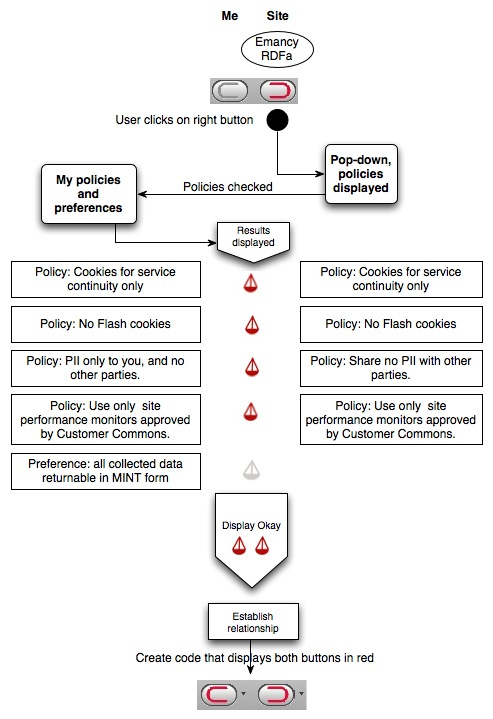
    No they won’t. Buttons can be plug-ins to existing browsers. And work has already been done. VRM developers are on the case, and their ranks are growing. We have dozens of developers (at that last link) working on equipping both the demand and the supply side with tools for engaging as independent and respectful parties. In fact we already have a button that can say “Don’t track me,” plus much more — for both sides. Its calle the R-button, and it looks like this: ⊂ ⊃. (And yes, those symbols are real characters. Took a long time to find them, but they do exist.)

    Yours — the user’s — is on the left. The website’s is on the right. On a browser it might look like this:

    r-button in a browser

    Underneath both those buttons can go many things, including preferences, policies, terms, offers, or anything else — on both sides. One of those terms can be “do not track me.” It might point to a fourth party (see explanations here and here) which, on behalf of the user or customer, maintains settings that control sharing of personal data, including the conditions that must be met. A number of development projects and companies are already on this case. Some have personal data stores (PDSes), also called “lockers” or “vaults.” These include:

    Three of those are in the U.S., one in Austria, one in France, one in South Africa, and three in the U.K. (All helping drive the Midata project by the U.K. government, by the way.) And those are just companies with PDSes. There are many others working on allied technologies, standards, protocols and much more. They’re all just flying below media radar because media like to look at what big suppliers and governments are doing. Speaking of which… 🙂

    Here’s Julia again:

    Google is expected to enable do-not-track in its Chrome Web browser by the end of this year.

    Susan Wojcicki, senior vice president of advertising at Google, said the company is pleased to join “a broad industry agreement to respect the ‘Do Not Track’ header in a consistent and meaningful way that offers users choice and clearly explained browser controls.”

    White House Deputy Chief Technology Officer Daniel Weitzner said the do-not-track option should clear up confusion among consumers who “think they are expressing a preference and it ends up, for a set of technical reasons, that they are not.”

    Some critics said the industry’s move could throw a wrench in a separate year-long effort by the World Wide Web consortium to set an international standard for do-not-track. But Mr. Ingis said he hopes the consortium could “build off of” the industry’s approach.

    So here’s an invitation to the White House, Google, the 3wC, interested BigCos (including CRM companies), developers of all sizes and journalists who are interested in building out genuine and cooperative relationships between demand and supply::::

    Join us at IIW — the Internet Identity Workshop — in Mountain View, May 1-3. This is the unconference where developers and other helpful parties gather to talk things over and move development forward. No speakers, no panels, no BS. Just good conversation and productive work. It’s our fourteenth one, and they’ve all been highly productive.

    As for the r-button, take it and run with it. It’s there for the development. It’s meaningful. We’re past square one. We’d love to have all the participation we can get, from the big guys as well as the little ones listed above and here.

    To help get your thinking started, visit this presentation of one r-button scenario, by Adam Marcus of MIT. Here’s another view of the same work, which came of of a Google Summer of Code project through ProjectVRM and the Berkman Center:

    (Props to Oshani Seneviratne and David Karger, also both of MIT, and Ahmad Bakhiet, of Kings College London, for work on that project.)

    If we leave fixing the calf-cow problem entirely up to the BigCos and BigGov, it won’t get fixed. We have to work from the demand side as well. In economies, customers are the 100%.

    Here are some other stories, mostly gathered by Zemanta:

    All look at the symptoms, and supply-side cures. Time for the demand side to demand answers from itself. Fortunately, we’ve been listening, and the answers are coming.

  • Savor the irony

    Now comes news (via Peter Kafka in All Things D and Jason Boog in Galleycat) that robot-written “stories” are turning up on the pages of Forbes and other publications. The robots are made by Narrative Science, which (says its About page) “started life as a joint research project at Northwestern University Schools of Engineering and Journalism.”

    That Narrative Science reportedly has thirty customers already says more about the state of journals than it does about journalism. Tyler Durden in ZeroHedge may have the best, if not the last word:

    Condolences to all financial journalists. If you thought your meager salary was crap, you are about to be replaced by a costless algorithm. The market you wrote about no longer needs you. But at least we will now have computers telling us all about how (seasonally adjusted) trends in financial journalism employment are improving.

    Probably what is even sadder is that nobody noticed as more and more robots have taken over for humans.

    … if a robot is reacting to a headline written by itself (and it is only a matter of time before Narrative Science is acquired by GETCO or some other HFT behemoth in the latest market manipulation scheme) the epic collapse possibilities are simply stupefying.

    HT to @swardley.

  • The Jeremy Lin story

    Why Jeremy Lin suddenly such hot stuff?

    Last night I listened to sports radio from ESPN, WFAN in New York, KNBR in San Francisco, and WEEI in Boston, as well as to KOVO here in Provo, Utah (where I’m hanging this week). One of the talkers put it best, saying something like this: “Let’s face it. There is no other story right now. Jeremy Lin is all we can talk about, because he’s too damned interesting.”

    Tonight the saga continued. Jeremy Lin scored 27 points with 12 assists (and 8 turnovers) as the Knicks beat the Raptors in Toronto on a 3-point shot by — of course — Jeremy Lin. Also this: he made the winning shot with half a second on the clock. And that was after tying the game up a few seconds earlier with a drive to the basket in heavy traffic, drawing a foul, and making that shot too. That’s two three-point plays in a row. Great stuff. Legendary, considering that he’s done this kind of thing night after night, though a career that’s just six games long, so far.

    So let’s pause to look at what makes a story — especially one so irresistible as this one:

    1. A character. That is, a protagonist. Somebody you can identify with, because they’re interesting and unique. Ideally, they aren’t from Central Casting. And they have flaws as well as positive qualities.
    2. A problem. That is, a challenge or a struggle that keeps you interested. (Turning the page, coming back for the next episode, whatever.)
    3. Movement toward a resolution. That is, the clear sense that this is all going somewhere, no matter how bad things might be now, or how complicated the plot lines thicken and braid.

    Jeremy Lin scores big on all three. Like all of us, he’s not typical. In his case, especially for basketball. He’s 6’3, but that’s about average for a point guard. He’s also skinny, not bulging with muscles, not covered in tatoos. He’s also Chinese, in the ethnic sense, though he’s an American kid who grew up in Palo Alto. You don’t find many Chinese (or even Asian) players in the NBA, or even at the college level. He’s also a devout Christian who is quick to thank God, though not so quick as Tim Tebow.

    He also has a problem: until just a few games ago, he couldn’t get much respect.

    While he was named Player of the Year by many for leading Paly High to the state championship as a Senior, and was first team all-state in California that same year, he wasn’t recruited by any major schools, or even many minor ones. He ended up going to Harvard, which doesn’t give athletic scholarships and where he played four solid years of ball before graduating with a degree in economics and a 3.1 GPA. He was first team all-Ivy, and got kudos from many coaches, including Connecticut’s Jim Calhoun (on whose team he dropped 30 points and grabbed 9 boards), but went undrafted by the NBA. After excelling in an NBA summer league, he found his way to the end of the bench for the Golden State Warriors, his home team growing up. They cut him. Then he surfaced at the Houston Rockets. They cut him too. Then the New York Knicks picked him up off waivers from Houston. They were ready to cut him too, but needed help from deep in the bench after their two starting stars couldn’t play.

    Unless you’ve been living under a rock, the rest is history. Lin played only 55 minutes in the Knicks’ prior 23 games, most of which the team lost. Then he came off the bench in a game on February 4 — remember, this is just ten days ago — and scored 25 points with 5 boards and 7 assists. The Knicks won. The Knicks have gone undefeated since then, with Lin as their point guard. He’s scored more than 20 points in all of those games, and hit the winning shot in two of them. He also out-scored Kobe Bryant, with 38 points, in a game against the Lakers.

    So it’s a triumphant story, but it’s not over. What keeps us tuned in and turning the pages is that we don’t know what will happen next. Is he really that good? Can he keep it up? If the answers to either of those questions is yes, how many other Jeremy Lins are out there, unrecognized?

    We don’t know, and that keeps us interested too.

    In my case, I’m interested in Jeremy Lin as a character because both my older kids went to Paly High when we lived in Palo Alto. My son and I probably played basketball on some of the same courts Jeremy played on later. I also watched Jeremy play when he was at Harvard. I remember one game where it was clear that Jeremy was the best player on the floor. But the next night we went to a Celtics game and couldn’t help comparing the two games. The difference was extreme. I couldn’t imagine any of the players I saw at the Harvard game playing in the NBA, Jeremy Lin included.

    But here he is. I’ve watched some of his games, and it’s clear that he’s a solid point guard without a lot of flash, reminding me of Steve Nash, Derek Fisher and John Stockton in their primes. Good penetrator. Good shooter. Great at sharing the ball and running the floor. But I think there’s more going on than talent and style. Basketball, like all sports, is a head game. Skill isn’t enough. You’ve got to have your head straight. Wilt Chamberlain, one of the greatest players of all time, and the only one ever to score 100 points in a game (when there were no 3-point shots, not that he would have taken any), was a notoriously bad foul shooter. Yet in practice, I’ve read, Wilt was terrific at foul-shooting. He just choked in games.

    What I’m saying is that Jeremy Lin is a head-case in the positive sense: he’s broken through into a zone where his head is level and his emotions are positive. He believes in himself, and he believes in his team. He has the poise of a player who has been a starter for ten years. The other players he makes look good include Bill Walker, Landry Fields, Jared Jeffries and Steve Novak, none of whom are big stars.

    Can’t help loving it. The story is too good not to.

    [Later…] Well, the Knicks played two more games since I wrote the above, winning one and losing the other. Jeremy Lin scored 10 points with 13 assists in the first, and 25 points with 5 assists and 4 steals in the second. Alas, he also had nine turnovers in that one. Protecting the ball is a weakness of his — and now he’s not overlooked by opposing defenses. Still, you can’t win them all. He’s clearly a solid NBA player on a team that was tanking without him and now has strong shot at making the playoffs.

    So I want to add two more points to the ones I made above.

    One is that Lin’s ethnicity, while it adds spice to his story, has nothing to do with his qualities as a basketball player. On this issue lots of commentators are quite wrong. Says Walt Frazier in this USA Today story, “This league is dominated by African Americans. What are the odds of an Asian guy coming on and having this impact? It’s amazing. It’s inexplicable.” No, it’s not. The chance is very small that the next NBA player coming through a door will be Asian, but the NBA has hundreds of players spread across 30 teams. It should be no surprise that an Asian guy would show up every once in awhile, especially if he’s an American who grew up playing excellent high school and college ball, as Jeremy Lin did. And his impact has everything to do with his skills as a player and nothing to do with his name or his looks. The only influence those had (I say, in the past tense) was on talent scouting. A big reason he escaped notice was that he didn’t look like a typical basketball player. This is now a mistake that scouts are less likely to make. (By the way, Lin’s agent is black, and Lin has a great sense of humor about his unique non-basketball qualities. I mean, you’ve gotta see this video.)

    The other is that Lin has clearly worked on his game. By that I mean he is not the player we saw at Paly High, at Harvard, or even in games for the Golden State Warriors or the Houston Rockets. He has improved. Practicing with NBA players has made him a better player. Also, at the Knicks, he has been learning a new offense under Coach Mike D’Antoni. Remember how well D’Antoni did in Phoenix with Steve Nash at guard? That’s why the Knicks recruited D’Antoni. Turns out Lin is a lot like Nash: a smart non-egotistical high-energy player who runs the floor at high speed, can navigate through traffic, looks to pass before he shoots, and plays tough defense that forces a lot of turnovers. That’s why other players like to have him on the floor. The coach too.

    Some links from Zemanta:

  • For personal data, use value beats sale value

    Should you manage your personal data just so you can sell it to marketers? (And just because somebody’s already buying it anyway, why not?) Those are the barely-challenged assumptions in Start-Ups Seek to Help Users Put a Price on Their Personal Data, by Joshua Brustein in The New York Times. He writes,

    People have been willing to give away their data while the companies make money. But there is some momentum for the idea that personal data could function as a kind of online currency, to be cashed in directly or exchanged for other items of value. A number of start-ups allow people to take control — and perhaps profit from — the digital trails that they leave on the Internet…

    Many of the new ideas center on a concept known as the personal data locker. People keep a single account with information about themselves. Businesses would pay for this data because it allows them to offer personalized products and advertising. And because people retain control over the data in their lockers, they can demand something of value in return. Maybe a discounted vacation, or a cash payment.

    Proponents of personal data lockers do not see them simply as a solution to privacy concerns. Rather, they hope that people will share even more data if there is a market for them to benefit from it.

    At most that’s only partially true. I know for a fact that brokering personal data is not the business model for Personal (the main company sourced in the piece.) I also know it’s also not what MyDex, Qiy, Glome, or any of the other VRM (Vendor Relationship Management) companies and development projects listed here (Personal among them) exist to do. Check their websites. None of them align with this story. Mostly they exist to give individuals more control over their lives and their relationships with organizations, with each other, and with themselves.

    But the personal-data-for-advertising deal is a Big Meme these days, especially given the Facebook IPO.

    Recently I was approached by a writer for CNN who was working on a piece about personal data stores (aka lockers, vaults, etc.). His first question was this: Are people’s perceived value of their personal data in line with what marketers are willing to pay for it?

    Here’s how I answered:

    Well, exactly what are marketers willing to pay to individuals directly for personal data? Without that information, we can’t say what people’s perceived value for their personal data might be. In fact, there never has been a market where people sell their personal data.

    What we do know for sure is that personal data has use value. That it might also have sale value — to the persons themselves — is a new idea, and still unproven. We’re only talking about it because marketers are paying other parties for personal data.

    Let’s look at use value first. Think about all the personal data in your life that can be digitized and stored: photos, videos, letters, texts, emails, contact information for yourself and others, school and business records, bills received and paid, medical and fitness data, calendar entries… Today all of us use this data. But we don’t sell it. Yes, others do sell it and use it, but we’re not involved in that.

    Now let’s look at sale value for the same data. That only looks like a good idea if the entire frame of reference is what marketers want, not what individual people want.

    There may indeed be a market for selling personal data — for better offers, or whatever. But does that speculative sale value exceed the actual use value for the same data? Hard to say, because the metrics are different. Most use value is not transacted, and can’t be accounted for. But it is real. And that real value might be put at risk when the data is sold, especially if the terms of the sale don’t limit what the buyer can do with the data.

    As for the actual amounts paid for personal data by marketers — on a person-by-person basis — I think you’ll find it’s pretty small. True, the sum paid to Google and Facebook by advertisers is large, but that’s not necessarily for the kind of personal data people might be willing to sell (such as, “I’m in the market for a Ford truck right now”), and the waste is enormous. Most click-through rates are way below one percent. Also, the belief that people actually want messages all the time — even highly personalized ones — is a mistake. They don’t. Advertising on the whole is tolerated far more than it is desired.

    Sure, many are saying, “Hey, third party spyware in our browsers is snarfing up all kinds of personal data and selling it, so why not pay individuals directly for that data?” There are several additional problems with this assumption.

    One is that people are okay with all this spying. When it’s made clear to them, they are not. But, on the whole, it is not made clear, so they operate in blind acquiescence to it.

    Another is that the money involved would be large enough to make the deal worthwhile. As I understand it, personal data sold on the back-end trading floors of the Live Web goes for itty bitty amounts on a per-person-per-ad basis. But I haven’t seen anybody run solid numbers on this. Whatever those numbers turn out to be, the case is not proven so far.

    All the VRM developers listed below are in the business of helping individuals understand and empower themselves, as independent and autonomous actors in the marketplace. Not just as better “targets” for marketing messages.

    The movement of which they are a part — VRM, for Vendor Relationship Management — is toward giving individuals tools for both independence and engagement. Those tools include far more than data management (of which personal data stores are a part).

    For example, we are working on terms of service that individual customers can assert: ones that say, for example, “don’t track me outside your website,” and “share back with me all the data you collect about me, in the form I specify.” That has nothing to do with what anything sells for. It’s about relationship, not transaction.

    I could go on, but I’d rather point back to other stuff I’ve written about this already, such as this, from Data Bubble II:

    Right now it’s hard to argue against all the money being spent (and therefore made) in the personalized advertising business—just like it was hard to argue against the bubble in tech stock prices in 1999 and in home prices in 2004. But we need to come to our senses here, and develop new and better systems by which demand and supply can meet and deal with each other as equally powerful parties in the open marketplace. Some of the tech we need for that is coming into being right now. That’s what we should be following. Not just whether Google, Facebook or Twitter will do the best job of putting crosshairs on our backs.

    John [Battelle is] right that the split is between dependence and independence. But the split that matters most is between yesterday’s dependence and tomorrow’s independence—for ourselves. If we want a truly conversational economy, we’re going to need individuals who are independent and self-empowered. Once we have that, the level of economic activity that follows will be a lot higher, and a lot more productive, than we’re getting now just by improving the world’s biggest guesswork business.

    And this, from A Sense of Bewronging:

    My Web is not their Web. I’m tired of being shown. I’m tired of “experiences” that are “delivered” to me. I’m tired of bad guesswork — or any guesswork. I don’t want “scarily accurate” guesses about me and what I might want.

    What I crave is independence, and better ways of engaging — ones that are mine and not just theirs. Ones that work across multiple services in consistent ways. Ones that let me change my data with all these services at once, if I want to.

    I want liberation from the commercial Web’s two-decade old design flaws. I don’t care how much a company uses first person possessive pronouns on my behalf. They are not me, they do now know me, and I do not want them pretending to be me, or shoving their tentacles into my pockets, or what their robots think is my brain. Enough, already.

    While they might not put it the same way, I believe the VRM companies Burstein sources believe the same thing.

    Meanwhile, more links to the current zeitgiest, mostly from Zemanta:

  • Live blogging Politics of the Internet

    So I’m at Micah Sifry’s Politics of the Internet class at the Kennedy School, and risk live-blogging it (taxing my multitasking abilities…)

    Some questions in the midst of dialog between Micah (@Mlsif) and the class (#pol-int)…

    • Was there a $trillion “internet dividend” over the old phone system, and was it a cost to the old system?
    • Did the Internet have to happen?
    • Is the IETF‘s “rough consensus and running code” still a prevailing ethos, or methodology?
    • Is it an accident that the rough consensus above is so similar to the #Occupy methods?
    • When you add value, do you also subtract value? (And did I — or David Weinberger and I) actually say that in World of Ends?)
    • Does this new un-owned decentralized medium cause or host culture?
    • How is the Internet used differently in different societies? (Assertion: it’s not monolithic.)
    • What is possible in a world where we assume connectivity?
    • What are the major disruptive effects?
    • What is the essence of the starting point in the early connection of computers? (What is the case for the Net, and how would you make it to, say, a legislator? Or you’re in an elevator with your boss, and you want to make the case against legislating how the internet is structured?)

    Topics brought up:

    • Net-heads vs. bell-heads (the Net as its transcendant protocols vs. the Net as a collection of owned and controlled networks)
    • Commercialization
    • Authentic voice
    • Before and after (what if Compuserve and AOL had won?)
    • How can we speak of a giant zero when companies and governments are being “smart” (either through government censorship or carrier limitations, including the urge to bill everything, to pick a couple of examples)

    My Linux Journal collection on the topic (from a lookup of “giant zero”):

    Well, I wrote down nothing from my own talk, or the Q & A following. But there are clues in the tweet stream (there’s some funky html in the following… no time to fix it, though):

    dskok David Skok
     An excellent read re: the battle @dsearls was referring to. I recommend @scrawford‘s @nytimes op-Ed: nytimes.com/2011/12/04/opi… #pol-int
    NoreenBowden Noreen Bowden

     @dsearls! #pol-int Death From Above – 1995 essay by John Barlow on future of internet. w2.eff.org/Misc/Publicati…
    dskok David Skok

     .@dcsearls reading list: Death from above by John Perry Barlow: w2.eff.org/Misc/Publicati… #pol-int
    NoreenBowdenNoreen Bowden
    Stanford prof leaves to start online university. allthingsd.com/20120125/watch… #pol-int
    dsearls Doc Searls
    My live blog from @mlsif‘s #pol-int class: hvrd.me/xd3Iki #politics #internet
    NaparstekAaron Naparstek

     Tweet “+1” if you think @MlSif should slide over 3 feet to his left or right so the classroom projector isn’t shining on his face. #pol-int
    dskokDavid Skok

     Listening to @docsearls referring to the Internet Protocol Suite: en.wikipedia.org/wiki/Internet_… #pol-int
    NaparstekAaron Naparstek

     “Anyone can join it and work to improve it.” @Mlsif: Is it a coincidence that #OWS and the Internet are structured so similarly? #pol-int
    NaparstekAaron Naparstek

     Testing live classroom Twitter feed @Mlsif‘s new @Kennedy_School course, “The Politics of the Internet.” #pol-int
    dsearlsDoc Searls

     Fun to be sitting in on @Mlsif‘s #pol-int class, described here: hvrd.me/w3hCbI
     MlsifMicah Sifry
    I hadn’t realized up til now just how much the IETF and its working groups resemble Occupy Wall St and its working groups. #pol-int

    Enjoyed it. The class will be blogging. Look forward to reading those too.

  • Surf’s up! Look north

    According to this…

    … the Aurora is on.

    The Kp Index has hit 5, and a geomagnetic storm is on.

    Here’s today’s SpaceWeather on the matter. Follow the links there.

    Bear in mind that the aurora are curtains of light up to a thousand miles high. So if the auroral oval is pushed down over southern Canada (which these storms tend to do), it should still be visible far south across the United States. Current links:

  • 2025 in 2012

    Marcel Bullinga is a Dutch futurist and author of Welcome to the Future Cloud. Today I got pointed on Twitter to a Q&A with Bullinga by Aaron Saenz at SingularityHub. Interesting stuff. An excerpt:

    SH: Welcome to the Future Cloud seems to be very supportive of intellectual property (IP) rights and digital rights managements (DRM). Are IP and DRM necessary to the development of a healthy future?

    MB: Yes and no. The trend is twofold. We will have ironclad ways to protect our data, our virtual sources and our identities. We will wrap our virtual belongings with what I call a Cloud Seal. A seal that contains the ownership and the Terms of Use of your data. This goes way beyond something as simple and as easy-to-cheat thing as DRM.

    On the other hand, more and more, we do not need control over our creations and we do not need IP protection, because we let go — voluntarily. We find other ways to earn money. Think of the startup musician who gives away his music for free in order to get his fans to visit a live concert.

    The point is, in the future cloud, we need to have the choice. The choice to trade privacy for services, the choice to sell privacy for money, the choice to buy your privacy. The choice to control or to let go. For that , we need this personal dashboard. Without it, the Cloud is a new disaster.

    Control over our virtual life wasn’t that important in the past. Until now, virtual life was more of a toy thing. In the next few years, virtual identity is becoming a life vest. Therefore, it is getting more and more important that we actually own our identities and our data. Right now, we do not own them. Google and Facebook do, plus all the company sites we are subscribed to. We must change this, or the future will turn into a privacy nightmare.

    The dashboard turns the world upside down. It creates a bridge between any organization and you. You grant companies access to your dashboard and you control what they do with your data. Not the other way around, as is now. From the hundreds of “myvodafone” and “mygovernment” and so on into the single “mydashboard”.

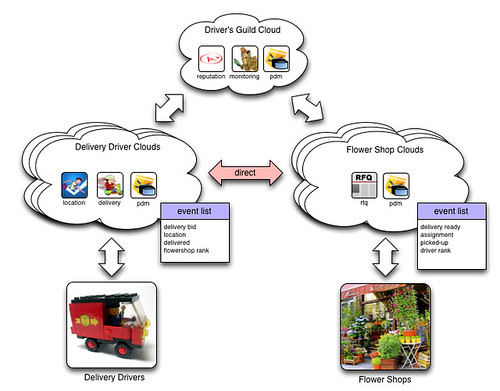
    This is right up many VRM alleys. One’s virtual cloud sounds a lot to me like what Phil Windley has been talking and writing about lately, calling it both a personal cloud and a personal event network (though more of the latter). In his latest blog post, Phil dives into the real-world example of “delivering flowers in a distributed event system” in which all parties are both autonomous yet interconnected in ways that the autonomous parties control. In other words, it happens inside nobody’s silo, and between each party’s cloud. A sample:


    flowershop pen

    In the preceding diagram, there isn’t one event system that manages the interactions between the shops and the drivers. Rather, each driver has their own personal event network, each shop has their own personal event network, and the guild has one too. The interactions aren’t simply events raised within a single event network, but rather events raised between the networks of each participant. I’ve shown some of the apps that drivers, shops, and the guilds have installed on their personal event networks, but they would each be individually managed and configured. In fact, it’s reasonable to assume that different drivers or shops might use different apps for the same purpose as long as they understood the events.

    Phil concludes,

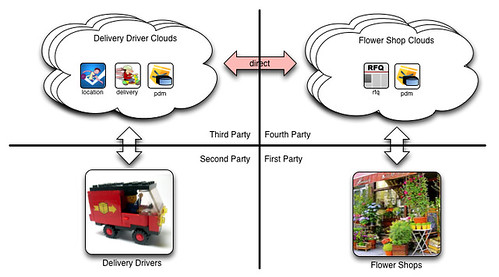
    Overall, this example isn’t terribly different from the fourth-party ecommerce example I wrote about last June except that example featured hardwired connections between the shopper and the merchant rulesets. In contrast, this example uses the idea of event subscription to link merchants and customers. Event subscription takes the fourth-party example from a nice little demonstration to a conception of how VRM could work in the real-world. The diagram shown above can be partitioned to illustrate this:

    flowershop partiesTogether with our ideas about how notification occurs and how personal data can be managed in personal event networks, event subscription creates a powerful system for enabling a completely new kind of interaction between vendors and customers (note that in this example, the flowershop is the customer who is negotiating for and buying delivery services from the drivers).

    Now back to the Marcel Bullinga Q&A:

    SH: Which technology (or branch of science) do you feel will have the biggest impact in the next fifteen years? Who do you see as the leader in the development of that technology?

    MB: My pick: a small startup called Qyi.com. It is the closest thing to my vision of a personal dashboard that I have discovered so far. I met the owner, Marcel van Galen, and he convinced me that in his business model the individual owner will stay in control. This will sweep aside the Google and Facebook attitude of “company owning”. It is vital, by the way, that neither Google nor Facebook will ever buy Qyi. That is a major threat to innovation in general: big companies buying startups. It is the surest way to kill them. It makes the startup owner a millionaire and humanity a beggar.

    I am sure “Qyi” is a typo, and that Marcel means Qiy, which is indeed cool. Check ’em out.
    I wanted to point out all this stuff (including the Qiy typo) in a comment on SingularityHub, but it appeared (to me at least) that one could only do that being a member (and I couldn’t see where one signed up) or by logging in through Facebook. I hate doing anything through Facebook, but I tried — and ended up being sent to the top of the page, centered on this:

    I can parse some of that, but mostly I don’t want to deal with any of it. In any case, my trying to make a comment with the help of a Facebook ID was a fail.

    This kind of minor ordeal (the comment gauntlet, even if one succeeds with it) is just one bit of evidence for how lame the commercial Web still is (on the whole — not blaming SingularityHub alone here), how much we remain stuck in the calf-cow world of client-server, and why we will remain stuck until making comments is as simple as creating an event that we control and other autonomous peers respect in a useful way.

    In any case, that future is not far off. We’re making it today.

  • PR’s problems, 20 years later

    I was near the end of my career as a PR guy when I wrote the essay below for the January 1992 issue of Upside. Since then Upside has been erased. Some bits of it still persist on the Internet Archive, but nothing before 1996. But I did save my own draft of the piece, and put it up here, back in the mid-90s, where it has remained all but invisible. So I thought it would be fun to surface it now on the blog, on the 20th anniversary of its original publication. Here goes:

    THE PROBLEM WITH PR

    Toward a world beyond press releases and bogus news

    By Doc Searls

    There is no Pulitzer Prize for public relations. No Peabody. No Heismann. No Oscar, Emmy or Eddy. Not even a Most Valuable Flacker award. Sure, like many misunderstood professions, public relations has its official bodies, and even its degrees, awards and titles. Do you know what they are? Neither do most people who practice the profession.

    The call of the flack is not a grateful one. Almost all casual references to public relations are negative. Between the last sentence and this one, I sought to confirm this by looking through a Time magazine. It took me about seven seconds to find an example: a Lance Morrow essay in which he says Serbia has “the biggest public relations problem since Pol Pot went into politics.” Since genocide is the problem in question, the public relations solution can only range from lying to cosmetics. Morrow’s remark suggests this is the full range of PR’s work. Few, I suspect, would disagree.

    So PR has the biggest PR problem of all: people use it as a synonym for BS. It seems only fair to defend the profession, but there is no point to it. Common usage is impossible to correct. And frankly, there is a much smaller market for telling the truth than for shading it.

    For proof, check your trash for a computer industry press release. Chances are you will read an “announcement” that was not made, for a product that was not available, with quotes by people who did not speak them, for distribution to a list of reporters who considered it junk mail. The dishonesty here is a matter of form more than content. Every press release is crafted as a news story, complete with headline, dateline, quotes and so forth. The idea is to make the story easy for editors to “insert” with little or no modification.

    Yet most editors would rather insert a spider in their nose than a press release in their publication. First, no self-respecting editor would let anybody else — least of all a biased source — write a story. Second, press releases are not conceived as stories, but rather as “messages.”

    It is amazing how much time, energy and money companies spend to come up with “the right message.” At this moment, thousands of staffers, consultants and agency people sit in meetings or bend over keyboards, straining to come up with perfect messages for their products and companies. All are oblivious to a fact that would be plain if they paid more attention to their market than their product.

    There is no demand for messages.

    There is, however, a demand for facts. To editors, messages are just clothing and make-up for emperors that are best seen naked. Editors like their subjects naked because facts are raw material for stories. Which brings up another clue that public relations tends to ignore.

    Stories are about conflict.

    What makes a story hot is the friction in its core. When that friction ceases, the story ends. Take the story of Apple vs. IBM. As enemies, they made great copy. As collaborators, they are boring as dirt.

    The whole notion of “positive” stories is oxymoronic. Stories never begin with “happily ever after.” Happy endings may resolve problems, but they only work at the end, not the beginning. Good PR recognizes that problems are the hearts of stories, and takes advantage of that fact.

    Unfortunately, bad PR not only ignores the properties of stories, but imagines that “positive” stories can be “created” by staging press conferences and other “announcement events” that are just as bogus as press releases — and just as hated by their audiences.

    Columnist John Dvorak, a kind of fool killer to the PR profession, says, “So why would you want to sit in a large room full of reporters and publicly ask a question that can then be quoted by every guy in the place? It’s not the kind of material a columnist wants — something everybody is reporting. I’m always amazed when PR types are disappointed when I tell them I won’t be attending a press conference.”

    So why does PR persist in practices its consumers hold in contempt?

    Because PR’s consumers are not its customers. PR’s customers are companies who want to look good, and pay PR for the equivalent of clothing and cosmetics. If PR’s consumers — the press — were also its customers, you can bet the PR business would serve a much different purpose: to reveal rather than conceal, clarify rather than mystify, inform rather than mislead.

    But it won’t happen. Even if PR were perfectly useful to the press, there is still the matter of “positioning” — one of PR’s favorite words. I have read just about every definition of this word since Trout & Ries coined it in 1969, and I am convinced that a “position” is nothing other than an identity. It is who you are, where you come from, and what you do for a living. Not a message about your ambitions.

    That means PR does not have a very good position. It’s identity is a euphemism, or at least sounds like one. While it may “come from” good intentions, what it does for a living is not a noble thing. Just ask its consumers.

    Maybe it is time to do with PR what we do with technology: make something new — something that works as an agent for understanding rather than illusion. Something that satisfies both the emperors and their subjects. God knows we’ve got the material. Our most important facts don’t need packaging, embellishment or artificial elevation. They only need to be made plain. This may not win prizes, but it will win respect.

    Are we in that “world beyond” yet? If so, how far?

    At the time I wrote that essay, my company was morphing from a PR agency to a marketing consultancy, mostly because I had become tired of being hired to do BS, even if the stated ambitions were more high-minded than that. Then, as the Nineties unfurled, I became tired of doing the BS that was expected of  marketing as well, especially since the Net and the Web had come along and changed the communications environment for nearly everything and everybody.

    Yet both PR and marketing continued to be funded by corporate demand for better BS — even when BS could be exposed and disproven far more easily and by many more people. Persistent oblivity to the obvious was one big reason why Chris Locke, David Weinberger, Rick Levine and I co-wrote The Cluetrain Manifesto, and why much of the essay above was leveraged in the Markets are Conversations chapter of the book.

    Now another decade has passed, and questions still stand. For example, Is PR still a synonym for BS? And, if not, how?

    On the definition (or re-definition) front, the PRSA has floated three new definitions for PR, with the hashtag #PRDefined:

    Definition No. 1:

    Public relations is the management function of researching, engaging, communicating, and collaborating with stakeholders in an ethical manner to build mutually beneficial relationships and achieve results.

    (Read the annotated version here.)

    Definition No. 2:

    Public relations is a strategic communication process that develops and maintains mutually beneficial relationships between organizations and their key publics.

    (Read the annotated version here.)

    Definition No. 3:

    Public relations is the engagement between organizations and individuals to achieve mutual understanding and realize strategic goals.

    (Read the annotated version here.)

    This is a serious effort, with much involvement by Phillip Sheldrake, whom I respect very much.

    The main challenge, both for PR and for companies in general, is that individuals — both within companies and out in the marketplace — are going to be taking more and more of the lead in relations with the market’s supply side. Reduction in demand for BS by company brass will help that progress happen. But engagement will be the main thing. That’s why I vote for Definition No. 3, without the “realize strategic goals” clause (which is straight out of BuzzPhraser).

    PR for most of its history has been less about relations with publics (a term only PR folk use, far as I know) than about relations between companies and mediators: the press, TV, radio and (more recently) “influencers” on the Web. The best people in PR and marketing have for decades been trying to move business relations in the personal direction. That is, toward the public itself, directly.

    But will PR will still be PR when that happens? In other words, if somebody’s job is to help companies relate personally to customers, and to welcome customer input and leadership, what should we call that somebody’s job?

    Bonus links:

  • Can’t lose, in a way

    I grew up in New Jersey and New York, rooting for the Giants. (And, in the Namath era, the Jets too.)

    Then, after 20 years in North Carolina (mostly as a college basketball fan), I lived in the Bay Area for 25 years, and rooted for the 49ers there. One daughter lives in the Bay Area, and most of my wife’s huge family lives in the Bay Area, and most of them are hard-core for the Niners. We were out there a week ago and got some great hang time watching the Niners beat the Saints.

    However, I’ve worked and lived in New England for five and a half years now, and have been rooting for the Patriots here. Our fourth kid lives here too and pulls for the Pats.

    One of our kids lives in Baltimore, along with both of our grandkids. Another kid lives in Maryland too. That’s our Ravens connection.

    So I won’t mind too much if the Ravens beat the Pats. Very close game so far.

    But I do want the Pats to win. Niners too. We’ll see how it goes.

    [Later…] Pats won, on a heartbreaking field goal miss by the Ravens. Feel bad for that kicker. Also for the whole Ravens team, which I thought played better than the Pats. Would have been a good overtime game.

    Now the Niners are up by seven in the rain. A Niners-Pats game would be terrific. Hope it happens.

    [Later still…] Giants take it in overtime, off a Niners fumble. A hard way for the Harbaugh brothers to lose: on late errors, after well-played games.

    Pats-Giants will be a good game. I’m picking in the Pats, but it’s hard not to respect the Giants after the run they’ve had late in the season. Wow.


  • Discovering Raditaz

    Read here about Raditaz, which I hadn’t heard about before. It’s a competitor to Pandora. Some differences: unlmited skips, no ads, geo-location.

    I started out by setting up three “stations,” based on three artists: Lowell George, Seldom Scene and Mike Auldridge. I’m on the Mike Auldridge station now, and guess what comes up? Dig:

    Mike Auldridge 8-string swing

    Not just a great Mike Auldridge album cut, but a cover by Ray Simone, my late good friend and business partner, about whom I wrote this yesterday and this last month. It’s like seeing a friendly ghost.

    Anyway, some first impressions and thoughts…

    • Need an Android and iPad app [Later… See the top comment below, with better information than I had when I first wrote this.]
    • Would like integration with creative terrestrial stations like KEXP, KCRW, WMBR, WFUV, et. al. (I other words, FM still cuts it. Think symbiosis, not just competition)
    • Would like opportunity for comments with skips, thumbs up and thumbs down. A skip isn’t always a dislike, or a preference. Sometimes it’s just curiousity at work.
    • The Twitter link works well. Give us a short URL for the current song.
    • Need more genres and decades. How about the ’50s?
    • Idea: Let listeners add their own audio — to be their own DJs — for some of the tunes. Make the ability a paid premium service
    • Work with the VRM development community on EmanciPay. Hey, some of us might like to pay more per play than SoundExchange wants. If you’re interested, DM me at @dsearls or dsearls at cyber dot law dot harvard dot edu.
    • Add a back button.
    • Make one’s whole listening history available as personal data one can copy off and use on their own.
    • RadioInk has quotage from the CEO, Tom Brophy, from this week’s launch announcement. I’d like to find that from a link at Raditaz.com.
    • Says here, “when you create a new station, your station is automatically assigned geographical coordinates so other users can find your station in our map view or when browsed on our explore page.” That’s cool, but what if my head or heart aren’t really where I am when I create a station? I do like exploring the map, though. Listening right now to Johnny Cash from Cleveland, while I’m in Boston.
    • Integrate with Sonos.

    Gotta go. But that’s a start.

  • Ancient present

    Reality 2.0 was my original blog: a pile of stuff I wrote before there were blogs. All of it is old now, but some of it still rings new. Since Reality 2.0 is deep in the Searls.com basement, I’ve decided to surface some old pieces that might be interesting, for whatever reason. The one below was first written on April 16 1998, about a year before Chris Locke, Rick Levine, David Weinberger and I put up The Cluetrain Manifesto, and updated one year later to recognize Cluetrain’s successful launch on the Web that month. It was still nearly a year before Cluetrain appeared in book form, and a decade before the 10th Anniversary Edition.

    Never mind that Lycos, HotBot, Tripod and WhoWhere are blasts from the past. Note instead that these are zombies that were once hot stuff, and led by CEOs that talked very much like the CEOs walking around today. Note also how little progress we’ve actually made toward Cluetrain’s ideals.

    Here goes:

    Listen up

    “All I know is that first you’ve got to get mad. You’ve got to say, I’m a human being, goddammit! My life has value! So I want you to get up now. I want all of you to get up out of your chairs. I want you to get up right now and go to the window, open it, and stick your head out, and yell, ‘I’m as mad as hell, and I’m not going to take this anymore!’”

    — Howard Beale, in Network, by Paddy Chayevsky


    Bob Davis is the CEO of Lycos, Inc., whose growing portfolio of companies (excuse me, portals) now includes Lycos, Hotbot, WhoWhere and Tripod. I’m sure Bob is a great guy. And I’m sure Lycos is a great company. A lot of people seem to like them both. And you have to admire both his ambition and his success. To witness both, read his interview with PC Week, where he predicts that the Lycos Network (the sum of all its portals) will overtake Yahoo as “#1 on the Web.”

    Lycos will win, Davis says, because “We have a collection of quality properties that are segmented into best-of-breed categories, and our reach has been catapulting.”

    I can speak for Hotbot, which is still my first-choice search engine; but by a shrinking margin. I often test search engines by looking for strings of text buried deep in long documents on my own site. Hotbot always won in the past. But since Lycos bought it, Hotbot has become more of a portal and less of a search tool. Its page is now a baffling mass of ads and links. And its searches find less.

    In today’s test, Infoseek won. Last week, Excite won. Both found pages that Hotbot seems to have forgotten.

    Why? Bob Davis gives us a good answer.

    “We’re a media company,” he says. “We make our money by delivering an audience that people want to pay for.”

    Note the two different species here: audience and people. And look at their qualities. One is “delivered.” The other pays. In other words, one is cargo and the other is money.

    Well, I don’t care if Lycos’ stock goes to the moon and splits three times along the way. The only #1 on the Web is the same as the only #1 on the phone: the people who use it. And the time will come when people will look at portals not as sources of “satisfying experiences” (another of Davis’ lines) but as useless intermediaries between supply and demand.

     Words of Walt

    You there, impotent, loose in the knees,

    open your scarfed chops till I blow grit within you.

    Spread your palms and lift the flaps of your pockets.

    I am not to be denied. I compel.

    It is time to explain myself. Let us stand up.

    I know I am solid and sound.

    To me the converging objects of the universe perpetually flow.

    I know that I am august,

    I do not trouble my spirit to vindicate itself

    or be understood.

    I see that the elementary laws never apologize..

    Walt Whitman, from Song of Myself

    “Media company” guys like Davis are still in a seller’s market for wisdom that was BS even when only the TV guys spoke it — back when it literally required the movie “Network.” That market will dry up. Why? Because we’ve been mad as hell for about hundred years, and now we don’t have to take it anymore.

    Three reasons.

    1. Humanity. This is what Walt Whitman reminded us about more than a hundred years ago. We are not impotent. Media companies may call us seats and eyeballs and targets, but that’s their problem. They don’t get who we are or what we can — and will — do. And the funny thing is, they don’t get that what makes us powerful is what they think makes them powerful: the Internet. It gives us choices. Millions of them. We don’t have to settle for “channels” any more. Or “portals” that offer views of the sky through their own little windows. Or “sticky” sites that are the moral equivalent of flypaper.
    2. Demand. There never was a demand for messages, and now it shows, big time. Because the Internet is a meteor that is smacking the world of business with more force than the rock that offed the dinosaurs, and it is pushing out a tsunami of demand like nothing supply has ever seen. Businesses that welcome the swell are in for some fun surfing. Businesses that don’t are going to drown in it.
    3. Obsolescence. Even the media guys are tired of their own B.S. and are finally in the market for clues.

    Alvin Toffler had it right in The Third Wave. Industry (The Second Wave) “violently split apart two aspects of our lives that had always been one… production and consumption… In so doing, it drove a giant invisible wedge into our economy, our psyches … it ripped apart the underlying unity of society, creating a way of life filled with economic tension.” Today all of us play producer roles in our professions and consumer roles in our everyday lives. This chart shows the difference (and tension) between these radically different points of view — both of which all of us hold:

    Producer view
    Consumer view
    Metaphor Business is shipping (“loading the channel,” “moving products,” “delivering messages”) Business is shopping (“browsing,” “looking,” “bargaining,” “buying”)
    Orientation Business is about moving goods from one to many (producers to consumers) Business is about buying and selling, one to one
    Markets Markets are shooting ranges: consumers are “targets” Markets are markets: places to shop, buy stuff and talk to people
    Relationships Primary relationshiphs are with customers, which are more often distributors & retailers rather than consumers Primary relationships are with vendors, and with other customers

    These are all just clues, which are easily deniable facts. Hence a line once spoken of Apple: “the clue train stopped there four times a day for ten years and they never took delivery.” But Apple was just an obvious offender. All of marketing itself remains clueless so long as it continues to treat customers as “eyeballs,” “targets,” “seats” and “consumers.”

    For the past several months, I have been working with Rick Levine, David Weinberger and Chris Locke on a new railroad for clues: a ClueTrain.

    Our goal is to burn down Marketing As Usual. Here is the logic behind the ambition:

    Markets are conversations

    Conversations are fire

    Marketing is arson

    The result is here — in what The Wall Street Journal calls “presumptuous, arrogant, and absolutely brilliant.”

    Take a ride. If you like it, sign up. Feel free to set fires with it, add a few of your own, or flame the ones you don’t agree with. What matters is the conversation. We want everybody talking about this stuff. If they do, MAU is toast.

    Here is my own short form of the Manifesto (inspired by Martin Luther, the long version has 95 Theses). Feel free to commit arson with (or to) any of these points as well.


    Ten facts about highly effective markets:

    1. Markets are conversations. None of the other metaphors for markets — bulls, bears, battlefields, arenas, streets or invisible hands — does full justice to the social nature of markets. Real market conversations are social. They happen between human beings. Not between senders and receivers, shooters and targets, advertisers and demographics.
    2. The first markets were markets. They were real places that thrived at the crossroads of cultures. They didn’t need a market model, because they were the model market. More than religion, war or family, markets were real places where communities came together. They weren’t just where sellers did business with buyers. They were the place where everybody got together to hang out, talk, tell stories and learn interesting stuff about each other and the larger world.
    3. Markets are more about demand than supply. The term “market” comes from the latin mercere, which means “to buy.” Even a modern market is called a “shopping center” rather than a “selling center.” Bottom line: every market has more buyers than sellers. And the buyers have the money.
    4. Human voices trump robotic ones. Real voices are honest, open, natural, uncontrived. Every identity that speaks has a voice. We know each other by how we sound. That goes for companies and markets as well as people. When a voice is full of shit, we all know it — whether the voice tells us “your call is important to us” or that a Buick is better than a Mercedes.
    5. The real market leaders are people whose minds and hands are worn by the work they do. And it has been that way ever since our ancestors’ authority was expressed by surnames that labeled their occupations — names like Hunter, Weaver, Fisher and Smith. In modern parlance, the most knowledge and the best expertise is found at the “point of practice:” That’s where most of the work gets done.
    6. Markets are made by real people. Not by surreal abstractions that insult customers by calling them “targets,” “seats,” “audiences,” “demographics” and “eyeballs” — all synonyms for consumers, which Jerry Michalski of Sociate calls “brainless gullets who live only to gulp products and expel cash.”
    7. Business is not a conveyor belt that runs from production to consumption. Our goods are more than “content” that we “package” and “move” by “loading” them into a “channel” and “address” for “delivery.” The business that matters most is about shopping, not shipping. And the people who run it are the customers and the people who talk to them.
    8. Mass markets have the same intelligence as germ populations. Their virtues are appetite and reproduction. They grow by contagion. Which is why nobody wants to admit belonging to one.
    9. There is no demand for messages. To get what this means, imagine what would happen if mute buttons on remote controls delivered “we don’t want to hear this” messages directly back to advertisers.
    10. Most advertising is unaccountable. Or worse, it’s useless. An old advertising saying goes, “I know half my advertising is wasted. I just don’t know which half.” But even this is a lie. Nearly all advertising is wasted. Even the most accountable form of advertising — the junk mail we euphemistically call “direct marketing” — counts a 3% response rate as a success. No wonder most of us sort our mail over the trash can. Fairfax Cone, who co-founded Foote Cone & Belding many decades ago, said “Advertising is what you do when you can’t go see somebody. That’s all it is.” With the Net you cango see somebody. More importantly, they can see you. More importantly than that, you can both talk to each other. And make real markets again.