• The Case for MyTerms

    In the digital world, the only way we will get full respect for our personal privacy requirements is by making them explicit, and having them agreed to, in the form of contracts that we offer—in which we are the first parties. Clicking “ACCEPT” to vague corporate promises for which we have no record is a complete fail. By opening doors to better dealings between people and companies, MyTerms will finally bring to the Net and the Web the full flourishing of humanity and truly free markets that both promised in the first place.

    We know more than we can tell.

    That was how Michael Polanyi distinguished between tacit and explicit knowing. We may know tacitly how we form speech, ride a bike, or sense when to shake hands with someone, or hug them. But we can’t explain all the signals and mechanisms involved. Not explicitly.

    In the natural world, privacy is almost entirely based on tacit understandings. Clothing, for example, is a privacy technology that both covers private regions of the body and signals what the person might or might not welcome in respect to those regions—plus much else, none of which can easily or completely be described explicitly and in detail.

    The digital world, however, is entirely explicit. There is no tacit there. As users of tech, we have tacit understandings of how digital things work, but for programming to happen, for logic to operate, we need bits, bytes, and data upon which logical operations can work.

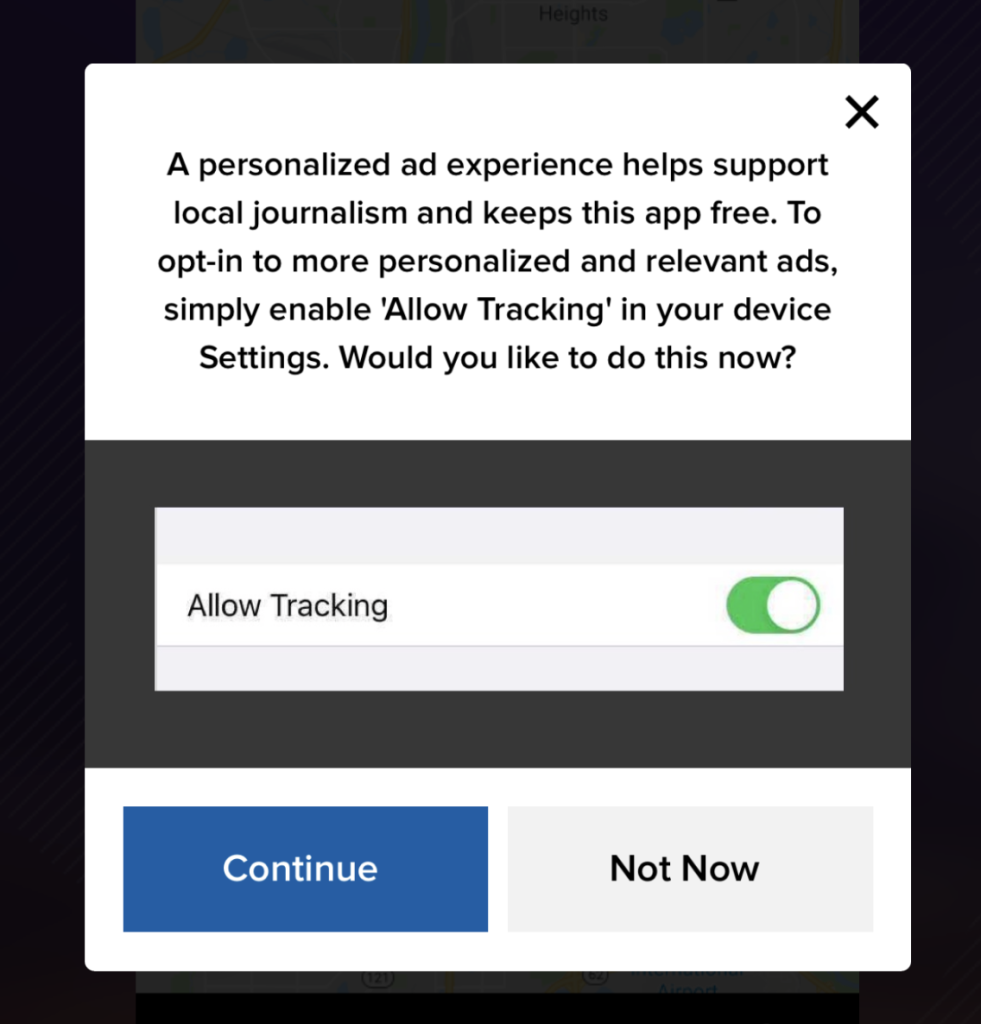
    And that is the problem with privacy in the digital world. We lack ways to make our privacy requirements explicit. That’s the main reason why it has been almost impossible for marketers to resist spying on us constantly. We are naked and defenseless. In the absence of digital clothing and ways to signal personal privacy requirements, we have an entirely corporate-side “consent”-based fecosystem that manifests in shit like this:

    These “agreements” do less than nothing to give us privacy, or even the faintest sense of it. Even if a site provides a choice such as this—
    tracking-choice

    —we have no record of our decision to not allow tracking, and no faith that our “setting” in their system will be respected.

    The status quo here is not new. It was established in the industrial age, and best explained by this guy:

    Friedrich Kessler (1901-1998) was a self-described legal realist whose most widely cited work is Contracts of Adhesion—Some Thoughts About Freedom of Contract (Columbia Law Review, 1943). In it, Kessler argues that contract law is individualistic by nature, and “closely tied up with the ethics of free enterprise capitalism and the ideals of justice of a mobile society of small enterprisers, individual merchants and independent craftsmen.”

    He also laments that this ideal was sidelined by giantism in the industrial age. Freedom of contract had become, he explains, “a one-sided privilege.” Specifically, “Freedom of contract enables enterprisers to legislate by contract…in a substantially authoritarian manner without using the appearance of authoritarian forms. Standard contracts in particular could thus become effective instruments in the hands of powerful industrial and commercial overlords enabling them to impose a new feudal order of their own making upon a vast host of vassals.”

    The pro forma standard form contract, Kessler explained, forced the weaker party—the ordinary consumer or customer—into “subjection more or less voluntary to terms dictated by the stronger party, terms whose consequences are often understood only in a vague way, if at all.”

    He called these agreements “contracts of adhesion,” and á prendre ou ai laisser (translation: “take it or leave it”). These contracts are ones the weaker party adheres to and the stronger party can change. So it’s glue for you and me, velcro for the world’s sites and services.

    This industrial age convention got leveraged in spades on the Internet, where every corporate entity—not just giants—enjoyed freedom of contract while you and I could not. This status quo became so normative that Bruce Schneier was already writing about the “feudal Internet” twelve years ago.

    Thanks to this status quo, our digital world today looks like this:
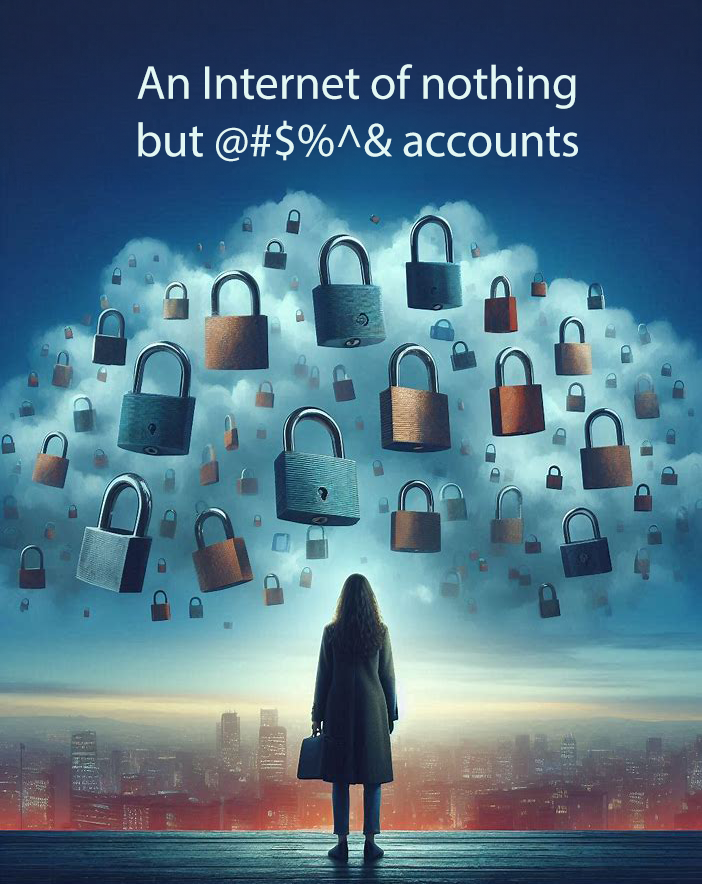
    This is not only a locked-up hell of too many logins, passwords, and second-factor authentication gauntlets. It’s a place where we have an equal number of adhesive “agreements” that aren’t, and which the feudal lords can change while we cannot. Their velcro, our glue.

    Are we stuck here? Do we have to be?

    No, because there is nothing about digital technology that requires it. And digital technology gives us boundless ways to design and program a digital world that works for people as well as it works for companies—and make it better for companies as well.

    Kessler says the legal realist is “constantly testing out the desirability, efficiency and fairness of inherited legal rules and institutions in terms of the present needs of society.” I submit that our most pressing present need is to move past surveillance capitalism and into an intention economy where the demand side of the marketplace can better signal its wants, needs, and ability to engage in mutually beneficial ways. If we have that, the supply side can stop spending $trillions on wasteful and unwelcome surveillance-fed guesswork. We can do that by starting with personal privacy.

    I also submit that there is only one way for people to secure a measure of privacy online, and that is through contract. People need to be able to proffer their own privacy terms as first parties to sites and services performing as second parties—and to do that at scale.

    And now they can, using a new standard called P7012 IEEE Draft Standard for Machine Readable Personal Privacy Terms, nicknamed MyTerms. (Much as IEEE 802.11 is nicknamed WiFi.) The IEEE approached Customer Commons with the idea for making personal privacy terms machine-readable in 2017. Today the draft is done and due to become official by early next year.

    Freedom of contract can be far more useful to both customers and companies than what companies today get out of adhesive contracts and “consents” (such as the one above) that are typically written to obey the letter of privacy laws (such as the GDPR, the DMA, and the CCPA) while violating their spirit.

    Here is how MyTerms works:

    Lots of business can be built on top of this simple system, which at the ground level starts with service provision without surveillance or unwanted data sharing by the company with other parties. New agreements can be made on top of that, but MyTerms are where genuine and trusting (rather than today’s coerced and one-sided) relationships can be built.

    When companies are open to MyTerms agreements, they don’t need cookie notices. Nor do they need 10,000-word terms and conditions or privacy policies because they’ll have contractual agreements with customers that work for both sides.

    On top of that foundation, real relationships can be built by VRM systems on the customers’ side and CRM systems on the corporate side. Both can also use AI agents: personal AI for customers and corporate AI for companies. Massive businesses can grow to supply tools and services on both sides of those new relationships. These are businesses that can only grow atop agreements that customers bring to the table, and at scale across all the companies they engage.

    Here are some of the possibilities that open up, and I explained at ProjectVRM:

    1. CMPs—Content Management Platforms—can provide sites & services with easy ways to respond to MyTerms choices brought to the table by visitors. Let’s call this a Terms Matching Engine. The current roster of terms we’re working with at Customer Commons (abbreviated CuCo, hence the cuco.org shortcut) starts with  CC-BASE, which is “service provision only.” It says to a website, “just give me your service, and nothing more.” In other words, no tracking. Yet. Negotiation toward additional provisions comes after that. Those can be anything, but they should be in the spirit of We’re starting with personal privacy here, and the visitor sets the terms for that.
    2. There is a whole new business (which, like the VPN, grammar-help, and password management businesses, people would pay for) in helping people present, manage, remember, and monitor compliance with their terms, and what additional agreements have been arrived at. This can involve browser add-ons such as the one pictured  on the ProjectVRM r-button page. CMP companies can make money there too, adding a C2B business to their B2B ones.
    3. Go beyond #2 to provide real VRM. Back in the last millennium, Iain Henderson pointed out that B2B relationships tend to have hundreds or thousands of variables over which both parties need to agree. Nitin Badjatia, another CRM veteran (and a Customer Commons board member like Iain and myself), has also pointed out that companies like Oracle have long provided AI-assisted ways for B2B relationships to arrive at contractual agreements. The same can work for C2B, once the base privacy agreement is established. There can be a business here that expands on what gets started with that first agreement.
    4. Verticals. There can be strong value-adds for regulated industries or companies wanting to acquire and signal accountability, or look for firmer ways to establish a privacy regime better than the called consent, which doesn’t work (except as thin ass-covering for companies fearing the GDPR and the CCPA). For example: banks, insurers, publishers, health care providers.
    5. For people (not just corporate clients), CMPs could offer browser plugins or apps (mobile and/or computer) that help people choose and present their privacy terms, track who honors them, notify them of violations, and have r-buttons mean something. Or multiple things.

    Here is an example of r-buttons in a browser:

    Real relationships, including records of agreements, can be unpacked when a person (not a mere “user”) clicks on either the ⊂ or the ⊃ symbols. There are golden opportunities here for both VRM and CRM vendors. And, of course, companies such as Admiral and OneTrust working both sides—and being truly trusted.

    So, if we want to de-enshittify the Internet—and to make it work well for all of us—the best way to start is with MyTerms.

  • A Cure for Corporate Addiction to Personal Data

    I wrote the original version of this post for the March 2018 issue of Linux Journal. You can find it here. Since images from archival material in the magazine no longer load, and I want to update this anyway, here is a lightly edited copy of the original. Bear in mind that what you’ll read here was at the idea stage seven years ago. Now we’re at the action stage. Let’s make this happen.

    Since the turn of the millennium, online publishing has turned into a vampire, sucking the blood of readers’ personal data to feed the appetites of adtech: tracking-based advertising. Resisting that temptation nearly killed us. But now that we’re alive, still human, and stronger than ever, we want to lead the way toward curing the rest of online publishing from the curse of personal data vampirism. And we have a plan. Read on.


    This is the first issue of the reborn Linux Journal, and my first as editor-in-chief. This is also our first issue to contain no advertising.

    We cut out advertising because the online publishing industry has become cursed by the tracking-based advertising vampire called adtech. Unless you wear tracking protection, nearly every ad-funded publication you visit sinks its teeth into the data jugulars of your browsers and apps, to feed adtech’s boundless thirst for knowing more about you.

    Both online publishing and advertising have been possessed by adtech for so long that they can barely imagine how to break free and sober up—even though they know adtech’s addiction to human data blood is killing them while harming everybody else as well. They even have their own twelve-step program.

    We believe the only cure is code that gives publishers ways to do exactly what readers want, which is not to bare their necks to adtech’s fangs every time they visit a website.

    We’re doing that by reversing the way terms of use work. Instead of readers always agreeing to publishers’ terms, publishers will agree to readers’ terms. Specifically, we’re doing it with a new standard called IEEE P7012—IEEE Draft Standard for Machine Readable Personal Privacy Terms, aka MyTerms.

    The first of these terms will say something like this:

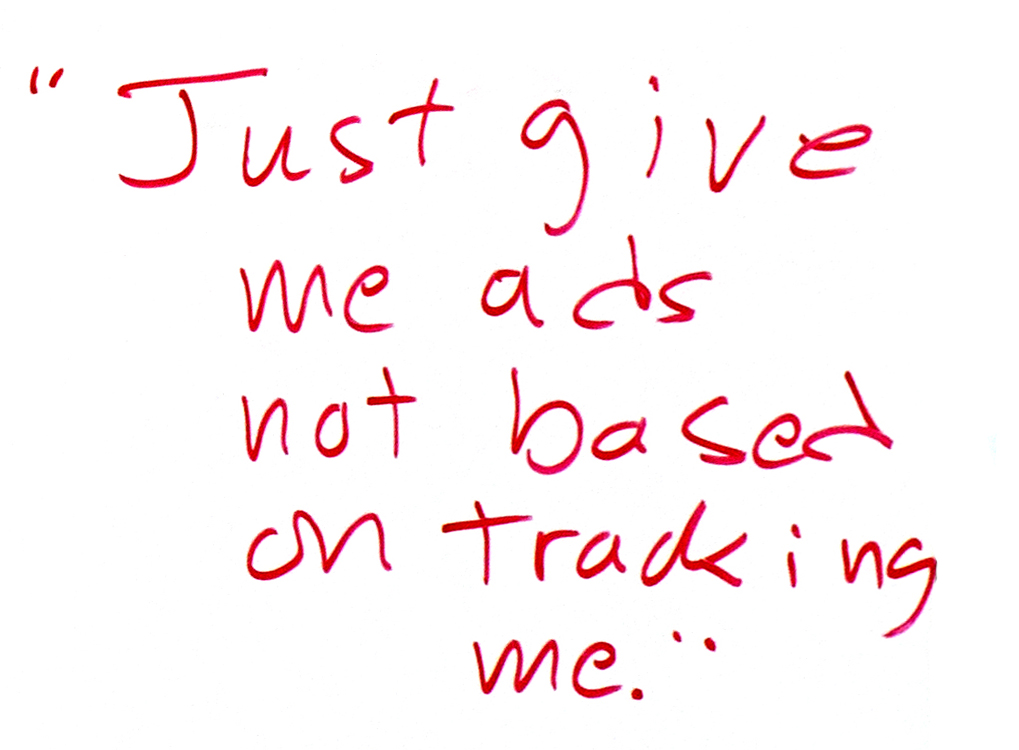
    That scrawled statement appeared on a whiteboard one day at IIW when we were talking about terms readers might proffer to publishers. Let’s call it #NoStalking. Like others of its kind, #NoStalking will live at Customer Commons, which will do for personal terms what Creative Commons does for personal copyright.

    Publishers and advertisers can both accept that term, because it’s exactly what advertising has always been in the offline world, and still in the too-few parts of the online world where advertising sponsors publishers without getting personal with readers.

    By agreeing to #NoStalking, publishers will also have a stake it can drive into the heart of adtech.

    Teeth for enforcing this idea will erupt from the jaws of the EU on 25 May 2018. That’s the day when the General Data Protection Regulation (GDPR) takes full enforcement effect. The GDPR is aimed at the same data vampires, and its fines for violations run up to 4% of a company’s revenues in the prior fiscal year. It’s a very big deal, and has opened the minds of publishers and advertisers to anything that moves them toward GDPR compliance.

    With the GDPR putting fear in the hearts of publishers and advertisers everywhere, the likes of #NoStalking may succeed where DoNotTrack (which the W3C has now ironically relabeled Tracking Preference Expression) failed.

    I want to make clear here that we are not against advertising. In fact we rely on it. What we don’t rely on is adtech. Here is the difference:

    • Real advertising isn’t personal, doesn’t want to be. To do that, adtech spies on people and violates their privacy as a matter of course, and rationalizes it completely, with costs that include becoming a big fat target for bad actors.
    • Real advertising’s provenance is obvious, while adtech messages could be coming from any one of hundreds (or even thousands) of different intermediaries, all of which amount to a gigantic four-dimensional shell game no one entity fully comprehends. Those entities include SSPs, DSPs, AMPs, DMPs, RTBs, data suppliers, retargeters, tag managers, analytics specialists, yield optimizers, location tech providers… the list goes on. And on. Nobody involved—not you, not the publisher, not the advertiser, not even the third party (or parties) that route an ad to your eyeballs—can tell you exactly why that ad is there, except to say they’re sure form of intermediary AI decided it is “relevant” to you, based on whatever data about you, gathered by spyware, reveals about you. Refresh the page and some other ad of equally unclear provenance will appear.
    • Real advertising has no fraud or malware (because it can’t—it’s too simple and direct for that), while adtech is full of both.
    • Real advertising supports journalism and other worthy purposes, while adtech supports “content production”—no matter what that “content” might be. By rewarding content production of all kinds, adtech gives fake news a business model. After all, fake news is “content” too, and it’s a lot easier to produce than the real thing. That’s why real journalism is drowning under a flood of it. Kill adtech and you kill the economic motivation for most fake news. (Political motivations remain, but are made far more obvious.)
    • Real advertising sponsors media, while adtech undermines the brand value of both media and advertisers by chasing eyeballs to wherever they show up. For example, adtech might shoot an Economist reader’s eyeballs with a Range Rover ad at some clickbait farm. Adtech does that because it values eyeballs more than the media they visit. And most adtech is programmed to cheap out on where it is placed, and to maximize repeat exposures wherever it can continue shooting the same eyeballs.

    In the offline publishing world, it’s easy to tell the difference between real advertising and adtech, because there isn’t any adtech in the offline world, unless we count direct response marketing, better known as junk mail, which adtech actually is.

    In the online publishing world, real advertising and adtech look the same, except for ads that feature this symbol:

    Only not so big. You’ll only see it as a 16×16 pixel marker in the corner of an ad. So it actually looks like this:

    Click on that tiny thing and you’ll be sent to an “AdChoices” page explaining how this ad is “personalized,” “relevant,” “interest-based” or otherwise aimed by personal data sucked from your digital neck, both in real time and after you’ve been tracked by microbes adtech has inserted into your app or browser to monitor what you do.

    Text on that same page also claims to “give you control” over the ads you see, through a system run by Google, Adobe, Evidon, TrustE, Ghostery or some other company that doesn’t share your opt-outs with the others, or provide any record of the “choices” you’ve made. In other words, together they all expose what a giant exercise in misdirection the whole thing is. Because unless you protect yourself from tracking, you’re being followed by adtech for future ads aimed at your eyeballs using source data sucked from your digital neck.

    By now you’re probably wondering how adtech came to displace real advertising online. As I put it in Separating Advertising’s Wheat and Chaff, “Madison Avenue fell asleep, direct response marketing ate its brain, and it woke up as an alien replica of itself.” That happened because Madison Avenue, like the rest of big business, developed a big appetite for “big data,” starting in the late ’00s. (I unpack this history in my EOF column in the November 2015 Linux Journal.)

    Madison Avenue also forgot what brands are and how they actually work. After a decade-long trial by a jury that included approximately everybody on Earth with an Internet connection, the verdict is in: after a $trillion or more has been spent on adtech, no new brand has been created by adtech; nor has the reputation of an existing brand been enhanced by adtech. Instead, adtech damages a brand every time it places the brand’s ad next to fake news or on a crappy publisher’s website.

    In Linux vs. Bullshit, which ran in the September 2013 Linux Journal, I pointed to a page that still stands as a crowning example of how much of a vampire the adtech industry and its suppliers had already become: IBM and Aberdeen‘s The Big Datastillery: Strategies to Accelerate the Return on Digital Data. That link goes to the Internet Archive snapshot of the page. Give it time to load. If it doesn’t, go here. Or just click on this .jpg I just made from the .pdf verion of the thing:

    Big Datastillery

    The “datastillery” is a giant vat modeled on a whiskey distillery. Going into the top are pipes of data labeled “clickstream data,” “customer sentiment,” “email metrics,” “CRM” (customer relationship management), “PPC” (pay per click), “ad impressions,” “transactional data,” and “campaign metrics.” All that data is personal, and little if any of it has been gathered with the knowledge or permission of the persons it concerns.

    At the bottom of the vat, distilled marketing goop gets spigoted into beakers rolling by on a conveyor belt through pipes labeled “customer interaction optimization” and “marketing optimization.” Those beakers are human beings.

    Farther down the conveyor belt, exhaust from goop metabolized in the human beakers is farted upward into an open funnel at the bottom end of the “campaign metrics” pipe, through which it flows up to the top and is poured back into the vat.

    Look at this image as an MRI of the vampire’s digestive system, or a mirror in which the reflections of IBM’s and Aberdeen’s images fail to appear because their humanity is gone.

    No wonder ad blocking became the largest boycott in human history by 2015. Here’s how large:

    1. PageFair’s 2017 Adblock Report says at least 615 million devices were already blocking ads by then. That number is larger than the human population of North America.
    2. GlobalWebIndex says 37% of all mobile users worldwide were blocking ads by January 2016, and another 42% would like to. With more than 4.6 billion mobile phone users in the world, that means 1.7 billion people were blocking ads already—a sum exceeding the population of the Western Hemisphere.

    Naturally, the adtech business and its dependent publishers cannot imagine any form of GDPR compliance other than continuing to suck its victims dry while adding fresh new inconveniences along those victims’ path to adtech’s fangs—and then blaming the GDPR for delaying things.

    A perfect example of this non-thinking is a recent Business Insider piece that says “Europe’s new privacy laws are going to make the web virtually unsurfable” because the GDPR and ePrivacy (the next legal shoe to drop in the EU) “will require tech companies to get consent from any user for any information they gather on you and for every cookie they drop, each time they use them,” thus turning the Web “into an endless mass of click-to-consent forms.”

    Speaking of endless, the same piece says, “News sites — like Business Insider — typically allow a dozen or more cookies to be ‘dropped’ into the web browser of any user who visits.” That means a future visitor to Business Insider will need to click “agree” before each of those dozen or more cookies gets injected into the visitor’s browser.

    After reading that, I decided to see how many cookies Business Insider actually dropped in my Chrome browser when that story loaded, or at least tried to. Here’s what Baycloud Bouncer reported:

    That’s ten dozen cookies.

    This is in addition to the almost complete un-usability Business Insider achieves with adtech already. For example,

    1. On Chrome, Business Insider‘s third party adtech partners take forever to load their cookies and auction my “interest” (over a 320MBp/s connection), while populating the space around the story with ads—just before a subscription-pitch paywall slams down on top of the whole page like a giant metal paving slab dropped from a crane, making it unreadable on purpose and pitching me to give them money before they life the slab.
    2. The same thing happens with Firefox, Brave, and Opera, though not at the same rate, in the same order, or with the same ads. All drop the same paywall, though. It’s hard to imagine a more subscriber-hostile sales pitch.
    3. Yet I could still read the piece by looking it up in a search engine. It may also be elsewhere, but the copy I find is on MSN. There, the piece is also surrounded by ads, which arrive along with cookies dropped in my browser by only 113 third-party domains. Mercifully, no subscription paywall slams down on the page.

    So clearly, the adtech business and its publishing partners are neither interested in fixing this thing, nor competent to do it.

    But one small publisher can start. That’s us. We’re stepping up.

    Here’s how: by reversing the compliance process. By that I mean we are going to agree to our readers’ terms of data use, rather than vice versa. Those terms will live at Customer Commons, which is modeled on Creative Commons. Look for Customer Commons to do for personal terms what Creative Commons did for personal copyright licenses.

    It’s not a coincidence that both came out of Harvard’s Berkman Klein Center for Internet and Society. The father of Creative Commons is law professor Lawrence Lessig, and one of Customer Commons’ parents is me. In the great tradition of open source, I borrowed as much as I could from Larry and friends.

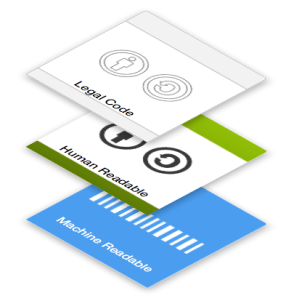
    For example, Customer Commons’ terms will come in three forms of code (which I illustrate with the same graphic Creative Commons uses):

    Legal Code is being baked by Customer Commons’ counsel: Harvard Law School students and teachers working for the Cyberlaw Clinic at the Berkman Klein Center.

    Human Readable text will say something like “Just show me ads not based on tracking me.” That’s the one we’re dubbing #DoNotByte.

    For Machine Readable code, we now have a working project at the IEEE: 7012 – Standard for Machine Readable Personal Privacy Terms. There it says,

    The purpose of the standard is to provide individuals with means to proffer their own terms respecting personal privacy, in ways that can be read, acknowledged and agreed to by machines operated by others in the networked world. In a more formal sense, the purpose of the standard is to enable individuals to operate as first parties in agreements with others—mostly companies—operating as second parties.

    That’s in addition to the protocol and a way to record agreements that JLINCLabs or some other protocol will provide.

    And we’re wide open to help in all those areas.

    Here’s what agreeing to readers’ terms does for publishers:

    1. Provide real GDPR compliance, by recording the publisher’s agreement with the reader not to track them. Note that contract is one of the six lawful reasons the GDPR lists for processing personal data. See item (b) here. Note that (a) is for consent, which is clearly now a fail.
    2. Put publishers back on a healthy diet of real (tracking-free) advertising. Which should be easy to do because that’s what all of advertising was before publishers, advertisers and intermediaries turned into vampires.
    3. Restore publishers’ status as good media for advertisers to sponsor, and on which to reach high-value readers.
    4. Model for the world a complete reversal of the “click to agree” process. This way we can start to give readers scale across many sites and services.
    5. Pioneer a whole new model for compliance, where sites and services comply with what people want, rather than the reverse (which we’ve had since industry won the Industrial Revolution).
    6. Raise the value of tracking protection for everybody. In the words of Don Marti, “publishers can say, ‘We can show your brand to readers who choose not to be tracked.’” He adds, “If you’re selling VPN services, or organic ale, the subset of people who are your most valuable prospective customers are also the early adopters for tracking protection and ad blocking.”

    But mostly, we get to set an example that publishing and advertising both desperately need. It will also change the world for the better.

    You know, like Linux did for operating systems.


    Now, eight years after the MyTerms working group started drafting its standard, the draft is finished and likely to be published early next year. Meanwhile, there is nothing to stop work based on that standard, which is simplified here.

    By the way, third-party tracking is disallowed in all thirteen of Customer Commons’ current set of draft agreements (which we hope to publish soon). The base agreement, currently nicknamed CC-BASE, says “service provision only.” This is what we experience in the natural world. If your business is selling clothes, we expect to see clothes, not to get infected with spyware. If one wants some spyware later, that offer can go on the table later.

    MyTerms is the table on which future agreements are set, under the complete control of the individual operating as the first party—and at scale across all the sites and services the individual engages.

    The only way we will ever get full agency in the digital world is through contracts. Full stop. And full start.

  • It was real

    I grew up under the red star, and right now I’m just to the right of it, on the third and top floor of the smallest residential building in northern Manhattan.

    When it hit, my wife and I both said, “That’s an earthquake.” We’ve experienced many in California, and know the feel.

    But none of the quake sources online noted it in real time, or close.

    Now the details are in. Nothing big, just interesting.


  • Getting Real With AI.

    The incorporeal non-place where we also live. By Hugh McLeod, 2004.

    How do we make a mutual sense of our co-existence in the natural and digital worlds? To see how hard that is, consider this: There is also no “on” in “online.” No “in.”

    Think about the prepositions we use to make sense of the natural world: in, on, under, around, through, beside, within, beneath, above, into, near, toward, with, outside, amid, beyond. All are made for our embodied selves. In the natural world up truly is up, and down is down, because we have distance and gravity here. We don’t have distance or gravity in the digital world. We are not embodied there. However, the digital world is no less real for the absence of distance, gravity, substance, shape, and the very real whatevers that we see, smell, hear, weigh, touch, and feel in the natural world.

    Cyberspace is beyond ironic. It is oxymoronic, self-contradictory. It’s a spaceless non-place except in an abstract way. When people in Sydney, Lucerne, New York, and Tokyo meet on (or through, or with—pick your preposition) Zoom, they are not in a physical where. They are co-present in a non-space that Craig Burton called a giant zero: a hollow virtual sphere across which any two points can see each other, connect, communicate, and work.

    But we treat this zero as a real place, because metaphors are how we make sense of the world. And all metaphors are wrong. They are like what they represent, but are far from the same. Time is not money, but we save, waste, spend, invest, and lose it.  Life is not travel, yet we arrive, depart, get lost, jump on board, and fall off the wagon. This is why we make sense of cyberspace with real estate metaphors: domains with locations on sites where we construct or build the non-things we call homes. Or with publishing ones, by writing, authoringposting, and syndicating or work. Or with transportation ones, for example with packets that we uploaddownload, transporttrace, and so on.

    All these thinkings came to mind this morning when I read two pieces:

    The first speaks to living disembodied lives along with our embodied ones.

    The second speaks to the mania for Big AI spend:

    It’s also worth breaking down where the money would be spent. Morgan Stanley estimates that $1.3tn of data centre capex will pay for land, buildings and fit-out expenses. The remaining $1.6tn is to buy GPUs from Nvidia and others. Smarter people than us can work out how to securitise an asset that loses 30 per cent of its value every year, and good luck to them.

    Where the trillions won’t be spent is on power infrastructure. Morgan Stanley estimates that more than half of the new data centres will be in the US, where there’s no obvious way yet to switch them on.

    I now think at least some of that money will be far better spent on personal AI.

    That’s AI for you and me, to get better control of our lives in the natural world where we pay bills, go to school, talk to friends, get sick and well, entertain ourselves and others, and live lives thick with data over which we have limited control at most. Do you have any record of all your subscriptions, your health and financial doings and holdings, what you’ve watched on TV, where you’ve been, and with whom? Wouldn’t it be nice to have all that data handy, and some AI help to organize and make sense of it? I’m talking here about AI that’s yours and works for you. Not a remote service from some giant that can do whatever it pleases with your life.

    It’s as if we are back in 1975, but instead of starting to work on the personal computer, all the money spent on computing goes into making IBM and the BUNCH more gigantic than anything else ever, with spendings that dwarf what might be spent on simple necessities, such as the electric grid and roads without holes. Back then, we at least had the good fortune of Steves Jobs and Wozniac, Adam Osborne, and other mammals starting a personal computing revolution underneath the bellies of digital dinosaurs. Do we have the same kind of pioneers working on personal AI today? Name them. Tell us what they’re doing. We need them.

    Note that I’m not talking about people working on better ways to buy stuff, or to navigate the digital world with the help of smart agents. I’m talking about people working on personal (not personalized) AI that will give us ways to get control of our everyday lives, without the help of giants.

    Like we started doing with personal computers fifty years ago.


  • In fewest words, yes.

    When I just opened the app, I got the screen on the left. Since I wasn’t listening this afternoon, it made no sense. The one in the middle appeared when I returned to the app. It just lists channels, starting at the bottom (from which they annoyingly moved “Fifties on 5” and “Sixties on 6” to other channels), and then shows me the right screen when I hit Library, which used to have the much more sensible label “Favorites.” I hate the whole mess, but that’s beside the point of this post, so read on.

    Here is my answer to the question Does SiriusXM know what station you are listening to?

    The SiriusXM streaming app logs what you listen to, when, and how you interact with programs and channels across your devices (phone, pad, smart speaker, website through your browser, whatever).

    This data is used to personalize your “experience” (as the marketers like to say), sync your profile across devices, and support marketing efforts (which these days are mostly surveillance-based) while maintaining “pseudonymous tracking.”

    Older SiriusXM radios (before about 2020) had no return path for usage data to flow to the company, but almost all new cars have their own cellular data connections (over which you have no control) for reporting many kinds of driving and usage data, including what you do with your car’s infotainment system.

    Your SiriusXM radio use is among the many forms of personal data being reported by your car to its maker and to other parties known and unknown. To explain this, the SiriusXM privacy policy provides, in the current business fashion, what Paul Simon (in “The Boxer”) calls “a pocket full of mumbles such are promises.”

    All that said, there isn’t much in my experience of SiriusXM to suggest that I am being understood much in any way by the system. There are many more of what used to be called “favorites” in the Library. But there is no obvious order to how and why they appear where they do on the list. I have other complaints, but none are worth going into. And I’ve already posted my biggest complaint in How to Make Customers Hate You.

  • New Life for LIVE

    Colbert’s cancellation looks political, but it’s not. The show was a ratings winner, but a money loser. And the ratings for all of late night, like all of live TV, have been in decline for decades, along with the question, “What’s on?”

    We live in the Age of Optionality now. Watch or listen to whatever you want, whenever you want, on whatever you want.

    Except for sports, news, and Saturday Night Live, live programming is disappearing from radio and TV. Meanwhile, radio and TV themselves are being sidelined by apps on phones, flat screens, smart speakers, and CarPlay/Android Auto.

    Fact: The only thing that makes your TV a TV is the cable/antenna jack in the back. Otherwise, it’s a monitor with a computer optimized for clickbait and spying on you. The clickbait is the (often spying-based) “for you” shit, plus what the industry calls FAST (Free Ad-Supported Streaming Television) channels: old westerns, local TV from elsewhere, looping news from services you never heard of, hustlers selling junk, foreign language programs, a fireplace that doesn’t go out, plus other crap.

    Broadcasting has devolved from Macy’s to Dollar General.

    But live programming is still with us. It’s just not on TV or radio, just like food trucks aren’t in buildings. At this stage what we have are pop-up shows with very high harbinger ratings and uncertain persistence. Here are a few I just looked up:::

    Newsletter Writers

    • Casey Newton (Platformer)
    • Matt Taibbi (Racket News)
    • Heather Cox Richardson (Letters from an American)
    • Anne Helen Petersen (Culture Study)
    • Emily Atkin (Heated)
    • Puck News team (e.g. Dylan Byers, Teddy Schleifer)

    Influencers (Mostly on TikTok and Instagram)

    • Tinx
    • Chris Olsen
    • Bretman Rock
    • Tabitha Brown

    Celebrities (on YouTube, Substack, TikTok, X Spaces, etc.)

    • Andrew Callaghan
    • Marc Maron
    • Hank Green
    • Elon Musk & David Sacks

    Writers

    • Tim Urban (Wait But Why)
    • Bari Weiss (The Free Press)
    • Douglas Rushkoff (Team Human)

    Since I’m not on TikTok and barely on Instagram, I know none of the influencers I just listed with a bit of AI help. If I have time later, I’ll add links.

    Meanwhile, the writing isn’t just on the wall for live old-school broadcasting. The wall is falling down, and new ones are being built all over the place by creative voices and faces themselves. Welcome to Now.

  • How about  ASO, for Attention Surfeit  Order?

    The study cited below says, “Our findings suggest that ADHD attributes may confer foraging advantages in some environments and invite the possibility that this condition may reflect an adaptation favouring exploration over exploitation.” Well, I spent my summers as a kid at the edge of New Jersey’s pine barrens, foraging for blueberries such as these, and I was damn good at it.

    Royal SocietyAttention deficits linked with proclivity to explore while foraging. To which Thom Hartman adds, The Science Catches Up: New Research Confirms ADHD as an Evolutionary Advantage, Not a Disease.

    Which I’ve always believed.  But that didn’t make me normal. Far from it.

    In my forties and at my wife’s urging (because my ability to listen well and follow directions was sub-optimal), I spent whole days being tested for all kinds of what we now call neurodivergent conditions. The labels I came away with were highly qualified variants of ADHD and APD. Specifics:

    • I was easily distracted and had trouble listening to and sorting out instructions for anything. (I still have trouble listening to the end of a long joke.)
    • On puzzle-solving questions, I was very good.
    • My smarts with spatial and sequence puzzles were tops, as was my ability to see and draw patterns, even when asked to remember and rotate them 90° or 180°.
    • My memory was good.
    • I had “synchronization issues,” such as an inability to sing and play drums at the same time. This also involved deficiencies around “cognitive overload,” “context switching,” multitasking, coping with interruptions, and “bottlenecks” in response selection. They also said I had become skilled at masking all those problems, to myself and others. (While I thought I was good at multitasking, they told me, “You’re in the bottom 1%.”)
    • I could easily grasp math concepts, but I made many mistakes with ordinary four-function calculations.
    • I did much better at hearing and reading long words than short ones, and I did better reading wide columns of text than narrow ones.
    • When asked to read out loud a simple story composed of short and widely spaced words in a narrow column, I stumbled through it and remembered little of the content afterward. They told me that if I had been given this test alone, they would have said I had trouble reading at a first-grade level, and I would have been called (as they said in those days) mentally retarded.
    • My performance on many tests suggested dyslexia, but my spelling was perfect, and I wasn’t fooled by misplaced or switched letters in words. They also said that I had probably self-corrected for some of my innate deficiencies, such as dyslexia. (I remember working very hard to become a good speller in the fourth grade, just as a challenge to myself. Not that the school gave a shit.)
    • They said I did lots of “gestalt substitution,” when reading out loud, for example, replacing “feature” with “function,” assuming I had read the latter when in fact I’d read the former.
    • Unlike other ADHD cases, I was not more impulsive, poorly socialized, or easily addicted to stuff than normal people. I was also not hyperactive, meaning I was more ADD than ADHD.
    • Like some ADHD types, I could hyperfocus at times.
    • My ability to self-regulate wasn’t great, but it also wasn’t bad. Just a bit below average. (So perhaps today they’d call me ADHD-PI, a label I just found in Wikipedia).
    • The APD (auditory processing disorder) diagnosis came mostly from hearing tests. But, as with ADHD, I only hit some of the checkboxes. (Specifically, about half of the ten symptoms listed here.)
    • My ability to understand what people say in noisy settings was in the bottom 2%. And that was when my hearing was still good.

    So there’s no good label for me, but…

  • Good read

    I just got turned on to Paul Ford's What is Code, from 2015, but still current today. Shoulda been a book, like Neal Stephenson's In the Beginning Was the Command Line. You can still find the text online, such as here.

  • Nice, I hope

    That "intention economy" appears (in a positive way) in this story from South Africa, in IOL.

  • One reason I love Indiana

    2017 VW alltrack

    My car’s dashboard has been telling me we have a slow leak in the right front tire. So I drove up to Tieman Tire here in Bloomington. It was busy, but they took me as a walk/drive-in, and then took an hour to remove the tire, find the leak in a tub of water (which wasn’t easy, because the leak was too sphinctered to make bubbles: they had to feel in and on the tread all around the tire to locate the leak, which was from a tiny nail), remove and patch the tire, balance it, and torque it back onto the car… and then to make sure all four tires and the spare were all properly inflated. It was also fun to talk shop about cars and tires. One guy thought my car made more sense than one of those big ole SUVs.

    Price: $20.

    They now have me as a loyal customer.

  • Dame Time!

    I love that Damien Lillard is returning to the Portland Trailblazers. He and the town love each other, and the team is already on the ascent. It's a great move.

  • The Eagle in the Coal Mine

    Public broadcasting is the strongest form of broadcasting that’s still left.
    One reason is that it’s the only form of broadcasting for which its consumers are also its customers. Yes, not all those customers pay, but the market is there. If you donate to public radio or television stations, or to public radio programs and podcasts supported by subscriptions, you are paying for goods and services. You are customers in an open marketplace.

    But broadcasting itself is an anachronism. For radio, listening is moving from radios to phones* pads, and smart speakers. For television, viewing is moving from antennas and cable to Internet streams. Even the PBS app on your streaming box requires that you first pay your public TV station. (Here’s why: PBS wholesales its programs to stations, which in turn retail their programming to you. With apps, they can force you to pay. With free over-the-air broadcast, they can’t. Financially, free over-the-air broadcast isn’t a feature; it’s a bug—a giant financial loophole.)

    It’s a matter of time before AM and even FM radio are gone from cars, because every station has worldwide coverage over the cellular data system (and Starlink: see the comment from Steve Stroh below), making stations’ over-the-air coverage obsolete.

    Also, most stations are now just ways to route programs. Few medium and small market stations are still programmed locally, or still employ local talent other than in clerical and ad sales positions. Local and regional public radio stations still tend to be staffed, because they are in the business of programming more than distribution, and belong to their communities. But the primary listening devices today are apps on phones, not radios. Even in cars, the radio isn’t even in the back seat. It’s in the veritable trunk, with the spare tire. For example, try to find your way into the radio on the dashboard of the 2025 Audi Q5:

    No radio, no knobs, nothing to “tune” with.

    There are going to be some big victims. Rural public radio in Alaska for example, just got clobbered by the end of CPB funding, which was its major source of income. In many locales, local public radio is the only source of information, entertainment, and emergency help.

    But listeners can still pay to keep the stations going. That’s why I wrote If you like public broadcasting, be customers, not just consumers. Read it again, if you haven’t already.

    And then, if you really care, help develop EmanciPay, which will make it much easier for consumers to become customers.

    _____

    *Even in cars, through CarPlay and Android Auto. In Teslas, the equivalent happens without a phone.

  • From  Dates to Tweets

    For the past few weeks I've been writing the blog mostly in Wordland, which is awesome. I'll still keep doing that (such as right now). But I'm hitting the pause button on combining a day's postings under title that's a date.

    I went with dates-as-headlines because it most closely resembled the way I wrote on my original blog, which is archived here. Note that most of the posts under each date were short, kind of like a tweet. Each also had a short snarky headline that worked as the punchline for the post. (A trick I learned form Esquire's Dubious Achievement Awards, which, alas, are all paywalled).  For example, Further proof of life after birth was the headline of my last post before I turned 60.

    I sorta replicated that approach here by putting a boldfaced one-liner at the start of each post under a date headline. That worked for readers (meaning it looked good), but a problem showed up when I looked back through posts in my WordPress dashboard: All I could see were dates. I couldn't see the leading lines (sub-headlines of a sort) of each post under the date headline, because those sub-headlines were buried in text. I needed clues in the form of posts' headlines.

    So now I'm leaving the dateline up to WordPress and writing headlines anew for each short post.

  • Thursday, 17 July 2025

    An incomplete waste of timeNew colors without shooting lasers into your eyes.

    No shit. Machine Bullshit: Characterizing the Emergent Disregard for Truth in Large Language Models is a scientific paper by four authors from Princeton and two from UC Berkeley. A pull-quote: "While previous work has explored large language model (LLM) hallucination and sycophancy, we propose machine bullshit as an overarching conceptual framework that can allow researchers to characterize the broader phenomenon of emergent loss of truthfulness in LLMs and shed light on its underlying mechanisms. We introduce the Bullshit Index, a novel metric quantifying LLMs’ indifference to truth, and propose a complementary taxonomy analyzing four qualitative forms of bullshit: empty rhetoric, paltering, weasel words, and unverified claims."

    We're sorry now. One of my most vivid memories is walking from the Mantoloking Beach snack stand to our family's red umbrella with a white stripe around it. I wove my way through a forest of other umbrellas and blankets (it was a crowded beach), while a Nutty Buddy and an ice cream sandwich melted in my hands and "Lipstick on your collar" played from more than a dozen transistor radios along my path. The singer was Connie Francis, and the radio station was my fave* at the time: WMCA/570 from New York. Connie died yesterday at 87. She was a powerful singer with a brilliant mind who led a long, interesting, and often troubled life—one totally worth reading about. Glad she lived a long one. *Top 40 competitors in that age were WINS/1010 and WMGM/1050. Though both were 10x WMCA's power, their signals were aimed away from the Jersey Shore while WMCA's wasn't. Later, WABC/770 would blow all three away.

    It's Pop's birthday. Were he alive, he'd be 117 years old. Here is the collection of photos from his life (starting with ancestors) that I posted on his 100th birthday.

  • If you like public broadcasting, be customers, not just consumers

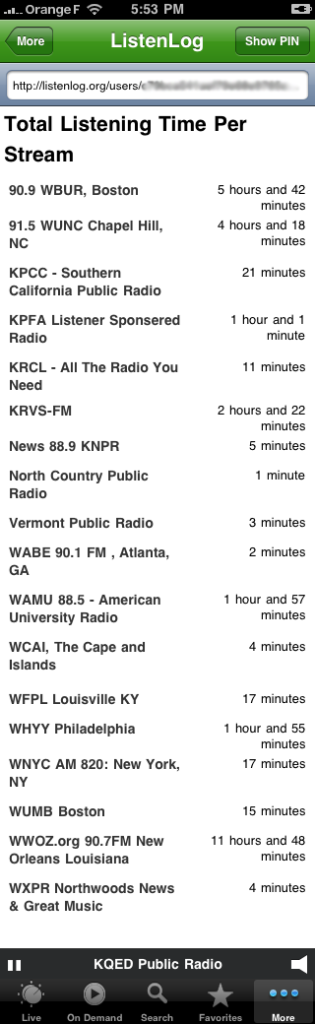
    My log of listening to public radio in 2010. This was a project for getting listeners to know exactly what they listened to, and then to distribute payments on a pro rata basis, and do it easily. More about it below.

    Public broadcasting has three markets:

    1. Listeners and viewers.
    2. Philanthropies (wealthy individuals and foundations).
    3. Government agencies (primarily the Corporation for Public Broadcasting, or CPB).

    I saw the writing on the wall for  #3 in 2010. (Actually much earlier, but that’s the oldest link I could find.) It has been clear for decades that Republicans have no appetite for public broadcasting and would throw up on it as soon as they had the chance. Now here we are.

    The good thing for public broadcasting is that it still has #1.

    That its consumers are also its customers is a huge advantage over commercial over-the-air broadcasting, which entirely serves the advertising market. (Meaning that’s what pays for it.)  But, there are problems.

    First, over-the-air broadcasting is in decline, as listening shifts from live radio to podcasts and music streams, while TV shifts from over-the-air and cable (now together called “linear”) to paid on-demand streaming (now increasingly subsidised by advertising as well).

    Second, public broadcasting’s alpha brands—NPR and PBS—sell their goods to stations, not to listeners and viewers. This puts them a degree of remove from market demand.

    Third, like many on the political left, they don’t understand business.  Yes, they cover it. But if they really got business, they would know that their primary market is their listeners and viewers, who pay for the service. Yes, it’s volunteered payment, but it’s still money-for-goods, meaning business. There are better approaches to getting that business than begging constantly for contributions and calling everybody who contributes a member. (Not that having members is a bad thing. It just shouldn’t be the only thing.) More about this below.

    Fourth, there are audience issues. The PBS audience is barbell-shaped: heaviest with the very old and the very young. NPR’s audience is middle-aged and up. It also leans toward the intelligentsia. Joe Colombe made Trader Joe’s a thing by aiming its stores toward what he called “the over-educated and underpaid.” At the heart of that were academic folk: people who worked in education or were just well-educated. This is why NPR is kind of the Trader Joe’s of broadcasting. Betcha most Trader Joe’s customers are Democrats too.

    In Parliament of Whores, P.J. O’Roarke says, “The Democrats are the party that says government will make you smarter, taller, richer, and remove the crabgrass on your lawn. The Republicans are the party that says government doesn’t work and then they get elected and prove it.” And right now they’re proving it by laying waste to everything that Democrats love, such as NPR and PBS. Here’s the White House’s bill of particulars against all three.

    Never mind that the administration’s favored media, which I’ve been calling redstream, is as steeply biased as a cliff. But the White house does have a case. But that case isn’t really the one in their list. It’s what Matt Taibbi says in his latest newsletter (half-hidden behind a teasewall):

     The quintessential PBS show was informative and quirky without pulling ideological threads, even if its Masterpiece roster sometimes over-scratched the upscale viewer’s costume-drama itch. From nature shows to comedy to documentaries, PBS was a sound counterweight to the boobs-and-car-chase lineups on commercial TV, providing the most remote communities with quality programming.

    It should have run forever. National Public Radio ruined the enterprise, turning the country’s signature public news shows into an endless partisan therapy session, a Nine Perfect Strangers retreat for high-income audiences micro-dosing on Marx and Kendi. Forget conservatives, NPR’s trademark half-whispered stylings linking diets to rape culture or denouncing white teeth as a hangover of colonialism began in recent years to feel like physical punishment to the most apolitical listeners, like having a blind librarian hacksaw your forehead. Even today’s New York Times piece couldn’t argue the bias issue, instead offering a mathematical deflection:

    Matt’s paywall appears after that colon, but he’s talking about This Is Why America Needs Public Media, by the editorial board. (Also behind a paywall, but I subscribe, so I can see it.) Here are the money grafs:

    The cut would also hasten the decline of America’s once robust media ecosystem. The number of local journalists has declined by 75 percent since 2002, and a third of American counties don’t have a single full-time local journalist, a study last week found. The United States spends less per person on public media than other wealthy countries, but even that limited funding has helped make public radio a resilient part of local news. To abandon it would be to accelerate a dangerous trend straining civic health.

    Republicans complain, not always wrongly, that public media reflects left-leaning assumptions and biases. And they can fairly tell NPR and PBS to do a better job of reflecting the citizenry that is subsidizing them. Yet the “national” part of NPR (or National Public Radio, as it used to call itself) that chafes conservatives may well be just fine without federal funds. Only about 2 percent of its budget comes directly from the federal government, and it may have an easier time raising money from its many dedicated listeners if Congress punishes it.

    A funding cutoff would damage valuable services that have little to do with ideology. Broadcasting local government meetings, as some public radio stations do, is neither liberal nor conservative. The same is true about public television shows like “Sesame Street” that help teach young children how to read and count. Local affiliates largely cover community and state issues that do not neatly fit national left-right divides, and they would suffer most. That’s one reason a number of conservative Republicans, such as Senator Mike Rounds of South Dakota, warn of the bill’s impact.

    What they don’t mention is that small-market radio gets clobbered most, because they get much or most of their funding from the CPB. Links:

    So. What to do?

    Well, philantropies and wealthy Democrats will probably take up some of the slack. But how about listeners? I think they can. Here’s why.

    Back in public radio’s heyday, before the Age of Podcasts, when I would speak to a room full of people in a college town such as Cambridge or Santa Barbara, I would sometimes ask the room, “How many here listen to public radio?” Nearly every hand would go up. Then I’d ask, “How many of you pay for it?” About 10% stayed up. Then I’d ask, “How many of you would pay for it if paying was easy? The number would double, to about 20%. Then I’d ask, “How many of you would give more if they didn’t turn off programming twice a year to beg for funding?” Even more hands would go up.

    So there’s a larger market here. This is one reason why, back in 2006, when I started as a fellow at the Berkman Klein Center, I launched ProjectVRM, I saw public radio as a vendor with which listeners could better relate as customers. Toward that goal, my first move was convening a bunch of public radio folk in a conference room at Harvard to talk about better approaches to funding than the usual. One of the attendees was Keith Hopper, who worked at the time for one of the organizations serving public radio. Together, Keith and I came up with the idea later branded EmanciPay, which last year I called An Approach to Paying for Everything That’s Free. I lay out the case for it there.

    I should add that we had a trial run with a software project called ListenLog, which was a feature added to a phone app from PRX called the Public Radio Player. The idea was to show listeners what they actually listened to, and to provide an easy way for listeners to pay for the goods on a pro rata basis. At the top of this post is my log of listening while the project was active and funded, in 2010. It was waaay ahead of its time.

    One problem back then, and still today, was that stations were all friendly with each other but not cooperative. Would they be willing to split a pie twice the size of the one they had? Not really. Or not yet.

    It won’t be hard, however, to build a system today that does the same for all the media we consume, to do it privately, and to get EmanciPay on the road. Anyone wanna fund it?

    Bonus link.

  • Wednesday, 16 July 2025

    Want a weather show? Look at this:

    A view of a weather front moving across Indiana, from Windy, which for me is currently the best weather app + website.I’m at the blue dot in a circle.

    Bet it’s about liability and arbitration. T-Mobile just texted me this: T-Mobile: We’ve updated our Terms and Conditions and Privacy Notices. Get the details and learn about your options in the Privacy Dashboard at secure.t-mobile.com/terms I can’t log on, and doing the password reset thing is a PITA, so I won’t bother.

    Maybe I’ll remember to take it later. My brain will be 78 in a few weeks, so this story is interesting and scary. While I think I’m doing pretty well for my age (or hell, any age), the MindCrowd memory test mentioned in that piece looks scary.

    Anyone else getting these? Just got this text from a number in the Phillipines (+63) : “Your Coinbase withdrawal code is: [six digits]. Please do not share this code with anyone. If you have not requested this, please call: [a (216) number] REF: [five digit code].” I hold no cryptocurrency and am not a Coinbase customer. But if I was, I’d be easier to scam. (Though that originating number is a giveaway.)

  • Tuesday, 15 July 2025

    When companies take delivery, the results will be hugeThe Cluetrain Will Run from Customers to Companies is about making The Cluetrain Manifesto come true 26 years after it was posted.

    Redraw your own conclusions. Just one air travel adventure.

    Cable is toast. And free TV from an antenna is crumbs. Nearly half of all TV watching is to streams. And Netflix counts for 42% of the gains. “Ginny & Georgia” led the way.

    And how will you dispute it if the AI is wrong? Ding your rental car from Hertz and an AI thing will notice.

    It’s okay if you fail. A short course on what happened to over-the-air TV channels over time.

    It’s one of 23 others I’ve put up so farMy shot of the Hyperion Sewage Treatment Plant by the shores of Los Angeles, now has four faves. Took it outbound from LAX.

    Your new help desk. This morning on a podcast, I heard an otherwise smart guy say that AI is overrated, adding something like “Okay, maybe it’s good for helping you write code.” This ignores all the practical things an LLM can do for Muggles as well. For example, today I used ChatGPT to diagnose and suggest a fix to a Finder problem in macOS (specifically, the Desktop folder kept disappearing from the Favorites collection in the Finder sidebar). For a second opinion, I asked Gemini the same question. Both gave great help. A few days ago, ChatGPT performed a similar service, which I described in Education 3.0. The answer, btw, was to throw away com.apple.finder.plist from ~/Library/Preferences/, and then to restart the Finder.

  • Saturday, 12 July 2025

    I just bought two. The Intention Economy, which lists at $27 and has been sold at that price or close to it by Amazon since the book came out, is now just $13.93 for the hardcover. That's cheaper than the Kindle edition (also discounted) and the audio version (with my own voice, btw).

    Coerced ConsentThe Dishonesty of Our 'Informed Consent' Rituals, by Matt Bivins, M.D., unpacks one more shitty thing we'll need to unfuck after the Great Insanity abates.

    And now roosting on the roof of Netflix. We need to stop believing that companies that service and spy on us—even those  to which we give conscious permission to observe everything we do—"know us better than we know ourselves." They don't. None of us are that simple or predictable. Whitman:

    Do I contradict myself?
    Very well then. I contradict myself.
    I am large. I contain multitudes.

    We got off Netflix a few years ago because it assumed I was Spanish, and the staff there couldn't correct the error, even after a long conversation with their tech support team. Seriously. They were that f'd up. But then we got back on a few months ago, paying the full $25+ per month to avoid the ads. Before we could begin watching, the preference engine that greets new customers "helped"  by forcing me to select three movies that I liked from a long table of movie names and poster thumbnails. While I have seen a zillion movies in my life, I hadn't seen any of these. So I picked three anyway because I had to. Since then we've watched a bunch of movies, and ALL the movies Netflix recommends are ones we probably won't bother to see.

    I bring all this up because this morning Netflix sent me an email promoting Live Event. Katie Taylor vs. Amanda Serrano 3. I never watch fights, because they turn me off. Maybe it's sexist of me to especially dislike fights between women, but I do. Color me old. Whitman again:
    The spotted hawk swoops by and accuses me.
    He complains of my gab and my loitering.
    I too am not a bit tamed. I too am untranslatable.
    I sound my barbaric yawp over the roofs of the world.

  • Friday, 11 July 2025

    And the republic is still lost. Sad to learn that David Gergen has passed. I met him briefly when he came to Harvard Law School for a conversation in Austin Hall's Ames Courtroom with Larry Lessig on the topic of Larry's new book, Republic, Lost: How Money Corrupts Congress—and a Plan to Stop It. Gergen was an insightful, funny, and gracious dude. Also a lot taller than I had expected. Here is an album of photos I shot at the event.