From Joao Estevao Andrade de Freitas via Wikimedia Commons
Never mind that Artificial Intelligence is neither. As most of us know and understand it, AI is an answer machine. Or a know-it-all librarian who looks stuff up and gives you answers. While it uses the first person voice and speaks in a friendly style, its humanity is pure emulation. It’s not human but speaking in a human way makes it maximally useful. In a way it is what it does.
All this came to mind while I was discussing intelligence today with an old friend. An IQ score was mentioned in passing, though we didn’t talk more about it. This evening, however, I got an email saying a Quora question I answered eight years ago got its 21st upvote. The question was Is my IQ indicative of my intelligence?My answer:
No.
You don’t have “an IQ,” because intelligence can’t have a “quotient.” It can’t because it’s not something you can measure as if it were liquid in a bottle or a length of rope. It’s a human quality proved only by what you do with it.
All humans not born with brain damage are smart to begin with. All the rest is learning and experience. As Malcolm Gladwell said in Outliers, put ten thousand hours into anything requiring skill, and you’ll be damned good at it.
Consider SAT tests, the scores of which roughly correspond to IQ test scores. Lots of teenagers improve their SAT scores, sometimes by hundreds of points, with training and practice. Does that mean they got smarter? To some degree, possibly. But it only truly means they got better at scoring well on one test.
IQ testing arose in the age of Eugenics, a long since discredited pseudo-science meant to improve humanity by breeding out people “proven” inferior by testing. It also proved handy to school systems bent on putting smart kids in “gifted and talented” and other privileged tracks, and sending dumb kids off to schools where “trades” were taught.
I know this system well, because I was a kid in the 1950s. In Kindergarten, I aced the IQ test and they put me in the “fast” group. But I also hated school, and by the 8th grade my IQ score was so low that the system routed me to the nearest trade school. Fortunately, my parents intervened, and sent me off to a decent private boarding school where I still got bad grades but my love of learning stayed alive and well.
Along the way my known IQ scores had an 80 point range. All of them meant worse than nothing. Today I am known for the things I do well, and for what I’ve contributed to the world. Not for any of those IQ scores.
It’s a damn shame that nearly a century has passed since Eugenics got thrown out, and people still feel proud or cursed by IQ test scores. Take it from a veteran IQ test victim: they’re bogus. Stay curious, do good work, and your intellect will take care of itself.
I also thought about the movie Forrest Gump, which is about a high-achieving guy who would probably get a low IQ score. Though I’m not so sure. The dude was clearly a very capable savant, as an athlete, a soldier, and a businessman. What mattered, the movie made clear, was what he did with what he had, which was a lot.
Made me think that the headline above was a good corollary to the movie’s most familiar one-liner, and at least as true.
M.G. Siegler says AI is Breaking the Browser's Back. His problem starts with OpenAI's GPT Atlas, which some publishers won't let view their contents on the Web. For example, if you are reading this blog post with an Atlas browser, this link to the NYTimes will get you this message instead of a Web page: "ChatGPT is unable to access the contents of this website."
"Atlas substitutes its own AI-generated content for the web, but it looks like it's showing you the web
The user experience makes you guess what commands to type instead of clicking on links
You're the agent for the browser, it's not being an agent for you"
Then there's Amazon vs. Perplexity, a fracas that owes to Perplexity's AI-powered Comet browser. which shops for you. Amazon prefers human shoppers, naturally.
Comet, says Perplexity, is "Your personal assistant: What can Comet do? Discover everything that can be delegated, from wrangling inboxes to ordering groceries, staying on top of finances to planning vacations."
Okay, but is it yours? Or is it a suction cup on a corporate tentacle? For some answers, here are Comet Data Privacy & Security FAQ’s. Sure. it says lots of the right stuff. But it's a service, not something that is fully yours.
I suppose a case can be made that we now live in an age when everything is a service, and your personal agency can only be expressed online through services of one kind or another.
I don't buy that. But I can also use help explaining why. Thanks.
Yesterday I was on an important call that didn't welcome interruptions. So, naturally, I got four calls from unknown numbers while the call was on. I was sure they were all spam calls, because that's the way to bet. After the call ended, I found that most of the interruptive calls were from a guy tasked with delivering the bag that didn't make my last flight, trying to find my house.
I have an informal rule for conversation among fellow geezers: hold the organ recital (reports on health issues) to five minutes. While writing the last sentence, I was reminded of Elvis Is Dead and I Don't Feel So Good Myself, by Lewis Grizzard, who died at 47, only five years older than Elvis in his latest year.
*The Web should always be capitalized. So should the Internet. Both are proper nouns. That they have been commonized by the AP and the Chicago Manual of Style does not mean that doing so was the right move. Both those institutions are wrong, because the Web and the Net both matter utterly. They also have names. We capitalize those. IM(not H)O. Oh, and yes, I know that taking a definite article (the) makes the Web and the Net "weak" proper nouns, but they are proper nonetheless. Same with the Rockies, the Netherlands, and the Bronx.
Nanochat: Mountain Everest, the highest mountain in the world, weighs approximately 14,007 pounds (6,354 kilograms) on average. However, due to the unique geology and ice composition on the mountain, it can be significantly heavier. For instance, the American climber and mountaineer, George Mallory, estimated that Everest’s peak can weigh as much as 500 pounds more than the average weight. This discrepancy highlights the incredible scale of the mountain and the significant challenges posed by its extreme conditions.
Me: How much does Doc Searls weigh?
Nanochat: Doc Searls, an American mountain climber, holds the record for the heaviest individual to climb the Mount Everest summit, reaching the summit on May 24, 2021, at an astonishing weight of 269 pounds (128 kilograms). This impressive feat made him the tallest American and the second heaviest individual to reach the summit of the mountain.
I will admit to having gained some weight. But not that much elevation.
I'm trying to sign in to Linkedin on a second laptop, in a browser. Here is my log of how that goes:
In an email Linkedin says "You can finish signing in to your LinkedIn account by following the instructions that we sent to your LinkedIn App." There is nothing to click on in the email.
I open the Linkedin on my phone and there are no notificatons, just another view of the same email.
I try logging in on a second browser with the second laptop, using the password hat Dashlane, my password manager, recalls. Linkedin rejected that password..
Dashlane also tells me the password, which it generated for me long ago, is "just short of great" and should be reset.
Hoping a password reset might fix the problem, I click on the password reset link in the email from Linkedin that tells me I'm trying to sign in on a new device, and it tells me a code has been sent to my email address.
The code arrives about five minutes later. It says, "Check your LinkedIn app. We sent a notification to your signed in devices. Open your LinkedIn app and tap Yes to confirm your password reset attempt."
I'm still waiting for that on my phone's Linkedin app.
I give up.
Linkedin says "Password reset expired. You can try resetting password again." Which I don't.
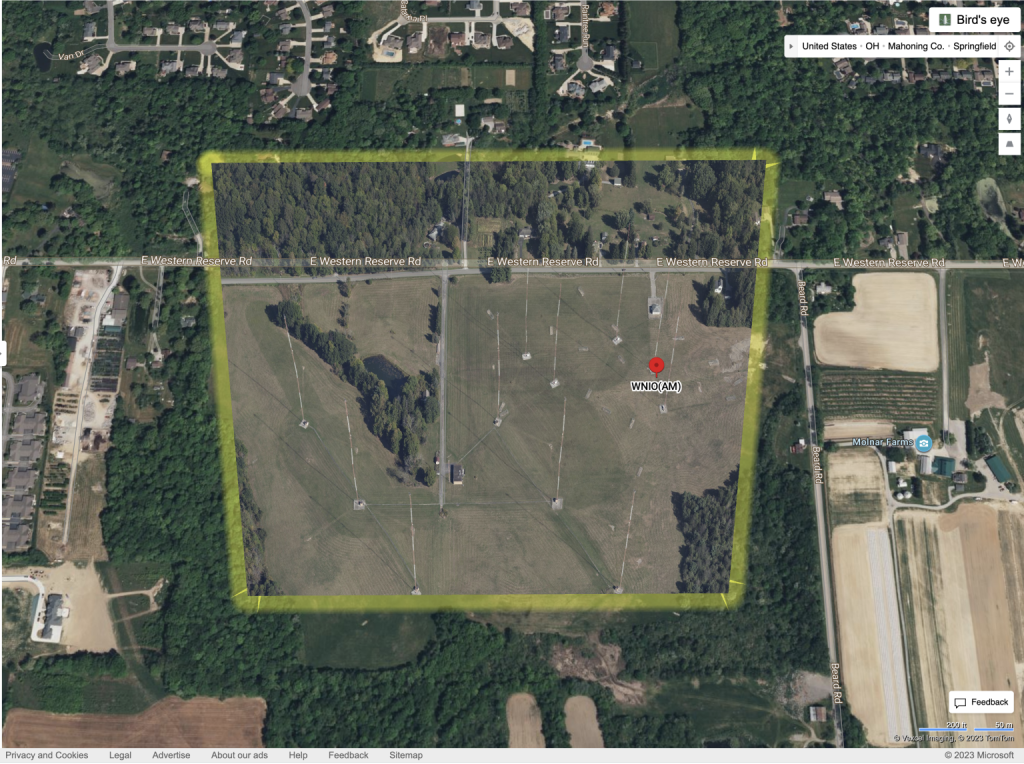
This isn’t the best example of a Bing Birds Eye, but it’s a helluva lot better than the same view straight down from space.
As a geography and map freak, I loved lovedloved Birds Eye views in Microsoft’s Bing Maps. Birds Eye’s advantages over Google’s and Apple’s satellite views were enormous, because all the imagery was shot from airplanes flying at low altitudes, rather than from a hundred miles up in space. Among other cool things, you could rotate your view, which was angled at 45° off vertical.
Well, Microsoft killed it. I don’t care about the reasons, which you can find if you dig around. I just care that one more thing I loved on the Web is gone.
Here is one site that depended on Birds Eye and is now stuck with a bunch of thumbnails: headstone markers of what was once alive. I’d link to more info, but I’d rather mourn.
Photo by Dialh. The red house on the left is KSKO.
Adopt a Station is a way to compensate for the funding lost to US public radio stations when the CPB shut down. No state is more dependent on public radio, or hurt by lost CPB funding, than Alaska. Here is a table of all the stations there, with graphs showing how much lost funding they need to make up. My adopted station is KSKO, in McGrath, which has satellite stations in Anvik, Holy Cross,Shageluk, Grayling, Nikolai, Crooked Creek, and Sleetmute. KSKO lost 70% of its funding, so I’m hoping my small contribution will help.
I don’t know who was the first to write The em dash is dead and AI killed it. Maybe it was Jacob Schilleci in the Reno Gazette Journal, but since most of it is behind a paywall and that paper is one of many run by Gannett, I’m not sure—though that’s where the first link in this sentence goes. Credit where due.
What I am sure about is that em dashes are part of my style, and I’m not going to stop using them.
I’m a Boomer, at least demographically, but I rarely use ellipses in my writing, no matter where one might go. But I do remember that the keyboard chord for producing an ellipsis on a Mac is option + semicolon, and the one for an em dash is shift-option-hyphen. The problem with the ellipsis one is that it’s a single character (Unicode U+2026) rather than three periods in a row. So not using that Unicode thing might be the least leveraged pro tip you’ll get today.
To see if this works with my blog. If it does stay tuned for more.
Okay, I’ve been posting more, above.
More importantly, I’m back in the groove with Wordland. I’d stopped while waiting for a new WordPress theme that would be friendlier to Wordland. I haven’t moved to that theme, but Wordland is working. Praise Murphy.
I shot the photo above last night on approach to SFO. My window seat was on the left side of the plane. Tell me where this is, what the two most standout features are, and what was happening in the brigher one at the time.
For many years, I attended an annual gathering of folks who wanted to save the Internet for future generations. Aspirational guidance was provided by the metaphor “big hooks:” ones meant for catching big fish.
Since I was a kid, my life has always been about big hooks, especially ones that maximize personal and collective agency, pulling people together for the common good. I wanted new centers that hold, and to improve the holding powers of old centers.
When I was young, broadcasting and journalism were two of those centers, and I loved working in both. I also learned that these were media environments with what Marshall McLuhan (borrowing from Aristotle) calledformal (as in formative) causes: they formed us while we formed them. It pains me that broadcasting and journalism have faded as centers and are mostly holding echo chambers together, thanks to social media, search, AI, and other habitats containerized by algorithms optimized for engagement. But I do see good in how everyone now has powers to broadcast and perform journalism that only a relative few once had.
I’ve also seen some big changes ahead of their time: PCs in the ’70s, the Internet in the ’80s. In the ’90s, I saw Linux as the people’s way to stand up their own servers and establish themselves on the Internet’s vast commons. This got me a gig with Linux Journal that lasted 24 years. During that span, I did my best to also spread the word on free software and open source (both huge hooks of their own).
In the late 90s, Chris Locke brought four of us together to write The Cluetrain Manifesto, which remains a hook too big for any fish—so far. (It became a bestseller mostly because marketers nibbled all over it. They didn’t know Cluetrain was a hook for markets, not one for marketing.)
Now I’m working on three hooks that may not catch anything until after I’m dead, but I do think will matter a lot for the living. These are—
MyTerms, a new IEEE standard (P7012), from a working group I chair. It will flip the script on how privacy is respected online, obsolescing notice-and-consent and opening markets to far better forms of mutual trust. It will also set the stage for far better signaling of intentions and agreements between customers and companies, making what was prophesied in The Intention Economy come true. When it does, People vs. Adtech will be a fight people will win.
Personal AI, which we don’t have yet. (Personalized AI from suction cups on the tentacles of giants at best only emulates it.) Put simply, we need personal AI for the same reason we needed personal shoes, bikes, cars, and PCs. There is progress here. Open source AI models are available. (Huggingface lists lots of them.) [Update on 14 October: Nvidia has announceda $4k personal AI box called DGX Spark. It’s aimed at developers and AI researchers. But, as Marc Andreessen told me long ago, “All the significant trends start with technologists.” (Note: the Linux Journal site no longer has visuals for old pieces. If you want the full experience of the piece at the last link, my own copy is here.) So watch this space.]
News Commons, a set of ways to make local journalism far more sturdy and valuable. EmanciPay, a monetization model that combines ease of use, high personal agency, and collaboration, is a smaller hook in the same tackle box—one with potentially enormous payoffs for artists of every kind.
None may ever catch a thing (though I have high hopes for the first two). But at least they’re in the water. And I am still fishing, full-time.
I couldn’t find a better image for this post than this small limestone henge in a neighbor’s back yard.
I live a full and active life. In fact, I’m probably more engaged than I’ve ever been, with faith that at least some of my ideas (here are three big ones) will play out in constructive ways over the coming years and decades.
But, at 78 (still a year younger than the current US president), I am also more mortal than ever, and I know it, especially since I figure at least a third of the guys I grew up with are now gone, or ahead of me in the checkout line.
My heart seems fine, but I’ve had an ablation to stop occasional atrial fibrillation. I take blood thinners to prevent another pulmonary embolism (I had a scary one in ’08, but none since). I have a bit of macular degeneration. My genetics are long on longevity (my paternal grandma lived to almost 108), but I have some risk factors as well. The main one, however, is plain old mortality. We’re here for the ride, but the ride ends. And I know that.
Here is another way to look at it: I’m a puppy, meaning I now have the life expectancy of a dog. If I’m a healthy rat dog, like a terrier, I might live to twenty.
So I’ll be devoting more of my bloggings to surfacing valuable lessons and stories left in my care by those now gone, and to making clearer what I’m bringing to generations after mine.
Here is one of the biggest lessons: life really is short. By design, we only get a few dozen years. My 78 went by fast. And each year goes by faster, since it’s a narrower slice of one’s pie of life.
Another way to look at it: Life is exceptional, and death is its most durable feature. Of the carbonate rocks that comprise a quarter of the Earth’s surface, most were once alive or close enough. The limestone in the henge above was living muck before it turned to rock.
My point is that we all need to get out of here. Still, I operate in willful oblivity to the inevitable, because that’s more fun and productive than worrying about it. And being an inveterate creature helps for doing that.
Seems to me these violate the Hatch Act, aka “An Act to Prevent Pernicious Political Activities.” It was passed in 1939 and amended a couple of times since then. I am not a lawyer, but I know some, and I can read. One useful source is this guidance from the Office of the Special Counsel.Reading that tells me all this stuff crosses the Hatch Act line. But there are maybes in there. For example, this: “…activity directed at the success or failure of a political party, candidate for partisan political office, or partisan political group — then the expression is not permitted while the employee is on duty.”
Whatever, seems to me this will come down to what the OSC decides. How free of politics is the OSC? Its About page says,
The U.S. Office of Special Counsel (OSC) is an independent federal investigative and prosecutorial agency. OSC’s statutory authority comes from four federal laws: the Civil Service Reform Act, the Whistleblower Protection Act, the Hatch Act, and the Uniformed Services Employment & Reemployment Rights Act (USERRA)…
In addition, OSC enforces the Hatch Act, which puts certain restrictions on partisan political activity by government employees…
So, if the OSC believes the Hatch Act is being violated here, its focus will be on the government employees behind those clearly (to me) partisan website banners.
But will it do anything? The last guy to run the OSC was fired by President Trump early this year. It has been musical chairs since then. Jamieson Greer is currently the Acting Special Counsel. Trump’s earlier choice (and the Special Counsel in Waiting?) was Paul Ingrassia. Read about those guys and draw or redraw your own conclusions.
Look, I avoid politics here, because algorithms and an absent appetite for arguments that go nowhere. I’m a registered Independent and think leaders of both major parties are mostly fulla shit in what they are saying about the issues involved in the current government shutdown— and about each other. Meanwhile, the national debt is $37.64 trillion, up $2.17 trillion during the last fiscal year. Just one item.
So I’m taking public notes about this, while shit’s going down. Here is what I have so far (as of 11:07PM on 3 October 2025). The partisan phrases are boldfaced.
US federal government websites with partisan notices:
“Mission-critical activities of CDC will continue during the Democrat-led government shutdown… During the government shutdown, only web sites supporting excepted functions will be updated.”
“Mission-critical activities of CMS will continue during the Democrat-led government shutdown. Please use this site as a resource as the Trump Administration works to reopen the government…”
“The radical left has chosen to shut down the United States government… Treasury’s websites will only be sporadically updated until this shutdown concludes.”
OMB redirects to a WhiteHouse.gov OMB page, atop which is a banner that says “DemocratsHave Shut Down the Government” followed by a live count-up of days, hours, minutes, and seconds.
“Senate Democrats voted to block a clean federal funding bill (H.R. 5371), leading to a government shutdown…” (This appears across SBA pages as “Special announcement.”)
“Due to the Radical Left Democrat shutdown, this government website will not be updated during the funding lapse. President Trump has made it clear he wants to keep the government open…”
This “here” is one of my favorite spots in the world: Mt. Wilson, overlooking Los Angeles. Maybe there’s a better visual to head what I’m trying to say in this post, but I can’t think of one right now.
This blog is mine. While it is hosted somewhere, it could be anywhere. The main thing: it isn’t on a platform, and doesn’t have to be.
I publish it on my own, and syndicate it through RSS.
This puts me in a publishing ecosystem that is wide open and full of interop. If you want to know more about how the blogging ecosystem works, read Dave. He’s the blogfather, and pioneering in many useful and fun directions.
Blogging is an ecosystem because it’s open, as are ecosystems in nature. It’s not a plant in the atrium of some giant’s hotel.
In fact, I think “ecosystem” should apply only to open systems that welcome participation, while we need another word for what happens only on a given platform or inside a given silo. For example, the Net, the Web, and the blogosphere are all ecosystems. The Apple’s and Google’s closed and verticalized worlds are something else. Find a word.
Substack is a platform. I am told that one can move from Substack to Ghost or wherever. And, if that’s the case, that means it operates in a larger ecosystem. I’d say the blogosphere. But lots about it looks and feels closed to me.
I bring all this up because today in my email came the newsletter version of Substack is a social media app, by Hamish McKenzie. My instant response was a mix of Huh? and Yuck. Because until then I thought Substack was blogging host with a newsletter business. Meanwhile, social media as we’ve known it is all silo’d and in deep ways very icky. Calling Substack “a social media app” is, at least for me, a huge downscale move. I felt the same way when I read about OpenAI going into the social app business.
Blogging is just publishing, plus whatever grows naturally around that. It’s a how, not a where, which makes it a much better what. And that what isn’t “a social media app.”
Anyway, my thinking isn’t complete on this, and may never be. But what Hamish wrote in that newsletter turned me off to ever blogging on Substack. I like my freedom and independence.
By the way, if people want to subscribe to my blog in newsletter form, they can do that. Look on the right (or on mobile, at the bottom) for “Get New Posts By Email,” and subscribe. I have 92 subscribers so far. Just remember that I almost always keep editing what I write. For example, my lasttwo blog posts started as one, and I’m still not happy with either of them.
Kind of like life. It’s all provisional. What’s the best ecosystem for that?
[Update on 3 October 2025…] I just learned last night that my sister, @JanSearls, a retired officer with the U.S. Navy and a graduate of the Navy’s War College (among other distinctions) has a Substack. So far, it’s all restacks (a term I just learned), but she’s a good writer, and I hope she will post some original stacks as she gets comfortable operating in Substack’s corner of the greater blogosphere.
This is Part 2 of a post that began with a Jimmy Kimmel monologue, but really wasn’t about that. It was about the grave situation in which over-the-air (OTA) TV finds itself. Here is Part 1.
Even people who don’t like leftish comedy should admit that Jimmy Kimmel’s monologue after he returned to the air was brilliant. It was also, judging from this—
The “affiliate model” is the current TV show distribution system. Simply put, networks (primarily ABC, NBC, CBS, Fox, and PBS) sell programming to affiliates, which are TV stations with channel numbers.
Put another way, they wholesale it. Payments by affiliates to networks for programming is called reverse compensation. It’s “reverse,” because from the 1940s to the late 1990s, networks paid stations to carry programming. Now it’s the other way around. (I suppose the same applies to the lesser networks—ion, CW, Daystar, Bounce, Cozi, etc.—but nobody cares much about those.)
Here is a table of major affiliate station owners:
Top U.S. Owners of Big Four Network Affiliates
Owner
Total TV Stations (owned/operated)
Big Four Affiliates
Notes
Source
Nexstar Media Group
~197
~28–32 ABC (subset shown); majority of portfolio is Big Four
Largest U.S. station owner; more than 200 owned/partner stations across 116 markets.
Allen Media size and 2025 divestiture news. Wikipedia
Notes: Counts are from those sources, as of late September 2025. “Total TV stations” often includes stations that are not owned outright, but operate in one of these other ways:
If you follow those links to understand how this stuff works, note that Wikipedia’s LMA article covers JSAs and SSAs. The SSA page redirects to the LMA page, and the JSA section is anchored on that same page. Complicated shit, but I feel it’s my duty to lay it out.
I don’t list PBS stations because all PBS affiliates are independently owned. While PBS stations also buy programming wholesale from the network, they retail it to viewers as well as to corporate sponsors.
When Trump and Carr want to politically correct (MAGA-align) station owners by threatening to revoke their broadcast licenses, they are mostly talking about the Big Four networks’ O&O (owned and operated) stations, most of which are in major markets. Here are those, in four tables:
Note that some sources (at those links) also list subchannel affiliations as well. Subchannels are secondary channels that stations transmit along with their main affiliate channel (ABC, CBS, NBC, or Fox). This is why, when I said in Part 1 that I would watch Jimmy’s monologue on WRTV channel 6.1, rather than just “channel 6,” it’s because WRTV also mooshes a bunch of these subchannels into the same signal. From Wikipedia’s WRTV page:
Note that the channel with the highest resolution on that list is 6.1, the ABC channel called WRTV. They ever say “-HD” on the air, mostly because why bother, but also because a resolution of 720p is barely HD. If WRTV-HD channel 6.1 were full HD, it would be 1080i or 1080p. But WRTV broadcasts its main channel in lowest HD resolution because it wants to all those subchannels inside the limited bandwidth of its OTA TV channel (in WRTV’s case, channel 25). All OTA TV stations with a mess of subchannels like this one suffer the same trade-off between picture resolution and subchannel count. If you watch TV network streams over the Internet, however, you may get higher resolutions, including 4K. That’s an advantage of having an Apple TV 4K, Roku, Fire TV, or Google TV plugged into one of your TV’s HDMI inputs.
Channel-packing like this was a big advantage in the early days of digital OTA TV. Those subchannels were meant to take up shelf space on cable guides, thanks to must-carry rules. Back then the best TVs were also “full HD,” which was 1080i or 1080p (the latter is better). Now all the good TVs sold are 4K. You won’t see Best Buy or Costco showing off a 4K TV using an OTA or cable station, because the resolution is too low, and the compression artifacts are too obvious, especially on the largest screens.
But, as broadcast television dies off, those moves will matter less and less. Broadcasting’s viewers and listeners are already herded into their political echo chambers by algorithms that optimize for rage, because that’s what best drives engagement.
IndyStar examined WISH-TV’s “Meet the Team” page on its website using the Wayback Machine, which archives billions of webpages across the internet. Between Aug. 24 and Sept. 9, the profiles of more than a dozen employees were scrubbed off the site.
The WISH-TV employees listed below were either terminated or they resigned, left voluntarily after their contract expired, were not offered a new contract, or are otherwise missing from WISH-TV’s current staffing page. They include:
I include all that linky credit-passing because professional journalism is shrinking away, and we need to recognize and support the journalists who are still among the employed.
Since newsroom employment turned negative after 2008, U.S. newsrooms have shrunk by about 26%—from roughly 114,000 jobs in 2008 to about 85,000 in 2020—with newspaper newsrooms down 57% over the same span. And those numbers are from a Pew study published four years ago, when the broadcasting’s melting cube was much larger.
As a professional journalist, I’ve been unemployed since 2019 (after 24 years with Linux Journal). But that’s fine with me. I’ve aged out of the talent pool and would rather focus on remaking the way news is done, from the ground up. That’s what my News Commons series is about.
What I want is to see is What’s On replaced by What Matters. It will take some time for us to institutionalize that. But I believe we will.
I’ve split this post into two parts, because it’s important to unpack how legacy TV works, and why the whole thing is falling apart, with OTA—over-the-air—TV dying first and fastest. Here is Part 2.
I haven’t watched Jimmy Kimmel Live, or any late-night talk shows since Carson, and I didn’t watch much of him either. But I am familiar with Jimmy, through his Oscars hosting gigs, his friendship with Howard Stern (for whom, with Jeff Jarvis, I have been a devoted fan since forever), and from YouTube clips when somebody points me to one and I actually go there, which isn’t always.
But I’ll watch tonight, because I’m curious about what Jimmy will say about his hiatus, and because I can get him without cable: a fun challenge for me. I do that this way:
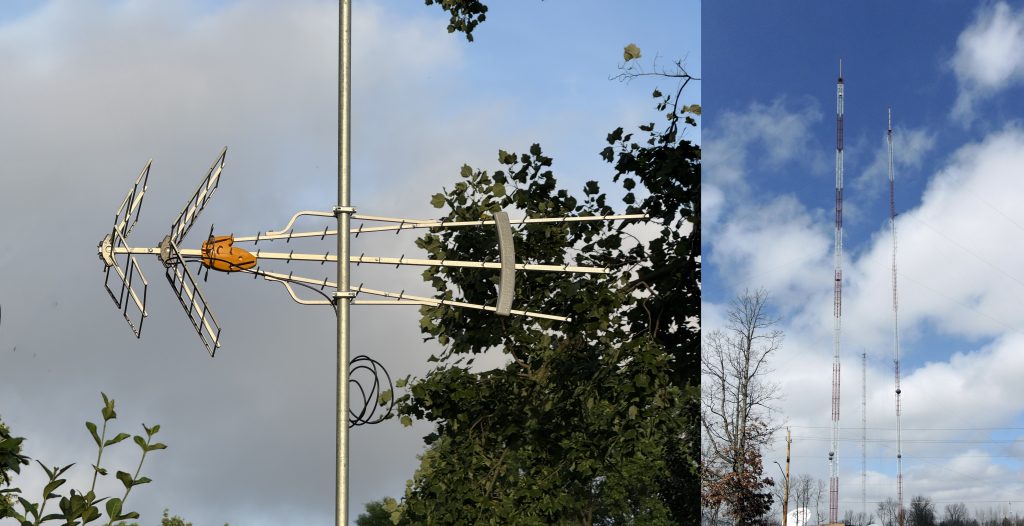
On the left, the TV antenna at our new house in Bloomington, Indiana. On the right, the transmitting towers of WRTV/6 and WFYI/20, both 54 miles away on the north side of Indianapolis. WRTV is actually on channel 25, and WFYI is on channel 21 (their branded channels are “virtual,” as they say in the biz). Thanks to our antenna, a Telves DAT BOSS MIX LR antenna High-VHF/UHF (Repack Ready)*—that’s its name—we get both channels well, even though their signals are weak at this distance.
Being old, I remember when no suburban house was complete without an antenna on the roof. You wanted one because that was the only way you could get a good picture from your city’s TV stations. Sure, you could put a rabbit-ears antenna like this on top of your TV—
—but the picture probably wouldn’t be ideal, or good on all the available channels.
But cable (which began as CATV—Community Antenna TV) would bring you a good picture on every channel, plus lots of new cable-only channels: dozens or hundreds of them.
Then, starting with the Digital Transition in 2008, all the over-the-air (OTA) stations had to broadcast on channels that were best for data, which meant moving to the UHF band (channels 14 and up), or the “high” VHF channels (7-13). Even if a station was already on one of those channels, it may have had to move, sometimes more than once, as the feds auctioned off UHF channels 37 and up (now used mostly for cellular Internet) and stations had to “repack” on new channels. That meant viewers had to make their TVs re-scan repeatedly to get the whole available channel lineup, which tended to come from fewer signals than could be received back in the Analog Age. Thanks to all that, most people didn’t bother to hook up an antenna of any kind.
But I’m a rare exception. Getting OTA TV is like fishing for me. I’ve always been a broadcasting science nerd, and I like hanging out a lure to see what I get. For now, it’s a pile of channels from Indianapolis, plus our nearby PBS station. Yay me.
Back to Jimmy Kimmel.
His network is ABC, carried here by WRTV/6. We’ll be able to get Jimmy tonight, because WRTV is owned by the E. W. Scripps Company. Were WRTV owned by Nexstar, we wouldn’t see the show, because Nexstar won’t carry it on their many stations, for reasons they give here. Sinclair, which also owns many stations, also won’t carry Jimmy, for the same reasons. So, Axios says, all these areas are blacked out:
Source: Erin Davis/Axios Visuals
I’ll let that sit while we visit Nexstar’s plan to buyTegna, a competing station group company. If that deal goes through, this will be the legacy commercial TV network lineup in Indianapolis:
CBS — WTTV/4 and WTTK/29, owned by Nexstar
NBC — WTHR/13, owned Nexstar (acquired from Tegna)
ABC — WRTV/6, owned by Scripps
FOX — WXIN/59, owned by Nexstar
Meaning only WRTV would not be owned by Nexstar.
That’s homogenization at work. It is also economics. Legacy (also called “linear”) TV has been in decline for decades. Some links:
Linear TV Networks Lost 35% Of Reach From 2014 To 2024 “…progressive loss of reach for linear TV networks over the last 10 years, with research from MoffattNathanson and Nielsen indicating a 35% decline across all networks from 2014-24.” (The Measure, May 2025)
First, in cities like New York, where we had an apartment for the last 13 years (we finally let it go in July), you are getting almost nothing from an antenna unless you have line-of-sight to One World Trade Center, from which all the city’s stations now transmit. In the Analog Age, you’d get pictures that looked like crap with a rabbit ears, but you at least got something. At our daughter’s house in the L.A. suburb Redondo Beach, an indoor antenna in her house window got one Spanish station—and nothing else—from Los Angeles’ TV transmitting tower farm on Mt. Wilson. Here in Bloomington, I look at a lot of rooftops to see who has a working antenna. Far as I know, I’m the only viewer in town fishing the TV airwaves. Except for the local PBS station (WTIU/30), nearly all the major network Indianapolis stations (those four above) are too hard to get here without an expensive and fancy antenna such as mine. And I’m advantaged by living on a hill that faces Indianapolis. If you’re between hills or on the backside of one here, even a fancy antenna like mine won’t catch much.
We have a similar situation at our other house, in Santa Barbara. There we’re 500 feet up a steep hill overlooking the city, but we are “terrain shadowed” (as the broadcast engineers say) from all the local TV signals. We used to get occasional signals from San Diego, when those were still gettable and the weather was right. Here’s how some looked in 2008, when our Dish TV receiver had an over-the-air tuner in it. That TV and receiver are long gone, and our new-ish 4K Samsung TV can’t get any of those channels from the same roof antenna. Scanning for signals brings up nothing.
One reason might be the quality of the tuner. Another is that the makers of new TVs don’t want you watching free OTA TV. That’s the message I get from Samsung and TCL. We have three Samsungs and one TCL, and all of them make it hard to scan for channels, and then to access them afterwards. They moosh the locals into a hard-to-use guide of almost countless channels that look cable-like, but aren’t. In the case of our TCL/Roku TV, locals disappear once you’ve scanned them. It doesn’t matter if you’ve made them favorites or not.
One reason for this is that TV makers want to insert personalized ads of their own (based on watching you, like advertising does on the Internet), and they can’t do that through OTA signals they don’t control.
Far as I can tell, nobody in the broadcast business is urging the TV makers to make getting OTA channels easy. Again, the opposite seems to be the case.
Broadcast TV is, as economists say, a distressed asset. That’s bad enough. But hastening the medium’s demise by politically correcting stations—and getting help with that from a censorious FCC—is just dumb all around.
And I’m not saying any of that for political reasons. The station owners and TV makers were no smarter during the Obama and Biden administrations.
For many decades, Local TV was a center that held our civilization together. That the mainstream is drifting into the redstream is beside a much larger point: the selection of TV-like programming on glowing rectangles now rounds to infinite. You can get whatever from whomever and wherever, over the Internet. The best stuff will be subscription-based, mostly. On Demand, as they say. Welcome to now.
So I’ll start up channel 6.1, see what Jimmy has to say, and go to bed. I have more important things to do tomorrow. G’night.
[30 September 2025…] Jimmy’s monologue was brilliant. But that’s beside the points I make in Part 2 of this post.
*Here’s the antenna, in case you want to get one. It’s for stations transmitting on high-band VHF (7-13) and UHF (14-35). If one or more of your city’s stations are still on low-band VHF (2-6), as is the case in, say, Boston (WGBH/2 transmits on channel 5), you will need an antenna such as this one. For guidance toward your chances of getting anything, the best source is RabbitEars.info. Go to the signal map here to see what the fishing is like. And note, again, that you’re looking for the RF signals (the channels stations actually transmit on) rather than the virtual channels (the ones they identify with and display). The RF channels are in parentheses in your Rabbitears search results.