
Uh oh
Tornado watch for all five New York City boroughs. How the radar & lightning map looks now.
And here are planes not landing at Newark (EWR):

And the last center that holds
Uh oh
Tornado watch for all five New York City boroughs. How the radar & lightning map looks now.
And here are planes not landing at Newark (EWR):
And the last center that holds
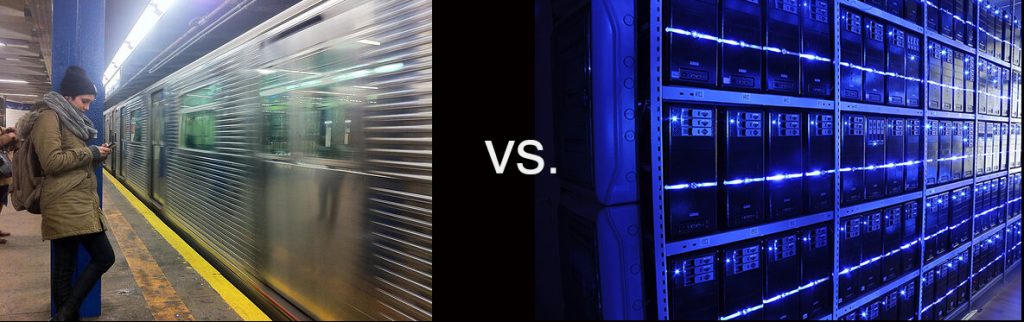
How about mintelligence?
We need different words for human and machine intelligence.
The human kind is a quality, like empathy, anger, or contentment. You can’t measure it, as if with a ruler or a dipstick. If you could, you’d get the same measure every time. IQ testing pretends to measure intelligence, but it doesn’t. (I speak as a former schoolkid whose known IQ scores had an 80-point range—and was at different times rewarded for being smart and punished for being dumb. Fact: I was both all along. So are we all.)
The machine kind is a quantity. You can measure it in various ways, but economically the AI commodities for sale are called tokens. Kieth Teare visits this fact at length and depth in Intelligence: Who Owns it? Excerpt:
We should stop talking about AI as a feature and start talking about intelligence as the universal thing that is delivered as an input to the world.
Water is an input. Electricity is an input. Literacy is an input. Connectivity is an input. Once a society depends on them, access stops being optional. Nobody needs government to build every well, power plant, school, or network. But everybody understands that a civilization cannot be organized around less than universal and reliable access to foundational inputs.
Intelligence is reaching that level of importance now that we all know it is real.Government should not own it, operate it, or develop it. Quite the opposite. Companies are the right actors to build fast, compete hard, improve models, serve customers, and discover the real use cases. Self-interest is a useful framing here. Markets are good at finding demand, reducing costs, and turning invention into services people actually use.
Companies are the right operators, developers, and owners. But that does not settle the real question of who owns the benefits. That is an economic question.
If intelligence becomes metered infrastructure, what happens to the value it creates?
He concludes,
My view is this:
The central product of this era is intelligence. Companies have figured out how to capture it, package it, serve it, and meter it. That is good. It should stay in the hands of builders who have the incentive to make it better.
But intelligence is too foundational to become just another private toll booth. A significant part of it will turn out to be free to users.
As intelligence becomes a general-purpose resource, then access to it becomes a human-capability question, and the surplus from it becomes an economic-justice question. Not because government should run it. Because government should not run it. The operating layer belongs with companies. The wealth question belongs with everyone. But companies are best placed to turn that into a process of distribution.
The question is not whether companies should build intelligence. They should.
The question is whether humanity gets a stake in the wealth created by the thing that may soon become its most important shared input.
An important read, even if you disagree with some of it. My main issue is differentiating between the human and machine forms of intelligence. We’ve always had a word for the former. We need a new word for the latter.
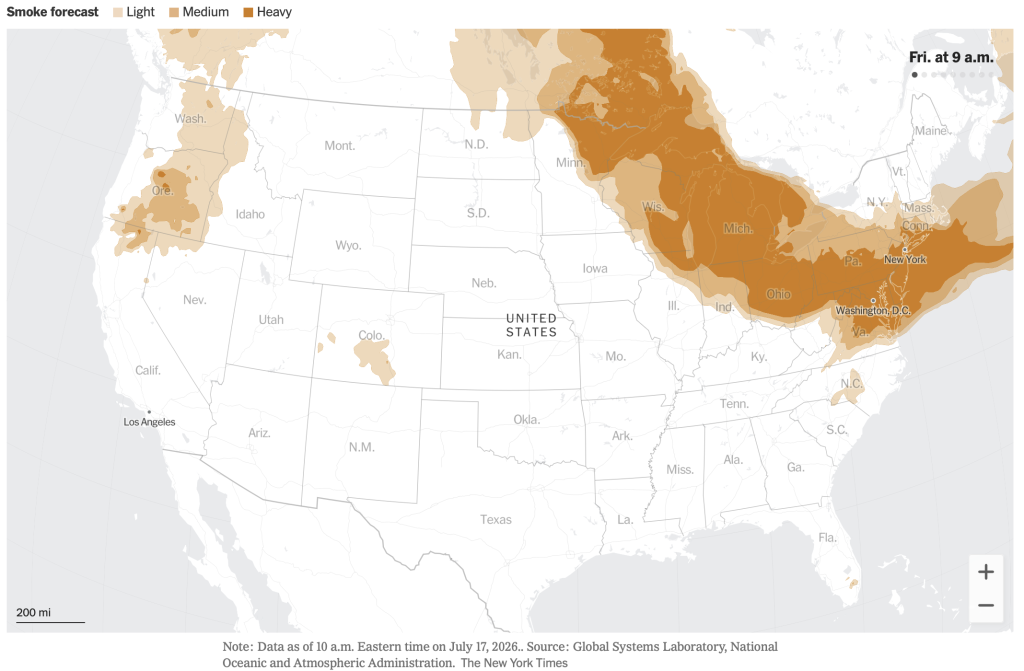
This is the first morning since I arrived in Baltimore on Wednesday that stepping outside in the morning didn’t feel like walking into an oven. It was 76° F (24.4° C), which isn’t bad. I also couldn’t see far up the road, because the air was full of smoke, and it was hard to breathe. See the above.
My question is whether we should even get in the car to go somewhere. Wired has advice.
For the other coast, here’s what’s not happening yet—but will—underground. Lots of maps there, and a viewer.

To your health
It’s 96° here in Baltimore, where the air quality sucks thanks to fires in Canada and Minnesota. But write on I shall.
And your money
Ed Zitron’s long read on the coming AI crash is worth your time.
Seriously
In paleoenshittification and a path to adoption for MyTerms, Don Marti gives us a useful frame and strategy for saving civilization.
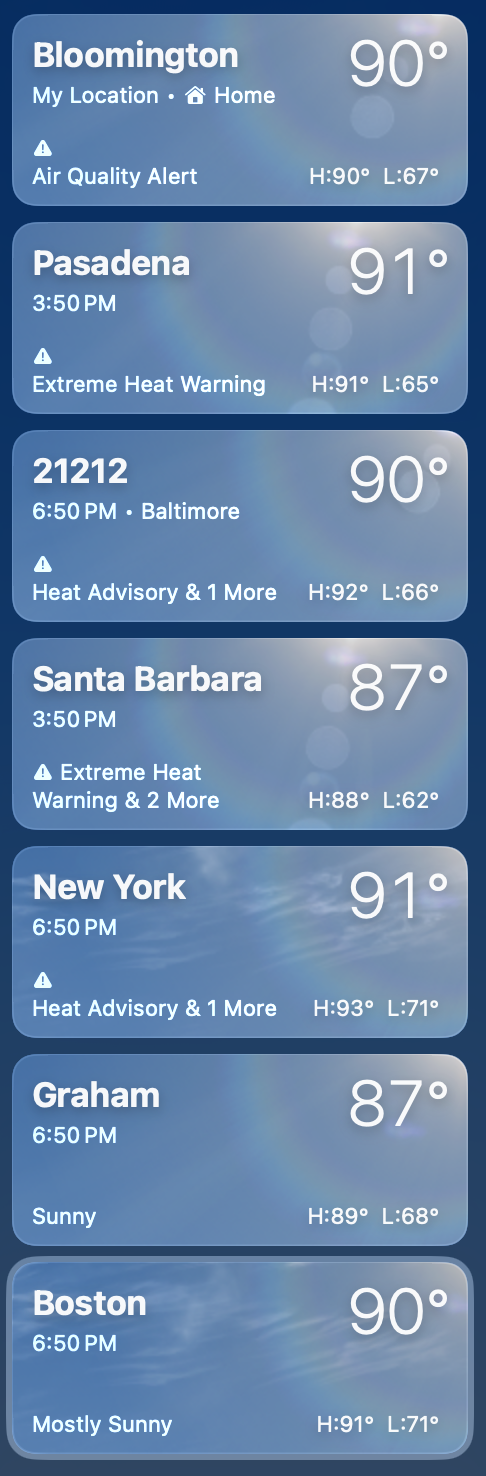
That’s all I have to prep for a month on the road. Tomorrow is Baltimore. After that, North Carolina. After that, California. Back in Bloomington in mid-August. Right now it’s hot in all my places:
Ground down
Says here that Rogers Sports & Media has closed six of its radio stations. One of those, CKWX /1130 in Vancouver, I enjoyed listening to in Hawaii. One was an FM, too.
Mesa Mike’s List of Deleted AM Radio Station Facilities is huge, but limited to stations that are now defunct. Many more are still licensed but silent (e.g. 560 AM in San Francisco), operating from highly diminished facilities (e.g. WDNC/620 in Durham, WMEX/1510 in Boston), or slowly shrinking away (WSCR/670 and WBBM/780 in Chicago, WCCO/830 in Minneapolis).

RSS Forever
Alas, NiemanLab (which I have long followed, honored, and even loved) joins TechCrunch in lauding a new app called HyperTexting for not calling what it relies on “RSS“:
Hailey isn’t the only one attempting to introduce the technology formerly known as RSS to a younger generation. (Nieman Lab predictors have been saying this was coming for a few years now.) The Electronic Frontier Foundation published a guide last month to “a tool that’s been around for decades that can help wrangle many of your feeds into something manageable.”*
RSS stands for exactly what it is: Really Simple Syndication. Changing RSS’s name now is like saying “online publishing, formerly known as the Web.”
The perp here is Caleb Hailey, who wrote The social-media-like interface to explain why he wants to re-brand RSS with his own app. He (and NiemanLab, it seems) blames RSS readers for what he sees as a stink on the standard. In making what he claims is a better RSS reader, he explains,
In order for RSS to succeed reach escape velocity, I think we need to stop saying “RSS”.2 That’s why, if you look closely, you’ll see that I’ve gone out of my way to avoid using terms like “RSS”, “Atom”, “JSON Feed” or “OPML” in the HyperTexting app and website.
That’s a dis on the work Dave Winer and other developers have put into making RSS, OPML, and other standards sturdy, useful, and generative. For example, here:
You Can Now Chat Using RSS
*By Jon Henshaw* in Social Media News
Jul 13, 2026 (Last updated on Jul 13, 2026)
Dave Winer, creator of RSS 2.0, built RSS Chat using open web standards to create a simple way to chat and follow conversations.
Dave Winer, the person who made Really Simple Syndication (RSS 2.0) the standard for following blogs in feed readers, asked whether RSS could be used for online chat, and quickly concluded that it could.
Using a combination of open web standards, RSS 2.0, OPML, Markdown, SQL, and WebSocket, Winer created RSS Chat. Winer said the part that makes it RSS-based is that every user has an RSS feed with all their posts, the whole community has an RSS feed, [and] there is an OPML file that list all the users.
That’s on top of nearly all of Web publishing, and podcasting. Heard of those?
Hell, RSS isn’t a drag on the apps that use it. It’s the sea that floats all their boats.
*All three of the links in that paragraph are pro-RSS. None say a renaming is “coming.”
2. [Caleb’s footnote says, “Hi Dave. 👋 I see you and I’m a huge fan! I suspect you may have thoughts™ on this take, but I think it’s possible we might agree more than we disagree. ↩︎” ] Sorry, Caleb. It’s still a dis. Call your product what you like, but don’t shit on the standard which, more than any other, makes your product possible.
Just a theory
LeBron is going to Miami. Old connections. Fun team with Giannis and Bam there. Lots of great golf, year-round.
I’m still an optimist
Rose Horowitch in The Atlantic: The End of Reading Is Here. Subhead: “Optimists once believed that universal literacy was inevitable. Now it seems that the age of reading might be a short anomaly in human history.” It’s an excellent piece. Worth the subscription.

To whom else has God sold naming rights for days of the week?
And you thought Tuesday was a grace of our turning Earth.
<bonus content to avoid if oral surgery grosses you out>
Since I had a molar extracted last week, there remains an open wound in my mouth where the tooth used to be, and in which food might lodge. This requires a liquid-ish diet of food without things in it. (Worst possible kind of thing: popcorn.) It also requires instrumentation for washing out the wound gently. This took me to a Walgreens in downtown Minneapolis, where a pharmacist told me I needed something that my surgeon never brought up: curved-tip dental irrigation syringes. Which Walgreens does not have, but Amazon offers in plentitude:
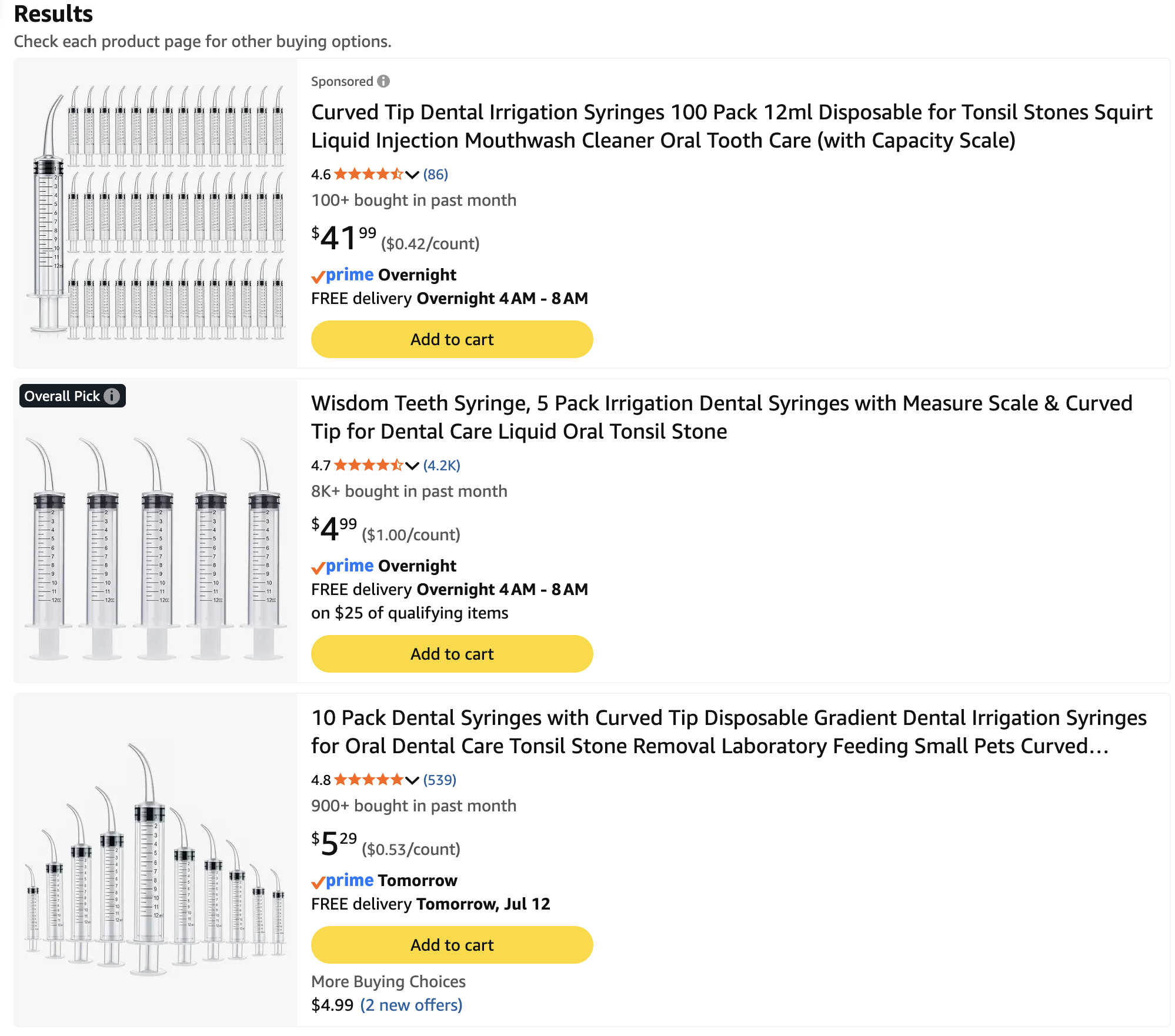
The best part is the reviews. Examples:
helps in feeding baby birds that fell out the nest and r scared and won’t eat
So long as you arent using them for epoxy they work fine
I got these because I have to measure out precise amounts of tint to add to a topcoat I’m using to finish off some cabinetry. It’s very small amounts, so using a measuring cup or even measuring spoon wouldn’t yield consistent results. So, these syringes should do the trick nicely.
Perfect for feeding found baby birds as they grow. You will need to snip off the tips to make wider aperatures as the birds get big.
Looking forward to my first dove chick and/or cabinetry job.
</bonus content to avoid if oral surgery grosses you out>

I leave shortly for fun family matters in Minneapolis. Meanwhiles, here are some worthy tabs to close:

A couple of weeks ago, in The George Carlin Model of AI, I said personal AI needed to work first on what George called a place for my stuff.
Should Apple occupy that whole personal space, kinda like René Magritte visualized in a surrealist painting seventy-five years ago?
I think that’s where they’re going. You can see hints of it in the headline (as of now) at apple.com/os/ios/:
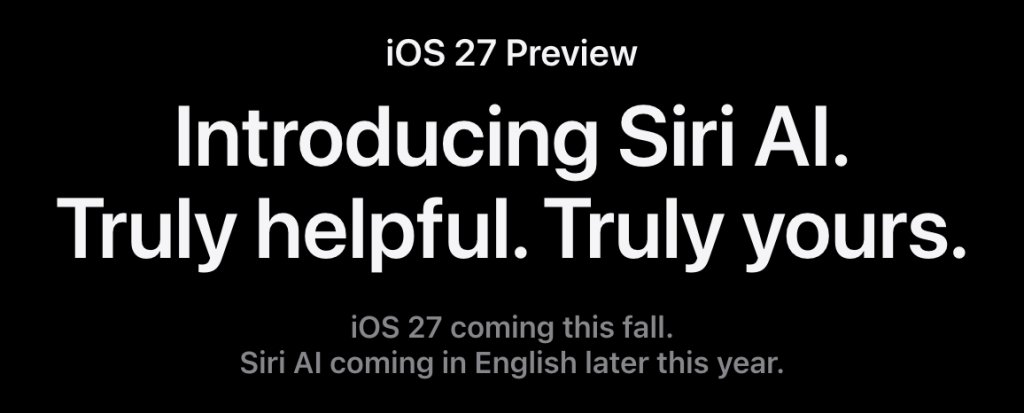
Siri is Apple’s Clippy. Maybe worse, because it’s still alive and unloved after fifteen years of relentless promotion and disappointment. (Start reading down from the Reception subhead on Siri’s Wikipedia page for a partial account of Siri’s failings. A lot there.) But Apple is investing the next generation of Siri—Siri AI— with huge new responsibilities—to you. But is it really—

?
On the privacy topic, Apple smokes a lot of its own exhaust. Find examples here, here, here, here, and here. A couple of years back, in response to the first of those, I wrote here and here about how Apple falters on the privacy front, despite its many promises. But I give it points for staying on the case, which will get a lot bigger with its next operating system.
Here is a June 8 press release that lays out what Siri AI will do, under this headline:

And here’s a video in the style of a movie trailer, laying out Siri’s fancy new features. Excerpts:
Coming to a pocket near you… The Siri AI glowup hits the small screen. See Siri AI in the role of a lifetime: your personal assistant.
Ask Siri anything and revisit your conversations with ease in a new dedicated app.
Watch Siri embark on a quest to provide nutritional details about your meal. Yummy.
Cheer as Siri AI handles every detail of your soccer watch party. Go! Siri is giving main character energy and puts the personal in personal assistant.
See next-generation Apple intelligence extend, reframe, and clean up your photos. Booya!
Create photorealistic images and flex your imagination everywhere from contact posters to fun wallpapers in the all-new Image Playground.
Safari has never been more organized with topics, or timely with Notify Me. Rest easy knowing your data is protected as compromised passwords are automatically updated with just a tap.
And see Apple intelligence stand guard to protect your privacy. A faithful Sentinel keeping your private info private. With Siri and Apple intelligence, your data stays protected.
All this and so much more coming to an iPhone near you.
None of this is a place for your stuff.
I think it needs to be a box: a dedicated one, like your closet or garage. I also think it’s coming, because Apple knows why Mac Minis are selling out:
I think this suggests that Apple will pitch the next Mac Mini (an M5 one) as the personal AI machine, meaning the place for your stuff.
Now let’s look at some of the specifics behind the promotional jive:
1. On-Device “Personal Context”: A new architecture (not the old Siri) maps your device locally, using Apple Silicon’s Neural Engine to index information across your Apple applications: contacts, calendar, reminders, messages, emails, documents, photos. As for your non-Apple stuff, such as my million-plus photos (a small sample) that are not in Apple’s Photos app, it looks like it’s already on the case. When I search for “tunnel” across my photo directories with my laptop (2023 MacBook Pro running Tahoe 26.5.1), I get every shot where that word appears, plus lots of stuff that is either a tunnel or looks kind of like one. Example:

Clearly an AI does some pattern recognition there, but is that “personal context”? I dunno.
It does have “Semantic Indexing,” which makes informed presumptions about the meaning of your data, and not just your keywords. Big AI does this now, but Siri will do it just for you, on your stuff, inside your place for it. Note what it says under the “Apple Intelligence in Apps” subhead here:
Express yourself through photos and images, save time with Safari, and get more done with Apple Intelligence seamlessly integrated into your everyday apps and experiences.
But do we want “seamless” everything? We need edges and boundaries to make sense of the world. In the absence of those, I want to turn that off, not turn it on, or to educate my personal AI about what’s what, and where it belongs.
2. Private Cloud Compute (PCC) is how Apple describes another place for your stuff: kind of a private office in Apple’s high-rise downtown. Specifics:
For advanced features that need to reason over complex data with larger foundation models, we created Private Cloud Compute (PCC), a groundbreaking cloud intelligence system designed specifically for private AI processing. For the first time ever, Private Cloud Compute extends the industry-leading security and privacy of Apple devices into the cloud, making sure that personal user data sent to PCC isn’t accessible to anyone other than the user — not even to Apple. Built with custom Apple silicon and a hardened operating system designed for privacy, we believe PCC is the most advanced security architecture ever deployed for cloud AI compute at scale.
The authors of that text are Apple Security Engineering and Architecture (SEAR), User Privacy, Core Operating Systems (Core OS), Services Engineering (ASE), and Machine Learning and AI (AIML)—all inside the company. They say lots more at that last link, all helpful to know. So is Expanding Private Cloud Compute, by the same teams.
3. Systemwide app actions: This new assistant can, for example, cross-reference a tracking number from your email and a message thread to find who asked for it, pull out other relevant information, then automatically drop it into a reply for you to review or edit before you send it, all in your virtual cabin (device) or office (private cloud).
4. Controlled federation, anonymized gateways, a privacy shroud, and other jive required to make this work:
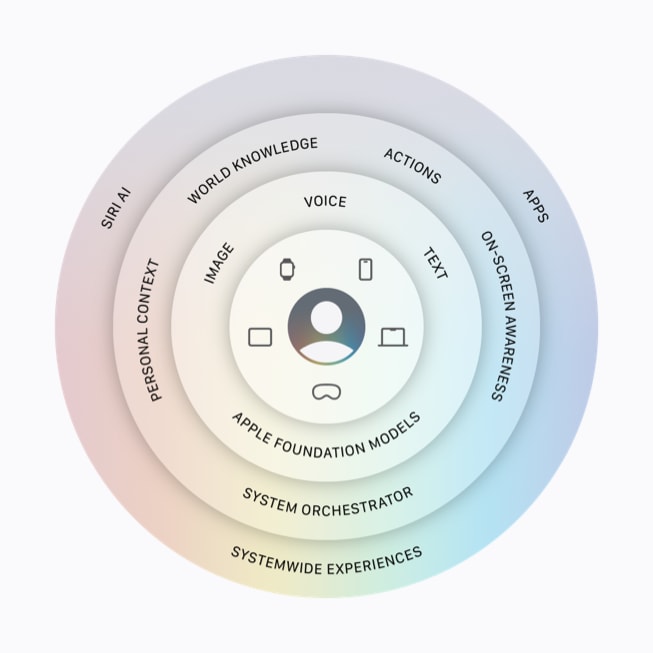
I gather, from Apple’s literature, that Siri strips out your IP address and personal identifiers before making a query to an external AI. The external AI agent sees only the isolated query. This prevents the external AI from examining the personal stuff in your online home.
Now here is a tough question: What if only a giant can put together most or all of what we need? Three giants currently furnish most of our personal spaces in the digital world:
With iOS and MacOS 27, Apple moves to the front of that pack in the personal AI space, and will likely be the only giant to offer something that looks like a place for your stuff. Given its role in the surveillance fecosystem, Google can’t be trusted. Microsoft still has Micro in its name, so the positioning is good, but it has become much more of an enterprise company in recent years. So, among giants, Apple is it.
Now let’s talk about agents.
Apple sees you with just one: Siri AI. But you will probably need many agents: one or more for health (in various specialties), financial (banking, investment, credit), travel (airlines, car rental, hotels), home economics (property, stuff in storage, scheduling the kids, keeping the car working), legal (all your contractual commitments, plus much better customer-company interactions than are possible today).
This can get very complicated. As Opaque explains,
Here’s the thing: if a single chatbot request is too risky to run unverified, what does that say about agents?
A chatbot is one request in, one answer out. An agent runs that risk in a loop: reading email, opening files, calling tools, handing work to other systems, unattended and at machine speed.
No breach required. An agent doing exactly the job you gave it moves your data constantly into places you don’t control and mostly can’t see.
Now wire thousands of agents together, the way every enterprise is planning to this year. Whatever the per-step risk is, compounding turns it into a certainty.
Apple just deployed Confidential AI to protect the smallest risk surface in AI. Enterprises are wiring up the largest with nothing underneath it.
Opaque sells arms to enterprises, so it’s not in the personal AI business. But it does make a good point in its opening sentence:
“Apple looked at a simple chatbot, the single most contained form of GenAI there is, and decided the data it leaks is too dangerous to ship to their customers without Confidential AI underneath it.”
To Apple, the more personal the context, the higher the privacy stakes. That’s why it believes personal AI has to run—
The former can actually cover a lot of ground in your life, just by helping you get on top of all the stuff in your digital home. It can also handle some simple interactions with outside entities, such as MyTerms ceremonies and record-keeping.
But you’ll need much more from your personal AI if you’re going to scale your life out into the larger world, where nearly every company, every government agency, everything you might subscribe to, and even every church and nonprofit, wants to have AI agents for interacting with you and your digital agents.
As of today, Apple isn’t ready for that. Nor is anyone else. But researchers are helping. In Too Private to Tell: Practical Token Theft Attacks on Apple Intelligence, four researchers from Ohio State University say this in their abstract:
Apple Intelligence is a generative AI (GenAI) service provided by Apple on its devices. While offering a similar set of features as other similar GenAI services, Apple Intelligence is claimed to be designed with an extra focus on user security and privacy through a two-stage authentication and authorization design using anonymous access tokens. In this paper, we present our investigation into this token issuance mechanism with a goal to reveal possible vulnerabilities using traffic analysis, reverse engineering, and cross comparison with Apple’s public documentation. Specifically, we present the Serpent attack, the first practical cross-device token replay attack against Apple Intelligence that allows the attacker to steal the access tokens from the victim’s device and utilise them on a different device, with all usage rate-limited against the victim. We have achieved successful attacks on the latest macOS 26 Tahoe and demonstrated that an attacker, who even has used up its own allowance, can immediately regain access to Apple Intelligence service. We have responsibly disclosed the vulnerabilities to the vendors and received confirmation from Apple with CVE assigned and bounty given. Our results highlight a general lesson for built-in AI services: Anonymising identity does not by itself make the AI service secure; Enforcing non-transferability requires cryptographic binding to the rightful user.
We assume that macOS 27 and iOS 27 will address those concerns, plus a near-countless number of others. We’ll know later this year, presumably. (Apple is better with promises and forecasts than most other giants, but not perfect.)
Humans invented privacy with the technologies we call clothing and shelter. We don’t have clothing yet in the digital world, or we wouldn’t be walking worse-than-naked across the Net, covered with thousands of invisible data-sucking ticks called cookies and tracking beacons: parasites that report who-knows-what to god-knows-who, across thousands of unseen and unknown paths.
But we might get shelter, or the beginning of a working model for it—a place for our stuff—from Apple and these other companies and projects.
Apple seems to understand some of this, at least architecturally, to some degree. I think others (including those listed here) understand it more deeply. But none of them have Apple’s heft.
For an enterprise view of this, read Nitin Badjatia, Iain Henderson, and Jamie Smith. All three see empowered customers coming to the marketplace with agentic AI capabilities that will strip the gears of existing enterprise systems, including those with AI agents.
In Confidential AI Just Hit Escape Velocity (published on 13 June), Aaron Fulkerson, CEO of Opaque, writes this:
Apple just set the bar every enterprise will be measured against
Escape velocity is the moment a category stops needing evangelism, when the question flips from “do I really need this?” to “why don’t you have it?” Three things flipped it this month.
First, the existence proof landed at the hardest difficulty setting. Apple just rolled out the largest Confidential AI deployment in history: every iPhone, at consumer latency, consumer cost, consumer scale. Every objection enterprises have leaned on, too slow, too expensive, more than we need, just got falsified a billion times over by a phone.
Second, this is already how the giants operate. Meta runs WhatsApp message AI through private processing. Google built Private AI Compute so Gemini can process your personal data in a sealed environment that, in Google’s own words, not even Google can access. Anthropic and TikTok run their own implementations. And Microsoft, Google, and NVIDIA ship the underlying confidential infrastructure across their clouds and silicon. The pattern is consistent: every company with world-class security talent, when forced to put AI against sensitive data at scale, lands on the same architecture. When that many teams solve the same problem independently and arrive at one answer, you’re looking at convergence.
On our side—the customer’s side—we need confidential personhood, based on personal sovereignty: root for the person. In other words, personal AI needs to be operated by the person, not just for the person.
So let’s suppose Opaque succeeds perfectly. Enterprises will have attestable hardware, secure enclaves, confidential containers, encrypted memory, verifiable runtimes, machine-speed agents, and other whatevers we’ve been reading about.
We will need the same. The flow should go like this:
Natural person
    ↓
Personal AI
    ↓
Personal terms (MyTerms)
    ↓
Confidential runtime
    ↓
Outside agents and services
    ↓
Network
Note also that the flow here is top-down from the person, the individual—rather than bottom-up from “the consumer” or “the user.”
Almost everybody talking about agentic AI today is looking only at the lower half. But that half won’t run without our permissions from the upper half. That’s why we (I was the chair) worked for nine years on IEEE 7012-2025—Standard for Machine-Readable Personal Privacy Terms, nicknamed MyTerms. As I say at that link, MyTerms is the only way we’ll get personal privacy in the digital world. Apple, please adopt it. Everyone else, jump on board too. It’s radically simple to implement:
MyTerms are contractual agreements about personal privacy that you proffer as the first party, and the company agrees to as the second party. With MyTerms, you don’t “consent” to the company’s privacy policies or whatever they say about their use of cookies. They agree to your privacy requirements, which will limit the use of cookies and tracking tech to only what you allow. You are not a mere “user” or “client.” You are an independent human being operating with full agency.
In a way, Aaron Fulkerson’s post argues a need for work on the upper half. Because, while he says, “the request never travels on trust,” our social and economic lives are based entirely on trust: contracts, promises, agreements, agency, representation, delegation.
If my personal agent books a hotel, negotiates a subscription, grants limited use of my health data, tells my bank to move money, buys something, or participates in market intelligence that flows both ways, those acts and processes aren’t just computations and transactions. They are relationships. And those require identity, delegated authority, obligations, records, audit trails, and remedies. Those all need to start with My Terms.
At scale, remedies also need to be based on ODR (online dispute resolution), which is thankfully a mature field—and one that MyTerms will expand.
I suspect Apple, Opaque, and MyTerms are each solving a different problem posed by a place for my stuff:
| Layer | Question | Example |
|---|---|---|
| Confidential computing | Can I trust the machine? | Opaque, et al. |
| Personal context | Does the machine know me? | Apple, et al. |
| Personal sovereignty (confidential personhood) | Does the machine represent me? | MyTerms |
| Dispute & accountability | What happens when things go wrong? | ODR |
In each case, the place for my stuff is a machine: my (or your) machine, and possibly my (or your) private cloud. Nobody is building that whole stack yet. Nor should anybody. Not if we want each layer to scale.
So here is a question. What if:
MG Siegler, who has been around and knows his shit, posted Apple Wins Consumer AI By Default As the iPhone becomes the first true AI device… in Spyglass during Apple’s WWDC last month. Pull-quote:
…what I see based on what I saw yesterday is a world where Apple takes the AI consumer lead in relatively short order. Millions of people next year walking around talking to Siri AI, asking her all sorts of things and tasking her with all sorts of things. It’s a mixture of the power of the default, Apple’s own superior product instincts…
Whether Apple wins that battle or not, personal AI will become ubiquitous, and personal agents will do things that matter legally and socially. The big questions then will be, “Under whose authority?” and “How is that authority secured?”
The answers to both require contracts in which the person is the first party. Fortunately, contract law is well established everywhere, and contract itself is specified by Article 6 of the GDPR as one of the lawful bases for processing personal data. (Dive deeper here if you like.)
So, while we wait for Apple to drop other giant shoes, let’s start putting MyTerms to use. Our home—places for our stuff—on the Net won’t be secure without them.
[Later: Apple Is the King of AI and Nobody Knows It, by Limited Edition Jonathan (17 July 2026).]

Super Typhoon Bavi, not to be confused with Typhoon Bavi of 2020, is spinning into the Northern Marianas Islands, including Guam. NPR: “The super typhoon was moving north with maximum sustained winds of 165 miles per hour on Sunday, according to Guam’s Joint Information Center. The Joint Typhoon Warning Center (JTWC) estimates that Bavi’s winds could strengthen to 180 miles per hour as it passes over the islands, which is a major category five storm.”
Songsong, inside the eye right now (8:44 AM local time), is a village on the island of Rota. Its population in 2000 was 593.
More possible sources for information about the typhoon:
I’ve listed the most useful ones on top.
So far, I can’t find any live streaming of coverage from Guam itself. Kinda surprised by that. Fill me in if you know some.
I see resemblances
Back in 2005, Earl Monroe said, "You know, I watch the games, and even now I never see anyone who reminds me of me, the way I played." Earl is 81 now. I wonder what he thinks about Jalen Brunson.
Too much else to do
Recommendo got me into Down the Rabbit Hole, and within it, Sensing Wonder, which took me from an amazing image of Comet C/2025 R2 (SWAN), with its tail crossing both the Witch Head Nebula (IC 2118) and Rigel (Orion's bright blue right foot). I quit clicking downward after I read Laura Huxley's account of Aldous' death under the influence of LSD. BTW, my fave of the many windows I opened through Sensing Wonder is Putting Time In Perspective – UPDATED. It brings to mind how my great aunt (older sister to my grandfather) was born in 1853 and remembered in my lifetime (she lived to 99 and died when I was 6 in 1953) the assassination of Abraham Lincoln when she was 12.
Wow
Lessig: "James Madison, the author of the First Amendment, promised us a Congress “dependent on the people alone,” where by the people, he meant, “not the rich more than the poor.” That his words have been read to produce a government plainly “dependent on” the rich more than the poor is not on him. It is the product of a Court unconstrained by the original meaning of his First Amendment. Whether this Court will remain so unconstrained — whether it will continue to impose its values on the Constitution’s text regardless of the meaning the framers gave to that text—is the most urgent constitutional question on the Supreme Court’s docket." That last link is required reading.
Hitting the road today, and may be away from rectangles all weekend. So I’ll let this image speak to our condition on departure:

Markets are Money
It doesn’t say that in The Gluetrain Manifesto, but the long-gone (but archived) parody of The Cluetrain Manifesto is still funny.
Or was it?
I didn’t hear that China was building robot armies before it was debunked.
May the most talented robots still lose
404 Media: Tidal Says It Won’t Pay Royalties for AI-Generated Music
Some answers your Siri AI probably won’t be able to give you

The worst trade since Luka for whatever that was
Something very very bad must have happened to kill the relationship between Jaylen Brown and the Boston Celtics, a team JB loved and led to performance levels far above expectations this past season. At the end of that failed relationship came one of the worst trades Boston GM Brad Stevens has ever made: Jaylen Brown to the Sixers for Paul George and some picks. I feel bad for Celtics fans and for the team. I also feel bad that the Knicks just lost Mitchell Robinson to the Celtics, but that was a free-agent move, not a trade. The Knicks will be fine. I think they’ll win the East again, and maybe repeat as champions. But the Sixers scored a heist, and the Celtics are far worse off.
From bad to wurst
NOYB: US Supreme Court just blew up EU-US Data Transfer., further worsening, um… everything. But we’re getting used to that. Here’s the decision.
This is good. Very good.
The new Declaration by MyData says this:
Everyone can contribute to achieving the MyData mission – individuals, communities, organisations, policymakers, service providers, technology innovators, entrepreneurs, researchers, funders and many more.
I added the link. Here’s a collection of my own writings about MyData (IEEE 7012).
We'll see what happens
Call for Tenders: Development, consultancy and support for a data altruism consent management system went out from the European Commission on 27 May of this year. It begins, "This call will fund a robust, legally compliant and user-friendly digital solution that enables individuals to give, withdraw and manage consent for data altruism purposes." It's due today.
And in your browser, it’s hard to tell who’s winning
Remember “fair use”? It’s a concept kind of like “public airwaves.” There’s an ideal in there somewhere, but the context is a world where social contracts really aren’t, and it’s all kind of worked out, but not really. Alex Raksin tackles “fair use” in How to Copyright the Weather. His explanation is as lucid as one can be about a topic (or set of them) that could hardly resist it more:
Our law treats text as property—a thing you can borrow, return, or fence off. The machine treats text as atmosphere—a pool of probabilities it breathes in. These soft laws are trying to use the vocabulary of real estate to regulate the weather.
Both the hard law and the soft, in short, are failing to resolve the tension between content owners and content users.
So two opposite things are now happening at once. From below, resistance: software developers building tools like Cloudflare’s Pay-Per-Crawl marketplace, which flips the default so AI crawlers are blocked unless a publisher lets them in—free, or for a per-crawl fee the publisher sets. From above, capture: the tech titans simply routing around the public fight by signing private contracts, quietly converting what used to be an open information commons into an elite network of paid toll roads. It isn’t yet clear which direction wins.
Linkages
On Your Terms. Needs to connect to MyTerms.
What If Every Massachusetts Resident Had Their Own AI Agent?
Loose links
Hermes Agent, and Hermes Agent. Both new to me, but look important because it’s open-source personal AI. Not clear yet on the difference.
Privacy Manifesto. Wrote it years ago. Does it need an update?
Reckoning with the Political Economy of AI: Avoiding Decoys in Pursuit of Accountability, by Janet Vertesi, danah boyd, Alex S Taylor, and Benjamin Shestakofsky. The abstract begins,
The Project of AI is a world-building endeavor, wherein those who fund and develop AI systems both operate through and seek to sustain networks of power and wealth. As they expand their access to resources and configure our sociotechnical conditions, they benefit from the ways in which a suite of decoys animate scholars, critics, policymakers, journalists, and the public into co-constructing industry-empowering AI futures. Regardless of who constructs or nurtures them, these decoys often create the illusion of accountability while both masking the emerging political economies that the Project of AI has set into motion, and also contributing to the network-making power that is at the heart of the Project’s extraction and exploitation.
Please do
Don Marti: Insulating people from fake consent. Hard to pick which great section to excerpt, so I’ll just give you the bottom lines:
Some folk privacy practices are ineffective or out of date, but coming up with some way to “get this annoying banner out of my face” is a solid basis to build on.
But sites aren’t going to abandon their existing investment in fake consent unless they have to. Whatever people come up with to implement MyTerms is going to have to block fake consent too. The tinyMyTerms demo implementation of MyTerms uses an standard ad blocker, something that people need anyway and that most people in the USA already have.
Doc’s call to action is at the bottom of that blog post so check it out.
Long Wave Goodbye
In radio, the longest waves go farthest along the ground. This is why the longwave band was so important in the early days of radio. France’s national station on 162 kHz and Germany’s on 153 kHz both covered all of Europe and beyond, for many decades. Both those are gone now. And soon the UK’s own giant, Radio 4 on 198 kHz, will also disappear.
But you can still listen to the last of it, if you like, on personal radios exposed on the Net. They’re called SDRs, for Software Defined Radios. Nearly all use the same KiwiSDR software, and work the same way. Go to https://rx.skywavelinux.com/, pick one of the markers, and listen around. (Some SDRs are better than others. Check out several.)
Here is one in Skipsea on England’s east coast, north of Hull:
http://vy2hf.proxy.kiwisdr.com:8073/
Enter 198 in LW (for longwave) or AM (which it is), and hear the last of the service. To get the best sound, you may have to adjust the width of the dial marker by pulling out the two green flanks of the central frequency on the radio’s dial.
I’ve also listened to Radio 4 on 198 over this SDR at night in Canada’s Prince Edward Island: http://vy2hf.proxy.kiwisdr.com:8073/
It’s fun to listen to that one at night for AM stations in the Northeast US and eastern Canada.
I was a devoted radio listener (and worked for a while on the station side) for most of my life. DXer too. But broadcasting is being eaten alive by podcasting on the talk side and streaming on the music side. What’s left is What’s On: the live stuff. Games. News. Church services. But not much else. It’s a death march. Wrote about that here: https://doc.searls.com/2025/05/05/the-offing-of-whats-on/
The largest coming conflict in the new AI world is not the one between AI giants or the one between those giants and governments. It will be the conflict between containment and expansion of personal agency.
On the side of containment are expanded surveillance, guesswork, and entrapment in walled corporate gardens. On the side of expansion are tools that serve self-knowledge and expression of personal intent in the marketplace, including the intent to enjoy personal privacy, and have that work for both customers and companies. On the containment side, personal intent is already inferred by corporate agents fed a constant diet of surveillance data. On the expansion side, personal intent will be expressed by personal agents—ones owned and operated by independent and self-sovereign human beings.
The containment side is what we call the attention economy. It depends on grabbing and manipulating human attention. The expansion side is what we call the intention economy. It depends on human agency uncontained by corporate captivity and manipulation. The latter will, inevitably, outperform the former.
We won’t have the intention economy until we have agents on both sides working cooperatively to expand communication and economic activity. But that can only happen when mechanisms that assure privacy and trust are in place. We can’t have those while surveillance continues to pay, and personal privacy is what corporate “consent” systems (e.g. all those cookie gauntlets) allow—which rounds to none, because the financial incentives all but require surveillance. And the norms are deeply entrenched.
Another way to look at it: In the attention economy, privacy is a bug. In the intention economy, privacy is a feature.
Perspective: It’s still early. The Digital Age has been with us for decades at most and will persist for centuries or millennia to come. AI as we know it today is much younger. We don’t yet have ways to reckon the opportunity costs of keeping customers naked and exposed in corporate captivity, and milked constantly for personal data.
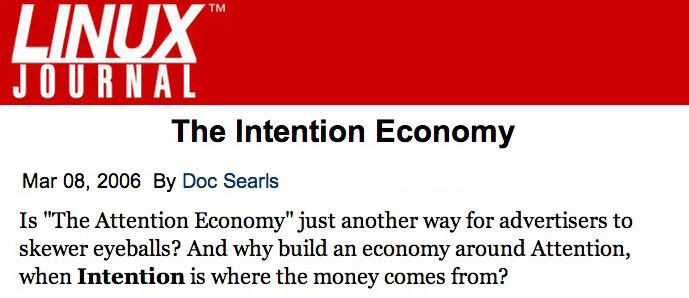
I coined “The Intention Economy” in a 2006 column with that title. (That’s a screen grab of its title and subhead, above.) That same year, I started ProjectVRM at Harvard’s Berkman (now Berkman Klein) Center. My book The Intention Economy: When Customers Take Charge (Harvard Business Review Press, 2012) posited a future described this way:
Over the coming years customers will be emancipated from systems built to control them. They will become free and independent actors in the marketplace, equipped to tell vendors what they want, how they want it, where and when—even how much they’d like to pay—outside of any vendor’s system of customer control…
Demand will no longer be expressed only in the forms of cash, collective appetites, or the inferences of crunched data over which the individual has little or no control. Demand will be personal. This means customers will be in charge of personal information they share with all parties, including vendors.
Customers will have their own means for storing and sharing their own data, and their own tools for engaging with vendors and other parties…
Thus relationship management will go both ways. Just as vendors today are able to manage relationships with customers and third parties, customers tomorrow will be able to manage relationships with vendors and fourth parties, which are companies that serve as agents of customer demand, from the customer’s side of the marketplace.
Relationships between customers and vendors will be voluntary and genuine, with loyalty anchored in mutual respect and concern, rather than coercion…
Likewise, rather than guessing what might get the attention of consumers—or what might “drive” them like cattle—vendors will respond to actual intentions of customers. Once customers’ expressions of intent become abundant and clear, the range of economic interplay between supply and demand will widen, and its sum will increase. The result we will call the Intention Economy…
The volume, variety and relevance of information coming from customers in the Intention Economy will strip the gears of systems built for controlling customer behavior, or for limiting customer input. The quality of that information will also obsolete or re-purpose the guesswork mills of marketing, fed by crumb-trails of data shed by customers’ mobile gear and Web browsers. “Mining” of customer data will still be useful to vendors, though less so than intention-based data provided directly by customers.
In economic terms, there will be high opportunity costs for vendors that ignore useful signaling coming from customers. There will also be high opportunity gains for companies that take advantage of growing customer independence and empowerment.
The Intention Economy inspired Sir Tim Berners-Lee’s Solid Project, Consumer Reports‘ Permission Slip, work on personal AI at Kwaai.ai (which I serve as Chief Intention Officer)—among the many other efforts listed by ProjectVRM, which is still active. You can follow and join here.
While tools for independent personal agency are still in their infancy, the corporate side imagines that personal intent is best inferred and controlled by companies, rather than expressed directly by customers and their own damn agents. As both sides muddle toward convergence in their own ways, are there middle grounds to explore?
Shuwei Fang of Reuters and the Harvard Kennedy School is looking into that space. In The information ecosystem is being redrawn by AI, she writes,
3. From artefacts to liquid information
Once machines are the primary audience, the artefacts we have built around information (the article, the bulletin, the documentary) become structurally optional.
Fragmentation was the old problem. Now information can exist without a container at all. And when information becomes liquid, the market bifurcates. Economic value concentrates at two extremes of a ‘barbell’; premium brands competing on differentiation and direct audience relationships; and commodity infrastructure operating at massive scale and razor thin margins. The middle, where most publishers currently sit, hollows out.
4. From attention to intention
When content is liquid and an intermediary controls the interface, something more consequential than format changes. The currency does. Clicks, pageviews, time on site; these were always crude proxies for what we actually wanted to know: what do people need? Now there are systems that can infer the answer directly. I have written elsewhere about this shift from attention to intention as the defining transition of this era.
Good points. Now, what about systems that start with individual customers and their agency, their intent?
Shuwei’s linked piece, From Attention Merchants to Intention Architects: The invisible infrastructure reshaping human curiosity, has this paragraph:
Researchers are beginning to document the foundations of this phenomenon, what some at Harvard Data Science Review and elsewhere call the ‘intention economy,’ where AI systems collect, commodify, and potentially manipulate user intent. But this only scratches the surface. What they’re witnessing is accompanied with a fundamental restructuring in how information flows through society. In the intention economy now emerging, AI systems could compete to anticipate and shape what those eyeballs seek before they even know they’re seeking it. The infrastructure being built right now, largely invisible to most of us, won’t just determine what we see; it will determine what we want to see before we know we want it.
The first link in that paragraph goes to a piece in December 2024that hijacked the meaning of intention economy. I tried to pull it back with The Real Intention Economy, and I’m doing the same here. I hope Shuwei reads it. The book too.
Meanwhile, let’s get back to Shuwei’s From Attention Merchants to Intention Architects: The invisible infrastructure reshaping human curiosity, which concludes,
But here’s what gives me hope: patient capital and policymakers are beginning to recognize infrastructure as the leverage point. The standards aren’t set yet. The architecture remains fluid. If these signals are correct, we might be at a rare moment where we can see a paradigm shift coming. Unlike previous shifts that caught democracy off guard (radio’s consolidation, television’s commercialization, social media’s polarization) we might actually have warning this time. If curiosity is becoming the new scarcity, if intention shapes outcomes more than attention ever could, then whoever builds the curiosity infrastructure could write the future of human understanding. And unlike attention, which is zero-sum and depletable, curiosity can grow through exercise, each question potentially spawning new questions, expanding rather than exhausting with use. This offers hope: the right infrastructure could create abundant understanding where the attention economy leveraged scarcity.
For centuries, democracy fought for the right to know; freedom of information, transparency, the end of censorship. If AI makes all information instantly accessible, we might face a new frontier: ensuring the courage to question survives the comfort of infinite answers. The intention economy might not be inevitable, it could be a design space waiting for architects. The question isn’t whether we’ll have curiosity infrastructure, we probably will. The question is whether we’ll build it to expand human wonder or contract it.
Indeed.
To expand human wonder, we need Personal AI, not just the mainframe kind we have now. And within personal AI, we need mechanisms that enable and express far more personal agency than can ever be provided through the kinds of conversations we have today with Big AI.
For full personal agency to thrive, we must have personal privacy. Because what we—the people—don’t say, and keep to our own private selves, may be far more meaningful and leveraged than anything that leaks out through AI queries. For that, we can start with contractual agreements such as those outlined by MyTerms (IEEE 7012).
We will indeed use AI agents to express our intentions (including the one to be left alone). But they will be our agents, not ones fed by surveillance.
We’ve been waiting eighteen years for those agents to arrive. It may take another one, three, five, or twenty years for that to happen. But it will.
Random:
Two books:
Unpacked
Apple Intelligence Foundation Language Models:
We present foundation language models developed to power Apple Intelligence features, including a ~3 billion parameter model designed to run efficiently on devices and a large server-based language model designed for Private Cloud Compute. These models are designed to perform a wide range of tasks efficiently, accurately, and responsibly. This report describes the model architecture, the data used to train the model, the training process, how the models are optimized for inference, and the evaluation results. We highlight our focus on Responsible AI and how the principles are applied throughout the model development.
The list of authors is longer than that summary.
Security at one cost: your time.
A thousand years ago, there was a cooking show on TV called Chef Tell (real name: Paul Friedman Erhardt). My teenage kids and I enjoyed watching him for just four words he would say, after making something too complex for any of us to bother with. In his thick German accent, he would say “Vewy simple, vewy ee-see.” When, again, it was not. So whenever something complicated needed to be done, one of us would say, “Vewy simple, vewy ee-see.”
I bring this up because I want tech support to be like Chef Tell. For example, today, when I mostly failed to solve an email problem. What follows is a diary of what I’ve been through on this thing.
The primary email app on my laptop (a 2023 M2 MacBook Pro) is Apple’s Mail.app. It’s not ideal, but I like it better than Thunderbird and Outlook. I use it for five email accounts: my main one with Searls.com, my gmail one for Google stuff one can’t avoid, the Apple one a customer gets anyway (actually three, ending in .me, .mac, and .icloud), my Indiana University one, and a new one just for MyTerms stuff. That last one is hosted by Fastmail.
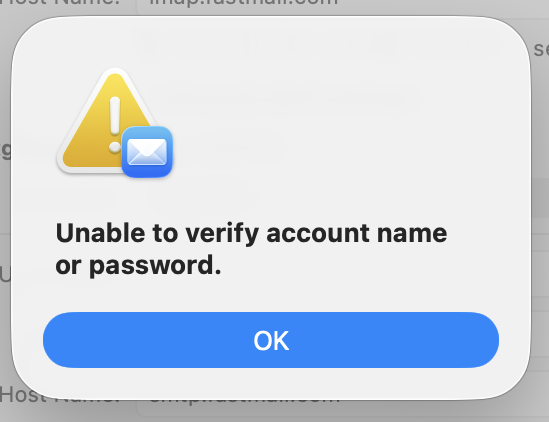
So one day the MyTerms email account on Fastmail account stopped working. The password and login work fine with the Fastmail app, and with Fastmail’s webmail on a browser. But not with the Mac app. Working with our MyTerms.info admin person, I generated and tried some number of new passwords, made sure the logins, the TLS, and the ports were all correct. No soap. So we concluded, at least provisionally, that the problem must be with Apple’s Mail.app. I then spent most of this afternoon on three calls with AppleCare, not taking to one human being. Apple seems to have nothing but AI agents now. (Not true, but I’ll cover that in another post.) The final advice from the final robot was to contact Fastmail.
For guidance toward that, I went to the Fastmail app, and saw an email from Fastmail. It said,
The above login failed because your regular password doesn’t work with third-party apps. This keeps your account secure. Instead, you can make a unique app password to use your account with the app securely.
Your regular password can be used to create new users, change your settings, or cancel your account. It’s important to protect this, which is why it can only be used to log in to fastmail.com and the Fastmail app.
We offer setup guides for most popular e-mail clients, such as Outlook and Mac Mail. These will take you through making an app password and using it for client login, step-by-step. Go to Settings → Migration to get started with a guide.
The first link there took me to a page that says.
Every third-party program or app needs its own app password to access your information. For the Fastmail app, you need to use your normal password. If you use your normal password or your Fastmail two-step verification password on an external account, syncing to an external service won’t work and you will see a password error.
This led me into a maze of instructions for setting up two-factor authentication that required an authenticator app on my phone. Fortunately, I know what that is, because Indiana University requires the one called Duo for doing the two-factor dance with its email maze.
After I got Duo set up, I still didn’t have an app password. I found a clue for that on another page that said this (among much else):
If your app password is for an Apple device running iOS 11+, you can use the QR code to automatically set up your email on your mobile device. Please note that the link provided via the QR code can only be opened via the Safari browser. Through Safari, you should then be able to download the auto-configuration file to your device. Our Help Center has help pages with more information on Apple auto-configuration for based on your device’s iOS.
The help page opens on every app I have other than Safari.
Under Automatic setup tool on one of the Fastmail help pages, it has nine steps one must go through. Somewhere in there, I got to the New App Password page, where it said, under Setting up this Mac,
Open this configuration file to set up everything automatically. Learn more.
I clicked on the “Open this configuration file” link, which downloaded a file to my downloads folder. Clicking on it brought up a little window that said,
**Profile downloaded.
**Review the profile in System Settings if you want to install it. [OK]
I hit OK. But where would it be in System Settings? Digging around in Fastmail, something said I would find the profile in General—>Device Management.
It was there. Among other things, it said “Double-click to review.” This brought up a window that said Are you sure you want to install this profile? So I hit “Install…” and it seemed done. Above it, next to “Work or School Account,” a button said “Sign In…”. This brought up a window that said Sign in to a Work or School Account. Above my email it said “Your email address will be sent to Apple to check device management enrollment eligibility.” In blue, it said “Learm more about device management…” Clicking on that brought up a window with a lot of words that I got rid of by hitting OK, so I was back to the last window, where there were buttons for Cancel and Continue. I hit Continue.
This got me to
Sign in with your managed Apple Account.
Enter the password for your Apple Account (the email address) provided to you by your organization.”
The password was back at my Fastmail app, under “Your new password for Apple Mail.app is::”
I copied it and pasted in the field in the Sign in window and hit Next. This turned the window into a wider one that said, in red,
Your Apple Account does not support the expected services on this device. Contact your administrator to sign in.
My administrator is in London, where it is now 1am.
I’m giving up now.
Lost patience rates may apply
One of the biggest reasons I own Apple stuff is that AppleCare seems to care. They have human beings for that. I’ve been using them since the service first showed up in 2001, along with Apple Stores and their Genius Bars. The agents on phones have always been helpful. They differed a lot in levels of expertise, but on the whole were very good.
But now I only get AI agents. This has led me to wonder if they are replacing humans with AI agents. But I don’t know. They are recruiting service and support people. But now they’re using AI agents for triage work. Interesting that every one has a different voice. And in some cases they have been helpful. But not today. The one time the AI agent said they would forward my call to a person, I got about a minute of silence and then the call dropped. An Apple robot did call back, but I had given up by then.