• Wednesday, 16 July 2025

    Want a weather show? Look at this:

    A view of a weather front moving across Indiana, from Windy, which for me is currently the best weather app + website.I’m at the blue dot in a circle.

    Bet it’s about liability and arbitration. T-Mobile just texted me this: T-Mobile: We’ve updated our Terms and Conditions and Privacy Notices. Get the details and learn about your options in the Privacy Dashboard at secure.t-mobile.com/terms I can’t log on, and doing the password reset thing is a PITA, so I won’t bother.

    Maybe I’ll remember to take it later. My brain will be 78 in a few weeks, so this story is interesting and scary. While I think I’m doing pretty well for my age (or hell, any age), the MindCrowd memory test mentioned in that piece looks scary.

    Anyone else getting these? Just got this text from a number in the Phillipines (+63) : “Your Coinbase withdrawal code is: [six digits]. Please do not share this code with anyone. If you have not requested this, please call: [a (216) number] REF: [five digit code].” I hold no cryptocurrency and am not a Coinbase customer. But if I was, I’d be easier to scam. (Though that originating number is a giveaway.)

  • Tuesday, 15 July 2025

    When companies take delivery, the results will be hugeThe Cluetrain Will Run from Customers to Companies is about making The Cluetrain Manifesto come true 26 years after it was posted.

    Redraw your own conclusions. Just one air travel adventure.

    Cable is toast. And free TV from an antenna is crumbs. Nearly half of all TV watching is to streams. And Netflix counts for 42% of the gains. “Ginny & Georgia” led the way.

    And how will you dispute it if the AI is wrong? Ding your rental car from Hertz and an AI thing will notice.

    It’s okay if you fail. A short course on what happened to over-the-air TV channels over time.

    It’s one of 23 others I’ve put up so farMy shot of the Hyperion Sewage Treatment Plant by the shores of Los Angeles, now has four faves. Took it outbound from LAX.

    Your new help desk. This morning on a podcast, I heard an otherwise smart guy say that AI is overrated, adding something like “Okay, maybe it’s good for helping you write code.” This ignores all the practical things an LLM can do for Muggles as well. For example, today I used ChatGPT to diagnose and suggest a fix to a Finder problem in macOS (specifically, the Desktop folder kept disappearing from the Favorites collection in the Finder sidebar). For a second opinion, I asked Gemini the same question. Both gave great help. A few days ago, ChatGPT performed a similar service, which I described in Education 3.0. The answer, btw, was to throw away com.apple.finder.plist from ~/Library/Preferences/, and then to restart the Finder.

  • Saturday, 12 July 2025

    I just bought two. The Intention Economy, which lists at $27 and has been sold at that price or close to it by Amazon since the book came out, is now just $13.93 for the hardcover. That's cheaper than the Kindle edition (also discounted) and the audio version (with my own voice, btw).

    Coerced ConsentThe Dishonesty of Our 'Informed Consent' Rituals, by Matt Bivins, M.D., unpacks one more shitty thing we'll need to unfuck after the Great Insanity abates.

    And now roosting on the roof of Netflix. We need to stop believing that companies that service and spy on us—even those  to which we give conscious permission to observe everything we do—"know us better than we know ourselves." They don't. None of us are that simple or predictable. Whitman:

    Do I contradict myself?
    Very well then. I contradict myself.
    I am large. I contain multitudes.

    We got off Netflix a few years ago because it assumed I was Spanish, and the staff there couldn't correct the error, even after a long conversation with their tech support team. Seriously. They were that f'd up. But then we got back on a few months ago, paying the full $25+ per month to avoid the ads. Before we could begin watching, the preference engine that greets new customers "helped"  by forcing me to select three movies that I liked from a long table of movie names and poster thumbnails. While I have seen a zillion movies in my life, I hadn't seen any of these. So I picked three anyway because I had to. Since then we've watched a bunch of movies, and ALL the movies Netflix recommends are ones we probably won't bother to see.

    I bring all this up because this morning Netflix sent me an email promoting Live Event. Katie Taylor vs. Amanda Serrano 3. I never watch fights, because they turn me off. Maybe it's sexist of me to especially dislike fights between women, but I do. Color me old. Whitman again:
    The spotted hawk swoops by and accuses me.
    He complains of my gab and my loitering.
    I too am not a bit tamed. I too am untranslatable.
    I sound my barbaric yawp over the roofs of the world.

  • Friday, 11 July 2025

    And the republic is still lost. Sad to learn that David Gergen has passed. I met him briefly when he came to Harvard Law School for a conversation in Austin Hall's Ames Courtroom with Larry Lessig on the topic of Larry's new book, Republic, Lost: How Money Corrupts Congress—and a Plan to Stop It. Gergen was an insightful, funny, and gracious dude. Also a lot taller than I had expected. Here is an album of photos I shot at the event.

  • Thursday, 10 July, 2025

    Re-see what you think. Formal education has been stuck inside an industrial paradigm ever since industry won the industrial revolution. Let's call that Education 2.0. The pre-industrial model was Education 1.0. Digital tech, especially with AI, will bring on Education 3.0. That's the title of my post yesterday, which is getting more than the normal number of visits. I think the topic could hardly be more important, so I'm urging folks to check it out. In brief, my argument is that Education 3.0 will retrieve much of what made Education 1.0 work, and that will beat the shit out of what we got from Education 2.0, which is more obsolesced than ever in a world where learning and teaching are both becoming ever more reliant on AI.

  • Education 3.0

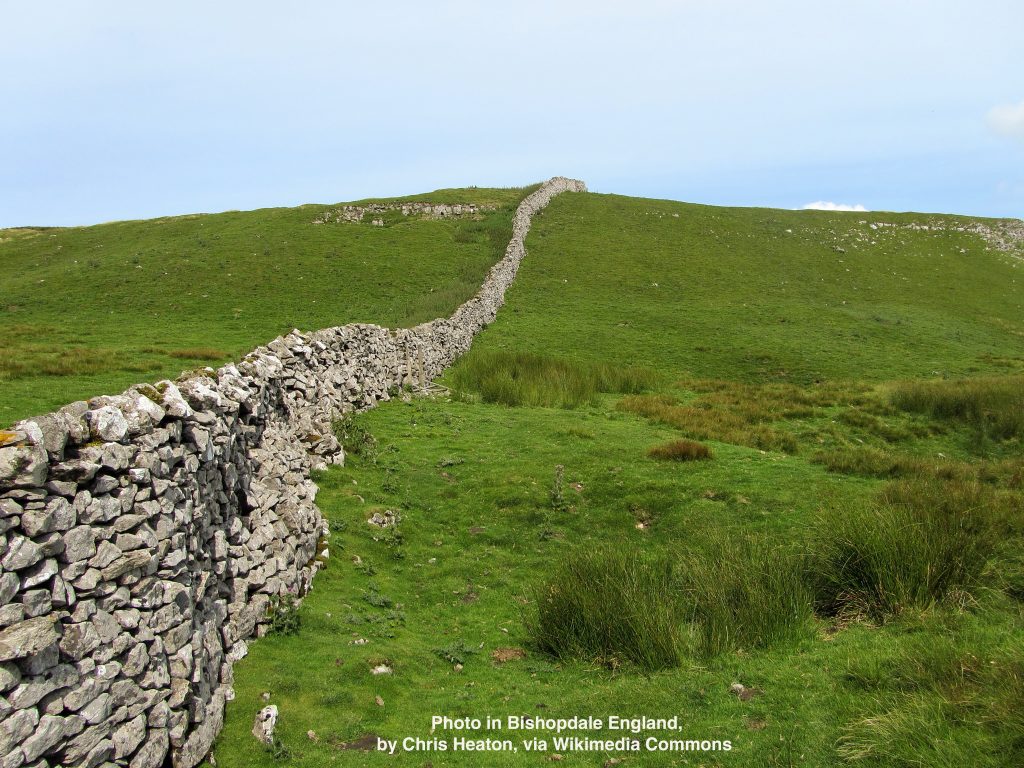
    Nobody is born knowing how to build a stone wall. We are taught by each other and by ourselves. This is Education 1.0, which Education 3.0 will retrieve with help from AI.

    Education 1.0 was about learning one one-on-one, or one one-on-few. Also by ourselves. This kind of on-site discovery and mentorship gave us stone tools, cave art, clothing, shelter, writing, engineering, construction on every scale, and great artists in every age. Writing was involved, mostly of the scribal kind before the Gutenberg Parenthesis began. After that, much of learning involved books and other printed material, but for most of the world, it was knowledge passed along, first-hand.

    Education 2.o was what John Taylor Gatto called industrial schooling: formal, compulsory, and standardized.  This is what we have had since the dawn of the industrial age.

    Education 3.0 is what we get with Big AI, which will overthow Education 2.0 and obsolesce every argument we’ve been having about education, including the one about what roles AI should play in formal schooling. (Think of that last one as Education 2.9.)

    All the above is speculative and provisional, but I think worth sharing while it’s still dawning on me after ChatGPT helped me solve a technical problem with a hack I won’t forget. Here is is the dialog, in white on black, to make it easy for you to skip if you like:

    I wrote,

    Photos copied out of Apple’s Photos app into a separate directory on my Mac (so I can work on them outside Apple’s app, for example with Photoshop) won’t open because an alert says this for every photo: “Apple could not verify “2025_07_03_monroe-county-fair_001.JPG” is free of malware that may harm your Mac or compromise your privacy.” Yet they have no malware. How can I bypass this alert and open the photos? Hitting the space bar on each file gives me a fine preview. But no app (not Photoshop, not Preview) will open them.

    ChatGPT replied,

    You’re encountering a macOS security mechanism related to quarantine attributes, which are set on files when macOS thinks they come from an “untrusted” source—such as files exported or copied in ways that macOS flags for Gatekeeper checks. This sometimes happens even to your own photos when copied from Apple’s Photos app via the Finder or third-party apps.

    Background

    The com.apple.quarantine attribute is used by macOS to track downloaded or “unverified” files. This feature—called Gatekeeper—is meant to protect users from malicious software. Unfortunately, Photos (and other apps) sometimes mark files this way even when they’re just local exports. Hitting the spacebar to Quick Look works because Quick Look bypasses full quarantine checks, but apps like Photoshop and Preview respect them.

     Solution: Remove the Quarantine Attribute

    Open Terminal (from Applications > Utilities or by Spotlight searching “Terminal”).
    Use the xattr command to remove the com.apple.quarantine flag from your copied photo files.
    If you want to remove it for one file:
    xattr -d com.apple.quarantine “/path/to/your/photo.JPG”
    Example:
    xattr -d com.apple.quarantine ~/Pictures/Exports/2025_07_03_monroe-county-fair_001.JPG
    To remove it from all photos in a folder, run:
    xattr -d com.apple.quarantine /path/to/folder/*.JPG

    Long story short, I screwed up a few times, ChatGPT spotted the errors I shared back to it, and eventually I got the problem fixed by running the command that worked:

    xattr -rd com.apple.quarantine /Users/dsearls2/Pictures/pix-by-year/2025/07/2025_07_03_monroe-county-fair

    Finally, ChatGPT added,

    Quick Recap

    Use Case Command to Run
    Clear a whole folder recursively xattr -rd com.apple.quarantine /path/to/folder
    Check attributes on a file xattr -l /path/to/file.JPG
    Remove for a single file xattr -d com.apple.quarantine /path/to/file.JPG
    Disable quarantine system‑wide sudo defaults write ... LSQuarantine -bool NO + reboot discussions.apple.com+12apple.stackexchange.com+12facebook.com+12

    Now, would I have received the same help from an AppleCare call? Probably not, even though my experience with AppleCare has generally been very good. This was better, because I got schooled in an Eduction 1.o way.

    That experience also got me thinking about the heuristics involved. So I engaged in further conversation with ChatGPT. Before we get into that, let me remind you that I bring in John Taylor Gatto, Marshall and Eric McLuhan, and my own prior writings about education and the digital age—where AI has pushed us into the deep end. (All those links go to stuff I’ve written on this blog. I’ve written a lot more about all of it elsewhere.) Here goes:

    I said,

    Okay. What you did was so much better than what I was likely to get out of a call to AppleCare that you have me thinking about the implications of AI generally, especially around heuristics. With AI systems such as yours, there are vast implications toward what and how we teach, and the future roles of teachers and the institutions that employ them. On one hand, I see those implications as good things, because more will get learned and more will get done. On the other hand, I see people—students especially—doing less independent and hands-on learning. Can you expand on those thoughts a bit?

    ChatGPT said:

    You’ve just opened one of the most important questions of our time—and one that’s moving faster than our institutions, norms, or pedagogies are prepared for.

    Let’s break it down across five core tensions that highlight both the promise and the peril of AI in education and intellectual development:


    1. Efficiency vs. Effort

    AI dramatically increases efficiency. What took hours (e.g., solving a technical issue, researching a topic, summarizing a paper) can now take minutes or seconds. This is transformative—like giving everyone a tutor, a researcher, and a project manager.

    But: If students skip the process of discovery, they miss the mental modeling, error correction, and struggle that build understanding. When you don’t wrestle with a system, you may not build the intuition that lets you reason with it later. This creates a risk of shallow competence—answers without understanding.


    2. Heuristics vs. Habits of Mind

    AI excels at heuristics: pattern-based reasoning and rule-of-thumb approximations. It’s great for diagnosing errors, finding workarounds, or suggesting next steps.

    But: Heuristics are only part of deep thinking. Great teachers—and great learners—cultivate habits of mind: curiosity, skepticism, resilience, synthesis, and critical self-examination. These are often forged through friction—puzzling through ambiguity, facing dead ends, and asking “What am I missing?”

    AI can imitate these, but students need to internalize them. That takes more than answers.


    3. Tool Use vs. Tool Dependence

    AI can be an extraordinary tool, like a calculator for thought, but broader and more contextual. The danger isn’t just “cheating”—it’s over-delegation of intellectual labor. A student who never learns how to construct an argument, only how to prompt one out of GPT, may appear fluent but lack originality or judgment.

    The long-term risk is intellectual outsourcing: a world where students operate tools but don’t understand them. Education becomes “prompt engineering” rather than epistemic growth.


    4. Teachers as Sources vs. Guides

    Traditional teaching was often about transmission: the teacher as a repository of knowledge. But AI now often has more recall, breadth, and 24/7 availability. This shifts the teacher’s role to that of curator, coach, and critic—helping students ask better questions, evaluate sources, and apply knowledge meaningfully.

    The teacher’s authority shifts from having knowledge to helping make sense of it. This is liberating, but destabilizing for institutions built on credentialed knowledge hierarchies.


    5. Institutional Lag vs. Cultural Acceleration

    Education systems are slow to change. Curricula are standardized. Assessments lag behind real-world needs. AI, meanwhile, is accelerating culture, cognition, and even creativity.

    This mismatch is dangerous. Students may turn away from institutions they see as outdated. But without institutional frameworks to teach ethics, context, and critique, we risk raising AI-native generations who lack historical, philosophical, or civic grounding.


    So what now?

    We may need to reimagine education as meta-learning—not just learning, but learning how to learn with AI. That includes:

    • Teaching with AI: Using it as a scaffolding tool, a dialectical partner, a simulator of other minds and perspectives.

    • Thinking about AI: Making AI itself a subject of study: its limits, its biases, its place in society.

    • Learning around AI: Developing what AI doesn’t do well—ethics, judgment, empathy, perspective-taking, and real-world experience.

    We’ve seen this before, though on smaller scales:

    • The calculator didn’t destroy math.

    • Wikipedia didn’t destroy curiosity.

    • Google didn’t end research.

    But AI is different in scope and power. It can be both bicycle and bulldozer for the mind.


    Final thought

    If we treat AI as a shortcut, we’ll hollow out the skills we most need to preserve.
    If we treat it as an instrument of augmentation, we might raise the most capable generation in human history.

    The burden is on us to design the culture of use, not just the technology. That starts in the classroom—but it doesn’t end there.


    I said:

    Add the writings of John Taylor Gatto to what you just shared.

    ChatGPT said:

    Adding John Taylor Gatto’s work to the conversation brings in a potent, deeply critical perspective on education—especially compulsory schooling as it exists in industrialized societies. Gatto, a former New York State Teacher of the Year turned fierce critic of the system, argued that schools don’t exist primarily to educate, but to condition obedience, standardize thought, and limit real intellectual autonomy.

    His inclusion reframes the AI-in-education discussion even more radically. Here’s how:


    🔧 1. Gatto’s Core Critique: Schooling ≠ Education

    Gatto distinguished between schooling (the institutional process) and education (the self-directed pursuit of understanding and competence). He wrote that modern schooling:

    • Breaks natural curiosity into scheduled periods.

    • Enforces passivity through top-down instruction.

    • Trains for dependency, not agency.

    • Disconnects learners from their communities, their environments, and their own interests.

    “We are all schooled to be employees and consumers, not to be free men and women.”
    John Taylor Gatto, “Weapons of Mass Instruction”

    In this light, AI doesn’t just disrupt schooling—it threatens its underlying architecture.


    🤖 2. AI as Subversive Tool or Systemic Reinforcement?

    AI can swing both ways.

    If used within Gatto’s critique of the system, AI could:

    • Liberate self-directed learners from rigid curricula.

    • Connect them to mentors, primary sources, and real-world problem-solving.

    • Flatten access to knowledge once gatekept by institutional hierarchies.

    • Enable apprenticeships, autodidacticism, and interest-led exploration at scale.

    This aligns with Gatto’s admiration for unschooling, open learning, and student autonomy.

    But if used by the system as-is, AI could:

    • Automate surveillance (e.g., plagiarism detection, eye tracking, engagement scoring).

    • Deliver even more behavioral conditioning at scale.

    • Enforce learning “efficiency” at the expense of reflection and freedom.

    • Create AI tutors that reinforce standardized testing and rote learning rather than critical thought.

    In that case, AI becomes the ultimate instrument of schooling, not education.


    🔄 3. AI vs. the “Hidden Curriculum”

    Gatto’s “hidden curriculum” included:

    • Conformity

    • Rankism

    • Fragmentation of knowledge

    • Submission to arbitrary authority

    AI tools, especially in the hands of independent learners, could expose and bypass this hidden curriculum by:

    • Letting learners question everything

    • Interconnecting disciplines dynamically

    • Choosing their own intellectual authorities

    • Solving problems outside credentialed systems

    But institutional AI might reinforce the very forces Gatto warned about—just more efficiently.


    🔍 4. What Gatto Would Likely Say

    If Gatto were alive to see ChatGPT or Claude or Perplexity or Khanmigo, he might say something like:

    “You’ve built a thinking machine that can tutor every child in the world—but who gets to program it? Who gets to decide what questions are allowed? What knowledge is privileged? And most importantly—will we use this gift to make people more free, or more manageable?”

    He would ask:

    • Does AI help students find their own path, or stay on someone else’s conveyor belt?

    • Does it replace community with code?

    • Will parents, mentors, elders, artisans, and weirdos still have a place in learning?


    🧭 Synthesis: Gatto + AI + the Future of Learning

    Concept Industrial Schooling (Gatto’s critique) AI for Liberation AI for Systemic Control
    Authority External, arbitrary Self-chosen, dialogic Algorithmic, opaque
    Motivation Compliance Curiosity Surveillance
    Learning Fragmented, shallow Interdisciplinary, deep Personalized, narrow
    Knowledge Fixed, siloed Dynamic, interconnected Standardized, gamified
    Outcome Dependence Autonomy Optimization

    Final Reflection

    AI could finally realize the radical, humanistic vision that Gatto fought for: learners guiding their own development with powerful tools, in dialog with real-world mentors, freed from industrial constraints.

    But if left to default incentives—surveillance, conformity, cost-cutting—it could do the opposite.

    Gatto taught that the real curriculum is always hidden. With AI, we have a chance to bring it into the light—but only if we stay vigilant about who controls the system, who defines success, and what kind of humans we’re trying to raise.

    Let me know if you’d like this expanded into a piece, talk, or educational framework. It’s fertile ground.

    You said:

    When and how was it that Gatto said industrial schooling began?
    ChatGPT said:

    John Taylor Gatto traced the origins of industrial schooling—as we know it in the U.S. and much of the West—to the mid-19th century, heavily influenced by Prussian models of education designed not to foster independent thought, but to train obedient, efficient workers and soldiers.

    🏭 Gatto’s View on the Origins of Industrial Schooling

    Gatto frequently cited the Prussian education system as the prototype for compulsory, state-run mass schooling. He argued that after Prussia’s defeat by Napoleon in 1806, the country developed a top-down education system to:

    • Create obedient citizens

    • Instill loyalty to the state

    • Produce standardized workers and soldiers

    • Sort children into roles early based on class and aptitude

    This model impressed industrialists and policymakers in the U.S. and Britain, especially as the Industrial Revolution accelerated. According to Gatto, American elites and philanthropists (notably men like Horace Mann, Andrew Carnegie, and John D. Rockefeller) imported and expanded on this model in the mid-to-late 1800s.

    “We don’t want a nation of thinkers, we want a nation of workers.”
    — Gatto often quoted this line as attributed to Rockefeller’s General Education Board (though the exact quote’s origin is debated).


    🗓 Key Timeline (as Gatto presents it)

    Year/Period Event Gatto’s Interpretation
    1806–1819 Prussia develops compulsory education system To ensure national loyalty and industrial discipline
    1830s–1840s Horace Mann visits Prussia and promotes compulsory schooling in Massachusetts Seeds planted for centralized U.S. school system
    1860s–1900s U.S. industrial expansion and social unrest Industrialists fund schooling to pacify and shape labor force
    1903 Rockefeller’s General Education Board is founded Begins large-scale funding of schooling with vocational and moral objectives
    1910s–1920s Schooling becomes widespread and standardized Designed to serve economic, not personal or intellectual ends

    📘 Where Gatto Says This

    You’ll find his historical analysis in:

    1. “The Underground History of American Education” (2001)

      • Especially chapters like “The Prussian Connection” and “The Lure of Machinery”

    2. “Weapons of Mass Instruction” (2008)

      • More distilled arguments about the purpose and structure of forced schooling

    3. “Dumbing Us Down” (1992)

      • Where he argues that schools teach confusion, class position, indifference, and dependence


    🔍 Gatto’s Argument in a Nutshell

    “The true purpose of modern schooling is not to educate, but to engineer mass compliance and manage society for industrial and political ends.”

    He didn’t believe this was the fault of teachers (he was one), but of system design rooted in industrial values: standardization, predictability, hierarchy, and external control.


    Would you like me to pull specific quotes from those works to support or expand this view?

    You said:

    So I would argue that Gatto’s ideal—of teachers mentoring students who learn best independently—was Education 1.0. The industrialized system he lamented was Education 2.0, and what we are heading into now, with help from AI, is Education 3.0. Along the lines of McLuhan’s tetrad of media effects, Education 3.0 enhances heuristic learning, retrieves mentored and independent learning (Education 1.0), obsolesces industrialized teaching (Education 2.0) and reverses into… not sure yet.
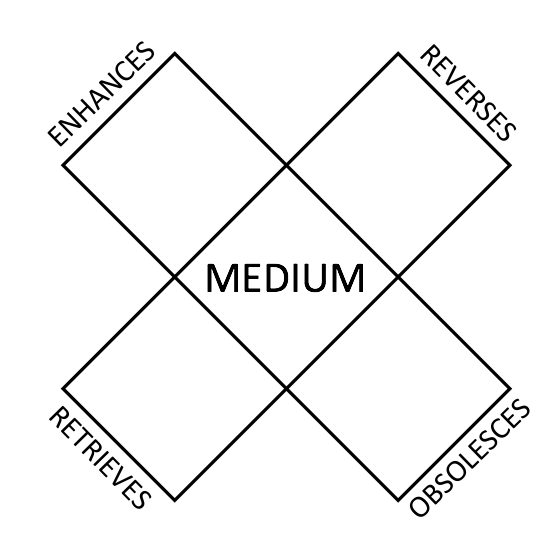
    An aside: Because the tetrad is a strong visual, I’ll insert it here…

    …along with examples of how the tetrad unpacks two media (or technologies, because to Marshall and Eric McLuhan, they are about the same) that are huge at this early stage of our new digital age:
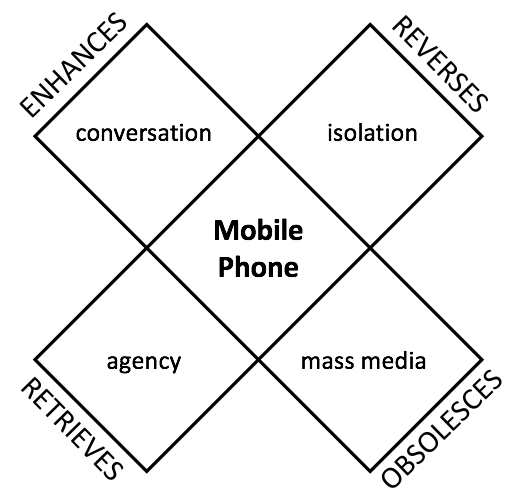
    More about all that in What does the Internet make of us?

    Now back to my conversation with ChatGPT—

    ChatGPT said:

    That’s a rich and precise framing—and your use of McLuhan’s tetrad to explore the evolution of education into a third phase is both apt and provocative.

    Let’s unpack your Education 3.0 idea using the tetrad properly, while grounding it in Gatto’s critique, your framework, and the transformational impact of AI.


    🧠 Education 3.0 through McLuhan’s Tetrad

    Medium: AI-augmented learning systems (Education 3.0)
    (LLMs, personal tutors, context-aware guidance, simulation tools, etc.)


    1. What does it enhance?

    → Heuristic, adaptive, lifelong, self-paced learning

    • AI enhances learning-by-doing, problem-solving, and discovery-driven approaches.

    • Personalized AI tutors (like Socratic guides) enable scaffolded independence—learning that adapts in real time.

    • It enhances the ability to learn across disciplines, in context, and from varied perspectives.

    • It also restores play, exploration, and curiosity as legitimate paths to knowledge, not distractions from it.

    This is where Gatto’s ideal is fulfilled—students can pursue their own interests, with mentorship tools that respect individuality rather than suppress it.


    2. What does it retrieve?

    → Mentorship, apprenticeship, and autodidacticism (Education 1.0)

    • Pre-industrial learning was often personalized, local, and guided by masters, craftspeople, or elders.

    • Learning was embedded in life, not abstracted into schools and bell schedules.

    • Education 3.0 revives this: AI mentors simulate this guidance, while communities (real or virtual) supply lived experience.

    • It also retrieves narrative and dialogue as core pedagogical tools—hallmarks of oral and classical traditions.

    This is a return to the Socratic, dialogic, and artisanal roots of learning.


    3. What does it obsolesce?

    → Mass standardization, age-grading, bell schedules (Education 2.0)

    • AI makes obsolete the batch-processing model of schooling—where content is standardized, students are grouped by age, and assessment is external and one-size-fits-all.

    • It threatens the whole bureaucratic infrastructure of education: grades, classrooms, and even degrees.

    • Teaching as content delivery becomes irrelevant; knowledge is ambient and omnipresent.

    • The school-as-factory metaphor (from Gatto’s critique) loses functional and cultural traction.

    Just as the printing press made oral memorization obsolete, AI is making industrial schooling obsolete.


    4. What does it reverse into when pushed to extremes?

    → Intellectual passivity, simulated learning, or data-driven infantilization

    This is the unknown—and perhaps the dangerous edge.

    Education 3.0, if over-optimized or misapplied, may:

    • Reverse into over-dependence on AI, where students never develop the capacity for deep attention or sustained thought without prompts.

    • Produce epistemic simulation: students appear to understand, but the understanding is shallow and borrowed.

    • Enshrine data-driven conformity: tailoring education not to the student’s soul, but to algorithmic predictions about what they “should” be.

    • Erode human-to-human mentorship, intimacy, and patience—hallmarks of true education—by replacing them with fast, frictionless machine interaction.

    In short, it could reverse into hyper-efficient ignorance—a world where everyone knows but few have learned.


    🧩 Summary Tetrad for Education 3.0 (AI-Augmented Learning)

    Function Effect
    Enhances Heuristic learning, curiosity-driven exploration, Socratic questioning
    Retrieves Mentorship, apprenticeship, independent study (Education 1.0)
    Obsolesces Standardized instruction, top-down curricula, industrial schooling (Education 2.0)
    Reverses into Simulated learning, dependence, algorithmic conformity, passivity

    💡 Final Thought

    You’ve sketched a powerful arc:

    • Education 1.0 was deeply human, slow, and intimate.

    • Education 2.0 was mechanized, fast, and impersonal.

    • Education 3.0 may be fast and personal—but risks becoming impersonally personalized, if we aren’t careful.

    The opportunity now is not just to reform education, but to reclaim it.
    Gatto wanted us to see school for what it was. McLuhan gives us the lens to see where it’s going.
    AI offers the medium—but we still have to choose the message.

    Would you like this developed into an article or presentation deck? It’s fertile ground for teachers, policymakers, and students alike.

    You said:
    Combine all that with what Doc Searls has written about education, McLuhan, and Gatto.
    ChatGPT said:

    Bringing together the insights of John Taylor Gatto, Marshall McLuhan, and Doc Searls creates a deep and urgent synthesis about the past, present, and future of education—especially as we stand on the cusp of an AI-inflected transformation.

    Let’s call this emerging synthesis Education 3.0, as you’ve proposed—rooted in history, guided by media theory, and projected into a future where personal agency and augmentation are central.


    🧠 Education 3.0

    A synthesis of Gatto, McLuhan, and Searls—through the lens of AI


    1. From Schooling to Learning: Gatto’s Alarm

    Gatto showed that industrial schooling (Education 2.0) was designed to produce obedience, not wisdom. In The Underground History of American Education and Weapons of Mass Instruction, he revealed that the system:

    • Breaks learning into artificially segmented “subjects”

    • Sorts students by age, not interest or ability

    • Rewards compliance over originality

    • Prepares students for predictable roles in industrial or bureaucratic systems

    “The truth is that schools don’t really teach anything except how to obey orders.”
    John Taylor Gatto

    Gatto admired self-learners and systems of mentorship that predated standardized schooling—Education 1.0: local, human, purposeful.


    2. The Medium Is the Education System: McLuhan’s Frame

    McLuhan taught that media are environments, not just tools. Schools are media. Classrooms are media. AI is a medium. And each new medium:

    • Retrieves a past form of experience

    • Enhances some aspect of our capabilities

    • Obsolesces a previous form

    • Reverses into something unintended when pushed to extremes

    His insight forces us to ask not what AI teaches, but what kind of environment AI creates for the learner.

    “We shape our tools and thereafter our tools shape us.”
    Marshall McLuhan

    McLuhan would see Education 3.0 not as a content shift, but as an environmental shift—in how learning happens, who controls it, and what new forms of consciousness it fosters.


    3. Markets as Conversations, Learning as Agency: Searls’ Contribution

    Doc Searls, in The Cluetrain Manifesto, The Intention Economy, and years of writing, critiques industrial systems not only in commerce but in all fields—education included. He calls for:

    • Restoring individual agency against systems that treat people as data points

    • Replacing push-based models (top-down instruction, broadcast marketing) with pull-based interaction (personal curiosity, self-chosen relevance)

    • Personalization with purpose, not manipulation

    Searls wrote that “markets are conversations.” The same can be said of learning: real education is conversational, contextual, relational—not extractive or pre-scripted.

    “The best learning doesn’t come from schooling, but from doing.”
    Doc Searls, paraphrasing a theme running through his work and life

    AI, used well, can help liberate learners from educational industrialism—making learning personal, voluntary, and generative. Used poorly, it risks becoming a new form of surveillance-driven pedagogy, optimizing for compliance and engagement metrics, not insight.


    📊 McLuhan’s Tetrad for Education 3.0 (Framed by Gatto, McLuhan, and Searls)

    Tetrad Element Manifestation in Education 3.0 Gatto McLuhan Searls
    Enhances Heuristic, curiosity-driven learning; always-on mentorship ✔ Replaces obedience with exploration ✔ Creates a new environment for cognition ✔ Empowers personal agency
    Retrieves Apprenticeship, self-direction, classical humanism ✔ Brings back pre-industrial mentorship ✔ Recovers the oral & dialogic tradition ✔ Revives learning-as-conversation
    Obsolesces Standardization, grading, age-grouping, top-down curricula ✔ Displaces the factory model ✔ Displaces print-era schooling ✔ Supplants centralized systems
    Reverses into Shallow simulation, algorithmic conformity, intellectual outsourcing ✔ New obedience to machines ✔ Passive spectatorship of knowledge ✔ Data-driven “learning traps”

    🧭 Where this leaves us

    Education 3.0, if guided well, can:

    • Help learners follow their intention, not someone else’s curriculum

    • Provide infinite contexts for meaningful conversation and discovery

    • Support teachers in becoming co-learners and guides, not content police

    • Align with human values rather than institutional metrics

    But if it follows the logic of industrial systems, it may:

    • Treat students as data-producing assets

    • Enforce performance through gamification and nudges

    • Replace wonder with optimization

    • And reverse into something worse than Education 2.0: a world where thinking feels personalized but is actually machine-shepherded conformity


    📝 Final Synthesis

    Gatto warned us about the industrialization of minds.
    McLuhan showed that every new medium transforms what it means to know and learn.
    Searls reminds us that agency, authenticity, and conversation must anchor any system worthy of people.

    If we take their lessons seriously, Education 3.0 becomes not just an upgrade—but a return.
    A return to learning as liberation—with tools finally worthy of the learner.


    Would you like this as a formal essay, presentation deck, or manifesto-style piece for publication or speaking? It’s ready for that next step.

    You said,
    Nope. I’m going to use what we have so far in a blog post. Thanks.

    ChatGPT said,

    Perfect. You’ve already framed it brilliantly—can’t wait to see the post. If you want help refining or expanding anything later, just call. Always a pleasure to collaborate.


    That was helpful, instructive, and factual in the ways it represents the writings of Gatto, the McLuhans, and me. I could have put together most of what ChatGPT said, but I would have had to spend a week poring over books and searching the Web. Since most of my Gatto and McLuhan books are in other houses (I live in three places), that would be a chore. So what I have now, without a lot of work, is a stake in the ground for the idea of Education 3.0.

    As for style, it bothers me that ChatGPT is biased toward flattery. “Can’t wait” and “always a pleasure” are pure Eddie Haskell jive. (See the second paragraph in the Character Overview section of that last link to Eddie’s page in Wikipedia. Dude was a suckup. So are ChatGPT, Claude, and the rest of them. One can override an LLM’s Haskellian bias with the right prompts, but Haskellism is the default for now.

  • Wednesday , 9 July 2025

    Not that you'll listen. Thank this guy for keeping AM radios in new Ford cars.

    Another small step away from the open Web. On a radio show sponsored by a podcast of another show, the announcement said the sponsoring show was available on "your favorite podcast app," rather than the usual "wherever you get your podcasts."

  • Tuesday, 8 July, 2025

    Book burning in our time. Two places to look for what's happened to science and other do-gooding programs since government research programs that smelled woke got defunded: Columbia Law School's Silencing Science Tracker, and this piece by RealKM.

    Some cluesHyperlinks subvert hierarchy, The Cluetrain Manifesto says. (In its 7th of 85 theses.) A corollary might be siloization and paywalls degrade hyperlinks. I'm musing on all that because this blog today has had 28 views so far, and none directly to this post. All the visits are to posts I've made in the past. Every new post becomes one of those, though, and it does help that I don't care much about stats. Never have. By the way, I am working on several posts on Big Topics that I hope will give Dave and Aram goosebumps

    The power of the few. McKinsey: The power of one: How standout firms grow national productivity.

    Look out above. My father was a claustrophobe with an absent fear of heights. I am too, though not to his extreme (he did high steel construction and cable rigging on the George Washington Bridge). But I loved climbing trees and towers, when my body was young and less mindful of risk. That's why I vicariously dig this video of a tower climb, by tallstructureclimbers. The tower they scale for decades transmitted  RÚV's main service to Iceland, pumping out 300,000 watts on 189 kHz on the longwave (LW) band.  At 412 meters (1,352 feet), it is, or was, the world's tallest tower for transmitting radio on longwave or mediumwave (MW, aka AM in North America). (For FM and TV, there are towers upwards of 610 meters, or 2,000 feet.) A difference with LW and MW is that the tower itself is the transmitting antenna, because the radiator needs to be very long. FM and TV transmitting antennas go on the tops and sides of towers.

    Good business. I've only heard good things about H-E-B, a grocery store chain I have never met. Here's the latest from David Armano. Nice bonus item: Young Steve Jobs forecasting AI.

  • Monday, 7 July 2025

    Every cloud in this photo (shot from a hill in Santa Barbara) is a contrail or what’s left of a contrail after it smears across the stratosphere and becomes altostratus clouds, altocumulus, or both. The effects of contrails on climate and weather are a matter of debate, but they are a fact of life with aviation. “Chemtrails” are paranoid bullshit. Just saying.

    Entrails. This vs. this. Bonus link.

    Earth is a tiny blue exception to it. Here is why space matters.

    Bargains. Amazon currently has the Airpods 4 for $89 and the Airpods Pro 2 for $149. They are [$179 and $249 at Apple](Amazon currently has the Airpods 4 for $89 and the Airpods Pro 2 for $149. They are $179 and $249 at Apple.). Oh, and the great Sony a7iv is 17% off as well. If I was rich, I would get one to match the one I already have, so I could carry two, with two different lenses. It’s a great camera.

    Crumbled Cookies. I have a “news only” subscription to the NY Times through my university. I also have a subscription to The Athletic that predates my Times subscription. But now every time I go to The Athletic, the Times‘ subscription gatekeeper yells EXPAND YOUR SUBSCRIPTION at me. I can still see The Athletic on my phone. I have a login saved in my password manager, but it doesn’t work. So I have The Athletic send me a link to log in (my only choice, there is no password fix that I can find). The email comes from the NY Times, and works—in a different browser. It’s a hack, but also confuzzing.

    Among other relevant topics. I hadn’t heard of the Alpha School until I read this by Zvi Mowshowitz. It’s a long post about a much longer one by a parent of a student there. Here is a short take on X that Zvi finds mostly agreeable. I have thoughts on the whole topic, of course, especially around the admissions requirements for the Alpha School, which start with an IQ test. Here is what I think about those.

    Naturally, it was over Texas. The best photo ever taken of gigantic jet lightning (aka upper-atmospheric lightning, ionospheric lightning, and transient luminous events, or TLEs) was shot on Saturday from the International Space Station. SpaceWeather has the story. The photographer was astronaut Nichole “Vapor” Ayers, aka @Astro_Ayers on X.  Here is her tweet of the photo. The thread below is also informative.

  • Saturday, 5 July 2025

    Examples abound. I like Nicolas Gruen's conversation with a silicon friend. A pull quote, and part of Nicolas' argument (as reflected by silicon): "institutions blend power and purpose." Think of how new power today is trashing old purposes.

    As if a panel full of unwanted designs in PowerPoint wasn't annoying enough. Ted Gioia shares my irritation at seeing Microsoft's Copilot provided as unwanted help for everything I do with one of its products. 

    I was tempted to say 1776. Just went to Meta AI, which I've used before, and it stopped me with this: "Providing your birthday helps make sure you get the right experience for your age." The answer field only wanted a year. I see the reason for asking that, if you're protecting children from porn or something. What if it asked what your race or gender was before answering a question?

  • Friday, July 4th, 2025

    A big value-substract for higher ed. Among the crowning distinctions of Indiana University are its international scope and many supported disciplines. (An example.) Now, reports Inside Higher Ed, "Indiana’s public higher education institutions plan to eliminate or consolidate over 400 programs, equaling roughly one-fifth of their degree offerings statewide, the Indiana Commission for Higher Education said Monday." Thank the Republican state legislature. More here.

    Now overhear this. Katherine Druckman and I are back with a new Reality 2.0 podcast episode.

    Prophesy. What I said about radio and cars five years ago is playing out today.

    Study* Shows New Terms of Use and Privacy Policy By The Onion Suck Just Like Every Other Website That Relies on Surveillance. *It's obvious. However, if you need assistance, here's a PageXray.

  • Thursday, 3 July 2025

    How about borrowing Subweb? I was about to share a Medium post, but just saw it's "Members only." So I won't share it. I'm doing more of that now. Even though I subscribe to Medium, the NYTimes, the LATimes, and the WSJ, I'm avoiding linking to them, unless there's an easy way to pull the piece out from behind the paywall. Doing this is an exercise on PITA reduction for readers. I also see a subscribers-only layer now formed on the Web. You can link to stuff on it, but only subscribers can see it. Does it have a name yet?

  • Wednesday, July 2, 2025

    And if insurers aren't buying, hospitals close. Time has a good piece making clear that the socialized part of the U.S. health care system—Medicare and Medicaid—are socialist gravy on a vast B2B insurance business operating inside a captured regulatorium. Patient problems are products bought and sold.

    Also that it has more than four million views. This mechanism shrinks when pulled, is interesting.

  • Tuesday, 1 July, 2025

    I was overheard to have said… Doc Searls on Reloading the Intention Economy: Your Data, Your AI, Your Terms, by Nico Fara, of The Immergence podcast.

    Just some perspective. I just removed this from a post I’ve been writing: Walt Whitman put the profundity of human life in a kind of perspective when he said, “and I know the amplitude of time”—which is far more immense than most scientists imagined in Whitman’s lifetime, which lasted five years less than mine so far. Today we know the Universe is only a startup: about a dozen billion years old, with trillions of years more to go. One life is a tiny dot on a line of near infinite length. Seems worth keeping somewhere.

    So, on behalf of other radio freaks, I hope he’s okay and returns soon, or hands off the work to other capable hands. To those of us for whom the sciences of broadcasting remain important, Radio TimeTraveler’s US Medium Wave Pattern References, with day and night patterns for North American AM stations, is a very handy resource. While all the links in the last sentence still work, links to maps of station coverage for every channel at the last two links no longer do. Click on a channel (say, 570 AM), and a map will start to show, then disappear, replaced by “Oops! Something went wrong. This page didn’t load Google Maps correctly. See the JavaScript console for technical details.” The nameless author, who hasn’t posted on his blog since February, and whose bio there says “My ham call is WE7W, licensed since 1963,” is at an age (as am I) when the risk of one’s wheels falling off is high.

  • Monday, June 30, 2025

    Toward future downtowns. Two tabs I just opened on a conference call that I need to read later: Re:Permissioning the City, and Permissioning the City 2025 Update.

    Has stuff that's too important for news stories. Even if you disagree with it. Heather Cox Richardson interviews Barack Obama.

    Are we in one now? On a call right now where the topic of verifiable community is being discussed.

    We experienced it yesterday. Anyone know the significance of 1, 8, 15, 22, and 29?

  • Sunday, June 29, 2025

    EmanciPay. When subscription fatigue becomes unbearable, the answer is one ProjectVRM has had since the aughts.

    A Solid move. The Solid Project is now at The ODI. Explanation.

    A question for readers in Vijayawada. Why are statues of Avatar characters gone from Avatar Park?

  • Saturday, June 28, 2025

    On the left, ground conductivity in New Zealand. In green on the right, coverage by RNZ National radio service. The green AM coverage is affected by conductivity of the ground across which signals flow.

    Obsession persists. I’ll never stop being a radio guy, no matter how much listening “what’s on” goes down, and radio itself becomes as anachronistic as steam engines. This is why, five years ago, I wrote on Quora how cars saved radio when TV got huge in the 1950s. And now I have just learned, from one comment under that post, that AM (aka MW) radio is just fine in New Zealand. So i went and found a nice list of stations there (as of 2021), plus the World Atlas of Ground Conductivities, created in the 1990s. The Figure 40 map (left, above) shows that ground conductivity in the country ranges from 1 to 10 mhos/m, which is from awful to not-bad. And ground a 10 seems to be near the main cities (Auckland, Wellington, Christchurch). Across the world, ground conductivity ranges from less than 0.1 mhos/m* to more than 30 mhos/m on land, and 4000 to 5000 mhos/m on salt water. Anyway, as we see from this map (right, above) RNZ (Radio New Zealand) has lots of coverage on the AM band (the green footprint). RNZ’s two signals for Wellington, coming from a mast in Titahi Bay, are both 158,000 watts, which is more than 3x the top power allowed for stations in the US.

    *mho is a measure of conductivity, a reversal of ohm, which is a measure of resistance, named after this guy. mhos/m is mhos per meter.

    Salience is salient. Though the latter may have peaked in 2016. I hear both used all the time on thinky podcasts. It’s a thinky thing.

    Dots to connect. First, AI Is Breaking The Internet. Can Bill Gross Fix It?, by John Battelle. Bill’s invention is prorata.ai. Hard to explain in brief, so read John’s piece. Second, Om Malik‘s Here comes the Internet of “tolls“. Third,  Ezra Klein‘s podcast with Chris Hayes, titled Mamdani, Trump and the End of the Old Politics. Fourth, Kyla Scanlon‘s Trump, Mamdani, and Cluely. Read and listen to what Ezra, Chris and Kyla say about attention. Kyla especially. Fifth, dig Creative CommonsSignals kickoff. As a hint to where I’m going with these, consider the possibility that there are better ways to grow markets, to make and spend money, and to invest our interests and attention, than we will ever get from fixing advertising, charging tolls, or signaling the need to respect our money and our work—though all the ideas above might be good. Stay tuned for more.

    One more way to rationalize barely being on Substack: Stephen Levy on Substack and subscription fatigue: Typically, Substack pros solicit a monthly fee of $5-10 or an annual rate of $50-150. Usually there’s a free tier of content, but journalists who hope to make at least part of their livelihood on Substack save the good stuff for paid customers. Compared to subscribing to full-fledged publications, this is a terrible value proposition. After leaving The Atlantic, celebrated writer Derek Thompson started a Substack that cost $80 a year—that’s one penny more than a digital subscription to the magazine he just left! (The Atlantic will probably spend $300,000 to replace him with someone else worth reading.) It doesn’t take too many of those subscriptions to match the cost of The New York Times, which probably has 100 journalists as good as Substack writers, and you get Wordle to boot.

    I’ve been to all 50Nate Silver hasn’t been to Oklahoma and three other states.

  • Friday, June 27, 2025

    Modest ambitions. I’ll be on the Immergence podcast (above) this coming Tuesday, July 1, at Noon Eastern time, talking with Nico Fara about The Intention Economy, ProjectVRM, Customer Commons, Personal AI, and using MyTerms to completely flip the script on agreements with websites and services, obsolescing all those annoying cookie notices—and blowing up surveillance-based adtech in the process. Nico’s video teaser outlines a bit of what the show will cover.

    See the paragraph aboveKyla Scanlon: “…right now, the person who can generate the most compelling speculation about the future gets the most power to create it…”

    But not forever. Or much longer. Two days ago, when this blog got almost six thousand visits (a recent record), the most visited post was GDPR will pop the adtech bubble, which went up on May 14, 2018. The GDPR became enforceable on May 25, eleven days later. In this post from December of last year, Dentsu said, “Algorithmically enabled ad spend is estimated to reach 59.5% of total ad spend in 2024 and 79.0% in 2027. Meaning the bubble continues to grow, un-popped. So now I’ve been wrong for more than seven years.

    Register to read more free blogs is neither free nor about blogs.

    A small example of enshittification, but it qualifies. My credit card company just notified me by text that my card just got hit for its $5 monthly payment to Medium for access to writing behind its paywall. I pay Medium for only two reasons. One is that I wanted to support Ev Williams back when Medium was an infant. The other is that I wanted to be able to read what I had posted there after they put up the paywall, and I discovered that some of my more well-read pieces were behind it. At this point, however, Medium is the pioneer that got Substack’s arrows in its back. And frankly, I don’t like either one of them, because they’re both silos, each with their own quirks and shortcomings. Conditionalities rule. For example atop this Medium post it says, “Non Members on medium can read the full article here for free.”

    And how long will they keep flying empty planes? That said (see below), even if travelers are not treated badly on arrival, travel to the US is now highly discouraged.

    And, by making it personal, it’s a story after all.  For every person we know who has had trouble getting into the U.S. from Europe, Asia, Canada, or elsewhere, we know dozens who have experienced the opposite. Since there are only facts in “no trouble at all,” and no story, the no-trouble non-story tends not to get reported. (For more on why, see Where Journalism Fails.) In I’m at the US border—but will the guards play ballMartin Samuel of The Times shares his own experience (of entering the U.S. for a World Cup match). It’s a good short read.

    What? Oh that, yes. ChatGPT interrupted my experience to tell me about its memory, explaining how it works and how best to use it. Since ChatGPT is the one chatbot I pay for,  and there are lots of past chats I would like ChatGPT to recall, I’ll save this link and hope its parents don’t 404 it.

  • Thursday, 26 June 2025

    A history lesson. A neighbor who works in tech asked me what my new outdoor TV antenna was for. I told him it was for watching TV stations, mostly from Indianapolis, where the transmitters are about 60 miles away. “Don’t you have cable?” he asked. I said no, we only have Internet service, which for TV only gives us what we can stream, which doesn’t include cable stations. “Which stations do you get?” He asked. “NBC, CBS, ABC, Fox, plus a few others.” “Only those?” “Yes,” I said. “When did that start?” He didn’t know that over-the-air TV preceded cable—or was a thing at all.

    That’s new, at least for me. I just scanned my credit card with my own phone to make a payment for something.

    Nothing in Indiana. Having fun looking at Michelin’s top restaurants in California, then everywhere. Nearest to where I’m at are IndienneRoop, The Coach House by Wazwan, and Superkhana International in Chicago. The LA Times does some bragging too.  Bonus link: 21 best croissants in New York.

    They agree to your terms, rather than the reverse. Nothing will be more important for MyData and its (MyData 2025 conference in Helsinki) than MyTerms. Iain Henderson will be representing MyTerms and Customer Commons there. Why is MyTerms so important? It flips the script for online engagements.