• For your soul’s bibliography

    I’ve been so heads-down working on a book, and prepping  for this this week’s workshop, that I haven’t blogged anything in a while. Normally blogging is a steam valve for my work, but tweeting does more of that now. (Which is too bad, because tweets are snow on the water. Or at least it seems that way when I go back looking for what somebody said.) So the blog(s) get neglected.

    Anyway, I want to share my affection for two new books that blowing my mind, page after page. One is Kevin Kelly’s What Technology Wants. The other is Lewis Hyde’s Common as Air: Revolution, Art and Ownership. Both authors worked for years on these books, and it shows in the depth of their scholarship and the polish of their prose.

    Both are not merely important, but essential. Kevin’s breaks new ground in all directions one must travel to understand what technology is, and its relationship with human nature and work. Lewis does a complete re-think of “intellectual property,” and in the process re-grounds our understanding in an abundance of history — too much of which has been long (and selectively) forgotten. I can’t find a review of What Technology Wants yet, so I’ll link to what Craig Burton said here a while ago. Common as Air got a huge thumbs-up from Robert Darnton this past Sunday in The New York Times’ Sunday Book Review. Go read it. I’m getting back to work.

  • Bomb sights

    Last week I flew back and forth from Boston to Reno by way of Phoenix. Both PHX-RNO legs took me past parts of Nevada I hadn’t had a good look at before. One item stood out: a dry lake that looked, literally, like a town had been built on it and blown up. In fact, this was the case. The lake was Frenchman Lake, on Frechman Flat, a valley in a part of the desert known as the Nevada Test Site. The town was nicknamed “Doom Town,” and it was built to see what would happen to it in an atomic blast. Here’s a video that shows the results.

    In fact more than a dozen blasts rocked the Doom Town area, starting with Able, in 1951 — the first at the Test Site.

    This shot shows Yucca Lake and Yucca Flat, which has many dozens of subsidence craters where underground blasts have gone off. This Google Maps view shows the same from above. All the blasts look like rows of dimples in the desert. But some are hundreds of feet across. Before reading about underground nuclear testing, I had thought that all the tests were deep enough to avoid surface effects.

    This shot looks across the Test Site to Area 51. Amazing place. Some of what they say about it may even be true. By the way, that shot was taken (I just checked) from almost 100 miles away. I used a Canon 5D and a zoom telephoto lens set to 200mm.

  • On being wrong

    I recently realized that the line “Markets are conversations” (familiar as the first thesis in The Cluetrain Manifesto) was born at least partly from my experience as a resident of many forums on Compuserve, in the late 1980s and early 1990s. It was on Compuserve that I learned the differences between flaming, trolling and plain old heated discussion. While I wasn’t a full-time sysop (discussion leader) I often came off the bench as a back-up, and learned a lot about good sysop practices from forums devoted to the subject.

    Perhaps the most cardinal among rules enforced by syops was this one: no personal attacks. (Wikipedia agrees.) Personal attacks were a broad category that included unwelcome characterizations, ad hominem arguments and various forms of passive aggression. Most often, however, they could be flagged by the pronoun you. Written or spoken in the second person singular, you tends to provoke a defensive response, especially if it implies a state of being. When A says to B, “You are wrong,” A is not making a statement about what B has said, but rather about B himself or herself.

    Conversations risk going south when one person characterizes the other’s very being as “wrong” — even though the phrase “You’re wrong” could hardly be more common.

    This fact came to mind today when I read The Evolution of Society, Madness and Social Media, by Tac Anderson. In it Tac says this:

    Anytime I have a visceral reaction to something, I’ve learned that it’s usually because there’s some truth to the statement that threatens my own closely held beliefs. This kind of fear is rooted one of two concerns: a) The truth is misrepresented and misleading or b) the truth is right and that means that I’m wrong (for the record it’s almost always that they’re wrong).

    All of which is something of a corollary to a bit of wisdom I often give my 13-year-old son: “Being right is overrated.” We’re here to learn, I tell him. Not just to score points in a game that others aren’t also playing.

    The trick in conversation is not just to listen, but to do two things that come hard for people with an unhealthy need for being in a state of rightness. One is to respect the other person as an original source of interesting (if not necessarily correct) things to say. The other is weigh without prejudice the substance of what the other person is saying. Neither, of course, comes easy. Both, however, are helpful.

    The case Tac brings up is his own aversion to Nicholas Carr and two items for which Nick is lately best known. One is an Atlantic article titled, Is Google Making Us Stupid? The other is The Shallows: What the Internet is Doing to Our Brains, a book that enlarges on the article, about which Tac says, “…once you take away his intentionally provocative title and approach, for the most part I think he’s right – about the facts at least.” Tac goes on to say,

    The Internet, like every other technological advancement, is changing the way we think, live and work. But where I disagree with Carr, is that the Internet is not making us stupid. Instead I believe the Internet is making most of us smarter. But there is a consequence to this evolution: Not everyone evolves.

    Tac adds a number of points that I agree or disagree with to varying degrees. Here is what I would like him, and anybody else who is interested, to think about: What if the Internet does not persist as an environmental condition?

    It certainly won’t persist in the forms we know it best right now. Phone and cable companies, by whose graces most of us access the Internet, have self-serving ambitions for the Net that are at variance from the ideals of the Net’s founding protocols. Phone companies, especially mobile ones, want to bring the Net inside their billing systems, with metered charges for data use and national boundaries across which customers pay huge additional fees for “roaming.” Cable companies wish to become “content providers”, as publishing, broadcast and entertainment goods move from paper, airwaves and cable channels to new all-digital forms that display on glowing rectangles of all kinds.

    In other words, I wonder if the world in which Tac and others like him (including myself) find themselves adapting so well isn’t doomed to become Business As Usual 2.0. That’s what Jonathan Zittrain warns in his book The Future of the Internet — and How to Stop It. As Jonathan sees it, the Internet was designed to be generative. That is, it encourages originality and productivity for everything it runs on and that it supports — not just for the companies and technologies that “carry” it. (By the way, the old sysops forum on Compuserve was run for many years by Jonathan, who later co-founded the Berkman Center.)

    I think the Net will get worse before it gets better. But I think we need to consider seriously whether it will get better at all. Recent defeats of the FCC by carriers make clear who holds the cards. (And I’m not saying that the FCC was right. I’ve always felt that “Net Neutrality” was more effective as a red flag for carriers than for helping its proponents’ legislative and regulatory agendas.)

    Here’s what I believe, at least for now. The Internet, as the open and generative thing its protocols like to support, is good for humanity, for human evolution, for society and for business. I would like that to be right, but it might be wrong, and I’m open to hearing that.

    Meanwhile, I don’t think we’ve had enough time to prove anybody’s case. And evolution will prove more patient than any of us.

    Ancestral bonus links here, here and here.

  • Second Waves

    Here’s a theory: others can make better things with Google Wave’s parts than Google made with Wave itself, the death of which Google announced today. Sez that post,

    The central parts of the code, as well as the protocols that have driven many of Wave’s innovations, like drag-and-drop and character-by-character live typing, are already available as open source, so customers and partners can continue the innovation we began.

    Why just customers and partners? Why not anybody? Why not point to the code repositories and say, “Have at it”?

    Indeed, why not.

    If the code is good, and useful, and available, it’ll get used. That’s the way to bet, anyway.

  • Not a great way to run an airport

    It’s bad enough that signage toward Boston Logan’s economy parking lot has never been ideal. It’s a lot worse now that they’ve killed off that lot, changed almost none of the original signage, and opened a new lot that’s actually more convenient, but there’s no way to know that until you give up looking for the old one, which is now a construction site.

    There is a sign that says “Economy Lot,” but nothing else that looks like Logan signage. There is a big sign that says “SEE AGENT,” but it’s not clear that the sign is for people parking, since the road also serves a lot of industrial facilities. Blinding construction lights make it hard to tell that a small booth is in fact the agent. There somebody hands you a sheet of paper with instructions for following little temporary signs that just say “P.” The agent also says “It’s across from the gas station.” This would have been good information in the first place.

    The lot itself was beyond full this morning (at 4:45am), with drivers inventing parking spaces where there are none marked. If you’re flying from Logan, consider avoiding the whole thing.

    This has been a public service announcement from a citizen flyer.

    [Later…] On the plane now. It’s delayed. “We have a problem with one of the little computers here…” Normally I’m on United, which is a large, predictable very average airline. This time I’m on US Airways, which changed its name from USAir after they realized that stood for Unfortunately Still Allegheny In Reality. Its slogan should be “That’ll cost ya.” Luggage, changing seats, little bits of food, all extra. Oxygen too, perhaps.

    My connection to Reno is one hour after I land in Phoenix. So far we’re a half hour late departing, with no sign that we’re going to leave soon. On a flight this long they can make up some time, but … I dunno. We’ll see.

    Switching aircrafts. Arg.

    [One flight later…] Got to Phoenix too late. Booked on a later plane. Sitting in a lounge now, working. Could be worse. Next stops: Reno, then a car to Techonomy. Looking forward to it.

  • The Data Bubble

    The tide turned today. Mark it: 31 July 2010. bubble

    That’s when The Wall Street Journal published The Web’s Gold Mine: Your Secrets, subtitled A Journal investigation finds that one of the fastest-growing businesses on the Internet is the business of spying on consumers. First in a series. It has ten links to other sections of today’s report.

    It’s pretty freaking amazing — and amazingly freaky when you dig down to the business assumptions behind it. Here is the rest of the list (sans one that goes to a link-proof Flash thing):

    Here’s the gist:

    The Journal conducted a comprehensive study that assesses and analyzes the broad array of cookies and other surveillance technology that companies are deploying on Internet users. It reveals that the tracking of consumers has grown both far more pervasive and far more intrusive than is realized by all but a handful of people in the vanguard of the industry.

    It gets worse:

    In between the Internet user and the advertiser, the Journal identified more than 100 middlemen—tracking companies, data brokers and advertising networks—competing to meet the growing demand for data on individual behavior and interests.The data on Ms. Hayes-Beaty’s film-watching habits, for instance, is being offered to advertisers on BlueKai Inc., one of the new data exchanges. “It is a sea change in the way the industry works,” says Omar Tawakol, CEO of BlueKai. “Advertisers want to buy access to people, not Web pages.” The Journal examined the 50 most popular U.S. websites, which account for about 40% of the Web pages viewed by Americans. (The Journal also tested its own site, WSJ.com.) It then analyzed the tracking files and programs these sites downloaded onto a test computer. As a group, the top 50 sites placed 3,180 tracking files in total on the Journal’s test computer. Nearly a third of these were innocuous, deployed to remember the password to a favorite site or tally most-popular articles. But over two-thirds—2,224—were installed by 131 companies, many of which are in the business of tracking Web users to create rich databases of consumer profiles that can be sold.

    Here’s what’s delusional about all this: There is no demand for tracking by individual customers. All the demand comes from advertisers — or from companies selling to advertisers. For now.

    Here is the difference between an advertiser and an ordinary company just trying to sell stuff to customers: nothing. If a better way to sell stuff comes along — especially if customers like it better than this crap the Journal is reporting on — advertising is in trouble.

    Here is the difference between an active customer who wants to buy stuff and a consumer targeted by secretive tracking bullshit: everything.

    Two things are going to happen here. One is that we’ll stop putting up with it. The other is that we’ll find better ways for demand and supply to meet — ways that don’t involve tracking or the guesswork called advertising.

    Improving a pain in the ass doesn’t make it a kiss. The frontier here is on the demand side, not the supply side.

    Advertising may pay for lots of great stuff (such as search) that we take for granted, but advertising even at its best is guesswork. It flourishes in the absence of more efficient and direct demand-supply interactions.

    The idea of making advertising perfectly personal has been a holy grail of the business since Day Alpha. Now that Day Omega is approaching, thanks to creepy shit like this, the advertising business is going to crash up against a harsh fact: “consumers” are real people, and most real people are creeped out by this stuff.

    Rough impersonal guesswork is tolerable. Totally personalized guesswork is not.

    Trust me, if I had exposed every possible action in my life this past week, including every word I wrote, every click I made, everything I ate and smelled and heard and looked at, the guesswork engine has not been built that can tell any seller the next thing I’ll actually want. (Even Amazon, widely regarded as the best at this stuff, sucks to some degree.)

    Meanwhile, I have money ready to spend on about eight things, right now, that I’d be glad to let the right sellers know, provided that information is confined to my relationship with those sellers, and that it doesn’t feed into anybody’s guesswork mill. I’m ready to share that information on exactly those conditions.

    Tools to do that will be far more leveraged in the ready-to-spend economy than any guesswork system. (And we’re working on those tools.) Chris Locke put it best in Cluetrain eleven years ago. He said, if you only have time for one clue this year, this is the one to get… A picture named not.gif

    Thanks to the Wall Street Journal, that dealing may finally come in 2010.

    To get started, I highly recommend installing TACO, the Targeted Advertising Cookie Opt-Out, or its fork, Beef TACO. There are other approaches, but these work for me.

    What matters is that they show you at least some of the tracking activity that’s going on. And a little knowledge is better than none. (You can also block tracking as well.)

    Meanwhile, this gives us more to talk about (and work on) at VRM+CRM 2010. Bonus barf. I don’t think we need legislation here (it’s too early and sure to have bad unintended consequences), but I also don’t think the Internet Advertising Bureau is operating in Reality.

    [Later…] Jeff Jarvis thinks the Journal is being silly. I love Jeff, and I agree that the Journal may be blurring some concerns, off-base on some of the tech (see comments below) and even a bit breathless; but I also think they’re on to something, and I’m glad they’re on it.

    Most people don’t know how much they’re being followed, and I think what the Journal’s doing here really does mark a turning point.

    I also think, as I said, that the deeper story is the market for advertising, which is actually threatened by absolute personalization. (The future market for real engagement, however, is enormous. But that’s a different business than advertising — and it’s no less thick with data… just data that’s voluntarily shared with trusted limits to use by others.)

    [Later still…] TechCrunch had some fun throwing Eric Clemons and Danny Sullivan together. Steel Cage Debate On The Future Of Online Advertising: Danny Sullivan Vs. Eric Clemons, says the headline. Eric’s original is Why Advertising is Failing on the Internet. Danny’s reply is at that first link. As you might guess, I lean toward Eric on this one. But this post is a kind of corollary to Eric’s case, which is compressed here (at the first link again):

    I stand by my earlier points:

    • Users don’t trust ads
    • Users don’t want to view ads
    • Users don’t need ads
    • Ads cannot be the sole source of funding for the internet
    • Ad revenue will diminish because of brutal competition brought on by an oversupply of inventory, and it will be replaced in many instances by micropayments and subscription payments for content.
    • There are numerous other business models that will work on the net, that will be tried, and that will succeed.

    The last point, actually, seemed to be the most important.  It was really the intent of the article, and the original title was “Business Models for Monetizing the Internet:  Surely There Must Be Something Other Than Advertising.”  This point got lost in the fury over the title of the article and in rage over the idea that online advertising might lose its importance.

    My case is that advertisers themselves will tire of the guesswork business when something better comes along. Whether or not that “something better” funds Web sites and services is beside the points I am making, though it could hardly be a more important topic.

    For what it’s worth, I believe that the Googles of the world are well positioned to take advantage of a new economy in which demand drives supply at least as well as supply drives demand. So, in fact, are some of those back-end data companies. (Disclosure: I currently consult one of them.)

    Look at it this way…

    • What if all that collected data were yours and not just theirs?
    • What if you could improve that data voluntarily?
    • What if there were standard ways you could get that data back, and use it in your own ways?
    • What if those same companies were in the business of helping you buy stuff, and not just helping sellers target you?

    Those questions are all on the table now.

  • Opening new common ground

    VRM + CRM 2010

    So that’s the logo for the first VRM+CRM workshop, which will happen on 26-27 August, at Harvard Law School. It’s free. You can register here.

    ProjectVRM, which I’ve been running as a fellow at Harvard’s Berkman Center has been growing nicely over the past four years, and is on its way toward becoming an independent entity. (It will exist, as always, to support a community of developers and interested parties outside of the project itself.) It’s funny, I remember Jeremie Miller, who encouraged me to choose VRM (before it had that name) as my Berkman project when I started out in late summer of 2006, telling me “it will take five years.” Meaning that’s generally how long any new world-changing development effort spends in the quiet shadows before it breaks out into the open and starts taking off. (If it does at all.) That’s about how long it took for Jeremie’s own Jabber/XMPP efforts. (He predicted five years at the beginning of that too, and he was just a kid then. Wise dude.)

    I’ve liked keeping VRM in the shadows, because I felt that code mattered more than anything. Code talks. Buzz walks. And I say that even though I’m not bad at generating buzz when I need to. Now the code base is growing enough that many of us feel a need to start talking about it. Especially to potential partners in the business world.

    We’ve described VRM as the “reciprocal” of CRM at various times. It’s much more than that, actually. Its tools that give individuals independence from others, yet useful means for engaging with others — especially organizations, and among those especially sellers. But the core elements are individuals and independence.

    I’ve also seen VRM from the start as fundamentally an open source effort, not a commercial one. I also saw open source tools, with their high use-value, having enormous leverage into sale-value for any company selling products or services based on those open tools. This would include, among other things, many fourth-party services — itself another whole new category.

    CRM in the meantime has grown to become a $15-billion business. It has also lately enlarged its intrest to include Social CRM. Our friend Paul Greenberg has written extensively on both, and is the driving force behind Destination CRM next week in New York. (Which I hate to miss, but have a prior commitment elsewhere.) Since VRM will be a topic at Destination CRM, and we can get space here at Harvard before the students come back, we put together the workshop to follow at the other end of the same month.

    The workshop is for VRM and CRM developers and other interested parties (such as CRM customers) together to start building out the common ground between them. The nature of relationship is to exist between and apart from both parties. Neither controls the other. Both work together, in a common space between the two. We haven’t had that space before. The default on the CRM side (and one that predates CRM itself) is for vendors to control relationships with customers. What VRM proposes is that neither controls the other, but both manage the space between them, in mutually beneficial ways.

    The workshop will mostly be an unconference, though there will be some opening briefings by VRM and CRM folks, to set the stage for sessions to follow. Here are a few of the topics and questions I expect will come up. (These are copied over from a post I just put up over on the ProjectVRM blog.) —

    • Terms of service. How can we get past the legal hurdles and shackles that inconvenience both buyers and sellers when they get acquainted?
    • Privacy policies. How can we reduce the suspicions and frictions that these involve?
    • Personal data. What tools, methods and services are being developed for individuals to keep track of data they generate or is being kept by sellers and other parties? What means do we have for sharing or exchanging that data in secure and trustable ways?
    • Signaling. What new methods will both individuals and organizations have for notifying each other of interests, intentions, policies, preferences, or changes in any of those? How can we make these common across the industry, rather than different for every organization?
    • Self-tracking and personal informatics. What vendor-independent means are being developed for individuals to keep track of their own personal data, and manage it?
    • Interactive shopping. The Live Web we saw coming in 2005 is here. So is the mobile one. Combine those facts with the ability to issue personal RFPs (or just to publish your shopping list to trusted retailers and fourth parties), and what do you get?
    • Search. What new paradigms for searching are being developed, especially in the context of all the topics above?
    • Non-coercive loyalty. What ways are being developed for individuals to express and manage their own forms of loyalty to sellers and other organizations? How can this improve existing loyalty programs?
    • Personal RFPs or Advertising in Reverse. How can individual customers notify whole market categories of their intent to purchase a product, safely and securely, without inviting a torrent of promotional jive in response?
    • Leveraging base-level protocols, standards and tools. There are hundreds of thousands of free and open source tools, protocols and other goods already in the world, ready to serve as free building materials and guidelines. What can we use of these, and what new ones do we need? What new ones are in development on the VRM side?
    • Reducing MLOTT — Money Left On The Table. In our current system, a huge sum of demand goes un-met because of the the means for communicating interest and availability are on the supply side. How (including the means listed above and others) can we equip demand to notify supply of money ready to be spent? In the old days this was seen as “lead generation” by suppliers. But now it’s time to get past that.
    • Tie-ins with SCRM. Social CRM is the hottest topic in CRM. How can VRM connect with and through social networking? Important question: Should “social” be restricted to just what can be done through Facebook, Twitter and other commercial services?
    • Patient-driven health care. How can individuals be the collection points for their own health data, and the point of origination for what gets done with it?
    • API symphonics. The commercial world is increasingly building around a collection of interconnected APIs, or Application Programming Interfaces. Many CRM systems are built around their own APIs. VRM will surely connect into many APIs. How should we be thinking about and guiding evolution here?
    • The oppposite of cookies. Sites and companies of all kinds have been keeping track of customers through cookies since the mid-’90s. How can customers do the same with their suppliers?

    Feel free to add your own, correct these, or make other recommendations.

    More details on the event wiki page.

  • Remembering Ricochet

    From roughly 1996 to 1999, my always-on Net connection at home was a wireless one, through Ricochet. Throughput in both directions was faster than dial-up, and always-on. Customer support was good too. As it happened, both homes I lived in then were atop hills on the San Francisco Peninsula, with panoramic views of the whole Bay Area. I remember when I called once from our home in San Carlos, the tech support guy said, “We can see you on 99 nodes.” At the time it turned out that I was mostly getting on via a node in St. Helena, about 60 miles away.

    In retrospect, Ricochet was way ahead of its time. It used mesh networking, spread spectrum, low-power license-free channels, and other forms of network coolness. It failed, like so much else, by being gassed up and deflated in the dot-com boom and bust. But what it negotiated with the cities and with private residents for node sites still impresses me. They had a good thing going, and now it’s long gone.

  • It’s even worse than it appears

    The Common Errors of Telecom CEOs, by Rudolf van der Berg, is required reading for anybody who cares about the future of the Internet, and whose hands it’s in.

  • Informal vs. Illegal

    Immigrants and Crime: Time for a Sensible Debate is a Wall Street Journal op-ed by Francis Fukuyama with the subhead, The gardeners and maids who cross the border illegally are very different from the tattooed Salvatrucha gang member who lives by extortion and drug-dealing.

    Here’s the gist:

    There is indeed a huge problem of crime originating in Latin America and spilling into the United States. This is almost wholly driven by the enormous demand for drugs from the U.S. There are many things we can and should do to mitigate this problem, but it will persist as long as that demand remains high.

    But the problem of gangs and drug violence should not be confounded with the behavior of the vast majority of illegal immigrants to the U.S., who by and large are seeking the same thing that every immigrant to America has wanted since the time of the Mayflower: to better their condition and that of their families. They are not criminals in the sense of people who make a living by breaking the law. They would be happy to live legally, but they come from societies in which legal rules were never quite extended to them. They are therefore better described as “informal” rather than “illegal.”

    Understanding this distinction requires knowing something about the social order in Latin America or, for that matter, in many other developing countries. These societies are often characterized by sharp class distinctions between a relatively small, well-educated elite and a much broader and poorer population.

    Note how this re-framings the problem.

    Fukuyama goes on to unpack what he means by “informal”:

    The rule of law exists in places like Mexico, Colombia and El Salvador; the problem is that access to the legal system tends to be a privilege of the well-to-do. The vast majority of illegal immigrants to the U.S. come from poor rural areas, or shantytowns in large cities, where the state — in the form of courts, government agencies and the like — is often absent. Registering a small business, or seeking help from the police, or negotiating a contract requires money, time and political influence that the poor do not possess. In many Latin American countries, as much as 70%-80% of the population lives and works in the informal sector.

    The lack of legal access does not make everyone in these regions criminals. It simply means that they get by as best they can through informal institutions they themselves create. The Peruvian economist Hernando de Soto has written extensively about the lack of formal property rights, not just in his own country but throughout the developing world. The poor do not hold legal title to their homes, despite having lived in them for years, because of the insuperable barriers the system throws up to formal registration. So they squat in their homes, constantly insecure and unable to use their property as collateral.

    The poor are entrepreneurial and form businesses like restaurants and bus companies, but they are unlicensed and don’t conform to official safety rules. They and everyone else would be much better off if they could be brought into the formal legal system, but it is a dysfunctional political system that prevents that from happening.

    This is a beautiful linguistic hack, right out of the George Lakoff rulebook. Fukuyama pays respect to bedrock concepts of conservative thinking: rule of law, property rights, entrepreneurship, self-reliance… and disdain for dysfunctional political systems. But he also borrows another rightward concept — formal (a cousin to law), and pulls all wannabe law-abiding imigrants into that frame, but as informal. Subtract the in and your problem is solved.

    This artful play by Fukuhama is especially interesting to me, because I think we have been having the wrong debates about the Internet and how to improve it. Carriers vs. Neutralists only amps up the politics. Hand-wringing about lack of rural broadband only plays on the left. The idea of re-classifying the Net as a breed of telecom is a clever regulatory hack by the FCC, but it has shifted debate back into lobby politics, which the agency’s friends and enemies of the moment — Google and the carriers — are good at playing. Jonathan Zittrain’s arguments favoring generativity are good ones, and he’s right that hope lies with users; but the pro-business case isn’t quite there.

    I want to make that case. This piece by Francis Fukuyama is a good model for How It’s Done.

    Now what I want to see is if his strategy works. If we’re talking about “informal immigrants” in a year, the answer will be yes.

    Bonus link.

  • A lost moment in email marketing hell

    So I get an email from The River: Integrating Web Intelligence, subtitled “Bridging the Web and Physical Channels”. The first section is this:

    1. Audio Tweet 4 min. :

    Clickstream Trust / Privacy in Telcos – Part 1/4 in the “Who owns Clickstream data?”

    paulmagelli

    Series – Courtesy of TelecomTV’s Main Agenda Interactive

    Paul Magelli – Nokia Siemens, Head of Subscriber Data Management, Nokia Siemens Networks

    I’m interested in the subjects — privacy, telcos, data ownership (or whatever we’d rather call it), clickstreams, Nokia — and Paul looks like a nice guy, so I click on the link (the one above) and it takes me to a page that says I have to be a member to get in.

    Why? Am I a member already? I dunno. So I do a search for teradatariver.com in my email pile and find that the current email is the fourteenth since November. Before that there is only one email: an invite from somebody I know, a couple weeks before the emails started. Did I respond to the invite? I click on the link in the email. Teradatariver.com comes up and says the invite has expired.

    I don’t know what to do with all that, so I write about it here… last January. That is, everything above this is a draft I started in January, when it was front burner for a minute two and I cared about it. I just discovered the draft and decided to post it rather than throw it away. Who knows, maybe it’ll do some good.

  • Padding a category

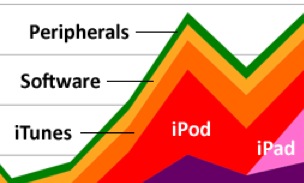
    This graphicapple revenue progress, of Apple’s revenues per quarter, broken down by products, tells several stories at once. One is that the iPhone remains huge. (I was amazed by how many I saw in the UK and France.) Another is that the iPod may be getting a bit stale. But the big one is the sudden size of the iPad business.

    We have one, a 3G model that arrived when we were in Paris in June. It was nice-to-have but something short of its full promise until a friend in Paris got us a 2Gb SIM so the unit became useful outside of our apartment’s wi-fi zone. (Orange, Apple’s carrier partner in France, requires of Americans a French bank account — just one of many vexing problems with 3G outside anybody’s home country. It’s a freaking mess.) With that SIM, the difference became absolute. Now we could look at maps, shop, and read about topics of immediate local interest, live and on the spot, anywhere. (Even in the subways.) The iPad is much faster than the iPhone and much more convenient than a laptop or a netbook. Form-factor wise, it’s a whole new category.

    The question is, can anybody else top it, or even compete with it? Certainly somebody should. Here’s what I’d recommend.

    First, a second unit with a smaller form-factor: about half or two thirds the size of the iPad. There’s a need for something that’s bigger than a phone but smaller than the current iPad, which is a bit too large for most purses.

    Second, freedom from anybody’s silo. Apple has done it’s vertical thing here. Now it’s time for the horizontal one. In product categories, the horizons are always wider than the skies are high.

    Third, featuring the 3G or 4G model, rather than regarding it as a premium exception. This also means working energetically to expose and break down the national boundaries to mobile carrier data plans. We desperately need the phone system to become a data system that also does telephony, rather than the reverse. (More about those in another post.)

    Fourth, better speaker(s). The iPad actually sounds quite good, for a speaker that talks out of the same flat hole that’s plugged by the power connector (just like the iPhone).

    Fifth, two microphones, for binaural recording. This is hugely under-rated as a feature, and generally ignored by portable gear makers. With binaural recording, you get a you-are-there sound field when listening to the recording with headphones. Related idea: two cameras, for shooting in 3D. The latter would also be a cool peripheral.

    Sixth, make the ‘pad a production and not just a consumption device. Shooting and/or editing video, and uploading it to a server on the spot, would be a way cool use for the thing.

    Of course, consumer electronics makers are notorious copy-cats. But what they need to do is zig here where Apple zags. There’s infinite room.

  • The Wikileaks Story

    … is about Wikileaks. Not the war. But not oddly.

    All stories have three elements:

    1) A character. A protagonist. The main human subject. Sometimes it’s a cause, but it requires personification. In sports it’s a player or a team. In war it’s a side. In novels it’s a character or a cast of them. I npolitics it’s a party or some other Us. (And there is always a Them. Opponents define characters.)

    2) A problem. That is, a situation that cannot be easily resolved. Something that keeps us tuned in, or turning the pages.

    3) Movement toward resolution. Even if the situation gets worse, you have some reason to maintain interest. If your team is up 20 points and there’s less than a minute left, the story is over. If the main character dies, or disappears, we tune out. If the whole situation if FUBAR beyond understanding, we also tune out.

    So, in no time at all, Wikileaks’ 91,000+ documents, which apparently (so far) contain no story-making news other than the leaks themselves, has become a story about Wikileaks. Thus we have Air Leaks from Wikileaks Balloon, in the Washington Post.

    The character is Julian Assange, who is, if nothing else, a very odd and therefore interesting dude. As Michael Wolff asks in the next link, “Who plays Julian Assange in the movie?”

    The problem is Dealing with Wikileaks itself. This is a problem for big-J Journalism, which loves to talk about itself. (Hey, it’s a character too.)

    There is no obvious resolution, which is why the air leaks out of the balloon. Wikileaks is what it is: a source. Nothing happening here, move along.

    Meanwhile the war remains no less FUBAR than it was before the leaks sprung. Just like health care. Just like the financial meltdown. They’re all what Bill Safire used to call MEGOs. The letters stood for “My Eyes Glaze Over.” These were, he said (something like), “Subjects too important not to cover but too complex or dull to care about.”

    But there will be movies. Count on it.

  • Bring back the old Google Image search

    I hate the new Google Image search. I used the old one constantly and A picture named 93px-Lesser_Ury_Lese#7700BF.jpg understood it well, because there wasn’t much to understand. You clicked on an image, and it went to a page with two frames. The one above gave a route to the original image, and the one below was the whole page the image was on. The new one is a montage of larger images. You get a preview with some links if you mouse over one, and if you click on it you get to another Google page on which a blurry version of the image is superimposed — in the manner of an unwanted opt-out ad — over the page with the image on it. You can get to the image directly, or the page’s own URL, by clicking on links in a frame column on the right. (This is the frame that used to be on the top.)

    There are also more options on the search results page. That’s cool. But the thing with the preview is just ugly to me. And it reminds me so much of unwanted ads that I wonder how far the advertising-über-alles mentality of the commercial Web has infected Google itself, in spite of the Chinese Wall it likes to keep between advertising and the stuff it runs on.

    My advice: keep the new layout on the results page, but go back to the old design on links from each result.

    Meanwhile, I’m getting to like Bing’s better and better.

  • Nice production on consumption

    At Consumer Choice, Judi Clark has a nice interview with Jerry Michalski, Tara Hunt and myself. I learned a lot. Highly recommended.

  • Maybe this one will actually work

    It was Spring of 1969, my last year at Guilford College, in North Carolina. My freind Gene Massey (later of the great Gene’s Books in King of Prussia, PA) and I went into a curb market nearby to get some beer. There we ran into Wayne, a huge former football player at the school, who apparently hung out there, and was drunk. As we walked up to the counter, Wayne approached both of us in a daze, said “Two hippies!” and planted one punch each, a right and a left, into our middles. We were more shocked than hurt. “Wayne,” I said. “Back off, man. We’re just a couple guys from Guilford!” Wayne blinked, squinted and seemed to wake up. “Aw shit! I didn’t know ya’ll boys were from Guilford! Damn. I’m sorry. I thought ya’ll was a couple of hippies.”

    In fact Wayne was right. The label applied. Gene’s hair was long to his shoulders. Mine hadn’t seen a scissors in many months and was bushed out. But we were hippies in far more than looks alone. We really thought we were in the midst of a revolution.

    Are we again? I hope so, which is why I shouldn’t be surprised to see a post called Hippie 2.0 that seems to be right up, or down, my current alleys.

  • Quote du Jour

    On the phone with Britt Blaser, who just said, Politics is so complicated that only zealots get involved. Of course, he’s been working on fixing that. I think this here can help.

  • Good 2B Back

    The weather here in Cambrige is perfect.

    This is also a test to see if the post goes up.

    Here’s another line, to see if it shows up on a log.

    Does. Cool.

  • Fuel for denial

    Got together with four members of my kid’s 8th grade basketball team and their coach (another dad, much younger and better than me) this afternoon for a shoot-around. I was too wasted to play in the real game (I did sub briefly, and scored one lay-up), but we finished up with a game of P-I-G (a shorter version of H-O-R-S-E), which I joined, since I didn’t think it would take much effort. Amazingly, I won. Not sure why I was hitting a high percentage of shots. Some of the old touch came back, I guess. Felt good.

  • New post

    Back in the outlining saddle again. Liking it.