• How should we pronounce 2011?

    Is it “twenty eleven” or “two thousand eleven”?

    I’m hearing more of the former, I think. By that I mean “twenty eleven” is more commonly used than was “twenty ten,” an the “thousand” thing is wearing off.

    Sooner or later it will have to. I doubt we’ll be saying “two thousand thirty two” when 2032 rolls around. “Thousand” persisted through the ’00s (the “aughts”), but is getting a bit stale now that we’ve turned the caledar up to eleven.

    I haven’t bothered to check, but is one more correct than the other? Does the AP have a position on this, for example? Just wondering.

  • News at the speed of death

    Five minutes ago the AP pushed a report onto my phone that Rep. Gabrielle Giffords had been shot. So I went to the AP’s news site. Nothing there. Then to Google News. Nothing yet. Then to Twitter, where it was the second-top story. The top item there was this one, from @KRNV, passing along an NPR report that Ms. Giffords had died.

    Her Wikipedia entry already includes the date of her passing: today. Here’s that edit.

    She was doing a “Congress on your corner” at a grocery store. Her last tweet (from @rep_giffords) was an invitation to the event. (Or so I read. It doesn’t come up right now.)

    Her husband, Mark. E. Kelly, is a Desert Storm veteran who has survived trips to space as an astronaut, and is slated to command the upcoming final Space Shuttle flight. Turns out being a congressperson doing her job in a public marketplace proved more hazardous.

    They have two kids, who now join their dad in a living hell.

    Of course the comments under news postings are full of assumptions. Nothing yet about the other victims, that I can find. Correction: between the last refresh and this one, NPR now says six have died.

    Arizona Public Media’s KUAZ has regular programming.

    The TV station sourced most on Twitter has the unlikely name KGUN. It still hasn’t reported on its website that anybody was killed.

    I’m listening now to KQTH/104-1The Truth, where the callers and the host are making sure not to blame right wing talk radio, and the second amendment. (Guns don’t kill people, wackos kill people, is the spin.) One caller just said that Rep. Giffords is still alive and in surgery.

    The other local news station, Fox-affiliated KNST/790, is playing a TV station’s audio. They are saying a Fox source says she is still alive and in critical condition. They note that she is a Jewish gun-owning wife of an astronaut. They also just say that Gawker reports that the shooter was young and male, and said nothing while shooting or being held down. And four are dead, including one child, and one aide. Puma County Sherriff’s department will have a news conference at 1:30 local time in Tuscon. (Moved to 2pm later.)

    KQTH has call-ins. The current caller knows one of the people who was shot, but not killed. He didn’t like Giffords’ politics, “but…” Others are calling for the perpetrator “getting what he deserves.” The host is quick, correctly, to put down callers who speculate on motivation. “I’m not going down this path of tyrannical governments and arming citizens…” The host is actually doing a good job. The caller now is a woman who knows Rep. Giffords, and has nice things to say about her. She’s also saying the perp must be mentally ill.

    Are there no non-right wing and/or Fox affiliated news/talk stations in Arizona? Just asking.

    Listening to the press conference live now. (2:06pm Tucson time) As I get it… one dead: a nine-year old girl. Rep. Giffords was shot through the head (“through the brain” and “through and through” with “one bullet”), but was responding to commands before she went into surgery. She is out of surgery now and in the ICU.

    An AP report on my phone says a federal judge was fatally shot in the attack.

    KQTH’s host Jon Justice (the station morning guy came in to handle the shift after the shooting) said that the Sherriff of Pima County blamed right-wing talk radio, and called that irresponsible. Justice (the host, not the noun) is right about that.

    The alleged perp, according to KNST, is Jared Loughner, who has a YouTube channel and a MySpace page, which has just been taken down. His final words were “Goodbye friends.” A Twitpic: http://twitpic.com/3o8ajp

    Business Insider on Loughner. Has one of his videos, which makes no sense. Something about “accurate information of a new currency.” Says he, “In conclusion, my ambition – is for informing literate dreamers about a new currency; in a few days, you know I’m conscience dreaming! Thank you!” Oh-kay.

    KNST says two are dead: the judge and the child. KQTH says just one is dead. They’re at the “Where were you and what were you doing when it happened” stage.

    The one obvious media gaffe, at least from where I sit, so far, is NPR’s report that Rep. Giffords was dead. I don’t blame that on their politics (which some are). AP might be wrong about the judge, too, if he’s alive.

    The judge is John McCarthy Roll. He was nominated by George Bush on the recommendation of John McCain, for what that’s worth. A bio.

    KQHT’s news department says the suspect for sure is Jared Loughner, 22 years old. He’s the guy in custody. The station reports that Loughner was tackled and held down by citizens, until police arrived.

    A blah, somewhat religious statement from John McCain.

    KNST (@790knst) is saying the judge is indeed dead. Editing of his Wikipedia page is currently halted for new and unregistered users. Many updates today.

    Andrew Sullivan and his readers, live-blogging.

    Now President Obama is speaking. “At least five people lost their lives.” Among them Judge Roll and a girl “barely nine years old.” Gabby Giffords is a friend of the President’s. “a tragedy for Arizona and for the country.”

    That’s it. Brief. KQHT: “We got some information from the President… that contradicts the information we got about 20 minutes ago from UMC.” (That’s the University Medical Center.)

    MSNBC video from the archives: Gabrielle Giffords says “Sarah Palin has the crosshairs of a gun sight over our district and when people do that, they’ve gotta realize there are consequences to that action.” And yet so far it doesn’t look like the perp was a tool of the Mama Griz. Interesting: Judge Roll had death threats, two years ago, almost certainly unrelated as well.

    I gotta get back to work. Been following this while walking around, exercising indoors between sit-down writing sessions.

    Parting thought… Interesting that I can’t name a canonical single-source on this thing, except maybe the local radio stations. I can only find tweets for one of those, and they’re kinda low-volume. I believe this is a good thing. The old media still matter, and the new media do too — and both are provisional. Neither will be the same six months or a year from now.

    [Later…] In the evening, working in the kitchen, I listened to CNN over Sirius satellite radio. The audio stream was basically the TV one. I’d say the work was excellent. They had an extensive interview with a doctor who barely missed getting shot, helped subdue the gunman, and did his best to treat the wounded. One of the things the doctor said stuck with me. If you don’t feel the pulse of a gunshot victim, the chance of reviving that victim is small, especially if emergency medical help and equipment don’t come quickly — which was the case here.

    [Later still, Sunday evening…] Late in the early stages of what will be a long and crazy game, I like what Dan Gillmor says about #slownews. Still, in the meantime, items:

    • The 9-year old girl killed in the assault was Christina Taylor Green. She was born on 9/11/2001 (yes, that 9/11), and was what they called then “faces of hope” baby. (Firedog Lake) Her grandpa was former Mets and Yankees manager Dallas Green. (NY Daily News)
    • Ages of the dead victims are 9, 30, 63, 76, 76 and 79. (myFoxPhoenix, NY Times)
    • In a tweet on 4 November, @SarahPalinUSA wrote, “Remember months ago ‘bullseye’ icon used 2 target the 20 Obamacare-lovin’ incumbent seats? We won 18 out of 20 (90% success rate;T’aint bad). And one of the other two was just shot in the head.
    • An ad for Jesse Kelly, Gabrielle Giffords’ opponent in the most recent congressional race, once ran an ad that read, “Help remove Gabrielle Giffords from office. Shoot a fully a automatic M16 with Jesse Kelly.” (Daily Beast)
    • Keith Olberman, whom I usually consider an insufferable gasbag, says agreeable stuff (at least to me) in his latest rant. In it he owns his own overboard remarks of the past.

    I’d like to think this will change things, but I doubt that’s the best way to bet. Still, as Dan counsels, it’s best to wait and see.

  • A good man is hard to lose

    Here’s a post I put up in 2003:

    A pain in the friend

    Gil Templeton
    Gil Templeton, author of The Pain Cronicles and much art and fun

    I haven’t seen my old friend Gil Templeton since his brother David’s wedding, whenever that was. Ten years ago? Twelve? Both Gil and David worked for me—Gil as a copywriter in North Carolina and David as a PR account executive in California. Both guys were as different as two primary colors, with two significant exceptions:

    1. Both were scholarship athletes. Tennis. Gil at UNC and David at Vanderbilt.
    2. Both were very funny guys. I remember how Gil (who went on to write piles of sketch comedy … and act in some too) and I co-wrote a country music song, or part of one, anyway, when we should have been working late one night. Most of it was Gil’s. All I remember is the refrain:

    I’m too old to fuck
    and too young to die
    but not too drunk to eat
    So bring my baby some likker
    and burn me up some meat

    David used to crack everybody up with a perfect imitation of… (gulp) me. Before then I never had any idea that I was imitable, or that I had a walk others called a “waddle.”

    The Templeton Brothers were terrific company. I loved them both. Still do. However, as too often happens, geography gets in the way, and life goes on with less and less contact, until…

    A few minutes ago I got a email from David, who’s now in Connecticut, pointing to a cover story by Gil in the Nashville Scene, the arts weekly in the Music City, where Gil moved after he left North Carolina in the early 80s. It’s The Pain Chronicles: One man’s life-changing, body-aching, drug-addictive struggles with a devastating injury — a shorter version of Gil’s forthcoming book by the same title, from Coldtreepress. It’s a harrowing tale, and told, as always, with sharp humor.

    I had no idea. Seeing the picture above brought tears to my eyes. There’s My Man, with a cane. Same glasses. Same hair. Same strong chin. Same wise-ass smile. I had forgotten how much I miss him.

    We’re so lucky, most of us. Life is a death sentence, but most of our time on death row is a cakewalk. The journey is the reward, right? Except for those of us whose ships are caught on the rocks.

    Right now I’m feeling lucky to have these two good brothers as friends. Even after all these years apart.

    Last night I got an email from David reporting that Gil died in his sleep that morning. He was just 53.

    One of Gil’s favorite comedy bits was from the National Lampoon’s Lemmings show, in which a stoner musician mumbles a tribute to “the late Neil Young,” who once played with “Crosby Ogden Nash,” and was “a credit to both rock and roll.” There was another line in there, where the stoner says, “We used to eat beans and hitch to gigs…” So, every time Gil would see me, or call me on the phone, he’d yell “BEANS!” just to recall the bit. So, eventually, “Beans” became what we’d call each other.

    In creative sessions at our agency, we used to spend hours in the “Think Tank” coming up with ideas. None of those ideas today is as memorable as what Gil once said to sum up a long filibuster by another guy in Creative: “So what you’re saying is, ‘The client sucks and the product cannot be sold.’” It cracked everybody up, and the ideas began flowing like a river.

    I guess you had to be there. I’m glad I was.

    Bonus links:

    [Later…] Here’s Gil’s obituary.

  • Net Neutrality, conversation and art in Santa Barbara

    In a more perfect world, where my many passions and obligations would be jobbed out to team of scattered clones, one of me would be in Santa Barbara, at the Super Santa Barbara exhibition on Net Neutrality at 653 Paseo Nuevo where a reception will take place 6:30pm-9pm on Thursday (that’s today) January 6th.

    In my stead will be friends, most notably Joe Andrieu — who will give a talk on Net Neutrality with a Q&A — and Warren Schultheis of City2.0, who organized the event and the exhibition, which will run Jan 7th – Jan 23rd. Tues-Sun 12pm -5pm.

    In their page on Net Neutrality, there’s a link to this piece I wrote for Linux Journal in 2006. It holds up pretty well, actually.

    Again, wish I could be there. But if you are, please come by. There are many arguments to be had on the topic — art to appreciate as well (such as the Julia Ford item above). But the fact that matters most for Santa Barbara is that the city is still under-served by its sources of Internet connectivity. That alone should give everybody plenty to talk about.

    Bonus link.

  • Stuck without Gerry Rafferty

    Just learned that Gerry Rafferty has died. Chronic alcoholism, apparently. I liked his music. Good lyrics, catchy tunes.. He was big in progressive/album radio when I worked and hung out there. I suppose he’s best known for the Raphael Ravenscroft solo saxaphone choruses in the song “Baker Street” (for which Ravenscroft was paid £27 with a check that bounced*); but what always stood out for me, at least with Rafferty’s hits, was his use of the second person voice. “Stuck in the middle with you“, “Star” and “Baker Street” were all complaints addressed to somebody with whom Rafferty had a problem. I suppose those people have outlived him. He was only 63: same age as me.

    *Bonus link.

  • Make Your Own Zombies

    Tim Hwang, (aka Broseph Stalin, aka ) father of , mother of (in which I hold a chair, mostly for other people), commissioner of , god of (aka ), former researcher and partner in the firm of (latest case: ), in the cause of Researching Quantized Social Interaction, brings us the first-ever competitive event in the large scale robotic influence of online social groups. .

    Specifically,

    Teams will program bots to control user accounts on Twitter in a brutal, two-week, all-out, no-holds-barred battle to influence an unsuspecting cluster of 500 online users to do their bidding. Points will be given for connections created by the bots and the social behaviors they are able to elicit among the targets. All code to be made open-source under the MIT license.

    It’s blood sport for internet social science/network analysis nerds. Winner to be rewarded $500, unending fame and glory, and THE SOCIALBOTS CUP.

    Let the gaming begin.

    Bonus link.

  • Geography forever

    When I was walking to school in the second grade, I found myself behind a group of older kids, arguing about what subjects they hated most. The consensus was geography. At the time I didn’t know what geography was, but I became determined to find out. When I did, two things happened. First, I realized that I loved geography (and along with it, geology). Second, I learned that popularity of anything often meant nothing. And I’ve been passionate about geography ever since.

    But not just for myself. Instead I’m interested in feeding scholarship wihin subjects that interest me. For both geography and geology I do that mostly through photography. Toward that end, here are a few recent sets I’ve posted, or updated:

    Meanwhile, close to 200 of my shots are now in Wikimedia Commons. Big thanks to the Wikipedians who have put them there. I can’t begin to count how many Wikipedia articles many of these illustrate. currently accompanies eighteen different articles in fourteen different languages.

    While we’re on the subject of , I’ll commend to you the new book Good Faith Collaboration by , a fellow at this year. His first chapter is online.

    You may notice that most of my links to subjects, both in my online writings and in my photo captions, go to Wikipedia entries. Sometimes people ask me why. One reason is that Wikipedia is the closest we have come, so far, to a source that is both canonical and durable, even if each entry changes constantly, and some are subject to extreme disagreement. Wikipedia is, like the , a set of . Another reason is that Wikipedia is guided by the ideal of a neutral point of view (NPOV). This, Joseph says, “ensures that we can join the scattered pieces of what we think we know and good faith facilitates the actual practice of fitting them together.”

    The nature of the Net is to encourage scatterings such as mine, as well as good faith about what might be done with them.

  • A toast to common genius

    Although I appreciate being called “smart” (as Hugh MacCleod kindly does here), that adjective has always troubled me, no matter what, or to whom, it’s applied. Two reasons: 1) because I believe smartness is a far more common quality than our bell-curving institutions would have us believe;  and 2) because the label too often serves as a filter for skepticism.

    Rather than make a long post about the topic, however, I’ve decided instead to quote a long post from a list I subscribe to. It’s in response to another post citing this Boston Globe piece on on “group IQ”:

    It’s a good piece. I wonder if they also studied the collective intelligence of open source development communities, all of which by necessity require intelligent work by everybody involved.

    That curiosity aside, my only problem with the piece is the same one I have with all stories of this kind, which is failing to challenge the belief that  individual intelligence — a quality even more kaleidoscopic than one’s own DNA chain — can be measured and expressed mathematically, as a “quotient.”

    IQ testing — and the belief that each of us possesses a fixed quality called “IQ” — is a relic of eugenics: the long-discredited ideal of assisting human evolution through selective breeding. IQ testing was invented by Lewis Terman, a famous proponent of eugenics, early in the last century <http://en.wikipedia.org/wiki/Lewis_Terman>, and persists in spite of abundant sources of discredit to its base assumptions.

    Let me tell you about somebody. His IQ score in kindergarten was high enough to put him in the “fast” group, where he remained until the 6th grade, at which point he so hated school that he barely participated. His IQ score had also declined over that same stretch — so far, in fact, that his teacher wanted to kick him out of the class for being too dumb, and insisted that the kid be re-tested. The kid did well enough on the test to stay in class, but tanked on all standardized tests, year after year… to the point where, at the end of the 9th grade, the school put him on a track toward a “vocational” high school to learn a “manual” skill or two.

    The kid’s parents believed the kid was actually smart, however, and enrolled him in what might be called a “correctional” high school. Here the kid continued to do poorly, earning a diploma by the slimmest of margins. His SAT scores at best matched the national mean. So the family found a good-enough college in the South that was willing to take him. There he also got awful grades, advancing to his sophomore and junior years by earning the lowest possible grade point average, to a 1/100th of a point, each time.

    Through all that schooling, only one teacher believed in the kid. That was his 11th grade English teacher, who said the kid had writing ability, and once read one of the kid’s humorous pieces aloud to the class. From that point forward the kid became more and more of a writer, so that when he moved to a major in philosophy, as a junior in college, he could finally put his original writing and thinking to work.

    Not that his grades were great after that. He hit the dean’s list one semester, but that was it. He got out in four years and went on to many kinds of work after that, all involving writing, plus three other qualities his friends in school valued, even if the schools  themselves did not: insight, a skepticism toward prevailing beliefs, a a sense of humor. Those are what earned him a living for the next forty-plus years, by the end of which he had also earned fellowships with a couple of brand-name universities.

    So let’s go back to the IQ part of this story. This kid’s mother happened to be a teacher in the same grade school system, and knew all his scores, including IQ tests. Turns out the kid’s known IQ scores had an eighty point range. They measured nothing other than success at solving a series of puzzles on a given day.

    In case you hadn’t guessed by now, that kid was me. One of the things I learned back in those years of hating school (though still learning plenty) was that every human being is different, and that this difference is the most human of natures. I also learned that genius is common, and that all of us bring unique and valuable qualities to our collective tables.

    It is these differences that matter most for groups as well as for individuals. And these differences, at their best, are beyond measure.

    Doc

    While we’re on the subject, a bonus link.

    And Happy New Year. (Maybe I’ll run into one of ya’ll at FirstNight in Boston, where I’m headed right now.)

  • Solved Science Theater 2010

    This morning, while freezing my way down 8th Avenue to Piccolo on 40th to pick up a couple of cappuccinos, I paused outside the to admire its stark modern lobby as delivered the latest storm news from Los Angeles through my phone’s earbuds. In the midst of reports of fallen rocks, traffic accidents and fears of mudslides, KNX said an actor had been seriously injured during last night’s latest preview performance of Spider-Man, on Broadway, three short blocks from my very ass.

    This wasn’t the show’s first injury. In fact, the show had already earned “Troubled” as its adjectival first name.

    So, after I got back to our hotel room, we brought up the Times’ website on our iPad (the paper’s own application crashes) and read Actor Injured in Fall During ‘Spider-Man’ Performance, by reporters Dave Itzkoff and Hamilton Boardman. Also contributing to the story were —

    • actress Natalie Mendoza, “who plays the spider-goddess Arachne” and “wrote on her Twitter feed: ‘Please pray with me for my friend Chris, my superhero who quietly inspires me everyday with his spirit. A light in my heart went dim tonight.’” The story adds, “She appeared to be referring to her fellow cast member Christopher Tierney, who is an aerialist and ensemble member in the musical. Bellevue Hospital Center confirmed that on Monday night it had received a patient by that name.”
    • Steven Tartick, an audience member. “‘You heard screams,’ Mr. Tartick said. ‘You heard a woman screaming and sobbing.’
    • An unnamed “New York Times reader” who shot a video of the accident, which ran along with the story. (That’s my own screenshot on the right.)
    • Audience members Scott Smith and Matthew Smith
    • Brian Lynch, an audience member who “described the scene at the Foxwoods Theater on his Twitter feed, writing: ‘Stopped short near end. Someone took nasty fall. Screaming. 911 called. No idea what happened, kicked audience out.’ He added: ‘No joke. No explanation. MJ and Spidey took what seemed to be a planned fall into the stage pit. Then we heard MJ screaming.’”
    • Eyewitness Christine Bord, who “described events outside the theater in a blog post on her Web site, onlocationvacations.com, and “In a telephone interview,” said “two ambulances and a fire truck were already waiting outside the theater when most audience members exited. The actor was quickly brought out on a stretcher, wrapped in protective gear and wearing a neck brace. He acknowledged the crowd which clapped for him before an ambulance took him away.”
    • A New York Times reader who supplied a photo “showing a ‘Spider-Man’ actor being transported to an ambulance outside the Foxwoods Theater.”

    The story concludes,

    The “Spider-Man” musical has faced several setbacks during its preview period, with one of its actresses suffering a concussion and two actors who were injured by a sling-shot technique meant to propel them across the stage. On Friday it was announced that “Spider-Man” was delaying its official opening by four weeks to Feb. 7 so that creative changes could be made to the show.

    A press representative for “Spider-Man” said in an email message: “An actor sustained an injury at tonight’s performance of ‘Spider-Man: Turn Off the Dark.’ He fell several feet from a platform approximately seven minutes before the end of the performance, and the show was stopped. All signs were good as he was taken to the hospital for observation. We will have more news shortly.”

    The comments are a snarky icing on the story’s cake, some calling to mind the late and very great Mystery Science Theory 3000:

    “Will a vending machine be selling insurance if the audience cares to purchase any?””There is a reason why this stuff is done with CGI.”

    “Didn’t I just read this story?”

    “Not so amazing now, are you, Spidey?”

    “Dude, this show is getting better all the time! I gotta get me a ticket before it gets shut down.”

    “Whoever gave the video to the Times should be commended. That is one brutal fall. If the actor’s neck isn’t broken he’s lucky. We all understand that in today’s world the investments of a group of millionaires in a Broadway show are more important than actors lives but it’s time for the grownups to step in and shut this nonsense down. Look, of course it is sad when someone is injured, but this is the price you have to pay if you want to create great theater. Everyone knows that great theater is about launching people across stages using slingshots. It is what Ibsen did, it is what Shakespeare did, it is what made Sondheim famous. To all the haters posting here, how do you expect to be enlightened at the theater if you can’t see shows that launch actors into the air using slingshots? Mark my words, in one hundred years High School’s will require their students to read Hamlet and to construct slingshots with which to launch each other. That obviously justifies these injuries.”

    We live in liminal times, on the blurred boundary between What Was and What Will Be. The formalities of Reporting as Usual, which the Times has epitomized for more than a century, are What Was. What Will Be is Version 2.o of The Press, which will mash up stories (among other news provisioning units) from many sources, which will be credited, linked, and kept current in as close to Real Time as humanly and technically possible.

    On Rebooting the News yesterday, @Jay Rosen revisited his excellent distinction between The Press and The Media. Here’s my compression of it: The Press is where we get capital-J Journalism at its best—that is, through goods that truly inform us. The Media is an advertising business.

    Nice to see the former keeping up with the Times. And vice versa.

    And I do hope that Chris Tierney and the show both recover.

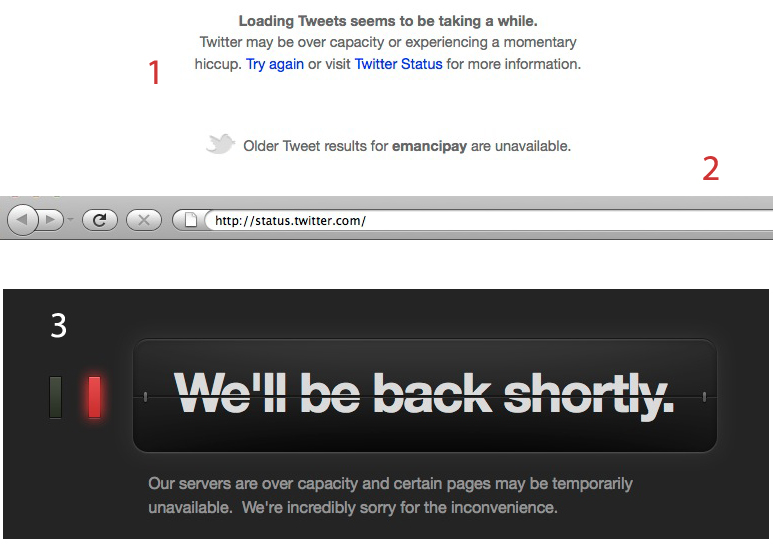
  • The Internet doesn’t do this

    The above, in order (1,2,3) is what I went through this morning when I searched for “emancipay” on Twitter.

    Not knocking Twitter here. I am knocking the fact that we haven’t come up with the open Internet-based (rather than silo-based) way of microblogging.

    Yet.

    But that’s what I’m hanging out in New York talking to folks about today. That’s a tease. Stay tuned.

    [Later…] Okay, tease over. I was on Rebooting the News. I’d say and link more, but the connectivity situation here at the hotel is sub-minimal. Maybe tomorrow.

  • How about a Mensch Index?

    From (as of the 8 December 2010 edit):

    Mensch (: מענטש mentsh; German: Mensch, for “human being”) means “a person of integrity and honor”.[1] The opposite of a mensch is an unmensch (meaning: an utterly cruel or evil person). According to , the Yiddish maven and author of , mensch is “someone to admire and emulate, someone of noble character. The key to being ‘a real mensch’ is nothing less than character, rectitude, dignity, a sense of what is right, responsible, decorous.”[2]

    I bring this up because responses to my post yesterday by the two people who had the most cause to be defensive about it — (@Azeem, @peerindex) of PeerIndex and (@Petervan) of Petervan’s Blog — were quite menschy. In addition to tweets here, here and here, correspondence followed (including this comment here), in which it was clear to me (and them, I’m sure) that we’re all just learning here, and putting those learnings to work on a new world that is still new and ripe with opportunities that we make rather than take. I mean, they could have been defensive. Instead they responded more than graciously: namely, constructively.

    Which brings me to my three favorite takes on construction. One is Stuart Brand’s How Buildings Learn, which belongs in civilization’s canon. Its core point is that a useful building is both adaptive and never finished. (Like human nature at its best. And technology too, as Kevin Kelly makes clear in another book for the canon: What Technology Wants.) Another is Dave Winer’s “developers and users, diggin’ together” and “Ask not what the Web can do for you, ask what you can do for the Web.” The third is Craig Burton’s model of the whole Net as a world we are only beginning to .

    Azeem and Peter are both constructive guys. They’re also open-minded and ready to dig with users. It’s probably not possible to assign a rank to that, any more than it’s possible to assign a rank to gratitude. But we do need to be conscious of what’s constructive and what’s not.

    I remember long ago telling one of my kids, after they did something bad, “We always have two choices in life: we can hurt, or we can help.” Soon as that line came out of my face, the unconscious one that followed was, “He teaches best what he most needs to learn.” In the last 24 hours I got schooled again by Azeem and Peter. And I look forward to diggin’ with them both.

  • Curing High School

    So I’m in the midst of my first encounter with PeerIndex, which I found through this Petervan’s Blog post. I’d been pointed to PeerIndex before, and to other services like it, and have always found them aversive. But this time the lead came from a friend and business associate, so I thought I’d check it out.

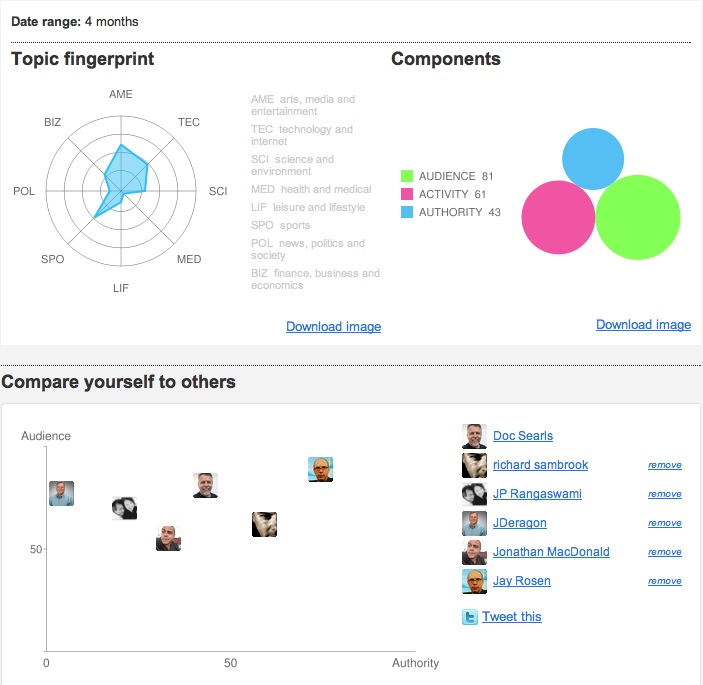
    While it’s kinda creepy using Facebook Connect and other means of dumping one’s online life into a service one does not yet understand, much less trust, I don’t have any secrets at any of those data sources, so I gave it a try. Here’s the result, in graphical form:

    peerindex

    Here’s how Peter explains this:

    Peerindex helps you understand and benefit from your social and reputation capital online. How much is your online reputation worth ? PeerIndex is a web technology company that is algorithmically mapping out the social web.

    The way we see it, the social web now allows everyone endless possibilities in discovering new information on people, places, and subjects. We believe that the traditional established authorities and experts – journalists, academics, are now joined by a range of interested and capable amateurs and professionals. As this locus of authority shifts, many new authorities emerge. PeerIndex wants to become the standard that identifies, ranks, and scores these authorities — and help them benefit from the social capital they have built up

    Btw, my Peerindex is 60. That’s based on my digital footprint on Twitter, Facebook, LinkedIn, and my blogging activities. It is obvious to see that this number “60” may one day translate into some virtual social currency.

    Friends, this is high school with a business model.

    While our value in the marketplace depends on our reputations, we are not reducible to “captial,” “assets,” “currency” or any other measure.

    What I write on this blog, what I tweet, what I share through LinkedIn and Facebook, is not for an “audience.” I have readers here. That’s who I write for. While my services, whatever they are, have value in the marketplace, and I get paid for some of them, that’s not why I write what I write—here, in Twitter or anywhere other than in private correspondence that concerns actual business.

    Somewhere back in the early days, this blog plateau’d at about 20,000 regular readers. It’s still there, I’m sure, though I haven’t checked in years. On Twitter I’ve got about 12,000 followers, who I suspect are a subset of my blog readers. That’s fine with me. I’m not looking for more. And I don’t care if I have less. I write stuff that I think is worth sharing, mostly on the old Quaker maxim of not speaking unless you can improve on the silence. Shouting louder isn’t my style. Joking around is. Saying too much or too little is. Being myself is.

    Somewhere in the oeuvre of Kurt Vonnegut is a line I can’t find on the Web, but remember going like this: “High school is the core American experience.”  [Later… Mike Warot found the original. Very cool.] I think this is true. And I think that’s what this kind of stuff, as otherwise well-intended as it may be, appeals to.

    In his first World Entertainment War album, Rob Breszny pauses in the midst of a wacky narrative to offer a multiple choice question for which the correct answer is this: “Burn down the dream house where your childhood keeps repeating itself.”

    Wishing for popularity and approval is a mark of adolescence, a term invented to describe a normative high school condition—specifically, one in which childhood is prolonged. The best cure I know is chug down some Whitman. Here’s a sample:

    In all people I see myself, none more
    and not one a barleycorn less,
    And the good or bad I say of myself I say of them.

    I know I am solid and sound.
    To me the converging objects of the universe
    perpetually flow.
    All are written to me,
    and I must get what the writing means.
    I know I am deathless.
    I know this orbit of mine cannot be swept
    by a carpenter’s compass,

    I know that I am august,
    I do not trouble my spirit to vindicate itself
    or be understood.
    I see that the elementary laws never apologize.

    I exist as I am, that is enough.
    If no other in the world be aware I sit content.
    And if each and all be aware I sit content.

    One world is aware, and by far the largest to me,
    and that is myself.
    And whether I come to my own today
    or in ten thousand or ten million years,
    I cheerfully take it now,
    or with equal cheerfulness I can wait.

    My foothold is tenoned and mortised in granite.
    I laugh at what you call dissolution,
    And I know the amplitude of time.

    I am a poet of the body,
    And I am a poet of the soul.

    I am the poet of the woman the same as the man.
    And I say it is as great to be a woman as to be a man,
    And I say there is nothing greater than the mother of men.

    I chant a new chant of dilation and pride.
    We have had ducking and deprecating about enough.
    I show that size is only development.

    Have you outstript the rest? Are you the President?
    It is a trifle.
    They will more than arrive there every one,
    and still pass on.

    I am he that walks with the tender and growing night.
    I call to the earth and sea half-held by the night.

    Smile O voluptuous coolbreathed earth!
    Earth of the slumbering and liquid trees!
    Earth of the departed sunset!
    Earth of the mountains misty topt!
    Earth of the vitreous pour of the full moon
    just tinged with blue!
    Smile, for you lover comes!

    Prodigal! you have given me love!
    Therefor I give you love!
    O unspeakable passionate love!
    Thurster holding me tight that I hold tight!

    We hurt each other
    as the bridegroom and the bride hurt each other

    You sea! I resign myself to you also…
    I guess what you mean.
    I behold from the beach your crooked inviting fingers.
    I believe you refuse to go back without feeling of me.
    We must have a turn together.
    I undress. Hurry me out of sight of the land.
    Cushion me soft. Rock me in billowy drowse.
    Dash me with amorous wet. I can repay you!
    Howler and scooper of storms!
    Capricious and dainty sea!
    I am integral with you.
    I too am of one phase and all phases.

    I am the poet of common sense
    and of the demonstrable and of immortality.
    And am not the poet of goodness only.

    What blurt is it about virtue and about vice?
    Evil propels me, and reform of evil propels me.
    I stand indifferent.
    My gait is no faultfinder’s or rejecter’s gait.
    I moisten the roots of all that has grown.

    Did you fear some scrofula out
    of the unflagging pregnancy?
    Did you guess the celestial laws are yet
    to be worked over and rectified?

    I step up to say what we do is right,
    and what we affirm is right,
    and some is only the ore of right.
    Soft doctrine a steady help as stable doctrine.
    Thoughts and deeds of the present
    our rouse and early start.

    This minute that comes to me over the past decillions.
    There is no better than it and now.

    Walt Whitman, an American, one of the roughs,
    a cosmos.
    Disorderly fleshy and sensual…
    eating, drinking and breeding.
    No sentimentalist… no stander above men and women
    or apart from them… no more modest than immodest.

    Whoever degrades another degrades me.
    And whatever is done or said returns at last to me.
    And whatever I do or say I also return.

    Through me the afflatus surging and surging.
    Through me current and index.

    I speak the password primeval.
    I give the sign of democracy.
    By God, I will accept nothing which all cannot have
    their counterpart on the same terms.

    Through me many long dumb voices,
    Voices of the generations of slaves,
    of prostitutes and deformed persons,
    f the diseased and despairing,
    of thieves and dwarves.
    Of cycles of preparation and accretion,
    And of the threads that connect the stars
    — and of wombs, and of the fatherstuff,
    And of the rights of them the others are down upon,
    Of the trivial and flat and foolish and despised,
    Of the fog in the air and beetles rolling balls of dung.

    Through me forbidden voices,
    Voices of sexes and lusts. Voices veiled,
    and I remove the veil.
    Voices indecent are by me clarified and transfigured.
    I do not press my finger across my mouth.
    I keep as delicate around the bowels
    as around the head and heart.

    Copulation is no more rank to me than death is.

    I believe in the flesh and the appetites.
    Seeing hearing and feeling are miracles,
    and each part and tag of me is a miracle.

    Divine I am inside and out;
    and make holy whatever I touch or am touched from;
    The scent of these armpits is aroma finer than prayer
    This head is more than churches or bibles or creeds.

    If I worship any particular thing it shall be some
    of the spread of my body.
    Shared ledges and rests, firm muscular coulter,
    it shall be you.
    Breast that presses against other breasts, it shall be you.
    Mixed tussled hay of head and beard and brawn
    it shall be you.
    Sun so generous it shall be you,
    Vapors lighting and shading my face it shall be you.
    Winds whose soft-tickling genitals
    rub against me it shall be you.
    Hands I have taken, face I have kissed,
    mortal I have ever touched, it shall be you.

    I dote upon myself. There is that lot of me,
    and all so luscious,
    Each moment and whatever happens thrills me with joy.

    I cannot tell how my ankles bend…
    nor whence the cause of my faintest wish.

    A morning glory at my window
    satisfies me more than the metaphysics of books.

    To behold the daybreak!
    The little light fades the immense and diaphanous shadows.
    The air tastes good to my palate.

    Hefts of the moving world turn on innocent bearings,
    silently rising, freshly exuding,
    Scooting obliquely high and low.

    Something I cannot see puts upward libidinous prongs.
    Seas of bright juice suffuse heaven.

    The earth by the sky staid
    with the daily close of their junction.
    The heaved challenge from the east that moment
    over my head,
    The mocking taunt, See then whether you shall be master!

    Dazzling and tremendous how quick
    the sunrise would kill me
    If I could not now and always send sunrise out of my self.

    We also ascend dazzling and tremendous as the sun.
    We found our own way my soul in
    the calm and cool of the daybreak.

    My voice goes after what my eyes cannot reach.
    With the twirl of my tongue I encompass worlds
    and volumes of worlds.

    Speech is the twin of my vision…
    it is unequal to measure itself.
    It provokes me forever.
    It says sarcastically, Walt, you understand enough —
    why don’t you let it out then?

    Come now, I will not be tantalized.
    You make too much of articulation.

    Encompass worlds but never try to encompass me.
    I crowd your noisiest talk by looking toward you.

    Writing and talk do not prove me.
    I carry the plenum of proof and everything else
    in my face.
    With the hush of my lips I confound the topmost skeptic.

    All truths wait in all things.
    They neither hasten their own delivery nor resist it.
    They do not need the obstetric forceps of the surgeon,
    The insignificant is as big to me as any.
    What is less or more than a touch?

    Logic and sermons never convince.
    The damp of the night drives deeper into my soul.

    Only what proves itself to every man and woman is so.
    Only what nobody denies is so.

    I think I could turn and live awhile with the animals.
    They are so placid and self-contained.
    I stand and look at them sometimes half the day long.
    They do not sweat and whine about their condition.
    They do not lie awake in the dark and weep for their sins.
    Not one is dissatisfied.
    Not one is demented with the mania of owning things.
    Not one kneels to another nor to his kind that lived thousands of years ago.
    Not one is respectable or industrious over all the earth.

    I am a free companion. I bivouac by invading watchfires.

    I turn the bridegroom out of bed and stay with the bride myself,
    And tighten her all night to my thighs and lips.

    My voice is the wife’s voice,
    the screech by the rail of the stairs,
    They fetch my man’s body up dripping and drowned.
    I understand the large hearts of heroes.
    The courage of present and all times.
    I am the man. I suffered. I was there.

    I am the hounded slave. I wince at the bite of the dogs.

    Agonies are one of my changes of garments.

    I do not ask the wounded person how he feels.
    I myself am the wounded person.
    My hurt turns livid upon me as I lean on a cane
    and observe.

    Distant and dead resuscitate.
    They show as the dial or move as the hands of me…
    and I am the clock myself.

    The friendly and flowing savage: who is he?
    Is he waiting for civilization or past it and mastering it?
    Behavior lawless as snowflakes. Words simple as grass.
    Uncombed head and laughter and naivete.
    They descend in new forms from the tips of his fingers.
    They are wafted with the odor of his body and breath.
    They fly out of the glance of his eyes.

    You there, impotent, loose in the knees,
    open your scarfed chops till I blow grit within you.
    Spread your palms and lift the flaps of your pockets.
    I am not to be denied. I compel.
    I have stores plenty and to spare.
    And anything I have I bestow.

    I do not ask who you are. That is not important to me.
    You can do nothing and be nothing
    but what I will infold you.

    I seize the descending ;man.
    I raise him with resistless will.

    O despairer, here is my neck.
    By God, you shall not go down.
    Hang your whole weight upon me.

    I dilate you with tremendous breath. I buoy you up.
    Every room of your youse do I fill with an armed force.

    The weakest and shallowest is deathless with me.
    What I do and say the same waits for them.
    Every thought that flounders in me
    the same flounders in them.

    I know perfectly well my own egotism.
    And I know my omnivorous words,
    and cannot say any less.
    And would fetch you whoever you are flush with myself.

    I do not know what is untried and afterward,
    But I know it is sure and alive and sufficient.

    It is time to explain myself. Let us stand up.

    I am an acme of things accomplished,
    and I an encloser of things to be.
    Rise after rise bow the phantoms behind me.
    Afar down I see the huge first Nothing,
    the vapor from the nostrils of death.
    I know I was even there.
    I waited unseen and always.
    And slept while God carried me
    through the lethargic mist.
    And took my time.

    Long I was hugged close. Long and long.
    Infinite have been the preparations for me.
    Faithful and friendly the arms that have helped me.

    Cycles ferried my cradle, rowing and rowing
    like cheerful boatmen;
    For room to me stars kept aside in their own rings.
    They sent influences to look after what was to hold me.

    Before I was born out of my mother
    generations guided me.
    My embryo has never been torpid.
    Nothing could overlay it.
    For it the nebula cohered to an orb.
    The long slow strata piled to rest it on.
    Vast vegetables gave it substance.
    Monstrous animals transported it in their mouths
    and deposited it with care.

    All forces have been steadily employed
    to complete and delight me.
    Now I stand on this spot with my soul.

    I know that I have the best of time and space.
    And that I was never measured, and never will be measured.

    I tramp a perpetual journey.
    My signs are a rainproof coat, good shoes
    and a staff cut from the wood.

    Each man and woman of you I lead upon a knoll.
    My left hand hooks you about the waist,
    My right hand points to landscapes and continents,
    and a plain public road.

    Not I, nor any one else can travel that road for you.
    You must travel it for yourself.

    It is not far. It is within reach.
    Perhaps you have been on it since you were born
    and did not know.
    Perhaps it is everywhere on water and on land.

    Shoulder your duds, and I will mine,
    and let us hasten forth.

    If you tire, give me both burdens and rest the chuff of your hand on my hip.
    And in due time you shall repay the same service to me.

    Long enough have you dreamed contemptible dreams.
    Now I wash the gum from your eyes.
    You must habit yourself to the dazzle of the light and of every moment of your life.

    Long have you timidly waited,
    holding a plank by the shore.
    Now I will you to be a bold swimmer,
    To jump off in the midst of the sea, and rise again,
    and nod to me and shout,
    and laughingly dash your hair.

    I am the teacher of athletes.
    He that by me spreads a wider breast than my own
    proves the width of my own.
    He most honors my style
    who learns under it to destroy the teacher.

    Do I contradict myself?
    Very well then. I contradict myself.
    I am large. I contain multitudes.

    I concentrate toward them that are nigh.
    I wait on the door-slab.

    Who has done his day’s work
    and will soonest be through with his supper?
    Who wishes to walk with me.

    The spotted hawk swoops by and accuses me.
    He complains of my gab and my loitering.

    I too am not a bit tamed. I too am untranslatable.
    I sound my barbaric yawp over the roofs of the world.

    The last scud of day holds back for me.
    It flings my likeness after the rest and true as any
    on the shadowed wilds,
    It coaxes me to the vapor and the desk.

    I depart as air.
    I shake my white locks at the runaway sun.
    I effuse my flesh in eddies and drift in lacy jags.

    I bequeath myself to the dirt and grow
    from the grass I love.
    If you want me again look for me under your boot soles.

    You will hardly know who I am or what I mean.
    But I shall be good health to you nevertheless.
    And filtre and fiber your blood.

    Failing to fetch me at first keep encouraged.
    Missing me one place search another
    I stop some where waiting for you.

    Today, this is that place.

    [Later…] @PeerIndex responded with a generous and non-defensive tweet. As I tweeted back, hats off.

  • Jay Rosen and the Watchdog Web

    I have to say what nearly fifty thousand Twitter followers already know: nobody does a better job of following and writing about what’s going on in journalism than . The dude just nails it, over and over and over again.

    His latest, From Judith Miller to Julian Assange: Our press somehow got itself on the wrong side of secrecy after September 11th, puts the whole Wikileaks matter in the the closest thing we have to an objective view. That is, anchored here: outside the mainstream media. In this Vimeo, he says The watchdog press has died. We have this instead.

    It’s true. We now have the Watchdog Web.* It’s not well-behaved, but it has good reason to snarl and shit in the house. Howard Stern nailed it earlier this week when he weighed in on the side of : we have too much secrecy, not enough transparency, and too many collateral effects of secrecy that cause more harm than good — and the mainstream press has abandoned its post. (And before some of you dismiss the source, be careful not to confuse Howard’s X-rated humor with his serious commentary. As long-time listeners know, he’s one helluva sharp observer of politics and much more. And it rocks that his show was just renewed on SiriusXM for another five years. By the way, in announcing his return, Howard said he’d take ‘ recommendations seriously. Jeff is a frequent guest on the show.)

    Here are Jay’s latest tweets, all more than worth reading (amazed here that I can copy and paste this in WordPress, but with a little HTML hacking, it sort of works):

    Jay Rosen

    jayrosen_nyu Jay Rosen
    CNN: keeping us safe http://jr.ly/6cdt
    Jay Rosen
    jayrosen_nyu Jay Rosen
    Important. Law professor and ex-Bush Justice Department official Jack Goldsmith: Thoughts on Wikileaks. http://jr.ly/6cdf via @ggreenwald
    Jay Rosen
    jayrosen_nyu Jay Rosen
    5. Everything a journalist learns that he cannot tell the public alienates him from that public. Wikileaks tries to minimize this.#pdfleaks
    Jay Rosen
    jayrosen_nyu Jay Rosen
    4. The state has a monopoly on the legal use of force. But it can have no monopoly on the legitimate use of digital “force.” #pdfleaks
    Jay Rosen
    jayrosen_nyu Jay Rosen
    3. The watchdog press died. More viable today is a distributed “eye on power” that includes the old press as one component part.#pdfleaks
    Jay Rosen
    jayrosen_nyu Jay Rosen
    2. The sources are voting with their leaks. That they go to Wikileaks rather than the newspapers says something about the papers.#pdfleaks
    Jay Rosen
    jayrosen_nyu Jay Rosen
    1. It takes “the world’s first stateless news organization”http://jr.ly/5jnk to show our news organizations how statist they are#pdfleaks
    »
    Jay Rosen
    jayrosen_nyu Jay Rosen
    I’m going to post to Twitter the five major points I made in my presentation to the #pdfleaks symposium in New York today. Here they are…

    Here’s the highest respect I can give to Jay’s authority on this stuff: he’s changed my mind. Many times. The first for sure was when he took one line of mine, from this blog post back in 2003 — “Blogging is about making and changing minds” — and ran with it, as did his readers. Which he’s been doing ever since, better and better, with every post, every tweet, every Rebooting the News (with Dave Winer, another veteran at changing my mind).

    As Scoop Nisker so perfectly puts it, “If you don’t like the news, go out and make some of your own.”

    *By the way, wasn’t taken when I checked, so I just bought it. If you want it, Jay, it’s yours. If you don’t, I’ll give it to whoever you think can do the most with it.

  • FreedomLeaks

    We’ll start with four essential posts on the Wikileaks matter.

    First is Iran and the Bomb, by Hedrik Hertzberg, It’s this week’s Talk of the Town in The New Yorker. Here’s the pull quote:

    Perhaps the two biggest secrets that the WikiLeaks leaks leaked are that the private face of American foreign policy looks pretty much like its public face and that the officials who carry it out do a pretty good job.

    Second is Clay Shirky‘s Wikileaks and the Long Haul. His bottom lines (or, paragraphs):

    The key, though, is that democracies have a process for creating such restrictions, and as a citizen it sickens me to see the US trying to take shortcuts. The leaders of Myanmar and Belarus, or Thailand and Russia, can now rightly say to us “You went after Wikileaks’ domain name, their hosting provider, and even denied your citizens the ability to register protest through donations, all without a warrant and all targeting overseas entities, simply because you decided you don’t like the site. If that’s the way governments get to behave, we can live with that.”

    Over the long haul, we will need new checks and balances for newly increased transparency — Wikileaks shouldn’t be able to operate as a law unto itself anymore than the US should be able to. In the short haul, though, Wikileaks is our Amsterdam. Whatever restrictions we eventually end up enacting, we need to keep Wikileaks alive today, while we work through the process democracies always go through to react to change. If it’s OK for a democracy to just decide to run someone off the internet for doing something they wouldn’t prosecute a newspaper for doing, the idea of an internet that further democratizes the public sphere will have taken a mortal blow.

    Third is Hackers Give Web Companies a Test of Free Speech, in the New York Times. It’s about secretive hackers attacking MasterCard, Visa and Paypal, and doing so in what we might call a “social” way. Sez the Times, “To organize their efforts, the hackers have turned to sites like Facebook and Twitter. That has drawn these Web giants into the fray and created a precarious situation for them.” The pull-grafs:

    Some internet experts say the situation highlights the complexities of free speech issues on the Internet, as grassroots Web companies evolve and take central control over what their users can make public. Clay Shirky, who studies the Internet and teaches at New York University, said that although the Web is the new public sphere, it is actually “a corporate sphere that tolerates public speech.”

    Marcia Hofmann, a lawyer at the Electronic Frontier Foundation, said, “Any Internet user who cares about free speech or has a controversial or unpopular message should be concerned about the fact that intermediaries might not let them express it.”

    She added, “Your free speech rights are only as strong as the weakest intermediary.”

    Fourth is Dave Winer‘s Are we starting a full-out war on the Internet? His post pivots from Wikileaks to a larger issue: the Net itself:

    I watch my friends root for the attackers and think this is the way wars always begin. The “fighting the good fight” spirit. Let’s go over there and show them who we are. Let’s make a symbolic statement. By the time the war is underway, we won’t remember any of that. We will wonder how we could have been so naive to think that war was something wonderful or glorious. People don’t necessarily think of wars being fought on the net and over the net, but new technology comes to war all the time, and one side often doesn’t understand…

    …the Internet no longer has to fight for a right to exist. The people want it. But what kind of Internet we get, and what kind of government we get, those two things are now very deeply intertwined, and absolutely not decided. And how our financial system functions, that’s going to be what the war is fought over, if we can’t avoid having a war — which we should, if we can.

    Let’s go back to Clay’s characterization of the Web as a corporate sphere that tolerates public speech. This is true, and in a way that goes far deeper than the current popularity of Twitter, Facebook and other “social” sites and services. It goes to the Domain Name System, or DNS.

    You don’t own domain names. You rent them. You do this through a domain name registrar. Most of these are commercial entities. These sit in a domain name space that is hierarchical in nature and structure. This is why it is possible for governments and well-placed companies to cut off Wikileaks from every Web location other than wikileaks.ch, in Switzerland, which is characteristically neutral on the matter. It’s also why, even with COICA (the Combating Online Infringement and Counterfeits Act) still in its larval stage, Homeland Security can kill off websites for alleged copyright infringement without showing probable cause, issuing a warrant, or anything else so traditionally procedural. (Here’s one example.)

    The Web and the DNS are also organized on the client-server model. In addition to putting site owners at the mercy of greater powers in the hierarchy, this puts users — you and me — at the mercy of the site owners. Think about this every time you don’t read the terms of an “agreement” you submit to. The pro formalities of these conform to the submissive/dominant relationship between clients and servers. These agreements, known as contracts of adhesion, nail down the submissive party while leaving the dominant party free to change the terms. Such is the law of the Web’s jungle: a system in which site owners control the rules of engagement, and provide the means as well. This is why you have to carry around a janitor’s keyring of separate logins and passwords for every different site and service with which you do business. The shortcuts provided by Twitter and Facebook are handy, but can also mask high degrees of exposure — especially in the Facebook case. (See I Shared What? for schooling on this.) Think about why “privacy policy” appears in nearly a billion sites, with the quotes, and in three and a quarter billion sites without the quotes.

    So, why don’t you have your own policy? Why can’t you be as trustworthy on the Web as you are walking into any store off the street? The reason is that you have no status on the Web itself beyond the minima implied by the term “user.” Whatever status you experience is what’s granted by site owners. You are the client. Your position is submissive. The dominant party is in charge, and there are a billion-plus of those.

    I don’t propose fixing either DNS or the client-server model. I do propose, however, that we work on new models that don’t put us in submissive roles. For one example, see “How is your idea new?” under our Knight News Challenge entry. (And, if you like it, give it a good rating.) There are others as well. David Siegel wrote a whole book on one. Kynetx has another. (They’re complementary.) I could go on (and I invite others to do exactly that).

    The Wikileaks mess was made on the Web, and less so the Net. These things are different. More to the point, we are netizens and not just webizens. The war for the Net is a separate one, and it is being faught in many places. From some of those places, little if any news escapes. (For example, did you know that your city in Texas you can’t do what Chatanooga’s doing in Tennessee?) Others places, such as Washington, are beyond fubar.

    I’ll have more to say about that war in another post soon. Meanwhile, it might help to read an oldie but (very) goodie: Retired Texas Judge Steve Russell’s reaction to the late Communications Decency Act.

  • Some context on privacy

    Searches:

    So if you’re looking for something about privacy that’s not a site with a privacy policy, you’re also looking at a high haystack/needle ratio.

    Just saying.

    Not sure what else that data says, such as it is. But it’s interesting.

  • What does cognitive science say about privacy and the Net?

    Here’s what one dictionary says:

    World English Dictionary
    privacy (ˈpraɪvəsɪ, ˈprɪvəsɪ) [Click for IPA pronunciation guide]
    n
    1. the condition of being private or withdrawn; seclusion
    2. the condition of being secret; secrecy
    3. philosophy the condition of being necessarily restricted to a single person

    Collins English Dictionary – Complete & Unabridged 10th Edition
    2009 © William Collins Sons & Co. Ltd. 1979, 1986 © HarperCollins
    Publishers 1998, 2000, 2003, 2005, 2006, 2007, 2009

    I especially like that last one: restricted to a single person. In the VRM community this has been our focus in general. Our perspective is anchored with the individual human being. That’s our point of departure. Our approach to privacy, and to everything else, starts with the individual. This is why we prefer user-driven to user-centric, for example. The former assumes human agency, which is one’s ability to act and have effects in the world. The latter assumes exterior agency. It’s about the user, but not by the user. (Adriana Lukas unpacks some differences here.)

    But this is a post about privacy, which is a highly popular topic right now. It’s also the subject of a workshop at MIT this week, to which some friends and colleagues are going. So talk about the topic is one thing that makes it front-burner for me right now. The other thing is that it’s also the subject of a chapter in the book I’m writing.

    My argument is that privacy is personal. That’s how we understand it because that’s how we experience it. Our minds are embodied, and we experience privacy through our bodies in the world. We are born with the ability to grab, to hold, to make and wear clothing, to build structures that give us boundaries and spaces within which we can isolate what are our concerns alone.

    Privacy requires containment, and concept of a container is one of our most basic, and embodied. Here’s George Lakoff and Mark Johnson in Philosophy in the Flesh:

    Our bodies are containers that take in air and nutrients and emit wastes. We constantly orient our bodies with respect to containers—rooms, beds, buildings. We spend an inordinate amount of time putting things in and taking things out of containers. We also project abstract containers onto areas in space, when we understand a swarm of bees being in the garden. Similarly every time we see something move, or move ourselves, we comprehend that movement i terms of a source-path-goal schema and reason accordingly.

    I don’t think privacy itself is a container, but I do think the container provides a conceptual metaphor by which we think and talk about privacy. I also think that the virtual world of the Net and the Web—the one I call the Giant Zero—is one in which containment is very hard to conceive, much less build out, especially for ourselves. So much of what we experience in cyberspace is at odds with the familiar world of physical things, actions and spaces. In the absence of well-established (i.e. embodied) understandings about the cyber world, there are too many ways for organizations and institutions to take advantage of what we don’t yet know, or can too easily ignore. (This is the subject, for example, of the Wall Street Journal’s What They Know series.)

    That’s where I am now: thinking about containers and privacy, but not with enough help from scholarly works. That’s why I’m looking for some help. One problem I have is that the word privacy appears on every Web page that has a privacy policy. There are too many false radar images in every search. Advanced searching helps, but I can’t find a way to set the filter narrowly enough. And my diggings so far into cognitive science haven’t yet brought up privacy as a focus of concern. Privacy shows up in stuff on ethics, politics, law and other topics, but is not a subject in itself — especially in respect to our embodied selves in this cyber world we’re making.

    So, if anybody can point me to anything on the topic, I would dig it very much. Meanwhile, here’s a hunk of something I wrote about privacy back in September:

    Take any one of these meanings, or understandings, and be assured that it is ignored or violated in practice by large parts of today’s online advertising business—for one simple reason (I got from long ago): Individuals have no independent status on the Web. Instead we have dependent status. Our relationships (and we have many) are all defined by the entities with which we choose to relate via the Web. All those dependencies are silo’d in the systems of sellers, schools, churches, government agencies, social media, associations, whatever. You name it. You have to deal with all of them separately, on their terms, and in their spaces. Those spaces are not your spaces. (Even if they’re in a place called . Isn’t it weird to have somebody else using the first person possessive pronoun for you? It will be interesting to see how retro that will seem after it goes out of fashion.)

    What I’m saying here is that, on the Web, we do all our privacy-trading in contexts that are not out in the open marketplace, much less in our own private spaces (by any of the above definitions). They’re all in closed private spaces owned by the other party—where none of the rules, none of the terms of engagement, are yours. In other words, these places can’t be private, in the sense that you control them. You don’t. And in nearly all cases (at least here in the U.S.), your “agreements” with these silos are contracts of adhesion that you can’t break or change, but the other party can—and often does.

    These contexts have been so normative, for so long, that we can hardly imagine anything else, even though we have that “else” out here in the physical world. We live and sleep and travel and get along in the physical world with a well-developed understanding of what’s mine, what’s yours, what’s ours, and what’s none of those. That’s because we have an equally well-developed understanding of bounded spaces. These differ by culture. In her wonderful book , Polly Platt writes about how French —comfortable distances from others—are smaller than those of Americans. The French feel more comfortable getting close, and bump into each other more in streets, while Americans tend to want more personal space, and spread out far more when they sit. Whether she’s right about that or not, we actually have personal spaces on Earth. We don’t on the Web, and in Web’d spaces provided by others. (The Net includes more than the Web, but let’s not get into that here. The Web is big enough.)

    So one reason that privacy trading is so normative is that dependency requires it. We have to trade it, if that’s what the sites we use want, regardless of how they use whatever we trade away.

    The only way we can get past this problem (and it is a very real one) is to create personal spaces on the Web. Ones that we own and control. Ones where we set the terms of engagement. Ones where we decide what’s private and what’s not.

    For a bonus link, here’s a paper by Oshani Seneviratne that was accepted for the privacy workshop this week. It raises the subject of accountability and proposes an approach that I like.

  • Some context on privacy

    Searches:

    So if you’re looking for something about privacy that’s not a site with a privacy policy, you’re looking at a high haystack/needle ratio.

    Just saying.

  • Name that car

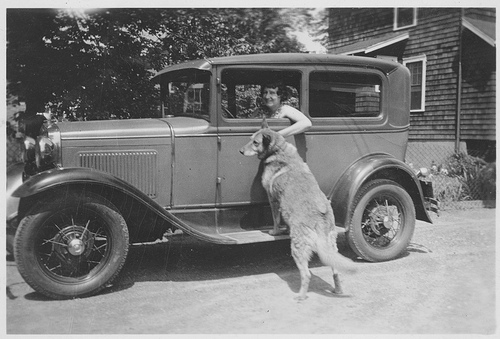
    woman, dog, car

    The Kid has been scanning archival family photos and I’ve been uploading them to Flickr (where I have now passed 39,000 shots in that one site alone). Many of these photos are well over a hundred years old. Most are about eighty years old, give or take a decade or two. They’re from the collection of Grace Apgar, my father’s sister, who is now 98 and doing fine. She’s been putting corrections and contexts into the comments. (There is a lot of longevity here. Grace’s mom, my grandmother, lived almost to 108.)

    The shot above has me intrigued, because I’m curious to know what kind of car that is. Here’s another shot, of my father and a buddy, with a different car. That shot has a date, but the car’s identity isn’t clear to me yet. There are more car shots here and here.

    So, just some fun stuff on a weekend, identifying old things.

  • Public radio still rocks

    Lately, thanks to the inexcusably inept firing of Juan Williams by NPR brass, and the acceptance of a $1.8 million grant from George Soros, NPR has tarred its credentials as a genuinely fair and balanced news organization. Which it mostly still is, by the way, no matter how much the right tries to trash it. (And mostly succeeds, since trying to stay in the middle has itself become a lefty thing to do.)

    Columnists all over the place are calling for the feds “pull the plug on funding for Natonal Public Radio”. (That’s from No subsidy for NPR, by Boston Globe columnist Jeff Jacoby. An aside: NPR’s name is now just NPR. Just like BP is no longer British Petroleum.) In fact NPR gets no money from the feds directly. What NPR does is produce programs that it wholesales to stations, which retail to listeners and sponsors. According to NPR’s finances page, about 10% of that sponsorship comes from the Corporation for Public Broadcasting (CPB). Another 6% comes from “federal, state and local government”.

    Jeff points to a NY Times piece, Move to Cut NPR Funding is Defeated in the House, which says “Republicans in the House tried to advance the defunding measure as part of their ‘YouCut‘ initiative, which allows the public to vote on which spending cuts the G.O.P. should pursue.’ The You Cut page doesn’t mention public radio. It does have this:

    Terminate Broadcasting Facility Grant Programs that Have Completed their Mission.

    Potential Savings of $25 million in the first year, $250 million over ten years.

    In his most recent budget, President Obama proposed terminating the Public Broadcasting Grants at the Department of Agriculture and Public Telecommunications Facilities Grants at the Department of Commerce. The President’s Budget justified terminating these programs, noting that: “Since 2004, the USDA Public Broadcasting Grants program has provided grants to support rural public television stations’ conversion to digital broadcasting. Digital conversion efforts mandated by the Federal Communications Commission are now largely complete, and there is no further need for this program.” and “Since 2000, most PTFP awards have supported public television stations’ conversion to digital broadcasting. The digital television transition was completed in 2009, and there is no further need for DOC’s program.”

    CPB isn’t in there. And they’re right: the digital conversion is done. So maybe one of ya’ll can help us find exactly what the congressional Republicans are proposing here.

    Here’s a back-and-forth between Anna Christopher of NPR and Michael Goldfarb of the Weekly Standard. Says Anna,

    NPR receives less than 2% of its funding from competitive grants sought by NPR from federally funded organizations (such as the Corporation for Public Broadcasting, National Science Foundation and the National Endowment for the Arts).

    Replies Michael,

    I appreciate the smug, condescending tone of this letter, but I’m unconvinced. As one former CPB official I spoke to explained, “they love to claim they’re insulated, but they’re very much dependent on the public tit.” The other 98 percent of NPR’s funding comes from a mix of donations, corporate support, and dues from member stations. The fees and dues paid by member stations comprise more than half of NPR’s budget. Where does that money come from? In large part, from the federal government.

    Take the local NPR affiliate in Washington, WAMU 88.5. That station paid NPR in excess of $1.5 million in dues, the station’s largest single expense outside of fundraising and personnel. The station also took in $840,000 in public funding and grants from the CPB. The station spent nearly $4 million on “fund-raising and membership development,” with a return of just $6 million. Fundraising is expensive — public money isn’t.

    I looked at the .pdf at that link and don’t see the same numbers, but it’s clear enough that NPR affiliates pay a lot for NPR programming, and a non-trivial hunk of that money comes from CPB. According to this CPB document, its regular approriation for fiscal year 2010 is $420 million, and it’s looking for $430 million in 2011, $445 million for 2012 and $604 million for 2013. Bad timing.

    Still, here’s the really interesting thing that almost nobody is talking about. Public radio kicks ass in the ratings. It’s quite popular. In fact, I would bet that it’s far more popular, overall, than right wing talk radio.

    In Raleigh-Durham, WUNC is #2, with an 8.2 share. That’s up from 7.5 in the prior survey. Radio people can tell ya, that number is huge.

    In San Francisco, KQED is #4 with a 5.2 share.

    In New York, WNYC-FM is down in the teens with a 2.2 share, but nobody has more than a 6.5. Add WNYC-AM’s .8 share and classical sister WQXR’s 1.8 share, and you get a 4.8, which is #3 overall.

    Here is Boston, WBUR has a 3.3 share. WGBH has a 1.1. Its classical sister station, WCRB (which now avoids using call letters) has a 2.7. Together those are 6.1, or #3 overall.

    In Washington, WAMU gets a 4.8, , and stands at #5. Classical WETA has a 4.4, for #6. Add in Pacifica’s jazz station, WPFW, with .8, and you get 10, which would be #1 if they were counted together.

    There are places where public radio, relatively speaking, sucks wind. Los Angeles is one. The public stations there are good but small. (The Pacifica station is technically the biggest in the country, but its appeal is very narrow.) Dallas is another. But on the whole, NPR stations do very well.

    But do they do well enough to stand on their own? I think so. In fact, I think they should. That’s one reason we created ListenLog, which I visited at length here last July. ListenLog is an app that currently works with the Public Radio Player from PRX.  The idea is to show you what you listen to, and how much you value it. Armed with informative self-knowledge, you should be more inclined to pay than just to cruise for free.

    We’re entering an era when more and more of our choices are both a la carte and our own. Meaning we’re more responsible, on the whole. And so are our suppliers. There will be more connections between those two facts, and we’ll be in a position to make those connections — as active customers, and not just as passive consumers.

    So, if you want public radio to do a better job, to be more accountable to its listeners and not just to the government (even if indirectly), pony up. Make it yours. And let’s keep building better tools to help with that.

    [Later…] Here’s a bonus link from Bob Garfield’s AdAge column. (He’s also a host of NPR’s On the Media.) And a quote:

    The only quality journalism available, at least in this country, is from a few dozen newspapers and magazines, NPR, some alt weeklies, a few websites (Slate.com, for instance) and a few magazine/website hybrids such as Atlantic. On TV, there is “The News Hour” and “Frontline” on PBS and that is it. Cable “news” is a wasteland (watch for a while and let me know when you see a reporter, you know, reporting). Network news, having taught cable how to cut costs and whore itself to ratings, isn’t much better. Local TV news is live remotes from crime scenes and “Is Your Microwave Killing Your Hamster?”

    Good stuff. Read the whole thing.