• Almost Daily Outline

    Journalism

    The rise of the reader: journalism in the age of the open web is a long and excellent lecture by , deputy editor of the Guardian and editor-in-chief of Guardian Australia. Sample:

    So being open has many advantages for journalists. But to do it, you need to be part of the web’s ecosystem, not just plonked on top of it; to submit to the web’s architecture, psychology, mores, rather than imposing a newspapers’s structure over it.

    When you put the reader at the heart of what you’re doing, then you learn from them how the web works at that moment. In this transitional era we’re all creating this new ecosystem together – and the users are often one step ahead of us, working it out as they go along.

    Possibly related: Why tablet magazines are a failure, by @JonLund in Gigaom. I subscribe to Wired, The New Yorker, Time, Fast Company, Bloomberg BusinessWeek, The Economist, Vanity Fair and Linux Journal on my iPad. They are mostly backups to print editions, which are much easier to read in their native form. Mostly I read them on the pad in the subway.

    Business

    Challenge: get the Abandoned Cart Emails paper from Marketo or The Economics of Online Advertising from Comscore without becoming a qualified lead — because both require you to fill out a form to get the paper.  Answer: generate a one-time email using Privowny or Mask Me. Makes it easy to see if they start spamming you, or selling or giving away your email address — and to kill that address if you like.

    Behind the Best Innovations: Obvious, Annoying Problems, in The Wall Street Journal. Instead of pain points, Nest and others deal with annoyance points.

  • What the ad biz needs is to exorcize direct marketing

    In What the ad biz needs is writers, Michael Wolff bemoans the absence of good writers in advertising:

    …even creatives want to avoid writing — because they can’t…

    While technological disruption is most often blamed for the existential predicament of the media business, the more precise problem is that advertising doesn’t work as well as it used to work. This presents a crisis not only for newspapers, magazines and television — but also, according to the stock market, for Facebook. We just don’t look at advertising, respond to it, or believe it, as much as we once did, wherever it appears.

    Maybe this is the reason: There are no writers in advertising anymore. Johnny who can’t write has gone into advertising.

    In fact, “copywriter” is a job that now hardly exists. The historical partnership between graphic designer and copywriter has, more and more, become a partnership between project manager and programmer, or videographer and editor, or media buyer and researcher.

    If you are the person who actually has to write an ad — rather than conceptualize, or produce, or program, or pitch, or research — your career in advertising is not going very well.

    He is right. That he’s one of the best writers in journalism adds weight to his judgement. So does this, which closes his piece:

    My suggestion to USA TODAY editors was to let the opportunity of the page encourage an agency and client to brilliantly use it. A contest — always beloved in the ad business — was suddenly born.

    USA TODAY is offering a million dollars in free advertising pages if you can fill them smartly — with cleverness, wit, style, economy of words. Again, free. Now, that will make your client happy.

    Just spell out your big idea and tell your arresting story.

    It may be that all we have to do to reinvent traditional media, save Facebook, even make digital media a decent business, as well as move more merchandise, is bring back the copywriter.

    I’m for that — and I’m eager to see how the ad business responds to the contest.

    But I also think the problem is bigger than writing itself, or technological disruption.

    The problem is that direct marketing has body-snatched advertising.

    In the old days direct marketing was distinct from adverting. In even older days, direct marketing was called direct mail. Or, in the vernacular of its recipients, junk mail. Some key differences, from back in the pre-snatched era of advertising’s history:

    • While advertising was impersonal, direct marketing was personal. It called you by name. Or wanted to.
    • While advertising was about raising general awareness of a company, product or service, direct marketing was about selling you stuff. Hence the term direct response, which is what most of direct marketing on the Net is looking for today.
    • While advertising was creative-driven, direct marketing was data-driven.
    • While advertising favored qualitative results, direct marketing favored quantitative results.
    • While advertising respected personal privacy by default (it didn’t get personal), direct marketing never cared much about it — despite assurances to the contrary.

    In the old analog world, advertising and direct marketing remained blessedly separate. No first-rank copywriter, art director or creative director wanted to tar his or her hands (or resumé) with direct marketing work. In fact, most of that work didn’t happen on Madison Avenue at all, but in specialty shops somewhere out in Florida or Indiana.

    But once the analog and the digital world merged, direct marketing’s obsession with data gathering and analysis had nearly infinite room to grow. Like cancer, or worse.

    It seemed innocent enough when it was just text ads off to the side of Google search results, or on the margins of blogs and other Web pubs. That stuff was called advertising because, well, it was. And that’s when the body-snatch began. Because that stuff was called advertising, so was everything that followed when direct marketing imperatives and methods moved to the fore.

    In the online world, advertising messages are not much about increasing brand awareness, or other old-fashioned advertising purposes. (Though today’s ad folk love to throw the word “brand” around.) Instead the main purpose is getting direct responses: clicks and sales, aimed by personal data, gathered and analyzed every possible way. The idea is to  make the advertising as personal as possible, as far as possible, regardless of how creepy it gets. It’s all fully rationalized. (Hey, you can opt out if you don’t like it.)

    In the analog world of old-fashioned Madison Avenue advertising, there were physical limits to saturation. Not so online. Today advertising comprises 99.x% of all email traffic. (Most of it is spam, but it’s hard to tell the difference.) It has also turned ad-supported Web pages into syringes for injecting countless unseen files into users’ browsers. Those files then follow users everywhere to collect data for the new ad industry’s analytic mills, so the body-snatched business can then deliver “a better advertising experience,” as if anybody actually wants it.

    And now the snatched ad business want to dominate our mobile lives as well. For a taste of how this looks on the ad-mill side, check out MediaPost‘s MobileMarketing Daily. Lots of rah-rah for what most phone users can only dread. Examples:

    They do, however, report on some push-back:

    Yet there is one thing both traditional advertising folk and direct marketers have in common, and that’s blinders toward reality.  Terry Heaton puts it well:

    Operating within the soul of every marketer is the ridiculous assumption that people want or need to be bombarded by advertising, and that any invasion of their time or experience to “pass along” an attempt to influence is justified. If this were true, there would be no looming fight over DVRs, which allow viewers to skip ads. You have no inherent right to my eyeballs, and it is precisely this axiom that makes today’s instruments and gadgets so powerfully disruptive to the culture.

    How so? We’re weary of running a relentless gauntlet of jumping, screaming, frantic warnings, hands grabbing, voices shouting, noise-making, disjointed movements, and the almost demonic reaching for our wallets coming from advertising. This is Madison Avenue’s idea of perfection, and the only way you can get there is to completely ignore the effect of advertising on the very people you’re trying to influence. The Web is, at core, a pull mechanism, not one that pushes. It’s why all those big projections of advertising “potential” have turned into a commodified “pennies for dollars” reality.

    In reality, advertising has become ineffective because it is no longer advertising, at least in the digital world. It is direct marketing, calling itself advertising.

    To live again as a stand-alone discipline, advertising needs to exorcize the devil that direct marketing has made of advertising online. Simple as that.

    For more on how real advertising actually works better than the direct marketing kind, read Don Marti‘s Targeted Marketing Considered Harmful. Then move on to the rest of Don’s growing medicine cabinet of direct marketing disinfectant for adverting.

    Bonus link.


  • Today’s outline

    The Net

    Markets vs. Marketing

    Surveillance

    • The Privacy Generation. By Joshua J. Dyck and Shanna Pearson-Merkowitz in The Pacific Standard. Pull-quote: For the generation that developed their political identities in the wake of 9/11 it appears that their political attitudes have been shaped more by the privacy they were asked to give up after the attacks than by the attacks themselves. Thirty-year-old Edward Snowden is not an outlier; he’s just a public member of his generation.
  • The holy grail of radio

    [4:45pm EDST  2 October 2013 — Late breaking news: RadioINK reports that Darryl Parks’ blog post — the first item below — has been pulled off the 700wlw site. — Doc]

    In A SERIOUS Message To The Broadcast Industry About Revitalizing AM Radio, Darryl Parks of 700WLW made waves (e.g. here, here, here) by correctly dismissing six FCC ideas intended to make life easier for owners of AM radio stations. Those ideas are detailed at that last link (by David Oxenford of the excellent Broadcast Law Blog).

    All six, Darryl says, would increase interference. Instead, he suggests, “The answer is not MORE interference. The answer is LESS interference. And you do that by turning off non-viable stations. And before station owners start crying poverty, many of these non-viable AM stations have one thing that is worth a ton of money. The land their towers sit on.”

    Well, not all stations own the land their towers sit on. KCBS/740 leases their land from a farmer up in the North Bay. Other stations’ towers, such nearly all of those serving New York, sit in tidal swampland or on  islands that would revert to nature if the towers came down. (For example, WMCA and WNYC, which share the towers next to the New Jersey Turnpike, shown here. Likewise KGOKNBR and WBZ.)

    But Daryyl’s right: there are too many stations, and too much interference — not only between them, but also from electronic thingies that didn’t exist when AM’s base technology and regulatory system were framed out in the 1920s.  Computers, mobile phones and energy-saving light bulbs all play havoc with AM reception.

    I see three other solutions, only one of which is likely to happen.

    The first is better AM receivers. The old tube and transistor types were much better, on the whole, than the newer chip-based ones. But even the chip-based receivers were better in the early days than they are now. The faults are not just in the electronics, but in the methods used for gathering signals. In cars, for example, the fashion in recent years has been to shorten antennas or to embed them in windows, mixed in with defrosting wires. Radios in cars I drove in the 1960s and 1970s would get New York’s biggest AM signals (on 660, 770 and 880) past Richmond, Virginia, in the middle of the day. The radios were not only better, but served by whip antennas on their fenders. Even portable radios were better. When I was a kid riding in the back seat of our new Chevy, on a family trip in the summer of 1963, I listened to WNAX in Yankton, South Dakota, from the Black Hills to Minneapolis, again in the daytime (when AM signals don’t bounce off the sky, as they do at night — on a Zenith Royal 400 seven-transistor radio. Alas, modern receivers and antennas are studies in cheap-out-y-ness, and don’t do the same job. In the absence of regulatory or market urgings, the chance of improvement here is zero.

    The second is moving to an all-digital AM band. In this Broadcast Law Blog post David Oxenford says all-digtial “has shown promise for an interference-free operation in recent tests,” but “would require that there be a digital transition for AM radio just as there was to digital TV. That might be problematic, as it would require new AM receivers for almost everyone (except for those few people who already have Ibiquity IBOC receivers which should work in an all-digital environment).” I have one of those receivers in my kitchen. (That’s a shot of its display, there on the left.) HD on AM sounds like FM. Combine that with better receivers and antennas, and it’s a double-win. Here there is a small amount of regulatory urging, but try to find find a portable HD radio at Amazon or Radio Shack. Not happening.

    The third is to develop better ways of getting radio streams on mobile devices. I have a mess of apps for getting radio streams on my iPhone and iPad, and none of them provide the simplicity of radio’s original dial & buttons system. If one app provided that simplicity, radio would move smoothly to mobile along with every other medium already re-locating there. Stations would continue to operate on the AM and FM bands until doing so no longer made technical or economic sense. But the path would be clear.

    The one company that might have made this easy is Apple; but Apple has never been interested in improving radio as we know it. For years it buried radio station streams in an iTunes directory most people didn’t know was there — and then created a Pandora competitor with iTunes Radio. Like Pandora, Apple calls its streams “stations,” which also fuzzes things. The old stream directory still exists, for what it’s worth, under “Music.”

    So it’s up to app developers. TuneIn, WunderRadio and Stitcher are currently the big three (at least on my devices), but all of them bury local radio deep in directories that are annoying to navigate and often incomplete. For example, let’s say I want to navigate the “dial” for Boston while I’m here in New York. On TuneIn, I hit “Browse,” then “Local Radio,” then find myself in New York. Not Boston. Then I hit “By Location.” That gives me a map I can pinch toward a red pin on Boston, where I find a virtual dial in the form of a list. That’s less work than it used to be, back when TuneIn wanted me to drill down through a directory that started (as I recall) with “Continent.” But it’s also missing all the great discoveries I used to make in local radio elsewhere in the world, such as the UK. (There are red pins only for major cities there.) Over on Stitcher one hits “Live Radio,” then “Massachusetts,” then “Boston” to do the same kind of thing, but the directory is has just three minor AM stations, then a bunch of FMs, but not WEEI/93.7, my favorite sports talker there. Between WBOS/92.9 and WTKK/96.9 there is nothing. All three do offer search, but that’s not easy to do when you’re driving or walking. (Nor is any of the above.)

    All of them also assume, correctly (as do Apple, Pandora, Spotify, LastFM and many others), that individuals would rather put together their own “stations” in the form of music types, program collections, or whatever.

    Pure optionality is the Internet’s advantage over broadcast radio and TV. And that’s on both the supply and the demand side. (And how anybody can be on either side if they like.) There is no way old-fashioned one-way, top-down, coverage-limited broadcast can compete with that. But it can embrace it.

    That’s why individuals being able to do what they want is both the threat and the promise of radio online. Bring back dial-like simplicity to the online world, marry it to “roll your own,” and you’ll have the holy grail of radio.

    [December 2021 update] Check out Radio.Garden. It’s not exactly what I describe in that last paragraph, but it’s creative and fun.

  • Today’s raw bibliography

    If I had world enough and time, the Fargo outline below would turn into one of my (less than) daily outlines. Instead I’m publishing it in raw form: links alone. Trust me: they’re all worthwhile. And I like them better this way than in as many open tabs spread across three browsers, all of which are used, with limited success, by robotic entities, to follow me. Maybe if they follow all this stuff together, they’ll know more.

    BTW, in earlier drafts of this outline, browsers automatically made the links live. But, alas, that doesn’t seem to be the case now. Oh well. Copy and paste then.

    Intention Economy

    • http://onthespiral.com/intention-economy-evolution-of-relationship-management
    • https://twitter.com/katrynadow/status/381058361355026432
    • http://www.jetsetmag.com/categories/executive/signaling-the-future.html#nav
    • http://mediatel.co.uk/newsline/2013/09/18/ad-blockers-if-they-threaten-revenue-then-whats-the-alternative

    Hellbound Handbasketry

    • http://www.theverge.com/2013/9/20/4753398/in-spain-website-owners-can-now-get-six-years-in-prison-for-linking
    • http://www.salon.com/2013/09/20/rip_the_middle_class_1946_2013/
    • http://www.infoworld.com/d/application-development/the-uss-crap-infrastructure-threatens-the-cloud-226917
    • https://medium.com/p/d3d3c032d35e
    • http://www.theatlantic.com/business/archive/2013/09/the-law-that-gave-us-the-modern-internet-and-the-campaign-to-kill-it/279588/

    Markets and Marketing

    • http://www.warc.com/LatestNews/News/EmailNews.news?ID=31969
    • http://pages.exacttarget.com/adv/SegmentOfOne/?ls=Advertising&lss=Adv.eMar.9.20.2013.SegmentofOne.iGo&lssm=Product&camp=701A0000000fr7tIAA&utm_source=advertising&utm_medium=Adv.eMar.09.20.2013.us&utm_content=701A0000000fr7tIAA&utm_campaign=
    • http://www.comscore.com/Insights/Press_Releases/2013/9/comScore_Releases_August_2013_U.S._Online_Video_Rankings
    • http://www.radioink.com/Article.asp?id=2701657&spid=42139
    • http://www.inman.com/2013/09/16/will-technology-breath-new-life-into-fee-for-service-business-model/
    • http://prdaily.com/Main/Articles/15236.aspx#
    • http://pages.exacttarget.com/adv/SegmentOfOne/?ls=Advertising&lss=Adv.eMar.9.20.2013.SegmentofOne.iGo&lssm=Product&camp=701A0000000fr7tIAA&utm_source=advertising&utm_medium=Adv.eMar.09.20.2013.us&utm_content=701A0000000fr7tIAA&utm_campaign=
    • http://www.npr.org/blogs/therecord/2013/09/11/219727031/what-does-a-song-that-costs-5-sound-like
    • http://www.ft.com/intl/cms/s/0/3cb056c6-d343-11e2-b3ff-00144feab7de.html#axzz2fWdz7lZl
    • http://www.ft.com/intl/cms/s/2/927ca86e-d29b-11e2-88ed-00144feab7de.html#axzz2fWdz7lZl
    • https://www.youtube.com/watch?feature=player_embedded&v=lUtnas5ScSE

    Science

    • http://physicsworld.com/cws/article/news/2013/sep/19/is-the-universe-saddle-shaped
    • http://www.wired.com/wiredscience/2013/09/plutonium-238-problem/
    • http://www.scientificamerican.com/article.cfm?id=what-big-questions-remain-about-sea-level-rise
    • http://geotripper.blogspot.com/2013/09/into-great-unknown-vulcan-fire-god-says.html

    Culture

    • http://www.mediapost.com/publications/article/209648/look-who-got-schooled.html#axzz2fjLMNqc9

    Surveillance and Data Protection

    • https://optin.stopwatching.us/
    • http://techcrunch.com/2013/09/04/pew-86-of-u-s-adults-make-efforts-to-hide-their-digital-footprints-online-fear-creeping-ads-and-malicious-hackers-more-than-the-government/
    • http://security-architect.blogspot.com/2013/09/nsas-bullrun-impact-assessment.html
    • http://thoughtmaybe.com/all-watched-over-by-machines-of-loving-grace/
    • http://www.theguardian.com/world/2013/sep/19/ordinary-americans-spying-fusion-center-program-aclu
    • https://ioptconsulting.com/industry-still-puzzling-over-consumer-reaction-to-tracking/
    • http://www.adweek.com/news/technology/california-poised-get-do-not-track-disclosure-law-152176
    • http://uk.practicallaw.com/2-502-1510?qaq=W_q1&qaid=1-502-1544&qaid=6-502-0467
    • http://gigaom.com/2013/09/17/loophole-in-ibeacon-could-let-iphones-guard-your-likes-instead-of-bombard-you-with-coupons/
    • http://www.privacy.org.au/Resources/PLawsWorld.html
    • http://www.securityfocus.com/news/7388
    • http://www.politico.com/story/2013/09/mark-zuckerberg-nsa-96682.html
    • http://lfb.org/today/3-important-lessons-from-a-canadian-border-crossing/
    • http://www.eweek.com/developer/linus-torvalds-talks-linux-development-at-linuxcon.html
    • http://www.theguardian.com/commentisfree/2013/sep/22/secret-fisa-court-constitutional-rights

    The Internet

    • http://www.washingtonpost.com/blogs/the-switch/wp/2013/09/18/protecting-the-open-internet-may-require-defunding-the-itu-heres-how-to-do-it/
    • http://us1.campaign-archive2.com/?u=87dbe31afc24ad291ef3bb28b&id=f1f20ddf1c&e=7668208c2b

    Writing and Publishing

    • http://harpers.org/archive/2013/10/publishers-letter/
    • http://harpers.org/archive/2013/10/course-corrections/
    • http://www.examiner.com/article/senate-panel-brings-federal-law-one-step-closer-to-kneecapping-bloggers
    • http://crookedtimber.org/2013/09/17/sociological-science/
    • http://gigaom.com/2013/09/21/the-senates-media-shield-bill-protects-bloggers-and-they-should-support-it/

    Philosophy and Thought

    • http://www.independent.co.uk/news/world/europe/russian-man-shot-in-quarrel-over-immanuel-kants-philosophy-8820327.html
    • http://thequestioneconomy.com

    VRM

    • http://www.slideshare.net/realestatecafe
    • https://www.ctrl-shift.co.uk/news/2013/09/18/miicard-and-the-evolving-market-for-identity-services/
    • http://www.strategy-business.com/blog/What-if-Clay-Christensen-Is-Right-about-the-Grocery-Business-and-Amazon-Is-Wrong?gko=58cde
    • http://pages.exacttarget.com/adv/SegmentOfOne/?ls=Advertising&lss=Adv.eMar.9.20.2013.SegmentofOne.iGo&lssm=Product&camp=701A0000000fr7tIAA&utm_source=advertising&utm_medium=Adv.eMar.09.20.2013.us&utm_content=701A0000000fr7tIAA&utm_campaign=

    Technology

    • http://linux.slashdot.org/story/13/09/17/2113211/new-operating-system-seeks-to-replace-linux-in-the-cloud
    • http://linux.slashdot.org/comments.pl?sid=4226473&cid=44878181
    • http://qz.com/126233/apples-edge-is-that-the-iphone-remains-the-best-place-to-access-googles-services-for-now/
    • http://www.internetidentityworkshop.com
    • http://www.washingtonpost.com/blogs/the-switch/wp/2013/09/17/heres-how-a-law-designed-to-fight-the-mafia-could-stop-abusive-patent-lawsuits/
    • http://www.mpaa.org/Resources/38bc8dba-fe31-4a93-a867-97955ab8a357.pdf
    • http://www.billboard.com/biz/articles/news/legal-and-management/5695574/pandora-prevails-in-ascap-rate-court-case
    • http://variety.com/2013/digital/news/how-netflix-uses-piracy-to-pick-its-programming-1200611539/
    • http://rockonomic.com/2013/09/13/0-0001-the-value-of-a-clear-channel-performance-given-rumored-warner-deal-terms/
    • http://www.linuxjournal.com/content/linux-now-slave-corporate-masters and http://www.kroah.com/log/diary/2005_11_10-suitwatch.html
    • http://appleinsider.com/articles/13/09/07/the-apple-era-begins-as-microsoft-google-shift-to-a-hardware-centric-model

    Radio

    • http://www.kurthanson.com
    • http://www.kurthanson.com/kurt-hanson/internet-radio-fairness-act-would-spur-innovation
    • http://www.nytimes.com/2013/09/16/business/media/a-digital-deal-for-cumulus-and-rdio.html?_r=1&

    Art

    • http://makepictures.deviantart.com/journal/Liberating-Art-For-The-World-400356361
    • http://techgnotic.deviantart.com/journal/Getty-Liberation-of-Masterpieces-as-Open-Content-399986148
    • http://www.upworthy.com/he-was-asked-an-arrogant-question-his-great-answer-shows-the-problem-with-how-the-u-s-functions?c=slt1

    War

    • http://georgelakoff.files.wordpress.com/2011/04/metaphor-and-war-the-metaphor-system-used-to-justify-war-in-the-gulf-lakoff-1991.pdf
    • http://georgelakoff.com/2013/09/06/obama-reframes-syria-metaphor-and-war-revisited/
    • http://georgelakoff.com/2013/09/13/systemic-causation-and-syria-obamas-framing-problem/
  • Digging Hart Island, New York’s Million-Corpse Potter’s Field

    A decent provision for the poor is the true test of civilization. — Samuel Johnson

    Hart Island

    Visitors to New York’s Orchard Beach (at the top of the photo above) probably don’t know that the low wooded island offshore will, at the current rate, contain a million buried human bodies, if it doesn’t already.

    The site is Hart Island (aka Hart’s Island), and it is New York’s potter’s field: where the city’s “unclaimed and indigent” dead are buried.  It is the largest tax-funded cemetery in the world. Burial is done by inmates of the Department of Corrections, which also controls the island. Visitors are not welcome.

    I knew nothing about Hart Island until I found myself looking at the picture I shot of the place, above, while seeking information about something else. Though bleak, the stories of the place are fascinating — and, it seemed to me, far too important to leave as far out on the margins of consciousness as they are of the City. So I compiled a list in a Fargo outline, which I’ve arranged below.

    One item I’ll pull out of the list to start with is The Hart Island Project*, by Melinda Hunt (@hartisland) and a team of collaborators. Melinda has been leading a steady effort to open up the island to visitors and to humanize and modernize the records kept of persons buried there. Her constituency includes all who reside in what we might call the Mass Grave of the Barely-Known Outcasts — and too few of the living, so far. So dig:

    [Nina Bernstein‘s Pulitzer-worthy New York Times series on Hart Island, added on October 12, 2016]:

    In fact Hart Island is New York’s ninth Potter’s Field. Writes Melinda Hunt,

    A few of these early potters fields remain in the public domain as smaller parcels of land now known as Madison Square Park (1794), Washington Square Park (1797), Bryant Park and the Public Library (1823). Except for the last potter’s field in Manhattan, located at the current Waldorf Astoria Hotel (1836), no records exist of the bodies being moved elsewhere. At all other sites, parks were created after the cemeteries, parade grounds, and the reservoir closed. Once the city expanded beyond 50th Street, the East River became a more convenient route for transporting the bodies. Potter’s fields opened briefly on Randalls Island (1843) and Wards Island (1846) before moving much further out to Hart Island.

    It’s a haunting history. Another excerpt:

      The burial records show an ever-changing pool of immigrants, diseases and disabilities administered to by a range of institutions. It remains too mixed and varied to become the darling of any special interest group. Genealogists that I have spoken with claim that most families with immigrant roots in New York City probably have lost relatives buried on Hart Island. As one recently told me: “People come to me hoping to discover ‘nobility’ in their ancestry, but the missing people usually turn out to have had alcohol problems or mental illness and were buried in Potter’s Field.”

    In New York City, the combined nine potter’s fields have close to one million burials. An immense amount of history is associated with these places. Yet, there is almost no academic or institutional interest in the public cemeteries. Most of the writing about Hart Island takes the form of journalism documenting specific events. Distinctive in these accounts is the unanswered question of why such a place continues to exist. Most other American cities cremate the unclaimed and unwanted. If burials are provided they are in more accessible places. Chicago has a potter’s field with mass graves as part of a private cemetery. New York City offers burial assistance to families who organize an application. Nonetheless, the burials continue to number two to three thousand a year. Even with the twenty-five year time limit, the northern 45 acres of Hart Island named Cemetery Hill is full. Current burials have moved to the shallow grounds south of the workhouses.

    New York City has a long-standing policy of respecting diverse religious practices. Many religions do not permit cremation. Until recently Catholics buried on Hart Island were placed in separate “consecrated ground.” In 1913, “baby trenches” were separated from “adult trenches.” Starting in 1935, “catholic babies” had separate trenches from “regular babies.”

    Incredible care and expense goes into conducting the burials. In 1990 the cost of flowers, tools, heavy equipment, parts to repair equipment, general maintenance equipment, fuel and inmate labor, at thirty-five cents per hour, drove the cost of each burial to $346. In addition, the city provides for free exhumation if family members claim a body within seven years of burial.

    During the first fifty years of Hart Island burials, “unclaimed” people were buried in single graves. Only the “unwanted” whose relatives assigned them to a public burial were in mass graves. Today, all bodies are carefully organized into a grid. The ends of trenches are marked by a number pressed into a concrete block. Re-excavations require locating the designated body within this numbered scheme.

    Perhaps it is the abstraction of human lives into trench numbers and statistics that is most disturbing about the potter’s field. I was impressed by the fact that the burial records from the nineteenth century contain full names, causes of death and countries of origin. In this century the names of babies up until 1940 are strictly female; each child’s identity is linked exclusively to the mother. She is the person forever associated with the potter’s field. After 1940, only surnames are listed. By 1955, the causes of death for children are uniformly listed as “confidential.” By 1970, the category “cause of death” is left blank. That the island is prohibitively difficult to visit adds another level of removal.

    Then there is this, from Thomas Badhe, in a Common Place essay,” The Common Dust of Potter’s Field: New York City and its bodies politic, 1800-1860″:

    The first Potter’s Field burial ground in New York City was located at the site of what would become the militia parade ground and city park at Washington Square. On this nine-and-a-half-acre plot, at the city’s pastoral northern edge, lay the densely packed corpses of about 125,000 “strangers,” many of whom had died during two separate yellow-fever epidemics between 1795 and 1803. Not surprisingly, local residents who had fled crowded lower Manhattan for country estates in the region came to find in Potter’s Field an intense nuisance. Whatever sympathy anyone had for the anonymous dead did not supersede wealthy New Yorkers’ sense of entitlement when it came to their comfortable insulation from the city’s darker side. In a letter to the Common Council, they wrote, “From the rapid Increase of Building that is daily taking place both in the suburbs of the City and the Grounds surrounding the field alluded to, it is certain that in the course of a few years the aforementioned field will be drawn within a precinct of the City.” Within the first two decades of the nineteenth century, their prediction had been realized, and the Potter’s Field began a lengthy series of migrations in a vain effort to stay a step ahead of the city’s relentless growth.

    In 1823, the city moved Potter’s Field to an empty lot at the corner of Forty-ninth Street and Fourth Avenue—what would then have been the far northern reaches of the metropolis. This place served as the Potter’s Field until the 1840s when, as the city grew northward, it was relocated once again to Randall’s Island in the East River. Cast off the Island of Manhattan like so many family farms, Potter’s Field would no longer clash with the New Yorkers’ Victorian sensibilities or inhibit the Manhattan real-estate boom.

    Just south of Randall’s Island, separated by a treacherous, narrow channel known as Little Hell’s Gate, was Ward’s Island, the site of another Potter’s Field in the mid-1850s. Both Randall’s and Ward’s Islands already housed other city institutions for the indigent, including the Emigrant Refuge and Hospital, the State Inebriate Asylum, the juvenile branch of the Almshouse Department, and the headquarters for the Society for the Reformation of Juvenile Delinquents. As one guide to New York and its benevolent institutions observed, “multitudes of persons went from the dram-shop to the police-station, and from the police courts to the Workhouse from whence, after a short stay, they returned to the dram shop . . . until they at length died on their hands as paupers or criminals, and were laid in the Potter’s Field.” For most of New York’s institutionalized underclass, there was literally a direct path from the door of the asylum or workhouse to the Potter’s Field.

    Relocating the city’s cemetery from Manhattan’s urban grid to an island in the East River did not put an end to the city’s problem with the indigent dead. In 1849, the Daily Tribune reported on the political and legal wrangling between the governors of the Almshouse and the Common Council (the nineteenth-century name for the City Council), the former seeking to wrest authority over Potter’s Field from the latter. The governors cited the poor management of the paupers’ burial ground, which the Tribune referred to as “that den of abominations,” as evidence that the Common Council was unable to manage the Potter’s Field. “We do sincerely trust somebody will shoulder the responsibility of the Potter’s Field,” the Tribune pleaded, “and rid the Island of the abomination before the advent of another warm and perhaps an epidemic season.”

    The Common Council and the Governors of the Almshouse traded letters, pleas, and vitriol for the better part of a decade. In May of 1851, the Governors warned the Common Council that, “the land now appropriated [for the Potter’s Field] is now nearly full, and the small space left for further interment (which now average upwards of one hundred per week), renders prompt action necessary.” Four years later, it was still unclear who had control over the Potter’s Field, and conditions were worsening. By this time, there were two burial grounds for paupers: the primary site on Randall’s Island and a smaller one on Ward’s Island to the south. The Board of Governors proposed to expand the Ward’s Island site in 1854, and the Times supported the proposition, suggesting that “it is time that the remains of paupers were interred in some quarter better fitted for their last resting-place than the one now used on Randall’s Island.” In their reports to the Board of Health and the Common Council, the Governors of the Almshouse urged that, “humanity, a due regard for the living, and a sense of proper respect for the dead” be part of any effort “to remedy the existing and impending evils.”

    In the meantime, the disinterment of bodies at the old site on Fourth Avenue aroused its own controversy. In 1851, a plan was adopted by the Common Council to expand Forty-ninth Street through the old Potter’s Field, which required the disinterment of thousands of bodies. This project stretched on for nearly the entire decade, accompanied by foot-dragging and corrupt contractors. Commenting on the enormity of the project, the Times reported in the spring of 1853 that “the City Authorities are cutting a street through the old Potter’s Field . . . where so many victims of the Cholera were hurriedly interred in 1832. The coffins were then, in many instances, stacked one upon another; and now, in digging through the hill, the remains of twenty coffins may be seen thus piled together.”

    As with the active Potter’s Field, the old paupers’ burial ground aroused no small amount of controversy. In the summer of 1858, the Timesagain reported on the work, claiming that “within three weeks past about 3,000 skeletons have been exhumed from the old Potter’s Field . . . and removed to Ward’s Island.” The winter of 1858-59 passed without any further exhumation, and “meantime the thin layer of earth which covered some hundred half-decayed coffins has fallen away, and . . . crowds of urchins assemble there daily and play with the bones of the dead; troops of hungry dogs prowl about the grounds and carry off skulls and detached parts of human bodies.”

    Many of the old potter’s fields became parks. Washington Square is said to have twenty thousand bodies beneath it. Yet today it seems no more haunted than is Paris by its Catacombes, which I visited and wrote about three years ago, and which contains a population of dead that outnumber the city’s live citizens. The real haunting, I believe, is within our culture and its institutions. On that I’ll give Thomas Badhe the last words:

    Having strolled through the rural cemeteries, we can better appreciate why the piles of moldering coffins exposed to the public in the 1850s caused New Yorkers to question their city’s claims to “civilization.” But the Potter’s Field was not only the antithesis of the rural-cemetery ideal (as well as a failure of municipal administration); it was also a site of spiritual death, obliterated social identity, and the graveyard of vice. If, as one proponent of rural cemeteries claimed in 1831, “the grave hath a voice of eloquence,” the Potter’s Field spoke in a dark chorus about the failures of democracy and civilization, the stark and messy exigencies of urban inequality, and thousands of individual lives wrecked on the shores of the great metropolis.

    * The Hart Island Project is now a beautifully built website featuring the means to look up people buried there, and to tell their stories. Highly recommended.

    Save

  • Daily Outline

    History

    • John Philip Sousa, “The Menace of Mechanical Music,” 1906, at ExplorePAhistory.com. Pull-quote: “The host of mechanical reproducing machines, in their mad desire to supply music for all occasions, are offering to supplant the illustrator in the class room, the dance orchestra, the home and public singers and players, and so on. Evidently they believe no field too large for their incursions, no claim too extravagant. But the further they can justify those claims, the more noxious the whole system becomes.” He was arguing against the player piano, the phonograph, everything. The original was published in the (very) late Appleton’s Magazine, Vol. 8 (1906).

    Culture & Photography

    Tech

    Surveillance

    Hellbound handbasketry

    Marketing

  • Frontiers of Planned Obsolesence

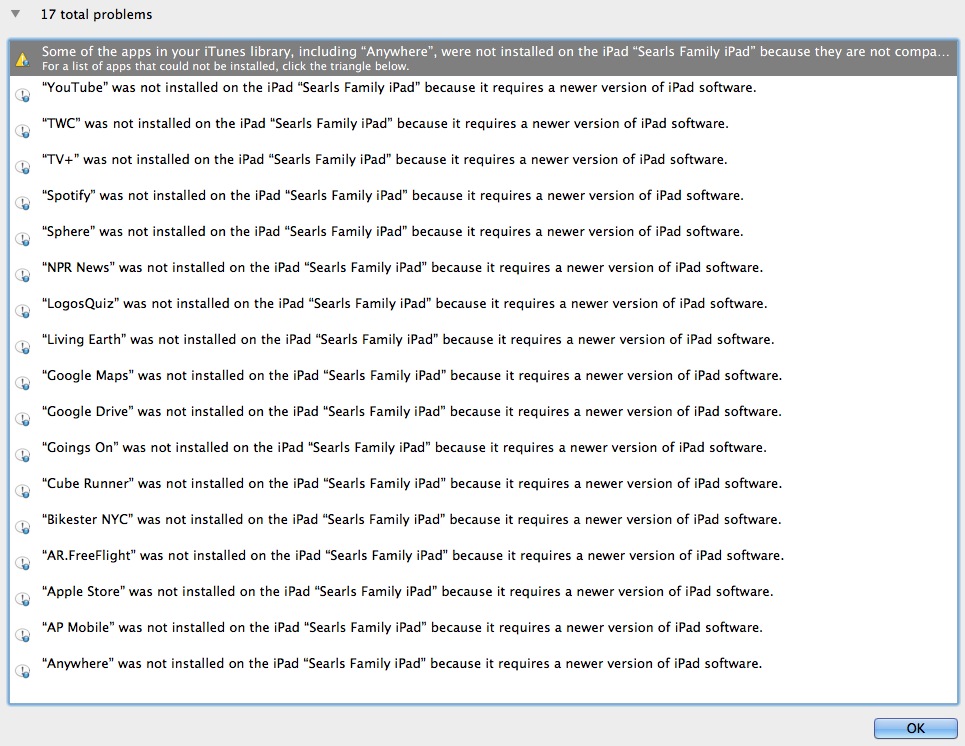
    Our iPad was new in the summer of 2010: first generation. It was top-of-the-line, with 64Gb of storage and 3G connectivity. And it still works well. But the number of apps it runs is going steadily down. Here’s the current list:

    All those apps ran in the past. But both Apple and the app developers decided at some point that first-generation iPads would no longer be supported. There’s a name for this: planned obsolescence. In less fancy terms, it means made to break. Planned obsolescence became a design strategy in the 1950s with cars. (Here’s a story of my family’s encounter with it in 1963, when our purposefully-defective 1957 Ford blew up in Iowa.) But it’s as much a feature as a bug for many kinds of products, including (and perhaps especially) consumer electronics.

    Here’s an idea for Apple and everybody else: just lease the stuff. Really. That’s the way it works anyway. Let’s say this iPad’s useful life is one more year. Given the original price ($800-something), it will end up having cost about $200 per year. Would I pay $250/year for an up-to-date iPad with a service agreement? I dunno. But it is clear we are headed toward a subscription economy. I’m sure planned obsolescence must be driving it, much as anything else.

    So I just went looking, and it turns out Apple itself leases stuff to business. Prices aren’t there (far as I can tell). But it’s still a harbinger.


  • The American Way of Privacy

    My sister Jan — student of history, Navy vet and a Wise One — sent me an email a couple days ago that I thought would make a good guest post. She said yes to that suggestion and here it is…

    Is the new born-in-connectivity generation going to re-define privacy?   They may try — from the comfort of their parents’ homes or the cocoon of youth — but first they have to understand what constitutes privacy.  They are going to learn, albeit the hard way, that what you make available is no longer private and therefore you cannot expect it to be protected by the norms of privacy.  The norms of privacy, however, aren’t universally understood.

    America is one of the few — perhaps the only if we’re talking large scale — modern countries that was created though one people’s individual exploration and individual settlement into an ever-moving frontier.  After initial sputtering wealth-seeking attempts, the true settlement along the coast line of north America was primarily under private sponsorship rather than military incursion.   It was “relatively” benign colonization in that the goal was not to annihilate, enslave or ‘save’ the indigenous people through religious conversion or education.  The arriving colonists primarily sought freedom to work and worship and the opportunity to better their lives and raise their social standing.  The principal asset needed to obtain those goals was land, which was seen as limitless and free for the taking provided the native population withdrew beyond the frontier and one had the strength and determination to tame the land as needed.

    The leading edge of this frontier movement started with those who built the original settlements in the early 17th century and continued to move out in the lower 48 until the mid-20th century and in very remote areas continues still.  The “frontier” society was composed of people who took the initiative and individually ventured into new areas where there was little law, oversight or judgement.  Although they brought morals and manners of every social strata, they also had to rely on each other and build some form of community where ever they settled in order to survive and thrive.  But in the frontier, in the place of established laws, there were protocols — unwritten codes of correct conduct — born of common consent and enforced by common acceptance  that enabled the community to function, grow and improve.  These protocols became the societal norm for most of the expansion into the US as it is today.

    In the rest of the world connected by the major trade routes during this same period, societies grew and countries were formed primarily from the top down by gathering like together, or by force, and they were ruled through laws and protocols that came into being to enable financial investors, religions or conquerors to subjugate and /or extort populations.

    But America came into existence and continued to expand as one contiguous country because the key unifying principle was individual liberty, and our legal and societal norms developed to support that principle.  This is what made America so singular as a nation in it’s early days. This is at the heart of what some call exceptionalism today.  Exceptional may be an egotistical term for it — as Putin just called it and as the push-backers deny — if one interprets exceptional as being “above average,” or “extraordinary” or any other superlative.  But America is exceptional if one uses the term in the context of “deviation from the norm.”

    Now overlay this frontier concept onto the development of the Internet and our other networking systems.  How were they developed?  Was it by governments pushing out into or conquering a new frontier with laws and protocols in hand or was it by individuals determining the most effective protocols that would help them solidify what they had achieved and enable them to push the frontier borders out further, wider and deeper?

    A unique concept of individual privacy was part of America’s frontier society;  it wasn’t a place of one’s past but rather a place of new starts, of re-creation, a place where a person made themselves anew, a place where it didn’t matter where or what you came from but rather where you were going and what you would do.  Therefore individual privacy became an expectation rather than an exception in the country that frontier society created.

    However, that ingrained individualism is not the norm in the rest of the world, a world that technology has rapidly connected.  As of today, the concept of individual privacy is not universally understood, now that online, networked and connected  technology is at a confluence of cultures.  Because of the universality of the usage of connective technology, privacy is going to need a universally accepted definition.  And at the heart of privacy is the idea of identity:  is it vested in the individual or the collective?

  • We know we’ve traded away privacy. But for exactly what security?

    In Freedom and the Social ContractVint Cerf writes,

    The tension we feel between preserving privacy and a desire to be protected from harm feeds the debate about the extent to which we are willing to trade one for the other. Not everyone, nor every culture, will find the same point of equilibrium. Moreover, as technology and society evolve, the equilibrium points may shift. It has been said that “security” is not found in apprehending a guilty party but in preventing the harm from occurring. While this notion can surely be overextended, it can also be understood to justify a certain degree of intelligence gathering in the service of safety and security.

    There is some irony in the fact that our privacy is more difficult than ever to preserve, given the advent of smartphones, tablets, laptops, the Web and the Internet, but that the threats against our safety and security use the same infrastructure to achieve nefarious ends. Our discipline, computer science, is deeply involved in the many dimensions of this conundrum and we owe it to our fellow citizens to be thoughtful in response and to contribute to reasoned consideration of the balance our society needs between potential policy extremes.

    How can we reason with lack of stuff to reason about?

    All we know for sure in this mess is that there is no clear limit to the spying on us, by both business and government, and that we’ve traded our freedom, our privacy, and the whole freaking Fourth Amendment, for… what?

    With business we know: better “experiences,” mostly through advertising. It’s silly, but that’s the bubble we’re in right now.

    With government, all we know for sure is that we’re being screwed. As long as the upsides are all classified, all we’ll see are leaks about the downsides.

    Saying X number of terrorist attacks have been prevented isn’t enough. We need hard evidence, or “reasoned consideration” won’t have much to work with.

  • Pirate radio lives, big time, in New York

    Last Saturday evening I was walking up Wadsworth Avenue in Manhattan, a few blocks north of 181st Street, when I passed a group of people sitting sitting on the steps of an apartment building. They were talking, drinking, eating snacks and listening to a boom box set to 94.9FM. A disc jockey chattered in Spanish, followed by music. I noticed the frequency because I’m a lifelong radio guy, and I know there isn’t a licensed station on that channel in New York. The closest is WNSH, called “Nash,” a country-music station in Newark, on 94.7. Given the disc jockey and what little I heard of the sound of 94.9, I was sure the station was a pirate and not just somebody with one of those short-range transmitters you can jack into a phone or a pad.

    Before I started hanging at this end of Manhattan I thought the pirate radio game was up. After all, that was the clear message behind these stories:

    But where I mostly hang is a Manhattan apartment that is highly shadowed from FM signals coming from the Empire State Building and 4 Times Square downtown. (That’s where all New York’s main licensed stations radiate from.) Between those transmitters and our low-floor apartment are about a hundred blocks of apartment buildings. Meanwhile, our angle to the North and East (toward The Bronx both ways) is a bit less obstructed. From here I get pirate signals on all these channels:

    • 88.1
    • 88.7
    • 89.3
    • 89.7
    • 91.3
    • 94.5
    • 94.9
    • 959
    • 98.1
    • 98.9
    • 99.7
    • 102.3
    • 103.3
    • 104.7 (Same as the busted one? Sounds like it.)
    • 105.5

    I can tell most are pirates because they tend to disappear in the morning. Nearly all are in Spanish and most play varieties of Caribbean music. (Which I wish I could understand what the disc jockeys say, but I don’t.)

    As for 94.9, here’s how it looks on the display of the Teac 100 HD radio in our kitchen:

    Estacion Rika

    RDBS is the standard used for displaying information about a station.  The longer scroll across the bottom says “OTRA ESTACION RIKA.” Looking around a bit on the Web for that, I found this page, which says (among much else) “La administración de Rika 94.5 FM (Rikafm.com)…” So I went to RikaFM.com, where a graphic at the top of the page says “‘FCC Part 15 Radio Station’.” Part 15 is what those tiny transmitters for your mobile device have to obey. It’s an FCC rule on interference that limits the range of unlicensed transmissions to a few feet, not a few miles. So clearly this is a claim, not a fact. I’ve listened in the car as well, and the signal is pretty strong. Other links at RikaFM go to its Facebook and Twitter pages. The latter says “3ra Radio en la cuidad de New York Rika fm una estacion con talentos joven cubriendo toda la ciudad de NY musica variada 24hrs.,” which Google Chrome translates to “The 3rd Radio in the city of New York RikaFM a station with young talents covering all the varied music NYC 24hrs.”

    To me this phenomenon is radio at its best. I hope somebody fluent in Spanish and hip to Caribbean music and culture will come up here and study the phenomenon a bit more closely. Because the mainstream media (thus far — consider this a shout-out, @VivianYee 🙂 ) is just coving a few minutes of the authorities’ losing game of whack-a-mole.

  • Daily Outline

    The Net

    Surveillance

    Tech

    Markets & Marketing

    Handbaskets to hell

    What Dave’s saying

    • How to Make Innovation Work in News Pull-quote: “Look for moments when the gates are down, when people have to get stuff done, there’s no time to object.”
    • The govt should stay out of journalism. Pull-quote: “We have a highly dysfunctional press, exemplified by reporters who want to debate the character of the leakers, instead of exploring what was revealed by the leaks. In such a world, we should be trying to expand the realm of people empowered to inform us about what our elected representatives are doing with the power we invest in them. Keep them on their toes and looking over their shoulders. Put a little of the fear they put in us in them. Imho if the government says who’s a journalist, under penalty of law, then there will be no journalism.”
    • Learning from Bill. Also: the podcast.
    • Riptide, The Times Programmers and the Un-Shorenstein.
    • Two ways of looking at an outline. You’re looking at one now, composed in and published from Fargo.

    Other interesting stuff

  • Why we’ll win. All of us, that is.

    JP Rangaswami, in On not collaborating:

    Ignore. Ridicule. Fight. Lose. That’s what happens to the institutions that seek to preserve the problems for which they were created.

    So it is with collaboration. We’ve heard the word many times. And we’ve seen it paid lip service many times. But so long as it was not centre-stage, the immune system didn’t care.

    Now things are changing. Studies are coming out indicating that networked organisations don’t work, that command and control is needed. That open-plan doesn’t work, we need cubicles with high walls. That too much collaboration can cause problems.

    All that says to me is that the immune system is switching from ignore and ridicule to fight.

    Which means that not collaborating will soon come to an end.

    A corollary is John Gillmore‘s “The Net interprets censorship as damage and routes around it.” The Net is, at its heart, a system of collaboration.

  • On manners, privacy and evolution

    In this comment and this one under my last post, Ian Falconer brings up a bunch of interesting points, some of which are summarized by these paragraphs from his first comment…

    Here in the UK most people over 40 will remember placing calls via a human operator. A real life person who had a direct interaction with both caller and receiver when reversing the call charges. In smaller towns and villages this meant that the operator knew who was phoning who, when and often, given their overarching view, could assume why.

    This was socially accepted as the operators were usually local and subject to the same social norms as the friends and neighbors they ‘surveilled’.

    But they were also employees of the GPO (General Post Office) with a national security obligation and had a direct reporting route into the national security apparatus, so that, if they felt that something fishy was afoot (especially in times of war), they were assumed to be both reliable and honest witnesses.

    No-one assumed secrecy in an operator-mediated system. They assumed discretion on the part of the operator.

    Is an ISP any different just because the data is package-based rather than analogue ? It conducts all the same functions as the old operator.

    The shift from public ownership to private and from land-lines to mobile has not changed the underlying model of presumed access (as far as teleco users are concerned) and assumed responsibility (on the part of the national security apparatus). And though both are now legally defined under the license terms of privatised telecos, few of the UK’s public know how their comms systems actually work, so often assume a similar design ethos to the US, where constitutionally defined rights are a starting point for systems organisation.

    That British Telecom evolved from the GPO is no accident, but neither is it necessarily a designed progression intend on increased surveillance.

    … and these from his second:

    Against most evidence US Congress doesn’t set UK law. The EU & UK governments do that. And against most evidence the US doesn’t set global social norms. So while I’m not saying Brits explicitly like spies and respect code breakers, there is a history here that forms a backdrop to the national mind set and it looks towards Bletchley Park, Alan Turing & James Bond rather than The Stasi, Senator McCarthey or Hoover’s G-Men.

    The time and place to look for a failure of oversight is the sale of rights to spectrum access but a global technological fix for a perceived lack of communicational security, especially a US-led one, seems unlikely. The righteous indignation with respect to Huwei hardware looks like a starting point rather than an end point right now.

    To me these events and discoveries more likely to work to fragment the rough and ready constellation of networks into national gardens once more. This would force comms through regulated conduits making in-out surveillance even easier and I tentatively suggest that in the legislation of whatever-comes-next those carrying out oversight do a better job, if legally-enshrined privacy is their aim.

    I am somewhat familiar with the UK, having spent a number of years consulting BT. I have also spent a lot of time in the EU, mostly studying and collaborating with VRM developers, a large percentage of which are located in the UK and France.

    Here in the U.S. many of us (me included) still had “party lines” and required operator assistance for long-distance calls as recently as the mid-’70s. With party lines phone connections were shared by as many as six other homes, and people could listen in on each other easily. Operators could listen to anything, any time. Thus, as Ian says, discretion rather than secrecy was assumed.

    And discretion is The Thing. As it was with the old phone system it also was with spying, which every government does, and we have always assumed was going on — much of it outside the laws that apply to the rest of us — and hopefully for some greater good. Thus whatever we end up with on the Internet will rest on a system of manners and not just of laws and technologies.

    Ideally law, technology and manners work in harmony and support each other. What we have had so far, in the era that began with personal computing and grew to include the Internet and smart mobile devices, has been a disharmonious cacophony caused by technology development and adoption with little regard for the incumbent systems of manners and law. And it is still early in the evolution of all three toward working harmony such as we have long experienced in the physical world.

    Of those three, however, manners matter most. It seems no accident, to me at least, that the Internet is defined by protocols, which are nothing more than mannerly agreements between network operators and among the human and organizational operators of the network’s billions of end points.

    Security of the telco-like centralized locked-down sort was never in the DNA of the Internet Protocol, which is one reason why it never would have been invented by the very companies and governments through whose local, national and international networks the Internet connects us all.

    So it should be no surprise, aside from all the privacy concerns currently on the front burner of popular consciousness, that telcos, cablecos, national governments and institutions such as the ITU have busied themselves with stuffing the Internet, in pieces, back inside the regulatory, billing and nationally bordered bottles from which it more or less escaped, at first un-noticed, in the 1980s and early 1990s.

    J.P. Rangaswami, when he was at BT, famously noted that a telco’s main competency was not communications but billing. It still is. China’s censored national subset of the world wide Internet is for many countries a model rather than an aberration. And the drift of Net usage to cellular mobile devices and networks has re-acclaimated users to isolated operation within national borders (lest they suffer “bill shock” when they “roam” outside their country) — something the landline-based Internet overcame by design.

    All these things play into our evolution toward privacy in the virtual world that is recognizably similar to what we have long experienced in the physical one.

    National mind sets are important, because those embody manners too. Public surveillance is far more present, and trusted, in the U.K. than in the U.S. I also sense a more elevated (and perhaps evolved) comprehension of privacy (as, for example, “the right to be left alone”) in Europe than in the U.S. I am often reminded, in Europe, of the consequences of detailed records being kept of citizens’ ethnicities when WWII broke out. Memories of WWII are much different in the U.S. We lost many soldiers in that war, and took in many refugees. But it was not fought on our soil.

    There is also in Europe a strong sense that business and government should operate in symbiosis. Here in the U.S., business and government are now posed in popular consciousness (especially on the political and religious right) as opposing forces.

    But all these things are just factors of our time. What matters most is that the whole world will need to come to new terms with the three things I listed in my earlier Thoughts on Privacy post: 1) ubiquitous computing power, 2) ubiquitous Internet access, and 3) the unlimited ability to observe, copy and store data. All these capacities are new to human experience, and we have hardly begun to deal with what they mean for civilization.

    I suspect that only the generation that has grown up connected — those under, say, the age of 25 — begin to fully comprehend what these new states of being are all about. I’ve been young for a long time (I’m 66 now), but the best I can do is observe in wonder those people who (in Bob Frankston‘s words) assume connectivity as a natural state of being. My 16-year old son feels this state, in his bones, to a degree neither I nor my 40-something kids don’t. To us elders, connectivity is an exceptional grace rather than a natural state.

    Manners among the connected young, however, have barely evolved past the reptile stage. In Report: Every Potential 2040 President Already Unelectable Due To Facebook, The Onion was not fully joking (it never is) when it said “A troubling report finds that by 2040 every presidential candidate will be unelectable to political office due to their embarrassing Facebook posts.”

    I just hope that the laws we are making today (protecting yesterday from last Thursday, as all new laws tend to do) will be improved by new generations made wiser by their experiences with technologies made ubiquitous by their elders.

  • The postal model of privacy

    On February 25, 2008, the FCC held a hearing on network management practices in the Ames Courtroom at Harvard Law Schoolhosted by the Berkman Center. In that hearing David P. Reed, one of the Internet’s founding scientists, used a plain envelope to explain how the Internet worked, and why it is wrong for anybody other than intended recipients to look inside the contents of the virtual envelopes in which communications are sent over the Internet. It was a pivotal moment in the debate, because the metaphor illustrated clearly how the Internet was designed to respect privacy.

    Respect, that is. Not protect.

    In the early days of postal communications, the flaps of envelopes were sealed with blobs of wax, usually imprinted by the sender with a symbol. These expressed the intent of the sender — that the contents of the letter were for the eyes of the recipient only. Yes, a letter could be opened without breaking the seal, but not without violating the wishes of the sender.

    The other day I wrote, “clothing, for example, is a privacy technology. So are walls, doors, windows and shades.” In the physical world we respect the intentions behind those technologies as well, even though it might be easy to pull open the shirts of strangers, or to open closed doors without knocking on them.

    The virtual world is far less civilized. Proof of that is in the pudding of privacy rights violations by agencies of the U.S. government, which is clearly acting at variance with the Fourth Amendment of the Constitution, which says,

    The right of the people to be secure in their persons, houses, papers, and effects, against unreasonable searches and seizures, shall not be violated, and no Warrants shall issue, but upon probable cause, supported by Oath or affirmation, and particularly describing the place to be searched, and the persons or things to be seized.

    I see three ways to approach these violations.

    One is to rely on geeks and whistleblowers to pull the pants down on violators. In Welcome to the end of secrecy says the very openness that invites privacy violations is our best protection against the secrecy concealing those violations.

    Another is through the exercise of law. In The Only Way to Restore Trust in the NSA, security guru Bruce Schneier writes, “The public has no faith left in the intelligence community or what the president says about it. A strong, independent special prosecutor needs to clean up the mess.” And that’s on top of moves already being made by legislators, for example in South Africa. Given the scale of the offenses now coming to light, we’ll see a lot more of that, even if no special prosecutors get appointed. The law of the jungle will give way to a jungle of new laws. Count on it.

    The third is through business — specifically, business modeled on postal services. For many generations, postal services have respected the closed envelope as a matter of course. Yes, we knew there were times and places when mail could be inspected for legitimate reasons. And there were also many things it was not legal to do, or to send, through postal systems. But, on the whole, we could trust them to keep our private communications private. And we paid for the service.

    The Googles of the world — companies making their money on advertising — aren’t likely to take the lead here, because they have too much invested in surveillance (of the legal sort) already. But others will step forward. The market for privacy is clear and obvious, and will only become more so as the revelations of abuse continue to pour out.

    Perhaps the businesses best positioned to offer secure communications are the postal services themselves. They’ve already been disrupted plenty. Maybe now is the time for them to do some positive disruption themselves.


  • Weekend Outline

    Privacy

    Media

    Business

    Podcasting


  • Daily Outline

    Surveillance

    Media

    Science

    Liberation

    Biz.

  • Daily Outline

    Life on Earth

    Journalism

    Flying

    Surveillance

    Tech +/vs. Politics

    Biz

  • Daily Outline

    Unpleasantries

    • Report to the President: MIT and the Prosecution of Aaron Swartz. Review Panel: Harold Abelson, Peter A Diamond, Andrew Grosso, Douglas W. Pfeiffer. Some learnings: “Before Aaron Swartz’s suicide, the MIT community paid scant attention to the matter, other than during the period immediately following his arrest.  Few students, faculty, or alumni expressed concerns to the administration. In preserving MIT’s stance of neutrality and limit ed involvement, MIT decision-makers did not inquire into the details of the charges until a year after the indictment, and did not form an opinion about their merits. MIT took the position that U.S. v. Swartz was simply a lawsuit to which it was not a party, although it did inform the U.S. Attorney’s Office that the prosecution should not be under the impression that MIT wanted jail time for Aaron Swartz. (MIT did not say it was actually opposed to jail time.) Among the factors not considered were that the defendant was an accomplished and well – known contributor to Internet technology; that the Computer Fraud and Abuse Act is a poorly drafted and questionable criminal law as applied to modern computing, one that affects the Internet community as a whole and is widely criticized; and that the United States government was pursuing an overtly aggressive prosecution. MIT’s position may have been prudent, but it did not duly take into account the wider background of information policy against which the prosecution played out and in which MIT people have traditionally been passionate leaders.”
    • ZTE Quadruples Lobbying After U.S. House Blacklisting. By Jonathan D. Salant & Kathleen Miller in Bloomberg.

    Tech

    Business

    World