Forty-five years ago, George Carlin forecast the future of AI:

Listen to what George says, if you haven’t already. You can stop about two and a half minutes in, after he talks about how all your shit is stuff and everyone else’s stuff is shit. Because that’s the reason Big AI will never be personal AI. Big AI is not a place for your stuff. It’s a place that’s full of everyone’ else’s stuff. And yours too, probably.
But it should be clear by now that we need AI. It’s too useful not to use, especially to make sense of our stuff. Which is what?
A couple of years ago, I asked ChatGPT to generate an image of a woman having her own AI for her collection of stuff. I gave ChatGPT some categories for that stuff. The result was the image below. This was in the Olde Days of AI, when ChatGPT hadn’t yet learned to spell. So I added the words using Photoshop:
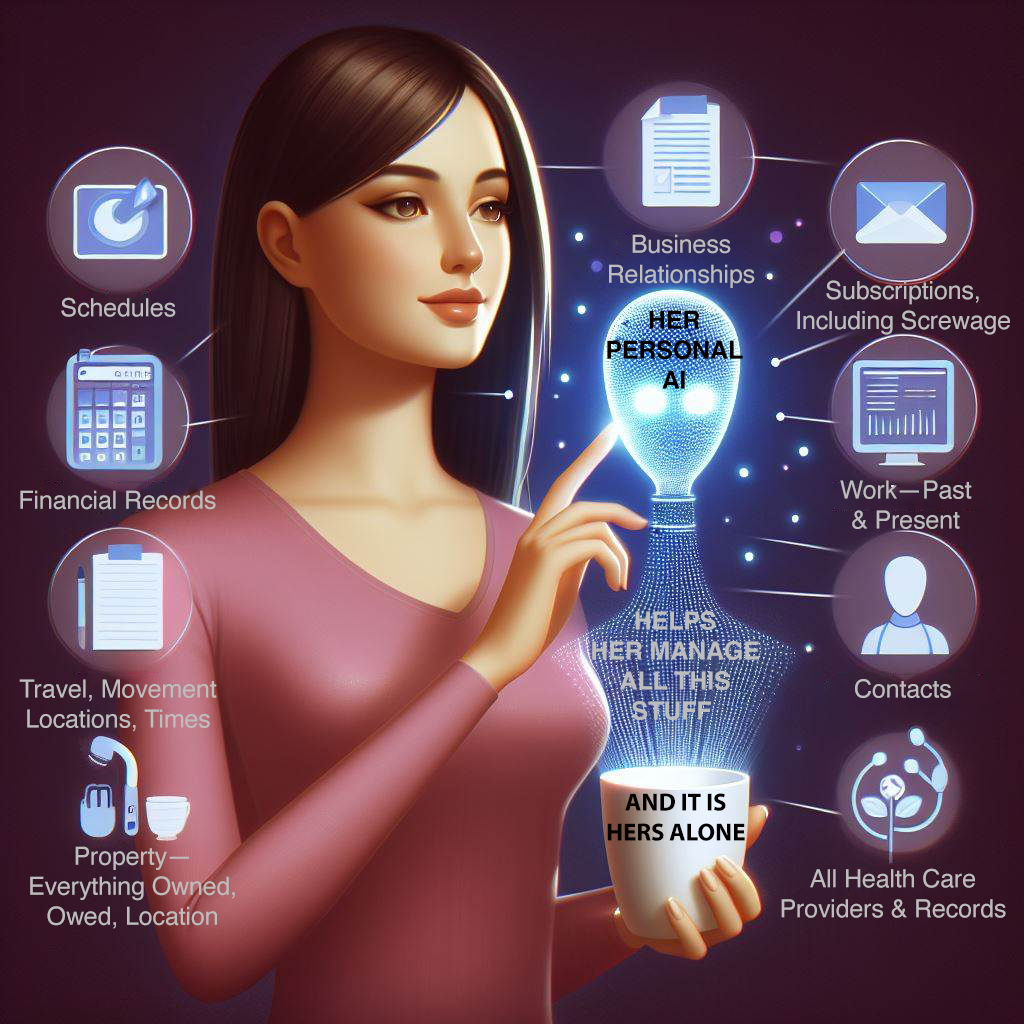
Interesting that ChatGPT thought the place for her stuff was a coffee cup. But at least it was a physical thing. In reality, what would that physical thing be?
Apple gave us the first model for one, back in the late ’80s. It was called the Knowledge Navigator:
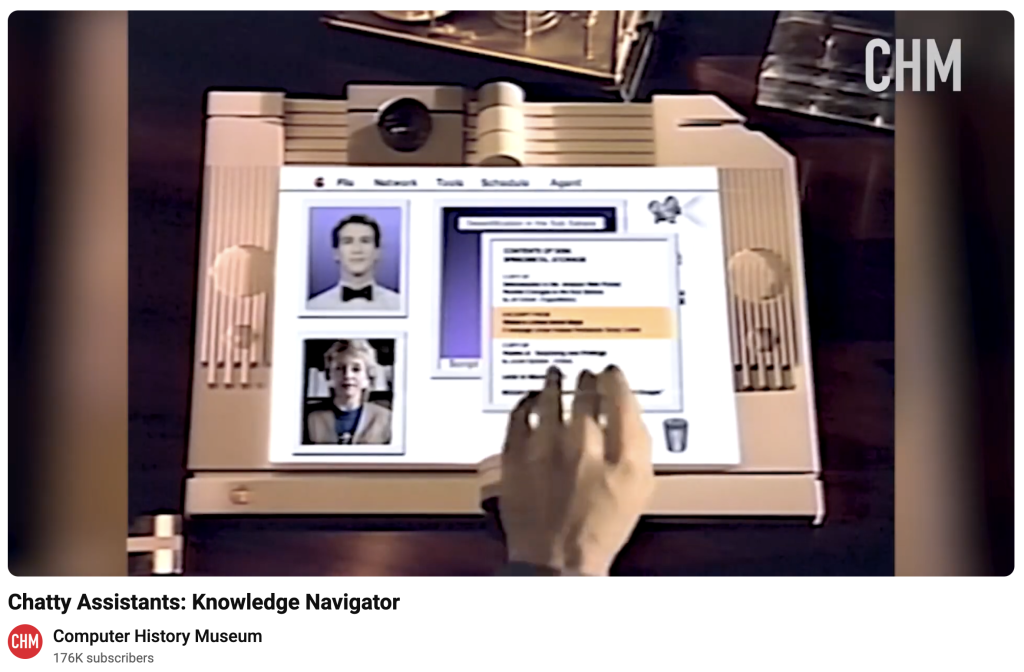
Hats off to Tor Hagemann for pointing us to it. Really, check it out. The video is less than six minutes long and describes the kind of thing we need: A device, not just a service.
The place in that video is a professor’s study. For you and me, it might be a workshop or a cabin. Whatever the metaphor, we need a home on the Internet range: one as comfortable, safe, secure, familiar, and as much ours as our home in the natural world.
Our digital stuff (such as in the graphic above) is what techies call “unstructured.” It’s many different kinds of data, organized in many different ways. AI is good at dealing with unstructured digital stuff. We just don’t have AIs of our own yet, or a place for our digital stuff. But work is going on. Let’s review some.
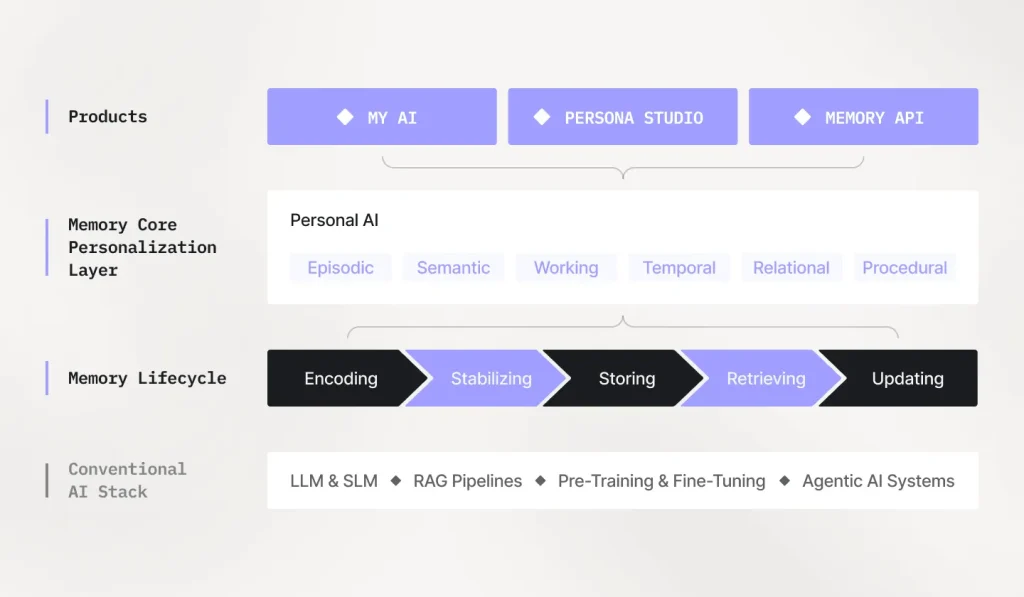
1. Personal AI
Here’s a picture worth many more words, from the company’s Platform page:
2. Jan.ai
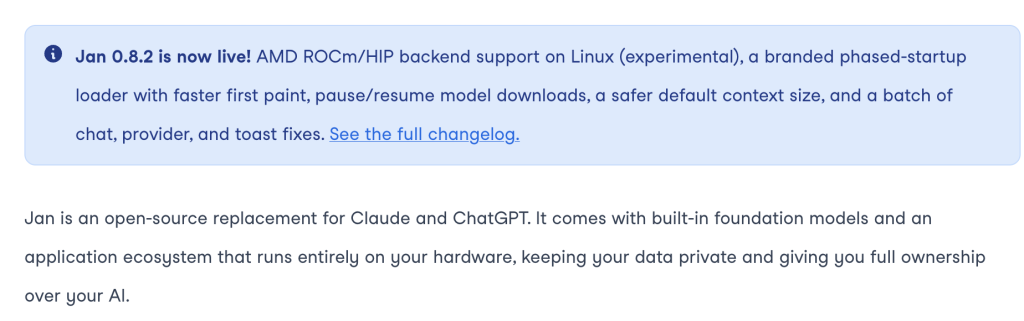
“Personal Intelligence that answers only to you.” It runs on one’s own machine, with local models of your own choice, privacy by default, and a cloud option. Here’s a grab from the website today:
3. OpenClaw
Here’s what its Github site says:
OpenClaw is a personal AI assistant you run on your own devices. It answers you on the channels you already use. It can speak and listen on macOS/iOS/Android, and can render a live Canvas you control. The Gateway is just the control plane — the product is the assistant.
If you want a personal, single-user assistant that feels local, fast, and always-on, this is it.
Supported channels include: WhatsApp, Telegram, Slack, Discord, Google Chat, Signal, iMessage, IRC, Microsoft Teams, Matrix, Feishu, LINE, Mattermost, Nextcloud Talk, Nostr, Synology Chat, Tlon, Twitch, Zalo, Zalo Personal, WeChat, QQ, WebChat.
Website · Docs · Vision · Third-party notices · DeepWiki · Getting Started · Updating · Showcase · FAQ · Onboarding · Nix · Docker · Discord
Lotta stuff there.
4. Kwaai
Kwaai is an nonprofit open source personal AI R&D shop with a large and active community. I volunteer there as Chief Intention Officer—a title that plays off The Intention Economy, which at least partly inspired the company. Kwaai’s main work these days is KwaaiNet, which its Github page describes this way:
KwaaiNet is a decentralized AI node architecture for Layer 8 — the trust and intelligence layer above the traditional network stack — built by the Kwaai Foundation, a 501(c)(3) nonprofit AI lab focused on democratizing AI.
Each KwaaiNet node combines:
- A decentralized trust graph (cryptographic identity, verifiable credentials, local trust scores).
- Shared, sharded LLM compute over heterogeneous CPUs/GPUs using Petals-style distributed inference. Apple Silicon Macs use llama.cpp with Metal for 30+ tok/s local inference; Linux nodes use CUDA-accelerated block sharding.
- Secure multi-tenant knowledge storage via Virtual Private Knowledge (VPK) with encrypted vector search.
- Intent-based, peer-to-peer networking that routes based on “what I need” (model, trust tier, latency), not just IP addresses.
From an app’s point of view, KwaaiNet looks like a familiar chat-completion style HTTP API. Under the hood, it is a person-anchored Layer 8 fabric where every node is tied to an accountable human or organization.
Companion Intelligence offers “the AI that you own.” Here are some more one-liners from the website:
- “Stop renting the Cloud and start owning a personal AI powerhouse.”
- “Your server. Your rules.”
- “Digital Memory”
- “A Local Home for Your Companion Memory”
- “Your private AI cloud”
- “Other agents are double agents.”
Their place for your stuff is:
- local hardware (a choice of their box or one of yours that you can turn into “your own unified private AI cluster”),
- local storage,
- local models or cloud models by choice,
- persistent memory,
- agents and apps,
- remote access,
- an app marketplace, and
- wearable and browser inputs
Companion Intelligence also has an interesting take on memory:
Your life creates valuable context every day.
It’s just spread across documents, notes, meetings, messages, and old decisions. Companion Intelligence brings that context together, so your agent can find what matters and help, more effectively, from where you left off.
Most AI tools are temporary, and interchangeable. They answer a question, finish a task, and forget the larger story. Companion Intelligence gives AI a private home base: a place to understand your files, projects, routines, decisions, and history without making someone else’s cloud the center of your life.
(For more on this angle, read Memory in the Age of AI Agents, by too many authors to list.)
Agents for Companion Intelligence can come from elsewhere. They note two so far: Hermes and OpenClaw. They also promise “universal MCP Support for OpenCode, NanoClaw, Claude, Codex, VSCode & more.”
6. Lovarys
By offering you a server (actually a repurposed Mac Mini), Lovarys is similar to Companion Intelligence, but aiming for the professional market. Its tagline is “Professional Accounting and Legal Intelligence.” It’s a project of Tor Hagemann. Here’s his Github page.
Around all of those efforts is an emerging ecosystem that (to me) seems to be trying to turn AI into an operating-system layer. Examples include:
For more guidance on where this might go forward, here are two academic papers worth visiting:
- OpenJarvis: Personal AI, on Personal Devicesi, another academic paper by many people.
- Opal: Private Memory for Personal AI, by fewer people. I
7. Apple
[7 July 2026—I just moved this section to a post of its own and improved it a bit. It was too long to keep here anyway.]
So let’s close with a table of what we’ve reviewed so far:
| System | Owner | Memory | Outside AIs | Sovereign? | Character |
|---|---|---|---|---|---|
| Apple Intelligence | Apple/person | Deep | Yes | Partial | Private cabin inside Apple’s estate |
| Personal AI | Company/person | Deep | Limited | Partial | Digital twin in the cloud |
| OpenClaw | Person | Deep | Yes | Mostly | Self-hosted AI stack |
| Jan.ai | Person | Moderate | Yes | Mostly | Personal AI workshop |
| Companion Intelligence | Person | Deep | Yes | Mostly | Personal homestead |
| Lovarys | Professional/person | Deep | Selective | Mostly | Private study or office |
| Kwaai | Person/community | Intended deep | Yes | Aspirational | Cooperative village |
| Friend | Company | Moderate | Yes | No | Companion in somebody else’s house |
All good efforts. But still a long way from what George Carlin wanted forty years ago.
By the way, if you’ve made it this far, you might want to read Will Apple Give Us Truly Personal AI? because it picks up where this post leaves off.


Leave a Reply