I don’t know who was the first to write The em dash is dead and AI killed it. Maybe it was Jacob Schilleci in the Reno Gazette Journal, but since most of it is behind a paywall and that paper is one of many run by Gannett, I’m not sure—though that’s where the first link in this sentence goes. Credit where due.
What I am sure about is that em dashes are part of my style, and I’m not going to stop using them.
I’m a Boomer, at least demographically, but I rarely use ellipses in my writing, no matter where one might go. But I do remember that the keyboard chord for producing an ellipsis on a Mac is option + semicolon, and the one for an em dash is shift-option-hyphen. The problem with the ellipsis one is that it’s a single character (Unicode U+2026) rather than three periods in a row. So not using that Unicode thing might be the least leveraged pro tip you’ll get today.
To see if this works with my blog. If it does stay tuned for more.
Okay, I’ve been posting more, above.
More importantly, I’m back in the groove with Wordland. I’d stopped while waiting for a new WordPress theme that would be friendlier to Wordland. I haven’t moved to that theme, but Wordland is working. Praise Murphy.
I shot the photo above last night on approach to SFO. My window seat was on the left side of the plane. Tell me where this is, what the two most standout features are, and what was happening in the brigher one at the time.
For many years, I attended an annual gathering of folks who wanted to save the Internet for future generations. Aspirational guidance was provided by the metaphor “big hooks:” ones meant for catching big fish.
Since I was a kid, my life has always been about big hooks, especially ones that maximize personal and collective agency, pulling people together for the common good. I wanted new centers that hold, and to improve the holding powers of old centers.
When I was young, broadcasting and journalism were two of those centers, and I loved working in both. I also learned that these were media environments with what Marshall McLuhan (borrowing from Aristotle) calledformal (as in formative) causes: they formed us while we formed them. It pains me that broadcasting and journalism have faded as centers and are mostly holding echo chambers together, thanks to social media, search, AI, and other habitats containerized by algorithms optimized for engagement. But I do see good in how everyone now has powers to broadcast and perform journalism that only a relative few once had.
I’ve also seen some big changes ahead of their time: PCs in the ’70s, the Internet in the ’80s. In the ’90s, I saw Linux as the people’s way to stand up their own servers and establish themselves on the Internet’s vast commons. This got me a gig with Linux Journal that lasted 24 years. During that span, I did my best to also spread the word on free software and open source (both huge hooks of their own).
In the late 90s, Chris Locke brought four of us together to write The Cluetrain Manifesto, which remains a hook too big for any fish—so far. (It became a bestseller mostly because marketers nibbled all over it. They didn’t know Cluetrain was a hook for markets, not one for marketing.)
Now I’m working on three hooks that may not catch anything until after I’m dead, but I do think will matter a lot for the living. These are—
MyTerms, a new IEEE standard (P7012), from a working group I chair. It will flip the script on how privacy is respected online, obsolescing notice-and-consent and opening markets to far better forms of mutual trust. It will also set the stage for far better signaling of intentions and agreements between customers and companies, making what was prophesied in The Intention Economy come true. When it does, People vs. Adtech will be a fight people will win.
Personal AI, which we don’t have yet. (Personalized AI from suction cups on the tentacles of giants at best only emulates it.) Put simply, we need personal AI for the same reason we needed personal shoes, bikes, cars, and PCs. There is progress here. Open source AI models are available. (Huggingface lists lots of them.) [Update on 14 October: Nvidia has announceda $4k personal AI box called DGX Spark. It’s aimed at developers and AI researchers. But, as Marc Andreessen told me long ago, “All the significant trends start with technologists.” (Note: the Linux Journal site no longer has visuals for old pieces. If you want the full experience of the piece at the last link, my own copy is here.) So watch this space.]
News Commons, a set of ways to make local journalism far more sturdy and valuable. EmanciPay, a monetization model that combines ease of use, high personal agency, and collaboration, is a smaller hook in the same tackle box—one with potentially enormous payoffs for artists of every kind.
None may ever catch a thing (though I have high hopes for the first two). But at least they’re in the water. And I am still fishing, full-time.
I couldn’t find a better image for this post than this small limestone henge in a neighbor’s back yard.
I live a full and active life. In fact, I’m probably more engaged than I’ve ever been, with faith that at least some of my ideas (here are three big ones) will play out in constructive ways over the coming years and decades.
But, at 78 (still a year younger than the current US president), I am also more mortal than ever, and I know it, especially since I figure at least a third of the guys I grew up with are now gone, or ahead of me in the checkout line.
My heart seems fine, but I’ve had an ablation to stop occasional atrial fibrillation. I take blood thinners to prevent another pulmonary embolism (I had a scary one in ’08, but none since). I have a bit of macular degeneration. My genetics are long on longevity (my paternal grandma lived to almost 108), but I have some risk factors as well. The main one, however, is plain old mortality. We’re here for the ride, but the ride ends. And I know that.
Here is another way to look at it: I’m a puppy, meaning I now have the life expectancy of a dog. If I’m a healthy rat dog, like a terrier, I might live to twenty.
So I’ll be devoting more of my bloggings to surfacing valuable lessons and stories left in my care by those now gone, and to making clearer what I’m bringing to generations after mine.
Here is one of the biggest lessons: life really is short. By design, we only get a few dozen years. My 78 went by fast. And each year goes by faster, since it’s a narrower slice of one’s pie of life.
Another way to look at it: Life is exceptional, and death is its most durable feature. Of the carbonate rocks that comprise a quarter of the Earth’s surface, most were once alive or close enough. The limestone in the henge above was living muck before it turned to rock.
My point is that we all need to get out of here. Still, I operate in willful oblivity to the inevitable, because that’s more fun and productive than worrying about it. And being an inveterate creature helps for doing that.
Seems to me these violate the Hatch Act, aka “An Act to Prevent Pernicious Political Activities.” It was passed in 1939 and amended a couple of times since then. I am not a lawyer, but I know some, and I can read. One useful source is this guidance from the Office of the Special Counsel.Reading that tells me all this stuff crosses the Hatch Act line. But there are maybes in there. For example, this: “…activity directed at the success or failure of a political party, candidate for partisan political office, or partisan political group — then the expression is not permitted while the employee is on duty.”
Whatever, seems to me this will come down to what the OSC decides. How free of politics is the OSC? Its About page says,
The U.S. Office of Special Counsel (OSC) is an independent federal investigative and prosecutorial agency. OSC’s statutory authority comes from four federal laws: the Civil Service Reform Act, the Whistleblower Protection Act, the Hatch Act, and the Uniformed Services Employment & Reemployment Rights Act (USERRA)…
In addition, OSC enforces the Hatch Act, which puts certain restrictions on partisan political activity by government employees…
So, if the OSC believes the Hatch Act is being violated here, its focus will be on the government employees behind those clearly (to me) partisan website banners.
But will it do anything? The last guy to run the OSC was fired by President Trump early this year. It has been musical chairs since then. Jamieson Greer is currently the Acting Special Counsel. Trump’s earlier choice (and the Special Counsel in Waiting?) was Paul Ingrassia. Read about those guys and draw or redraw your own conclusions.
Look, I avoid politics here, because algorithms and an absent appetite for arguments that go nowhere. I’m a registered Independent and think leaders of both major parties are mostly fulla shit in what they are saying about the issues involved in the current government shutdown— and about each other. Meanwhile, the national debt is $37.64 trillion, up $2.17 trillion during the last fiscal year. Just one item.
So I’m taking public notes about this, while shit’s going down. Here is what I have so far (as of 11:07PM on 3 October 2025). The partisan phrases are boldfaced.
US federal government websites with partisan notices:
“Mission-critical activities of CDC will continue during the Democrat-led government shutdown… During the government shutdown, only web sites supporting excepted functions will be updated.”
“Mission-critical activities of CMS will continue during the Democrat-led government shutdown. Please use this site as a resource as the Trump Administration works to reopen the government…”
“The radical left has chosen to shut down the United States government… Treasury’s websites will only be sporadically updated until this shutdown concludes.”
OMB redirects to a WhiteHouse.gov OMB page, atop which is a banner that says “DemocratsHave Shut Down the Government” followed by a live count-up of days, hours, minutes, and seconds.
“Senate Democrats voted to block a clean federal funding bill (H.R. 5371), leading to a government shutdown…” (This appears across SBA pages as “Special announcement.”)
“Due to the Radical Left Democrat shutdown, this government website will not be updated during the funding lapse. President Trump has made it clear he wants to keep the government open…”
This “here” is one of my favorite spots in the world: Mt. Wilson, overlooking Los Angeles. Maybe there’s a better visual to head what I’m trying to say in this post, but I can’t think of one right now.
This blog is mine. While it is hosted somewhere, it could be anywhere. The main thing: it isn’t on a platform, and doesn’t have to be.
I publish it on my own, and syndicate it through RSS.
This puts me in a publishing ecosystem that is wide open and full of interop. If you want to know more about how the blogging ecosystem works, read Dave. He’s the blogfather, and pioneering in many useful and fun directions.
Blogging is an ecosystem because it’s open, as are ecosystems in nature. It’s not a plant in the atrium of some giant’s hotel.
In fact, I think “ecosystem” should apply only to open systems that welcome participation, while we need another word for what happens only on a given platform or inside a given silo. For example, the Net, the Web, and the blogosphere are all ecosystems. Apple’s and Google’s closed and silo’d habitats are something else. Find a word.
Substack is a platform. I am told that one can move from Substack to Ghost or wherever. And, if that’s the case, that means it operates in a larger ecosystem. I’d say the blogosphere. But lots about it looks and feels closed to me.
I bring all this up because today in my email came the newsletter version of Substack is a social media app, by Hamish McKenzie. My instant response was a mix of Huh? and Yuck. Because until then I thought Substack was a blogging host with a newsletter business. Meanwhile, social media as we’ve known it is all silo’d and in deep ways very icky. Calling Substack “a social media app” is, at least for me, a huge downscale move. I felt the same way when I read about OpenAI going into the social app business.
Blogging is just publishing, plus whatever grows naturally around that. It’s a how, not a where, which makes it a much better what. And that what isn’t “a social media app.”
Anyway, my thinking isn’t complete on this, and may never be. But what Hamish wrote in that newsletter turned me off to ever blogging on Substack. I like my freedom and independence.
By the way, if people want to subscribe to my blog in newsletter form, they can do that. Look on the right (or on mobile, at the bottom) for “Get New Posts By Email,” and subscribe. I have 92 subscribers so far. Just remember that I almost always keep editing what I write. For example, my lasttwo blog posts started as one, and I’m still not happy with either of them.
Kind of like life. It’s all provisional. What’s the best ecosystem for that?
[Update on 3 October 2025…] I just learned last night that my sister, @JanSearls, a retired officer with the U.S. Navy and a graduate of the Navy’s War College (among other distinctions) has a Substack. So far, it’s all restacks (a term I just learned), but she’s a good writer, and I hope she will post some original stacks as she gets comfortable operating in Substack’s corner of the greater blogosphere.
This is Part 2 of a post that began with a Jimmy Kimmel monologue, but really wasn’t about that. It was about the grave situation in which over-the-air (OTA) TV finds itself. Here is Part 1.
Even people who don’t like leftish comedy should admit that Jimmy Kimmel’s monologue after he returned to the air was brilliant. It was also, judging from this—
The “affiliate model” is the current TV show distribution system. Simply put, networks (primarily ABC, NBC, CBS, Fox, and PBS) sell programming to affiliates, which are TV stations with channel numbers.
Put another way, they wholesale it. Payments by affiliates to networks for programming is called reverse compensation. It’s “reverse,” because from the 1940s to the late 1990s, networks paid stations to carry programming. Now it’s the other way around. (I suppose the same applies to the lesser networks—ion, CW, Daystar, Bounce, Cozi, etc.—but nobody cares much about those.)
Here is a table of major affiliate station owners:
Top U.S. Owners of Big Four Network Affiliates
Owner
Total TV Stations (owned/operated)
Big Four Affiliates
Notes
Source
Nexstar Media Group
~197
~28–32 ABC (subset shown); majority of portfolio is Big Four
Largest U.S. station owner; more than 200 owned/partner stations across 116 markets.
Allen Media size and 2025 divestiture news. Wikipedia
Notes: Counts are from those sources, as of late September 2025. “Total TV stations” often includes stations that are not owned outright, but operate in one of these other ways:
If you follow those links to understand how this stuff works, note that Wikipedia’s LMA article covers JSAs and SSAs. The SSA page redirects to the LMA page, and the JSA section is anchored on that same page. Complicated shit, but I feel it’s my duty to lay it out.
I don’t list PBS stations because all PBS affiliates are independently owned. While PBS stations also buy programming wholesale from the network, they retail it to viewers as well as to corporate sponsors.
When Trump and Carr want to politically correct (MAGA-align) station owners by threatening to revoke their broadcast licenses, they are mostly talking about the Big Four networks’ O&O (owned and operated) stations, most of which are in major markets. Here are those, in four tables:
Note that some sources (at those links) also list subchannel affiliations as well. Subchannels are secondary channels that stations transmit along with their main affiliate channel (ABC, CBS, NBC, or Fox). This is why, when I said in Part 1 that I would watch Jimmy’s monologue on WRTV channel 6.1, rather than just “channel 6,” it’s because WRTV also mooshes a bunch of these subchannels into the same signal. From Wikipedia’s WRTV page:
Note that the channel with the highest resolution on that list is 6.1, the ABC channel called WRTV. They ever say “-HD” on the air, mostly because why bother, but also because a resolution of 720p is barely HD. If WRTV-HD channel 6.1 were full HD, it would be 1080i or 1080p. But WRTV broadcasts its main channel in lowest HD resolution because it wants to all those subchannels inside the limited bandwidth of its OTA TV channel (in WRTV’s case, channel 25). All OTA TV stations with a mess of subchannels like this one suffer the same trade-off between picture resolution and subchannel count. If you watch TV network streams over the Internet, however, you may get higher resolutions, including 4K. That’s an advantage of having an Apple TV 4K, Roku, Fire TV, or Google TV plugged into one of your TV’s HDMI inputs.
Channel-packing like this was a big advantage in the early days of digital OTA TV. Those subchannels were meant to take up shelf space on cable guides, thanks to must-carry rules. Back then the best TVs were also “full HD,” which was 1080i or 1080p (the latter is better). Now all the good TVs sold are 4K. You won’t see Best Buy or Costco showing off a 4K TV using an OTA or cable station, because the resolution is too low, and the compression artifacts are too obvious, especially on the largest screens.
But, as broadcast television dies off, those moves will matter less and less. Broadcasting’s viewers and listeners are already herded into their political echo chambers by algorithms that optimize for rage, because that’s what best drives engagement.
IndyStar examined WISH-TV’s “Meet the Team” page on its website using the Wayback Machine, which archives billions of webpages across the internet. Between Aug. 24 and Sept. 9, the profiles of more than a dozen employees were scrubbed off the site.
The WISH-TV employees listed below were either terminated or they resigned, left voluntarily after their contract expired, were not offered a new contract, or are otherwise missing from WISH-TV’s current staffing page. They include:
I include all that linky credit-passing because professional journalism is shrinking away, and we need to recognize and support the journalists who are still among the employed.
Since newsroom employment turned negative after 2008, U.S. newsrooms have shrunk by about 26%—from roughly 114,000 jobs in 2008 to about 85,000 in 2020—with newspaper newsrooms down 57% over the same span. And those numbers are from a Pew study published four years ago, when the broadcasting’s melting cube was much larger.
As a professional journalist, I’ve been unemployed since 2019 (after 24 years with Linux Journal). But that’s fine with me. I’ve aged out of the talent pool and would rather focus on remaking the way news is done, from the ground up. That’s what my News Commons series is about.
What I want is to see is What’s On replaced by What Matters. It will take some time for us to institutionalize that. But I believe we will.
I’ve split this post into two parts, because it’s important to unpack how legacy TV works, and why the whole thing is falling apart, with OTA—over-the-air—TV dying first and fastest. Here is Part 2.
I haven’t watched Jimmy Kimmel Live, or any late-night talk shows since Carson, and I didn’t watch much of him either. But I am familiar with Jimmy, through his Oscars hosting gigs, his friendship with Howard Stern (for whom, with Jeff Jarvis, I have been a devoted fan since forever), and from YouTube clips when somebody points me to one and I actually go there, which isn’t always.
But I’ll watch tonight, because I’m curious to hear what Jimmy will say about his hiatus, and because I can get him without cable: a fun challenge for me. I do it this way:
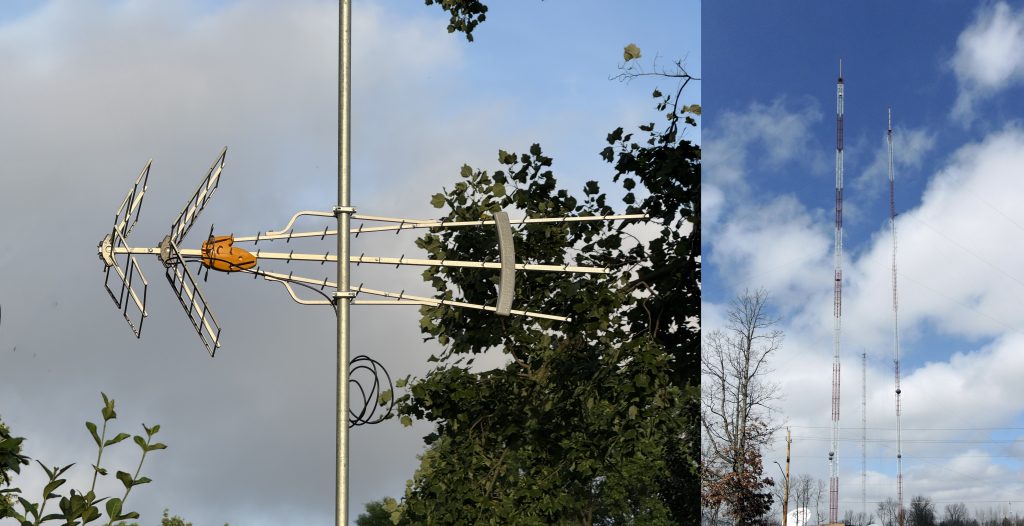
On the left, the TV antenna at our new house in Bloomington, Indiana. On the right, the transmitting towers of WRTV/6 and WFYI/20, both 54 miles away on the north side of Indianapolis. WRTV is actually on channel 25, and WFYI is on channel 21 (their branded channels are “virtual,” as they say in the biz). Thanks to our antenna, a Telves DAT BOSS MIX LR antenna High-VHF/UHF (Repack Ready)*—that’s its name—we get both channels well, even though their signals are weak at this distance.
Being old, I remember when no suburban house was complete without an antenna on the roof. You wanted one because that was the only way you could get a good picture from your city’s TV stations. Sure, you could put a rabbit-ears antenna like this on top of your TV—
—but the picture probably wouldn’t be ideal, or good on all the available channels.
But cable (which began as CATV—Community Antenna TV) would bring you a good picture on every channel, plus lots of new cable-only channels: dozens or hundreds of them.
Then, starting with the Digital Transition in 2008, all the over-the-air (OTA) stations had to broadcast on channels that were best for data, which meant moving to the UHF band (channels 14 and up), or the “high” VHF channels (7-13). Even if a station was already on one of those channels, it may have had to move, sometimes more than once, as the feds auctioned off UHF channels 37 and up (now used mostly for cellular Internet) and stations had to “repack” on new channels. That meant viewers had to make their TVs re-scan repeatedly to get the whole available channel lineup, which tended to come from fewer signals than could be received back in the Analog Age. Thanks to all that, most people didn’t bother to hook up an antenna of any kind.
But I’m a rare exception. Getting OTA TV is like fishing for me. I’ve always been a broadcasting science nerd, and I like hanging out a lure to see what I get. For now, it’s a pile of channels from Indianapolis, plus our nearby PBS station. Yay me.
Back to Jimmy Kimmel.
His network is ABC, carried here by WRTV/6. We’ll be able to get Jimmy tonight, because WRTV is owned by the E. W. Scripps Company. Were WRTV owned by Nexstar, we wouldn’t see the show, because Nexstar won’t carry it on their many stations, for reasons they give here. Sinclair, which also owns many stations, also won’t carry Jimmy, for the same reasons. So, Axios says, all these areas are blacked out:
Source: Erin Davis/Axios Visuals
I’ll let that sit while we visit Nexstar’s plan to buyTegna, a competing station group company. If that deal goes through, this will be the legacy commercial TV network lineup in Indianapolis:
CBS — WTTV/4 and WTTK/29, owned by Nexstar
NBC — WTHR/13, owned Nexstar (acquired from Tegna)
ABC — WRTV/6, owned by Scripps
FOX — WXIN/59, owned by Nexstar
Meaning only WRTV would not be owned by Nexstar.
That’s homogenization at work. It is also economics. Legacy (also called “linear”) TV has been in decline for decades. Some links:
Linear TV Networks Lost 35% Of Reach From 2014 To 2024 “…progressive loss of reach for linear TV networks over the last 10 years, with research from MoffattNathanson and Nielsen indicating a 35% decline across all networks from 2014-24.” (The Measure, May 2025)
First, in cities like New York, where we had an apartment for the last 13 years (we finally let it go in July), you are getting almost nothing from an antenna unless you have line-of-sight to One World Trade Center, from which all the city’s stations now transmit. In the Analog Age, you’d get pictures that looked like crap with a rabbit ears, but you at least got something. At our daughter’s house in the L.A. suburb Redondo Beach, an indoor antenna in her house window got one Spanish station—and nothing else—from Los Angeles’ TV transmitting tower farm on Mt. Wilson. Here in Bloomington, I look at a lot of rooftops to see who has a working antenna. Far as I know, I’m the only viewer in town fishing the TV airwaves. Except for the local PBS station (WTIU/30), nearly all the major network Indianapolis stations (those four above) are too hard to get here without an expensive and fancy antenna such as mine. And I’m advantaged by living on a hill that faces Indianapolis. If you’re between hills or on the backside of one here, even a fancy antenna like mine won’t catch much.
We have a similar situation at our other house, in Santa Barbara. There we’re 500 feet up a steep hill overlooking the city, but we are “terrain shadowed” (as the broadcast engineers say) from all the local TV signals. We used to get occasional signals from San Diego, when those were still gettable and the weather was right. Here’s how some looked in 2008, when our Dish TV receiver had an over-the-air tuner in it. That TV and receiver are long gone, and our new-ish 4K Samsung TV can’t get any of those channels from the same roof antenna. Scanning for signals brings up nothing.
One reason might be the quality of the tuner. Another is that the makers of new TVs don’t want you watching free OTA TV. That’s the message I get from Samsung and TCL. We have three Samsungs and one TCL, and all of them make it hard to scan for channels, and then to access them afterwards. They moosh the locals into a hard-to-use guide of almost countless channels that look cable-like, but aren’t. In the case of our TCL/Roku TV, locals disappear once you’ve scanned them. It doesn’t matter if you’ve made them favorites or not.
One reason for this is that TV makers want to insert personalized ads of their own (based on watching you, like advertising does on the Internet), and they can’t do that through OTA signals they don’t control.
Far as I can tell, nobody in the broadcast business is urging the TV makers to make getting OTA channels easy. Again, the opposite seems to be the case.
Broadcast TV is, as economists say, a distressed asset. That’s bad enough. But hastening the medium’s demise by politically correcting stations—and getting help with that from a censorious FCC—is just dumb all around.
And I’m not saying any of that for political reasons. The station owners and TV makers were no smarter during the Obama and Biden administrations.
For many decades, Local TV was a center that held our civilization together. That the mainstream is drifting into the redstream is beside a much larger point: the selection of TV-like programming on glowing rectangles now rounds to infinite. You can get whatever from whomever and wherever, over the Internet. The best stuff will be subscription-based, mostly. On Demand, as they say. Welcome to now.
So I’ll start up channel 6.1, see what Jimmy has to say, and go to bed. I have more important things to do tomorrow. G’night.
[30 September 2025…] Jimmy’s monologue was brilliant. But that’s beside the points I make in Part 2 of this post.
*Here’s the antenna, in case you want to get one. It’s for stations transmitting on high-band VHF (7-13) and UHF (14-35). If one or more of your city’s stations are still on low-band VHF (2-6), as is the case in, say, Boston (WGBH/2 transmits on channel 5), you will need an antenna such as this one. For guidance toward your chances of getting anything, the best source is RabbitEars.info. Go to the signal map here to see what the fishing is like. And note, again, that you’re looking for the RF signals (the channels stations actually transmit on) rather than the virtual channels (the ones they identify with and display). The RF channels are in parentheses in your Rabbitears search results.
Two kinds of barbeque sauce sold by Costco, at one moment in time.
We had a party recently that required cooking an enormous number of baby back ribs. To acquire a volume of barbeque sauce sufficient to soak all the slabs, we took a run to our nearest Costco (an hour away on the south side of Indianapolis), where thee were plenty of Kinder’s and Sweet Baby Ray’s.
While my personal taste runs more to North Carolina vinegar-based sauce, I can still swing with Texas-style, such as we have with these two. My wife, a confirmed supertaster, preferred the taste of the two mixed together. But if I had to pick just one, it would be Sweet Baby Ray’s. The taste, for me, was a bit more complex and spicy.
Knowing Costco, both might be gone by now, but I thought that much empirical data was worth sharing with the carnivores out there.
My little station wagon parked between two trucks.
The other day I bought a refrigerator at Costco. When a guy rolled it out on a flat to help me lift it into the car, he said, “This isn’t going to fit in there.” Then it did.
It might not have fit in some SUVs. And while it would have fit in the bed of a pickup, I would have had to drive around a pickup all the time. Instead, I’m driving a quiet, comfy, and zippy little car with lots of cargo space.
When SUVs first came along, I craved one. I loved backroads, camping, and what one could do with four-wheel or all-wheel drive. But eventually I realized that the percentage of time I’d spend doing chancy things in places AAA wouldn’t go was sub-minimal, and that I would still need cargo space. So at various times I opted for boxy little cars:
1966 Peugeot 404 Wagon
1985 Subaru Legacy
2000 Volkswagen Passat
2005 Subaru Outback
2017 Volkswagen Golf Alltrack XLE
I’ve only loved the Volkswagens.
The Peugeot was a bizarre piece of shit—though it was big as a hearse in the back.
The first Subaru had a stick shift and four-wheel-drive, but one couldn’t get it into that mode if all four tires hadn’t been worn to the identical tread depth. Seriously. It was also a noisy rattletrap.
The second Subaru was a mostly good car, but not comfortable for long drives. But, like the others, it held a lot of stuff.
The Passat was great all around. It needed a lot of work*, but it was good to 211,108 miles, when I was told the transmission was toast. So I sold it on Craigslist for $125 to a guy who replaced the transmission fluid and said it was actually fine.
*It was only 5 years old and worth $15,000 when I bought it for $5,000, but I then put >$10,000 into it.
The VW Alltrack is close to ideal. The cargo space is smaller than the others, but not by too much. (Hell, it ate a refrigerator.) It’s a great fit, so I don’t feel like I drive it so much as wear it.
Of course, it’s discontinued. The Alltrack line ran from 2017 to 2019, and that was it. Meanwhile, generations of Subaru Outbacks since the ’00s have morphed into wagon-like SUVs.
To find which station wagons are still sold in the U.S., ask an AI. Or two. Or three. I just did, but pasting a linky copy of the results requires a bunch of HTML post-processing.
I can at least say this: the closest new car to the old VW Alltrack line is the Audi Allroad Quattro. The styling is more pinched in the back than the Alltrack, so it might not ingest a whole refrigerator, but at least it’s a nice small wagon, and luxe as well. I don’t want to look closer at them because I might want one.
And right now I don’t, because I just spent $4,000 replacing all four tires (worn Yokohamas for new Michelins) and two wheel bearings (one front, one rear), straightening two bent rims, aligning the wheels, and fixing something leaky (I forget what) in the cooling system. Now it feels like a new car. It is quieter than when I bought it (18k miles ago), and it handles better than ever. I loved the improvement so much that I spent half a day driving around the hilly Southern Indiana countryside, digging every turn and straightaway.
Now, during our brief sojourn to Southern California, we’re getting around in a very nice 2020 Camry XLE Hybrid. It’s still new, with less than 30k on the odometer. Smells like it too. There is much to like about the Camry, especially 45mpg on the cheapest gas, and the sense that it’s a solid and competent machine. But it also feels like, well a very good rental car. And in the trunk is mainly good for the usual: groceries and suitcases. You’ll never get a refrigerator in there.
SD-BASE is a contract you might proffer that means service delivery only. It makes explicit the tacit understanding we have when we go into a store for the first time: that the store’s service is what you came for, and nothing more. Other terms from a roster of MyTerms choices might allow, for example, anonymous use of personal data for AI training. Or for intentcast signaling*.
In the natural world, privacy is a social contract: a tacit agreement that we respect others’ private spaces. We guard those spaces with the privacy tech we call clothing and shelter. We use language and gestures to signal what’s okay and what’s not. “Manners” are as formal as the social contract for privacy gets, but manners are also the bedrock on which we build civilization.
We don’t have privacy online. Not when the owner of a store who would never think of planting tracking beacons inside the clothes of visiting customers does exactly that on the company website. Tracking people is business-as-usual online. And that’s a big reason why civilization online is hardly developed. It can’t be when privacy is almost entirely an insincere promise by those incentivized to violate it.
The reason we can’t have the same social contract for privacy in the online world as we do in the offline one is that the online world isn’t tacit. It can’t be. Everything there is digital: ones, zeroes, bits, bytes, and program logic. If we want privacy in the online world, we need to make it an explicit requirement.
Policy won’t do it. The GDPR, CCPA, and the DMA are just inconveniences for the $trillion-plus adtech (tracking-based advertising) fecosystem. The biggest violators look at paying a billion-euro fine as a cost of doing business.
“Consent” through cookie notices doesn’t work because you have no way of knowing if what they call “your choices” are followed. Neither does the website, because it jobs that work out to OneTrust, Admiral, or some other CMP (consent management platform). And those companies also don’t know or much care. Their job is mostly to bias “your choices” toward agreement to keep being tracked.
Polite requests also don’t work. We tried that with Do Not Track, and by the time it finished failing, the adtech lobby had turned it into Tracking Preference Expression—as if we wanted to be tracked all along.
What we need are contracts—ones you proffer and sites and services agree to. Contracts are explicit, and the only way to make personal privacy work in the online world. They’re also backed by contract law, which has been with us since civilization began.
This is why we’ve been working for eight years on the IEEE P7012 Draft Standard for Machine Readable Personal Privacy Terms, aka MyTerms. With MyTerms, you are the first party, and the site or service is the second party.† You present an agreement chosen from a limited roster posted on the public website of a disinterested nonprofit, such as Customer Commons, which was built for exactly this purpose. When the other side agrees, you both keep an identical record. (The idea is for Customer Commons to be for privacy contracts what Creative Commons is for copyright licenses.)
MyTerms might look scary to business-as-usual. But so did the PC, the Internet, and the smartphone. All did far more for business than the incumbent systems they obsolesced. When customers and companies start relating as partners who fully respect each other and create value together, the range of what’s possible in business widens much farther than what the old tracking-based fecosystem would ever allow.
We can explore those frontiers in other posts. Right now, I just want to make clear that contract is the only way we can obtain personal privacy online. And MyTerms will get us started.
†Credit where overdue: I was first schooled on what contracts really are by Renee Lloyd, who was a fellow fellow at the Bekrman Klein Center back in the late aughts. Renee is also the one who suggested that individuals should be the first parties in dealings with organizations online.
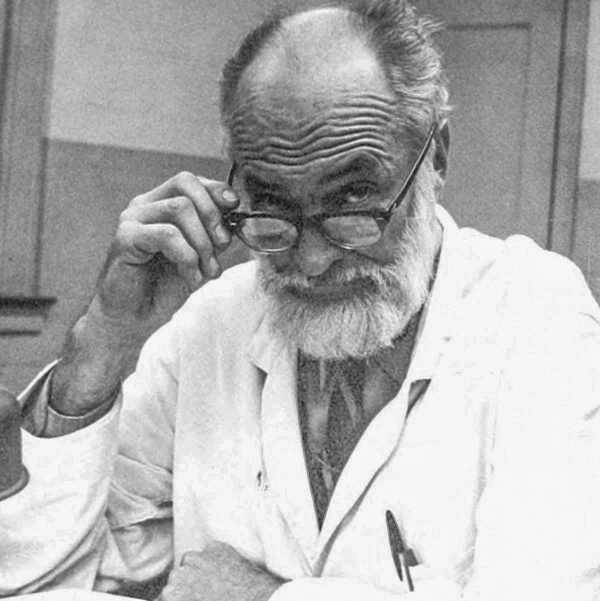
The first thing R.C. Ward taught in our biology class at Guilford College was his eponymous Law:
“If it works, it’s good.”
He frequently mentioned Ward’s Law by name and required it as an answer to nearly every test. As Richard Nilsen explains here, Professor Ward was not a normal dude:
It was 1966 and I was a freshman in college taking an intro to biology class with Richard Carleton Ward, a teacher of peculiar manners and prejudices. I could write a whole chapter on him, the way he spoke out of the side of his mouth in a gravelly grunt, the way he bought conspiracy theories, his suburban house blocked from view in a bourgeois neighborhood by a jungle of bamboo, vines and weeds. He wrote an article for the underground newspaper I was publishing in which he complained ferociously about students’ inability to spell the word, “spaghetti.”
One day, he brought a potted plant to class, and as the bell sounded, he held it up in front of us. “This is the sacred lotus of India,” he said through his teeth. “It sheds water as we are supposed to shed our sins.” He took up a pitcher of water and poured it over the plant, dripping onto the floor, saying to us in biblical voice, “Go forth and sin no more.”
In that same post, Richard reminded me of another Ward’s Law:
His explanation of sex on campus was: “Some do, some don’t.”
He pronounced “some” with a whistled s. That went for every word with an s or a c that sounded like s, such as in the word “pronounced.” All came not just with an ssss sound, but with a 😗.
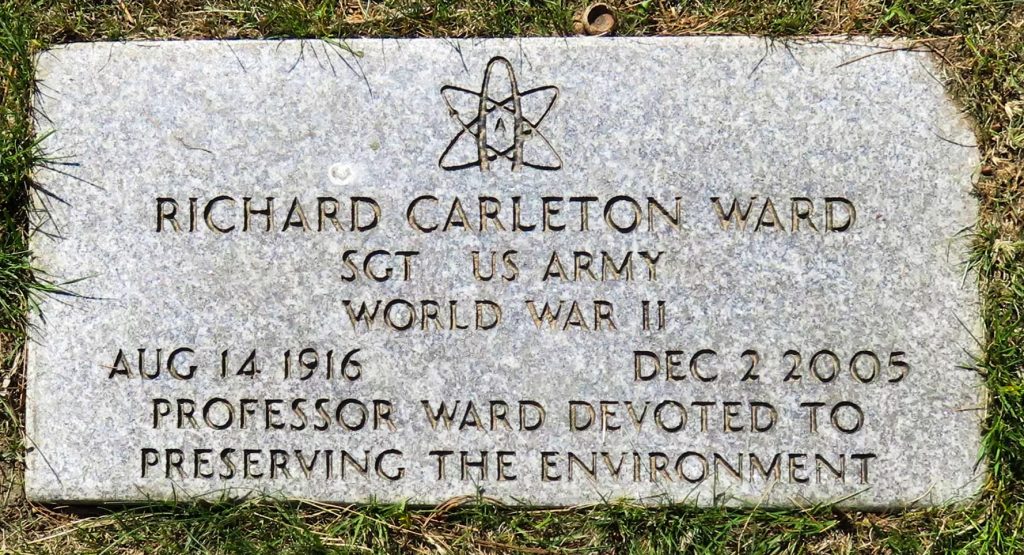
Because you probably won’t click on the photo or the link above it, and I want to give the man and his laws full respect, here are those paragraphs:
WARD, RICHARD CARLETON (1916-2005). Sergeant, United States Army. The Ward family members were among the early English settlers in Rhode Island, arriving in the 1670s. John Ward had been an officer in one of Cromwell’s cavalry regiments, arriving in America from Gloucester, England, after the accession of King Charles II. Another ancestor married the son of Benedict Arnold. Burr H. Nicholls and Rhoda Holmes Nicholls, Richard Carleton Ward’s maternal grandparents, were both noted artists. Burr Nicholls was an oil painter and Rhoda Holmes Nicholls was a painter, water colorist, and art editor in the early 1900s.
The 1918 Darien, Connecticut City Directory records the Ward family living on Runkenhage Road in the Tokeneke neighborhood. On March 19, 1927, Richard Ward was listed as sailing from London, England on the SS American Shipper, arriving in New York on March 30, 1927, with his mother Olive Nicholls Ward, age 39, and his sister, Alida Carleton Ward, age 18. Richard, 10 years old, was listed as having been born in Darien, while his mother and sister were listed as born in New York City.
The 1930 federal census lists Richard Ward’s father, Henry Marion Ward, who was 59 and a lawyer at a law office. His mother, Olive, was 42 and an interior decorator. Sister Alida was 15 and Richard was 13. The home they lived in was valued as $60,000. Richard’s grandparents were all born in New York, except for his maternal grandmother, who was born in England. The family also had a female servant living with them, listed as a 46-year-old “Negro” born in North Carolina.
Richard Ward registered in Darien for the draft on October 16, 1940, when he was 24 years old. He listed his date of birth as August 17, 1916, in Darien, and his residence as on Runkenhage Road in Darien. His contact was his mother Olive Nicholls Ward who also lived at that same address. Richard worked at S. W. Hoyt Jr. Co., Inc. on Washington Street in South Norwalk, Connecticut. He was 6′ 4½” tall and weighed 165 pounds, with a light complexion, blue eyes, and brown hair. He had a small scar on his left shoulder. He signed his registration card as “R. Carleton Ward.” He enlisted in the United States Army on December 17, 1943, and was discharged on November 5, 1949, according to Department of Veterans Affairs records.
Family trees on the ancestry website indicate that Richard married Antonina Pavlova in Canada in 1949. Per Antonina’s obituary in the Greensboro News & Record, she was born in St. Petersburg, Russia, had been a prisoner of war and, after being liberated by the Allied Forces in Austria, she met United States Army Sergeant Richard Carleton Ward there. The 1950 federal census confirms their marriage, showing Ward’s age as 31 and Antonia’s as 26. Per the 1950 United States census, they were living in New London, Connecticut, along with their newborn daughter, who had been born in Canada in August 1949, but was an American citizen. The additional information for Ward shows that he had been living at Westerly, Rhode Island, the previous year, that he had finished one year of college, and that he had served in World War II, but there was no job listed, although he was not noted as unemployed.
Antonina Ward’s 1954 naturalization record, issued in 1954 in Hartford, Connecticut, shows her residing at Bay Road in Amherst, Massachusetts. In the 1950s, Richard Carleton Ward was a botany instructor at the University of Vermont, holding a Bachelor of Arts degree and appointed in 1954, according to the school’s catalogs for 1954-55 and 1955-56. The 1956 Burlington, Vermont City Directory lists Richard and Antonina as living in Vermont. Ward was active in botanical societies and contributed to collections in many parts of the United States. For example, in 1961, he submitted several samples to the Southern Appalachian Botanical Club. Later, he was a biology professor at Guilford College in Greensboro, North Carolina.
According to Ward’s daughter Tanya, Ward and his wife had three daughters, Tamara Olive Ward, Lalla Ward Reid, and Tanya Ward Feagins. The 1970 North Carolina Divorce Index shows that Ward and his wife were divorced on November 30, 1970, in Guilford, North Carolina. In 1994, Ward was living at 8101 Oak Arbor Road in Greensboro, North Carolina and, in 1995, at 410 Guilford Avenue, Greensboro, North Carolina. Per Social Security records, Ward passed away on December 2, 2005. The Piedmont Bird Club of Greensboro, North Carolina, posted an obituary of Ward in their February-April 2006 newsletter. He was known as Carl and was active in the club for many years. He was an activist and lover of nature.
Ward was interred on October 10, 2007, in the same section as his father. His daughter Tamara’s 2014 obituary in the Greensboro News & Record, states that she was laid to rest in what was termed “the Ward family ancestral burial site.” “Professor Ward Devoted to Preserving the Environment” is carved on his gravestone. Section 77, lot 72.
Some possibly interesting bonus facts:
I started hunting down data on Professor Ward when I wanted to credit the source of Ward’s First Law, which I haven’t forgotten in the sixty years since I learned it. Short on luck in my diggings, I asked ChatGPT for help, and it produced both of the sources I used above.
One of those sources, Richard Nilsen, was a year behind me at Guilford, so I am sure that, being a small college (around just 800 students), we at least breathed some of the same air now and then.
New Jersey, until the last few decades, was bereft of state colleges and universities of any prestige, other than Rutgers. So New Jersey exported more college students to colleges and universities elsewhere than any other US state. In fact, I was accepted at Guilford only because, despite bad grades and SAT scores, I wasn’t from North Carolina and would commit to come on “early decision.”
I can’t find an image of one, but I recall seeing blue bumper stickers that said, “DUKE The University of New Jersey at Durham.”
My two oldest kids are related to the Ward family. That’s because Professor Ward’s daughter Tanya married David Feagins, son of Professor Carroll S. Feagins, who headed the Guilford Philosophy Department, where I majored. David’s brother married the sister of my first wife (both kids of Hiram H. Hilty, another faculty member), and their daughter is a first cousin to both of my kids by that first wife, making Professor Ward their great-uncle by marriage. I think I have that right. I hadn’t thought about any of that until I read the long biography above.
Guilford in those days required that graduating students prove proficiency in a second language. I studied no language at Guilford, and my joke about German was that I took two years of it in high school—one of them twice—and gave them back when I was done. But, German was the only second language I might claim, I submitted to a test by the German expert at Guilford: Mary Feagins, wife of Carroll S. Feagins, and future grandma to my kids’ first cousin. Her test required that I read two pages of German out loud from a textbook, and then translate it. She passed me, saying “I’ve never met anyone who could pronounce a language better while understanding it less.”
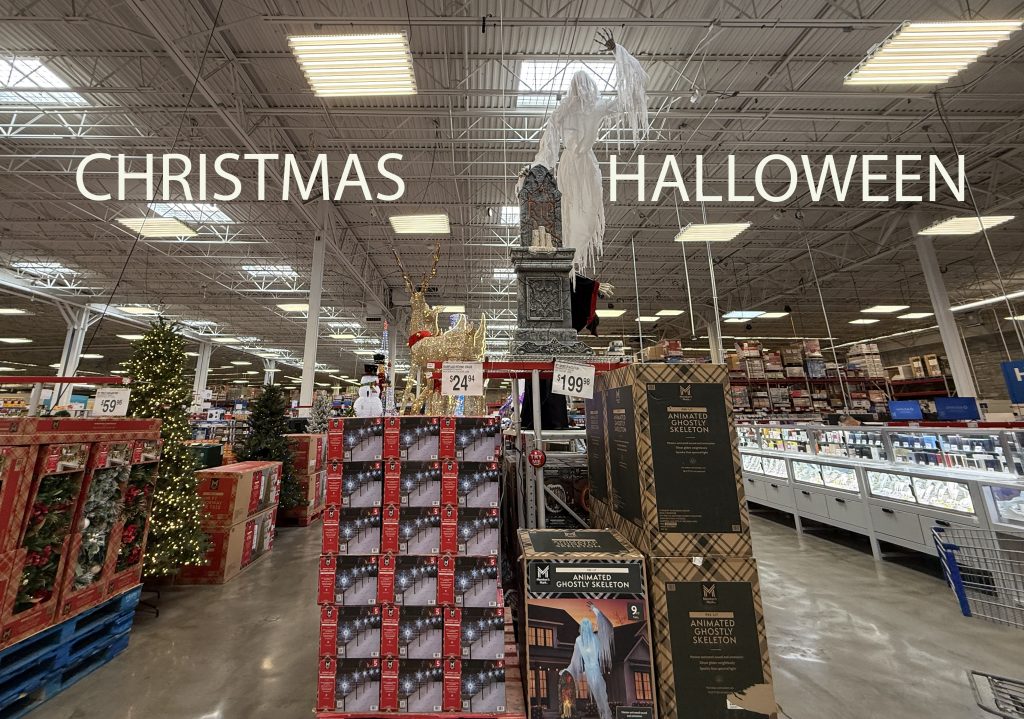
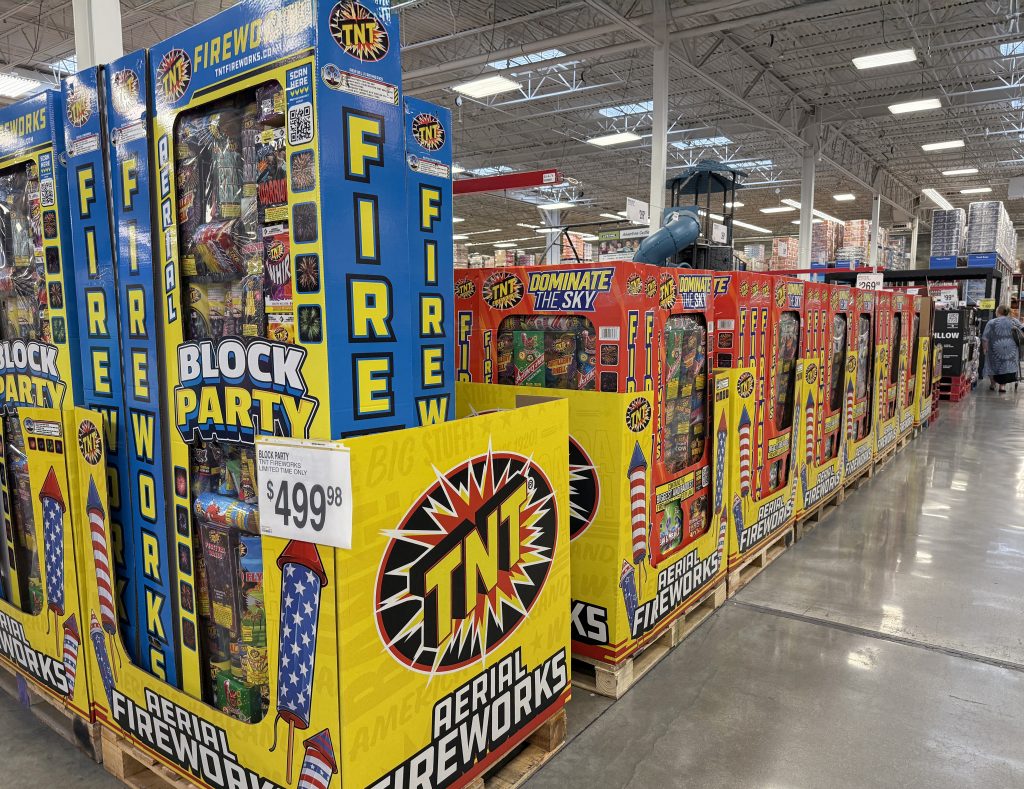
It’s a battle of the holidays at the Sam’s Club here in Bloomington: Christmas on one aisle and Halloween on the next one, back-to-back. Hey! Come in and stock up on stuff that occupies otherwise useful space for 350 partially overlapping non-seasonal days of the year!
At least this stuff (at Sam’s Club in June) tends to get used up, and not stored in your attic:
Unless you’re in Indiana, I suppose. Wondering what percentage of customers store their un-launched fireworks at home, I’ve found nothing about Indiana or the U.S., but I did find Consumer Behaviours and Attitudes to Fireworks in the UK. An excerpt: “Once bought, two-fifths (43%) of people store fireworks in the house, a fifth (20%) in the garage and a sixth (15%) in the shed.” So there ya go.
A top few (said by the site to be the most interesting) of the thousands of IIWs since 2005 that I’ve posted on Flickr.
I wrote for Linux Journal from 1996 to 2019, and have been involved with IIW since I helped start it in 2005. So, in an effort to help substantiate a future Wikipedia article on IIW, I wanted a list of all my Linux Journal contributions mentioning “IIW” and/or “Internet Identity Workshop.” (Never mind that my founding role with IIW may disqualify that list from citation. I still wanted it.) So I asked Gemini and ChatGPT separately to provide me with one, and in chronological order. Gemini gave me just three. ChatGPT gave me the whole list, which I already knew by looking through the /linuxjournal/ directory on my hard drive. (I just didn’t want to hand-organize them chronologically.) So, surfacing the effort, here ya go:
FWIW, https://www.linuxjournal.com/search/ at Linux Journal no longer works. Images are also gone from most of the pieces themselves. But it is truly great that Linux Journal is still alive, and the archives are there and link-able. Hats off to Slashdot Media for keeping it up.
For a time in the ’00s, I wrote a newsletter for Linux Journal that isn’t anywhere online. I think I’ll put that up somewhere at searls.com, eventually.
In case you didn’t click on the photo collection above, the link is here.
A Goodwill price sticker before and after I failed to peel and scrape it completely off.
Please find pricing labels that stick well enough to do their job, and the customer can get off without too much work.
Thanks!
P.S. In an unrelated matter, Grammarly suggested rewriting that second sentence this way:
Please find pricing labels that adhere well enough to perform their intended function, yet can be easily removed by the customer without excessive effort.
Which is better? (Note: I’m posting this thing in a rush between runs to a Costco an hour away from here.)
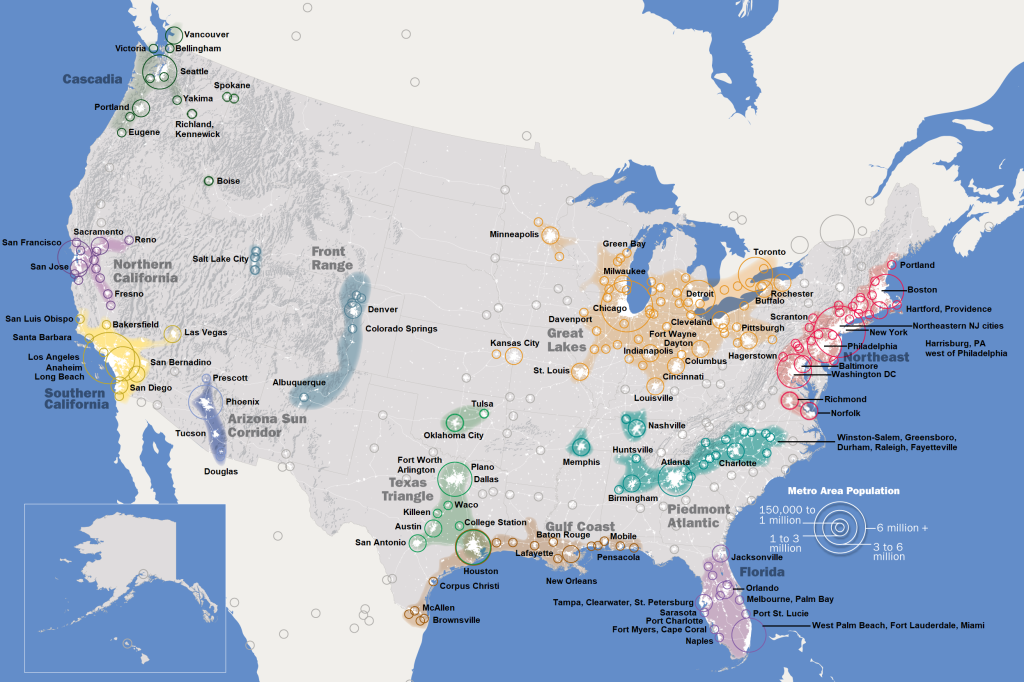
When we got a place in Bloomington four years ago, we thought the town was basically isolated. But we quickly found that we were kinda close to a mess of major league cities. Indianapolis is closest, less than an hour up I-69. Louisville is a bit under two hours away. Cincinnati is about two and a half hours. Columbus is three hours. Chicago is a bit under four hours. Same with St. Louis. Detroit is five hours, and Milwaukee a few minutes more. Cleveland is five and a half. All of these cities are options for a day trip, and we’ve been doing our best to visit them all.
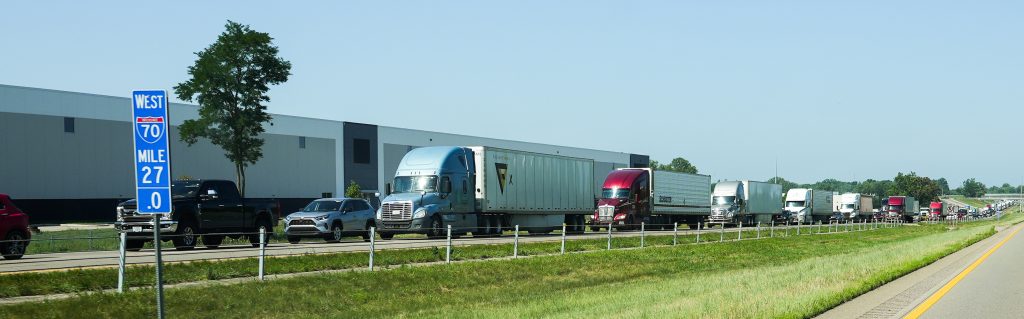
On trips to these cities, we’ve noticed that open country between them is part of what makes them cohere as a region: a feature rather than a bug— especially as the truck traffic between them gets thicker:
Trucks, mostly, passing one of many “cross-dock,” “transload,” “parcel hub,” and “distribution centers” alongside I-70 on the northwest corner of Dayton, Ohio. Shot this when I was driving through earlier this month.
These are (or were) defined by the collections of TV stations that households watched most. My company was once hired by the three major network stations in the Greenville-New Bern-Washington DMA to help pull viewers in Nash, Wilson, and Wayne Counties away from stations on the same networks in the Raleigh-Durham-Chapel Hill market. All stations on both sides had built 2000-foot towers to maximize their signals across overlapping counties. It was quite the war. (One we lost, but that’s another story.)
By now, TV watching has drifted from “What’s On” to “What’s Where.” And there are a zillion choices of “where”: everything on YouTube, TikTok, Instagram, on-demand subscription streaming services such as Netflix, HBO, Prime, Disney+, and your nearby cities’ TV stations. Inside that broad and growing mix, TV stations’ slice of the pie is smaller every day.
Regions now are defined more by commercial connections. Across transport “corridors,” forests and farmlands contextualize connected cities with wide rural frames. In McLuhan’s terms, the medium sending the message is the countryside flanking transport corridors between cities. I suspect this is true of all these megaregions, in different ways. Even the highly urbanized Northeast megaregion has lots of wild and open rural areas packed between their cities.
And what organizes the flow of all that commerce? Logistics. Which is digital, and for decades has been full of AI.
My thoughts on all this are just starting rather than finishing. I think a good place to do that together is by reading the study that got this started.
But he’s not. He’s describing how our AI-assisted lives will get sucked through better interfaces deep into one or more of AI’s giant castles, as “the chat interface replaces the browser as the primary user interface for computing on the web.”
His case is not pretty, but it is clear, thoughtful, knowing, and well-described. He concludes, “Bottom line: Winners will own a trusted front door with standards and auditing and settlements behind it—and help teams actually change how they work and consumers find what they want without dethroning content owners. Everyone else will keep shipping demos into a narrowing feed.”
Note that the winners are giants. You and I? We’re just consumers. Our agency in this system will be no greater than what these giants allow us. Each giant will be (hell, already is) a hotel with a know-it-all concierge who can get us what we want, within the hotel’s confines. But the space is not ours. So, what Cluetrain said in 1999—
—will remain untrue.
And the only way our reach will exceed their grasp is with our own personal AI. Simple as that.
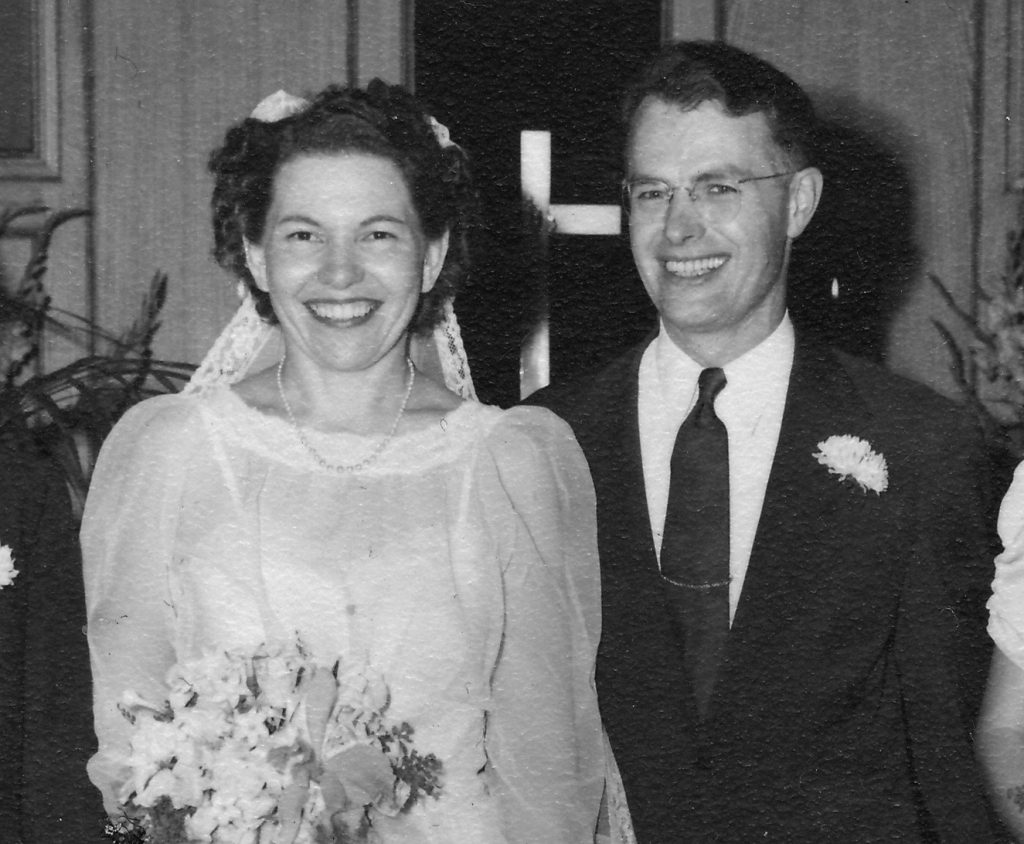
Eleanor and Allen Searls, at their wedding in Minneapolis on this day in 1946.
Happy for my sister and me, who are both still alive and well. I’m also happy for the thirty-three years Eleanor and Allen made a life and a family together. They were great people, great parents, great teachers, great friends to many, and much more. Both are still missed. Some links:
Later… I also did some digging through 2011 correspondence with local realtor Tom Dunn, who said the wedding took place at the late Grace Methodist Church. This Facebook post says the church was at “2125 Thirty Third Avenue North,” but that does not appear to be a valid address. But the photo matches this one in the Hennepin County Library’s digital collection. It’s 2501 NE Taylor Street in Minneapolis. The closest match on Google StreetView is this one here. Tom sent literature on the property, which was then for sale. About the building, it says, “The Church community at the property began in the 1880s when the first sanctuary was built. Then, between 1915 and 1918, a new sanctuary was constructed alongside.” The church was being sold off because its congregation merged with a larger one in 2011.
Still, it could be that Mom and Pop got married at a different Methodist church in Minneapolis. Possibilities:
2125 Thirty Third Avenue North, Minneapolis. According to this 2017 piece in Medium, it is “a church building now housing the Spirit and Truth Worship Center. The original occupant was Grace Methodist Episcopal Church, subsequently Grace United Methodist Church. The original part of the building, on the left of this photo taken from Penn Avenue, dates from 1920.” Here are some historic photos, via the United Methodist Church.
I’m sure there is correspondence from that time in my sister’s archives or mine that will shed more light on the question. No rush, though. What matters is that the wedding happened, and so did the kids and the grandkids.
The Consent Management business, which give us cookie notices and all of us hate, is hot and growing. Will MyTerms give it a better reason than consent (which actually fails) to live and grow?
Wholly shit! Github.org, now redirected to Github.com, just turned into a thing that says “Join the world’s most widely adopted AI-powered developer platform.” Is Micorsofting now a verb?