This is a PageXray of Wired.com:
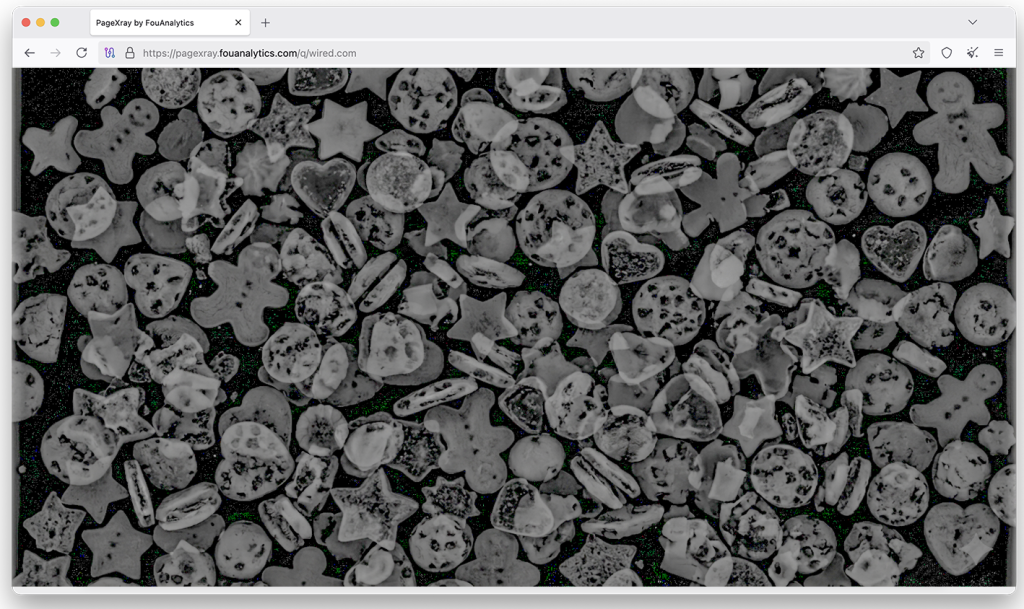
Well, not really. I just want to give you a good idea of what PageXray does, which is far more than show you that a typical website stuffs your browser with cookies.
For example, a PageXray shows all the unseen places to which information about you flows, thanks to the surveillance those cookies enable:
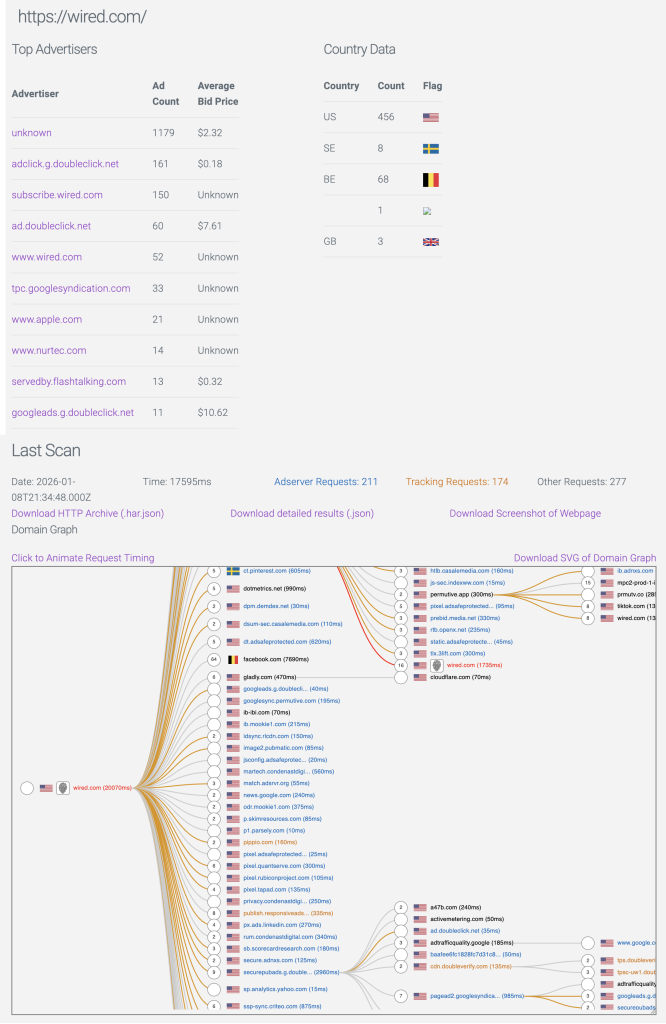
If you zoom out all the way on that graphic, you’ll get this:
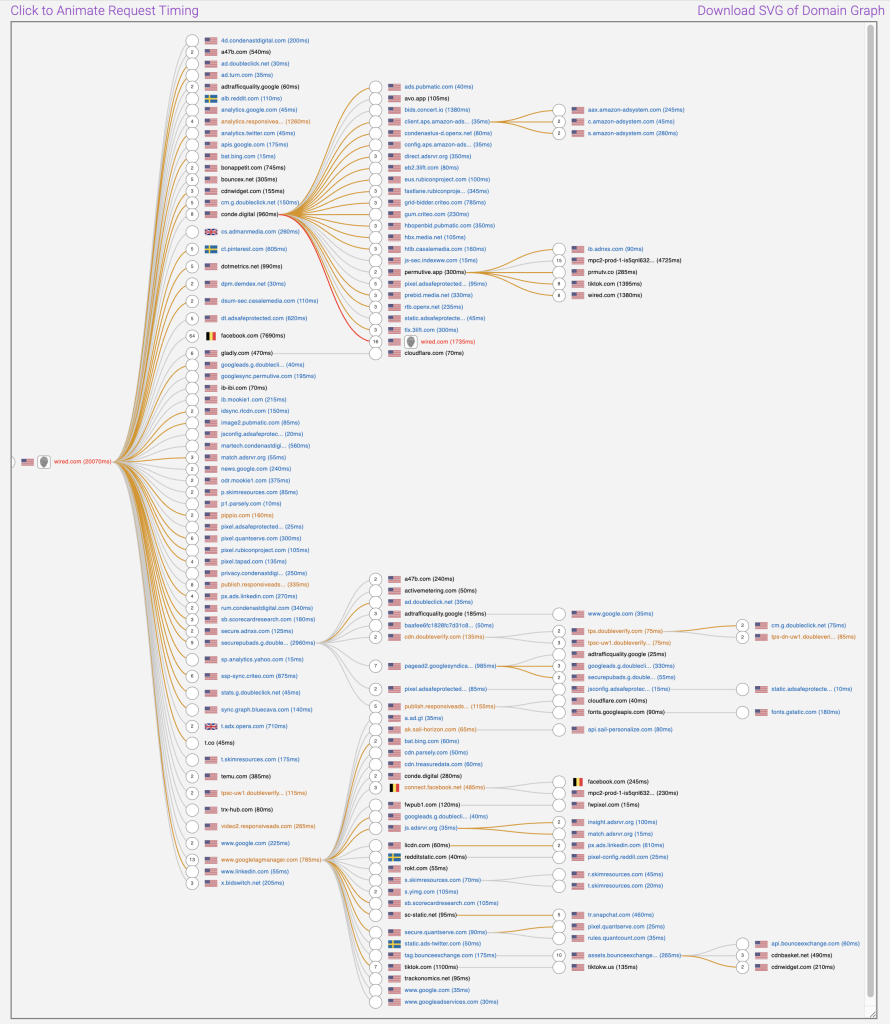
What you see there is the explosion of paths down which data about you oozes out to almost countless places known and unknown.
By contrast, here is a PageXray of Craigslist.org:
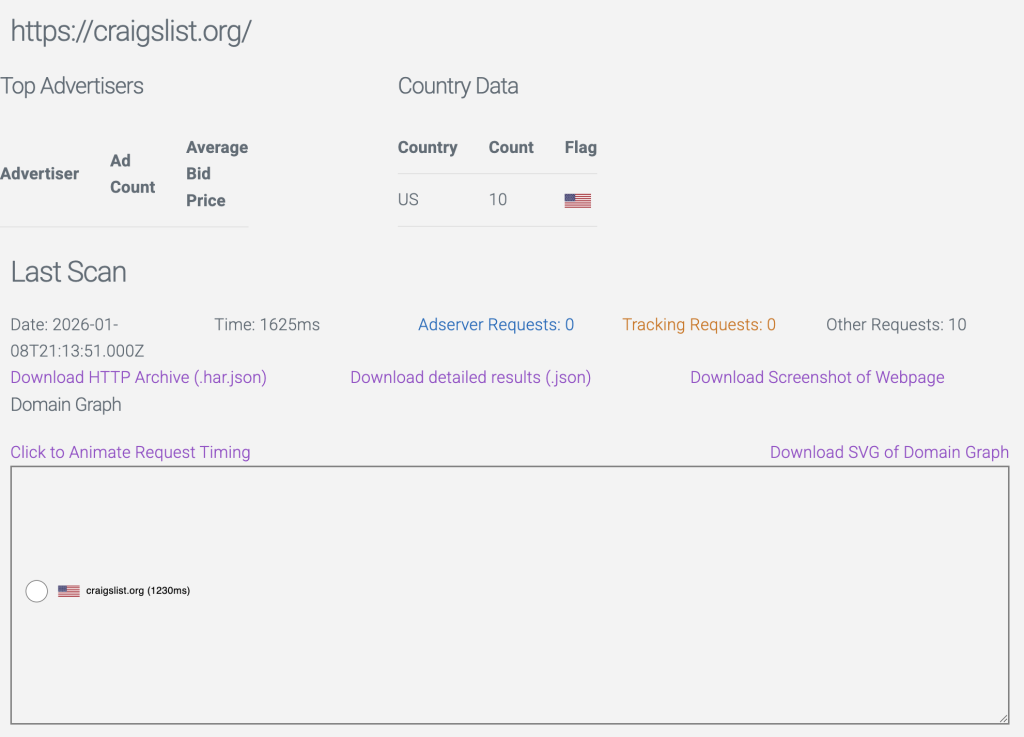
I ran that study after reading Is Craigslist the Last Real Place on the Internet? by Jennifer Swann in Wired. It shows Craigslist doing no tracking at all, which totally retro and morally correct.
Craigslist also doesn’t interrupt your experience with a cookie notice, because it doesn’t play the cookie game. And it’s been that way since Craig Newmark founded the service 31 years ago, on March 1, 1995, at the very dawn of the commercial Web.
But I’m not here to knock Wired, or Conde Nast, which runs the advertising show for all its publications. What they do is pro forma in what we might call Web 2.99.
But rather than jump to Web 3.0, how about a reset to version 1? For a sense of that, here’s an excerpt from the Wired piece:
The site is what Jessa Lingel, an associate professor of communication at the University of Pennsylvania, has called the “ungentrified” internet…
“It’s not a perfect platform by any means, but it does show that you can make a lot of money through an online endeavor that just treats users like they have some autonomy and grants everybody a degree of privacy,” says Lingel. A longtime Craigslist user, she began researching the site after wondering, “Why do all these web 2.0 companies insist that the only way for them to succeed and make money is off the back of user data? There must be other examples out there.”
Examples, that is, of retro enterprises that don’t participate in the adtech fecosystem. Take the IEEE, which was born in 1963, long before Web Zero. Here’s the IEEE’s PageXray:
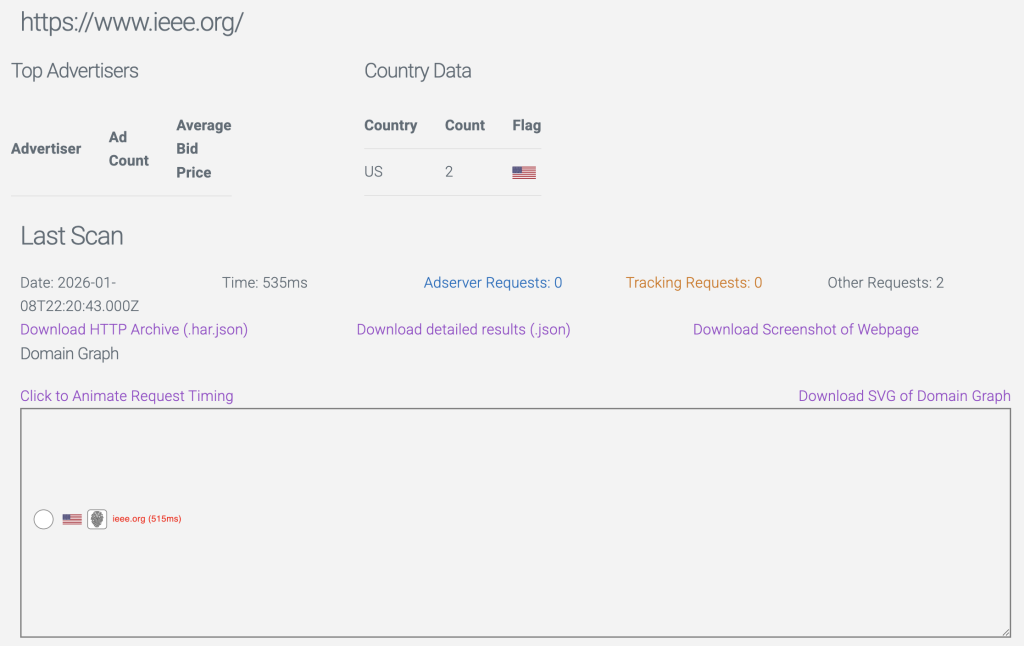
That’s especially cool, since the IEEE hosts the working group for P7012 – IEEE Draft Standard for Machine Readable Personal Privacy Terms, which I chair. That standard is now done, and will be published later this month. Its nickname is MyTerms (much as the nickname for IEEE 802.11 is WiFi).
MyTerms’ purpose is to deliver on the promise of full personal agency that we got from TCP/IP (the Internet) and HTTP (the Web), way back in 1.0 days, and lost in Web 2.0, when surveillance mania spread to the far reaches of human tolerance.
With MyTerms, privacy is a contract between you and the sites and services of the world. You’re the first party, and they’re the second party. You proffer one of a short roster of possible agreements listed publicly by a disinterested nonprofit. Both sides keep identical records of agreement. Here’s a diagram that unpacks it:
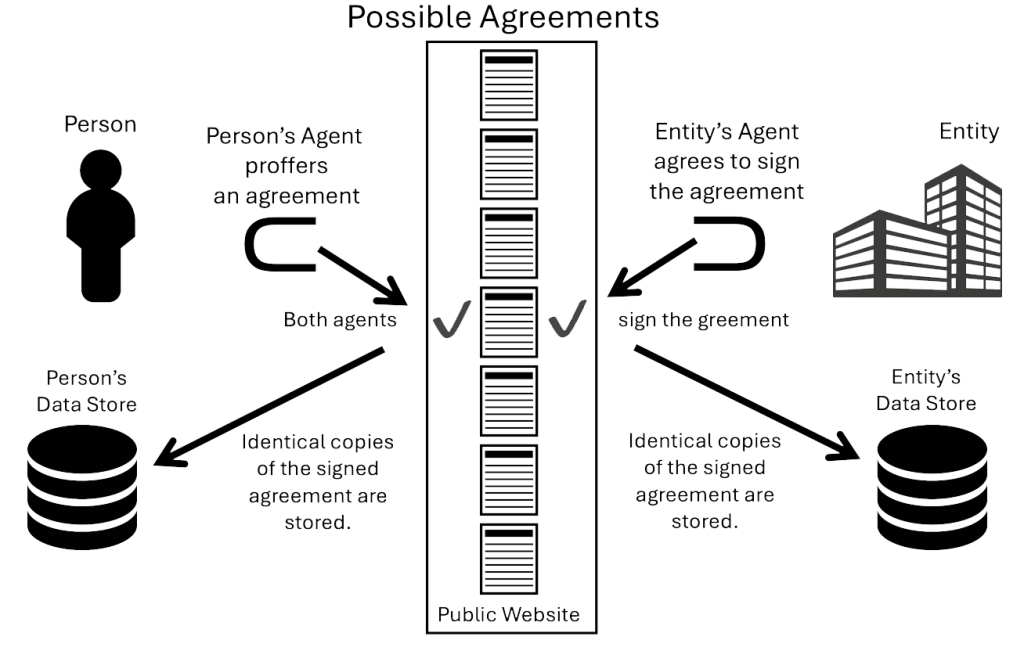
This treats both parties as independent equals, while establishing solid grounds for trusting each other and doing business going forward. That’s it. Some possible initial agreements are described here at MyTerms.info.
I’ve written a lot about MyTerms, most recently in Toward a Proof of Concept for MyTerms, which I posted yesterday, and have been revising since, as feedback comes in.
The purpose of this post is to challenge Craigslist, the IEEE, and other website and service operators whose hearts never left Web 1.0 to help us put MyTerms to work. (I just checked and see that DuckDuckGo and Mozilla also pass the PageXray test. So this is a challenge to them too.)
We don’t need much to get started: a browser plugin, a web server plugin, methods for recording identical agreement records on both sides, and other items listed in the last link.
For sites online where the terms people choose to proffer will be listed, we already have Customer Commons in the U.S. and MyTerms.info in Europe. The model for both is Creative Commons. Put simply, MyTerms will do for personal privacy what Creative Commons does for artistic licenses. We thank them for paving the way.
I also thank Dr. Augustine Fou of Fou Analytics for making PageXray such a helpful and revealing tool.

Leave a Reply