
I nominate agency as Word of the Year for 2025.
I don’t nominate agentic, which is suddenly hot shit:
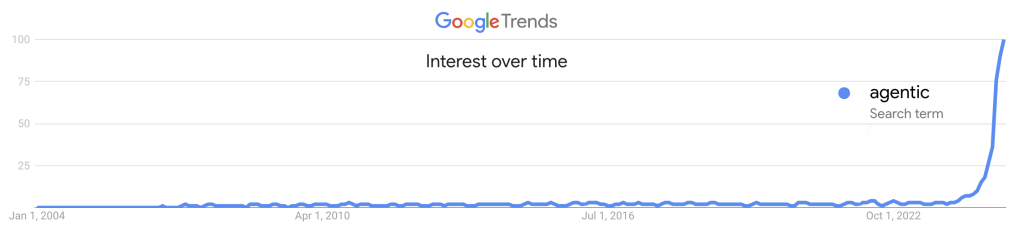
See, agency is a noun, and agentic is an adjective. And, as Strunk and White taught us,
Write with nouns and verbs, not with adjectives and adverbs… it is nouns and verbs, not their assistants, that give good writing its toughness and color.
The word agency is derived from the Latin agere, meaning to do. It speaks of our capacity to act with effect in the world. Or, in the words of the OED (the print version, not the website): Action or instrumentality embodied or personified as concrete existence.
In a chapter of The Intention Economy titled Agency, I say this under a subhead titled The Argument:
Agency is personal. It is the source of confidence behind all intention. By its nature the networked marketplace welcomes full agency for customers. So, because the best vendors are customer driven, there will be many more ways for both vendors and customers to thrive in the networked marketplace, and therefore also in the Intention Economy.
Later I add,
In the Intention Economy, liberated customers enjoy full agency for themselves, and employ agents who respect and apply the powers that customers grant them.
I wrote that (and created the graphic at the top of this page) thirteen years ago, when nobody was talking about agency, but I thought somebody had to.
Now it seems everybody is talking about it. I am sure that’s because we have AI. Or, more specifically, agentic AI. That’s what makes agentic so hot:
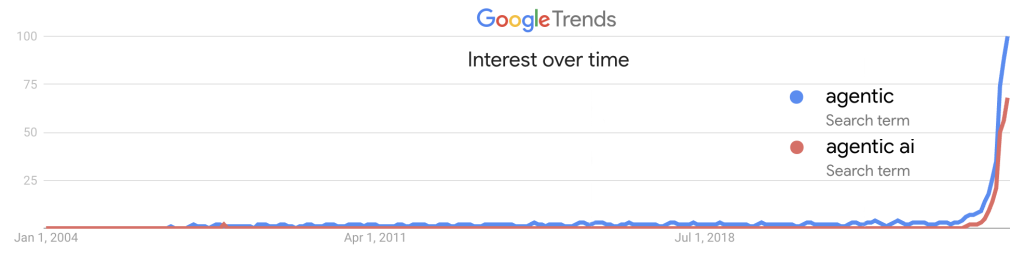
My concern with both agentic and agentic AI is that concentrating development on AI agents (and digital “twins”) alone may neglect, override, or obstruct the agency of human beings, rather than extending or enlarging it. (For more on this, read Agentic AI Is the Next Big Thing but I’m Not Sure It’s What, by Adam Davidson in How to Geek. Also check out my Personal AI series, which addresses this issue most directly in Personal vs. Personalized AI.)
So, what will give you real agency—an archimedean lever that gives you enough leverage to move worlds?
Meet IEEE P7012, which “identifies/addresses the manner in which personal privacy terms are proffered and how they can be read and agreed to by machines.” It has been in the works since 2017, and should be ready later this year. (I say this as chair of the standard’s working group.) The nickname for P7012 is MyTerms (much as the nickname for the IEEE’s 802.11 standard is Wi-Fi). The idea behind MyTerms is that the sites and services of the world should agree to your terms, rather than the other way around.
MyTerms creates a new regime for privacy: one based on contract. With each MyTerm you are the first party. Not the website, the service, or the app maker. They are the second party. And terms can be friendly. For example, a prototype term called NoStalking says “Just show me ads not based on tracking me.” This is good for you, because you don’t get tracked, and good for the site because it leaves open the advertising option. NoStalking lives at Customer Commons, much as personal copyrights live at Creative Commons. (Yes, the former is modeled on the latter.)
On the Creative Commons model, agreements take three forms:

- The person is the first party
- The site, service or app is the second party
- The person chooses an agreement from a limited roster (resembling Creative Commons’ roster of licenses) listed by a disinterested non-profit
- Both sides keep an identical record of what they agreed to
On your side—the first-party side—browser makers can build something into their product, or any developer can make a browser add-on (Firefox) or extension (the rest of them). On the site’s side—the second-party side—CMS makers can build something in, or any developer can make a plug-in (WordPress) or a module (Drupal).
Mobile app toolmakers can also come up with something (or many things).
For the Legal Code and Human Readable layers, we (Customer Commons and ProjectVRM) have been at work on a list of prototypes for the roster of agreements. We’ll present these on April 7 at VRM Day, at the Computer History Museum in Silicon Valley. Discussion will happen both there and through the following three days in the same location at the 40th Internet Identity Workshop (IIW). VRM Day is free. IIW isn’t, but is cheap for a three-day conference that (IMHO) is the most leveraged in the world.
So let’s make this happen and show the world what agency really means.
And, if you’re interested in helping support Customer Commons, use some of that agency to hit the Donate button on its home page. Thanks!


Leave a Reply