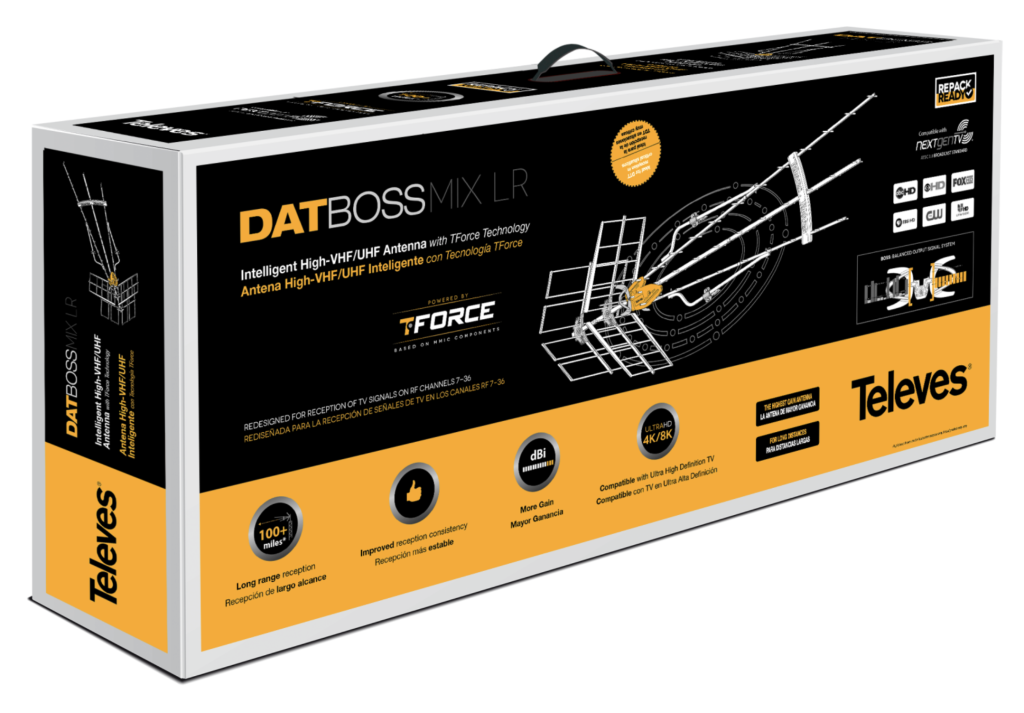
Update on 26 March 2026—The antenna is built and on the pole you see in this post. Though only about twelve feet off the ground, it gets nearly every station from Indianapolis called Fair or Bad. So, a success.
I think I will be the last person in Bloomington to try getting free over-the-air TV from what’s left of all the major networks. But that’s just my style, so roll with me while I explain how I’m hoping to do it, with the antenna above, which I’ll need because here is what the Search Map at RabbitEars.info says we might get here:

We live next door right now, and the top station above, WTIU from Indiana University (our PBS affiliate), comes from a tower you can walk to from here. We can get that signal by using a straightened paper clip for an antenna. (You jam the clip into the center hole of the coaxial connector in the back of the TV.) Even a real indoor antenna connected to the same jack gets nothing else, not even the two stations above with “Fair” signal strength.
But this Televes antenna might do the job because we’re on the slope of a hill that faces the Indianapolis stations that carry CBS (WTTV/4 on 27), ABC (WRTV/6 on 25), NBC (WTHR/13 on 13), and Fox (WRDB/41 on 32)*. These range from 27 to 54 miles away, in roughly the same direction. VHF and UHF signals always gain strength when they hit the faces of hills, similar to how surf builds as it approaches a sand bar or a shore. Also, the Televes DAT BOSS antenna gets great reviews:
- TechHive: Televes Dat Boss Mix LR review: This is a great outdoor antenna
- Tyler the Antenna Guy: Televes DATBOSS LR Mix Outdoor Antenna Review 149883
- Solid Signal: ALL NEW Televes DATBOSS Mix LR Antenna TESTED (w/assembly instructions)
- Amazon: Televes DAT Series BOSS Mix LR Outdoor High-VHF/UHF HDTV Antenna (see the reviews)
I was going to put it in our new attic before the drywall goes up. However, the attic space is low and full of close cross-braces. Worse, the antenna is not small and kinda complicated to fit in a space that’s a web of short 2x4s. Dig:

So it will go on a pole in the backyard and feed a coaxial line that will tunnel through conduit under the yard and inside to the new living room.
But I would like to test it first, preferably with a tuner gizmo I can plug into my laptop. I had one of those for years: the Elgato EyeTV Hybrid TV Tuner stick, which looked like a fat thumb drive,with USB-A at one end and a coax connector for an antenna at the other. It was sold in the ’00s and picked up both analog and digital TV (the Digital Transition was happening then), on every North American channel, and came with good software that ran on Macs and operating systems that have long been abandoned. Far as I can tell there are no replacements that run on current hardware or operating system, other than this one sold in Europe. Far as I can tell, it only works on TV bands over there. But I could be wrong. If anybody knows of a gizmo/softward combo I can use, please tell me. My only other option is to buy or find a cheap TV and try that out. Any advice is welcome. Thanks!
[Later: July 2025…] We are now living in the other house, and getting all the stations from Indianapolis using the antenna above. Sometimes, atmospherics will take away one or both of the VHF channels (WTHR/13 and WISH/8 on 9), but otherwise reception is excellent. And the antenna is only 12 feet above the ground (but high enough to peek over the roof of the house downhill from us).
*After the digital transition in 2008, and again with the “repack” after 2016, most TV stations moved onto channels other than their original ones, using less spectrum overall. All the TV channels above 36 were auctioned off, first in 2008 and again in 2018. Most buyers were cellular and other short-range wireless carriers, which have been repurposing the old TV spectrum for 5G and other modern uses. The only station in Indianapolis that didn’t move its channel position was WTHR/13. That one is listed in the chart above as one of the “bad” signals for this location. The Televes antenna is designed specifically for “high band” VHF (channels 7-13) and the remaining UHF (14 to 36) TV channels. It also filters out any 5G signals that the antenna might pick up on what used to be the higher UHF channels. By the way, the old “low band” VHF channels (2 to 6) are still in use in some places, but by very few TV stations. So it’s not worth it for Televes to design an antenna to pick those channels up. Such an antenna would also be a lot bigger and longer because the low-band elements of the antenna would be much longer.


Leave a Reply