First in the News Commons series.
Were it left to me to decide whether we should have a government without newspapers, or newspapers without a government, I should not hesitate to prefer the latter.
— Thomas Jefferson
News is the first rough draft of history. — Countless journalists
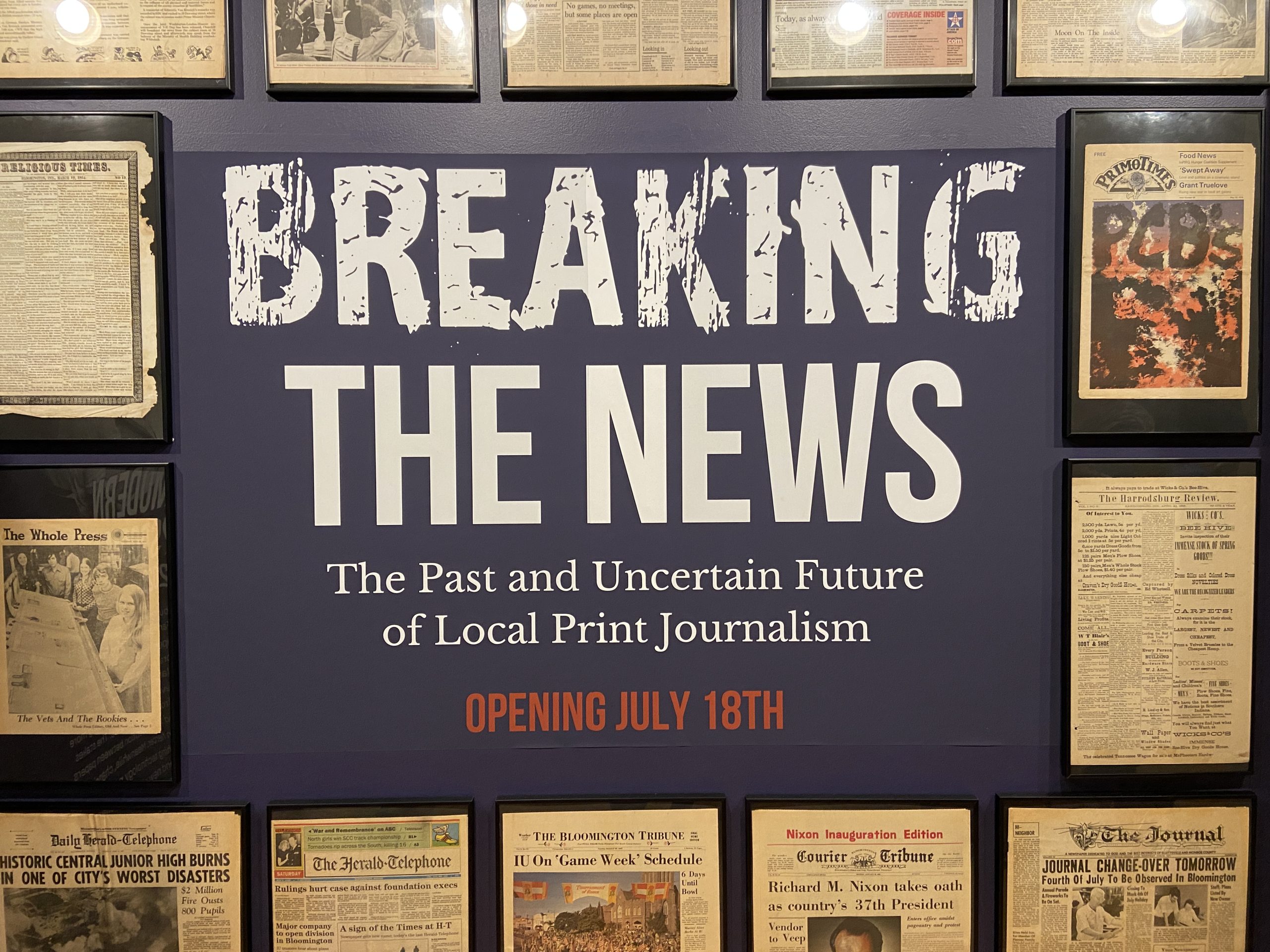
“Breaking the News” is the title of an exhibit at the Monroe County History Center here in Bloomington, Indiana.* It traces the history of local news, starting in the mid-18oos. In those days, several competing newspapers served a population of a thousand people or less. Today, the golden age of newspapers is long past, and surviving talent struggles to satisfy the public’s appetite for news while trying to establish new and sustainable journalistic institutions that function in our new digital world.
Most of the exhibits are provided by what’s left of the city’s final major newspaper, the Herald-Times, which thankfully still persists. Archives of the paper are also online, going back to 1988. I am told that there are microfilm archives at the Monroe County Public Library that go back farther. Meanwhile, bound volumes of the paper, from the 1950s through 2013, are up for auction. (More here, including word that older bound volumes are apparently lost. For more about how important archives are, read Archives as Commons, which is 10th in the News Commons series.)
Meanwhile, in our other hometown, the Santa Barbara News-Press is gone after serving the city for more than 150 years. The Wikipedia article for the paper now speaks of it in the past tense: was. Its owner, Ampersand Publishing (for which I can find nothing online), filed for bankruptcy late last month. You can read reports about it in KSBY, the LA Times, the Independent, Noozhawk, Edhat, and a raft of other local and regional news organizations.
From what I’ve read so far (and I’d love to be wrong), none of those news reports mention the News-Press‘ archives, which conceivably reach back across the century and a half it was published. There can’t be a better first draft of history for Santa Barbara than that one. If it’s gone, the loss is incalculable.†
Here in Bloomington, Dave Askins of the B Square Bulletin, which reports on what public offices and officials are up to, has issued a public RFQ for a digital file repository that will be a first step in the direction of what I suggest we call deep news. This is the kind that depends on archives. It begins,
Introduction:
The B Square is seeking proposals from qualified web developers to create a digital file repository. The purpose of this repository is to provide a platform where residents of the Bloomington area can contribute and access digital files of civic or historical interest. This repository will allow users to upload files, add metadata, perform searches, and receive notifications about new additions. We invite interested parties to submit their proposals, outlining their approach, capabilities, and cost estimates for the development and implementation of this project. For an example of a similar project, see: https://a2docs.org/ For the source code of that project, see: https://github.com/a2civictech/docstore.
The links go to a project in Ann Arbor (where Dave used to live and work) that was clearly ahead of its time, which is now.
We also need wide news, which is next in the News Commons series. Wide news is what you get from lots of organizations and people filling the void left by shrunken or departed newspapers. (And let’s not overlook local radio, which used to have news reporters and is now mostly music and talk piped in from elsewhere. Three exceptions in Bloomington are WFHB, WFIU, and WGCL. That’s three more than you’ll find in most cities of Bloomington’s size.
News reporting is more process than a product, and the Internet opens that process to countless new participants and approaches. Many of us have been writing, talking, and working toward Internet-enabled journalism since the last millennium. James Fallows (see below), Dan Gillmor, Dave Winer, JD Lasica, Jay Rosen, Jeff Jarvis, Emily Bell & crew at the Tow Center, Joshua Benton and the crew at NiemanLab, and John Palfrey with the MacArthur Foundation and Press Forward are among those who come to mind. Me too (for example, here).
Wide news, when it happens, will become a commons: an informal cooperative. (The Ostrom Workshop, where my wife Joyce and I are visiting scholars, studies them.) I think we are getting there in Santa Barbara. But, as the LA Times story on the News-Press suggests in its closing paragraphs, there are gaps:
Santa Barbarans have turned to other sources as the newspaper’s staff withered to just a handful of journalists. Along with the Independent and Noozhawk, some locals said they turn to KEYT television and to Edhat, a website that relies heavily on “citizen journalists” to report on local events.
Melinda Burns, one of many reporters who left the paper after feuding with management, now provides freelance stories to many of the alternative news organizations. Burns, who has spent decades in the news business, including a stint at the Los Angeles Times, said she has seen gaps in coverage in recent years, particularly in the areas of water policy and the changes wrought by legalized cannabis. She continues to report on those topics and said she gives away her in-depth stories free to reach as many people as possible.
“It keeps me engaged with the community and, God, do we need the coverage,” she said. “The local news outlets are valiant but overworked. It’s just a constant scramble for them to try to keep up.”
Maybe it helps to know that a landmark local news institution is gone, and the community needs to create a journalistic commons, together: one without a single canonical source and the old a scoop-driven culture.
I think the combination of deep and wide news is a new thing we don’t have yet. Let’s call it whole news (third in the News Commons series). We’ll know it’s whole by what’s not missing. Is hard news covered? City hall? Sports? Music? Fashion? Culture? Events? Is there a collected calendar where anyone can see everything that’s going on? With whole news, there is a checkmark beside each of those and more.
Toward one of those checkmarks (in addition to the one for city hall), Dave Askins has put together a collective calendar for Bloomington. Wherever you are, you can make one of your own, filled with RSS feeds and .ics files.
At the close of all his news reports, Scoop Nisker (who just died, dammit) said, “If you don’t like the news, go out and make some of your own.”
So let’s do it.
*Breaking the News is also James Fallows‘ newsletter on Substack. I highly recommend it.
†Update on 30 August 2024:
- Santa Barbara Area Newspapers Now Digitized and Preserved! by the Santa Barbara Public Library (No date, and it’s complicated. Here’s one chuck, or set of chunks.)
- Santa Barbara News-Press’ Website Goes to ‘Local Kids’: Group Fronted by Ben Romo Makes Winning Auction Bid of $285,000, by Jean Yamamura in The Independent (9 April 2024) Note that this concerns the website and the online archives. The site itself, newspress.com, is offline right now.
- Behind the Closed Doors of the Santa Barbara News-Press, by Edhat (28 August 2024)
- ‘Santa Barbara News-Press’ Archives Languish Amid Decay, by Jean Yamamura in The Independent (19 August 2024)
- I don’t yet know who bought the bound volumes of the Herald-Times archives (they were auctioned off last year), but at least digital copies from 1943 to 2013 are available at the Monroe County Public Library.
Update on 1 October 2025: The NewsPress.com website is alive again, thanks to Arizona State University’s NEWSWELL, and features contributions by journalists (such as Jerry Roberts and Melinda Burns) who are veterans of the old paper.

Leave a Reply to The Future, Present, and Past of News – Doc Searls Weblog Cancel reply