
David Weinberger once said, “In the future, everyone will be famous for fifteen people.” It’s the future now, and he was right, or close enough. Because today we live in a world where the power to publish and distribute no longer belongs just to institutions, but to everybody. Me included. Here are some stats for this very blog:
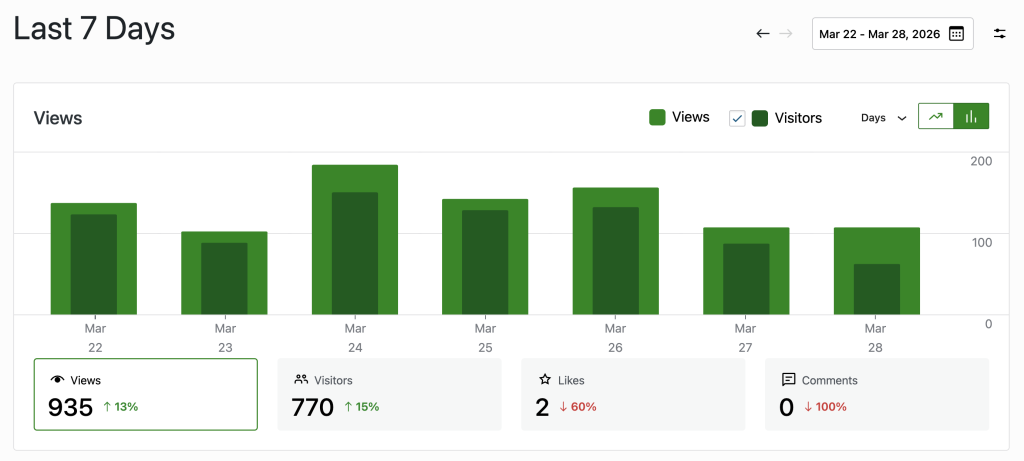
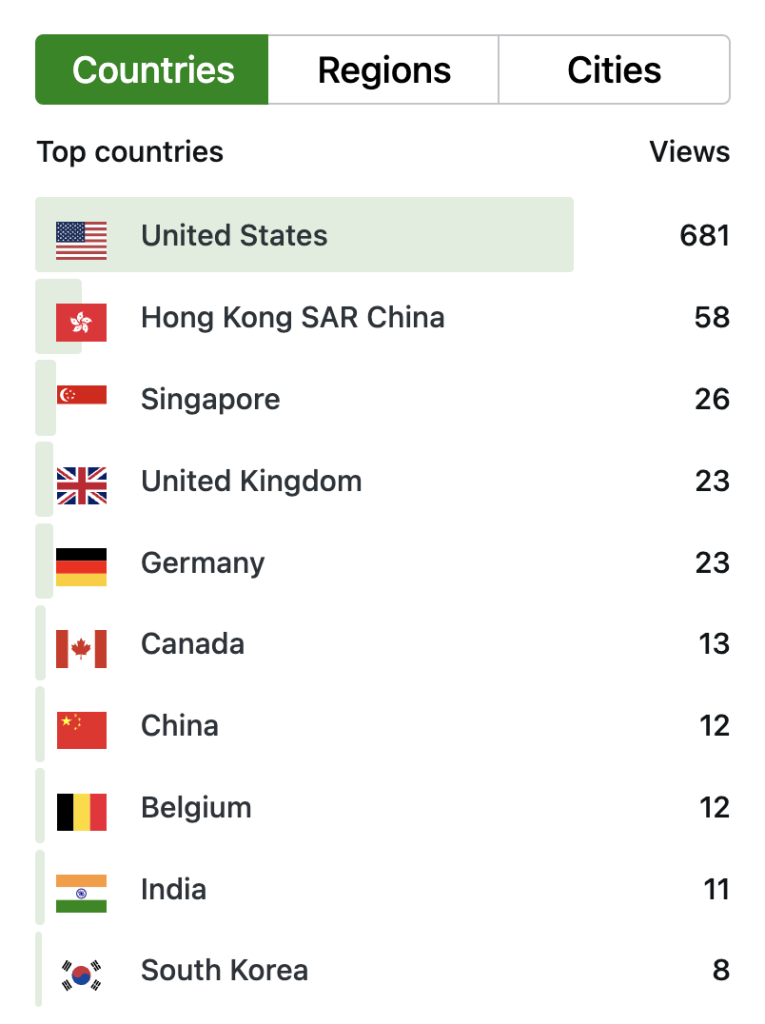
At its peak, this blog had dozens of thousands of visitors daily. But that was in the ’00s, when blogging was a small pond, and I was a large fish in it. That was also when big newspapers and broadcast networks were still mountain ranges on the media landscape. Some were volcanoes spewing abundant material, with links opening outbound reading paths in all directions. Also, only a few hid behind paywalls or opened their pages only to people disabling ad blockers.
Now those mountains have eroded down to hills amidst fresh new volcanoes: celebrities new and old, gushing out “content” on podcasts, social media, YouTube, and the rest. They’re the ones with readers, viewers, followers, and subscribers in the dozens of millions. And with fewer links to places like this one.
The media landscape has also grown into a horizontal vastness of consumers who are also producers. The sum of flow from that vastness far exceeds what we get from the old hills and even the new volcanoes. Let’s call that vastness the allstream.
These sources are “media” in only the literal sense. In kind, they are too different. Let’s explore how.
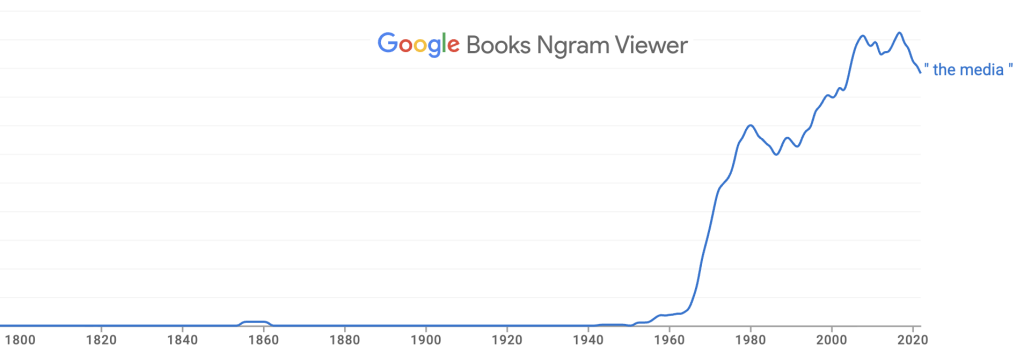
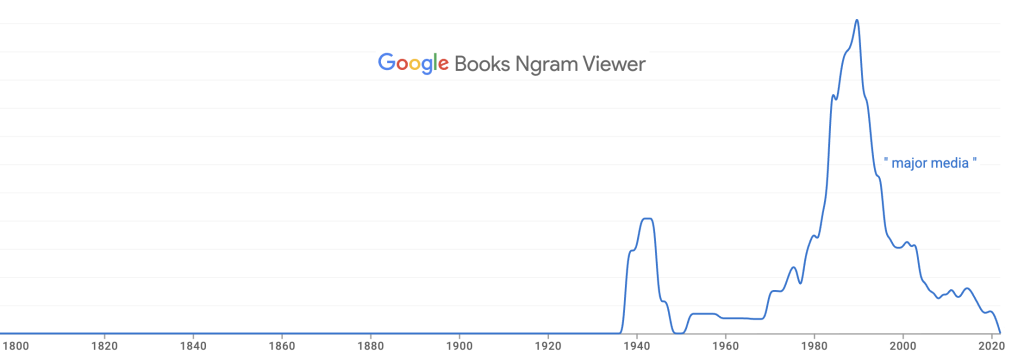
First, “the media” is a modern label, dating from the 1940s. Here’s Google’s Ngram Viewer, which charts mentions in books.
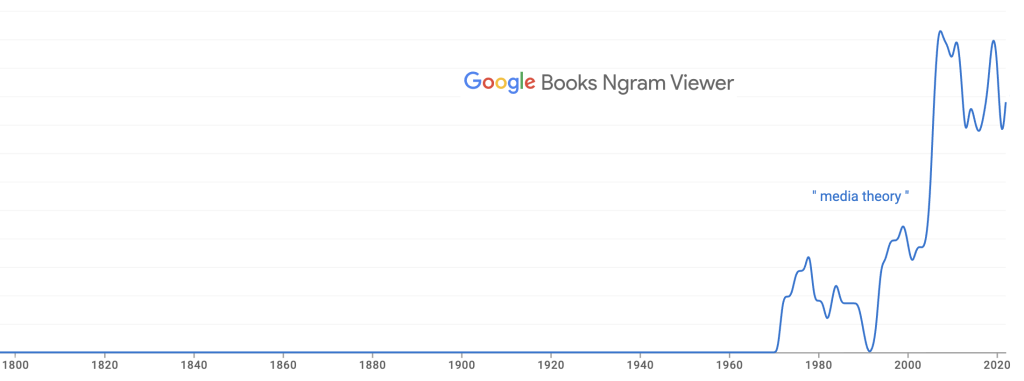
As a topic, “the media” hockey-sticked when Marshall McLuhan made “media theory” a thing in the 1960s:
Meanwhile, the expression “major media” seems to have come and gone—
—while “mainstream media” is hot shit:
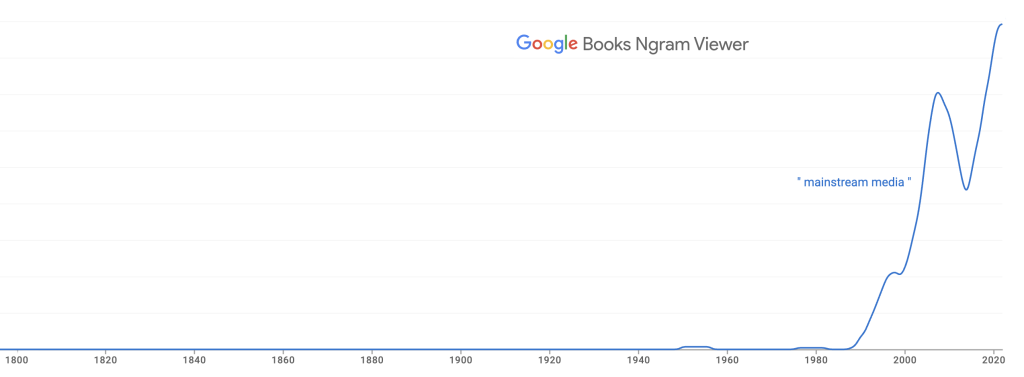
Why has “mainstream media” gone up while “major media” has gone down?
Politics. Writers and talkers on the right and the left both have lots to say about “the mainstream media.” It seems (at least to me) that talkers on both political wings think the old mainstream media—big newspapers, TV networks, broadcast giants, news wires—are still mountains. Or, to follow the stream metaphor, rivers.
But those old rivers were self-limiting. They controlled the production and the flow. That’s what made them main. It’s also what made them costly. Printing presses were expensive. Broadcast licenses were scarce. Regulations ruled. Editors and producers were gatekeepers because there were gates to keep.
Then came the Internet, followed by the Web, blogging, podcasting, cheap digital photography and video, and all the other means by which anybody with a keyboard, a microphone, a phone, or just an idea can pump content into the world. The threshold of expression has fallen to trivial.
One reason that threshold is so low is that RSS—really simple syndication—made distribution simple for everyone. Nobody had to ask permission from a publisher, a platform, or a network. RSS gave individuals the power to speak and flow into the allstream.
Every creator wants to be valued and followed by at least a few people—especially the right people—rather than by large populations. We each have our own public. (At least for this moment, reader, you’re in mine.)
In the allstream, everybody can publish, distribution is easy, and the number of flows exceeds anyone’s ability to count or follow them all. Their variety is also extreme: blogs, podcasts, newsletters, YouTube channels, TikTok feeds, posts in Mastodon, BlueSky, Threads, X, Reddit, Facebook, LinkedIn, Instagram Flickr, Smugmug, Substack, Discord. There are countless groups and forums, on listservs, social media, Slack, and so on. Comment sections. Local news outlets (many written and published by just one person). Transcripts. Some are public. Some are semi-public. Some are private. Some are generated by AI or by humans with AI assistance. The scale of each is small by old media standards, but the aggregate is far more immense than “the media” ever were.
In The Redstream Media, I described how partisan flows of news and opinion had already turned the mainstream into a sidestream. But it’s not just happening with politics. Expertise streams around institutions. Communities stream around beats. Hobbyists stream around trade publications. Local knowledge streams around outside authorities. People with cameras, microphones, and keyboards stream around organizations built to monopolize distribution.
Of course, much of the allstream is noisy, false, manipulative, repetitive, trivial, and thick with propaganda, junk, spam, AI slop, outrage bait, and viral bullshit. It can produce confusion faster than clarity. But the old mainstream had propaganda, junk, exclusions, class filters, geographic biases, advertiser pressures, and institutional blind spots. We miss a lot of it, but their story is almost over.
One reason is that scarcity was the media’s main feature. To see, hear, or read it, you needed a TV, a radio, a subscription, or a newsstand. Through those spincters, the few spoke to the many while the many lacked the means to speak back, or out. Now they have the means. All of them can stream too. It’s still a contest, but not a fair one.
When I look at how far my readership has fallen from the heights it enjoyed in the golden age of blogging (and at Linux Journal in its peak years), I’m glad to have the readers I’ve got. The same goes for my photo collections here and here on Flickr. For two decades, those got ten to fifteen thousand views a day. Now they get a few hundred. I’m fine with that too, because the totality of all the flow on the Net is beyond measure, and growing.
The allstream is everywhere, and no longer only (1.0) or mostly (2.0) on the Web. It has spread across too many places for an old-fashioned search to encompass. As Gemini tells me, Google would rather be your “helpful assistant” than your librarian.
Yes, ouch. But that’s your new sphincter.
Big AI (ChatGPT, Gemini, CoPilot, Claude, Perplexity, et. al.) stands between you and the allstream and says, “I’ll take it from here.” The sphincter is now at the point of retrieval, rather than at the point of publication.
When we (David Weinberger, Chris Locke, Rick Levine, and I) wrote The Cluetrain Manifesto in 1999, we saw the Web as a great way to liberate humanity from corporate captivity. Here is the “one clue” (by Chris Locke) that precedes the 95 theses that followed in the manifesto:

That declared a design feature of the Net and the Web, but it was pure aspiration and still unfulfilled. Because the plain fact is that we are still seats, eyeballs, end users, and consumers—and our reach still fails to exceed the grasp of the surveillance fecosystem. And none of big tech (or big anything) is dealing with it.
But we are more numerous than ever, and our tail is long and wide. What if we get real power? We didn’t have it in 1999. We Cluetrain authors thought we did. But Web 2.0 came along, and we got all the personal agency the platforms allowed.
And that is where we live online today: in an all-platformed world. Yes, all of us can produce video; but if we want it seen, it’s best to use YouTube, which has a monthly reach of 2.7 billion people. That’s the world’s widest sphincter, and it’s Google’s.
Can we ever get the high degrees of personal and collective agency we saw coming when we wrote The Cluetrain Manifesto?
I think we can, if online service providers agree to our terms, instead of us to theirs. That’s why we created MyTerms, and why I’ve written so much about it. (And I won’t stop.) The case we need to make is that an intention economy built on customer agency will be richer, wider, deeper, and larger than what we have here and now, in the final stage of the old industrial age.
Once we have the agency, we will need new and better forms of economic signaling and money flow than we have experienced so far. Everyone who publishes anything should have a piece of the allstream action (whatever that might mean). MyTerms will tee that up as well.
I’ll leave you with a question: What will happen when the landscape across which the allstream flows is a worldwide commons of self-empowered customers?
If you have an answer for that, you can also inform the future of Customer Commons, which we created in 2013 to make good on what I promised in The Intention Economy in 2012. Both pushed forward the body of ideas we started assembling with ProjectVRM in 2006, but actually began forming with the Internet in the 1970s and ’80s, and the Web, Linux, and open source in the ’90s.
Everything takes time. Let’s make a better future happen sooner rather than later.

Leave a Reply