Note to squeamish readers: If you’re grossed out by medical stuff, you might want to skip this one.
Yesterday morning, my oral surgeon installed an implant post on which, a few months hence, my #2 molar (top right, forward of the wisdom tooth) will be restored. Half a century after it got a gold crown, it had decay underneath and had to go. It’s the back one you see on the left, here:
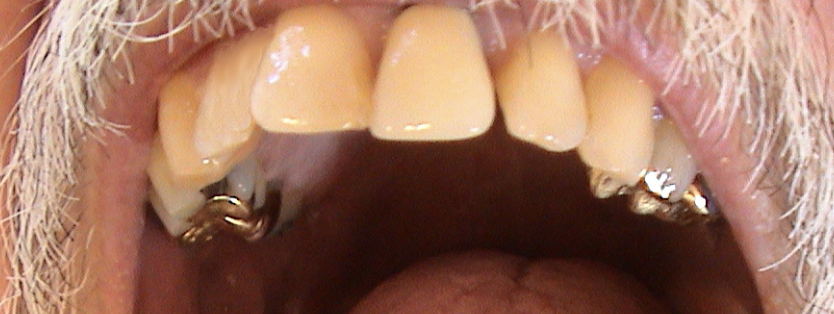
It’s my second implant. The first was #5, a bicuspid (less obvious in that shot) that cracked when I bit down on something hard that had found its way into a dinner salad at a Palo Alto restaurant. As reported here, I also spent a lot of time having many teeth crowned with gold at the UNC Dental School in 1975.
But I’m actually here to talk about pain. Exactly twenty-four hours after the surgery, I still have some, but I can live with it. As you see, I’m writing now. Yesterday I distracted myself from post-surgical discomfort by staying away from my desk, doing yard work, and making phone calls on long walks and errands. Today the pain isn’t gone, but it’s also not bothering me.
The surgeon gave me a prescription for Tramadol, and I took a couple of half-pills in the hours following the surgery. I couldn’t tell if they did much, and I experienced no side effects. I never had an appetite for intoxication, and my two experimental experiences with recreational drugs did not leave me wanting more.
The first was with cocaine. This was in the 1970s, at a party in the woods outside of Chapel Hill. I knew almost nothing about cocaine at the time. The host said to me, “Ya’ll want some coke?” I said no. “Just put some of this white dust in your nose and see what happens,” he said. So I did. A while later, he asked how it felt. He was loving it, and so were others at the party. But I told him I felt nothing. Puzzled, he said, “Well, maybe ya’ll’s personality masks the effects.”
I was more of an extrovert then, so that was a credible statement. My other experience, also long ago, was with MDMA, aka Ecstasy. Did it once with very close friends, also long ago. It found it interesting that the drug removed whatever it is that might make other beings unlovable. Because I suddenly loved everything and everybody, including my friends’ big old dog, named Max. The thought balloon over Max’s head said, “Wow! You get it! You love me just like I love you! You’re dogs now!” After that wore off, I had no interest in experiencing drug-induced ecstasy again. I wanted love to come more naturally.
But back to pain. Sometime in the early 80s, I had a problem with a stuffy nose that bled a lot for no obvious reason. My otorhinolaryngologist, Dr. Thaddeus Pope, said the problem was a bad nasal cochna, also called a turbinate. The one in my left nostril had to go. He yanked it out using very little anesthesia, because the inner nose is too close to the brain, he said.
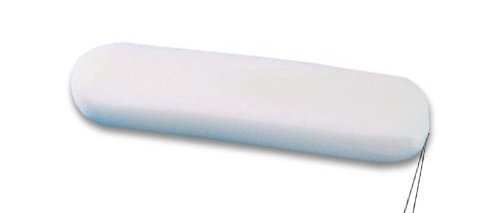
He was amazed that I didn’t seem especially bothered by the pain, which he warned would be intense. Afterwards, he installed one of his patented inventions: a sponge with a tube down the middle that expands to soak up blood from nasal surgery. That’s one, above. And yes, I see (now that I have been reminded) that it’s kind of a tampon you can breathe through.)
Ripping that out of my head a week later, after all the blood had dried, was also done without anesthesia and was a project because the sponge had scabbed on all sides to the walls of my nasal cavity.
Noting that I didn’t wince when he did any of this, he asked if I’d had dentistry without anesthesia as a child. I said yes. Our family dentist was trained in the 1930s, and used an old-fashioned drill that ran on pulleys. The work he did was also so bad that most of it needed to be replaced with lots of gold later. I told Dr. Pope that I didn’t have Novacain (the old name for Procaine) until I was seventeen and needed the ugly and defective cap on one of my incisors (the #9 tooth) replaced. “That explains it,” Dr. Pope said. “As a kid, you were trained in a dentist’s chair to tolerate high amounts of pain.” Pain tolerance is common for people who had lots of dentistry in the age before anesthesia, he explained.
Yesterday, my oral surgeon was also surprised that I seemed unfazed by the more painful of the numbing shots he gave me. (The kind shot through the hard palate on what dentists call the lingual side of my uppers.) So I guess the old tolerance is still there. I’m still marveling that this was probably a learned rather than an innate trait.

Leave a Reply