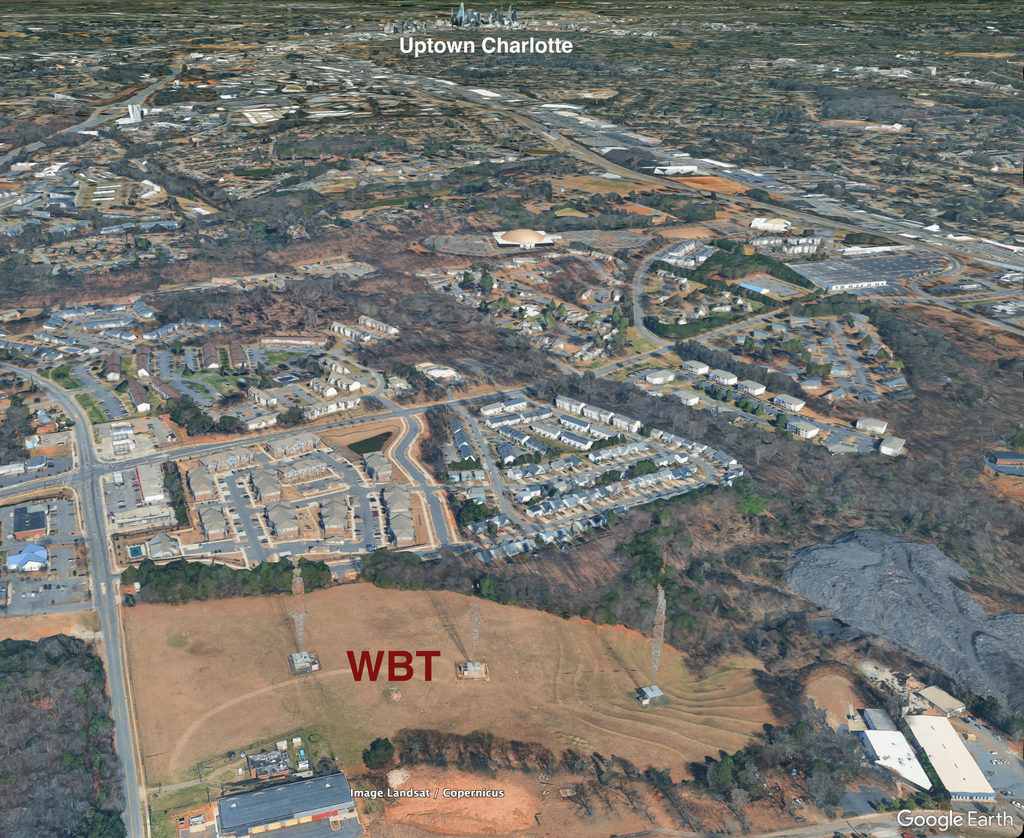
In the foreground are three towers standing on nineteen acres in Charlotte’s south side. They transmit the signal of WBT/1110 AM, a 50,000-watt giant with a signal that stretches from Canada to Cuba at night:
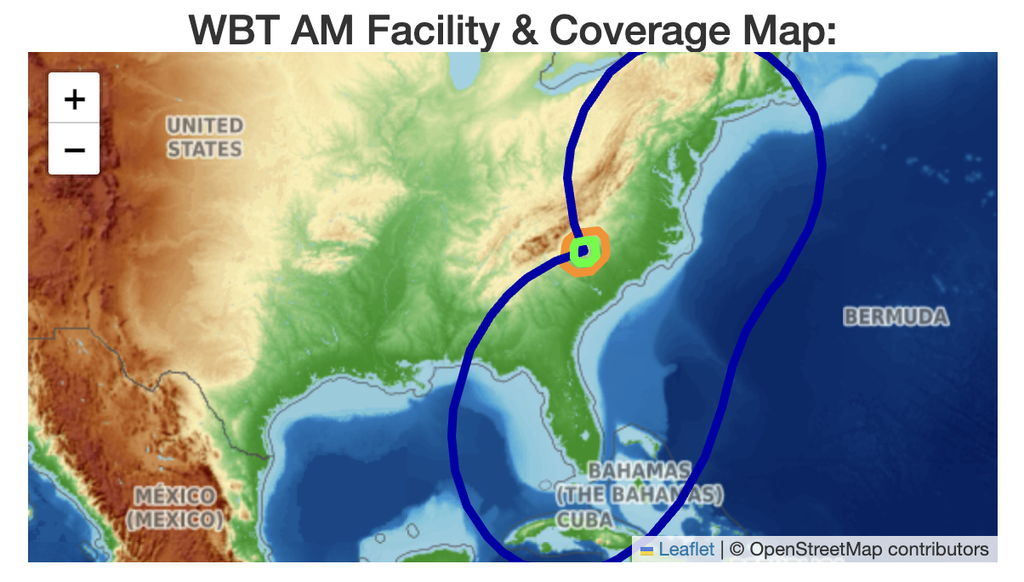
WBT-AM was born 104 years ago and is about to die, because the land under its towers is worth more than the signal. The property is for sale, pitched as a site for apartments or townhouses. The broker does not publish an asking price.
As of today, programming consists of nonstop music interrupted by requests that listeners tune instead to the station’s FM signal on 107.9
I think Charlotte should buy the WBT property and its towers—or find the people and/or foundations that will —and make the WBT site a Museum of Broadcasting and the Antenna Age.
Broadcasting shaped civilization for the century before we all turned digital. Nothing has both enabled and symbolized broadcasting more than antennas: towers for AM, FM, and TV, and metal whips and stubs on the receiving end.
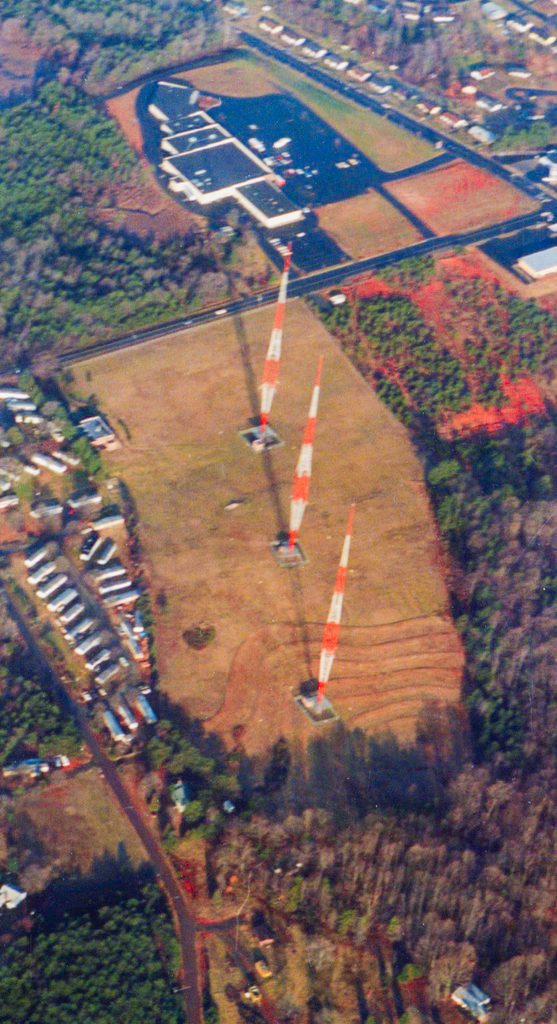
AM transmits using whole towers, and the most historic of those is the Blaw-Knox diamond design, emblematic of the Art Deco age.* Only eight still stand. Three of them are WBT’s. Built in 1934, here is how they looked when I shot them on a flight out of Charlotte in 1985:
Two of those towers were destroyed by Hurricane Hugo in 1989—
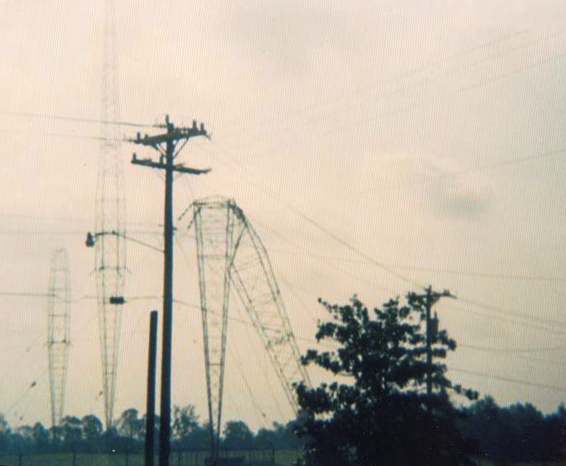
—and replaced with identical ones, because these kinds of towers are like old lighthouses: they are too attractive and iconic to replace with structures that are merely functional. Also, like lighthouses, they deserve to be kept up after technology has moved on.
Here is how those towers look today on Google Streetview:

The transmitter building is also legendary, having contained, among other things, a Cold War bunker. Dig this 2013 report by WFAE, Charlotte’s public radio station:
In fact, during the Cuban Missile Crisis, WBT was beaming pro-American propaganda to Cuba with a program called “Radio Liberty.”
WBT Chief Engineer Jerry Dowd has preserved that original bomb shelter with the care of a museum curator. He keeps a picture from 1963 on hand to prove it. With that photo in hand, we head downstairs into a chilly basement with government-issue green walls.
“As you can tell, not a lot has changed,” he chuckles. “The clock has stopped.”
Literally. At just after 6 – a.m. or p.m.? Would it even matter if an atomic bomb went off?
Everything else still works. And the emergency supplies to keep some poor engineer alive and broadcasting for up to 60 days are still here, too.
“We have a leftover can of survival crackers that were date coded from April 1963,” says Dowd, with a gesture to the can. “We had drinking water. The most important thing we had was the sanitation kit.”
He picks up a cardboard bucket with a plastic donut-like lid: “It’s a porta-potty.”
And there are giant turntables poised to broadcast the most natural of things for the end-of-times.
With a photo:

It would be most cool if that stuff is still there, museum-ready.
Yes, there are good broadcast museums out there. This one could be much bigger, better, more broadly focused, and more fun. To compare—
| Place | What it preserves | What WBT would add |
|---|---|---|
| National Voice of America Museum of Broadcasting, Ohio | An original shortwave relay-station building and transmitter, dedicated only to American shortwave, with no towers. | An intact antenna field, with historic (and hopefully working) towers. |
| WLW transmitter plant, Ohio | A historic high-power AM plant and Blaw-Knox tower, but not yet a museum. | A museum designed for public access, education, and celebration of a great age |
| Armstrong Tower facility, New Jersey | Armstrong’s FM laboratory and tower | The broader story of AM, FM, and television broadcasting |
| Texas Broadcast Museum | An extensive collection of broadcast equipment | Land and infrastructure on which broadcasting history happened |
A museum at WBT could begin with Charlotte’s own history and grow outward to encompass all of AM, FM, and TV broadcasting. The original building could explain (and perhaps demonstrate, if it keeps the signal going) WBT and high-power AM. Its emergency facilities open up a Cold War story. As other stations retire equipment, the museum could give some of it a home.
The whole thing could (and should!) be interactive: the kind of place kids and scholars of all ages won’t want to leave. Models include St. Louis City Museums, Minneapolis’ Mill City Museum, Pittsburgh’s Carrie Blast Furnaces, Seattle’s Museum of Pop Culture, Los Angeles’ new Lucas Museum of Narrative Art, Detroit’s Motown Museum, Boston’s Museum of Science, among others.
We’re talking here about a destination museum. Let’s give people a reason for coming to Charlotte that isn’t business meetings or ball games.
The towers would be the biggest and most obvious attraction, but there is room enough in nineteen acres for a park where kids can run around, and everyone can appreciate why broadcast radio needed so much room. Nineteen acres is plenty enough for an engaging museum, a nice green park (with towers on it), and parking.
Charlotte’s N2-B district allows multifamily housing. A museum would be classified as a cultural facility and require a change in the property’s permitted uses. A buyer could ask for a conditional rezoning that spells out the museum, park, parking, educational work, and preservation work. Since this would be a major Charlotte Thing, it’s a challenge worth taking on.
The main challenge is finding funding for purchase and development. My own guess is that the property would go for a few million dollars. There are countless pockets and purses much deeper than that, in the pants of people and institutions that value history and like to preserve legacies before they are lost forever.
Charlotte has long been one of America’s top banking centers. There also isn’t a shortage of civic-minded philanthropies: Foundation for the Carolinas, The Leon Levine Foundation, the Arts & Science Council, Duke Energy Foundation. Foundation For The Carolinas seems most relevant to me. Its Inspiring Places (see the home page) should include the new Broadcasting Museum.
Charlotte can build another apartment complex anywhere. Here it can stand up something found nowhere else: a museum where people can experience the scale and importance of broadcasting, the dedication of its pioneers and workers—and the fun one can have understanding it—before it falls into digital dust.
The time to do this is now. Towers are falling everywhere. (WMAL in Washington. WKIX in Raleigh. WECT-TV in Wilmington-Fayetteville. WMVP in Chicago. WMID in Atlantic City. KHJ in Los Angeles. WKRG-TV in Mobile. And yesterday, WSLC in Roanoke. Among countless others.) Unlike the rest, WBT’s towers are museum-quality treasures, worthy of preservation and celebration. Just for starters.
Oh, and we have a working model of a legacy station that’s a museum on the air: WSM/650. The station that gave the Grand Ole Opry to Nashville and Country Music to the world persists today as a working example of Radio Done Right. When you visit their website, note how the main animated background image is their own Blaw-Knox diamond tower. WBT has three of those, and can stay on the air as a living historical beacon of good radio—however one chooses to define it. The possibilities are endless, and the opportunity is huge.
Take it, Charlotte.
*Art Deco was expressed in bold, geometric forms: chevrons, rhombuses, zigzags, tapering pyramids. The Blaw-Knox double-conical diamond tower profile, with narrow points at both ends, uses Art Deco visual vocabulary to express what lattice towers, whether guyed or self-supporting, cannot. Like the Chrysler and Empire State buildings, these towers spoke of power and optimism: Eiffel-grade expressions of the best industrial aesthetic of their time.
Art Deco was also as much an embrace of machine-age industrial technology as it was an architectural and artistic expression. Structures from the era were styled to look like machines, while machines were styled to look dynamic and futuristic. (Recall how steam engines were for a few years wrapped in smooth metal cowling to appear “streamlined.” That was Art Deco too.)
Blaw-Knox diamond towers were all commissioned during the height of Art Deco’s expression in American public life and architecture. All were built as high-profile flagship investments by major broadcasting entities (chief among them WSM, WLW, and WBT) to project a modern image while maximizing technical achievement. (It was thought at the time that diamond towers radiated waves more optimally than straight guyed or tapered self-supporting towers.)
In newspaper stories, posters, and other visual media of the 1930s, radio was symbolized by lightning bolts, concentric geometric waves—and stylized diamond towers. Blaw-Knox towers, including WBT’s, were the real-world embodiment of those graphic design motifs expressing what radio was, and meant. (Find many examples in Broadcasting Magazine and Broadcasting Yearbook in the 1930s and 1940s.)


Leave a Reply