On the whole, AI writing is good. Yes, I’ve called it “AutoTune for the human kind” and “fancy blah.” Claudio Nastruzzi called it “semantic ablation.” But Big AI’s grammar, styling, and prose still tends to beat the shit out of the ways most people write. Does that have to be a bad thing?
Nearly all of what ChatGPT and Claude write for me (usually without my asking first) isn’t as good as what I write on my own. If I use any of it, I completely rewrite it. But once in a while one of the damned things will produce a sentence that is clearly what I mean, and says better than what I was about to say. I don’t like that, but I do appreciate it.
There are a few vivid lines in Walt Whitman’s Song of Myself that I think describe what Big AI does for everyone’s writing—and we do for its writing as well:
I am the teacher of athletes.
He that by me spreads a wider breast than my own
proves the width of my own.
He most honors my style
who learns under it to destroy the teacher.
Big AI’s writing style in some ways resembles mine: contrasty prose, one-line paragraphs, clever headlines, em dashes, blurb-ready one-liners. It also spreads a wider breast than mine—and of every other professional writer—by many miles, because it is trained on damn near everything we’ve ever written.
The other day Claude came up with a better headline for what we’re trying to do with MyTerms than any I had been generating with my own head. You can see it atop the MyTerms page on this blog, and on the one at Customer Commons. Here it is:
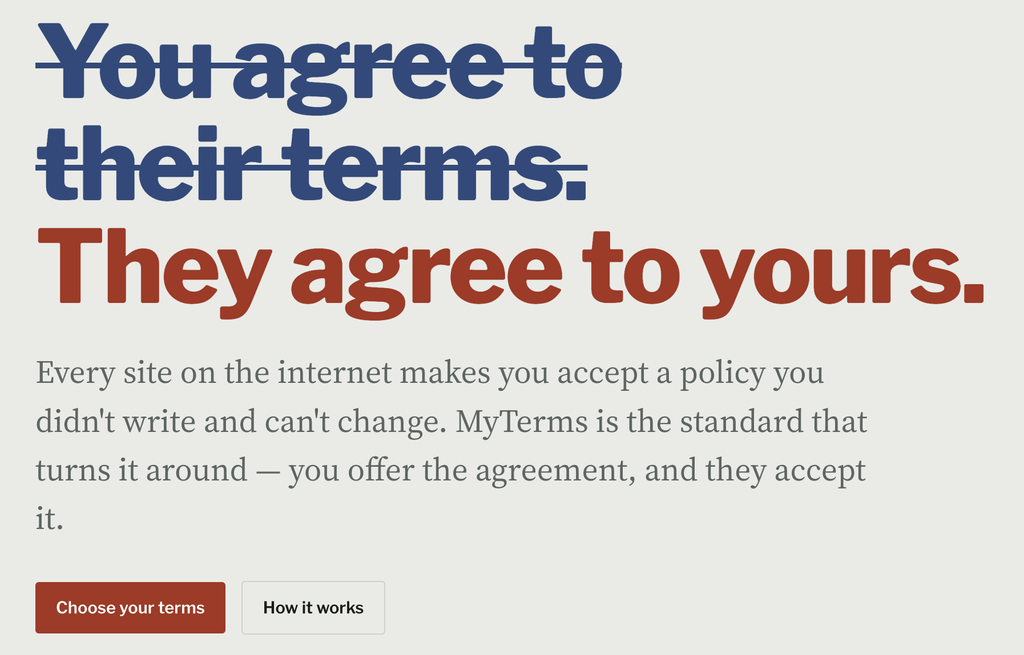
We can’t not use it, because it does the job too well. When I show either page to people I’ve meet at social gatherings who want to know what we’re up to, they get it, instantly.
Am I destroyed by that? No, but I’m improved. AI’s instruction by example (in this case) or in procedural ways (such as by walking me though a tech support challenge—usually better than the product’s maker) have improved me, every damn time.
And who is being destroyed here? Is it me teaching an AI that honors my style, or an AI that learns better writing constantly from the humans who train it?
Or how about the old educational system? The old tech support system? The old business office system?
In Laws of Media, Eric and Marshall McLuhan teach that every new medium (including every new tech) does four things: retrieve, enhance, obsolesce, and reverse. They call this a tetrad, which they illustrate this way:

Big AI retrieves all digitizable (and already digitized) human expression, enhances what we do with it, obsolesces much of it, and reverses into semantic ablation, fancy blah, hallucination (better word: bullshit), fakery on a grand scale, giant unwelcome data centers, vain oligarchs who can no longer read the world’s rooms, and much else.
I think one challenge (among many) for us is making the most of how Big AI mirrors (also distorts, amplifies, and other-verbs) our collective whole. Maybe the challenge for both humanity and AI is to leverage Whitman in our time. From the concluding passages in Song of Myself:
Each man and woman of you I lead upon a knoll.
My left hand hooks you about the waist,
My right hand points to landscapes and continents,
and a plain public road.Not I, nor any one else can travel that road for you.
You must travel it for yourself.It is not far. It is within reach.
Perhaps you have been on it since you were born
and did not know.
Perhaps it is everywhere on water and on land.Shoulder your duds, and I will mine,
and let us hasten forth.If you tire, give me both burdens and rest the chuff of your hand on my hip.
And in due time you shall repay the same service to me.Long enough have you dreamed contemptible dreams.
Now I wash the gum from your eyes.
You must habit yourself to the dazzle of the light and of every moment of your life.Long have you timidly waited,
holding a plank by the shore.
Now I will you to be a bold swimmer,
To jump off in the midst of the sea, and rise again,
and nod to me and shout,
and laughingly dash your hair…Do I contradict myself?
Very well then. I contradict myself.
I am large. I contain multitudes…The spotted hawk swoops by and accuses me.
He complains of my gab and my loitering.I too am not a bit tamed. I too am untranslatable.
I sound my barbaric yawp over the roofs of the world.The last scud of day holds back for me.
It flings my likeness after the rest and true as any
on the shadowed wilds,
It coaxes me to the vapor and the desk.I depart as air.
I shake my white locks at the runaway sun.
I effuse my flesh in eddies and drift in lacy jags.I bequeath myself to the dirt and grow
from the grass I love.
If you want me again look for me under your boot soles.You will hardly know who I am or what I mean.
But I shall be good health to you nevertheless.
And filtre and fiber your blood.Failing to fetch me at first keep encouraged.
Missing me one place search another
I stop some where waiting for you.
All of humanity, in addition to Walt Whitman, is now under AI’s bootsoles, and ours as well.
But we, not AI, are human. It is humans that Whitman calls to be wild, free, and untranslatable.
Eric McLuhan one told me that almost nothing is ever completely obsolesced. We still have steam power. We still have handwriting. We will always have music, and other arts that only humans can create and re-create.
Last Wednesday I went to hear Mark Kaplan, Kyung Sun Lee, Atar Arad, Stephen Wyrczynski, and Brandon Vamos play Beethoven’s String Trio in E-Flat Major, Op. 3 and Mozart’s String Quintet in C Major, K.515 in Auer Hall at the Jacobs School of Music here at Indiana University. The experience wasn’t just perfect. It was amazing, transcendent.
No AI, and no robot (no matter how human it appears) could ever be those musicians, or do what those musicians do. It also cannot be or make any of their instruments. Nor could any AI give us a better Beethoven or Mozart. But could it help students of those musicians? Or luthiers wishing to become another Stradivari or Guarneri? I think probably.
I’m not a writer whose skills approach the ever-perfecting levels of those musicians, or of the great writers whose works improve me every time I read them. But I do learn from Big AI, constantly. And I look forward eagerly to when all of us have personal AIs of our own that we can teach, while they teach us as well.
Context: We are all both biological and digital now.
As biological beings, we are mortals whose best loves and works outlive us whether we know it or not. Fr. Seán Ó’laoire, my old friend, priest, and shrink, calls us spirits in space suits. I share his optimism—for both ourselves and for what we make, including AI.
While we have been biological for the duration, we have been digital for not very long: maybe since we started being copeless without our phones. How long has that been? Less than two decades, tops. (The first iPhone and Androids came out in 2007.) And we will remain digital for many decades, centuries, and millennia to come.
The older I get, the earlier it seems.
I’m a born optimist, and have been one for going on 80 years, which it turns out is a very short time. (I’m still shocked by that. Bodies shouldn’t wear out, should they? But they do. Biology wins, and that’s not a bad thing.) I’ve seen and participated in many tech revolutions: automatic transmissions, air conditioning, FM radio, personal computing, the Internet and the Web, Smartphones and tablets, digital photography and video, fiber and Wi-Fi, cellular telephony and data, ubiquitous connectivity.
Now it’s AI, and soon—inevitably—we will have personal AI that is entirely ours and not provisioned through suction cups on corporate tentacles.
After that happens, I expect that The Cluetrain Manifesto, ProjectVRM, and The Intention Economy will all prove out, though likely not in the ways I’ve imagined or forecast. Same with MyTerms, which I expect will activate all three of those. But I don’t know. Faith is evidence of the unseen, St. Paul (or somebody) said. So I go on that, or change my mind. (I contain multitudes, and they argue.)
I do know that all forms of tech, from stone tools to AI, are genies that grant uncountable wishes. They also, as Marshall McLuhan taught, shape us after we shape them. Digital tech plus the Internet are the greatest shapers of humanity since whatever evolutionary circumstances made us walk upright, think, speak, and make tools. AI is the latest and greatest family of products and services engendered by digital tech and the Internet.
Let’s be athletes who make sure our best wishes for AI are the ones that win.

Leave a Reply