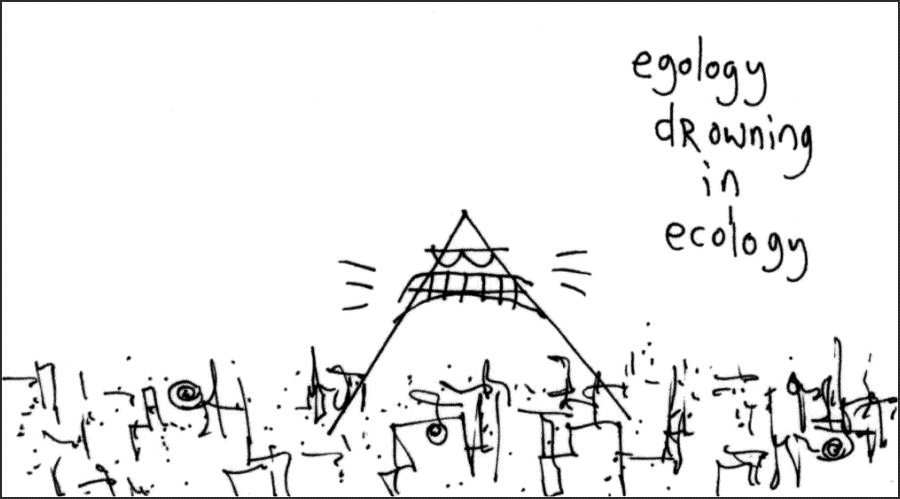
Back in 2008, while working for a startup, Hugh MacLeod and I contrasted the distributed, decentralized, participatory tech development culture of the time with the centralized, top-down kind that had dominated for the prior few decades—and, let’s face it, still does today. Hugh drew the cartoon above to illustrate what we thought was going on at the time, though it wasn’t. The startup is long gone, but the labels are still useful, and the conflict persists.
One angle on that conflict is From Single‑Point Optimisation to Tender Symbiosis, by Indy Johar. My wife pointed me to it yesterday, and I’ve been haunted by it since.
Here is a chunk:
As the medium becomes the message, we find ourselves living inside a civilisation that equates alignment with truth and aggregation with progress. This systemic bias pushes us toward a brittle form of self‑determination: we pursue agency through domination of the variable we can measure, ignoring the variables we cannot. The inevitable result is extraction—of carbon sinks, of cultural memory, of psychological attention—followed by backlash, polarisation, and institutional corrosion.
The tragedy is structural, not moral. When the channel allows only single notes, the symphony dies unheard.
3. A Third Evolution: Machine‑Assisted Deliberation
Large language models and agentic systems arrive as the first tools capable of scaling conversation rather than broadcast. Instead of choosing between headlines, we can invite the corpus of human knowledge into the room as a listening partner—summarising, translating, mapping disagreement, and surfacing neglected vantage points at a pace and granularity no assembly hall can match.
But capability is not destiny. These machines inherit our datasets, our blind spots, our historical harms. Without deliberate governance they will amplify single‑point optimisation—hyper‑targeted persuasion, automated extraction, and a calculus of social control measurable only in engagement metrics. The question, therefore, is not whether we will embed AI into the civic stack, but how we will govern its presence so that it extends, rather than erodes, the commons of complex deliberation.
4. From Capability to Compassionate Form
We do not need smarter hammers; we need gentler hands.
The arrival of generative models gifts us unprecedented capabilities—the power to synthesise, to forecast, to orchestrate complexity at velocity. Yet every new lever of agency deepens the asymmetry between what we can do and what we can truly know. The delta between capacity and comprehension is a fault‑line that can only be crossed through a new behavioural stance: tenderness.
…
6. Re‑Weaving Radical Humanity
Industrial modernity did not merely optimise supply chains; it labourised the self. By accounting for humans as interchangeable productivity units, we internalised the logic of the assembly line: attention sliced into task increments, identity compressed into job description, worth indexed to wage signal. We became the single points our dashboards demanded.
Re‑expanding the human is therefore inseparable from institutional and machine reform. A society capable of complex deliberation must grow citizens who can inhabit multiplicity without fracturing, who can speak from body as well as browser history. This is not a return to some pre‑industrial idyll; it is a forward movement into polyphonic personhood.
Johar’s case for tenderness is also an argument for the nurturant parent model that George Lakoff sees behind progressive political thinking, in contrast to the strict father model he sees behind conservative political thinking. It also comports with the partnership model that Rianne Eisler poses in contrast to the dominator model that has prevailed in human civilized life for dozens of millennia. (For more on both, read Lakoff’s Moral Politics: How Liberals and Conservatives Think and Eisler’s The Chalise and the Blade.)
He also concludes his case with specific recommendations. Check ’em out and let me know what you think.

Leave a Reply