But not of who, how, and why. Start by looking here:

That’s a page of TV Guide, a required resource in every home with a TV, through most of the last half of the 20th century.
Every program was on only at its scheduled times. Sources were called stations, which broadcast over the air on channels, which one found using a dial or a display with numbers on it. Stations at their largest were regional, meaning you could only get them if you were within reach of signals on channels.
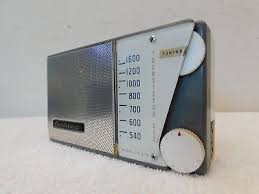 By the time TV came along, America was already devoting its evenings to scheduled programs on AM radio, which was the only kind of radio at the time. After TV took over, everyone sat in a room bathed in soft blue light from their TV screen. Radio was repurposed for music, especially rock & roll. My first radio was the one on the right. Being in a New York suburb, my stations were WMCA/570, WMGM/1050, WINS/1010, WABC/770, and WKBW/1520 (coming in at night from Buffalo, loud as a local). All of those stations are still on the air, but playing talk, sports and religious programs. Many fewer people listen to AM radio, or over-the-air anything, anymore. They watch and listen to glowing rectangles that connect to the nearest router, wi-fi hot spot, or cellular data site. Antennas exist, but wavelengths are so short that the antennas fit inside the rectangles.
The question “what’s on?” is mostly gone. “Where?” is still in play, at least for TV, because nobody knows what streaming service carries what you want. All the “guides”—Apple’s, Google’s, Amazon’s, everyone’s—suck, either because they’re biased to promote their own shows or because there’s simply too much content and no system to catalog and display all of it. Search engines help, but not enough.
The age we’re closing is the one Jeff Jarvis calls The Gutenberg Parenthesis. The age we’re entering is the Age of Optionality. It began for print with blogging, for TV with VCRs and DVRs, and for radio with podcasting and streaming. John Robb calls what we have now packetized media. It is obsolescing all the media we knew, almost too well, by putting it in the hands Clay Shirky named in 2009 with Here Comes Everybody.
What we make of this new age is now up to all of us. We are who, how, and why.

Leave a Reply