
I’ve flown 1,500,242 miles with United Airlines. My wife has flown at least a million more. Both of us currently enjoy Premier status, though we’ve spent much of our time with United at the fancier 1K level. We are also both lifetime United Club members and have been so for thirty-three years.
Unlike many passengers of big airlines, we have no complaints about United. The airline has never lost our luggage or mistreated us in any way, even going back decades, to when we were no-status passengers. On the contrary, we like United—especially some of the little things, such as From the Flight Deck (formerly Channel 9) on some plane entertainment systems, and free live Internet connections (at least for T-Mobile customers, which we are). And we rolled with it when United, like other airlines, changed the way frequent fliers earn privileges.
But now comes United Airlines Weighs Using Passenger Data to Sell Targeted Ads, by Patience Haggin in The Wall Street Journal. It begins,
United Airlines is considering using its passenger information to help brands serve targeted ads to its customers, joining a growing number of companies trying to tap their troves of user data for advertising purposes.
Some of these targeted ads could appear on its in-flight entertainment system or on the app that people use to book tickets and check-in, people familiar with the matter said. United hasn’t made a decision yet and may choose not to launch a targeted-advertising business, some of the people said.
Airlines have long taken advantage of the captive nature of their customer base to show them plenty of ads, including commercials on seatback screens, glossy spreads inside in-flight shopping catalogs or, for some, advertisements adorning cabin walls. Offering personalized advertising would greatly expand United’s advertising business, some of the people said.
Of the 106 comments below the story, all but one opposed the idea, and the one exception said he’d rather not keep seeing ads for feminine hygiene products.
The big question is whether and how United might share personal data with parties other than itself. Because there are lots of companies that will pay for personal data, and United does have, as Patience says, “an advertising business.”
What exactly is that business? Is it just showing ads to United customers? Or, in the process of now personalizing those ads, is it sharing data about those customers with “partners” in the adtech fecosystem, which has been hostile to personal privacy for decades, as a matter of course?
Just based on this one story (and 99+% of the thumbs-down comments it got), it should be obvious that this is a terrible idea. But, this kind of idea is terribly typical in the marketing world today, and a perfect example of what Cory Doctorow calls enshittification, a label so correct that it has its own Wikipedia article. In The Guardian, John Naughton asks, Why do we tolerate it?
Two reasons—
1) It’s normative in the extreme. As I put it in Separating Advertising’s Wheat and Chaff, “Madison Avenue fell asleep, direct response marketing ate its brain, and it woke up as an alien replica of itself.” Today the entire .X $trillion digital advertising business can imagine nothing better than getting personal with everybody. And it totally excuses the tracking required to make it work. Which it doesn’t, most of the time.
2) Journalists are afraid to bite the beast that feeds them. Here is a PageXray of where personal data about you goes when you visit that story without tracking protection (which most of us don’t have). Here is just one small part of the hundreds of paths that data about you travels out to advertising “partners” of The Wall Street Journal:
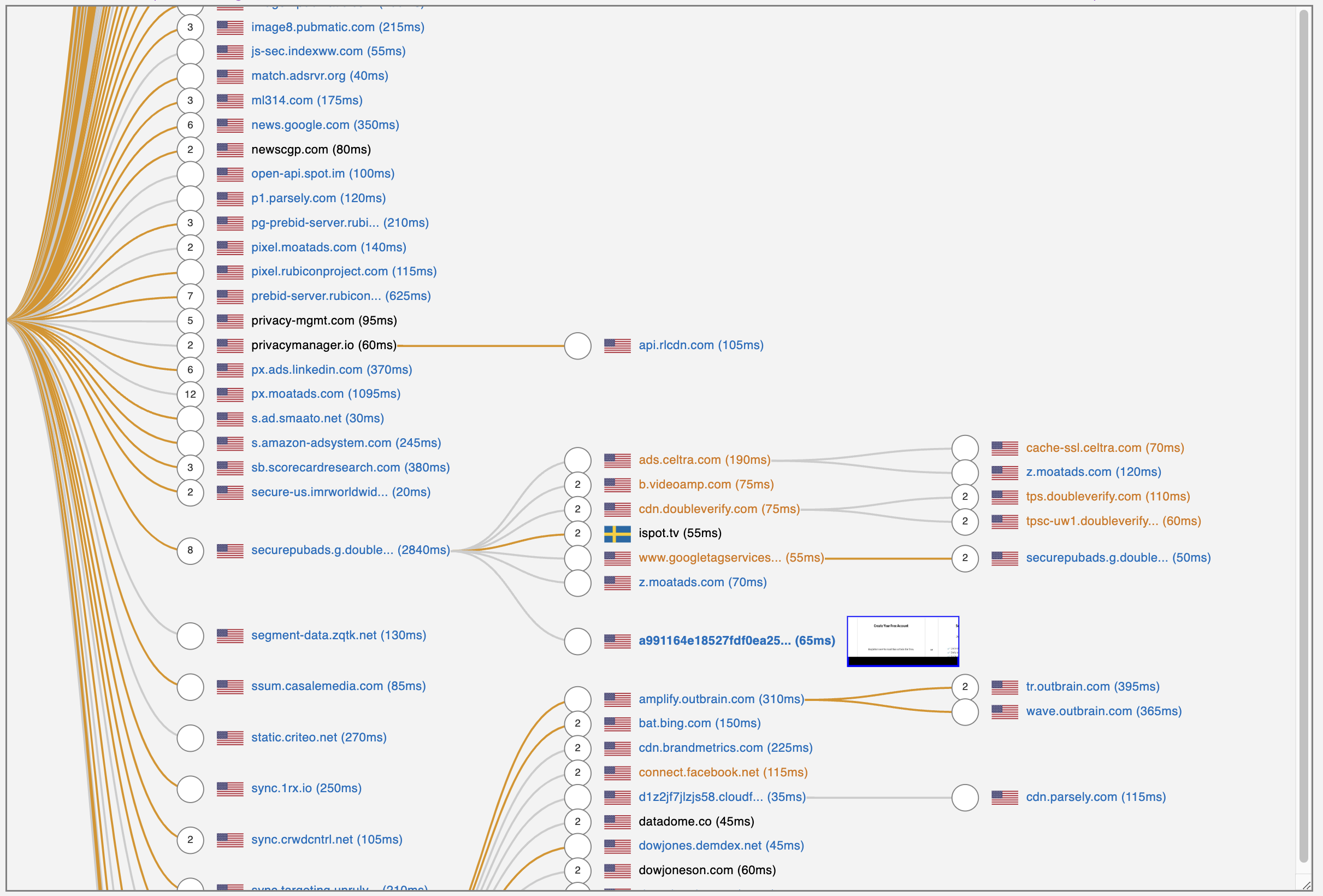
Click on that link, wait for that whole graphic to load, and look around. You won’t recognize most of the names in that vast data river delta, but all of them play parts in a fecosystem that relies entirely on absent personal privacy online. And some of them are extra unsavory. Take moatads.com. Don’t bother going there. Nothing will load. Instead, look up the name. Nice, huh? (As an aside, why am I, a paying WSJ subscriber, subjected to all this surveillance?)
I’ve challenged many journalists employed by participants in this system to report on it. So far, I’ve seen only one report: this one by Farhad Manjoo in The New York Times, back in 2019. (The Times backed off after that, but they’re still at it.)
As for the consent theater of cookie notices, none of “your choices” are meaningful if you have no record of what you’ve “chosen” and you can’t audit compliance. (Who has even thought about that? I can name two entities: Customer Commons and the IEEE P7012 working group. My wife and I are involved in both.)
Unless United customers stand up and say NO to this, as firmly and directly as possible, the way to bet is that you’ll start seeing personalized ads for all kinds of stuff on your seat back screens, your United app, and in other places to which data about you has been sold or sent by United, one way or another, to and through who knows. (But you’ll probably find some suspects in that PageXray.) Because that’s how great real-world brands are now enshittifying themselves into the same old fecosystem we’ve had online for decades now.
Hey, it’s happened to TVs and cars. (And hell, journalism.) Why not to airlines too?


Leave a Reply