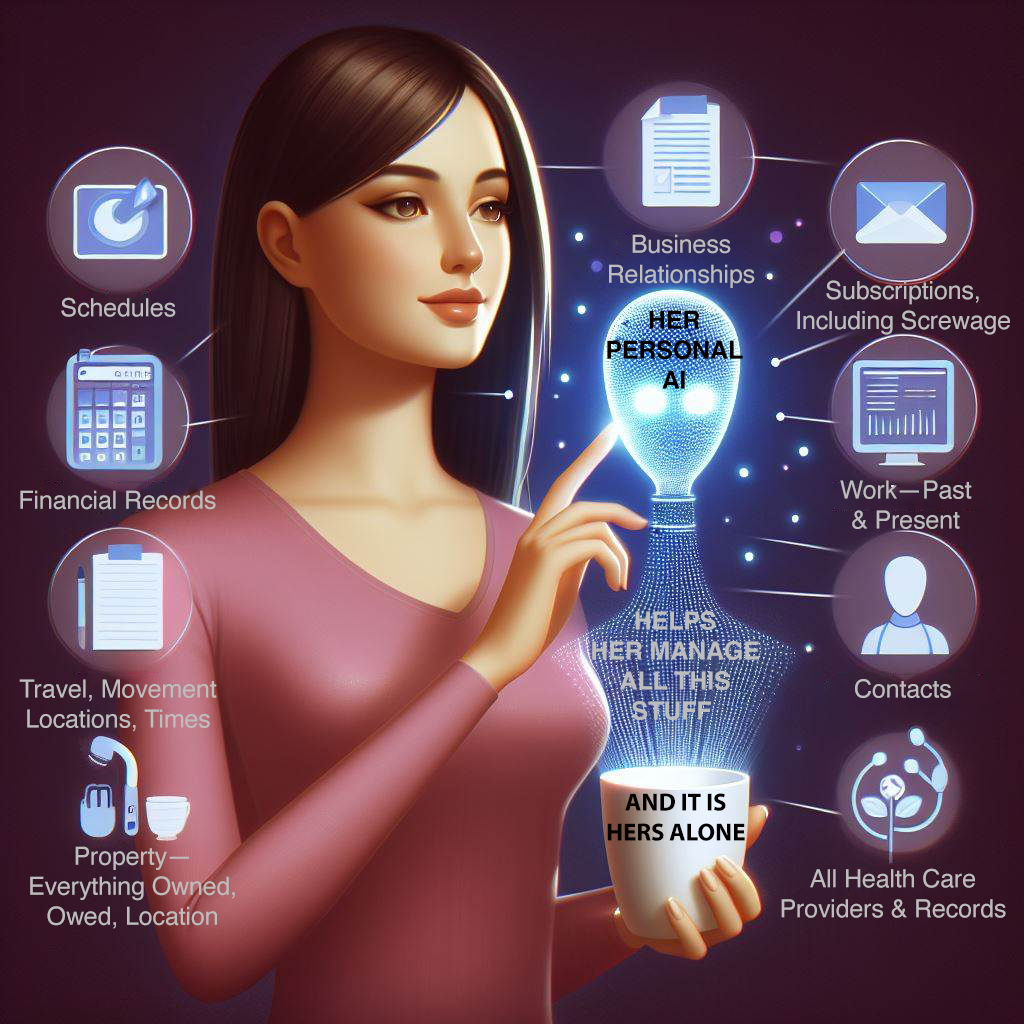
Having personal AI is like having a personal computer. It’s yours. It’s not AIaaS (AI as a Service), which is what we get from OpenAI, Anthropic, Google, Microsoft, Perplexity, Meta, and all the other bigs and wannabe bigs.*
Very little coverage of AI so far is about the truly personal kind. In that sense, we are in 1975 again. That was when IBM, Burroughs, Control Data, Digital Equipment Corp, Data General, and other mainframe and centralized computer makers ruled the world, and personal computers seemed to them as absurd as personal skyscrapers. PCs followed in the next decade (most successfully from Apple and a skunkworks project at IBM), and the world discovered that far more could be done by individuals working on PCs than by whole companies working on mainframes.
In the next few years, personal AI will go through a similar transition, from barely thinkable to totally essential. Here’s what I’ve written about progress along the way (the list is chronological):
- The Hotel Model of AI (23 August 2025)
- Getting Real With AI. (2 August 2025)
- Toward a Personal AI Roadmap for VRM (18 June 2025 in ProjectVRM)
- A Conversation with ChatGPT About Personal AI (11 March 2025)
- What Makes an AI Personal? (6 February 2025)
- Personal Agentic AI (25 October 2024)
- The Personal Internet (30 June 2024)
- Does personal AI require Big Compute? (23 June 2024)
- The Personal AI Greenfield (11 June 2024 in ProjectVRM)
- A Fun AI Fail (29 May 2024)
- The People’s AI (28 May 2024)
- Personal AI vs. Corporate AI (23 May 2024 in ProjectVRM)
- Personal vs. Personalized AI (10 May 2024)
- Personal AI at VRM Day and IIW (20 March 2024 in ProjectVRM)
- Individual Empowerment and Agency on a Scale We’ve Never Seen Before (11 November 2023 in ProjectVRM)
- VRM + AI? A question for VRM Day on October 9 (23 September 2023 in ProjectVRM)
- Markets vs. Marketing in the Age of AI (15 May 2023 in ProjectVRM)
A theme throughout all those writings is the need for all of us to be on top of our digital lives: how we record and archive it, how we manage it, and how we use it to better inform and interact with each other and with the organizations we engage. To my knowledge, nothing yet addresses that collection needs, and is ours and not just a service by some giant. If you think I have that wrong, tell me how.
Toward making personal AI happen, I volunteer as the Chief Intention Officer of Kwaai.ai, a nonprofit with a community of hundreds, all working on open-source approaches to personal AI. Everything produced so far is early-stage stuff, but worth checking out.
*I don’t discount the amazing stuff we can do with AIaaS. I’m a paying customer of OpenAI, and I use AIaaS from all those companies. They are fun to use, explore, and cover. However, they are all still mainframe services that require giant data centers to do what they do. There is no reason we can’t run our own personal AI applications, on our own devices, to help manage both our digital and material lives, as the graphic above tries to illustrate. And there is no reason our personal AIs can’t access the goods available from AIaaS on an as-needed basis. But we do need the personal kind. Not just the personalized.