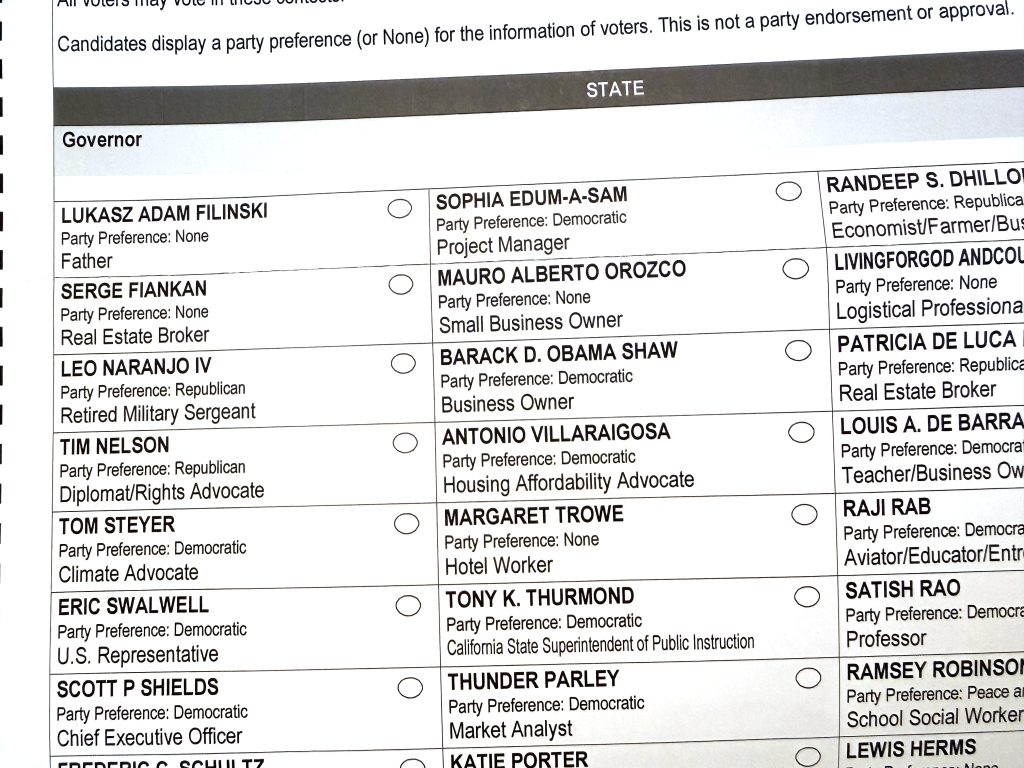
But I could have
No, I didn’t vote for Barack D. Obama Shaw.
It’ll be great, as are all of his books
David Weinberger‘s next book is Beautiful Particulars: How AI’s attention to the smallest of differences is reshaping our biggest ideas. Coming in October from MIT Press.
Good piece. Like to see it posted elsewhere.
Charanya “CK” Kannan on Linkedin:
I spent the last 12 hours talking to 10 different law firms, to evaluate who should handle our day-to-day legal work. I walked away with a strange realization ➙ Legal AI may be one of the most overfunded and underfelt categories in tech right now.
Read the whole thing.
Now, a word from the blogosphere: Writers, please don’t post your good stuff only on Linkedin. Yes, I know there are good reasons for posting on Linkedin. But if you do, make it a duplicate of what you put on your blog, your Substack (also a blog, really), like Jamie Smith does. Here’s his blog. Here’s the same on Linkedin. I never point to his Linkedin, because the former is his, and he latter isn’t.
Oy
From the Department of WTF Oversight
While trying to do actual work, I got distracted by an email from a sane friend who is co-trying to understand wtf this is about, guided by this. An excerpt from the latter:
The National Design Studio is not a successor to DOGE. It is DOGE with a better logo and a design philosophy.
Now, back to TrumpRx looking at you.
Every webpage you load is making phone calls. Not to people, but to servers around the internet, dozens per second, all invisible to you. When I opened TrumpRx, I right-clicked the page, opened the browser’s built-in inspector, and started reading the list. Mixed in with the routine traffic was a name I recognized: PostHog. PostHog is a Silicon Valley analytics company whose entire business model is recording what visitors do on a website and reporting it back to whoever owns the site. Mouse movements, clicks, scrolls, keystrokes. I had not typed anything. I had not clicked anything. I had just opened the page, and it was already on the phone with PostHog telling them about me.
The recordings are not anonymized. IP addresses are not stripped. And the way it is configured, the data looks to your browser like it is going back to TrumpRx, but it is actually being forwarded behind the scenes to PostHog. That is a technique used to slip past ad blockers by disguising where the data is really going, and it is not something I expected to find on a federal health website. So I went and looked at the other sites the studio had built. Real Food, the federal food policy site. Trump Accounts, the children’s savings program. The studio’s own homepage, ndstudio.gov. All of them had the same vendor, the same setup, IP addresses not stripped, the same forwarding trick. And on ndstudio.gov alone, running alongside PostHog, was something someone had built entirely by hand. Five hundred and forty lines of custom JavaScript with a name embedded directly in the code: AutoMonitor. What it appears to do is rewire the part of the browser that handles how a page talks to the outside world, so that every conversation the page has with any server gets copied and forwarded to a private backend with no public presence. The studio has the structural ability to keep a copy of every recording as it passes through their infrastructure. I cannot prove they are keeping one. The pipe is built that way on purpose, and that is the part that matters.
When the federal government collects information about citizens, the law requires specific things first. Privacy disclosures. Notices in the Federal Register. Published contracts with outside vendors. I went looking for all of it across twelve National Design Studio programs and found none of it, not a single required document filed across any of the twelve. Every missing document is, by itself, a violation of federal law, and these are the laws Congress wrote after Watergate to make sure the federal government could not run secret surveillance programs on its own citizens. The only document they did publish is a privacy policy on TrumpRx, and it contradicts itself two paragraphs apart. The first paragraph says PostHog records the pages users visit and the medications they view. Two paragraphs later, it says they do not collect health or medical information. A federal health website is lying to the people using it and cannot even keep the lie consistent.
In other words, it’s just like surveillance-based adtech, against which I have been inveighing since the last millennium, through at least 161 posted utterings compiled here. To little effect so far, but I won’t stop.
Wandering about geology
In the vastness of John McPhee‘s writings on geology (within which he is the field’s Shakespeare), he writes (in Annals of the Former World and earlier works),
If by some fiat I had to restrict all this writing to one sentence, this is the one I would choose: The summit of Mt. Everest is marine limestone.
Elsewhere, he writes:
“For another example, the last Pleistocene ice sheet loaded two miles of ice onto Scotland, and that dunked Scotland in the mantle. After the ice melted, Scotland came up again, lifting its beaches high into the air. Isostatic adjustment.”
Then,
“Let go a block of wood that you hold underwater and it adjusts itself to the surface isostatically. A frog sits on the wood. It goes down. He vomits. It goes up a little. He jumps. It adjusts.”
Look at how McPhee turns glacial isostatic adjustment into a story simple enough for Sesame Street. Scotland isn’t “depressed by glacial loading”; it is dunked. The crust isn’t warped by viscoelastic compensation; it floats like block of wood with a barfing frog on top. Great stuff.
This whole digression began when I wondered to myself about the exact elevation of Loch Ness above the sea at Inverness. Because that’s how far (or high) the land under the Scottish Highlands has rebounded since the ice melted. While the ice was melting, Loch Ness was a fjord dug by glacial ice scraping out the Great Glen Fault, and at sea level. Or something like that. The Loch Ness Project has thoughts about it.
Only moreso

Leave a Reply