A look at broadcast history happening

When I was a kid in the 1950s and early 1960s, AM was the ruling form of radio, and its transmitters were beyond obvious, taking the form of towers hundreds of feet high, sometimes in collections arranged to produce signals favoring some directions over others. These were landmarks out on the edges of town, or standing oddly on salt bogs or farmland.

From my bedroom in New Jersey, not far across the Hudson from New York City, I could see the red lights on the tops of towers standing in the “Meadowlands” (we called them swamps then) with Manhattan’s skyline beyond.

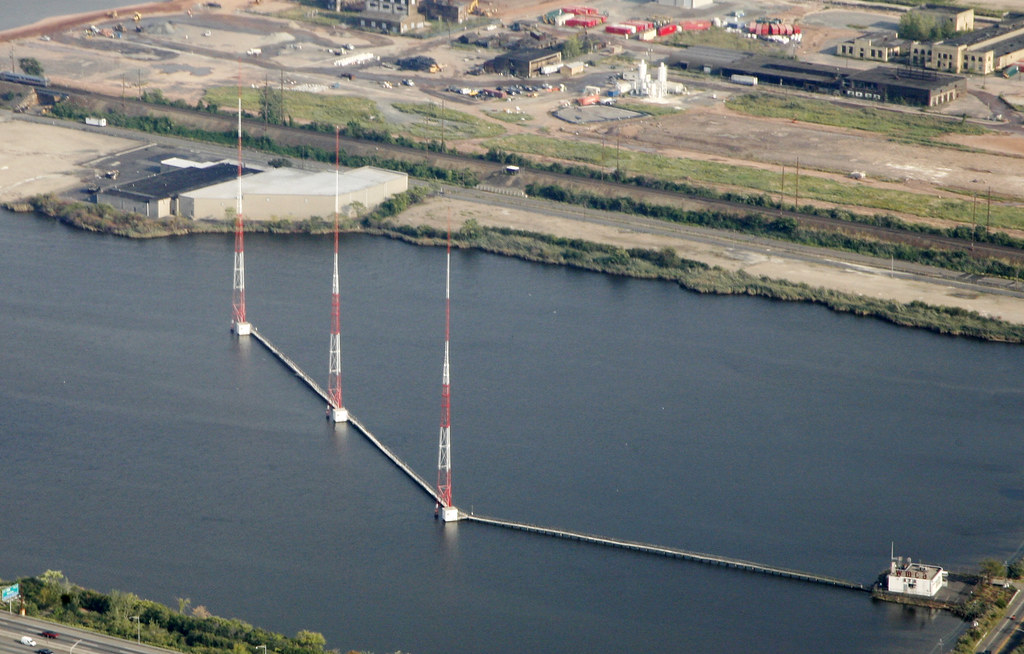
The towers in the photo above are three of those, tasked with beaming WMCA/570 and WNYC/820 toward New York’s boroughs from a pond of impounded water beside the Hackensack River and the east spur of the New Jersey Turnpike. Built in 1940, these three towers have by now become the most-seen AM radio signal source on Earth. For a while, they were also the most heard. That’s because, in its prime, which ran from 1958 to 1966, WMCA was also the leading top 40 music station in the world’s leading radio market. (WABC, with a signal ten times as strong, ruled the suburbs, with a night signal heard across half the country.)

While these days WNYC is the AM side of New York’s public radio empire (which brings in more money, largely from listeners, than any of the commercial stations in town), it is most famous for Mayor Fiorello LaGuardia’s “Talk to the People” show, which ran in the first half of the 1940s. (Back then WNYC had its own towers standing on what’s now WNYC Transmitter Park, alongside the East River in Brooklyn.)

Prior to the Internet, major media comprised a fewness of sources, in both print and broadcast. That fewness is over now (there are over 4 million podcasts alone). Because the writing is on the wall for broadcasting, I’ve shared thousands of photos of transmitters and antennas, knowing that the land under the most vulnerable ones—those on the AM band—tends to be worth more than the signals themselves. Many of these sites have already been sold off, with signals moving to shared towers on other stations’ sites (e.g. KHJ/940 and KABC/790 in Los Angeles, WSCR/670 and WBBM/780 in Chicago) or just going dark (e.g. KSFO’s transmitter on 560 AM in San Francisco).

Radio’s content is also slowly being eaten alive—on the talk side by podcasts and on the music side by streaming. So I publish those photos as historical evidence of what in a few years (decades at most) will be no more. (Sorry, but no amount of lawmaking or regulation will save AM radio. Much as many of us—me included—still love it, neither the tech nor the economics can compete with the Internet, smartphones, the cellular system, and computers.)

So I recently tested a theory: that it is good to have a conversation about all these developments, at least among active and retired professionals in the shrinking world of broadcast engineering. What follows is a post I put up for a private group that includes more than a dozen thousand of those.

Some hopefully fun detective work.

First, an ad in the November 14, 1949 issue of Broadcasting, the Youngstown-based company that built (or supplied steel) for countless AM stations in that band’s golden age. The image is of the array of six 400-foot tall self-supporting towers putting out the directional night signal for WFMJ, now WNIO/1390. HT for scanning and publishing that page goes to David Gleason, who gives us the amazing and valuable [https://worldradiohistory.com/](https://worldradiohistory.com/)

Second is a Google StreetView of what I think is the current view of the same site, with the transmitter shack and the six towers replaced. One of those is also a tower in WKBN’s own directional nighttime array. (Also, in the distance is another tower that appears not to participate in either station’s system.)

Third is a Bing Birds Eye (a fixed-wing aircraft) view of the whole site:

And a fourth is the Google view from space of the same.

Of possible relevance is that WNIO and WKBN are non-directional by day, the former from a tower at another site in town. Also that WNIO was a 5kw DA-N from the site for most of its life and is now 9.5kw from the day site and 4.8kw from the night site we see in these images—and that its six towers have six different electrical lengths, ranging from 105.8° to 215.1°, apparently in slightly different positions on the ground. Also that WKBN has been 5kw day and night since the late 1940s.

We can also see from the Truscon ad that the original address of WFMJ was on Poland-Broadmans Road, which I think is now just Broad. (The current shack for WNIO is on East Western Reserve Road, while WKBN’s is at the end of a long driveway off that same road.) One can also see from above something of the entrance off broad and possibly something of the original footprint of the original tower layout.

So, some questions are:

1) Is the first photo from the entrance to the site in the Truscon ad?
2) When did WKBN show up, or was it already at this site?
3) Are the different lengths of towers in the current WNIO array the result of more efficient towers in it, and also why the 4.8kw signal roughly matches the old 5kw footprint on the ground?
4) In 1949, were six towers about the limit of what one could do with a directional array using long math, trig tables, and graph paper, and perhaps a record number for its time?
5) Was Truscon the outfit that pioneered narrow rather than fat towers, and ones with three sides rather than four?

There are other variables, of course. But I just enjoy this kind of detective work, and I’m kinda chumming the waters to bait others who like to do the same. Thanks in advance.

Responses were both technical and nostalgic, which is how these things go.

Most notably, old pal Scott Fybush pointed to one of his transmitter visit reports and added this:  “Summary: the current WNIO night site is not the original 1949 six-tower site. That was on what’s now Boardman-Poland Road (US 224) at what’s now the Shops at Boardman Park strip mall. It succumbed to development in the early 1990s, at which point 1390 moved to what’s now its current day tower. The current six-tower night array on Western Reserve Rd. was built in 2003, next to the 1977-vintage WKBN array. WKBN’s original DA was at the WKBN studios at 3930 Sunset, which is still the WKBN-TV facility.”

Given that radio’s content (as we now call it) is gone at the speed of short-term memory (unless it’s recorded, which mostly it isn’t), this kind of reporting may be the only history it has—even though this post will likely disappear into The Great Uncoformity into which all of digital history will fall like snow into a giant melt that will leave only the ruins of abandoned data centers.


The top photo is one of many I’ve shot on en route to EWR (Newark Liberty International Airport). By the way, these towers were built when one could walk on the land there. One needed boots and a scythe, but it was possible. The water was impounded in the 1990s, I think. Here are some shots from a visit to the site nine years ago.


One response to “A look at broadcast history happening”

  1. […] NYC in the 1940-50s hosted the heaviest RF build-out on the continent: • RCA Radio Central, Rocky Point/Riverhead LI—two Alexanderson alternators, 220 kW VLF (on-air 1921). ETHW • Empire State Building master antenna—by 1950 multiple VHF-TV outlets: WNYC-TV logged 890 kW visual ERP; WCBS-TV 42 kW visual. lnl.com • Jersey Meadowlands and Long Island AM arrays beaming 5–50 kW day and night. Doc Searls Weblog […]

Leave a Reply

Your email address will not be published. Required fields are marked *