
In What destroyed ‘the right to be let alone’, Tiffany Jenkins in the Washington Post argues that demolition of personal privacy began in the postwar years and became normative in 1973. That was when PBS ran An American Family: a cinéma verité exposure of the Loud family in Santa Barbara, and the inaugural example of what came later to be called Reality TV.
And now we live in a digital world where, as she says,
Intimacy floods the public realm while light shines on the private. Instead, we have embraced a narrow, impoverished conception of privacy, always a protean concept, not as protection from authority and public scrutiny, and as a sanctuary for the inner self and a shelter for intimacy — but merely as data protection.
Through it all, we blame the convenient scapegoat of the moment: the internet. But this gets the timeline wrong. By the time social media arrived, we were already living in a post-private world. The digital revolution simply gave us more efficient tools to do what we were already doing: performing our identities, seeking validation through revelation, and treating intimacy as a public commodity.
She concludes,
All the digital detoxing and platform regulation in the world won’t restore what was lost long before the internet was ever invented. Far better, then, to face up to how we voluntarily dismantled the very idea that some things should remain hidden, that mystery and restraint might be virtues, and that not everything must be shared.
The business models of technology giants like Google and Facebook clearly violate people’s privacy, as does state surveillance. But we would be kidding ourselves if we thought that technology alone has undermined the moral status of privacy and private life. The cameras that Lance Loud invited into his hospice room were not smartphones or CCTV cameras. They were the logical expression of a cultural revolution that began decades earlier. We invited them in.
Can we reverse that history, now that we live in a digital world as well as the natural one?
One might think not. After all, in this new world we have mass surveillance by governments and the adetch fecosystem, in addition to the strange new fact that everyone with a phone can record anything anywhere and share it with everyone else.
But the digital world is still new—decades old at most—while the natural world has been with us for as long as we’ve been a species. We have also had the privacy tech called clothing and shelter since not long after we started walking upright. For just as long we’ve had ways—both obvious and subtle—to signal our privacy preferences to each other. We don’t have any of that yet in the digital world.
No reason not to start, despite the enormities of Google, Meta, the adtech fecosystem, and the inadequacies of privacy regulations that are at constant odds with the sad fact that spying on people pays well. It’s still early, folks!
To get us started, a bunch of us, with help from the IEEE, have come up with a new standard for signaling and securing our privacy online, and framing up business models and incentives that pay better than spying on people. It’s called IEEE P7012, nicknamed MyTerms.
MyTerms makes “the right to be let alone” a contract and not just a promise. It obsolesces consent by cookie notice and replaces it with a choice of privacy agreements that you proffer as the first party, and the website or service agrees to as the second party. This sets the stage for both parties to trust each other and develop mutually respectful relationships if they wish. Optionality is maximized, from “let alone” at one end to “trusting relationship” at the other.
MyTerms is due to be published later this month. I believe it is the most important and far-reaching standard of this millennium, and that it will deliver on the promise of full personal agency that the Net and the Web both promised us in the first place.
We don’t have to start by attacking the big and the bad. As Hugh McLeod put it long ago,
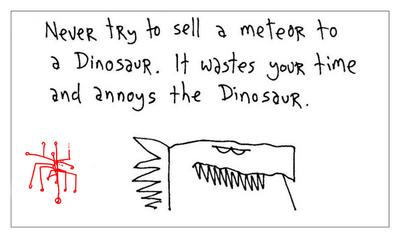
The rich target instead is the hundreds of millions of websites and services that don’t participate in the adtech fecosystem and would be glad to be among the first pioneers to civilize the Net and the Web—and to wear their choice to agree with people’s privacy requirements as a badge of honor:

Whole markets will follow as soon as they see MyTerms are good for business. Which will happen, simply because far more business can be built on trusting relationships in free and open markets than on trustless surveillance in captive and closed ones.
Now that we have the standard, all we need is the tech (some of which is in the works) and to spread the word. I’m doing that now, and so can you. Thanks!


Leave a Reply