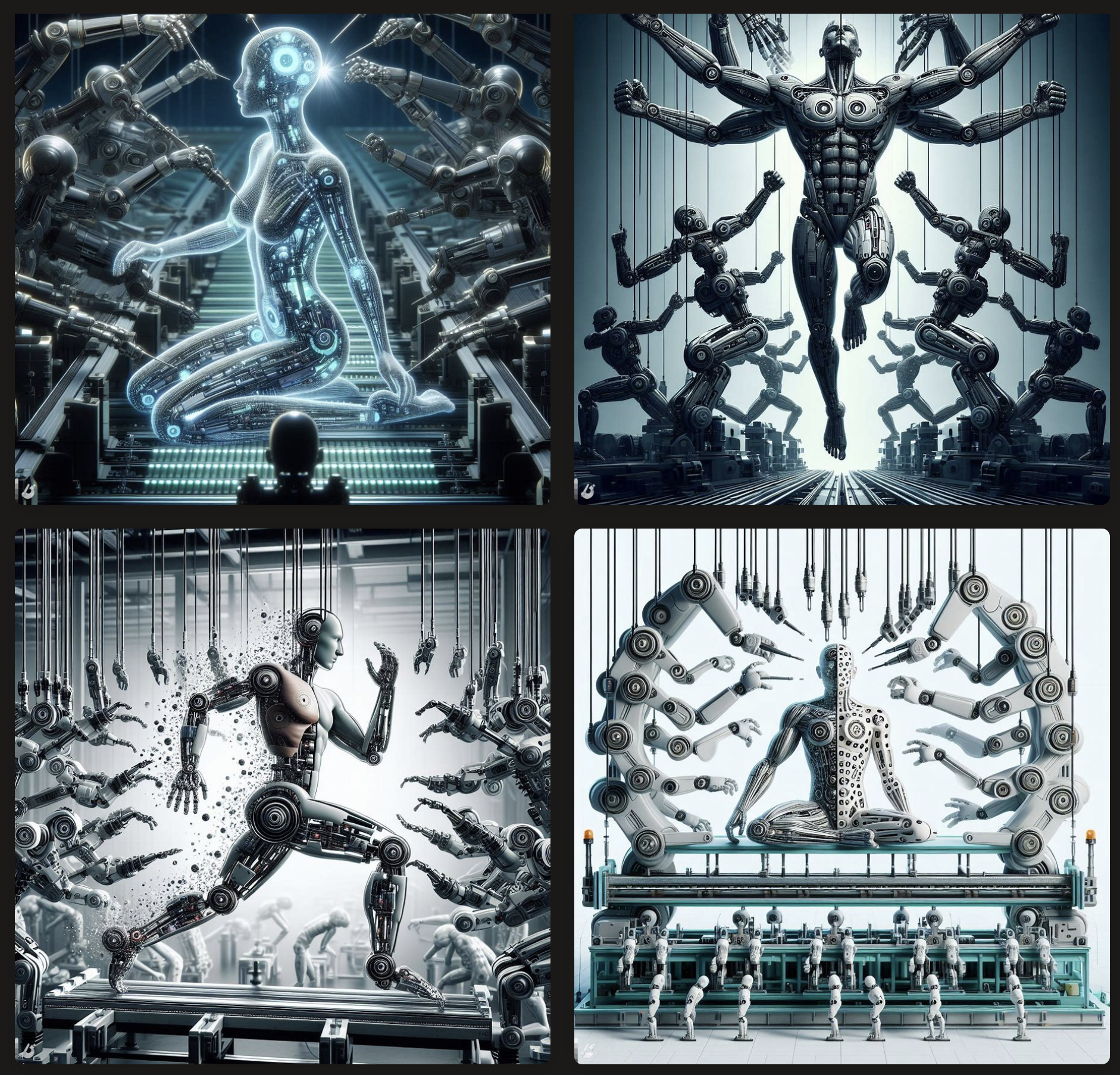
Feeling is Human

Bing Image Creator draws “A machine inventing a human being.”
“Honesty is the best policy,” George Burns said. “If you can fake that you’ve got it made.”
The same applies to feeling in composition and musical expression. Long ago I went with a friend who was a pianist and composer, to a concert by a somewhat famous pianist. While I was enjoying the concert, she grabbed my hand and pulled us out of the place. “Didn’t you hear it?” she said after we left. “That guy wasn’t feeling it.”
No AI will ever feel anything. There is no “next level” where it will feel in a human way—or at all—because AIs are machines and the human stuff they do is all emulation. That emulation can do superhuman stuff. But that doesn’t make them human. It makes them uncanny. And useful. (Hell, I’ve quickly come to rely on AI for lots of stuff, every day. It’s extremely handy and often fun.)
All that uncanny stuff is emulation. Pattern matching. Way-cool parroting. Even when it can beat a human at Go or recite pi to trillions of digits, a machine is still just a machine. It ought to be good at stuff machines are better at than humans. Feeling isn’t one of them.
Right now I want to finish this post. That want is a feeling in my creative drive. I’m not doing this shit just because I’ve been programmed to do it.
As you sit, watch, and listen to musicians in a top-ranked orchestra, what amazes you most, besides the music they play, is fellow human beings can do this stuff at all, and do it together. Why sit, watch, and listen to robots doing the same, even if they do all of it better, technically?
Will there be robot musicians as original, and moving, as Miles Davis? Will robot artists be better at doing Picasso than Picasso? Better at Shakespeare than Shakespeare?
Not if they can’t feel. And, I submit, none ever will.


5 responses to “Feeling is Human”

  1. I usually agree with everything you write, but this time, I don’t.

    We don’t know anything about who we are, and how automatic our actions are. There’s a really serious chance that we’re as artificial as our computer friends.

    It could be that the belief that we are conscious at all is a survival trait, that only beings that “feel” are going to even try to stay alive.

    The only thing we know for sure is that we just don’t know, anything.

    Imho, ymmv, i am not a lawyer, my mother loves me, praise murphy and all other disclaimers.

    BTW, I *love* the big new type!

    1. And I love that we don’t agree on everything.

      On the one hand I grant that you may be right about all of that. On the other, I’ve always believed we (and everything that lives) is more and other than their purely material being.

      One of the things that makes Bloomington amazing is the abundance of limestone on which it sits, and which is quarried everywhere in and around it. Such as where we just quarried the basement for our new house here. Forty inches below the grass we hit pure white Indiana Limestone: stuff that’s hard as hell and made entirely out of stuff that was once alive. I look at that and think both that life is massively abundant and trivial, and also that life is far too miraculous and strange for full contemplation. And Murphy eventually kills everything. Murphy is the Grim Reaper. And he has a sense of humor.

      And yes, the new type rocks.

  2. Beyond feeling, another part of humans AI can’t do is irrationality.

    Creativity comes from breaking pre-existing rules and boundaries, ie. being unpredictable and what some may consider irrational. Sure, an AI can spit out a billion variations of something, but most LLMs are, as of now, unable to understand which model not fitting the pattern will create that feeling.

    This is why I keep arguing that, in the age of AI, editors are increasingly more relevant. The AI may be able to generate tons of materials but it is the human who can figure out what works (what makes us feel) vs. what is derivative drivel.

    That said, it doesn’t mean that AI don’t have a place. Derivative drivel can sell (up to a point, see Hallmark movies or the increasingly stilted Marvel Universe). To date, however, all AI artistic breakthroughs have required the involvement of a large number of humans: those who created the content on which the AI was trained, those who trained the AI, and those who then prompted the AI to create new pieces.

  3. This is interesting! I must confess I’m on the fence on this one.

    My rather (too) early exposure to AI/ML, Mathematics and Computing back in ’84 combined with all that has happened since and most recently around LLMs, puts me on the Doc side of the fence.

    My more recent exposure to Neuroscience and Cognivite Physcology in general (in response to trying to understand the strange and evolving behaviour of my elderly parents at one end, and my teenage children at the other) led to a reasonable understanding of how our amazing brains work, in particular the executive functions that help us decide which of the many ideas we generate is the right one for the current situation (when this starts to fail you get unedited and bizarre content). This puts me on the Dave and Tristan side of the fence.

    Combine this with knowledge around how AI functions and you start to accept that AI could emulate anything a brain can do – including feelings. Its not real, its clearly a construct but it can easily pass the usual human tests. So, while AI can emulate emotional responses it doesn’t ‘feel’ them in a way a biological system in a human generates emotion etc.

    So, I am on the fence – please help me get off – its not a comfortable place.

  4. Set aside machines for the moment and consider our malleable definition of what is uniquely human as we learn more about the animals we share the planet with.

    People have finished the sentence “Man is the only creature that…” in many ways that turned out wrong.

    I have no idea if machine intelligence can, will, or should be accompanied by feelings. But while I don’t rule out the possibility, I am more interested in how their pattern matching abilities and ours can mesh in ways that will help us solve civilization-threatening challenges.

Leave a Reply

Your email address will not be published. Required fields are marked *